Agenda 
 Chart of Accounts, General Ledger and Transactions 
 Understanding the Balance Sheet, the Income 
Statement and the Cash Flow Worksheet 
 Why You Need a General Operating Budget and How 
to Create One 
 Managing by Budget 
 Avoiding Problems
Important Note 
Any commission rates used in examples in this course are 
arbitrary numbers. 
They do not reflect industry standards or common practice 
in any particular locality.
One Size Does Not Fit All 
• We are aware that some of the suggestions we will make 
in this course might not fit the size and scope of your 
operation or your market. 
• As such, please remember that the assumptions made 
throughout this course are designed to represent an 
average vacation rental company. 
• We encourage you to speak up and share your 
experience as another point of view.
Getting Started 
“Everything is associated with money, 
and the person who knows what they 
have at all times wins” 
Julie Aydlott owner of San Diego Business Accounting 
Solutions, and author of The Quick Guide to Small Business 
Budgeting
To be financially successful a VRM 
must: 
Have the financial knowledge and resources to meet the 
company’s financial obligations 
Ensure the company remains a going concern for the 
benefit of owners, shareholders, employees, guests and 
the community
Accounting vs. Bookkeeping 
Bookkeeping is a systematic recording of every revenue and 
expense transaction, including dates, amounts and 
descriptions. 
Bookkeeping is the financial infrastructure of your business. 
 Accounting provides a bigger picture by tracking bookkeeping 
transactions and using them to analyze business results. 
Managers use the financial reports generated by accounting 
to make decisions and plans for their business.
Why You Should Know Some 
Bookkeeping and Accounting 
To effectively manage your company to ensure it remains 
a viable operation 
To avoid being taken advantage of financially 
(particularly embezzlement and fraud) 
To assist in the planning and control of your business 
To be able to knowledgably communicate financial 
information to employees, potential lenders and 
investors, shareholders, and the media
First Things First 
Accounting systems and financial reports are only as 
reliable as the information and processes used to create 
them. 
To create reliable information and processes, follow these 
steps . . .
First Things First (continued) 
Create clear, standardized policies and procedures 
This consistency creates trust 
Ensure policies and procedures aren’t just for accounting 
employees—every employee is involved in some aspect of 
financial accountability and needs to know where he or she 
fits into the bigger picture 
Start by reviewing the workflow of accounts receivable, 
accounts payable and property management revenue to 
ensure your company has a fundamental accounting 
foundation
First Things First (continued) 
Ensure that transactions are complete, accurate and 
timely 
Ensure that transactions have source documents 
Hire knowledgeable, skilled employees 
Create and enforce strong internal controls to 
minimize errors and temptations to dishonesty as 
well as to safeguard assets
First Things First (continued) 
To create and enforce strong internal controls: 
Segregate employee duties to provide checks and balances 
—don’t have the same person process purchase orders and 
receive inventory or write checks and reconcile bank 
statements 
Ensure all transactions have verifiable source documents 
and are properly stored 
Consider using electronic storage to save money and space
First Things First (continued) 
Ensure proper authorization of transactions, such as 
requiring two manager signatures to approve a transaction 
over a specific amount 
Ensure physical control of assets, such as limiting employee 
entry and exit routes, installing fences and locks, using 
surveillance equipment, conducting unexpected inventory 
counts and inspections and establishing inventory par 
levels
First Things First (continued) 
Check references or perform background checks before 
hiring new employees 
Perform independent checks on performance, such as 
requiring employees to take vacations and using a 
substitute while gone 
Review “7 Signs of Internal Accounting Fraud” article at end 
of Student Workbook 
Consider doing some of your own bookkeeping at 
first so that you understand how your accounting 
system and transaction processes actually work
Chart of Accounts 
List of all the accounts your company uses to track 
transactions 
Types of accounts or categories: assets, liabilities, 
owner’s equity, revenue, and expense 
Assets are anything your company owns that has 
monetary value
Chart of Accounts (continued) 
Current Assets can easily be converted into cash (cash, 
savings, checking, accounts receivable, inventory) 
Non-Current Assets cannot easily be converted into cash 
(equipment, real estate, other capital assets) 
Establish a minimum asset to avoid wasting time tracking 
low cost assets
Chart of Accounts 
Liabilities are anything your company owes to people 
or businesses—they are financial obligations 
Current Liabilities are payable within one year (wages, 
accounts payable, taxes, etc.) 
Long Term Liabilities are payable after one year (long term 
leases, long term debt, pension obligations, etc.) 
Owner’s Equity or “capital” = Assets - Liabilities
Account Organization 
Keep it simple 
You decide the number of accounts within each 
category and level of detail 
When naming accounts, use common terminology 
that quickly allows managers and employees to 
determine the meaning of a specific account 
Organize the chart of accounts to allow decision 
making employees to quickly understand transactions 
and financial information
Account Organization (continued) 
Only create material accounts 
Once chart of accounts established, ensure 
employees are consistently coding to these accounts 
and minimize creation of new accounts 
Consistency is the key
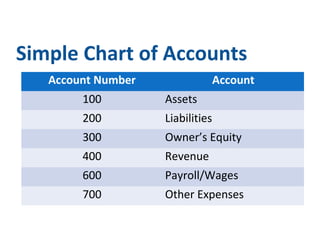
Simple Chart of Accounts 
Account Number Account 
100 Assets 
200 Liabilities 
300 Owner’s Equity 
400 Revenue 
600 Payroll/Wages 
700 Other Expenses
General Ledger and Transactions 
General Ledger (G/L) is the part of your accounting 
system used to record (post) transactions 
Two methods of recording transactions in G/L: cash 
and accrual 
Cash Basis 
Revenue recorded upon receipt of cash 
Expense recorded upon payment of cash 
No accounts payable or receivable
General Ledger and Transactions 
(continued) 
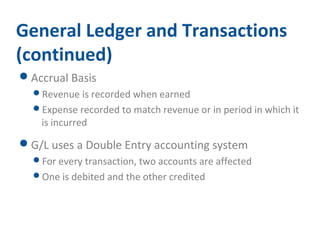
Accrual Basis 
Revenue is recorded when earned 
Expense recorded to match revenue or in period in which it 
is incurred 
G/L uses a Double Entry accounting system 
For every transaction, two accounts are affected 
One is debited and the other credited
General Ledger and Transactions 
(continued) 
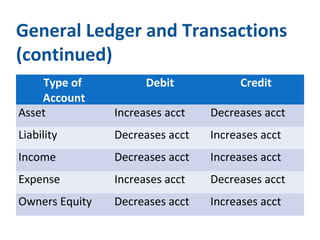
Type of 
Account 
Debit Credit 
Asset Increases acct Decreases acct 
Liability Decreases acct Increases acct 
Income Decreases acct Increases acct 
Expense Increases acct Decreases acct 
Owners Equity Decreases acct Increases acct
General Ledger and Transactions 
(continued) 
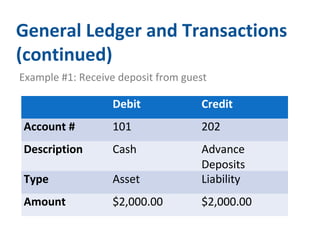
Example #1: Receive deposit from guest 
Debit Credit 
Account # 101 202 
Description Cash Advance 
Deposits 
Type Asset Liability 
Amount $2,000.00 $2,000.00
General Ledger and Transactions 
(continued) 
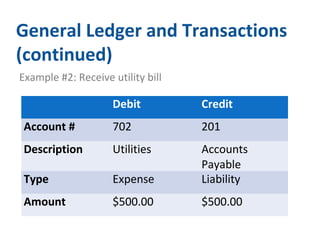
Example #2: Receive utility bill 
Debit Credit 
Account # 702 201 
Description Utilities Accounts 
Payable 
Type Expense Liability 
Amount $500.00 $500.00
General Ledger and Transactions 
(continued) 
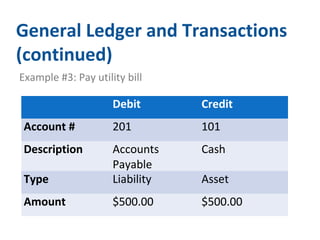
Example #3: Pay utility bill 
Debit Credit 
Account # 201 101 
Description Accounts 
Payable 
Cash 
Type Liability Asset 
Amount $500.00 $500.00
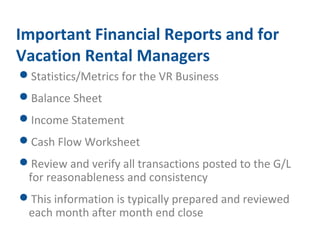
Important Financial Reports and for 
Vacation Rental Managers 
Statistics/Metrics for the VR Business 
Balance Sheet 
Income Statement 
Cash Flow Worksheet 
Review and verify all transactions posted to the G/L 
for reasonableness and consistency 
This information is typically prepared and reviewed 
each month after month end close
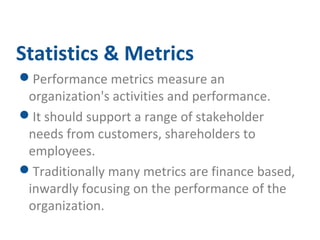
Statistics & Metrics 
Performance metrics measure an 
organization's activities and performance. 
It should support a range of stakeholder 
needs from customers, shareholders to 
employees. 
Traditionally many metrics are finance based, 
inwardly focusing on the performance of the 
organization.
Sample Statistics & Metrics 
Total Available Nights 
Nights Net Available Nights 
Guest Occupied Nights 
Owner Occupied Nights 
Occupancy % 
Average Daily Rate (Guest nights only) 
Management Commissions 
Commission Per Property 
Average Length of Stay Number of Reservations
Sample Statistics & Metrics cont’d 
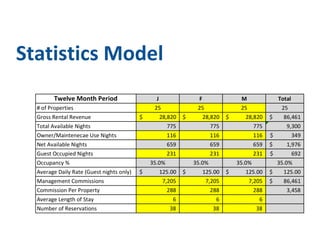
Total Available Nights – include ALL nights available 
to sell. (Number of properties * 365) 
Nights Net Available Nights – Total Available Nights 
less Owner/Maintenance Use Nights. 
Guest Occupied Nights – Paying Guest Nights 
Owner Occupied Nights – Owner or Non-paying 
Guest Nights
Sample Statistics & Metrics cont’d 
Occupancy % - Total Occupied Guest Nights/Net 
Available Nights 
Average Daily Rate (Guest nights only) – Gross Rental 
Revenue/Total Occupied Guest Nights 
Management Commissions – Gross Rental Revenue 
less Payments to Owners 
Average Length of Stay - Total Occupied Guest 
Nights/Number of Reservations
Sample Statistics & Metrics cont’d 
Total Available Nights – include ALL nights available 
to sell. (Number of properties * 365) 
Nights Net Available Nights – Total Available Nights 
less Owner/Maintenance Use Nights. 
Guest Occupied Nights – Paying Guest Nights 
Owner Occupied Nights – Owner or Non-paying 
Guest Nights
Sample Statistics & Metrics cont’d 
Review Sample Statistics and Business Metrics
Balance Sheet 
Also known as Statement of Financial Condition 
Provides a snapshot of your company’s financial 
condition at any one point in time 
Assets = Liabilities + Owner’s Equity 
Typically compared to last year’s Balance Sheet at 
same point in time
Statistics Model
Balance Sheet (continued) 
Helps you determine if your company can withstand 
typical market fluctuations, if you can expand and if 
you need additional cash reserves 
Helps you spot trends in accounts payable and 
receivable 
Frequently required by potential lenders and 
investors
Reviewing the Balance Sheet 
Review each account for reasonableness 
Perform an Acid Test 
Also called Quick Ratio or Liquid Ratio 
Acid Test (current assets – current liabilities) measures the 
ability of a company to use its current assets to 
immediately satisfy current liabilities
Reviewing the Balance Sheet 
(continued) 
The Acid Test indicates a company’s capacity to maintain 
operations as usual with current cash; thus, this test 
implies a liquidation approach and does not recognize the 
revolving nature of current assets and liabilities 
Generally, the Acid Test ratio should be 1:1 or better; 
however, this varies widely by industry
Income Statement 
Also known as Profit and Loss Statement or Earnings 
Statement 
Reports how well your company operated over a 
period of time. Did it make or lose money? What’s 
the bottom line? 
Revenue - Expenses = Net Income (or Loss) 
Net Income (or Loss) gets moved to the Balance 
Sheet and becomes Owners Equity
Income Statement (continued) 
Typically compared to budget and prior year’s 
operations 
Helps you determine which areas are under or over 
budget 
Frequently required by potential lenders and 
investors 
Investigate each variance
Reviewing the Income Statement 
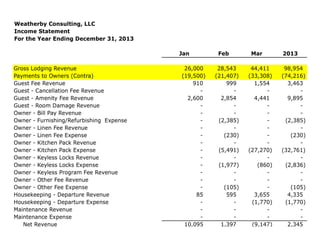
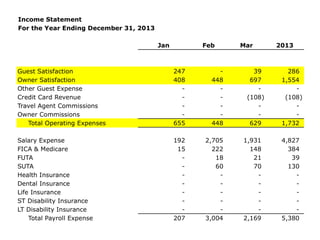
Top line revenue—Did you hit your forecast? 
Payments to owners—What is the percentage of top 
line? Are you paying more than you should? If so, 
why? 
Review all other revenue accounts for 
reasonableness
Reviewing the Income Statement 
(continued) 
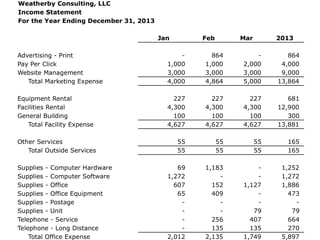
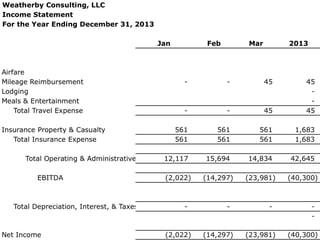
Review all expenses for reasonableness 
Compare each account to budget and prior year 
Focus on variances 
Net operating income—Did you hit your forecast? If 
not, why?
Cash Flow Worksheet 
Part of a larger and more complex report called 
Statement of Cash Flows 
Reports cash generated and used by your company 
over a period of time 
Don’t confuse profitability (revenue – expenses) with 
cash flow -- you can be profitable and still lack cash 
and still go out of business
Cash Flow Worksheet (continued) 
Helps you determine if you’ll have enough cash each 
month 
Helps you assess capability of generating future cash 
flow 
Focus on including all line items 
Cash Flow Worksheet is only as good as information 
provided therein
Reviewing the Cash Flow 
Worksheet 
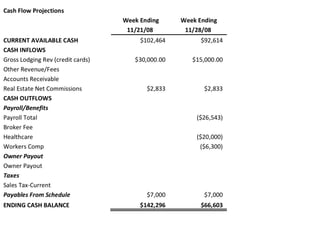
Ensure all accounts and transactions are included 
Look for irregularities or short falls in cash 
Short falls in cash will require you to add additional 
capital to your business 
Simple planning can negate or minimize the need for 
additional capital
What is a General 
Operating Budget?
A Financial Planning Tool 
that… 
 Is an itemized summary of projected income and 
expenses for a period of time 
Helps you identify your company’s financial values, 
prioritize your spending, manage your money and 
track performance 
Provides a means of managing your actual 
performance against your projected performance
What You Need a General 
Operating Budget 
To achieve your company’s goals 
It allows you to more effectively and efficiently manage the 
financial operation of your company 
It can provide you with a better basis for understanding 
your company’s operations in relation to the general 
environment 
It leads to faster reactions to developing events, which 
increases your company’s ability to perform effectively
Why You Need an Operating 
Budget (continued) 
To plan for your company’s future 
It allows you to be prepared—you can either “wing it” or 
you can plan for profit, cash flow, and the financial 
condition of your business 
It allows you to anticipate change and adapt, such as a 
downturn in your company’s performance 
It is an indicator of financial health, stability and 
sophistication to any potential lender, investor or buyer
Why You Need an Operating 
Budget (continued) 
To obtain the most productive and profitable use of 
your company’s resources—not to limit expenditures
Creating a General Operating 
Budget 
Be kind to yourself (and others)—Realize that you’ll 
make some mistakes and that there is a learning 
curve 
Start in October or November 
Make time for budgeting 
Use last year’s financial statements to provide the 
foundation for this year’s budget, then you can 
evaluate assumptions each year and make 
corrections
Creating a General Operating 
Budget (continued) 
Create a realistic and detailed budget—record true 
and accurate revenue and expense assumptions— 
avoid “sand bagging” 
Review your budget every month and revise your 
forecast (a revision detailing material increases or 
decreases to your budget) regularly 
Use it for restraint and not constraint
Involve Your Managers 
Have your managers create financial plans for the 
year, including specific objectives and means of 
accomplishing those objectives 
Review those plans with your managers and reach 
consensus among your team 
Incorporate those plans into the General Operating 
Budget
Involve Your Managers 
(continued) 
Have your managers review budget versus actual 
throughout the year and make mid-course 
corrections via a forecast 
Support their budget-based management decisions 
throughout year 
This process helps managers do a better job of 
forecasting
Involve Your Managers 
(continued) 
This process motivates managers and employees, 
particularly if you tie incentive bonuses to financial 
performance 
This process allows you to more effectively monitor 
and manage against departmental/employee 
performance
Identify Revenue Sources 
Use last year’s revenue as a guide—pull amounts from 
your reservation system 
Be realistic and conservative—Don’t overestimate 
income 
Understand Key Metrics and Terminology 
Focus on Gross Lodging Revenue because it will allow 
you to forecast expenses 
Determine what you’ll charge for services and fees—use 
your market to determine a viable price structure
Develop Key Revenue 
Schedules 
Based on Gross Lodging Revenue and other key 
metrics 
Housekeeping 
Maintenance
Identify Direct Operating and 
General & Admin Expenses 
Direct Operating Expenses 
Are typically variable and fluctuate with Gross Lodging 
Revenue 
Examples include housekeeping, maintenance, and hourly 
payroll 
General & Administrative Expenses 
Are typically fixed —they stay the same each month 
Examples include rent, management salaries, and vehicle 
lease payments
Identify Direct Operating and General 
& Admin Expenses (continued) 
Use last year’s expenses as a guide 
Be realistic and conservative—Don’t underestimate 
expenses
Develop Key Expense 
Schedules 
Payroll 
Leases (office, vehicles, copier, postage machine, 
etc.) 
Marketing 
Housekeeping and Maintenance (included in General 
Operating Budget Worksheet—not done separately)
Remember Consensus is the Key 
Meet with dept managers to explain reason for 
budget and set goals 
It is their planning tool 
It is their chance to make requests (wish lists) 
It is their opportunity to reveal their planning skills 
It is their statement of resources required to meet their 
goals
Remember Consensus (continued) 
Set thresholds 
Give dept managers a timeframe to complete and 
submit their budgets 
Ask them for a narrative to accompany budget 
Allow dept managers to manage against budgeted 
items 
Don’t micromanage your employees 
 Manage against performance
Finalize the First Draft of Your General 
Operating Budget 
Analyze 
Conduct a detailed review and make adjustments 
Duplication 
Reasonability checks 
Staffing requests 
Wishful thinking 
Poor calculations 
Denials 
Omissions
Finalize First Draft (continued) 
Return to dept managers with request to cut money (not 
everyone) 
Prepare add/subtract list by department 
BALANCE THE BUDGET! Worst Case! 
Note that Income Statement and General Operating 
Budget look identical
Creating a Capital Budget 
Capital expenditures are recorded when a company 
spends money to acquire or upgrade fixed assets 
Examples are equipment, property and buildings
Conducting a Final Review and 
Sign Off 
Review all budgets one last time with overall picture 
in mind 
Add items or money as needed 
Cut items or money if you do not feel it is necessary to 
obtain department or company goals 
Distribute to Dept Managers
Managing by Budget 
Review actual versus budget on a monthly basis 
If income is down, why? 
If expenses are up, why?
Managing by Budget 
(continued) 
Pay particular attention to: 
Wages and employee benefits, including overtime 
New project expenses 
Accounts with previous problems 
Workman’s compensation and other taxes 
Advertising 
Housekeeping income versus expense 
Laundry income versus expense
Managing by Budget 
(continued) 
Drill down as necessary 
Adjust and adapt as necessary 
Evaluate extra expenditures 
Are they in the budget? 
Exceptions for catastrophic omissions only or unique 
opportunities (CEO decision) 
Ideally exceptions exchanged somewhere else
Managing by Budget 
(continued) 
Consider implementing a “Think Tank” day 
Conducted off site just before budget is prepared 
Every department is evaluated 
Allows everyone a say in what needs to change and how to 
run things more efficiently and effectively 
Not punitive 
Use results to adjust your budget if appropriate
Managing by Budget 
(continued) 
Consider implementing a “Kick Off “ Day 
Unveil budget and projections for new year for company 
and specific departments 
Allow employees to see which of their ideas influenced the 
budget
Avoiding Problems 
Avoid “I don’t really need to use it” mentality 
Avoid “I’ll trade it for something else” mentality 
Avoid “I’ve got extra money to spend” mentality 
Make thoughtful decisions
Avoiding Problems (continued) 
Do not implement across the board cuts 
Discourages padding 
All items are not equally sacrificial 
Closely monitor assumptions for accuracy (# of 
reservations, # of work orders, high income season 
daily/weekly) 
Look for problems EARLY
Avoiding Problems (continued) 
If you’re a company owner 
Stick to your own budget 
Don’t jeopardize company by dipping into reserves 
Assess at end of year (end of quarter at most)
Conclusions and Summary 
Know where your checkbook should be EVERY month 
Be prepared to adjust if necessary 
Hold dept managers accountable for their expense 
budgets 
Meet your budget goals 
Consider bonus incentive for dept managers who 
meet goals
Conclusions and Summary 
(continued) 
Benefits if you use a budget: 
Stronger company 
Unified approach to planning 
Respect from banks and greater chance of successful 
financial requests 
Higher market value for your company 
Positive equity position
7 Signs of Internal Accounting 
Fraud 
1. An in-house accountant works without direct 
supervision on every aspect of a company's financial 
operations. When one trusted bookkeeper or accountant is 
responsible for records, payroll, receivables, deposits, 
payments and so on, the company is placed at risk for 
fraudulent activity.
7 Signs (continued) 
2. An in-house accountant refuses to follow recently 
established accounting and/or payroll guidelines. In such a 
case, owners should demand that guidelines be strictly 
followed and investigate financial and payroll records for 
up to several years in the past. 
3. An accountant continually works after hours, comes in 
frequently on weekends or insists on taking work home. 
Fraudulent activities are easier to accomplish when work is 
unobserved and unsupervised.
7 Signs (continued) 
4. An accountant refuses to take a vacation. This individual 
may be thought of as a highly dedicated and hard-working 
employee, but it could be that he or she simply doesn't 
want anyone to discover how the books are being cooked.
7 Signs (continued) 
5. An accountant insists that he or she handle activities for 
which other departments are normally responsible. These 
can include picking up the daily mail (for fear that 
something could arrive that would tip-off management), 
acting as the sole go-between with the company's financial 
contacts (banks, auditors, creditors, etc.) and working with 
police when items or money are found missing.
7 Signs (continued) 
6. An accountant continually misfiles important items such 
as payroll receipts, deposit records, supplier 
correspondence and estimates. 
7. Deposits frequently seem too small. Owners should 
always carefully monitor income and deposits, comparing 
sales receipts against actual amounts put into the bank. 
(Reprinted from National Federation of Independent 
Business 04/ 15/ 2002)

Vacation rental management budgeting and financial management 401

  • 2.
    Agenda  Chartof Accounts, General Ledger and Transactions  Understanding the Balance Sheet, the Income Statement and the Cash Flow Worksheet  Why You Need a General Operating Budget and How to Create One  Managing by Budget  Avoiding Problems
  • 3.
    Important Note Anycommission rates used in examples in this course are arbitrary numbers. They do not reflect industry standards or common practice in any particular locality.
  • 4.
    One Size DoesNot Fit All • We are aware that some of the suggestions we will make in this course might not fit the size and scope of your operation or your market. • As such, please remember that the assumptions made throughout this course are designed to represent an average vacation rental company. • We encourage you to speak up and share your experience as another point of view.
  • 5.
    Getting Started “Everythingis associated with money, and the person who knows what they have at all times wins” Julie Aydlott owner of San Diego Business Accounting Solutions, and author of The Quick Guide to Small Business Budgeting
  • 6.
    To be financiallysuccessful a VRM must: Have the financial knowledge and resources to meet the company’s financial obligations Ensure the company remains a going concern for the benefit of owners, shareholders, employees, guests and the community
  • 7.
    Accounting vs. Bookkeeping Bookkeeping is a systematic recording of every revenue and expense transaction, including dates, amounts and descriptions. Bookkeeping is the financial infrastructure of your business.  Accounting provides a bigger picture by tracking bookkeeping transactions and using them to analyze business results. Managers use the financial reports generated by accounting to make decisions and plans for their business.
  • 8.
    Why You ShouldKnow Some Bookkeeping and Accounting To effectively manage your company to ensure it remains a viable operation To avoid being taken advantage of financially (particularly embezzlement and fraud) To assist in the planning and control of your business To be able to knowledgably communicate financial information to employees, potential lenders and investors, shareholders, and the media
  • 9.
    First Things First Accounting systems and financial reports are only as reliable as the information and processes used to create them. To create reliable information and processes, follow these steps . . .
  • 10.
    First Things First(continued) Create clear, standardized policies and procedures This consistency creates trust Ensure policies and procedures aren’t just for accounting employees—every employee is involved in some aspect of financial accountability and needs to know where he or she fits into the bigger picture Start by reviewing the workflow of accounts receivable, accounts payable and property management revenue to ensure your company has a fundamental accounting foundation
  • 11.
    First Things First(continued) Ensure that transactions are complete, accurate and timely Ensure that transactions have source documents Hire knowledgeable, skilled employees Create and enforce strong internal controls to minimize errors and temptations to dishonesty as well as to safeguard assets
  • 12.
    First Things First(continued) To create and enforce strong internal controls: Segregate employee duties to provide checks and balances —don’t have the same person process purchase orders and receive inventory or write checks and reconcile bank statements Ensure all transactions have verifiable source documents and are properly stored Consider using electronic storage to save money and space
  • 13.
    First Things First(continued) Ensure proper authorization of transactions, such as requiring two manager signatures to approve a transaction over a specific amount Ensure physical control of assets, such as limiting employee entry and exit routes, installing fences and locks, using surveillance equipment, conducting unexpected inventory counts and inspections and establishing inventory par levels
  • 14.
    First Things First(continued) Check references or perform background checks before hiring new employees Perform independent checks on performance, such as requiring employees to take vacations and using a substitute while gone Review “7 Signs of Internal Accounting Fraud” article at end of Student Workbook Consider doing some of your own bookkeeping at first so that you understand how your accounting system and transaction processes actually work
  • 15.
    Chart of Accounts List of all the accounts your company uses to track transactions Types of accounts or categories: assets, liabilities, owner’s equity, revenue, and expense Assets are anything your company owns that has monetary value
  • 16.
    Chart of Accounts(continued) Current Assets can easily be converted into cash (cash, savings, checking, accounts receivable, inventory) Non-Current Assets cannot easily be converted into cash (equipment, real estate, other capital assets) Establish a minimum asset to avoid wasting time tracking low cost assets
  • 17.
    Chart of Accounts Liabilities are anything your company owes to people or businesses—they are financial obligations Current Liabilities are payable within one year (wages, accounts payable, taxes, etc.) Long Term Liabilities are payable after one year (long term leases, long term debt, pension obligations, etc.) Owner’s Equity or “capital” = Assets - Liabilities
  • 18.
    Account Organization Keepit simple You decide the number of accounts within each category and level of detail When naming accounts, use common terminology that quickly allows managers and employees to determine the meaning of a specific account Organize the chart of accounts to allow decision making employees to quickly understand transactions and financial information
  • 19.
    Account Organization (continued) Only create material accounts Once chart of accounts established, ensure employees are consistently coding to these accounts and minimize creation of new accounts Consistency is the key
  • 20.
    Simple Chart ofAccounts Account Number Account 100 Assets 200 Liabilities 300 Owner’s Equity 400 Revenue 600 Payroll/Wages 700 Other Expenses
  • 21.
    General Ledger andTransactions General Ledger (G/L) is the part of your accounting system used to record (post) transactions Two methods of recording transactions in G/L: cash and accrual Cash Basis Revenue recorded upon receipt of cash Expense recorded upon payment of cash No accounts payable or receivable
  • 22.
    General Ledger andTransactions (continued) Accrual Basis Revenue is recorded when earned Expense recorded to match revenue or in period in which it is incurred G/L uses a Double Entry accounting system For every transaction, two accounts are affected One is debited and the other credited
  • 23.
    General Ledger andTransactions (continued) Type of Account Debit Credit Asset Increases acct Decreases acct Liability Decreases acct Increases acct Income Decreases acct Increases acct Expense Increases acct Decreases acct Owners Equity Decreases acct Increases acct
  • 24.
    General Ledger andTransactions (continued) Example #1: Receive deposit from guest Debit Credit Account # 101 202 Description Cash Advance Deposits Type Asset Liability Amount $2,000.00 $2,000.00
  • 25.
    General Ledger andTransactions (continued) Example #2: Receive utility bill Debit Credit Account # 702 201 Description Utilities Accounts Payable Type Expense Liability Amount $500.00 $500.00
  • 26.
    General Ledger andTransactions (continued) Example #3: Pay utility bill Debit Credit Account # 201 101 Description Accounts Payable Cash Type Liability Asset Amount $500.00 $500.00
  • 27.
    Important Financial Reportsand for Vacation Rental Managers Statistics/Metrics for the VR Business Balance Sheet Income Statement Cash Flow Worksheet Review and verify all transactions posted to the G/L for reasonableness and consistency This information is typically prepared and reviewed each month after month end close
  • 28.
    Statistics & Metrics Performance metrics measure an organization's activities and performance. It should support a range of stakeholder needs from customers, shareholders to employees. Traditionally many metrics are finance based, inwardly focusing on the performance of the organization.
  • 29.
    Sample Statistics &Metrics Total Available Nights Nights Net Available Nights Guest Occupied Nights Owner Occupied Nights Occupancy % Average Daily Rate (Guest nights only) Management Commissions Commission Per Property Average Length of Stay Number of Reservations
  • 30.
    Sample Statistics &Metrics cont’d Total Available Nights – include ALL nights available to sell. (Number of properties * 365) Nights Net Available Nights – Total Available Nights less Owner/Maintenance Use Nights. Guest Occupied Nights – Paying Guest Nights Owner Occupied Nights – Owner or Non-paying Guest Nights
  • 31.
    Sample Statistics &Metrics cont’d Occupancy % - Total Occupied Guest Nights/Net Available Nights Average Daily Rate (Guest nights only) – Gross Rental Revenue/Total Occupied Guest Nights Management Commissions – Gross Rental Revenue less Payments to Owners Average Length of Stay - Total Occupied Guest Nights/Number of Reservations
  • 32.
    Sample Statistics &Metrics cont’d Total Available Nights – include ALL nights available to sell. (Number of properties * 365) Nights Net Available Nights – Total Available Nights less Owner/Maintenance Use Nights. Guest Occupied Nights – Paying Guest Nights Owner Occupied Nights – Owner or Non-paying Guest Nights
  • 33.
    Sample Statistics &Metrics cont’d Review Sample Statistics and Business Metrics
  • 34.
    Balance Sheet Alsoknown as Statement of Financial Condition Provides a snapshot of your company’s financial condition at any one point in time Assets = Liabilities + Owner’s Equity Typically compared to last year’s Balance Sheet at same point in time
  • 35.
  • 36.
    Balance Sheet (continued) Helps you determine if your company can withstand typical market fluctuations, if you can expand and if you need additional cash reserves Helps you spot trends in accounts payable and receivable Frequently required by potential lenders and investors
  • 37.
    Reviewing the BalanceSheet Review each account for reasonableness Perform an Acid Test Also called Quick Ratio or Liquid Ratio Acid Test (current assets – current liabilities) measures the ability of a company to use its current assets to immediately satisfy current liabilities
  • 38.
    Reviewing the BalanceSheet (continued) The Acid Test indicates a company’s capacity to maintain operations as usual with current cash; thus, this test implies a liquidation approach and does not recognize the revolving nature of current assets and liabilities Generally, the Acid Test ratio should be 1:1 or better; however, this varies widely by industry
  • 39.
    Income Statement Alsoknown as Profit and Loss Statement or Earnings Statement Reports how well your company operated over a period of time. Did it make or lose money? What’s the bottom line? Revenue - Expenses = Net Income (or Loss) Net Income (or Loss) gets moved to the Balance Sheet and becomes Owners Equity
  • 40.
    Income Statement (continued) Typically compared to budget and prior year’s operations Helps you determine which areas are under or over budget Frequently required by potential lenders and investors Investigate each variance
  • 41.
    Reviewing the IncomeStatement Top line revenue—Did you hit your forecast? Payments to owners—What is the percentage of top line? Are you paying more than you should? If so, why? Review all other revenue accounts for reasonableness
  • 42.
    Reviewing the IncomeStatement (continued) Review all expenses for reasonableness Compare each account to budget and prior year Focus on variances Net operating income—Did you hit your forecast? If not, why?
  • 43.
    Cash Flow Worksheet Part of a larger and more complex report called Statement of Cash Flows Reports cash generated and used by your company over a period of time Don’t confuse profitability (revenue – expenses) with cash flow -- you can be profitable and still lack cash and still go out of business
  • 48.
    Cash Flow Worksheet(continued) Helps you determine if you’ll have enough cash each month Helps you assess capability of generating future cash flow Focus on including all line items Cash Flow Worksheet is only as good as information provided therein
  • 49.
    Reviewing the CashFlow Worksheet Ensure all accounts and transactions are included Look for irregularities or short falls in cash Short falls in cash will require you to add additional capital to your business Simple planning can negate or minimize the need for additional capital
  • 51.
    What is aGeneral Operating Budget?
  • 52.
    A Financial PlanningTool that…  Is an itemized summary of projected income and expenses for a period of time Helps you identify your company’s financial values, prioritize your spending, manage your money and track performance Provides a means of managing your actual performance against your projected performance
  • 53.
    What You Needa General Operating Budget To achieve your company’s goals It allows you to more effectively and efficiently manage the financial operation of your company It can provide you with a better basis for understanding your company’s operations in relation to the general environment It leads to faster reactions to developing events, which increases your company’s ability to perform effectively
  • 54.
    Why You Needan Operating Budget (continued) To plan for your company’s future It allows you to be prepared—you can either “wing it” or you can plan for profit, cash flow, and the financial condition of your business It allows you to anticipate change and adapt, such as a downturn in your company’s performance It is an indicator of financial health, stability and sophistication to any potential lender, investor or buyer
  • 55.
    Why You Needan Operating Budget (continued) To obtain the most productive and profitable use of your company’s resources—not to limit expenditures
  • 56.
    Creating a GeneralOperating Budget Be kind to yourself (and others)—Realize that you’ll make some mistakes and that there is a learning curve Start in October or November Make time for budgeting Use last year’s financial statements to provide the foundation for this year’s budget, then you can evaluate assumptions each year and make corrections
  • 57.
    Creating a GeneralOperating Budget (continued) Create a realistic and detailed budget—record true and accurate revenue and expense assumptions— avoid “sand bagging” Review your budget every month and revise your forecast (a revision detailing material increases or decreases to your budget) regularly Use it for restraint and not constraint
  • 58.
    Involve Your Managers Have your managers create financial plans for the year, including specific objectives and means of accomplishing those objectives Review those plans with your managers and reach consensus among your team Incorporate those plans into the General Operating Budget
  • 59.
    Involve Your Managers (continued) Have your managers review budget versus actual throughout the year and make mid-course corrections via a forecast Support their budget-based management decisions throughout year This process helps managers do a better job of forecasting
  • 60.
    Involve Your Managers (continued) This process motivates managers and employees, particularly if you tie incentive bonuses to financial performance This process allows you to more effectively monitor and manage against departmental/employee performance
  • 61.
    Identify Revenue Sources Use last year’s revenue as a guide—pull amounts from your reservation system Be realistic and conservative—Don’t overestimate income Understand Key Metrics and Terminology Focus on Gross Lodging Revenue because it will allow you to forecast expenses Determine what you’ll charge for services and fees—use your market to determine a viable price structure
  • 62.
    Develop Key Revenue Schedules Based on Gross Lodging Revenue and other key metrics Housekeeping Maintenance
  • 63.
    Identify Direct Operatingand General & Admin Expenses Direct Operating Expenses Are typically variable and fluctuate with Gross Lodging Revenue Examples include housekeeping, maintenance, and hourly payroll General & Administrative Expenses Are typically fixed —they stay the same each month Examples include rent, management salaries, and vehicle lease payments
  • 64.
    Identify Direct Operatingand General & Admin Expenses (continued) Use last year’s expenses as a guide Be realistic and conservative—Don’t underestimate expenses
  • 65.
    Develop Key Expense Schedules Payroll Leases (office, vehicles, copier, postage machine, etc.) Marketing Housekeeping and Maintenance (included in General Operating Budget Worksheet—not done separately)
  • 66.
    Remember Consensus isthe Key Meet with dept managers to explain reason for budget and set goals It is their planning tool It is their chance to make requests (wish lists) It is their opportunity to reveal their planning skills It is their statement of resources required to meet their goals
  • 67.
    Remember Consensus (continued) Set thresholds Give dept managers a timeframe to complete and submit their budgets Ask them for a narrative to accompany budget Allow dept managers to manage against budgeted items Don’t micromanage your employees  Manage against performance
  • 68.
    Finalize the FirstDraft of Your General Operating Budget Analyze Conduct a detailed review and make adjustments Duplication Reasonability checks Staffing requests Wishful thinking Poor calculations Denials Omissions
  • 69.
    Finalize First Draft(continued) Return to dept managers with request to cut money (not everyone) Prepare add/subtract list by department BALANCE THE BUDGET! Worst Case! Note that Income Statement and General Operating Budget look identical
  • 70.
    Creating a CapitalBudget Capital expenditures are recorded when a company spends money to acquire or upgrade fixed assets Examples are equipment, property and buildings
  • 71.
    Conducting a FinalReview and Sign Off Review all budgets one last time with overall picture in mind Add items or money as needed Cut items or money if you do not feel it is necessary to obtain department or company goals Distribute to Dept Managers
  • 72.
    Managing by Budget Review actual versus budget on a monthly basis If income is down, why? If expenses are up, why?
  • 73.
    Managing by Budget (continued) Pay particular attention to: Wages and employee benefits, including overtime New project expenses Accounts with previous problems Workman’s compensation and other taxes Advertising Housekeeping income versus expense Laundry income versus expense
  • 74.
    Managing by Budget (continued) Drill down as necessary Adjust and adapt as necessary Evaluate extra expenditures Are they in the budget? Exceptions for catastrophic omissions only or unique opportunities (CEO decision) Ideally exceptions exchanged somewhere else
  • 75.
    Managing by Budget (continued) Consider implementing a “Think Tank” day Conducted off site just before budget is prepared Every department is evaluated Allows everyone a say in what needs to change and how to run things more efficiently and effectively Not punitive Use results to adjust your budget if appropriate
  • 76.
    Managing by Budget (continued) Consider implementing a “Kick Off “ Day Unveil budget and projections for new year for company and specific departments Allow employees to see which of their ideas influenced the budget
  • 77.
    Avoiding Problems Avoid“I don’t really need to use it” mentality Avoid “I’ll trade it for something else” mentality Avoid “I’ve got extra money to spend” mentality Make thoughtful decisions
  • 78.
    Avoiding Problems (continued) Do not implement across the board cuts Discourages padding All items are not equally sacrificial Closely monitor assumptions for accuracy (# of reservations, # of work orders, high income season daily/weekly) Look for problems EARLY
  • 79.
    Avoiding Problems (continued) If you’re a company owner Stick to your own budget Don’t jeopardize company by dipping into reserves Assess at end of year (end of quarter at most)
  • 80.
    Conclusions and Summary Know where your checkbook should be EVERY month Be prepared to adjust if necessary Hold dept managers accountable for their expense budgets Meet your budget goals Consider bonus incentive for dept managers who meet goals
  • 81.
    Conclusions and Summary (continued) Benefits if you use a budget: Stronger company Unified approach to planning Respect from banks and greater chance of successful financial requests Higher market value for your company Positive equity position
  • 82.
    7 Signs ofInternal Accounting Fraud 1. An in-house accountant works without direct supervision on every aspect of a company's financial operations. When one trusted bookkeeper or accountant is responsible for records, payroll, receivables, deposits, payments and so on, the company is placed at risk for fraudulent activity.
  • 83.
    7 Signs (continued) 2. An in-house accountant refuses to follow recently established accounting and/or payroll guidelines. In such a case, owners should demand that guidelines be strictly followed and investigate financial and payroll records for up to several years in the past. 3. An accountant continually works after hours, comes in frequently on weekends or insists on taking work home. Fraudulent activities are easier to accomplish when work is unobserved and unsupervised.
  • 84.
    7 Signs (continued) 4. An accountant refuses to take a vacation. This individual may be thought of as a highly dedicated and hard-working employee, but it could be that he or she simply doesn't want anyone to discover how the books are being cooked.
  • 85.
    7 Signs (continued) 5. An accountant insists that he or she handle activities for which other departments are normally responsible. These can include picking up the daily mail (for fear that something could arrive that would tip-off management), acting as the sole go-between with the company's financial contacts (banks, auditors, creditors, etc.) and working with police when items or money are found missing.
  • 86.
    7 Signs (continued) 6. An accountant continually misfiles important items such as payroll receipts, deposit records, supplier correspondence and estimates. 7. Deposits frequently seem too small. Owners should always carefully monitor income and deposits, comparing sales receipts against actual amounts put into the bank. (Reprinted from National Federation of Independent Business 04/ 15/ 2002)

Editor's Notes

  • #13 Check Kiting, Fake Owners, Fake Vendors
  • #14 Soap is $.22, Toilet Paper, etc… Locks, DVD players, TV’s This is even more important in this day and age, as more & more VRM are going virtual
  • #15 Background checks – Not done every time, but when done, we found something.
  • #16 Now let’s move into further detail…… C of A
  • #19 As you set up a C of A, focus on account organization.
  • #20 Note the pitfalls of inconsistent, non material accounts
  • #21 Show expanded Simple Chart of Accounts on Elmo, then show More Complex Chart of Accounts on Elmo
  • #22 Are you cash basis or accrual basis?
  • #23 Matching Revenue/Expenses – Matching principal Accrual basis accounting matches revenues to the time period in which they are earned and matches expenses to the time period in which they are incurred
  • #27 Perhaps a good time to stop.
  • #28 The big three……
  • #29 Show Balance Sheet on Elmo.
  • #30 Show Balance Sheet on Elmo.
  • #31 Show Balance Sheet on Elmo.
  • #32 Show Balance Sheet on Elmo.
  • #33 Show Balance Sheet on Elmo.
  • #34 Show Balance Sheet on Elmo.
  • #35 Show Balance Sheet on Elmo.
  • #37 Continue to show Balance Sheet on Elmo.
  • #38 Continue to show Balance Sheet on Elmo. Discuss Cowboy Math…..Big Four Accounting vs. a true operational manager Cash…is most important, secondly is liabilities
  • #39 Note that a acid test is important when reviewing the BS when going into the off season
  • #40 Show Income Statement on Elmo.
  • #41 Continue to show Income Statement on Elmo.
  • #42 Continue to show Income Statement on Elmo.
  • #43 Continue to show Income Statement on Elmo.
  • #44 Show Cash Flow Worksheet on Elmo. Note assimilations of cash from Operating, Financing and Investing activities….
  • #49 Continue to show Cash Flow Worksheet on Elmo.
  • #50 Continue to show Cash Flow Worksheet on Elmo.
  • #57 Use the calendar year if possible…
  • #58 Review departmental projections….to ensure your managers are not shooting high/low so as to provide cushion and hit their numbers
  • #61 Talk about various bonus plans….
  • #62 Show Key Metrics and Terminology on Elmo Identfying top line revenue is the key….most expenses trend top line revenue…
  • #63 Show General Operating Budget Worksheet on Elmo Note that most PMS track Housekeeping, Maintenance and Credit Card Fees.
  • #66 Show Payroll Schedule, Lease Schedule and then Marketing Schedule on Elmo
  • #69 Show General Operating Budget on Elmo
  • #70 Continue to show General Operating Budget on Elmo
  • #71 Show Capital Budget on Elmo
  • #82 Hit what you say you’ll hit….
  • #83 Discuss if enough time.