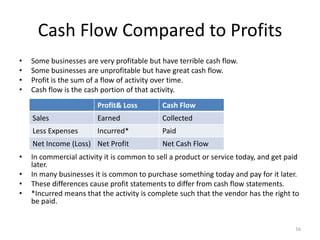
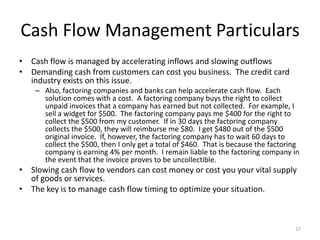
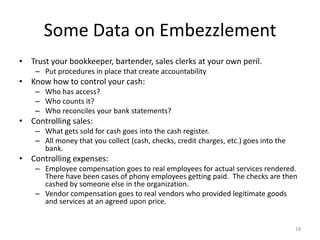
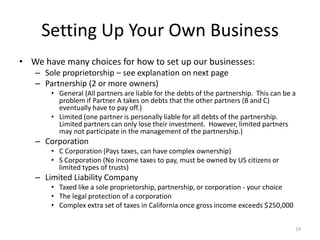
Managing Your Cash FlowKen Cone, CPAAugust 17, 2010408-859-3109ken@order-from-chaos.com1
Learn How to Make Your Money Work for YouThis program is intended for future entrepreneurs.  An entrepreneur is a person who organizes and manages any enterprise, esp. a business, usually with considerable initiative and risk; Random House.
My goal for today is to help you learn that understanding the accounting function empowers you.  Through this empowerment, you can attain your purposes.
Small businesses have three main activities:Production: what the Art Institute is training you to doMarketing: driving business in the doorAccounting: managing the data and facility that your activities require and produce.  (Facility is something that permits the easier performance of an action, course of conduct, etc. Random House)Most of you who do go into business will do so in the profession that you are now being trained for.  This means that you will be very good at production.   However, you will need training in running the business in such a way that marketing and accounting are helping you to be profitable. 2
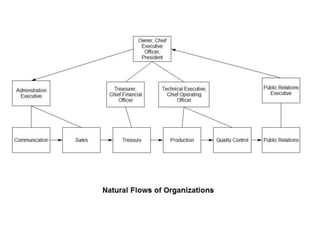
The Flows of Activity Through an OrganizationOur bodies require food, air, and water to live.  Those substances are systematically processed by our bodies.  Businesses also operate on a system of flows that can be understood. Communication: Someone comes through the front door, calls into your facility, or emails you, etc.
That person is routed to the proper place, by a receptionist, host, or customer service, for example:
Prospects (a prospect is something in view as a source of profit; Random House.)  In our case, prospects refer to potential customers.
Customers
Vendors (a person or agency that sells, Random House.)
Others (Such as legal, police, people asking for the restroom, etc.)3
4
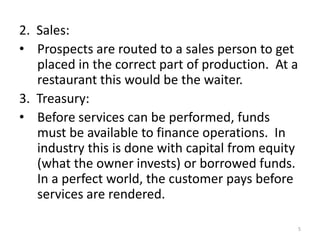
2.  Sales:Prospects are routed to a sales person to get placed in the correct part of production.  At a restaurant this would be the waiter.3.  Treasury:Before services can be performed, funds must be available to finance operations.  In industry this is done with capital from equity (what the owner invests) or borrowed funds.  In a perfect world, the customer pays before services are rendered.  5
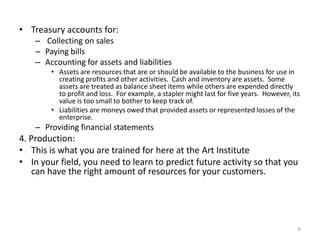
Treasury accounts for:
 Collecting on sales
Paying bills
Accounting for assets and liabilities
Assets are resources that are or should be available to the business for use in creating profits and other activities.  Cash and inventory are assets.  Some assets are treated as balance sheet items while others are expended directly to profit and loss.  For example, a stapler might last for five years.  However, its value is too small to bother to keep track of.
Liabilities are moneys owed that provided assets or represented losses of the enterprise.
Providing financial statements4. Production:This is what you are trained for here at the Art Institute
In your field, you need to learn to predict future activity so that you can have the right amount of resources for your customers.6
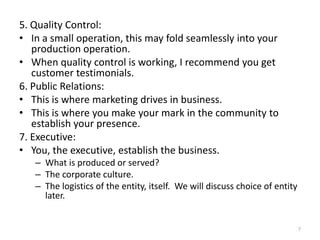
5. Quality Control:In a small operation, this may fold seamlessly into your production operation.
When quality control is working, I recommend you get customer testimonials.6. Public Relations:This is where marketing drives in business.

Managing your cash flow 2

  • 1.
    Managing Your CashFlowKen Cone, CPAAugust 17, 2010408-859-3109ken@order-from-chaos.com1
  • 2.
    Learn How toMake Your Money Work for YouThis program is intended for future entrepreneurs. An entrepreneur is a person who organizes and manages any enterprise, esp. a business, usually with considerable initiative and risk; Random House.
  • 3.
    My goal fortoday is to help you learn that understanding the accounting function empowers you. Through this empowerment, you can attain your purposes.
  • 4.
    Small businesses havethree main activities:Production: what the Art Institute is training you to doMarketing: driving business in the doorAccounting: managing the data and facility that your activities require and produce. (Facility is something that permits the easier performance of an action, course of conduct, etc. Random House)Most of you who do go into business will do so in the profession that you are now being trained for. This means that you will be very good at production. However, you will need training in running the business in such a way that marketing and accounting are helping you to be profitable. 2
  • 5.
    The Flows ofActivity Through an OrganizationOur bodies require food, air, and water to live. Those substances are systematically processed by our bodies. Businesses also operate on a system of flows that can be understood. Communication: Someone comes through the front door, calls into your facility, or emails you, etc.
  • 6.
    That person isrouted to the proper place, by a receptionist, host, or customer service, for example:
  • 7.
    Prospects (a prospectis something in view as a source of profit; Random House.) In our case, prospects refer to potential customers.
  • 8.
  • 9.
    Vendors (a personor agency that sells, Random House.)
  • 10.
    Others (Such aslegal, police, people asking for the restroom, etc.)3
  • 11.
  • 12.
    2. Sales:Prospectsare routed to a sales person to get placed in the correct part of production. At a restaurant this would be the waiter.3. Treasury:Before services can be performed, funds must be available to finance operations. In industry this is done with capital from equity (what the owner invests) or borrowed funds. In a perfect world, the customer pays before services are rendered. 5
  • 13.
  • 14.
  • 15.
  • 16.
    Accounting for assetsand liabilities
  • 17.
    Assets are resourcesthat are or should be available to the business for use in creating profits and other activities. Cash and inventory are assets. Some assets are treated as balance sheet items while others are expended directly to profit and loss. For example, a stapler might last for five years. However, its value is too small to bother to keep track of.
  • 18.
    Liabilities are moneysowed that provided assets or represented losses of the enterprise.
  • 19.
    Providing financial statements4.Production:This is what you are trained for here at the Art Institute
  • 20.
    In your field,you need to learn to predict future activity so that you can have the right amount of resources for your customers.6
  • 21.
    5. Quality Control:Ina small operation, this may fold seamlessly into your production operation.
  • 22.
    When quality controlis working, I recommend you get customer testimonials.6. Public Relations:This is where marketing drives in business.