DISORDERS OF EARS
Presented by:
Sivasakthi. K
M.sc nursing
CON-PIMS
INTRODUCTION
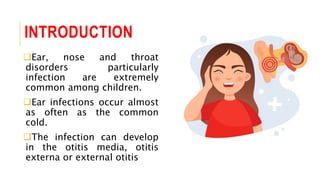
Ear, nose and throat
disorders particularly
infection are extremely
common among children.
Ear infections occur almost
as often as the common
cold.
The infection can develop
in the otitis media, otitis
externa or external otitis
ANATOMY OF
THE EAR
PHYSIOLOGY OF THE EAR
EXTERNAL EAR:
• Receives sound and transmit them to the middle ear via the eardrum.
MIDDLE EAR:
• middle ear bones from the bridge between eardrum and the inner ear. Eustachian tube,
ensures that the pressure on either side of the eardrum is balanced and the sound can be
heard correctly.
INNER EAR
• organ of corti transforms the mechanical energy of the sound waves into nerve energy by
creating electric impulses that are sent to the brain through the vestibulocochlear nerve
TERMINOLOGIES
Tinnitus
Otalgia
Barotraumas
Myringotomy
Otorrhea
Myringoplasty
Tympanoplasty
otosclerosis
DISORDER
OF
EXTERNAL
EAR
OTITIS
EXTERNA
Inflammation of external auditory canal
Causes:
Infection by staphylococcus aureus
causing boils in auditory canal
Swimmers ear
Prolonged exposure to moisture or by
allergic reaction to dandruffs, soap, hair
spray and hair dyes
Clinical manifestation:
Pain and discharge from auditory canal
Fever
Pruritis , hearing loss or feeling of
fullness.
CONT’D
Medical management:
Antibiotic
Antifungal
Corticosteroid
Analgesic
Prevention:
Avoid swimming and not allow water to enter
the ear when shampooing or showering.
A cotton ball can be covered in a water
insoluble gel such as petroleum jelly and
placed in the ear as a barrier to contamination
This Photo by Unknown Author is licensed under CC BY-ND
IMPACTED
CERUMEN
Definition
It is a condition in which earwax
accumulates in ear canal leading to
blockage and pressure on ear canal.
Cause:
Use of eardrum or ear plugs
Putting object in the ear
CONT’D
Clinical manifestation:
Tinnitus
Itching
Difficulty in hearing
Ear discharge
Odor from ear
Management
Irrigate ear canal
Instill antibiotic ear drops
Manual removal of wax
Definition:
It is infectious disorder characterized formation
of boils in the hair follicles.
Causes
Poor hygiene
Malnutrition
Weak immune system
Prescence of abrasions and cuts
CONT’D
Signs and symptoms
Tenderness
Hearing loss
Management
Nimesluide 100mg bd
Apply antibiotic steroid
cream
Warm compress
Abscess drainage by
incision
ROLE OF NURSE
Nurse need to teach
Not to clean the external
auditory canal with cotton
tipped applicator
Avoid swimming
Not to allow water in ear
Use of petroleum jelly as a
barrier
Octic preparation after
swimming
FOREIGN BODIES IN THE EAR
Foreign bodies refers to any object in
the ear which can cause harm in
absence of medical attention. Some of
the items that are commonly found in
the ear canal includes
Food
Insects
Toys
Buttons
Small batteries
CLINICAL FEATURES:
Pain in the ear
Rednesss
Drainage from ear
MANAGEMENT:
Prompt removal of objects by
physician.
Instruments may be inserted
in the ear.
Magnets are used if object is
metallic
A machine with suction helps
to pull the objects out.
DISEASE OF
THE MIDDLE
EAR
OTITIS MEDIA
Definition:
Otitis media is one of the
most common infection of
early childhood.
Types of
otitis
media
ACUTE OTITIS MEDIA
Childhood acute otitis media
tend to occur in a bimodal age
distribution with children
between ages 12 and 24 months
and between ages 5 and 6 years
at greater risk.
ETIOLOGY
streptococcus pneumonia
Hemophilus influenza
Moraxella catarrhalis
Streptococcus pyrogens
Staphylococcus aureus
SIGNS AND
SYMPTOMS
Presence of middle ear
effusion
Often history of recent
upper respiratory tract
infection
Ear pain
Ear tugging and rubbing
Fever
Excessive crying
Poor appetite
Impaired hearing in
DIAGNOSIS
Otoscopic examination
generally reveals a red and
bulging tympanic
membrane.
Suppration may have already
occurred in which case
reddish brown fluid may be
seen filling the ear canal.
TREATMENT AND CARE FOR
CHILD
Antimicrobial therapy
Amoxicillin and cotrimoxazole- first
line therapy
Secondary line therapy is indicated
for unresponsive infections eg.,
cefuroxime
TREATMENT FOR COMPLICATED
AOM
Tymphanocentosis (
aspiration of middle ear fluid)
may be performed with an 18
gauge spinal needle.
Prolonged antibiotic
prophylaxis (eg) amoxicillin
for 3 -6 months for child with
recurrent episodes of AOM.
OTITIS MEDIA WITH EFFUSION
Following episode of AOM,
serous or mucoid middle ear
effusion may be seen in
number of children.
Effusion has been found to
persist in upto 40% of
children
SIGNS AND
SYMPTOMS
Mild to moderate hearing loss
Sense of earblockage
Sometimes asymptomatic
No ear pain
DIAGNOSI
S
Otoscopy – dull tympanic
membrane with or without fluid
Reduce mobility of the tympanic
membrane
TREATMENT
Antibiotics
Tympanostomy ( tube
insertion)
PREVENTIO
N
Surface swimming
is encouraged
Avoid swimming
altogether
This Photo by Unknown Author is licensed under CC BY-SA
CHRONIC SUPPURATIVE OTITIS
MEDIA
Persistent or recurrent
ear discharge is generally due
to chronic inflammation of the
middle ear space or mastoid
air cells
CAUSE
S
Often results from
neglected acute middle
ear infection.
Eustachian tube
dysfunction
Causative organism
- pseudomonas
arginosa
- staphylococcus
aureus
DIAGNOSIS
Chronic ear discharge is the
hallmark sign for CSOM
TREATMENT
Topical antibiotics (
quinolones)
Aural toilet
Ciprofloxacin ear drops
Surgical therapy
Tympanoplasty
Mastoidectomy
COMPLICATIO
N
•Meningitis
•Brain abscess
•Otitis hydrocephalus
Intracranial
•Labrynthis fistula
•Facial nerve paralysis
•mastoditis
Extracranial
ROLE OF NURSE
Positioning: Sit up, raise
head, lie on unaffected ear
side
Heat application: Apply
heating pad or hot water
bottle
Diet: Encourage
breastfeeding for infant
Hygiene: Cover mouth and
nose while sneezing,
handwashing
DISORDERS
OF INNER EAR
MENIERE’S DISEASE
It is a disorder that affects the
inner ear. It causes vertigo,
hearing problem and a ringing
sound in the ear, it usually affects
only one ear.
CAUSES
Excessive
endolymph
Viral infection
Allergies
Stress
aspirin
CLINICAL
MANIFESTATI
ON
Vertigo and dizziness
Tinnitus
Deafness
Fullness in both ear
Photophobia
Nausea and vomiting
Signs and
symptoms
TREATMEN
T
Antihistamines used to relieve pressure
Sedative ( benzodiazepines) – balance
Hearing aids
Low salt diet
Restrict caffeine
Surgery
Endolymphatic sac decompression
Vestibular neurectomy
LABYRINTHITIS
It is an inner ear
disorder it occurs
when a vestibular
nerve becomes
inflamed.
CAUSES
AOM
Meningitis
Viral infection
Head injury
Allergy
Upper respiratory
tract infection
CLINICAL
MANIFESTATIO
N
Vertigo and dizziness
Sensorineural hearing loss
Tinnitus
Otorrhea
Otalgia
Neck pain and stiffness
Cognitive impairment
Manageme
nt
HEARING
LOSS
Definition
Hearing impairment is
a general term indicating
disability that may range in
severity from slight to
profound hearing loss.
TYPES
CAUSES
Conductive
Impaired ear wax
Foreign body
AOM, CSOM
Injury to tympanic membrane
Sensorineural
Congenital
Meniere’s disease
Infections eg., mumps
CLINICAL
MANIFESTATION
FOR INFANTS
Lack of
startle
and
blinking
reflex
Failure to
awakene
d in loud
environm
ent
Fail to
localize
sound at
6 month
of age
General
indiffere
nce to
sound
CONT’D
Children
•Use of gesture rather than verbalization
•Failure to develop speech by the age of 24
months
•Vocal play, head banging or foot stamping
for vibratory sensation
•Avoidance of social interaction
•Shy, timid and withdrawn behaviour
TREATME
NT
•Antibiotic therapy
•Hearing aid
Conductive hearing loss
•Hearing aids
•Cochlear implants
Sensorineural
ROLE OF
NURSE
Cued speech for communication
Sign language
Speech language therapy
Socialization extremely important for child
development
Support child and family
Care during
hospitalizat
ion
Childs understanding of explanation
need to be constantly reassessed
Check for working condition of
hearing aid
If the verbal response is poor ask the
child to draw, write and use of sign
language
Always stand at the site where the
child can able to see the nurse
Make bond with child by drawing or
writing
Be an advocate for the childs special
need to other health care team
members
PREVENTION
OF HEARING
IMPAIRMENT
Prevention of hearing loss
Prenatal and perinatal
prevention
Genetic counselling, avoidance
of smoke exposure,
management of maternal dm,
rule out syphilis
Avoid exposure to excessive
noise
Wear ear protection
CONCLUSIO
N
Ear is the organ of
hearing and balance. Proper
management is necessary for
the prevention of hearing
impairment. Child with hearing
loss requires a special
attention and care. Provide
social and moral support to the
child.
ANY DOUBT?
Questio
n time
Write an assignment on the care of child with
hearing aids and care of hearing aids
REFEREN
CE
Wong’s “ essential of paediatric nursing”,
2nd edition, elsiver publishers, pp904- 908,
806
Op ghai, Vinoth k paul, Aravind bagge, “
essential of paediatrics”, 7th edition, cbc
publisher, newdelhi, pp 329-334
Parul dutta, “ paediatric nursing”, 4th
editiom, elsiver publisher, newdelhi, pp 352-
356
dorthy,. R . Marlow, “textbook of paediatric
nursing”, south Asian edition, pp 428- 436
Dr. renu, charhan, “anatomy for nursing”,
pp 129-135
Rimple sahrma, “ essential of paediatric
nursing”, 2nd edition, elsiever publisher, pp
236-240
REFEREN
CE
Net reference
www. Slideshare. “ disorder of the ear”.
Net
www. Slideshare. “ care of child with ear
disorder”. net
www. Slideshare. “ anatomy and
physiology of ear”. Net
Journal reference
E. alpert, i. spivate, abg- ilan, “
composition and method for treatment of
ear disorder”.
Kaithri batamilizia mukara, peter
waiswa, “ knowledge and care seeking
practices for ear infections among
parents of under five children”.
ear disorder.pptx

ear disorder.pptx