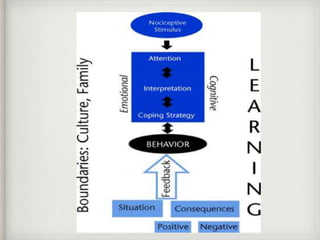
LUMBAR PAIN
Mrinal Joshi
MBBS MD DNB MNAMS GCMskMed
Professor & Head, Dept. of PMR
Rehabilitation Research Center
SMS Medical College & Hospital
Jaipur
Low Back Pain
• Most expensive and common cause of
disability
• Maximum number of physician office visit
• Even more at quacks and alternate
practitioners
• Rates of surgery is on rise
• Recurrent symptom but benign prognosis
2
3
4
Back Problem
• Extremely common medical issue
• Most expensive industrial injury ??
• 25% to 45% have symptom radiating below gluteal
fold
• 5% neurological changes during physical
examination
• 2% indicative of good surgical outcome by
decompression
• Half of the above recovery sufficiently to lose interest
in surgery
9
Irrational Aspects
• Bleeding legs
• Screening x-rays
• Ageing changes as indication of pathology,
CT/MRI
• Passive treatments
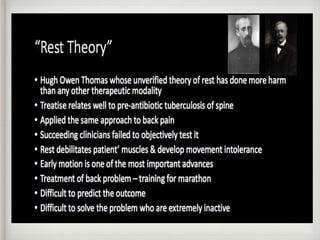
• Huge Owen Thomas
10
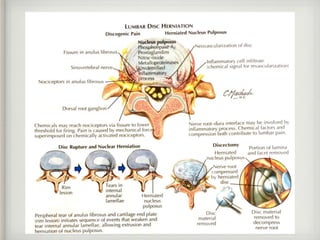
Elements of Pain
• Sinuvertebral nerves are primary innervation of disc
• Travel rostrally 2 levels and caudally 3 levels
• Posterior rami circumflex extends to facet joints
• Potential autonomic input responsible for burning skin,
shocks etc.,
• Sciatica results from both chemical and mechanical
irritation
• Muscular protection reduces with age e.g. leg in cast
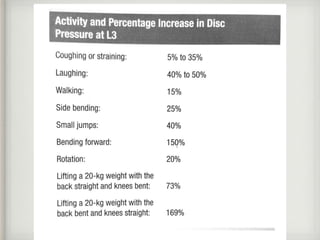
• Activity beyond the capacity can result in symptoms
12
Caveats
• Difficult to predict the outcome of back
problems
• Difficult to pain in those who are extremely
inactive
• Convince that there is nothing dangerous
• Using the back is beneficial and safe
• Managing back pain is like training for
marathon 14
Precis of Assessment
• History (sitting)
• Observation (standing)
• Examination
• Active movements (standing)
• Forward flexion
• Extension
• Side flexion (L/R)
• Rotation (L/R)
• Quick test
• Trendelenburg’s and S1 root test
15
• Passive movements (with care and caution)
• Peripheral joints scan (standing)
• Sacroiliac joints
• Special tests (standing)
• One leg standing lumbar extension test
• H & I test
• Resisted isometric movements (sitting)
• Forward flexion
• Extension
• Side flexion (L/R)
• Rotation (L/R)
• Special tests (sitting)
• Slump test
• Sitting root test
• Resisted isometric movements (supine lying)
• Dynamic abdominal endurance
• Double straight leg lowering
• Internal/external abdominal oblique test
• Peripheral joint scan (supine lying)
• Hip joint (F/E/Ab/Ad/MR/LR)
• Knee joint (F/E)
• Ankle joint (Df/Pf)
• Foot joints (Sup/Pro)
• Toe joints (F/E)
• Myotomes
• Hip flexion (L2)
• Hip extension (S1)
• Knee extension (L3)
• Knee flexion (S1-S2)
• Ankle dorsiflexion (L4)
• Toe extension (L5)
• Ankle eversion or plantar flexion (S1)
• Special tests (supine lying)
• SLR and its variants
• Buttock signs
• Reflexes & cutaneous distribution
• Palpation (supine lying)
• Resisted isometric movements (side lying)
• Horizontal side support
• Special tests (side lying)
• Femoral nerve traction test
• Special torsion tests
• Peripheral joint scan (prone lying)
• Hip joint (Ex/MR/LR)
• Resisted dynamic extension test
• Special test (prone lying)
• Prone knee bending test
• Joint play (prone lying)
• Posteroanterior central vertebral pressure
(PACVP)
• Posteroanterior unilateral vertebral pressure
(PAUVP)
• Transverse vertebral pressure (TVP)
• Palpation
• Multifidus test
Waddell Embellishment Tests
• Tenderness: subcutaneous (or less) pressure to reproduce
symptoms
• Simulation
• Simulation of loading spine with weight of your hand to reproduce
pain
• Simulation of twisting trunk when rotating the hips and shoulder in
unison to reproduce pain
• Distraction: sitting knee extension and SLR test
• Non-anatomic distribution of pain on pain drawing or giving away on
muscle testing
• Overreaction: grimacing, complaints or suffering displays
inappropriate for situation or manoeuvre21
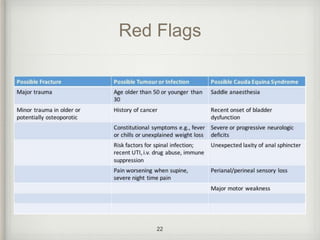
Red Flags
22
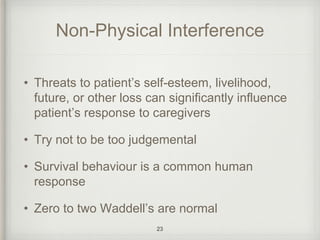
Non-Physical Interference
• Threats to patient’s self-esteem, livelihood,
future, or other loss can significantly influence
patient’s response to caregivers
• Try not to be too judgemental
• Survival behaviour is a common human
response
• Zero to two Waddell’s are normal
23
Treatment
• Assure that there is nothing to fear
• Comfortable activity tolerance can be achieved only by overcoming or
avoiding the debilitation of inactivity
• Conditioning
• 3-4 weeks of general conditioning
• Speed walk, stationary cycle, jogging
• Specific muscle training at least 4-5 times/week
• Next phase of other core and neck muscles
• Work hardening
• Patient benefit more from our honest help than judgement of legitimacy
24
Diagnostic Considerations
In
Delayed Recovery
• If back symptoms persist and continue to limit
activity for more than 4 weeks, SEEK CAUSE
• A picture of tissue/bone abutting the dura does
not indicate it to be the cause
• Physiological evidence will tell us whether the
nerve root is compromised
25
Diagnostic Considerations
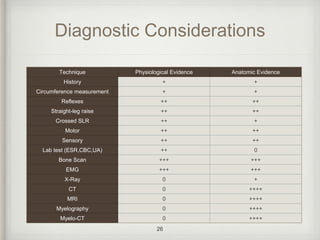
26
Technique Physiological Evidence Anatomic Evidence
History + +
Circumference measurement + +
Reflexes ++ ++
Straight-leg raise ++ ++
Crossed SLR ++ +
Motor ++ ++
Sensory ++ ++
Lab test (ESR,CBC,UA) ++ 0
Bone Scan +++ +++
EMG +++ +++
X-Ray 0 +
CT 0 ++++
MRI 0 ++++
Myelography 0 ++++
Myelo-CT 0 ++++
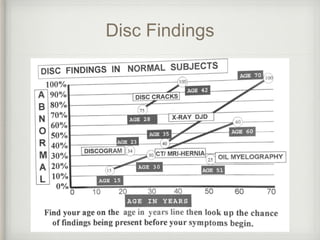
Disc Findings
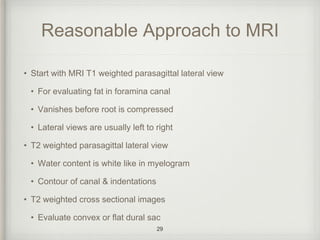
Reasonable Approach to MRI
• Start with MRI T1 weighted parasagittal lateral view
• For evaluating fat in foramina canal
• Vanishes before root is compressed
• Lateral views are usually left to right
• T2 weighted parasagittal lateral view
• Water content is white like in myelogram
• Contour of canal & indentations
• T2 weighted cross sectional images
• Evaluate convex or flat dural sac
29
Wheel of Fortune
30
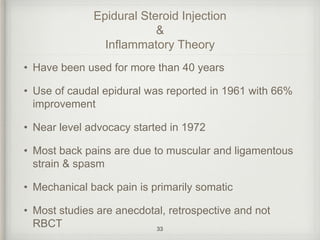
Epidural Steroid Injection
&
Inflammatory Theory
• Have been used for more than 40 years
• Use of caudal epidural was reported in 1961 with 66%
improvement
• Near level advocacy started in 1972
• Most back pains are due to muscular and ligamentous
strain & spasm
• Mechanical back pain is primarily somatic
• Most studies are anecdotal, retrospective and not
RBCT 33
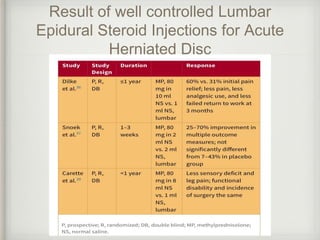
Result of well controlled Lumbar
Epidural Steroid Injections for Acute
Herniated Disc
Current Role
• Efficacy of ESI has not been conclusively demonstrated
• Very good short to intermediated-term success in
selected patients
• Presence of nerve root irritation is required to justify use
of ESI
• Less efficacious in patients with neurologic deficits and a
large disc herniations
• Comprehensive management rather than being a needle
jockey
• Fundamentally a safe injection with good efficacy but
should a part of multidisciplinary plan35
Surgery in Sciatica
• Only when non-operative treatment fails except some
emergencies
• Nonsurgical management should be attempted for at 4-6
weeks to 6 months depending on condition
• Back pain with leg symptoms of pain, numbness or
weakness after a dermatomal distribution
• Sinuvertebral nerve can get irritated with mechanical or
chemical factors
• Short term relief of symptoms is better with surgery but in
most the long term outcomes are almost similar
37
Surgery for Herniated Disc
• Tendon reflexes do not usually recover
• One-third are left with some sensory deficit
• Only absolute indication is caudal equina syndrome
• Relative indication
• Gross motor weakness
• Loss of bowel bladder function
• Recurrent incapacitating leg pain
• Persisting leg pain
• Best window 3-6 months
• Not a life saving procedure but improves QOL
• Exclude other causes
• Most have 70% improvement
38
Herniated Disk
• Back & leg pain with strong physiological
evidence on physical examination or EMG and
corresponding anatomic confirmation on
Imaging are an indication to consider
decompression
• If able to function at less than 3+ EMG and
deferred surgery will eventually recover with
60% recurrence
• With surgery recurrence rate is down to 10%
39
Appropriate Treatment
• No more than 2-3 days bed rest
• Trial of NSAIDs for 3-4 weeks
• Physical therapy/conditioning
• Nerve root/epidural injection may be attempted
• Lack of scientific data on effect
• Decision usually case-by-case basis
40
Procedures
• Chemonucleolysis
• Percutaneous discectomy
• Mechanical
• Laser
• Open Surgery
• Posterior Surgery
• Standard laminectomy and discectomy
• Limited approach/microdiscectomy
• Far lateral discectomy
• Anterior approach
• Arthroscopic discectomy
41

Lumbar pain - Mrinal Joshi

  • 1.
    LUMBAR PAIN Mrinal Joshi MBBSMD DNB MNAMS GCMskMed Professor & Head, Dept. of PMR Rehabilitation Research Center SMS Medical College & Hospital Jaipur
  • 2.
    Low Back Pain •Most expensive and common cause of disability • Maximum number of physician office visit • Even more at quacks and alternate practitioners • Rates of surgery is on rise • Recurrent symptom but benign prognosis 2
  • 3.
  • 4.
  • 8.
    Back Problem • Extremelycommon medical issue • Most expensive industrial injury ?? • 25% to 45% have symptom radiating below gluteal fold • 5% neurological changes during physical examination • 2% indicative of good surgical outcome by decompression • Half of the above recovery sufficiently to lose interest in surgery 9
  • 9.
    Irrational Aspects • Bleedinglegs • Screening x-rays • Ageing changes as indication of pathology, CT/MRI • Passive treatments • Huge Owen Thomas 10
  • 11.
    Elements of Pain •Sinuvertebral nerves are primary innervation of disc • Travel rostrally 2 levels and caudally 3 levels • Posterior rami circumflex extends to facet joints • Potential autonomic input responsible for burning skin, shocks etc., • Sciatica results from both chemical and mechanical irritation • Muscular protection reduces with age e.g. leg in cast • Activity beyond the capacity can result in symptoms 12
  • 13.
    Caveats • Difficult topredict the outcome of back problems • Difficult to pain in those who are extremely inactive • Convince that there is nothing dangerous • Using the back is beneficial and safe • Managing back pain is like training for marathon 14
  • 14.
    Precis of Assessment •History (sitting) • Observation (standing) • Examination • Active movements (standing) • Forward flexion • Extension • Side flexion (L/R) • Rotation (L/R) • Quick test • Trendelenburg’s and S1 root test 15
  • 15.
    • Passive movements(with care and caution) • Peripheral joints scan (standing) • Sacroiliac joints • Special tests (standing) • One leg standing lumbar extension test • H & I test • Resisted isometric movements (sitting) • Forward flexion • Extension • Side flexion (L/R) • Rotation (L/R)
  • 16.
    • Special tests(sitting) • Slump test • Sitting root test • Resisted isometric movements (supine lying) • Dynamic abdominal endurance • Double straight leg lowering • Internal/external abdominal oblique test
  • 17.
    • Peripheral jointscan (supine lying) • Hip joint (F/E/Ab/Ad/MR/LR) • Knee joint (F/E) • Ankle joint (Df/Pf) • Foot joints (Sup/Pro) • Toe joints (F/E) • Myotomes • Hip flexion (L2) • Hip extension (S1) • Knee extension (L3) • Knee flexion (S1-S2) • Ankle dorsiflexion (L4) • Toe extension (L5) • Ankle eversion or plantar flexion (S1)
  • 18.
    • Special tests(supine lying) • SLR and its variants • Buttock signs • Reflexes & cutaneous distribution • Palpation (supine lying) • Resisted isometric movements (side lying) • Horizontal side support • Special tests (side lying) • Femoral nerve traction test • Special torsion tests • Peripheral joint scan (prone lying) • Hip joint (Ex/MR/LR) • Resisted dynamic extension test • Special test (prone lying) • Prone knee bending test
  • 19.
    • Joint play(prone lying) • Posteroanterior central vertebral pressure (PACVP) • Posteroanterior unilateral vertebral pressure (PAUVP) • Transverse vertebral pressure (TVP) • Palpation • Multifidus test
  • 20.
    Waddell Embellishment Tests •Tenderness: subcutaneous (or less) pressure to reproduce symptoms • Simulation • Simulation of loading spine with weight of your hand to reproduce pain • Simulation of twisting trunk when rotating the hips and shoulder in unison to reproduce pain • Distraction: sitting knee extension and SLR test • Non-anatomic distribution of pain on pain drawing or giving away on muscle testing • Overreaction: grimacing, complaints or suffering displays inappropriate for situation or manoeuvre21
  • 21.
  • 22.
    Non-Physical Interference • Threatsto patient’s self-esteem, livelihood, future, or other loss can significantly influence patient’s response to caregivers • Try not to be too judgemental • Survival behaviour is a common human response • Zero to two Waddell’s are normal 23
  • 23.
    Treatment • Assure thatthere is nothing to fear • Comfortable activity tolerance can be achieved only by overcoming or avoiding the debilitation of inactivity • Conditioning • 3-4 weeks of general conditioning • Speed walk, stationary cycle, jogging • Specific muscle training at least 4-5 times/week • Next phase of other core and neck muscles • Work hardening • Patient benefit more from our honest help than judgement of legitimacy 24
  • 24.
    Diagnostic Considerations In Delayed Recovery •If back symptoms persist and continue to limit activity for more than 4 weeks, SEEK CAUSE • A picture of tissue/bone abutting the dura does not indicate it to be the cause • Physiological evidence will tell us whether the nerve root is compromised 25
  • 25.
    Diagnostic Considerations 26 Technique PhysiologicalEvidence Anatomic Evidence History + + Circumference measurement + + Reflexes ++ ++ Straight-leg raise ++ ++ Crossed SLR ++ + Motor ++ ++ Sensory ++ ++ Lab test (ESR,CBC,UA) ++ 0 Bone Scan +++ +++ EMG +++ +++ X-Ray 0 + CT 0 ++++ MRI 0 ++++ Myelography 0 ++++ Myelo-CT 0 ++++
  • 26.
  • 28.
    Reasonable Approach toMRI • Start with MRI T1 weighted parasagittal lateral view • For evaluating fat in foramina canal • Vanishes before root is compressed • Lateral views are usually left to right • T2 weighted parasagittal lateral view • Water content is white like in myelogram • Contour of canal & indentations • T2 weighted cross sectional images • Evaluate convex or flat dural sac 29
  • 29.
  • 32.
    Epidural Steroid Injection & InflammatoryTheory • Have been used for more than 40 years • Use of caudal epidural was reported in 1961 with 66% improvement • Near level advocacy started in 1972 • Most back pains are due to muscular and ligamentous strain & spasm • Mechanical back pain is primarily somatic • Most studies are anecdotal, retrospective and not RBCT 33
  • 33.
    Result of wellcontrolled Lumbar Epidural Steroid Injections for Acute Herniated Disc
  • 34.
    Current Role • Efficacyof ESI has not been conclusively demonstrated • Very good short to intermediated-term success in selected patients • Presence of nerve root irritation is required to justify use of ESI • Less efficacious in patients with neurologic deficits and a large disc herniations • Comprehensive management rather than being a needle jockey • Fundamentally a safe injection with good efficacy but should a part of multidisciplinary plan35
  • 36.
    Surgery in Sciatica •Only when non-operative treatment fails except some emergencies • Nonsurgical management should be attempted for at 4-6 weeks to 6 months depending on condition • Back pain with leg symptoms of pain, numbness or weakness after a dermatomal distribution • Sinuvertebral nerve can get irritated with mechanical or chemical factors • Short term relief of symptoms is better with surgery but in most the long term outcomes are almost similar 37
  • 37.
    Surgery for HerniatedDisc • Tendon reflexes do not usually recover • One-third are left with some sensory deficit • Only absolute indication is caudal equina syndrome • Relative indication • Gross motor weakness • Loss of bowel bladder function • Recurrent incapacitating leg pain • Persisting leg pain • Best window 3-6 months • Not a life saving procedure but improves QOL • Exclude other causes • Most have 70% improvement 38
  • 38.
    Herniated Disk • Back& leg pain with strong physiological evidence on physical examination or EMG and corresponding anatomic confirmation on Imaging are an indication to consider decompression • If able to function at less than 3+ EMG and deferred surgery will eventually recover with 60% recurrence • With surgery recurrence rate is down to 10% 39
  • 39.
    Appropriate Treatment • Nomore than 2-3 days bed rest • Trial of NSAIDs for 3-4 weeks • Physical therapy/conditioning • Nerve root/epidural injection may be attempted • Lack of scientific data on effect • Decision usually case-by-case basis 40
  • 40.
    Procedures • Chemonucleolysis • Percutaneousdiscectomy • Mechanical • Laser • Open Surgery • Posterior Surgery • Standard laminectomy and discectomy • Limited approach/microdiscectomy • Far lateral discectomy • Anterior approach • Arthroscopic discectomy 41