Future Missions:
Dark Energy
The Search for Life
Mark Clampin
Goddard Space Flight Center
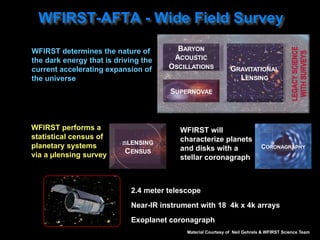
WFIRST determines the nature of
the dark energy that is driving the
current accelerating expansion of
the universe
WFIRST will
characterize planets
and disks with a
stellar coronagraph
WFIRST performs a
statistical census of
planetary systems
via a µlensing survey
mLENSING
CENSUS
CORONAGRAPHY
SUPERNOVAE
BARYON
ACOUSTIC
OSCILLATIONS GRAVITATIONAL
LENSING
2.4 meter telescope
Near-IR instrument with 18 4k x 4k arrays
Exoplanet coronagraph
Material Courtesy of Neil Gehrels & WFIRST Science Team
WFIRST-AFTA - Wide Field Survey
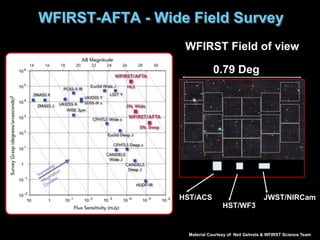
WFIRST Field of view
HST/ACS
HST/WF3
JWST/NIRCam
0.79 Deg
Material Courtesy of Neil Gehrels & WFIRST Science Team
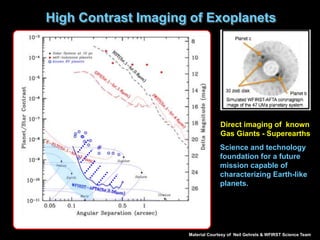
High Contrast Imaging of Exoplanets
Material Courtesy of Neil Gehrels & WFIRST Science Team
Direct imaging of known
Gas Giants - Superearths
Science and technology
foundation for a future
mission capable of
characterizing Earth-like
planets.
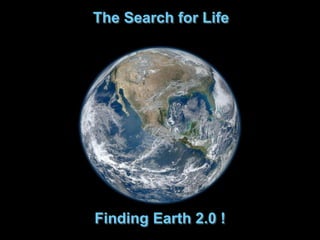
The Search for Life
Finding Earth 2.0 !
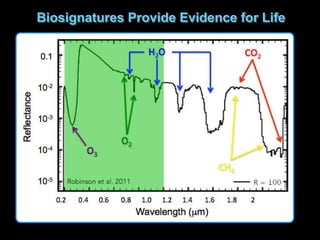
Biosignatures Provide Evidence for Life
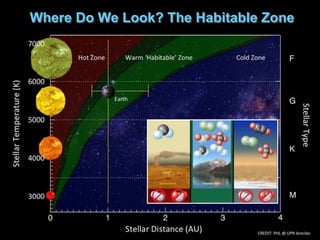
Where Do We Look? The Habitable Zone
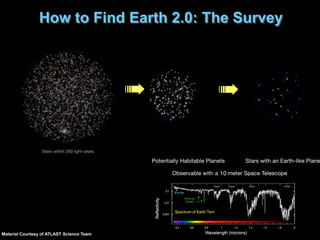
How to Find Earth 2.0: The Survey
➠
Material Courtesy of ATLAST Science Team
➠
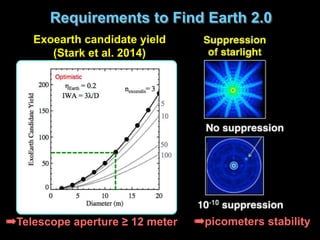
Requirements to Find Earth 2.0
➠picometers stability
Exoearth candidate yield
(Stark et al. 2014)
➠Telescope aperture ≥ 12 meter
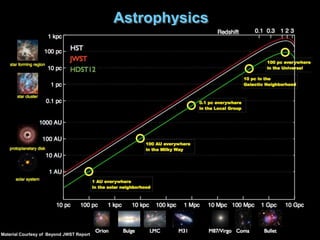
Astrophysics
Material Courtesy of Beyond JWST Report
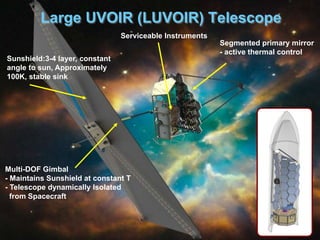
Large UVOIR (LUVOIR) Telescope
Multi-DOF Gimbal
- Maintains Sunshield at constant T
- Telescope dynamically Isolated
from Spacecraft
Serviceable Instruments
Segmented primary mirror
- active thermal control
Sunshield:3-4 layer, constant
angle to sun, Approximately
100K, stable sink
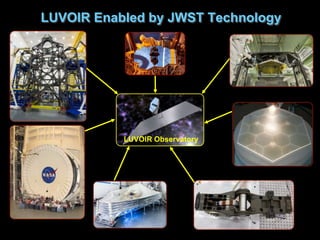
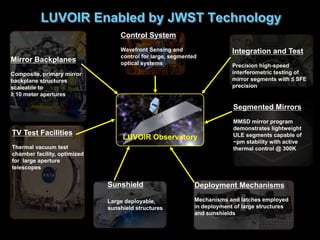
LUVOIR Enabled by JWST Technology
LUVOIR Observatory
LUVOIR Enabled by JWST Technology
LUVOIR Observatory
Mirror Backplanes
Composite, primary mirror
backplane structures
scaleable to
≥ 10 meter apertures
Segmented Mirrors
MMSD mirror program
demonstrates lightweight
ULE segments capable of
~pm stability with active
thermal control @ 300K
Sunshield
Large deployable,
sunshield structures
Control System
Wavefront Sensing and
control for large, segmented
optical systems
TV Test Facilities
Thermal vacuum test
chamber facility, optimized
for large aperture
telescopes
Integration and Test
Precision high-speed
interferometric testing of
mirror segments with ≤ SFE
precision
Deployment Mechanisms
Mechanisms and latches employed
in deployment of large structures
and sunshields
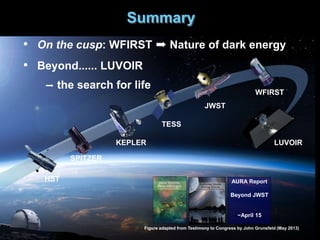
HST
SPITZER
KEPLER
TESS
JWST
WFIRST
Figure adapted from Testimony to Congress by John Grunsfeld (May 2013)
AURA Report
Beyond JWST
~April 15
LUVOIR
Summary
• On the cusp: WFIRST ➠ Nature of dark energy
• Beyond...... LUVOIR
➡ the search for life
Acknowledgements
• GSFC: Matt Bolcar, Julie Crooke, Shawn
Domagal-Goldman, Lee Feinberg, Avi Mandell,
Norman Rioux, Aki Roberge, Chris Stark, Karl
Stapelfeldt & Harley Thronson,
• JPL: Nick Siegler
• MSFC: Phil Stahl
• STScI Marc Postman, Matt Mountain

Goddard 2015: Mark Clampin, NASA

  • 1.
    Future Missions: Dark Energy TheSearch for Life Mark Clampin Goddard Space Flight Center
  • 2.
    WFIRST determines thenature of the dark energy that is driving the current accelerating expansion of the universe WFIRST will characterize planets and disks with a stellar coronagraph WFIRST performs a statistical census of planetary systems via a µlensing survey mLENSING CENSUS CORONAGRAPHY SUPERNOVAE BARYON ACOUSTIC OSCILLATIONS GRAVITATIONAL LENSING 2.4 meter telescope Near-IR instrument with 18 4k x 4k arrays Exoplanet coronagraph Material Courtesy of Neil Gehrels & WFIRST Science Team WFIRST-AFTA - Wide Field Survey
  • 3.
    WFIRST-AFTA - WideField Survey WFIRST Field of view HST/ACS HST/WF3 JWST/NIRCam 0.79 Deg Material Courtesy of Neil Gehrels & WFIRST Science Team
  • 4.
    High Contrast Imagingof Exoplanets Material Courtesy of Neil Gehrels & WFIRST Science Team Direct imaging of known Gas Giants - Superearths Science and technology foundation for a future mission capable of characterizing Earth-like planets.
  • 5.
    The Search forLife Finding Earth 2.0 !
  • 6.
  • 7.
    Where Do WeLook? The Habitable Zone
  • 8.
    How to FindEarth 2.0: The Survey ➠ Material Courtesy of ATLAST Science Team ➠
  • 9.
    Requirements to FindEarth 2.0 ➠picometers stability Exoearth candidate yield (Stark et al. 2014) ➠Telescope aperture ≥ 12 meter
  • 10.
  • 11.
    Large UVOIR (LUVOIR)Telescope Multi-DOF Gimbal - Maintains Sunshield at constant T - Telescope dynamically Isolated from Spacecraft Serviceable Instruments Segmented primary mirror - active thermal control Sunshield:3-4 layer, constant angle to sun, Approximately 100K, stable sink
  • 12.
    LUVOIR Enabled byJWST Technology LUVOIR Observatory
  • 13.
    LUVOIR Enabled byJWST Technology LUVOIR Observatory Mirror Backplanes Composite, primary mirror backplane structures scaleable to ≥ 10 meter apertures Segmented Mirrors MMSD mirror program demonstrates lightweight ULE segments capable of ~pm stability with active thermal control @ 300K Sunshield Large deployable, sunshield structures Control System Wavefront Sensing and control for large, segmented optical systems TV Test Facilities Thermal vacuum test chamber facility, optimized for large aperture telescopes Integration and Test Precision high-speed interferometric testing of mirror segments with ≤ SFE precision Deployment Mechanisms Mechanisms and latches employed in deployment of large structures and sunshields
  • 14.
    HST SPITZER KEPLER TESS JWST WFIRST Figure adapted fromTestimony to Congress by John Grunsfeld (May 2013) AURA Report Beyond JWST ~April 15 LUVOIR Summary • On the cusp: WFIRST ➠ Nature of dark energy • Beyond...... LUVOIR ➡ the search for life
  • 15.
    Acknowledgements • GSFC: MattBolcar, Julie Crooke, Shawn Domagal-Goldman, Lee Feinberg, Avi Mandell, Norman Rioux, Aki Roberge, Chris Stark, Karl Stapelfeldt & Harley Thronson, • JPL: Nick Siegler • MSFC: Phil Stahl • STScI Marc Postman, Matt Mountain

Editor's Notes

  • #4 Multiple surveys: enabled by massive wide field imaging capability High-Latitude Survey Imaging, spectroscopy, supernova monitoring Repeated Observations of Bulge Fields for microlensing 25% Guest Observer Program Coronagraph Observations Supernova Survey: standard candle distances HLS: galaxy redshifts - Standard ruler (distances and expansion rate) imaging - dark matter clustering History of dark energy and deviations from GR Multiple DE techniques to measure - expansion history - growth of structure
  • #5 Imaging focuses on RV planets: 16 known & ~12 survey Gas giants and superearths Provide the first direct images of planets around our nearest neighbors similar to our own giant planets. Provide important insights about the physics of planetary atmospheres through comparative planetology. Assay the population of massive debris disks that will serve as sources of noise and confusion for a flagship mission. Develop crucial technologies for a future mission, and provide practical demonstration of these technologies in flight. Future mission is search for life
  • #6 Most compelling question in science: are we alone. Can we find evidence of life? - spans a range of scientific disiplines from astrophysics to biology - captures imagination of the public: turn on TV or look at legacy of shows like star trek - heard yesterday great nations explore. Search for life is the next frontier in exploration
  • #7 Venus and Earth look the same to all planet-finding techniques except those that enable planet atmosphere spectra: To examine for evidence of life we need to obtain spectra that address several key biosignatures namely