Celebrating the Spitzer Space Telescope: 5 Years and Counting! Presented to the American Astronautical Society by Michael Werner  Spitzer Project Scientist JPL/Caltech November 19, 2008
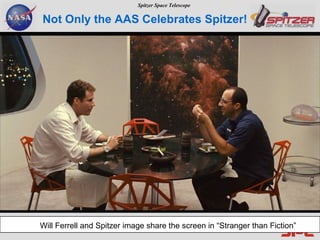
Not Only the AAS Celebrates Spitzer! Will Ferrell and Spitzer image share the screen in “Stranger than Fiction”
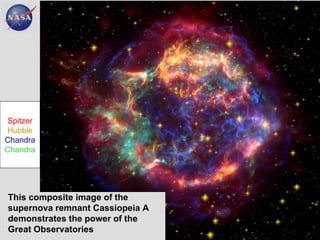
Spitzer Hubble Chandra Chandra This composite image of the supernova remnant Cassiopeia A demonstrates the power of the Great Observatories
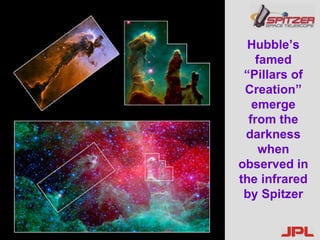
Hubble’s famed “Pillars of Creation” emerge from the darkness when observed in the infrared by Spitzer
The Spitzer Space Telescope A Assembled SIRTF Observatory at Lockheed-Martin*, Sunnyvale. Key Characteristics: Aperture – 85 cm Wavelength Range - 3-to-180um Telescope Temperature – 5.5K Mass – 870kg Height – 4m *Other key team members:  Ball Aerospace, U. Arizona, Cornell, U., Smithsonian, Goddard, Caltech Infrared member of NASA’s family of Great Observatories.  Managed and operated by JPL Launched in August 2003 into Earth-trailing solar orbit Three instruments use state-of-the art infrared detector arrays, cooled by liquid helium to as low as 1.4K Provides new and unprecedented view of the infrared sky.  Scientific results far exceed all expectations Helium lifetime of ~6 yrs [ending mid 2009] far exceeds  2.5 yr requirement.  But that is not the end….. 4:1 oversubscription in first proposals received for Warm Spitzer mission, which will run through at least mid-2011 with unique scientific capabilities
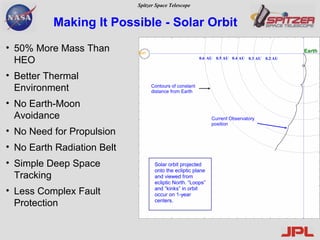
Making It Possible - Solar Orbit 50% More Mass Than HEO Better Thermal Environment No Earth-Moon Avoidance No Need for Propulsion No Earth Radiation Belt Simple Deep Space Tracking Less Complex Fault Protection Sun
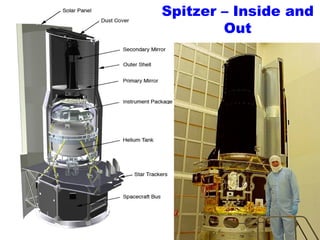
Spitzer – Inside and Out
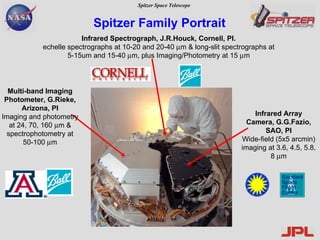
Spitzer Family Portrait Infrared Array Camera, G.G.Fazio, SAO, PI Wide-field (5x5 arcmin) imaging at 3.6, 4.5, 5.8, 8   m Infrared Spectrograph, J.R.Houck, Cornell, PI. echelle spectrographs at 10-20 and 20-40   m   & long-slit spectrographs at 5-15um and 15-40   m, plus Imaging/Photometry at 15   m Multi-band Imaging Photometer, G.Rieke, Arizona, PI Imaging and photometry at 24, 70, 160   m & spectrophotometry at 50-100   m
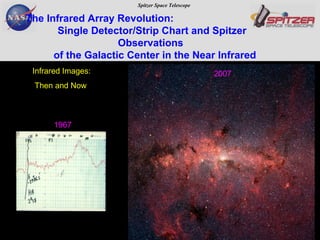
The Infrared Array Revolution:  Single Detector/Strip Chart and Spitzer  Observations    of the Galactic Center in the Near Infrared 1967 Infrared Images: Then and Now 2007
 
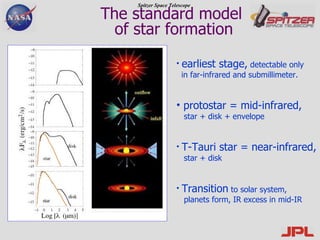
The standard model of star formation earliest stage,  detectable only  in far-infrared and submillimeter.  protostar = mid-infrared, star + disk + envelope  T-Tauri star = near-infrared,   star + disk  Transition  to solar system,  planets form, IR excess in mid-IR
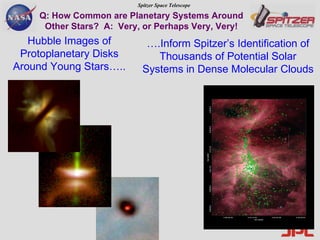
Hubble Images of Protoplanetary Disks Around Young Stars….. … .Inform Spitzer’s Identification of Thousands of Potential Solar Systems in Dense Molecular Clouds Q: How Common are Planetary Systems Around Other Stars?  A:  Very, or Perhaps Very, Very!
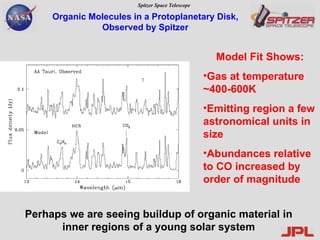
Organic Molecules in a Protoplanetary Disk, Observed by Spitzer Model Fit Shows: Gas at temperature ~400-600K Emitting region a few astronomical units in size Abundances relative to CO increased by order of magnitude Perhaps we are seeing buildup of organic material in inner regions of a young solar system
Spitzer has Found  “ The Mountains Of  Creation” L. Allen, CfA [GTO]
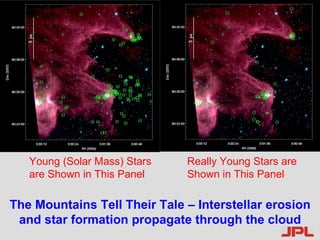
The Mountains Tell Their Tale – Interstellar erosion and star formation propagate through the cloud Young (Solar Mass) Stars are Shown in This Panel Really Young Stars are Shown in This Panel
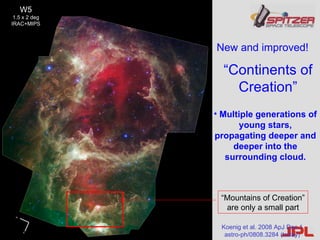
New and improved!   “ Mountains of Creation” are only a small part Koenig et al. 2008 ApJ Dec 1 astro-ph/0808.3284 (today) W5 1.5 x 2 deg IRAC+MIPS “ Continents of Creation” Multiple generations of young stars, propagating deeper and deeper into the surrounding cloud. N E
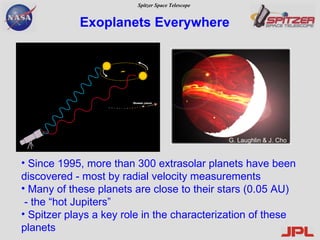
Exoplanets Everywhere Since 1995, more than 300 extrasolar planets have been discovered - most by radial velocity measurements Many of these planets are close to their stars (0.05 AU)  - the “hot Jupiters” Spitzer plays a key role in the characterization of these planets G. Laughlin & J. Cho
How Spitzer Characterizes Extrasolar Planets –Transits and Eclipses N
HD 189733b: First [one-dimensional] temperature map of an exoplanet 970K on night side; 1210K on day side “ warm spot” 30 degrees E of high-noon point. High “easterly” winds, 6000 mph, carry heat around planet These lengthy and highly precise observations are enabled by Spitzer’s remarkable stability in the solar orbit Model:  Assumes tidal locking of planet to star and extrapolates in latitude. Data – flux at 8um over more than half an orbit
Thermal pulse predicted for planet in elliptical orbit will demonstrate dynamics of planetary atmosphere Eccentric Orbits Produce Rapid Thermal Variations on Exoplanets
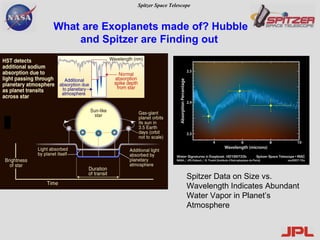
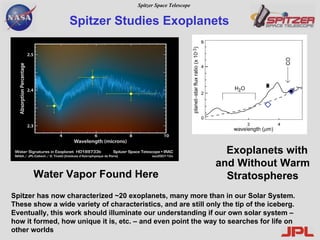
What are Exoplanets made of? Hubble and Spitzer are Finding out  Spitzer Data on Size vs. Wavelength Indicates Abundant Water Vapor in Planet’s Atmosphere
More Exoplanet Molecules NICMOS/HST [left] and Spitzer [right] spectra of transiting exoplanets show structure which reflects molecular composition and thermal structure of the exoplanet atmospheres
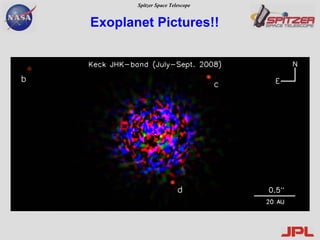
Exoplanet Pictures!!
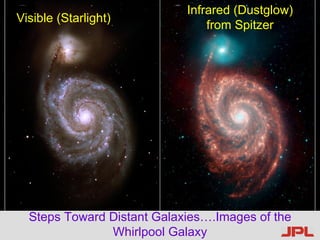
Steps Toward Distant Galaxies….Images of the Whirlpool Galaxy Visible (Starlight) Infrared (Dustglow) from Spitzer
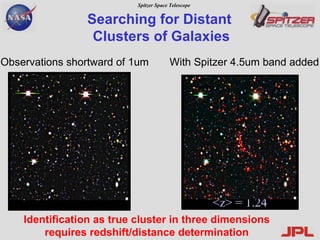
Optical  Alone Observations shortward of 1um  With Spitzer 4.5um band added Searching for Distant  Clusters of Galaxies Identification as true cluster in three dimensions requires redshift/distance determination <z> = 1.24
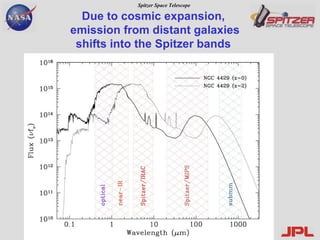
Due to cosmic expansion,  emission from distant galaxies shifts into the Spitzer bands
Clusters discovered in Bootes field greatly increase the number of known high redshift clusters [from red to blue].  Deeper observations are underway to find more. Potential Applications Include: Determination of Cosmological Parameters and Growth of Structure  Studies of Evolution of Cluster Galaxies Identification of z>1 Supernovae in Dust-Poor Galaxies The Bottom Line
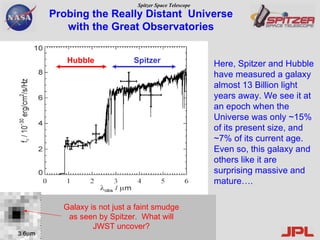
Probing the Really Distant  Universe with the Great Observatories Here, Spitzer and Hubble have measured a galaxy almost 13 Billion light years away. We see it at an epoch when the Universe was only ~15% of its present size, and  ~7% of its current age.  Even so, this galaxy and others like it are surprising massive and mature…. Galaxy is not just a faint smudge as seen by Spitzer.  What will JWST uncover? Hubble Spitzer
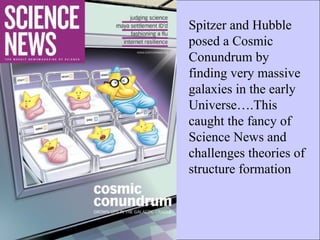
Spitzer and Hubble  posed a Cosmic Conundrum by finding very massive galaxies in the early Universe….This caught the fancy of Science News and challenges theories of structure formation
Warm mission [starting mid 2009] includes:  3.6 and 4.5 um observations with current sensitivity   Robust program of research using archive from cryo mission and from warm mission   Coming Up:  The Spitzer Warm* Mission *Warm=30K.  The Spitzer outer shell is at 34K, passively cooled Based on Senior Review recommendation, NASA has approved first two years of Warm Mission, through mid-2011 First call for proposals was oversubscribed by 4x; proposals are being evaluated even as we speak Based on quantity and quality of proposals, we are planning to propose to extend Warm Mission through end of 2013
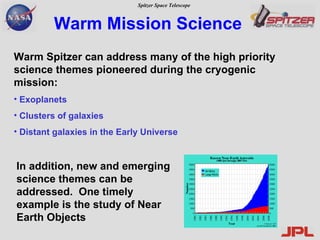
Warm Mission Science   Warm Spitzer can address many of the high priority science themes pioneered during the cryogenic mission: Exoplanets Clusters of galaxies Distant galaxies in the Early Universe In addition, new and emerging science themes can be addressed.  One timely example is the study of Near Earth Objects
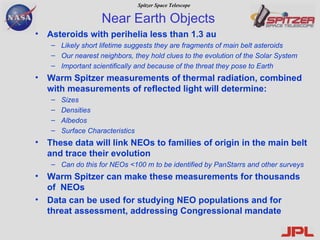
Near Earth Objects   Asteroids with perihelia less than 1.3 au Likely short lifetime suggests they are fragments of main belt asteroids Our nearest neighbors, they hold clues to the evolution of the Solar System Important scientifically and because of the threat they pose to Earth Warm Spitzer measurements of thermal radiation, combined with measurements of reflected light will determine: Sizes Densities Albedos Surface Characteristics These data will link NEOs to families of origin in the main belt and trace their evolution  Can do this for NEOs <100 m to be identified by PanStarrs and other surveys Warm Spitzer can make these measurements for thousands of  NEOs   Data can be used for studying NEO populations and for threat assessment, addressing Congressional mandate
  Spitzer Observations of NEO 1993GD Observation took 900s with Spitzer.  Target 1.28 au from Sun, 0.49 au from Earth Diameter of 175 +/- 15 m makes this one of the smallest asteroids [MB or NEOs] for which size is known.  Warm mission bands at 3.6 and 4.5 μ m alone give result very close to that from all four Spitzer bands. Albedo of 0.28+/-.06 agrees with other results for small NEOs Warm Spitzer is only mission capable of direct size determinations for thousands of small NEOs. This will be revolutionary, not incremental.
Spitzer’s Adventures with  Gamma Ray Burst 080319B First infrared detection of the afterglow of a gamma ray burst
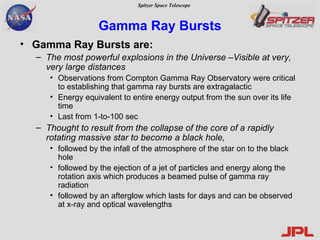
Gamma Ray Bursts Gamma Ray Bursts are: The most powerful explosions in the Universe –Visible at very, very large distances Observations from Compton Gamma Ray Observatory were critical to establishing that gamma ray bursts are extragalactic Energy equivalent to entire energy output from the sun over its life time Last from 1-to-100 sec Thought to result from the collapse of the core of a rapidly rotating massive star to become a black hole,  followed by the infall of the atmosphere of the star on to the black hole followed by the ejection of a jet of particles and energy along the rotation axis which produces a beamed pulse of gamma ray radiation followed by an afterglow which lasts for days and can be observed at x-ray and optical wavelengths
Images of GR080319B – the first “naked-eye” Gamma Ray burst X-ray and UV/Optical [right] images from SWIFT Image from “Pi of the Sky” ground network Magnitude vs. time from Pi of the sky telegram shows naked eye brightness.  These observations overlap SWIFT trigger in time.  Spectroscopic follow up showed z~1, not at all unusual for Gamma Ray bursts
Now you see it, now you don’t! [with Spitzer, that is!] 2.5 days after explosion ~8 days after explosion
Let’s go to: http://grb.fuw.edu.pl/pi/index.html To see a movie of this remarkable event
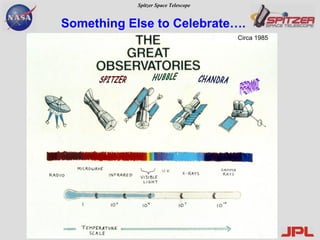
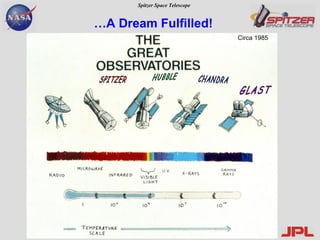
SPITZER HUBBLE CHANDRA Circa 1985 Something Else to Celebrate…. FERMI
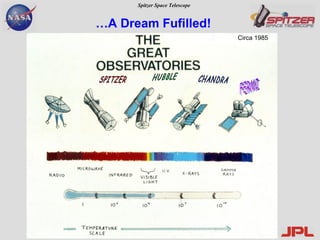
SPITZER HUBBLE CHANDRA Circa 1985 … A Dream Fufilled! FERMI
 
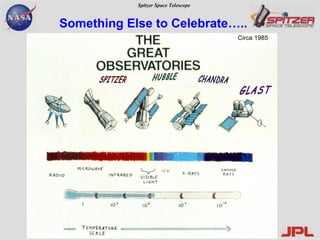
SPITZER HUBBLE CHANDRA GLAST Circa 1985 Something Else to Celebrate…..
SPITZER HUBBLE CHANDRA GLAST Circa 1985 … A Dream Fulfilled!
Spitzer Studies Exoplanets Water Vapor Found Here Spitzer has now characterized ~20 exoplanets, many more than in our Solar System.  These show a wide variety of characteristics, and are still only the tip of the iceberg.  Eventually, this work should illuminate our understanding if our own solar system – how it formed, how unique it is, etc. – and even point the way to searches for life on other worlds Exoplanets with and Without Warm Stratospheres

AAS National Conference 2008: Michael Werner

  • 1.
    Celebrating the SpitzerSpace Telescope: 5 Years and Counting! Presented to the American Astronautical Society by Michael Werner Spitzer Project Scientist JPL/Caltech November 19, 2008
  • 2.
    Not Only theAAS Celebrates Spitzer! Will Ferrell and Spitzer image share the screen in “Stranger than Fiction”
  • 3.
    Spitzer Hubble ChandraChandra This composite image of the supernova remnant Cassiopeia A demonstrates the power of the Great Observatories
  • 4.
    Hubble’s famed “Pillarsof Creation” emerge from the darkness when observed in the infrared by Spitzer
  • 5.
    The Spitzer SpaceTelescope A Assembled SIRTF Observatory at Lockheed-Martin*, Sunnyvale. Key Characteristics: Aperture – 85 cm Wavelength Range - 3-to-180um Telescope Temperature – 5.5K Mass – 870kg Height – 4m *Other key team members: Ball Aerospace, U. Arizona, Cornell, U., Smithsonian, Goddard, Caltech Infrared member of NASA’s family of Great Observatories. Managed and operated by JPL Launched in August 2003 into Earth-trailing solar orbit Three instruments use state-of-the art infrared detector arrays, cooled by liquid helium to as low as 1.4K Provides new and unprecedented view of the infrared sky. Scientific results far exceed all expectations Helium lifetime of ~6 yrs [ending mid 2009] far exceeds 2.5 yr requirement. But that is not the end….. 4:1 oversubscription in first proposals received for Warm Spitzer mission, which will run through at least mid-2011 with unique scientific capabilities
  • 6.
    Making It Possible- Solar Orbit 50% More Mass Than HEO Better Thermal Environment No Earth-Moon Avoidance No Need for Propulsion No Earth Radiation Belt Simple Deep Space Tracking Less Complex Fault Protection Sun
  • 7.
  • 8.
    Spitzer Family PortraitInfrared Array Camera, G.G.Fazio, SAO, PI Wide-field (5x5 arcmin) imaging at 3.6, 4.5, 5.8, 8  m Infrared Spectrograph, J.R.Houck, Cornell, PI. echelle spectrographs at 10-20 and 20-40  m & long-slit spectrographs at 5-15um and 15-40  m, plus Imaging/Photometry at 15  m Multi-band Imaging Photometer, G.Rieke, Arizona, PI Imaging and photometry at 24, 70, 160  m & spectrophotometry at 50-100  m
  • 9.
    The Infrared ArrayRevolution: Single Detector/Strip Chart and Spitzer Observations of the Galactic Center in the Near Infrared 1967 Infrared Images: Then and Now 2007
  • 10.
  • 11.
    The standard modelof star formation earliest stage, detectable only in far-infrared and submillimeter. protostar = mid-infrared, star + disk + envelope T-Tauri star = near-infrared, star + disk Transition to solar system, planets form, IR excess in mid-IR
  • 12.
    Hubble Images ofProtoplanetary Disks Around Young Stars….. … .Inform Spitzer’s Identification of Thousands of Potential Solar Systems in Dense Molecular Clouds Q: How Common are Planetary Systems Around Other Stars? A: Very, or Perhaps Very, Very!
  • 13.
    Organic Molecules ina Protoplanetary Disk, Observed by Spitzer Model Fit Shows: Gas at temperature ~400-600K Emitting region a few astronomical units in size Abundances relative to CO increased by order of magnitude Perhaps we are seeing buildup of organic material in inner regions of a young solar system
  • 14.
    Spitzer has Found “ The Mountains Of Creation” L. Allen, CfA [GTO]
  • 15.
    The Mountains TellTheir Tale – Interstellar erosion and star formation propagate through the cloud Young (Solar Mass) Stars are Shown in This Panel Really Young Stars are Shown in This Panel
  • 16.
    New and improved! “ Mountains of Creation” are only a small part Koenig et al. 2008 ApJ Dec 1 astro-ph/0808.3284 (today) W5 1.5 x 2 deg IRAC+MIPS “ Continents of Creation” Multiple generations of young stars, propagating deeper and deeper into the surrounding cloud. N E
  • 17.
    Exoplanets Everywhere Since1995, more than 300 extrasolar planets have been discovered - most by radial velocity measurements Many of these planets are close to their stars (0.05 AU) - the “hot Jupiters” Spitzer plays a key role in the characterization of these planets G. Laughlin & J. Cho
  • 18.
    How Spitzer CharacterizesExtrasolar Planets –Transits and Eclipses N
  • 19.
    HD 189733b: First[one-dimensional] temperature map of an exoplanet 970K on night side; 1210K on day side “ warm spot” 30 degrees E of high-noon point. High “easterly” winds, 6000 mph, carry heat around planet These lengthy and highly precise observations are enabled by Spitzer’s remarkable stability in the solar orbit Model: Assumes tidal locking of planet to star and extrapolates in latitude. Data – flux at 8um over more than half an orbit
  • 20.
    Thermal pulse predictedfor planet in elliptical orbit will demonstrate dynamics of planetary atmosphere Eccentric Orbits Produce Rapid Thermal Variations on Exoplanets
  • 21.
    What are Exoplanetsmade of? Hubble and Spitzer are Finding out Spitzer Data on Size vs. Wavelength Indicates Abundant Water Vapor in Planet’s Atmosphere
  • 22.
    More Exoplanet MoleculesNICMOS/HST [left] and Spitzer [right] spectra of transiting exoplanets show structure which reflects molecular composition and thermal structure of the exoplanet atmospheres
  • 23.
  • 24.
    Steps Toward DistantGalaxies….Images of the Whirlpool Galaxy Visible (Starlight) Infrared (Dustglow) from Spitzer
  • 25.
    Optical AloneObservations shortward of 1um With Spitzer 4.5um band added Searching for Distant Clusters of Galaxies Identification as true cluster in three dimensions requires redshift/distance determination <z> = 1.24
  • 26.
    Due to cosmicexpansion, emission from distant galaxies shifts into the Spitzer bands
  • 27.
    Clusters discovered inBootes field greatly increase the number of known high redshift clusters [from red to blue]. Deeper observations are underway to find more. Potential Applications Include: Determination of Cosmological Parameters and Growth of Structure Studies of Evolution of Cluster Galaxies Identification of z>1 Supernovae in Dust-Poor Galaxies The Bottom Line
  • 28.
    Probing the ReallyDistant Universe with the Great Observatories Here, Spitzer and Hubble have measured a galaxy almost 13 Billion light years away. We see it at an epoch when the Universe was only ~15% of its present size, and ~7% of its current age. Even so, this galaxy and others like it are surprising massive and mature…. Galaxy is not just a faint smudge as seen by Spitzer. What will JWST uncover? Hubble Spitzer
  • 29.
    Spitzer and Hubble posed a Cosmic Conundrum by finding very massive galaxies in the early Universe….This caught the fancy of Science News and challenges theories of structure formation
  • 30.
    Warm mission [startingmid 2009] includes: 3.6 and 4.5 um observations with current sensitivity Robust program of research using archive from cryo mission and from warm mission Coming Up: The Spitzer Warm* Mission *Warm=30K. The Spitzer outer shell is at 34K, passively cooled Based on Senior Review recommendation, NASA has approved first two years of Warm Mission, through mid-2011 First call for proposals was oversubscribed by 4x; proposals are being evaluated even as we speak Based on quantity and quality of proposals, we are planning to propose to extend Warm Mission through end of 2013
  • 31.
    Warm Mission Science Warm Spitzer can address many of the high priority science themes pioneered during the cryogenic mission: Exoplanets Clusters of galaxies Distant galaxies in the Early Universe In addition, new and emerging science themes can be addressed. One timely example is the study of Near Earth Objects
  • 32.
    Near Earth Objects Asteroids with perihelia less than 1.3 au Likely short lifetime suggests they are fragments of main belt asteroids Our nearest neighbors, they hold clues to the evolution of the Solar System Important scientifically and because of the threat they pose to Earth Warm Spitzer measurements of thermal radiation, combined with measurements of reflected light will determine: Sizes Densities Albedos Surface Characteristics These data will link NEOs to families of origin in the main belt and trace their evolution Can do this for NEOs <100 m to be identified by PanStarrs and other surveys Warm Spitzer can make these measurements for thousands of NEOs Data can be used for studying NEO populations and for threat assessment, addressing Congressional mandate
  • 33.
    SpitzerObservations of NEO 1993GD Observation took 900s with Spitzer. Target 1.28 au from Sun, 0.49 au from Earth Diameter of 175 +/- 15 m makes this one of the smallest asteroids [MB or NEOs] for which size is known. Warm mission bands at 3.6 and 4.5 μ m alone give result very close to that from all four Spitzer bands. Albedo of 0.28+/-.06 agrees with other results for small NEOs Warm Spitzer is only mission capable of direct size determinations for thousands of small NEOs. This will be revolutionary, not incremental.
  • 34.
    Spitzer’s Adventures with Gamma Ray Burst 080319B First infrared detection of the afterglow of a gamma ray burst
  • 35.
    Gamma Ray BurstsGamma Ray Bursts are: The most powerful explosions in the Universe –Visible at very, very large distances Observations from Compton Gamma Ray Observatory were critical to establishing that gamma ray bursts are extragalactic Energy equivalent to entire energy output from the sun over its life time Last from 1-to-100 sec Thought to result from the collapse of the core of a rapidly rotating massive star to become a black hole, followed by the infall of the atmosphere of the star on to the black hole followed by the ejection of a jet of particles and energy along the rotation axis which produces a beamed pulse of gamma ray radiation followed by an afterglow which lasts for days and can be observed at x-ray and optical wavelengths
  • 36.
    Images of GR080319B– the first “naked-eye” Gamma Ray burst X-ray and UV/Optical [right] images from SWIFT Image from “Pi of the Sky” ground network Magnitude vs. time from Pi of the sky telegram shows naked eye brightness. These observations overlap SWIFT trigger in time. Spectroscopic follow up showed z~1, not at all unusual for Gamma Ray bursts
  • 37.
    Now you seeit, now you don’t! [with Spitzer, that is!] 2.5 days after explosion ~8 days after explosion
  • 38.
    Let’s go to:http://grb.fuw.edu.pl/pi/index.html To see a movie of this remarkable event
  • 39.
    SPITZER HUBBLE CHANDRACirca 1985 Something Else to Celebrate…. FERMI
  • 40.
    SPITZER HUBBLE CHANDRACirca 1985 … A Dream Fufilled! FERMI
  • 41.
  • 42.
    SPITZER HUBBLE CHANDRAGLAST Circa 1985 Something Else to Celebrate…..
  • 43.
    SPITZER HUBBLE CHANDRAGLAST Circa 1985 … A Dream Fulfilled!
  • 44.
    Spitzer Studies ExoplanetsWater Vapor Found Here Spitzer has now characterized ~20 exoplanets, many more than in our Solar System. These show a wide variety of characteristics, and are still only the tip of the iceberg. Eventually, this work should illuminate our understanding if our own solar system – how it formed, how unique it is, etc. – and even point the way to searches for life on other worlds Exoplanets with and Without Warm Stratospheres