VERNACULAR ARCHITECTURE
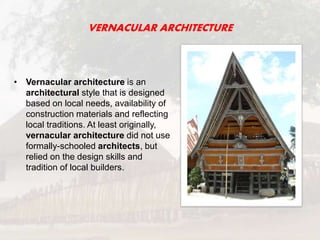
• Vernacular architecture is an
architectural style that is designed
based on local needs, availability of
construction materials and reflecting
local traditions. At least originally,
vernacular architecture did not use
formally-schooled architects, but
relied on the design skills and
tradition of local builders.
VERNACULAR ARCHITECTURE INDIA
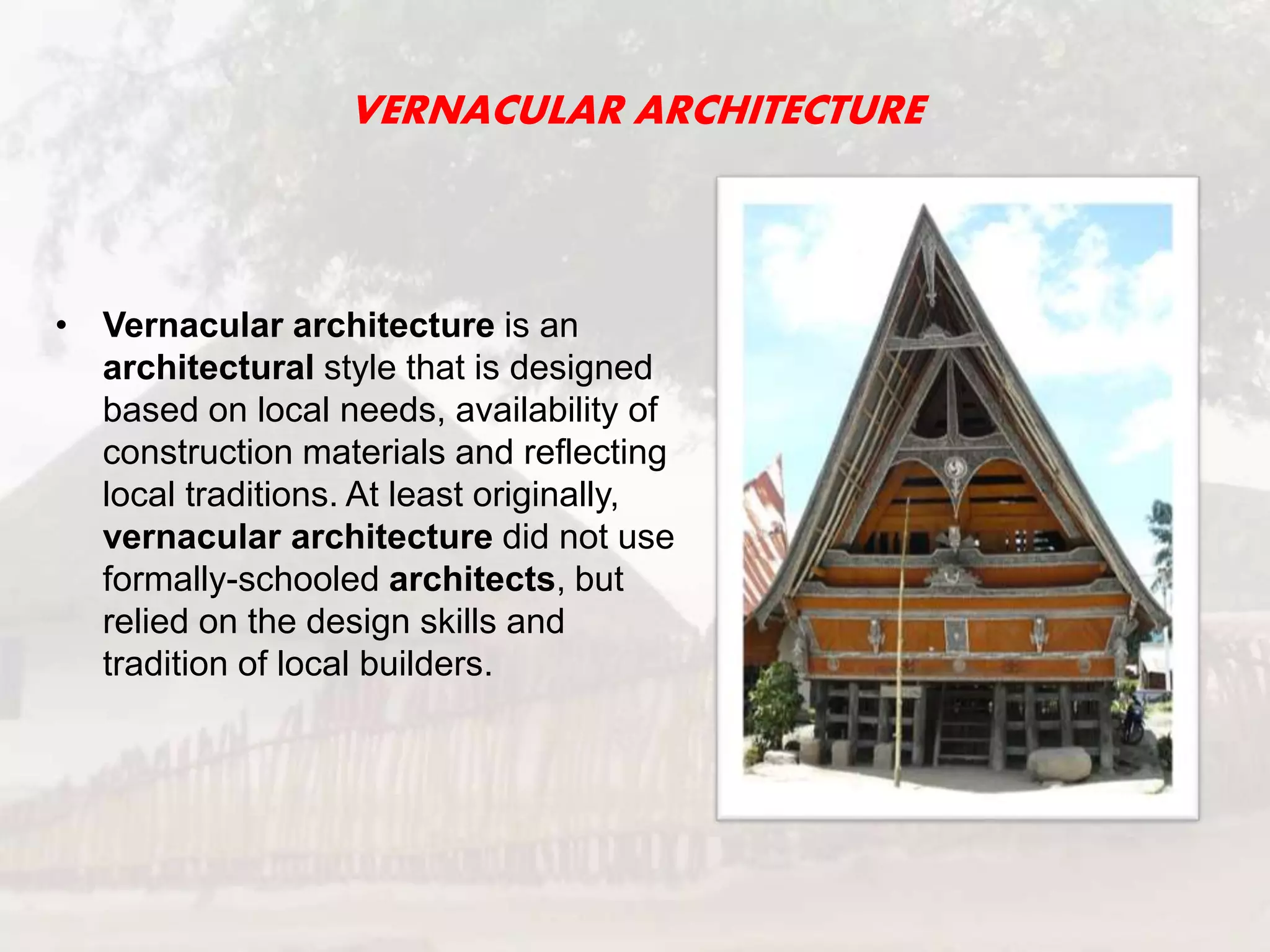
• Indian vernacular architecture the
informal, functional architecture of
structures, often in rural areas of
India, built of local materials and
designed to meet the needs of the
local people. The builders of these
structures are unschooled informal
architectural design and their work
reflects the rich diversity of India's
climate, locally available building
materials, and the intricate variations
in local social customs and
craftsmanship. It has been estimated
that worldwide close to 90% of all
building is vernacular, meaning that it
is for daily use for ordinary, local
people and built by local craftsmen.
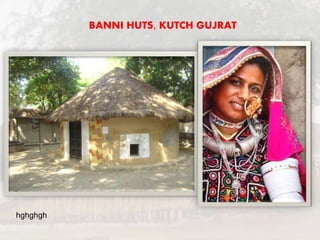
BANNI HUTS, KUTCH GUJRAT
hghghgh
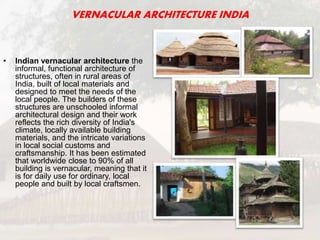
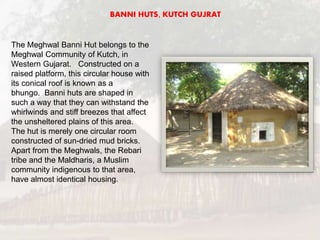
The Meghwal Banni Hut belongs to the
Meghwal Community of Kutch, in
Western Gujarat. Constructed on a
raised platform, this circular house with
its conical roof is known as a
bhungo. Banni huts are shaped in
such a way that they can withstand the
whirlwinds and stiff breezes that affect
the unsheltered plains of this area.
The hut is merely one circular room
constructed of sun-dried mud bricks.
Apart from the Meghwals, the Rebari
tribe and the Maldharis, a Muslim
community indigenous to that area,
have almost identical housing.
BANNI HUTS, KUTCH GUJRAT
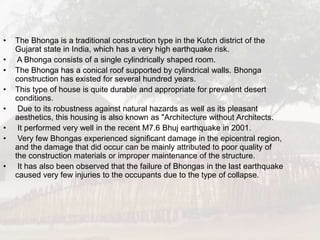
• The Bhonga is a traditional construction type in the Kutch district of the
Gujarat state in India, which has a very high earthquake risk.
• A Bhonga consists of a single cylindrically shaped room.
• The Bhonga has a conical roof supported by cylindrical walls. Bhonga
construction has existed for several hundred years.
• This type of house is quite durable and appropriate for prevalent desert
conditions.
• Due to its robustness against natural hazards as well as its pleasant
aesthetics, this housing is also known as "Architecture without Architects.
• It performed very well in the recent M7.6 Bhuj earthquake in 2001.
• Very few Bhongas experienced significant damage in the epicentral region,
and the damage that did occur can be mainly attributed to poor quality of
the construction materials or improper maintenance of the structure.
• It has also been observed that the failure of Bhongas in the last earthquake
caused very few injuries to the occupants due to the type of collapse.
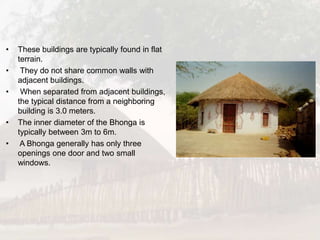
• These buildings are typically found in flat
terrain.
• They do not share common walls with
adjacent buildings.
• When separated from adjacent buildings,
the typical distance from a neighboring
building is 3.0 meters.
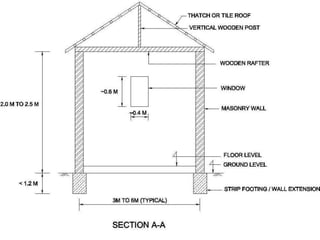
• The inner diameter of the Bhonga is
typically between 3m to 6m.
• A Bhonga generally has only three
openings one door and two small
windows.
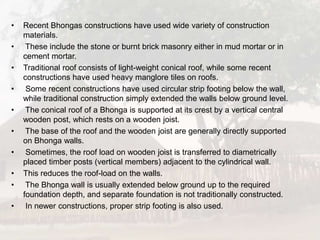
• Recent Bhongas constructions have used wide variety of construction
materials.
• These include the stone or burnt brick masonry either in mud mortar or in
cement mortar.
• Traditional roof consists of light-weight conical roof, while some recent
constructions have used heavy manglore tiles on roofs.
• Some recent constructions have used circular strip footing below the wall,
while traditional construction simply extended the walls below ground level.
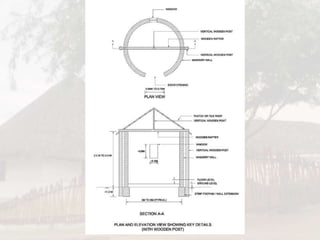
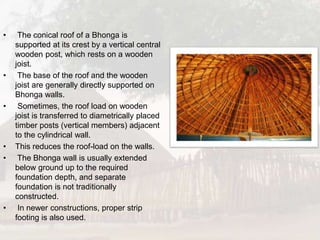
• The conical roof of a Bhonga is supported at its crest by a vertical central
wooden post, which rests on a wooden joist.
• The base of the roof and the wooden joist are generally directly supported
on Bhonga walls.
• Sometimes, the roof load on wooden joist is transferred to diametrically
placed timber posts (vertical members) adjacent to the cylindrical wall.
• This reduces the roof-load on the walls.
• The Bhonga wall is usually extended below ground up to the required
foundation depth, and separate foundation is not traditionally constructed.
• In newer constructions, proper strip footing is also used.
• The conical roof of a Bhonga is
supported at its crest by a vertical central
wooden post, which rests on a wooden
joist.
• The base of the roof and the wooden
joist are generally directly supported on
Bhonga walls.
• Sometimes, the roof load on wooden
joist is transferred to diametrically placed
timber posts (vertical members) adjacent
to the cylindrical wall.
• This reduces the roof-load on the walls.
• The Bhonga wall is usually extended
below ground up to the required
foundation depth, and separate
foundation is not traditionally
constructed.
• In newer constructions, proper strip
footing is also used.
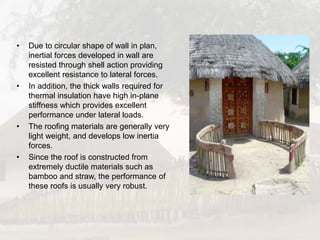
• Due to circular shape of wall in plan,
inertial forces developed in wall are
resisted through shell action providing
excellent resistance to lateral forces.
• In addition, the thick walls required for
thermal insulation have high in-plane
stiffness which provides excellent
performance under lateral loads.
• The roofing materials are generally very
light weight, and develops low inertia
forces.
• Since the roof is constructed from
extremely ductile materials such as
bamboo and straw, the performance of
these roofs is usually very robust.
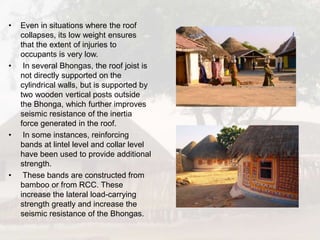
• Even in situations where the roof
collapses, its low weight ensures
that the extent of injuries to
occupants is very low.
• In several Bhongas, the roof joist is
not directly supported on the
cylindrical walls, but is supported by
two wooden vertical posts outside
the Bhonga, which further improves
seismic resistance of the inertia
force generated in the roof.
• In some instances, reinforcing
bands at lintel level and collar level
have been used to provide additional
strength.
• These bands are constructed from
bamboo or from RCC. These
increase the lateral load-carrying
strength greatly and increase the
seismic resistance of the Bhongas.
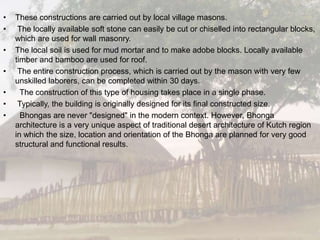
• These constructions are carried out by local village masons.
• The locally available soft stone can easily be cut or chiselled into rectangular blocks,
which are used for wall masonry.
• The local soil is used for mud mortar and to make adobe blocks. Locally available
timber and bamboo are used for roof.
• The entire construction process, which is carried out by the mason with very few
unskilled laborers, can be completed within 30 days.
• The construction of this type of housing takes place in a single phase.
• Typically, the building is originally designed for its final constructed size.
• Bhongas are never "designed" in the modern context. However, Bhonga
architecture is a very unique aspect of traditional desert architecture of Kutch region
in which the size, location and orientation of the Bhonga are planned for very good
structural and functional results.
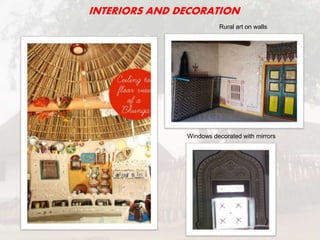
Rural art on walls
Windows decorated with mirrors
INTERIORS AND DECORATION
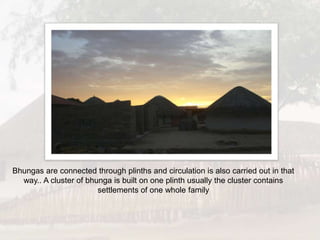
Bhungas are connected through plinths and circulation is also carried out in that
way.. A cluster of bhunga is built on one plinth usually the cluster contains
settlements of one whole family
Thank you

Lucknow

  • 1.
    VERNACULAR ARCHITECTURE • Vernaculararchitecture is an architectural style that is designed based on local needs, availability of construction materials and reflecting local traditions. At least originally, vernacular architecture did not use formally-schooled architects, but relied on the design skills and tradition of local builders.
  • 2.
    VERNACULAR ARCHITECTURE INDIA •Indian vernacular architecture the informal, functional architecture of structures, often in rural areas of India, built of local materials and designed to meet the needs of the local people. The builders of these structures are unschooled informal architectural design and their work reflects the rich diversity of India's climate, locally available building materials, and the intricate variations in local social customs and craftsmanship. It has been estimated that worldwide close to 90% of all building is vernacular, meaning that it is for daily use for ordinary, local people and built by local craftsmen.
  • 3.
    BANNI HUTS, KUTCHGUJRAT hghghgh
  • 4.
    The Meghwal BanniHut belongs to the Meghwal Community of Kutch, in Western Gujarat. Constructed on a raised platform, this circular house with its conical roof is known as a bhungo. Banni huts are shaped in such a way that they can withstand the whirlwinds and stiff breezes that affect the unsheltered plains of this area. The hut is merely one circular room constructed of sun-dried mud bricks. Apart from the Meghwals, the Rebari tribe and the Maldharis, a Muslim community indigenous to that area, have almost identical housing. BANNI HUTS, KUTCH GUJRAT
  • 5.
    • The Bhongais a traditional construction type in the Kutch district of the Gujarat state in India, which has a very high earthquake risk. • A Bhonga consists of a single cylindrically shaped room. • The Bhonga has a conical roof supported by cylindrical walls. Bhonga construction has existed for several hundred years. • This type of house is quite durable and appropriate for prevalent desert conditions. • Due to its robustness against natural hazards as well as its pleasant aesthetics, this housing is also known as "Architecture without Architects. • It performed very well in the recent M7.6 Bhuj earthquake in 2001. • Very few Bhongas experienced significant damage in the epicentral region, and the damage that did occur can be mainly attributed to poor quality of the construction materials or improper maintenance of the structure. • It has also been observed that the failure of Bhongas in the last earthquake caused very few injuries to the occupants due to the type of collapse.
  • 6.
    • These buildingsare typically found in flat terrain. • They do not share common walls with adjacent buildings. • When separated from adjacent buildings, the typical distance from a neighboring building is 3.0 meters. • The inner diameter of the Bhonga is typically between 3m to 6m. • A Bhonga generally has only three openings one door and two small windows.
  • 8.
    • Recent Bhongasconstructions have used wide variety of construction materials. • These include the stone or burnt brick masonry either in mud mortar or in cement mortar. • Traditional roof consists of light-weight conical roof, while some recent constructions have used heavy manglore tiles on roofs. • Some recent constructions have used circular strip footing below the wall, while traditional construction simply extended the walls below ground level. • The conical roof of a Bhonga is supported at its crest by a vertical central wooden post, which rests on a wooden joist. • The base of the roof and the wooden joist are generally directly supported on Bhonga walls. • Sometimes, the roof load on wooden joist is transferred to diametrically placed timber posts (vertical members) adjacent to the cylindrical wall. • This reduces the roof-load on the walls. • The Bhonga wall is usually extended below ground up to the required foundation depth, and separate foundation is not traditionally constructed. • In newer constructions, proper strip footing is also used.
  • 9.
    • The conicalroof of a Bhonga is supported at its crest by a vertical central wooden post, which rests on a wooden joist. • The base of the roof and the wooden joist are generally directly supported on Bhonga walls. • Sometimes, the roof load on wooden joist is transferred to diametrically placed timber posts (vertical members) adjacent to the cylindrical wall. • This reduces the roof-load on the walls. • The Bhonga wall is usually extended below ground up to the required foundation depth, and separate foundation is not traditionally constructed. • In newer constructions, proper strip footing is also used.
  • 11.
    • Due tocircular shape of wall in plan, inertial forces developed in wall are resisted through shell action providing excellent resistance to lateral forces. • In addition, the thick walls required for thermal insulation have high in-plane stiffness which provides excellent performance under lateral loads. • The roofing materials are generally very light weight, and develops low inertia forces. • Since the roof is constructed from extremely ductile materials such as bamboo and straw, the performance of these roofs is usually very robust.
  • 12.
    • Even insituations where the roof collapses, its low weight ensures that the extent of injuries to occupants is very low. • In several Bhongas, the roof joist is not directly supported on the cylindrical walls, but is supported by two wooden vertical posts outside the Bhonga, which further improves seismic resistance of the inertia force generated in the roof. • In some instances, reinforcing bands at lintel level and collar level have been used to provide additional strength. • These bands are constructed from bamboo or from RCC. These increase the lateral load-carrying strength greatly and increase the seismic resistance of the Bhongas.
  • 13.
    • These constructionsare carried out by local village masons. • The locally available soft stone can easily be cut or chiselled into rectangular blocks, which are used for wall masonry. • The local soil is used for mud mortar and to make adobe blocks. Locally available timber and bamboo are used for roof. • The entire construction process, which is carried out by the mason with very few unskilled laborers, can be completed within 30 days. • The construction of this type of housing takes place in a single phase. • Typically, the building is originally designed for its final constructed size. • Bhongas are never "designed" in the modern context. However, Bhonga architecture is a very unique aspect of traditional desert architecture of Kutch region in which the size, location and orientation of the Bhonga are planned for very good structural and functional results.
  • 14.
    Rural art onwalls Windows decorated with mirrors INTERIORS AND DECORATION
  • 15.
    Bhungas are connectedthrough plinths and circulation is also carried out in that way.. A cluster of bhunga is built on one plinth usually the cluster contains settlements of one whole family
  • 16.