Magazine publishing houses.
IPC Media
Magazines published:
• NME
• What’s on TV
• Horse and hound
• Golf monthly
• Soaplife
• Look
• Now
• Style at home
• Chat
• Cycling fitness
And more…
History:
The International Publishing Corporation Ltd was formed in 1963 following the
merger of the UK's three leading magazine publishers - George Newnes, Odhams
Press and Fleetway Publications - who came together with the Mirror Group to
form the International Publishing Corporation (IPC). Five years later IPC was
created (1968) these 3 company's already had a lot of history after being
founded in 1881, 1890 and 1880 respectively. IPC was acquired by Time Warner
in 2001 and was renamed Time Inc. UK in 2014 after Time Inc. acquired the
company in connection with its spinoff from Time Warner.
IPC Media had a revenue of 6bn pounds as from September 2014 to
September 2015.
They recently sold their ‘Nuts magazine’ this shows that they
want to be a more respectful company and do not support
pornography. This would give the company a higher name in the
industry. Other magazines produced by IPC Media have target
audience’s like older males as they have editions such as ‘golf
monthly’ and ‘cycling fitness’ but also accommodate for young
female adults with things such as ‘chat’ and soap life’. Magazines
such as ‘NME’ are for everyone as they cover a range of bands.
Which all have a wide variety of fans. Magazines such as ‘style at
home’ are for everyone from families to young couples and this
magazine helps them with designs in their new homes.
The mission statement for IPC Media is Iconic media brands. Content built on
amazing relationships and inspired conversations with millions of consumers.
General circulation figures:
• What’s on TV: 1,253,697, magazines printed per year but has risen 0.3%
since last year.
• Chat: 374,730, magazines printed per year, dropped -9.7% in the last year.
• Marie Claire: 266,881, magazines printed per year but has risen 0.7% in
the last year.
• NME: 15,384 printed per year but has risen 21.1% in the last year.
Bauer Media
Magazines published:
• Kerrang
• Take A Break
• Tv Choice
• Q
• Women's weekly
• Empire
And more….
History:
At the beginning of the 20th century, Bauer is one of the first companies ever to publish
a free advertising paper in Germany: the Rothenburgsorter Zeitung. Today the Bauer
Media Group is Europe's largest magazine publisher and a market leader with its titles,
including the key markets of Australia, Great Britain, New Zealand, Poland and the USA.
The company has a presence in a total of 20 countries. Since 2010 responsibility for the
family company has been held by Yvonne Bauer, the fifth generation to lead the
publishing corporation. She is driving the expansion of international business as well as
the continued development of the magazines and digital business.
General circulation figures:
• Take a break: 791,001, magazines printed per year but has dropped -%5
since last year
• Kerrang!: 42,077 magazines printed per year but has dropped -2.1% since
last year.
• TV Choice 1,404,382 magazines printed per year but has dropped -4.3%
since last year.
• Empire: 167,056 magazines printed per year but has dropped -3.2% since
last year.
Mission statement:
The UK’s most influential media brand network
Conde Nast
Magazines published:
• Vogue,
• Glamour,
• Wired,
• House & garden,
• Pitch fork,
• Golf world ,
• Brides
• And more…
55 million subscribers.
History:
The publishing house was founded by entrepreneur
Condé Nast in 1909 in the United States. His first
purchase was Vogue, a high-class fashion magazine
at the time, an elegant compilation of beautiful
verses and photos. Condé Nast inherited his high
society vision from his French mother and it helped
him get to know the target audience of his new
magazine and its demands. As a result, Vogue
became a raving success in the US.
Conde Nast reports 15.5% in pre-tax
profits.
Condé Nast International is the international arm of
the New-York based publishing company which
produces many of the world's best known magazine
brands, including Vogue, Glamour, Gentleman's
Quarterly, Architectural Digest, Wired, House &
Garden, Condé Nast Traveller, Tatler and Vanity Fair.
With headquarters located in London, Condé Nast
International publishes 126 magazines, close to 100
websites and more than 200 tablet and mobile apps.
Conde Nast's Target Audiences:
• Prestige Pioneer (prestige beauty buyer/first to try)
• Big-Basket Beauty (mass beauty/volume buyer)
• Right from the Runway (luxury fashion follower)
• Eclectic Stylist (high/low fashion buyer)
• Alpha-Millennial (young peer leaders)
• Lovemark Mom (moms who buy brand names/not generics)
• Motor Maven (luxury car experts/the source for their friends)
• Shopping without Borders (global traveler)
• Tech-thusiast (volume consumer electronics buyer)
• On-The-Towners (leading-edge singles, large social network, love to socialize)
Future Media
Magazines published:
• Guitarist
• Pc gamer
• Film
• PlayStation
• Fast
Etc….
The company was founded as Future Publishing in Somerton, Somerset in 1985 by Chris
Anderson with the sole magazine Amstrad Action. An early innovation was the
inclusion of free software on magazine covers, the first company to do so.
Anderson sold Future to Pearson PLC for £52.7m in 1994, but bought it back in 1998,
with Future chief executive Greg Ingham and Apax Venture Partners, for £142m. In
2001 Anderson left Future.
The high-end magazine publisher's pre-tax profits fell for the second year in a row – profits have
halved since 2011– with much of the blame due to investment in its fashion and design college
and information technology.
Turnover at the company, which publishes a range of titles including Tatler and Vanity Fair, fell
by just over 6% to £109.95m.
Future Publishing has reported the first profit at its struggling US business in seven years, as the
embattled media owner cut total pre-tax losses to £1.3m in the half year to the end of March.
Future, publisher of a portfolio of websites and magazines including T3, Gizmodo and Total Film, also
reported that 50% of its revenues now come from digital and diversified businesses.
The company, which reported a £35m loss and cut more than 400 staff last year, said that the
transformation of the struggling print-focused business into a digitally diversified content business is
now almost completed.
Adjusted profits – earnings before interest, tax, depreciation, amortisation and exceptional items – were
£1.8m in the six months to the end of March
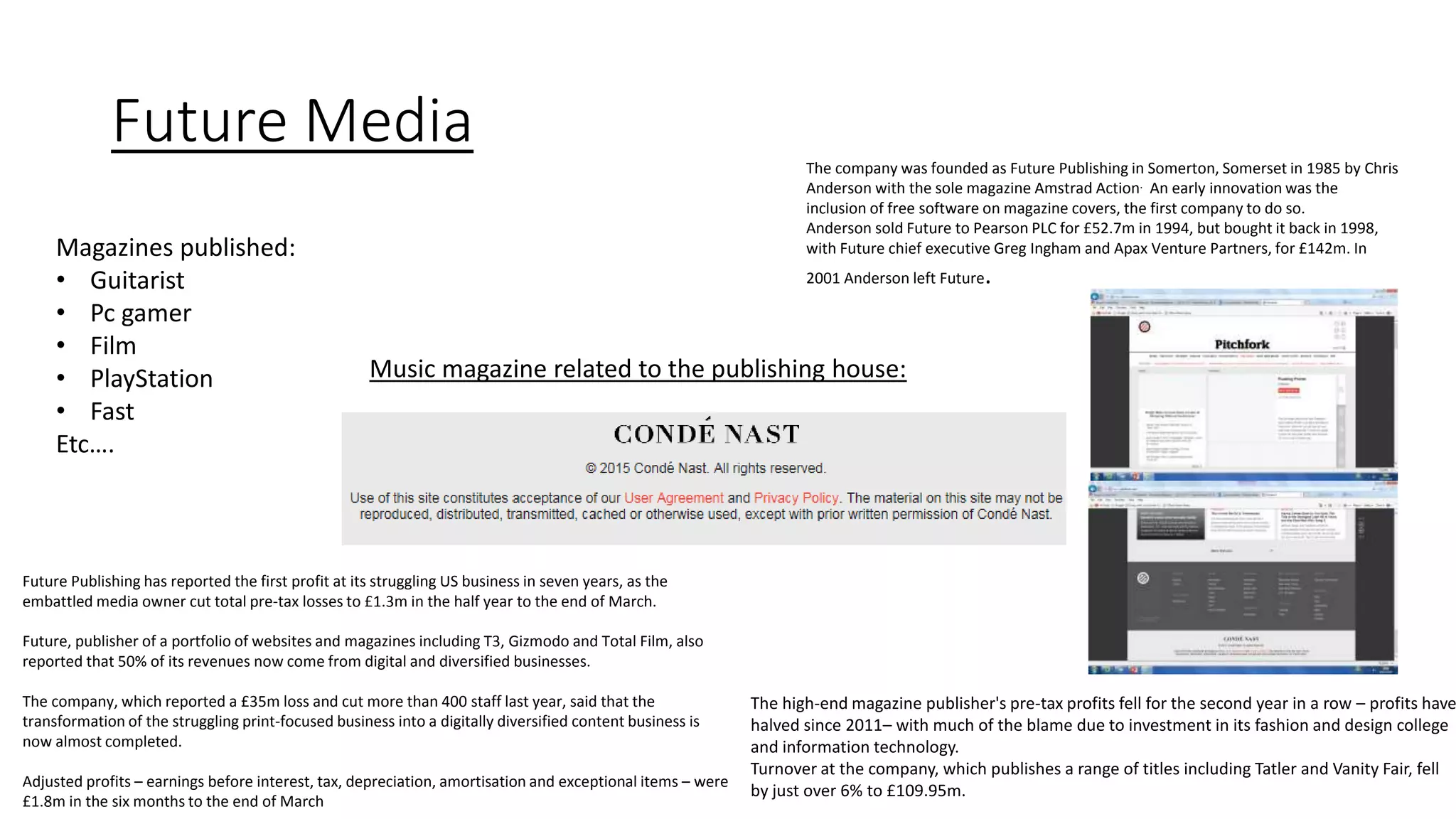
Music magazine related to the publishing house:

Lucas Sneddon Media mag research

  • 1.
    Magazine publishing houses. IPCMedia Magazines published: • NME • What’s on TV • Horse and hound • Golf monthly • Soaplife • Look • Now • Style at home • Chat • Cycling fitness And more… History: The International Publishing Corporation Ltd was formed in 1963 following the merger of the UK's three leading magazine publishers - George Newnes, Odhams Press and Fleetway Publications - who came together with the Mirror Group to form the International Publishing Corporation (IPC). Five years later IPC was created (1968) these 3 company's already had a lot of history after being founded in 1881, 1890 and 1880 respectively. IPC was acquired by Time Warner in 2001 and was renamed Time Inc. UK in 2014 after Time Inc. acquired the company in connection with its spinoff from Time Warner. IPC Media had a revenue of 6bn pounds as from September 2014 to September 2015. They recently sold their ‘Nuts magazine’ this shows that they want to be a more respectful company and do not support pornography. This would give the company a higher name in the industry. Other magazines produced by IPC Media have target audience’s like older males as they have editions such as ‘golf monthly’ and ‘cycling fitness’ but also accommodate for young female adults with things such as ‘chat’ and soap life’. Magazines such as ‘NME’ are for everyone as they cover a range of bands. Which all have a wide variety of fans. Magazines such as ‘style at home’ are for everyone from families to young couples and this magazine helps them with designs in their new homes. The mission statement for IPC Media is Iconic media brands. Content built on amazing relationships and inspired conversations with millions of consumers. General circulation figures: • What’s on TV: 1,253,697, magazines printed per year but has risen 0.3% since last year. • Chat: 374,730, magazines printed per year, dropped -9.7% in the last year. • Marie Claire: 266,881, magazines printed per year but has risen 0.7% in the last year. • NME: 15,384 printed per year but has risen 21.1% in the last year.
  • 2.
    Bauer Media Magazines published: •Kerrang • Take A Break • Tv Choice • Q • Women's weekly • Empire And more…. History: At the beginning of the 20th century, Bauer is one of the first companies ever to publish a free advertising paper in Germany: the Rothenburgsorter Zeitung. Today the Bauer Media Group is Europe's largest magazine publisher and a market leader with its titles, including the key markets of Australia, Great Britain, New Zealand, Poland and the USA. The company has a presence in a total of 20 countries. Since 2010 responsibility for the family company has been held by Yvonne Bauer, the fifth generation to lead the publishing corporation. She is driving the expansion of international business as well as the continued development of the magazines and digital business. General circulation figures: • Take a break: 791,001, magazines printed per year but has dropped -%5 since last year • Kerrang!: 42,077 magazines printed per year but has dropped -2.1% since last year. • TV Choice 1,404,382 magazines printed per year but has dropped -4.3% since last year. • Empire: 167,056 magazines printed per year but has dropped -3.2% since last year. Mission statement: The UK’s most influential media brand network
  • 3.
    Conde Nast Magazines published: •Vogue, • Glamour, • Wired, • House & garden, • Pitch fork, • Golf world , • Brides • And more… 55 million subscribers. History: The publishing house was founded by entrepreneur Condé Nast in 1909 in the United States. His first purchase was Vogue, a high-class fashion magazine at the time, an elegant compilation of beautiful verses and photos. Condé Nast inherited his high society vision from his French mother and it helped him get to know the target audience of his new magazine and its demands. As a result, Vogue became a raving success in the US. Conde Nast reports 15.5% in pre-tax profits. Condé Nast International is the international arm of the New-York based publishing company which produces many of the world's best known magazine brands, including Vogue, Glamour, Gentleman's Quarterly, Architectural Digest, Wired, House & Garden, Condé Nast Traveller, Tatler and Vanity Fair. With headquarters located in London, Condé Nast International publishes 126 magazines, close to 100 websites and more than 200 tablet and mobile apps. Conde Nast's Target Audiences: • Prestige Pioneer (prestige beauty buyer/first to try) • Big-Basket Beauty (mass beauty/volume buyer) • Right from the Runway (luxury fashion follower) • Eclectic Stylist (high/low fashion buyer) • Alpha-Millennial (young peer leaders) • Lovemark Mom (moms who buy brand names/not generics) • Motor Maven (luxury car experts/the source for their friends) • Shopping without Borders (global traveler) • Tech-thusiast (volume consumer electronics buyer) • On-The-Towners (leading-edge singles, large social network, love to socialize)
  • 4.
    Future Media Magazines published: •Guitarist • Pc gamer • Film • PlayStation • Fast Etc…. The company was founded as Future Publishing in Somerton, Somerset in 1985 by Chris Anderson with the sole magazine Amstrad Action. An early innovation was the inclusion of free software on magazine covers, the first company to do so. Anderson sold Future to Pearson PLC for £52.7m in 1994, but bought it back in 1998, with Future chief executive Greg Ingham and Apax Venture Partners, for £142m. In 2001 Anderson left Future. The high-end magazine publisher's pre-tax profits fell for the second year in a row – profits have halved since 2011– with much of the blame due to investment in its fashion and design college and information technology. Turnover at the company, which publishes a range of titles including Tatler and Vanity Fair, fell by just over 6% to £109.95m. Future Publishing has reported the first profit at its struggling US business in seven years, as the embattled media owner cut total pre-tax losses to £1.3m in the half year to the end of March. Future, publisher of a portfolio of websites and magazines including T3, Gizmodo and Total Film, also reported that 50% of its revenues now come from digital and diversified businesses. The company, which reported a £35m loss and cut more than 400 staff last year, said that the transformation of the struggling print-focused business into a digitally diversified content business is now almost completed. Adjusted profits – earnings before interest, tax, depreciation, amortisation and exceptional items – were £1.8m in the six months to the end of March Music magazine related to the publishing house: