Kahalu’u School
The bus takes a pit stop to
         refresh
Let’s check our systems

Professional development teams foster
collective responsibility for improved
student performance.”                               from Joellen Killion, Deputy Executive
Director, National Staff Development Council, Becoming a Learning School, Collaborative
Professional Learning Teams
Team’s must do’s
Align with rigorous state student academic achievement standards, related local and school improvement
goals.
Conduct among educators at the school, facilitated by well-prepared principals or school based coaches/
teacher leaders.
Engage teams several times per week in a continuous cycle of improvement.
   Define clear goals based on rigorous analysis of data
   Implement coherent, sustained, evidenced based learning strategies such as lesson study and the
   development of formative assessments, that improve instructional effectiveness and student
   achievement.
   Support the transfer of new knowledge and skills to the classrooms through coaching or other
   assistance.
   Regularly assess the effectiveness of the teams in achieving goals, improving teaching, assisting
   all students in meeting challenging state academic achievement standards.
Let’s Check the Map
       (are we getting close?)
Where are we now?
Where do we want to go?
How would we know we have arrived?
Tune up the bus!
For 2nd quarter, have a focus:
  Task - what is your team going to do?
  Roles - Who will be responsible for doing what?
  Timeline -When will you do it?
  Outcomes - What results do we want to achieve?
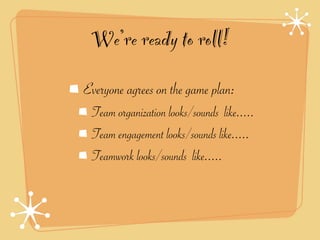
We’re ready to roll!
Everyone agrees on the game plan:
 Team organization looks/sounds like.....
 Team engagement looks/sounds like.....
 Teamwork looks/sounds like.....
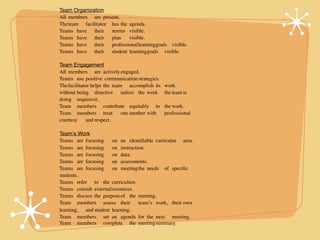
Team Organization
All
 members
 are
 present.
The
team
 facilitator
 has
the
 agenda.
Teams
 have
 their
 norms
 visible.
Teams
 have
 their
 plan
 visible.
Teams
 have
 their
 professional
learning
 oals
 visible.
                                          g
Teams
 have
 their
 student
 learning
 oals
 visible.
                                        g

Team Engagement
All
 members
 are
 actively
engaged.
Teams
 use
positive
 communication
strategies.
The
facilitator helps
the
 team
 accomplish
 its
   work
without
being
 directive
 unless
 the
 work
        the
team
is
doing
 requires
it.
Team
 members
 contribute
 equitably
 to
           the
work.
Team
 members
 treat
 one
another
with
             professional
courtesy
 and
respect.

Teamʼs Work
Teams
 are
 focusing
 on
 an
 identifiable
 curricular
 area.
Teams
 are
 focusing
 on
 instruction.
Teams
 are
 focusing
 on
 data.
Teams
 are
 focusing
 on
 assessments.
Teams
 are
 focusing
 on
 meeting
the
 needs
 of
 specific
students.
Teams
 refer
 to
 the
 curriculum.
Teams
 consult
 external
resources.
Teams
 discuss
 the
 purpose
of
 the
 meeting.
Team
 members
 assess
 their
 team’s
 work,
 their
own
learning,
 and
student
 learning.
Team
 members
 set
 an
 agenda
 for
 the
 next
 meeting.
Team
 members
 complete
 the
 meeting
summary.
The journey continues

Faculty

  • 1.
    Kahalu’u School The bustakes a pit stop to refresh
  • 2.
    Let’s check oursystems Professional development teams foster collective responsibility for improved student performance.” from Joellen Killion, Deputy Executive Director, National Staff Development Council, Becoming a Learning School, Collaborative Professional Learning Teams
  • 3.
    Team’s must do’s Alignwith rigorous state student academic achievement standards, related local and school improvement goals. Conduct among educators at the school, facilitated by well-prepared principals or school based coaches/ teacher leaders. Engage teams several times per week in a continuous cycle of improvement. Define clear goals based on rigorous analysis of data Implement coherent, sustained, evidenced based learning strategies such as lesson study and the development of formative assessments, that improve instructional effectiveness and student achievement. Support the transfer of new knowledge and skills to the classrooms through coaching or other assistance. Regularly assess the effectiveness of the teams in achieving goals, improving teaching, assisting all students in meeting challenging state academic achievement standards.
  • 4.
    Let’s Check theMap (are we getting close?) Where are we now? Where do we want to go? How would we know we have arrived?
  • 5.
    Tune up thebus! For 2nd quarter, have a focus: Task - what is your team going to do? Roles - Who will be responsible for doing what? Timeline -When will you do it? Outcomes - What results do we want to achieve?
  • 6.
    We’re ready toroll! Everyone agrees on the game plan: Team organization looks/sounds like..... Team engagement looks/sounds like..... Teamwork looks/sounds like.....
  • 7.
    Team Organization All members are present. The team facilitator has the agenda. Teams have their norms visible. Teams have their plan visible. Teams have their professional learning oals visible. g Teams have their student learning oals visible. g Team Engagement All members are actively engaged. Teams use positive communication strategies. The facilitator helps the team accomplish its work without being directive unless the work the team is doing requires it. Team members contribute equitably to the work. Team members treat one another with professional courtesy and respect. Teamʼs Work Teams are focusing on an identifiable curricular area. Teams are focusing on instruction. Teams are focusing on data. Teams are focusing on assessments. Teams are focusing on meeting the needs of specific students. Teams refer to the curriculum. Teams consult external resources. Teams discuss the purpose of the meeting. Team members assess their team’s work, their own learning, and student learning. Team members set an agenda for the next meeting. Team members complete the meeting summary.
  • 8.