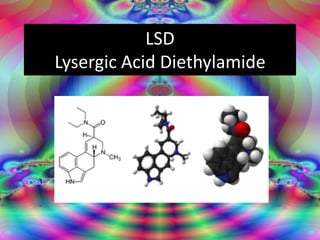
LSD
Lysergic Acid Diethylamide
What is LSD?
• A hallucinogenic manmade drug developed in
1938 by Swedish chemist Albert Hofmann
• Produces delusions and hallucinations that
distort the user’s sense of time and identity
• During 1940’s, it was used to treat 40,000
patients with mental illnesses (including
schizophrenia)
• “Turn On, Tune In, Drop Out” – Timothy Leary
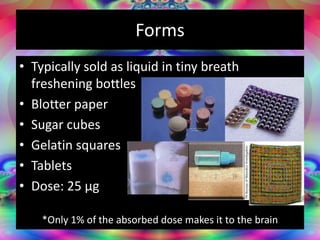
Forms
• Typically sold as liquid in tiny breath
freshening bottles
• Blotter paper
• Sugar cubes
• Gelatin squares
• Tablets
• Dose: 25 µg
*Only 1% of the absorbed dose makes it to the brain
Street Names
• Acid
• Boomers
• Yellow sunshine
• Lucy in the Sky with Diamonds
• Dots
• Looney Tunes
• Elvis
• Superman
• Zen
• Pane
• Doses
• Battery Acid
• Back Breaker
Effects
• The effects are unpredictable and depend upon
the amount taken, the surroundings in which the
drug is used, and the user's personality and
mood.
• LSD users may develop long-lasting psychoses,
such as schizophrenia or severe depression.
• Not considered addictive. However, LSD users
may develop tolerance to the drug.
• Believed to work similarly to serotonin
neurotransmitters
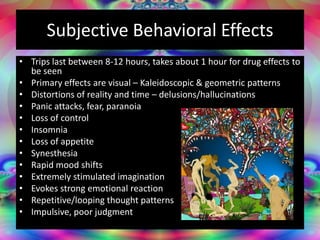
Subjective Behavioral Effects
• Trips last between 8-12 hours, takes about 1 hour for drug effects to
be seen
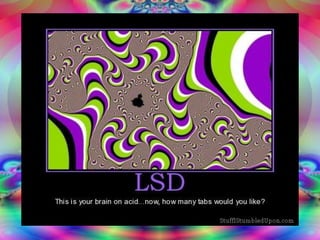
• Primary effects are visual – Kaleidoscopic & geometric patterns
• Distortions of reality and time – delusions/hallucinations
• Panic attacks, fear, paranoia
• Loss of control
• Insomnia
• Loss of appetite
• Synesthesia
• Rapid mood shifts
• Extremely stimulated imagination
• Evokes strong emotional reaction
• Repetitive/looping thought patterns
• Impulsive, poor judgment
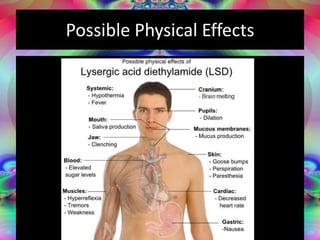
Possible Physical Effects
Worst Case Scenario: A Bad Trip
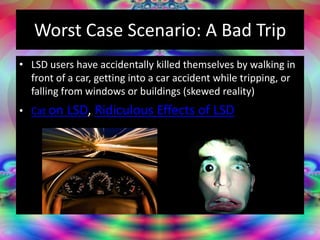
• LSD users have accidentally killed themselves by walking in
front of a car, getting into a car accident while tripping, or
falling from windows or buildings (skewed reality)
• Cat on LSD, Ridiculous Effects of LSD
Works Cited
http://www.justice.gov/ndic/pubs4/4260/index.htm
http://www.drugabuse.gov/drugs-abuse/lsd-acid

LSD: The Basics

  • 1.
  • 2.
    What is LSD? •A hallucinogenic manmade drug developed in 1938 by Swedish chemist Albert Hofmann • Produces delusions and hallucinations that distort the user’s sense of time and identity • During 1940’s, it was used to treat 40,000 patients with mental illnesses (including schizophrenia) • “Turn On, Tune In, Drop Out” – Timothy Leary
  • 3.
    Forms • Typically soldas liquid in tiny breath freshening bottles • Blotter paper • Sugar cubes • Gelatin squares • Tablets • Dose: 25 µg *Only 1% of the absorbed dose makes it to the brain
  • 4.
    Street Names • Acid •Boomers • Yellow sunshine • Lucy in the Sky with Diamonds • Dots • Looney Tunes • Elvis • Superman • Zen • Pane • Doses • Battery Acid • Back Breaker
  • 5.
    Effects • The effectsare unpredictable and depend upon the amount taken, the surroundings in which the drug is used, and the user's personality and mood. • LSD users may develop long-lasting psychoses, such as schizophrenia or severe depression. • Not considered addictive. However, LSD users may develop tolerance to the drug. • Believed to work similarly to serotonin neurotransmitters
  • 6.
    Subjective Behavioral Effects •Trips last between 8-12 hours, takes about 1 hour for drug effects to be seen • Primary effects are visual – Kaleidoscopic & geometric patterns • Distortions of reality and time – delusions/hallucinations • Panic attacks, fear, paranoia • Loss of control • Insomnia • Loss of appetite • Synesthesia • Rapid mood shifts • Extremely stimulated imagination • Evokes strong emotional reaction • Repetitive/looping thought patterns • Impulsive, poor judgment
  • 7.
  • 8.
    Worst Case Scenario:A Bad Trip • LSD users have accidentally killed themselves by walking in front of a car, getting into a car accident while tripping, or falling from windows or buildings (skewed reality) • Cat on LSD, Ridiculous Effects of LSD
  • 10.