



Substance Abuse and its Deadly Consequences Nick van Terheyden, MD
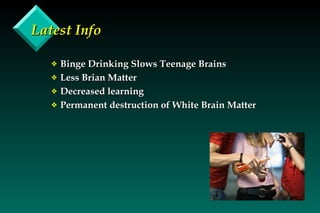
Latest Info Binge Drinking Slows Teenage Brains Less Brian Matter Decreased learning Permanent destruction of White Brain Matter
Drug Myths I am stronger than the drug I can control what others cannot Drugs make me more creative/social etc. Life is better stoned. Drugs do no permanent harm. What I do in my own time is my own business Doctors/counselors/authorities are liars. *** is  way  safer than alcohol. I know a guy/girl who’s been doing this for years and s/he’s  fine …
Drug Stats I The illegal drug industry ranks in size with Mobil Oil as the U.S. second largest business-only Exxon is larger. Drugs and alcohol cost taxpayers nearly $276 billion dollars a year in preventable health care costs, extra law enforcement, auto crashes, crime, and lost productivity.
Drug Stats II In 1999, an estimated 14.8 million Americans were current illicit drug users. There is an average of 1.5 million emergency room visits per year because of drug use. Five typical marijuana cigarettes have the same cancer-causing capability as 112 tobacco cigarettes.
Statistics America has only 5% of the world population but consumes 60% of ALL illegal drugs produced in the world Each year, a typical young person in the United States is inundated with more than 1,000 commercials for beer and wine coolers in addition to several thousand fictional drinking incidents on television.  Alcohol is involved in 50% of all driving fatalities. Almost half of Americans ages 12 and older reported being current drinkers of alcohol.  This translates into 105 million people. In the next 30 days, 17% of all 7 th  graders will use alcohol.  25% of all 9-12 th  graders will use enough to be defined as heavy drinkers. Every 40 minutes, a kid is arrested for drunk driving
Narcotics (Opioids) Heroin Morphine Codeine Hydrocodone Hydromorphone Oxycodone Methadone Meperidine Fentanyl Propoxyphene
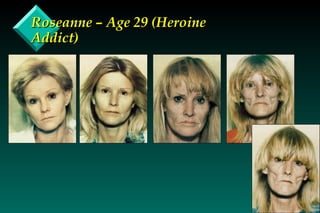
Roseanne – Age 29 (Heroine Addict)
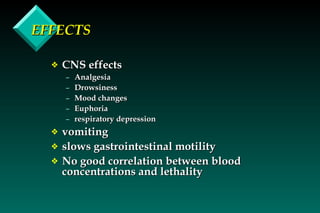
EFFECTS CNS effects Analgesia Drowsiness Mood changes Euphoria respiratory depression vomiting slows gastrointestinal motility No good correlation between blood concentrations and lethality
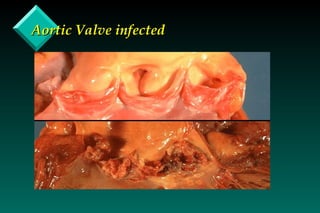
Aortic Valve infected
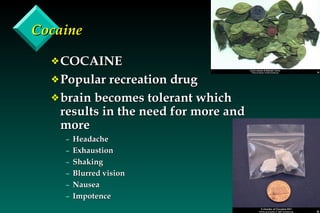
Cocaine COCAINE Popular recreation drug brain becomes tolerant which results in the need for more and more Headache Exhaustion Shaking Blurred vision Nausea Impotence
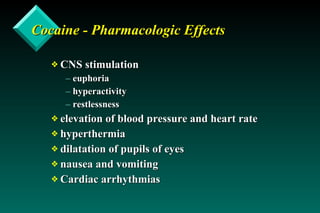
Cocaine - Pharmacologic Effects CNS stimulation euphoria hyperactivity restlessness elevation of blood pressure and heart rate hyperthermia dilatation of pupils of eyes nausea and vomiting Cardiac arrhythmias
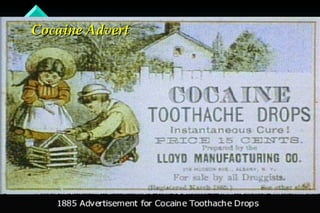
Cocaine Advert
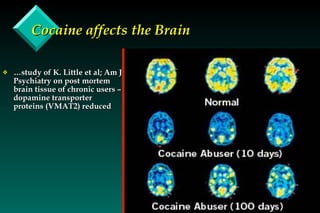
Cocaine affects the Brain … study of K. Little et al; Am J Psychiatry on post mortem brain tissue of chronic users – dopamine transporter proteins (VMAT2) reduced
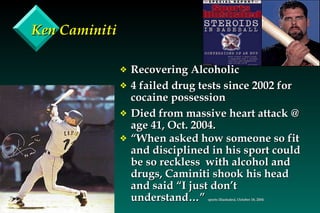
Ken Caminiti Recovering Alcoholic 4 failed drug tests since 2002 for cocaine possession Died from massive heart attack @ age 41, Oct. 2004. “ When asked how someone so fit and disciplined in his sport could be so reckless  with alcohol and drugs, Caminiti shook his head and said “I just don’t understand…”  sports illustrated, October 18, 2004
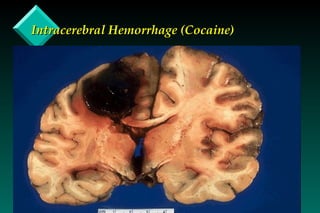
Intracerebral Hemorrhage (Cocaine)
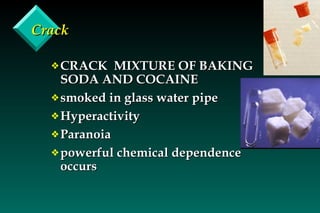
Crack CRACK  MIXTURE OF BAKING SODA AND COCAINE smoked in glass water pipe Hyperactivity Paranoia powerful chemical dependence occurs
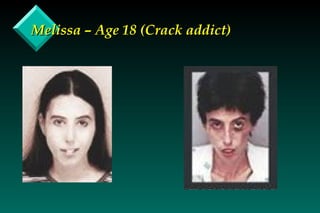
Melissa – Age 18 (Crack addict)
Psychedelics And Hallucinogens Peyote Mescaline LSD LYSERGIC ACID DIETHYLAMIDE “Trips” Trigger Panic, Depression, Confusion, Fear Of Insanity, Distorted Thoughts And Perceptions PCP Phencyclidine “Angel Dust”  Behaviorally Toxic -Psychotic Attacks Temporary Insanity
Lysergic Acid Diethylamide (LSD) The “High”:  Visual hallucinations Serious Risks:  Possible “flashbacks”; poor judgment leading to accidents (crashes, jumping off high places) Dilated pupils higher body temperature increased heart rate and blood pressure Sweating loss of appetite Sleeplessness dry mouth Tremors Numbness Weakness Trembling Nausea hallucinations
Phencyclidine - Pharmacologic Effects hallucinogen slurred speech staggering gait nystagmus hyperthermia increased heart rate and blood pressure hostile and bizarre behavior distorted sensory experience
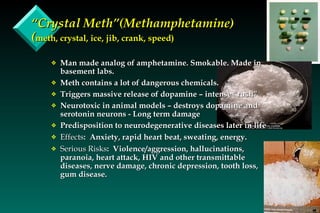
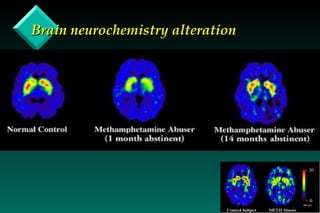
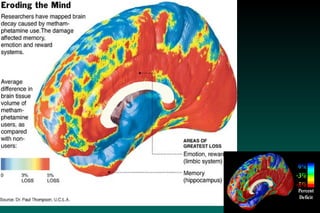
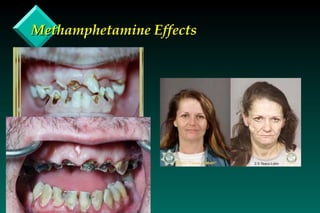
“ Crystal Meth”(Methamphetamine)  ( meth, crystal, ice, jib, crank, speed) Man made analog of amphetamine. Smokable. Made in basement labs. Meth contains a lot of dangerous chemicals. Triggers massive release of dopamine – intense “rush” Neurotoxic in animal models – destroys dopamine and serotonin neurons - Long term damage Predisposition to neurodegenerative diseases later in life Effects :  Anxiety, rapid heart beat, sweating, energy. Serious Risks :  Violence/aggression, hallucinations, paranoia, heart attack, HIV and other transmittable diseases, nerve damage, chronic depression, tooth loss, gum disease.
Brain neurochemistry alteration
Eroding the Mind
Methamphetamine Effects
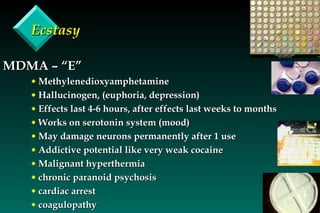
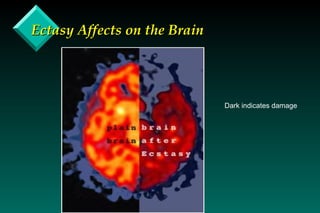
Ecstasy MDMA – “E” Methylenedioxyamphetamine Hallucinogen, (euphoria, depression) Effects last 4-6 hours, after effects last weeks to months Works on serotonin system (mood) May damage neurons permanently after 1 use Addictive potential like very weak cocaine Malignant hyperthermia chronic paranoid psychosis cardiac arrest coagulopathy
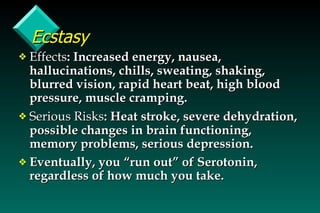
Ecstasy Effects : Increased energy, nausea, hallucinations, chills, sweating, shaking, blurred vision, rapid heart beat, high blood pressure, muscle cramping. Serious Risks : Heat stroke, severe dehydration, possible changes in brain functioning, memory problems, serious depression. Eventually, you “run out” of Serotonin, regardless of how much you take.
Ectasy Affects on the Brain Dark indicates damage
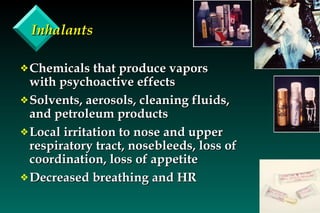
Inhalants Chemicals that produce vapors with psychoactive effects Solvents, aerosols, cleaning fluids, and petroleum products Local irritation to nose and upper respiratory tract, nosebleeds, loss of coordination, loss of appetite  Decreased breathing and HR
Inhalants Effects : Nausea Sneezing Fatigue Coughing nose bleeds rapid pulse Headaches involuntary release urination or feces impaired judgment Serious Risks: Violent behavior loss of consciousness loss of feeling in hands and feet Kidney damage brain damage loss of smell Loss of hearing Loss of memory Loss of bone marrow hepatitis
Drug Abuse Related Toxicity HIV (Human Immunodeficiency Virus) infection AIDS (Acquired Immunodeficiency Syndrome) In large cities perhaps 40-50% of IV drug users test positive for HIV. Sharing of needles and syringes is primarily responsible. Hepatitis B - Another blood-borne disease responsible for 100s of deaths in IV drug abusers
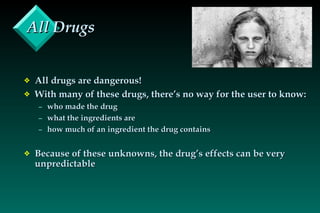
All Drugs All drugs are dangerous! With many of these drugs, there’s no way for the user to know: who made the drug what the ingredients are how much of an ingredient the drug contains Because of these unknowns, the drug’s effects can be very unpredictable
Alcohol
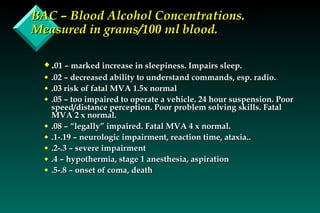
BAC – Blood Alcohol Concentrations. Measured in grams/100 ml blood. . 01 – marked increase in sleepiness. Impairs sleep. .02 – decreased ability to understand commands, esp. radio. .03 risk of fatal MVA 1.5x normal .05 – too impaired to operate a vehicle. 24 hour suspension. Poor speed/distance perception. Poor problem solving skills. Fatal MVA 2 x normal. .08 – “legally” impaired. Fatal MVA 4 x normal. .1-.19 – neurologic impairment, reaction time, ataxia.. .2-.3 – severe impairment .4 – hypothermia, stage 1 anesthesia, aspiration .5-.8 – onset of coma, death
Limits
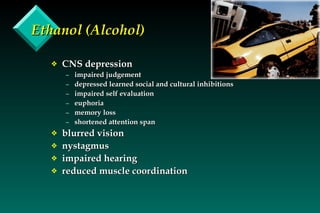
Ethanol (Alcohol) CNS depression impaired judgement depressed learned social and cultural inhibitions impaired self evaluation euphoria memory loss  shortened attention span blurred vision nystagmus impaired hearing reduced muscle coordination
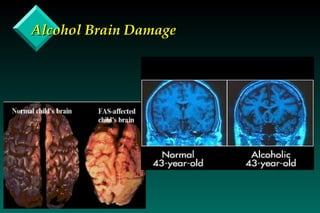
Alcohol Brain Damage
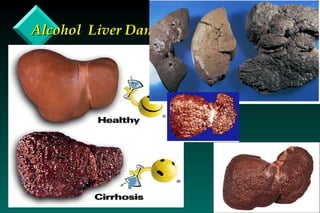
Alcohol  Liver Damage
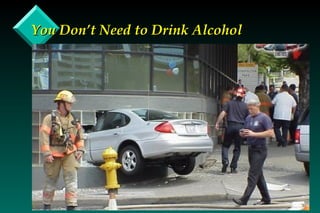
You Don’t Need to Drink Alcohol
Drinking/Drugs and Driving
Jacqueline Saburido
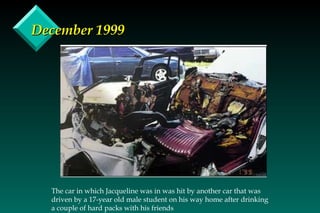
December 1999 The car in which Jacqueline was in was hit by another car that was driven by a 17-year old male student on his way home after drinking a couple of hard packs with his friends
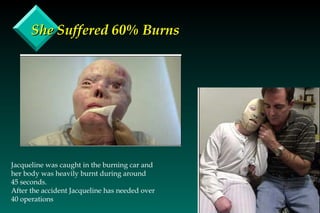
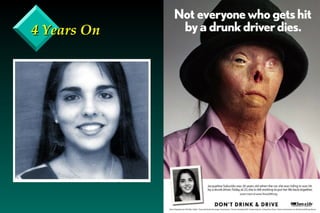
She Suffered 60% Burns Jacqueline was caught in the burning car and her body was heavily burnt during around 45 seconds.  After the accident Jacqueline has needed over 40 operations
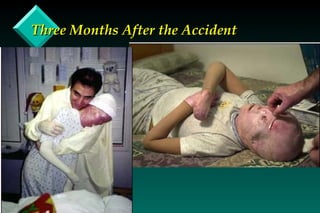
Three Months After the Accident
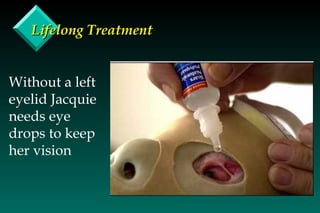
Lifelong Treatment Without a left eyelid Jacquie needs eye drops to keep her vision
4 Years On
Tobacco
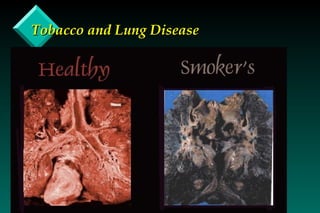
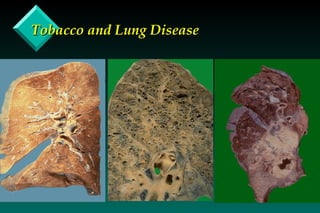
Tobacco and Lung Disease
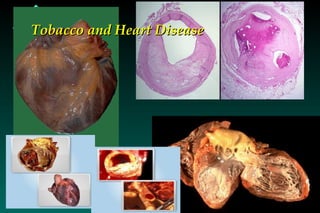
Tobacco and Heart Disease
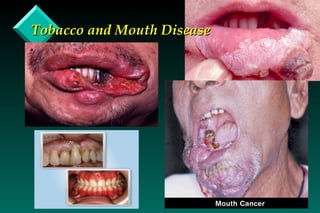
Tobacco and Mouth Disease
Marijuana
Marihuana EFFECTS euphoria sleepiness impaired short-term memory impaired balance altered time perception impaired multi-tasking Hashish extract of cannabis 2 to 10 times more potent than marijuana
Thank You Questions?

2009 05 30 Substance Abuse And Its Deadly Consequences

  • 1.
    Substance Abuse andits Deadly Consequences Nick van Terheyden, MD
  • 2.
    Latest Info BingeDrinking Slows Teenage Brains Less Brian Matter Decreased learning Permanent destruction of White Brain Matter
  • 3.
    Drug Myths Iam stronger than the drug I can control what others cannot Drugs make me more creative/social etc. Life is better stoned. Drugs do no permanent harm. What I do in my own time is my own business Doctors/counselors/authorities are liars. *** is way safer than alcohol. I know a guy/girl who’s been doing this for years and s/he’s fine …
  • 4.
    Drug Stats IThe illegal drug industry ranks in size with Mobil Oil as the U.S. second largest business-only Exxon is larger. Drugs and alcohol cost taxpayers nearly $276 billion dollars a year in preventable health care costs, extra law enforcement, auto crashes, crime, and lost productivity.
  • 5.
    Drug Stats IIIn 1999, an estimated 14.8 million Americans were current illicit drug users. There is an average of 1.5 million emergency room visits per year because of drug use. Five typical marijuana cigarettes have the same cancer-causing capability as 112 tobacco cigarettes.
  • 6.
    Statistics America hasonly 5% of the world population but consumes 60% of ALL illegal drugs produced in the world Each year, a typical young person in the United States is inundated with more than 1,000 commercials for beer and wine coolers in addition to several thousand fictional drinking incidents on television. Alcohol is involved in 50% of all driving fatalities. Almost half of Americans ages 12 and older reported being current drinkers of alcohol. This translates into 105 million people. In the next 30 days, 17% of all 7 th graders will use alcohol. 25% of all 9-12 th graders will use enough to be defined as heavy drinkers. Every 40 minutes, a kid is arrested for drunk driving
  • 7.
    Narcotics (Opioids) HeroinMorphine Codeine Hydrocodone Hydromorphone Oxycodone Methadone Meperidine Fentanyl Propoxyphene
  • 8.
    Roseanne – Age29 (Heroine Addict)
  • 9.
    EFFECTS CNS effectsAnalgesia Drowsiness Mood changes Euphoria respiratory depression vomiting slows gastrointestinal motility No good correlation between blood concentrations and lethality
  • 10.
  • 11.
    Cocaine COCAINE Popularrecreation drug brain becomes tolerant which results in the need for more and more Headache Exhaustion Shaking Blurred vision Nausea Impotence
  • 12.
    Cocaine - PharmacologicEffects CNS stimulation euphoria hyperactivity restlessness elevation of blood pressure and heart rate hyperthermia dilatation of pupils of eyes nausea and vomiting Cardiac arrhythmias
  • 13.
  • 14.
    Cocaine affects theBrain … study of K. Little et al; Am J Psychiatry on post mortem brain tissue of chronic users – dopamine transporter proteins (VMAT2) reduced
  • 15.
    Ken Caminiti RecoveringAlcoholic 4 failed drug tests since 2002 for cocaine possession Died from massive heart attack @ age 41, Oct. 2004. “ When asked how someone so fit and disciplined in his sport could be so reckless with alcohol and drugs, Caminiti shook his head and said “I just don’t understand…” sports illustrated, October 18, 2004
  • 16.
  • 17.
    Crack CRACK MIXTURE OF BAKING SODA AND COCAINE smoked in glass water pipe Hyperactivity Paranoia powerful chemical dependence occurs
  • 18.
    Melissa – Age18 (Crack addict)
  • 19.
    Psychedelics And HallucinogensPeyote Mescaline LSD LYSERGIC ACID DIETHYLAMIDE “Trips” Trigger Panic, Depression, Confusion, Fear Of Insanity, Distorted Thoughts And Perceptions PCP Phencyclidine “Angel Dust” Behaviorally Toxic -Psychotic Attacks Temporary Insanity
  • 20.
    Lysergic Acid Diethylamide(LSD) The “High”: Visual hallucinations Serious Risks: Possible “flashbacks”; poor judgment leading to accidents (crashes, jumping off high places) Dilated pupils higher body temperature increased heart rate and blood pressure Sweating loss of appetite Sleeplessness dry mouth Tremors Numbness Weakness Trembling Nausea hallucinations
  • 21.
    Phencyclidine - PharmacologicEffects hallucinogen slurred speech staggering gait nystagmus hyperthermia increased heart rate and blood pressure hostile and bizarre behavior distorted sensory experience
  • 22.
    “ Crystal Meth”(Methamphetamine) ( meth, crystal, ice, jib, crank, speed) Man made analog of amphetamine. Smokable. Made in basement labs. Meth contains a lot of dangerous chemicals. Triggers massive release of dopamine – intense “rush” Neurotoxic in animal models – destroys dopamine and serotonin neurons - Long term damage Predisposition to neurodegenerative diseases later in life Effects : Anxiety, rapid heart beat, sweating, energy. Serious Risks : Violence/aggression, hallucinations, paranoia, heart attack, HIV and other transmittable diseases, nerve damage, chronic depression, tooth loss, gum disease.
  • 23.
  • 24.
  • 25.
  • 26.
    Ecstasy MDMA –“E” Methylenedioxyamphetamine Hallucinogen, (euphoria, depression) Effects last 4-6 hours, after effects last weeks to months Works on serotonin system (mood) May damage neurons permanently after 1 use Addictive potential like very weak cocaine Malignant hyperthermia chronic paranoid psychosis cardiac arrest coagulopathy
  • 27.
    Ecstasy Effects :Increased energy, nausea, hallucinations, chills, sweating, shaking, blurred vision, rapid heart beat, high blood pressure, muscle cramping. Serious Risks : Heat stroke, severe dehydration, possible changes in brain functioning, memory problems, serious depression. Eventually, you “run out” of Serotonin, regardless of how much you take.
  • 28.
    Ectasy Affects onthe Brain Dark indicates damage
  • 29.
    Inhalants Chemicals thatproduce vapors with psychoactive effects Solvents, aerosols, cleaning fluids, and petroleum products Local irritation to nose and upper respiratory tract, nosebleeds, loss of coordination, loss of appetite Decreased breathing and HR
  • 30.
    Inhalants Effects :Nausea Sneezing Fatigue Coughing nose bleeds rapid pulse Headaches involuntary release urination or feces impaired judgment Serious Risks: Violent behavior loss of consciousness loss of feeling in hands and feet Kidney damage brain damage loss of smell Loss of hearing Loss of memory Loss of bone marrow hepatitis
  • 31.
    Drug Abuse RelatedToxicity HIV (Human Immunodeficiency Virus) infection AIDS (Acquired Immunodeficiency Syndrome) In large cities perhaps 40-50% of IV drug users test positive for HIV. Sharing of needles and syringes is primarily responsible. Hepatitis B - Another blood-borne disease responsible for 100s of deaths in IV drug abusers
  • 32.
    All Drugs Alldrugs are dangerous! With many of these drugs, there’s no way for the user to know: who made the drug what the ingredients are how much of an ingredient the drug contains Because of these unknowns, the drug’s effects can be very unpredictable
  • 33.
  • 34.
    BAC – BloodAlcohol Concentrations. Measured in grams/100 ml blood. . 01 – marked increase in sleepiness. Impairs sleep. .02 – decreased ability to understand commands, esp. radio. .03 risk of fatal MVA 1.5x normal .05 – too impaired to operate a vehicle. 24 hour suspension. Poor speed/distance perception. Poor problem solving skills. Fatal MVA 2 x normal. .08 – “legally” impaired. Fatal MVA 4 x normal. .1-.19 – neurologic impairment, reaction time, ataxia.. .2-.3 – severe impairment .4 – hypothermia, stage 1 anesthesia, aspiration .5-.8 – onset of coma, death
  • 35.
  • 36.
    Ethanol (Alcohol) CNSdepression impaired judgement depressed learned social and cultural inhibitions impaired self evaluation euphoria memory loss shortened attention span blurred vision nystagmus impaired hearing reduced muscle coordination
  • 37.
  • 38.
  • 39.
    You Don’t Needto Drink Alcohol
  • 40.
  • 41.
  • 42.
    December 1999 Thecar in which Jacqueline was in was hit by another car that was driven by a 17-year old male student on his way home after drinking a couple of hard packs with his friends
  • 43.
    She Suffered 60%Burns Jacqueline was caught in the burning car and her body was heavily burnt during around 45 seconds. After the accident Jacqueline has needed over 40 operations
  • 44.
    Three Months Afterthe Accident
  • 45.
    Lifelong Treatment Withouta left eyelid Jacquie needs eye drops to keep her vision
  • 46.
  • 47.
  • 48.
  • 49.
  • 50.
  • 51.
  • 52.
  • 53.
    Marihuana EFFECTS euphoriasleepiness impaired short-term memory impaired balance altered time perception impaired multi-tasking Hashish extract of cannabis 2 to 10 times more potent than marijuana
  • 54.