Preserving Eyesight
Vector image designed by freepik.com
1 2 3 4 5click a topic to start
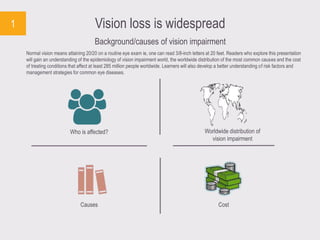
1 Vision loss is widespread
Background/causes of vision impairment
Normal vision means attaining 20/20 on a routine eye exam ie, one can read 3/8-inch letters at 20 feet. Readers who explore this presentation
will gain an understanding of the epidemiology of vision impairment world, the worldwide distribution of the most common causes and the cost
of treating conditions that affect at least 285 million people worldwide. Learners will also develop a better understanding of risk factors and
management strategies for common eye diseases.
Who is affected?
Causes
Worldwide distribution of
vision impairment
Cost
Vision loss is widespread
Who is affected?
1
~285 million people worldwide
cannot pass a routine eye exam
Sight problems range from normal to moderate or severe visual impairment. Thirty-
nine million people are blind and ~90% of visually impaired people live in low-
income settings. Nearly two-thirds of visually impaired (65%) and 82% of blind
people are over the age of 50, although this group comprises only 20% of the
world’s population. Moreover, the preventable causes of the global visual
impairment burden are as high as 80%.
Vision loss is widespread
1990–2010 data*
1
Cataracts, uncorrected refractive errors,
and macular degeneration widespread
In 2010, higher proportions of blindness or moderate and severe vision impairments
(MSVI) were caused by cataracts and macular degeneration in women than men.
Uncorrected refractive errors
caused a larger proportion of MSVI in South Asia than other regions (65.4% vs.
43,2% ─ 48.1%). However, macular degeneration in South Asia was low,
compared to regions with older populations (2.6% compared with >15% of
blindness attributed to macular degeneration in Central and Eastern Europe).
Lowest and highest glaucoma rates were seen in east sub-Saharan Africa and
tropical Latin America, respectively (4.0% vs. 15.5%).
*lack of epidemiological data in countries with trachoma may affect data.
Causes
Uncorrected refractive errors, cataracts, age-related macular degeneration,
diabetic retinopathy, and eye cancer
1
Major causes of vision problems range
from treatable to lethal diseases
Uncorrected refractive errors, cataracts, and glaucoma are the major causes of
visual impairments. ii. Cataracts, glaucoma and age-related macular
degeneration are the major causes of blindness. Diabetic retinopathy (DR), a key
microvascular complication of diabetes mellitus, is also a major cause of visual
impairment in 20- to 74-year-old adults. Eye cancer, whether occurring as primary
tumors in the immune-privileged eye, or as secondary diseases that started
somewhere else and spread to the eye, is an umbrella term for a group of rare
diseases that can also cause vision impairment.
Cost
The high costs of low or no vision worldwide
1
At $139 billion in 2013, vision
impairments are costly to the USA
Direct costs equal $66.8 billion ie, medical costs for diagnosing
eye disorders/low vision, medical vision aids, vision assistive devices and
adaptations, and direct services including special education and assistance
programs. Indirect costs of $72.2 billion
capture the burden of consequences of low vision, including productivity losses,
long-term care, informal care, and the costs of transfer and entitlement programs.
Overview of vision impairments2
image
placeholder
image
placeholder
Refractive errorsCataracts Glaucoma
Age-related
macular
degeneration
Diabetic
Retinopathy
Eye cancers
3 Age-related eye diseases
Background/causes of vision impairment
Vision changes are a normal part of the aging process. The National Eye Institute recommends a dilated eye exam for anyone at or over the
age of 50. In addition to low vision and dry eyes, older adults may be affected by two forms of age-related macular degeneration (AMD), suffer
clouding of lenses known as cataracts, or may be affected by a secondary complication of diabetes mellitus known as diabetic eye diseases.
Diabetic retinopathy is the most common diabetic eye disease and the leading cause of vision impairment and blindness among working-age
adults in the USA.
Dry AMD
Cataracts
Wet AMD
Diabetic retinopathy
3 Dry AMD
Background/causes of vision impairment
Dry AMD (also called non-neovascular or non-exudative AMD) is characterized by progressive thinning and loss of function of layers of the
macula (including the photoreceptors and the retinal pigment epithelium) . The color of the macular changes and tiny piles of cellular
debris called drusen appears on the retina.
Description
AMD is more common among whites and is the leading
cause of permanent vision loss in the elderly. Dry or
atrophic AMD lowers the central vision and can affect the
preception of color. Although not as severe as the wet
form of the disease, dry AMD can lead to profound vision
loss over time. More information can be found at amd.org
Merck Professional Manual: “Funduscopic changes in
dry AMD include drusen, areas of chorioretinal atrophy,
and changes to the retinal pigment epithelium”
3 Wet AMD
Background/causes of vision impairment
Wet AMD (also called neovascular AMD or exudative AMD) is characterized by choroidal neovascularization. Fluid, lipids, and blood from the
new, weaker vessels may leak into the retina (including layers of the macula)- resulting retinal scarring and reduced function
Description
While most people have the dry version of the disease, up
to 90% of severe vision loss is due to the wet type.
Merck Professional Manual:” Funduscopic changes in
wet AMD include retinal edema and localized
elevation, detachment of the retinal pigment
epithelium, a gray-green discoloration under the
macula, and exudates in and around the macula.”
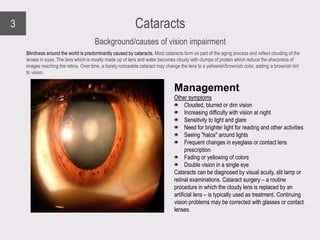
3 Cataracts
Background/causes of vision impairment
Blindness around the world is predominantly caused by cataracts. Most cataracts form as part of the aging process and reflect clouding of the
lenses in eyes. The lens which is mostly made up of lens and water becomes cloudy with clumps of protein which reduce the sharpness of
images reaching the retina. Over time, a barely noticeable cataract may change the lens to a yellowish/brownish color, adding a brownish tint
to vision.
Management
Other symptoms
Clouded, blurred or dim vision
Increasing difficulty with vision at night
Sensitivity to light and glare
Need for brighter light for reading and other activities
Seeing "halos" around lights
Frequent changes in eyeglass or contact lens
prescription
Fading or yellowing of colors
Double vision in a single eye
Cataracts can be diagnosed by visual acuity, slit lamp or
retinal examinations. Cataract surgery – a routine
procedure in which the cloudy lens is replaced by an
artificial lens – is typically used as treatment. Continuing
vision problems may be corrected with glasses or contact
lenses.
3 Diabetic Retinopathy (DR)
Background/causes of vision impairment
DR can cause cause blood vessels in the retina to leak fluid or hemorrhage (bleed), distorting vision. In its most advanced stage, new
abnormal blood vessels proliferate (increase in number) on the surface of the retina, which can lead to scarring and cell loss in the retina.
Asymptomatic patients may experience vision fluctuations related to blood glucose levels or as a symptom of cataracts, while symptomatic
patients may have gradual or acute vision loss, depending on the nature of the underlying changes eg, macular edema/vitreous hemorrhage
Diagnosis
Symptoms
• Mild or moderate nonproliferaive DR (NPDR)
symptoms may include microaneurysms, intraretinal
hemorrhage, cotton wool spots and lipid exudates
• Symptoms may be more severe in severe NDPR
• NPDR may progress to proliferative DR (PDR)
Strong risk factors include young-onset diabetes, longer
duration of diabetes, poor glycemic control, hypertension,
renal disease
Change from the first photograph of the fundus; Change
from the first scan by optical coherence tomography
scanning; Fluorescein angiography or B scan
ultrasonography may also be used as tests.
3 Diabetic Retinopathy (DR)
Treatment Approach
Hypertensive and glycemic control are key priorities in order to stem vision sight-threatening loss. Once symptoms of DR are present,
ophthalmic treatment should include macular laser therapy, intravitreal therapy, pan-retinal photocoagulation, vitrectomy surgery, or
combinations of these treatments.
Treatment
Current
For non-severe NPDR, prescribed treatments may be
intravitreal anti-VEGF therapy ± macular laser therapy;
Non-high-risk NPDR or severe PDR may be treated with
intravitreal anti-VEGF therapy ± macular laser therapy ±
pan-retinal photocoagulation or pan-retinal
photocoagulation may be considered as 1st line treatment;
High risk PDR with iris neovascularization may require
urgent pan-retinal photocoagulation as a single treatment
or in combination with intravitreal anti-VEGF therapy and
macular laser therapy; A vitrectomy may be prescribed for
severe PDR.
Very common and rare vision impairments
Uncorrected refractive errors/eye cancer
4
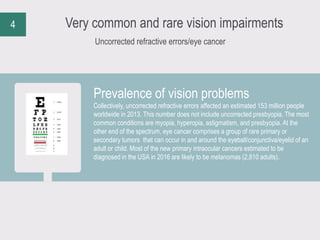
Prevalence of vision problems
Collectively, uncorrected refractive errors affected an estimated 153 million people
worldwide in 2013. This number does not include uncorrected presbyopia. The most
common conditions are myopia, hyperopia, astigmatism, and presbyopia. At the
other end of the spectrum, eye cancer comprises a group of rare primary or
secondary tumors that can occur in and around the eyeball/conjunctiva/eyelid of an
adult or child. Most of the new primary intraocular cancers estimated to be
diagnosed in the USA in 2016 are likely to be melanomas (2,810 adults).
Uncorrected refractive errors (REs)
~$268.8 billion US dollars lost per year in lost productivity (2014 estimate)
4
Most common uncorrected REs
REs occur when the shape of the eye stops light from focusing on the retina.
Changes in the shape of cornea, length of the eyeball, genetics or aging can lead to
REs. The most common types of refractive errors are myopia, hyperopia,
astigmatism, and presbyopia. Some of the diagnostic tests include visual acuity and
peripheral vision assessments. Typically, vision can be corrected with glasses,
contact lenses or refractive surgery.
Uncorrected REs
Diagnosis
4
c
Get the facts on tests
Doctors determine how near or far you can see by looking at letters and symbols of
different sizes on an eye chart eg, a Snellen chart. Refraction tests are done to
determine levels of near- or far-sightedness in order to determine the correct
prescription for glasses or contact lenses. Gaps in peripheral vision are assessed
with visual field tests. Some people with retinal or optic nerve damage may be color
bling and this condition can be determined with color vision tests
Uncorrected REs
Management
4
Treatment options
Generally, refractive errors can be corrected with glasses, contact lenses or
refractive surgeries (eg, LASIK). For instance, early contact lens and spectacle
interventions can reduce the rate of progression of myopia and these non-
pharmacological interventions are also able to significantly reduce the burden of
myopia. Additionally, pharmacotherapies that cause changes in the sclera show
promising efficacies. Laser in situ keratomileusis (LASIK) is one of the lens-based
procedures that can be considered by appropriate patients.
Eye cancer
Tumor types
4
c
The most common primary intraocular
cancer in adults is melanoma
Eye cancer, whether occurring as primary tumors in the immune-privileged eye, or
as secondary diseases that started somewhere else and spread to the eye, is an
umbrella term for a group of rare diseases that can also cause vision impairment.
Primary intraocular lymphoma, a type of non-Hodgkin lymphoma, can also occur in
adults. Cancers of the orbit and adnexa can develop from tissues such as muscle,
nerve, and skin around the eyeball. In children, the most common primary
intraocular cancer is retinoblastoma
Eye cancer
Spread and lethality of eye cancer in the USA
4
Eye cancer is rare and can be lethal
2,810 new cancers (mainly melanomas) of the eye and orbit
280 deaths from cancers of the eye and orbit: 150 in men and 130 in women
3 out of 4 people with eye melanoma survive for at least 5 years
For localized disease, the 5-year relative survival rate is about 80%
For tumors that have spread beyond the eye, the 5-year relative survival rate is
about 15%
Eye cancer
Diagnosis of choroidal melanoma (CM)
4
Whites of Northern Europeans prone
to CM
CM is the most common primary malignant intraocular tumor and the second most
common type of primary malignant melanoma. After excluding other causes, a
differential diagnosis can be made based on choroidal detachment,
intraocular foreign body, chronic angle closure glaucoma
glaucoma, hyphema, neovascular glaucoma, cavernous hemangioma, vitreous
hemorrhage, hyphema, ciliary body melanoma, conjunctival melanoma, and iris
melanoma.
Eye cancer
Most common primary ocular tumor: Melanoma
4
Management in Adults
Depending on the site and spread of the disease, doctors may suggest radiation
treatment, surgery, thermotherapy or intraocular injections. Metastatic disease may
be managed with liver-directed treatment options, radiation, and ablation. Systemic
therapies such as targeted, chemo-, and immunotherapies are also treatment
options for appropriate patients.
5 Saving vision through prevention
Global Action Plan
It remains a shocking fact that 80% of visual impairments could have been prevented or treated. The International Agency for the Prevention
of Blindness (IAPB) has proposed a WHO-endorsed global action plan for preventing blindness (see Figure). This plan forms part of VISION
2020: The Right to Sight. The long-term goal of VISION 2020 and other international plans are to rid the world of avoidable blindness and
visual impairment.
Credits
• Articulate E-learning for the template
• Wikimedia and freepik.com for images
• In addition to the Merck Professional Manual, the
IAPB (see Prevention Infographic)and the Mayo
Clinic, some of the key sources are listed in the pdf.

Preserving Eyesight

  • 1.
    Preserving Eyesight Vector imagedesigned by freepik.com 1 2 3 4 5click a topic to start
  • 2.
    1 Vision lossis widespread Background/causes of vision impairment Normal vision means attaining 20/20 on a routine eye exam ie, one can read 3/8-inch letters at 20 feet. Readers who explore this presentation will gain an understanding of the epidemiology of vision impairment world, the worldwide distribution of the most common causes and the cost of treating conditions that affect at least 285 million people worldwide. Learners will also develop a better understanding of risk factors and management strategies for common eye diseases. Who is affected? Causes Worldwide distribution of vision impairment Cost
  • 3.
    Vision loss iswidespread Who is affected? 1 ~285 million people worldwide cannot pass a routine eye exam Sight problems range from normal to moderate or severe visual impairment. Thirty- nine million people are blind and ~90% of visually impaired people live in low- income settings. Nearly two-thirds of visually impaired (65%) and 82% of blind people are over the age of 50, although this group comprises only 20% of the world’s population. Moreover, the preventable causes of the global visual impairment burden are as high as 80%.
  • 4.
    Vision loss iswidespread 1990–2010 data* 1 Cataracts, uncorrected refractive errors, and macular degeneration widespread In 2010, higher proportions of blindness or moderate and severe vision impairments (MSVI) were caused by cataracts and macular degeneration in women than men. Uncorrected refractive errors caused a larger proportion of MSVI in South Asia than other regions (65.4% vs. 43,2% ─ 48.1%). However, macular degeneration in South Asia was low, compared to regions with older populations (2.6% compared with >15% of blindness attributed to macular degeneration in Central and Eastern Europe). Lowest and highest glaucoma rates were seen in east sub-Saharan Africa and tropical Latin America, respectively (4.0% vs. 15.5%). *lack of epidemiological data in countries with trachoma may affect data.
  • 5.
    Causes Uncorrected refractive errors,cataracts, age-related macular degeneration, diabetic retinopathy, and eye cancer 1 Major causes of vision problems range from treatable to lethal diseases Uncorrected refractive errors, cataracts, and glaucoma are the major causes of visual impairments. ii. Cataracts, glaucoma and age-related macular degeneration are the major causes of blindness. Diabetic retinopathy (DR), a key microvascular complication of diabetes mellitus, is also a major cause of visual impairment in 20- to 74-year-old adults. Eye cancer, whether occurring as primary tumors in the immune-privileged eye, or as secondary diseases that started somewhere else and spread to the eye, is an umbrella term for a group of rare diseases that can also cause vision impairment.
  • 6.
    Cost The high costsof low or no vision worldwide 1 At $139 billion in 2013, vision impairments are costly to the USA Direct costs equal $66.8 billion ie, medical costs for diagnosing eye disorders/low vision, medical vision aids, vision assistive devices and adaptations, and direct services including special education and assistance programs. Indirect costs of $72.2 billion capture the burden of consequences of low vision, including productivity losses, long-term care, informal care, and the costs of transfer and entitlement programs.
  • 7.
    Overview of visionimpairments2 image placeholder image placeholder Refractive errorsCataracts Glaucoma Age-related macular degeneration Diabetic Retinopathy Eye cancers
  • 8.
    3 Age-related eyediseases Background/causes of vision impairment Vision changes are a normal part of the aging process. The National Eye Institute recommends a dilated eye exam for anyone at or over the age of 50. In addition to low vision and dry eyes, older adults may be affected by two forms of age-related macular degeneration (AMD), suffer clouding of lenses known as cataracts, or may be affected by a secondary complication of diabetes mellitus known as diabetic eye diseases. Diabetic retinopathy is the most common diabetic eye disease and the leading cause of vision impairment and blindness among working-age adults in the USA. Dry AMD Cataracts Wet AMD Diabetic retinopathy
  • 9.
    3 Dry AMD Background/causesof vision impairment Dry AMD (also called non-neovascular or non-exudative AMD) is characterized by progressive thinning and loss of function of layers of the macula (including the photoreceptors and the retinal pigment epithelium) . The color of the macular changes and tiny piles of cellular debris called drusen appears on the retina. Description AMD is more common among whites and is the leading cause of permanent vision loss in the elderly. Dry or atrophic AMD lowers the central vision and can affect the preception of color. Although not as severe as the wet form of the disease, dry AMD can lead to profound vision loss over time. More information can be found at amd.org Merck Professional Manual: “Funduscopic changes in dry AMD include drusen, areas of chorioretinal atrophy, and changes to the retinal pigment epithelium”
  • 10.
    3 Wet AMD Background/causesof vision impairment Wet AMD (also called neovascular AMD or exudative AMD) is characterized by choroidal neovascularization. Fluid, lipids, and blood from the new, weaker vessels may leak into the retina (including layers of the macula)- resulting retinal scarring and reduced function Description While most people have the dry version of the disease, up to 90% of severe vision loss is due to the wet type. Merck Professional Manual:” Funduscopic changes in wet AMD include retinal edema and localized elevation, detachment of the retinal pigment epithelium, a gray-green discoloration under the macula, and exudates in and around the macula.”
  • 11.
    3 Cataracts Background/causes ofvision impairment Blindness around the world is predominantly caused by cataracts. Most cataracts form as part of the aging process and reflect clouding of the lenses in eyes. The lens which is mostly made up of lens and water becomes cloudy with clumps of protein which reduce the sharpness of images reaching the retina. Over time, a barely noticeable cataract may change the lens to a yellowish/brownish color, adding a brownish tint to vision. Management Other symptoms Clouded, blurred or dim vision Increasing difficulty with vision at night Sensitivity to light and glare Need for brighter light for reading and other activities Seeing "halos" around lights Frequent changes in eyeglass or contact lens prescription Fading or yellowing of colors Double vision in a single eye Cataracts can be diagnosed by visual acuity, slit lamp or retinal examinations. Cataract surgery – a routine procedure in which the cloudy lens is replaced by an artificial lens – is typically used as treatment. Continuing vision problems may be corrected with glasses or contact lenses.
  • 12.
    3 Diabetic Retinopathy(DR) Background/causes of vision impairment DR can cause cause blood vessels in the retina to leak fluid or hemorrhage (bleed), distorting vision. In its most advanced stage, new abnormal blood vessels proliferate (increase in number) on the surface of the retina, which can lead to scarring and cell loss in the retina. Asymptomatic patients may experience vision fluctuations related to blood glucose levels or as a symptom of cataracts, while symptomatic patients may have gradual or acute vision loss, depending on the nature of the underlying changes eg, macular edema/vitreous hemorrhage Diagnosis Symptoms • Mild or moderate nonproliferaive DR (NPDR) symptoms may include microaneurysms, intraretinal hemorrhage, cotton wool spots and lipid exudates • Symptoms may be more severe in severe NDPR • NPDR may progress to proliferative DR (PDR) Strong risk factors include young-onset diabetes, longer duration of diabetes, poor glycemic control, hypertension, renal disease Change from the first photograph of the fundus; Change from the first scan by optical coherence tomography scanning; Fluorescein angiography or B scan ultrasonography may also be used as tests.
  • 13.
    3 Diabetic Retinopathy(DR) Treatment Approach Hypertensive and glycemic control are key priorities in order to stem vision sight-threatening loss. Once symptoms of DR are present, ophthalmic treatment should include macular laser therapy, intravitreal therapy, pan-retinal photocoagulation, vitrectomy surgery, or combinations of these treatments. Treatment Current For non-severe NPDR, prescribed treatments may be intravitreal anti-VEGF therapy ± macular laser therapy; Non-high-risk NPDR or severe PDR may be treated with intravitreal anti-VEGF therapy ± macular laser therapy ± pan-retinal photocoagulation or pan-retinal photocoagulation may be considered as 1st line treatment; High risk PDR with iris neovascularization may require urgent pan-retinal photocoagulation as a single treatment or in combination with intravitreal anti-VEGF therapy and macular laser therapy; A vitrectomy may be prescribed for severe PDR.
  • 14.
    Very common andrare vision impairments Uncorrected refractive errors/eye cancer 4 Prevalence of vision problems Collectively, uncorrected refractive errors affected an estimated 153 million people worldwide in 2013. This number does not include uncorrected presbyopia. The most common conditions are myopia, hyperopia, astigmatism, and presbyopia. At the other end of the spectrum, eye cancer comprises a group of rare primary or secondary tumors that can occur in and around the eyeball/conjunctiva/eyelid of an adult or child. Most of the new primary intraocular cancers estimated to be diagnosed in the USA in 2016 are likely to be melanomas (2,810 adults).
  • 15.
    Uncorrected refractive errors(REs) ~$268.8 billion US dollars lost per year in lost productivity (2014 estimate) 4 Most common uncorrected REs REs occur when the shape of the eye stops light from focusing on the retina. Changes in the shape of cornea, length of the eyeball, genetics or aging can lead to REs. The most common types of refractive errors are myopia, hyperopia, astigmatism, and presbyopia. Some of the diagnostic tests include visual acuity and peripheral vision assessments. Typically, vision can be corrected with glasses, contact lenses or refractive surgery.
  • 16.
    Uncorrected REs Diagnosis 4 c Get thefacts on tests Doctors determine how near or far you can see by looking at letters and symbols of different sizes on an eye chart eg, a Snellen chart. Refraction tests are done to determine levels of near- or far-sightedness in order to determine the correct prescription for glasses or contact lenses. Gaps in peripheral vision are assessed with visual field tests. Some people with retinal or optic nerve damage may be color bling and this condition can be determined with color vision tests
  • 17.
    Uncorrected REs Management 4 Treatment options Generally,refractive errors can be corrected with glasses, contact lenses or refractive surgeries (eg, LASIK). For instance, early contact lens and spectacle interventions can reduce the rate of progression of myopia and these non- pharmacological interventions are also able to significantly reduce the burden of myopia. Additionally, pharmacotherapies that cause changes in the sclera show promising efficacies. Laser in situ keratomileusis (LASIK) is one of the lens-based procedures that can be considered by appropriate patients.
  • 18.
    Eye cancer Tumor types 4 c Themost common primary intraocular cancer in adults is melanoma Eye cancer, whether occurring as primary tumors in the immune-privileged eye, or as secondary diseases that started somewhere else and spread to the eye, is an umbrella term for a group of rare diseases that can also cause vision impairment. Primary intraocular lymphoma, a type of non-Hodgkin lymphoma, can also occur in adults. Cancers of the orbit and adnexa can develop from tissues such as muscle, nerve, and skin around the eyeball. In children, the most common primary intraocular cancer is retinoblastoma
  • 19.
    Eye cancer Spread andlethality of eye cancer in the USA 4 Eye cancer is rare and can be lethal 2,810 new cancers (mainly melanomas) of the eye and orbit 280 deaths from cancers of the eye and orbit: 150 in men and 130 in women 3 out of 4 people with eye melanoma survive for at least 5 years For localized disease, the 5-year relative survival rate is about 80% For tumors that have spread beyond the eye, the 5-year relative survival rate is about 15%
  • 20.
    Eye cancer Diagnosis ofchoroidal melanoma (CM) 4 Whites of Northern Europeans prone to CM CM is the most common primary malignant intraocular tumor and the second most common type of primary malignant melanoma. After excluding other causes, a differential diagnosis can be made based on choroidal detachment, intraocular foreign body, chronic angle closure glaucoma glaucoma, hyphema, neovascular glaucoma, cavernous hemangioma, vitreous hemorrhage, hyphema, ciliary body melanoma, conjunctival melanoma, and iris melanoma.
  • 21.
    Eye cancer Most commonprimary ocular tumor: Melanoma 4 Management in Adults Depending on the site and spread of the disease, doctors may suggest radiation treatment, surgery, thermotherapy or intraocular injections. Metastatic disease may be managed with liver-directed treatment options, radiation, and ablation. Systemic therapies such as targeted, chemo-, and immunotherapies are also treatment options for appropriate patients.
  • 22.
    5 Saving visionthrough prevention Global Action Plan It remains a shocking fact that 80% of visual impairments could have been prevented or treated. The International Agency for the Prevention of Blindness (IAPB) has proposed a WHO-endorsed global action plan for preventing blindness (see Figure). This plan forms part of VISION 2020: The Right to Sight. The long-term goal of VISION 2020 and other international plans are to rid the world of avoidable blindness and visual impairment.
  • 23.
    Credits • Articulate E-learningfor the template • Wikimedia and freepik.com for images • In addition to the Merck Professional Manual, the IAPB (see Prevention Infographic)and the Mayo Clinic, some of the key sources are listed in the pdf.