LOTUS TEMPLE
PRIMARY ELEMENTS:
CENTRAL POINT
INNER LEAVES
OUTER LEAVES
OUTERMOST LEAVES
All the points join to form lines of
the leaves and these curved lines
form the structure.
The surfaces
are all
inclined to 45
degree angle
from each
other.
In plan its form is composition of
circles and circular segments .
Stable and neutral
plan because of its
centrally oriented
planning.
The form in its plan
is the collision of 2
figures
i.e. a square and a
rhombus
FORM:
Conceptually inspired this flower symbolizes purity and
holiness in the Hindu tradition is that the architect Fariborz
Sahba
The temple
gives the
impression of
a half-open
lotus flower,
afloat,
surrounded by
its leaves. Each
component of
the temple is
repeated nine
times.
Since the lotus is open at the top, a
glass and steel roof at the level of the
radial beams provides protection from
rain and facilitates the entry of natural
light into the auditorium.
INNER LEAVES HOUSING
THE MAIN PRAYER HALL
OUTER LEAVES COVERING
THE INNER HALL
ENTRANCE LEAVES
FORM:
•The inner leaves enclose the interior dome in a canopy made of crisscrossing ribs and
shells of intricate pattern.
• When viewed from inside, each layer of ribs and shells disappear as it rises, behind the
next, lower layer. Some of the ribs converge radially and meet at a central hub.
The outer coating of white
marble makes the building
visible from a distance and
highlight with sunlight, turning
purple at sunset.
FORM:
LOTUS TEMPLE IN DAY
LOTUS TEMPLE AT NIGHT
•The temple is surrounded by nine large pools of
water that not only enhance its beauty but also
play a role in the natural cooling system of the
hall.
•All elements are in multiples of “9” as it is said to
symbolise comprehensiveness, oneness and unity.
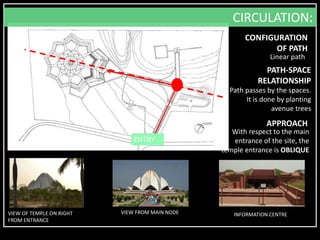
With respect to the main
entrance of the site, the
temple entrance is OBLIQUE
APPROACH
CIRCULATION:
ENTRY
INFORMATION CENTRE
VIEW OF TEMPLE ON RIGHT
FROM ENTRANCE
VIEW FROM MAIN NODE
CONFIGURATION
OF PATH
Linear path
PATH-SPACE
RELATIONSHIP
Path passes by the spaces.
It is done by planting
avenue trees
ENTRANCE
The outermost petals
open outwards to
form entrance.
CONFIGURATION
OF PATH
Radial path
PATH-SPACE RELATIONSHIP
Path passes by the spaces and
terminates at he central chamber
MAIN ENTRY
SECONDARY ENTRY
The temple is reached
by a flight of steps on
the front and green
mounds on both sides
which adds a vertical
dimension to it.
APPROACH
Frontal approach
CIRCULATION:
SENSE OF
VERTICALITY
COMMON PLINTH
TERMINATING POINT-
PRAYER HALL
SPACE WITHIN A SPACE A space may be contained within the volume of a
larger space.
SPATIAL ORGANISATION- CENTRALISED ORGANISATION
ORGANISATION OF SPACE:
GREEN SITE AS
SPACE
PRAYER HALL AS
SPACE WITHIN
SPACE AS IT IS AT
COMMON PLINTH
•All the spaces are arranged
around the central prayer hall
covered by leaves.
PATTERN OF ORGANISATION
in this case
the pattern is TERMINATING
IN OR AROUND THE
CENTRAL SPACE.
MAIN SPACE
(PRAYER HALL)
SECONDARY SPACES
(WATER BODIES )
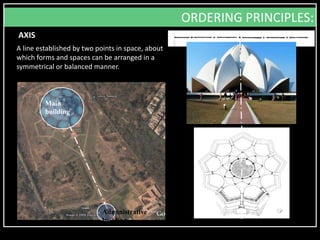
A line established by two points in space, about
which forms and spaces can be arranged in a
symmetrical or balanced manner.
AXIS
Main
building
Administrative
building
ORDERING PRINCIPLES:
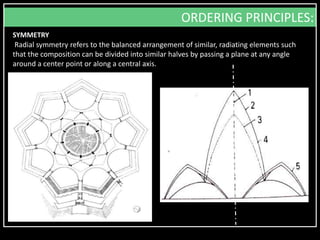
SYMMETRY
Radial symmetry refers to the balanced arrangement of similar, radiating elements such
that the composition can be divided into similar halves by passing a plane at any angle
around a center point or along a central axis.
ORDERING PRINCIPLES:
The articulation of the importance or significance of a form or space by its size, shape, or
placement relative to the other forms and spaces of the organization
HIERARCHY
•The hierarchy is marked by
the entrace to the temple.
•At the main entrance,there
are long steps being an
exception to an otherwise
regular pattern.
•There are 2 other pathways
marking the entry/exit to the
temple, but are less in width
marking the hierachy of
spaces.
•All the other spaces do not
have separate pathways to
access, but are on platform.
ORDERING PRINCIPLES:
MAIN PRAYER HALL
PLINTH MARKING ENTRANCE
A unifying movement characterized by a
patterned repetition or alternation of
formal elements or motifs in the same
or a modified form.
RHYTHM & REPETITON •The design is composed of 27 free-standing marble-
clad "petals" arranged in clusters of three to form nine
sides.
•These 3 petals each with a pond, have been repeated
symmetrically at reguar intervals creating a rhythmic
pattern.
•Rhythmic patterns provide continuity and lead us to
anticipate what comes next.
ORDERING PRINCIPLES:
3 petals and a
water body are
rhythmically
repeated 9
times.
Its external structure
consists of 27 giant marble
petals reaching to a height
of upto 40 m.
SCALE AND PROPORTION:
Scale alludes to the size of something compared
to a reference standard or to the size of
something else.
TOTAL SITE AREA : 105000 SQ.M.
X2X
X
X
4X
26X
4X
X
26X
40M. HIGH –
MONUMENT
AL SCALE
PRAYER HALL
40M. HIGH
WITH SKYLIGHT
IN CENTRE-TO
SIGNIFY
CONNECTION
WITH UNIVERSE
28MTS
33.6MTS
22.5MTS
7.8MTS
SCALE AND PROPORTION:
All the elements are in
proportion to each other.
PROPORTION REFERS TO THE PROPER
OR HARMONIOUS RELATION OF ONE
PART TO ANOTHER OR TO THE WHOLE.
•From the main node the structure looks
monumental
•The entry gates in the main hall are in
human scale with almost 4m of height
•Once you enter the main prayer hall,
the sense of monumentality continues
with the hall almost 40 m. High.
•The hall can seat almost 1200 people at
a time.
SOURCE:
•http://www.bahaihouseofworship.in/architectural-blossoming
•https://en.wikiarquitectura.com/index.php/Lotus_Temple_(Bah%C3%A
1'%C3%AD_House_of_Worship)
•http://www.architecture-student.com/architecture/lotus-temple-
delhi-innovation-in-architecture/
•DK CHING –FORM SPACE AND ORDER

Lotus Temple...........................................................

  • 1.
  • 2.
    PRIMARY ELEMENTS: CENTRAL POINT INNERLEAVES OUTER LEAVES OUTERMOST LEAVES All the points join to form lines of the leaves and these curved lines form the structure. The surfaces are all inclined to 45 degree angle from each other.
  • 3.
    In plan itsform is composition of circles and circular segments . Stable and neutral plan because of its centrally oriented planning. The form in its plan is the collision of 2 figures i.e. a square and a rhombus FORM: Conceptually inspired this flower symbolizes purity and holiness in the Hindu tradition is that the architect Fariborz Sahba
  • 4.
    The temple gives the impressionof a half-open lotus flower, afloat, surrounded by its leaves. Each component of the temple is repeated nine times. Since the lotus is open at the top, a glass and steel roof at the level of the radial beams provides protection from rain and facilitates the entry of natural light into the auditorium. INNER LEAVES HOUSING THE MAIN PRAYER HALL OUTER LEAVES COVERING THE INNER HALL ENTRANCE LEAVES FORM: •The inner leaves enclose the interior dome in a canopy made of crisscrossing ribs and shells of intricate pattern. • When viewed from inside, each layer of ribs and shells disappear as it rises, behind the next, lower layer. Some of the ribs converge radially and meet at a central hub.
  • 5.
    The outer coatingof white marble makes the building visible from a distance and highlight with sunlight, turning purple at sunset. FORM: LOTUS TEMPLE IN DAY LOTUS TEMPLE AT NIGHT •The temple is surrounded by nine large pools of water that not only enhance its beauty but also play a role in the natural cooling system of the hall. •All elements are in multiples of “9” as it is said to symbolise comprehensiveness, oneness and unity.
  • 6.
    With respect tothe main entrance of the site, the temple entrance is OBLIQUE APPROACH CIRCULATION: ENTRY INFORMATION CENTRE VIEW OF TEMPLE ON RIGHT FROM ENTRANCE VIEW FROM MAIN NODE CONFIGURATION OF PATH Linear path PATH-SPACE RELATIONSHIP Path passes by the spaces. It is done by planting avenue trees
  • 7.
    ENTRANCE The outermost petals openoutwards to form entrance. CONFIGURATION OF PATH Radial path PATH-SPACE RELATIONSHIP Path passes by the spaces and terminates at he central chamber MAIN ENTRY SECONDARY ENTRY The temple is reached by a flight of steps on the front and green mounds on both sides which adds a vertical dimension to it. APPROACH Frontal approach CIRCULATION: SENSE OF VERTICALITY COMMON PLINTH TERMINATING POINT- PRAYER HALL
  • 8.
    SPACE WITHIN ASPACE A space may be contained within the volume of a larger space. SPATIAL ORGANISATION- CENTRALISED ORGANISATION ORGANISATION OF SPACE: GREEN SITE AS SPACE PRAYER HALL AS SPACE WITHIN SPACE AS IT IS AT COMMON PLINTH •All the spaces are arranged around the central prayer hall covered by leaves. PATTERN OF ORGANISATION in this case the pattern is TERMINATING IN OR AROUND THE CENTRAL SPACE. MAIN SPACE (PRAYER HALL) SECONDARY SPACES (WATER BODIES )
  • 9.
    A line establishedby two points in space, about which forms and spaces can be arranged in a symmetrical or balanced manner. AXIS Main building Administrative building ORDERING PRINCIPLES:
  • 10.
    SYMMETRY Radial symmetry refersto the balanced arrangement of similar, radiating elements such that the composition can be divided into similar halves by passing a plane at any angle around a center point or along a central axis. ORDERING PRINCIPLES:
  • 11.
    The articulation ofthe importance or significance of a form or space by its size, shape, or placement relative to the other forms and spaces of the organization HIERARCHY •The hierarchy is marked by the entrace to the temple. •At the main entrance,there are long steps being an exception to an otherwise regular pattern. •There are 2 other pathways marking the entry/exit to the temple, but are less in width marking the hierachy of spaces. •All the other spaces do not have separate pathways to access, but are on platform. ORDERING PRINCIPLES: MAIN PRAYER HALL PLINTH MARKING ENTRANCE
  • 12.
    A unifying movementcharacterized by a patterned repetition or alternation of formal elements or motifs in the same or a modified form. RHYTHM & REPETITON •The design is composed of 27 free-standing marble- clad "petals" arranged in clusters of three to form nine sides. •These 3 petals each with a pond, have been repeated symmetrically at reguar intervals creating a rhythmic pattern. •Rhythmic patterns provide continuity and lead us to anticipate what comes next. ORDERING PRINCIPLES: 3 petals and a water body are rhythmically repeated 9 times.
  • 13.
    Its external structure consistsof 27 giant marble petals reaching to a height of upto 40 m. SCALE AND PROPORTION: Scale alludes to the size of something compared to a reference standard or to the size of something else. TOTAL SITE AREA : 105000 SQ.M. X2X X X 4X 26X 4X X 26X 40M. HIGH – MONUMENT AL SCALE PRAYER HALL 40M. HIGH WITH SKYLIGHT IN CENTRE-TO SIGNIFY CONNECTION WITH UNIVERSE
  • 14.
    28MTS 33.6MTS 22.5MTS 7.8MTS SCALE AND PROPORTION: Allthe elements are in proportion to each other. PROPORTION REFERS TO THE PROPER OR HARMONIOUS RELATION OF ONE PART TO ANOTHER OR TO THE WHOLE. •From the main node the structure looks monumental •The entry gates in the main hall are in human scale with almost 4m of height •Once you enter the main prayer hall, the sense of monumentality continues with the hall almost 40 m. High. •The hall can seat almost 1200 people at a time.
  • 15.