PROJECT
DOCUMENTATION
CASE STUDY
LOTUS TEMPLE
NEW DELHI, INDIA
SUBMITTED TO :
PROF MRS ROHINI KUSHWAH
DATE :
20/07/2021
SUBMITTED BY :
ANJALI SETHIYA
B. DES. SEM II , I YEAR
SDPS WOMEN'S COLLEGE
CONTENTS
 INTRODUCTION
 PROJECT PROFILE
 DETAILED CASE STUDY (PLAN, ELEVATION, LOCATION)
 SITE SURROUNDING
 LOCATION ON MAP
 CLIMATE
 TRAFFIC
I. INTRODUCTION
 THE LOTUS TEMPLE, LOCATED IN DELHI, INDIA, IS A BAHÁʼÍ
HOUSE OF WORSHIP THAT WAS DEDICATED IN DECEMBER 1986.
NOTABLE FOR ITS FLOWERLIKE SHAPE, IT HAS BECOME A
PROMINENT ATTRACTION IN THE CITY. ... THE LOTUS TEMPLE HAS
WON NUMEROUS ARCHITECTURAL AWARDS AND HAS BEEN
FEATURED IN MANY NEWSPAPER AND MAGAZINE ARTICLES.
 THERE ARE NO ALTARS OR PULPITS INSIDE THE LOTUS TEMPLE,
WHICH IS A COMMON FEATURE OF ALL BAHAI HOUSES OF
WORSHIP. ... THEY GIVE THE IMPRESSION OF A HALF-
BLOOMED LOTUS IN A WATER BODY AND THE WHOLE
STRUCTURE LOOKS SPECTACULAR WHEN ILLUMINATED IN
THE NIGHT.
 KNOWN FOR ITS FLOWER-LIKE SHAPE, IT SERVES AS THE
MOTHER TEMPLE OF THE INDIAN SUBCONTINENT AND WAS
CREATED TO BE A PLACE OF WORSHIP FOR ALL FAITHS AND
RELIGIONS.
 LOTUS TEMPLE, BAHĀʾĪ FAITH HOUSE OF WORSHIP, OR MASHRIQ
AL-ADHKĀR (ARABIC: “A PLACE WHERE THE UTTERING OF THE NAME
OF GOD ARISES AT DAWN”), IN NEW DELHI. IN THE EARLY 21ST
CENTURY IT WAS ONE OF ONLY NINE MASHRIQS IN THE WORLD.
2. PROFILE
 NAME :- LOTUS TEMPLE
 ADDRESS :- LOTUS TEMPLE ROAD, BAHAPUR, SHAMBHU DAYAL BAGH, KALKAJI NEW DELHI, 110019
 AREA COVERED :- 26 ACRE (10.5 HECTARE)
 ARCHITECT :- FARIBORZ SAHBA. IT WAS DESIGNED BY IRANIAN ARCHITECT FARIBORZ SAHBA, WHO WON
ACCLAIM FOR THE PROJECT EVEN BEFORE THE TEMPLE WAS COMPLETED. ARCHITECT MR. FARIBORZ SAHBA
WAS SELECTED BY THE WORLD GOVERNING BODY OF BAHA’I FAITH, “ THE UNIVERSAL HOUSE OF JUSTICE”
IN THE YEAR 1974 •
 ARCHITECTURE STYLE :- EXPRESSIONIST ARCHITECTURE.
 STRUCTURAL ENGINEER :- FLINT AND NEIL. • FLINT & NEILL PARTNERSHIP OF LONDON WAS THE
CONSULTANCY • ECC CONSTRUCTION GROUP OF LARSEN & TOUBRO LTD. WERE THE CONTRACTORS • DESIGN
PROCESS FOR THE STRUCTURE BEGAN IN THE YEAR 1976.
 STRUCTURAL SYSTEM :- CONCRETE FRAME AND PRECAST CONCRETE RIBBED ROOF
 DIAMETER :- 70 METERS (230 FEET)
 PROJECT DURATION :- 10 YEARS (1976-86)
 OPENED :- 13 NOVEMBER 1986
 SEATING CAPACITY :- 2500 PEOPLE
3. CASE STUDY
A. CONSTRUCTION AND ARCHITECTURAL DETAILS
 All Baháʼí Houses of Worship, including the Lotus Temple, share certain
architectural elements, some of which are specified by Baháʼí
scripture. ʻAbdu'l-Bahá, the son of the founder of the religion, stipulated
that an essential architectural character of a House of Worship is a nine-
sided circular shape.[10] While all current Baháʼí Houses of Worship have a
dome, this is not regarded as an essential part of their architecture.[11
 ] Baháʼí scripture also states that no pictures, statues or images be
displayed within the House of Worship and no pulpits or altars be
incorporated as an architectural feature.
 .[4]
 The surface of the House of Worship is made of white marble
from Penteli mountain in Greece, the same marble used in the construction
of many ancient monuments (including the Parthenon[8]) and other Baháʼí
buildings.[12] Along with its nine surrounding ponds and gardens, the Lotus
Temple property comprises 26 acres (105,000 m²; 10.5 ha).
CONSTRUCTION AND ARCHITECTURAL DETAILS
 The temple is located in the village of Bahapur in New Delhi, National Capital
Territory of Delhi. The architect was an Iranian, Fariborz Sahba who now lives in La
Jolla, California,[13] after living some years in Canada.[14]
 He was approached in 1976 to design the Lotus Temple and later oversaw its
construction. The structural design was undertaken by the UK firm Flint and
Neill over the course of 18 months,[5] and the construction was done by ECC
Construction Group of Larsen & Toubro Limited[15] at a cost of $10 million.[1]
 The major part of the funds needed to buy this land was donated by Ardishír
Rustampúr of Hyderabad, Sindh (Pakistan), whose will dictated that his entire life
savings would go to this purpose.[16]
 A portion of the construction budget was saved and used to build a greenhouse to
study indigenous plants and flowers that would be appropriate for use on the site.
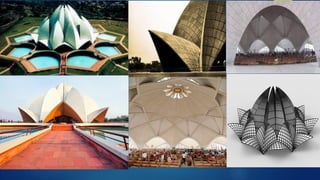
 Inspired by the lotus flower, the design for the House of Worship in New Delhi is
composed of 27 free-standing marble-clad "petals" arranged in clusters of three to
form nine sides.[3] The nine doors of the Lotus Temple open onto a central hall 34.3
meters tall[3] that can seat 1,300 people[8] and hold up to 2,500 in all
B. CONSTRUCTION SYSTEM
CONSTRUCTION SYSTEM
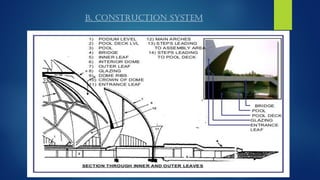
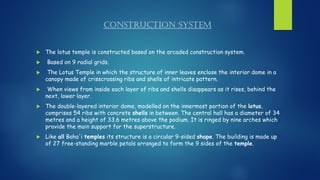
 The lotus temple is constructed based on the arcaded construction system.
 Based on 9 radial grids.
 The Lotus Temple in which the structure of inner leaves enclose the interior dome in a
canopy made of crisscrossing ribs and shells of intricate pattern.
 When views from inside each layer of ribs and shells disappears as it rises, behind the
next, lower layer.
 The double-layered interior dome, modelled on the innermost portion of the lotus,
comprises 54 ribs with concrete shells in between. The central hall has a diameter of 34
metres and a height of 33.6 metres above the podium. It is ringed by nine arches which
provide the main support for the superstructure.
 Like all Baha'i temples its structure is a circular 9-sided shape. The building is made up
of 27 free-standing marble petals arranged to form the 9 sides of the temple.
C. STRUCTURAL DETAILS
PARTS OF STRUCTURE
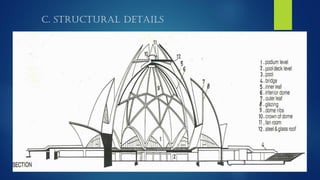
 The complexity of the structure and the high level of labour necessary required a
dynamic management with high grade of innovation. One of the essential means of
achieving the fixed objective was to anticipate problems in advance and to resolve
them using test and Models.
PARTS OF STRUCTURE
A. Basement
B. Three groups of Nine shells springing from the podium
C. Double layered Interior Dome
D. Nine Arches
E. Nine Ponds
F. Walkways
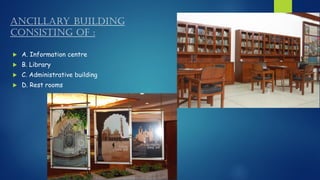
Ancillary Building
Consisting of :
 A. Information centre
 B. Library
 C. Administrative building
 D. Rest rooms
COMPONENTS OF STRUCTURE
GEOMETRY
➢ By the help of geometry problem this typical structure design.
➢ The architect conceived the beautiful concept of the lotus, had to be converted/transfer
into definable geometrical shapes such as spheres, cylinders, toroid and cones.
➢ The structure shapes were translated into equations, which were then used as a basis for structural
analysis and engineering drawings.
➢ The resultant geometry of structure was so complex.
➢ The designers took over two and half years to complete the detailed drawings of the Lotus Temple.
➢ Complex geometry in simple terms describe below such as:
A. ENTRANCE LEAVES AND OUTER LEAVES
➢ The surfaces created by the shell on each side of the entrance-ways and the outer leaves are formed by
spheres of different radii, with their centres located at different points of the interior of the building.
There is a group of spheres for the leaves of the entrance, some of which define the interior surfaces
and others which define the exterior surfaces of the shells.
➢ The diameters of the spheres have been fixed to satisfy the structural consideration of the varying
thicknesses of the petals.
Components of structure
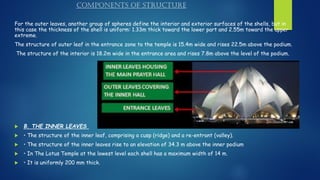
For the outer leaves, another group of spheres define the interior and exterior surfaces of the shells, but in
this case the thickness of the shell is uniform: 1.33m thick toward the lower part and 2.55m toward the upper
extreme.
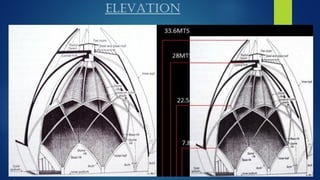
The structure of outer leaf in the entrance zone to the temple is 15.4m wide and rises 22.5m above the podium.
The structure of the interior is 18.2m wide in the entrance area and rises 7.8m above the level of the podium.
 B. THE INNER LEAVES
 • The structure of the inner leaf, comprising a cusp (ridge) and a re-entrant (valley).
 • The structure of the inner leaves rise to an elevation of 34.3 m above the inner podium
 • In The Lotus Temple at the lowest level each shell has a maximum width of 14 m.
 • It is uniformly 200 mm thick.
COMPONENTS OF STRUCTURE
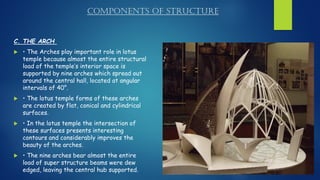
C. THE ARCH
 • The Arches play important role in lotus
temple because almost the entire structural
load of the temple’s interior space is
supported by nine arches which spread out
around the central hall, located at angular
intervals of 40°.
 • The lotus temple forms of these arches
are created by flat, conical and cylindrical
surfaces.
 • In the lotus temple the intersection of
these surfaces presents interesting
contours and considerably improves the
beauty of the arches.
 • The nine arches bear almost the entire
load of super structure beams were dew
edged, leaving the central hub supported.
COMPONENTS OF STRUCTURE
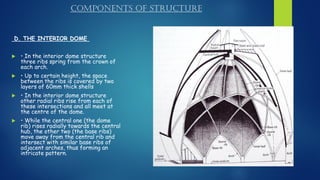
D. THE INTERIOR DOME
 • In the interior dome structure
three ribs spring from the crown of
each arch.
 • Up to certain height, the space
between the ribs is covered by two
layers of 60mm thick shells
 • In the interior dome structure
other radial ribs rise from each of
these intersections and all meet at
the centre of the dome.
 • While the central one (the dome
rib) rises radially towards the central
hub, the other two (the base ribs)
move away from the central rib and
intersect with similar base ribs of
adjacent arches, thus forming an
intricate pattern.
STRUCTURAL SYSTEM
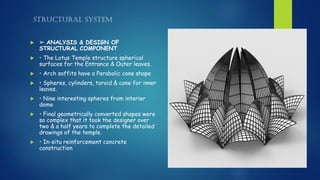
 ➢ ANALYSIS & DESIGN OF
STRUCTURAL COMPONENT
 • The Lotus Temple structure spherical
surfaces for the Entrance & Outer leaves.
 • Arch soffits have a Parabolic cone shape
 • Spheres, cylinders, toroid & cone for inner
leaves.
 • Nine interesting spheres from interior
dome
 • Final geometrically converted shapes were
so complex that it took the designer over
two & a half years to complete the detailed
drawings of the temple.
 • In-situ reinforcement concrete
construction
STRUCTURAL SYSTEM
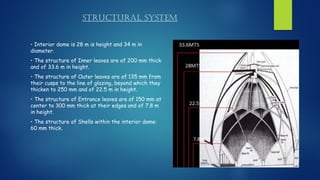
• Interior dome is 28 m is height and 34 m in
diameter.
• The structure of Inner leaves are of 200 mm thick
and of 33.6 m in height.
• The structure of Outer leaves are of 135 mm from
their cusps to the line of glazing, beyond which they
thicken to 250 mm and of 22.5 m in height.
• The structure of Entrance leaves are of 150 mm at
center to 300 mm thick at their edges and of 7.8 m
in height.
• The structure of Shells within the interior dome:
60 mm thick.
➢ LOTUS TEMPLE DESIGNED FOR
A. DEAD LOAD
B. LIVE LOAD
C. WIND LOAD
WIND TUNNEL TEST IN AERONAUTICAL ENGINEERING
DEPARTMENT AT IMPERIAL COLLEGE, LONDON
D. EARTHQUAKE LOAD
➢ LOTUS TEMPLE IS DESIGNED BY
A. TUBULAR STEEL GLAZING FRAMES
B. FINITE ELEMENT ANALYSIS
C. EQUIVALENT GRILLAGE MODELS FOR SHELLS IN THE COMPUTER
PROGRAM
D. QUADRILATERAL ELEMENT
material
 The Inner surface of all the shells have a uniform, bush-hammered, exposed
concrete surface with architectural patterns.
 For the inner leaves, these pattern were formed out of radial and vertical
planes intersecting the surface of torus.
 For the outer and entrance leaves, and the interior dome, the patterns
were formed out of longitudes and latitudes of sphere.
 The Lotus Temple structure formwork was designed in a manner that timber
joist support the panel instead of the regular pattern of the structural steel
supporting members of the structural steel supporting members of the
space frame.
 In the lotus temple Full-scale mockups of the bottom surface of each of the
shells were first made at ground level and the architectural patterns marked
on this surface
CONCRETE
• In The Lotus Temple all the ribs and shells up to radial beam level are in white concrete.
 • To avoid crazing and shrinkage cracks in lotus temple structure, a mix of M30 Grade white concrete
was designed.
 • The entire quantity of white cement for lotus temple was therefore imported from Korea.
• Specially graded dolomite aggregates were procured from Alwar mines near Delhi and white silica sand
from Jaipur.
 • Water/cement ratio: 0.43 • Slump achieved was in the range of 70-100 mm.
 • Bush hammered finish for interior dome, inner and outer leaves. • Concrete was drum mix on site.
 • Three inner leaves at 120⁰ spacing, were concreted at a time, in only two lifts from their bases to the
level of the star beams above.
 • Outer and Entrance leaves were concreted in a continuous operation one at a time, using the removable
outer shutter panels for access for concrete and vibrators to avoid cold joints.
 • Concreting time for an outer leaf of lotus temple was of the order of 48 hours.
 • Ice melt water was used in the mix to take care of the hot weather in Delhi to cool the concrete, that
brought down temperature of concrete from 40⁰ C to 25⁰ C.
 • Systems of horizontal sprinkler pipes were used in curing.
MARBLE CLADDING
 Lotus Temple in which the Shells & arches are clad in white Greek Marble panels,
performed in Italy to the surface profile and to patterns related to the geometry
by Marmi Vicentini S.P.A Company.
 The lotus temple in which the panels are fixed by means of stainless steel brackets
secured by bolts in holes drilled after concreting and the joints were filled with
moulded rubber cordon & silicon sealant was applied over it.
 Floor finishes were also of white marble.
 Balustrades, stairs were precast
 Stones used for stairs were made of red sandstone.
 Complete construction of the structure was completed in the year 1986.
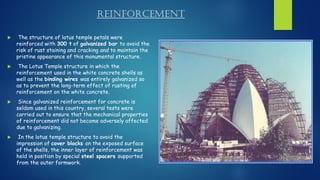
Reinforcement
 The structure of lotus temple petals were
reinforced with 300 t of galvanized bar to avoid the
risk of rust staining and cracking and to maintain the
pristine appearance of this monumental structure.
 The Lotus Temple structure in which the
reinforcement used in the white concrete shells as
well as the binding wires was entirely galvanized so
as to prevent the long-term effect of rusting of
reinforcement on the white concrete.
 Since galvanized reinforcement for concrete is
seldom used in this country, several tests were
carried out to ensure that the mechanical properties
of reinforcement did not become adversely affected
due to galvanizing.
 In the lotus temple structure to avoid the
impression of cover blocks on the exposed surface
of the shells, the inner layer of reinforcement was
held in position by special steel spacers supported
from the outer formwork.
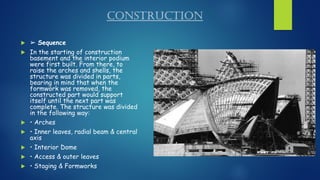
CONSTRUCTION
 ➢ Sequence
 In the starting of construction
basement and the interior podium
were first built. From there, to
raise the arches and shells, the
structure was divided in parts,
bearing in mind that when the
formwork was removed, the
constructed part would support
itself until the next part was
complete. The structure was divided
in the following way:
 • Arches
 • Inner leaves, radial beam & central
axis
 • Interior Dome
 • Access & outer leaves
 • Staging & Formworks
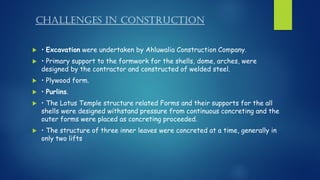
CHALLENGES IN CONSTRUCTION
 • Excavation were undertaken by Ahluwalia Construction Company.
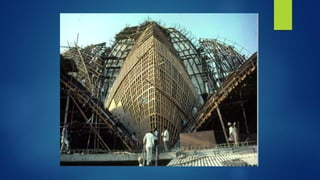
 • Primary support to the formwork for the shells, dome, arches, were
designed by the contractor and constructed of welded steel.
 • Plywood form.
 • Purlins.
 • The Lotus Temple structure related Forms and their supports for the all
shells were designed withstand pressure from continuous concreting and the
outer forms were placed as concreting proceeded.
 • The structure of three inner leaves were concreted at a time, generally in
only two lifts
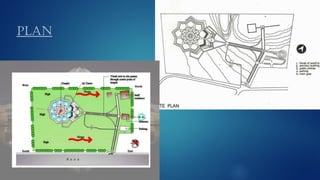
PLAN
ELEVATION
4. SITE SURROUNDING
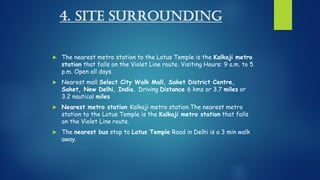
 The nearest metro station to the Lotus Temple is the Kalkaji metro
station that falls on the Violet Line route. Visiting Hours: 9 a.m. to 5
p.m. Open all days.
 Nearest mall Select City Walk Mall, Saket District Centre,
Saket, New Delhi, India. Driving Distance 6 kms or 3.7 miles or
3.2 nautical miles
 Nearest metro station Kalkaji metro station.The nearest metro
station to the Lotus Temple is the Kalkaji metro station that falls
on the Violet Line route.
 The nearest bus stop to Lotus Temple Road in Delhi is a 3 min walk
away.
Attractions near
Lotus Temple
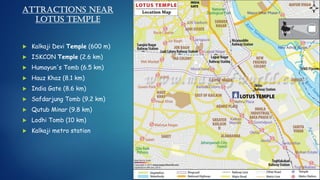
 Kalkaji Devi Temple (600 m)
 ISKCON Temple (2.6 km)
 Humayun's Tomb (6.5 km)
 Hauz Khaz (8.1 km)
 India Gate (8.6 km)
 Safdarjung Tomb (9.2 km)
 Qutub Minar (9.8 km)
 Lodhi Tomb (10 km)
 Kalkaji metro station
5. CLIMATE
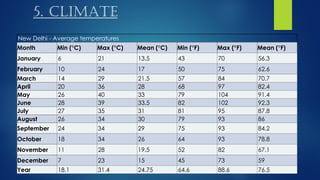
New Delhi - Average temperatures
Month Min (°C) Max (°C) Mean (°C) Min (°F) Max (°F) Mean (°F)
January 6 21 13.5 43 70 56.3
February 10 24 17 50 75 62.6
March 14 29 21.5 57 84 70.7
April 20 36 28 68 97 82.4
May 26 40 33 79 104 91.4
June 28 39 33.5 82 102 92.3
July 27 35 31 81 95 87.8
August 26 34 30 79 93 86
September 24 34 29 75 93 84.2
October 18 34 26 64 93 78.8
November 11 28 19.5 52 82 67.1
December 7 23 15 45 73 59
Year 18.1 31.4 24.75 64.6 88.6 76.5
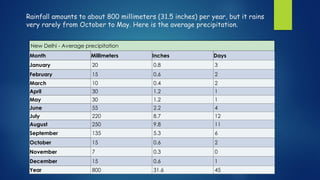
Rainfall amounts to about 800 millimeters (31.5 inches) per year, but it rains
very rarely from October to May. Here is the average precipitation.
New Delhi - Average precipitation
Month Millimeters Inches Days
January 20 0.8 3
February 15 0.6 2
March 10 0.4 2
April 30 1.2 1
May 30 1.2 1
June 55 2.2 4
July 220 8.7 12
August 250 9.8 11
September 135 5.3 6
October 15 0.6 2
November 7 0.3 0
December 15 0.6 1
Year 800 31.6 45
BEST TIME TO VISIT
 Although the Lotus Temple can be visited all
throughout the year, considering the
winter season between November and February would
be an ideal choice as the weather remains pleasant
and favourable to explore the complex with less
humidity.
Lotus temple case study by Anjali Sethiya

Lotus temple case study by Anjali Sethiya

  • 1.
  • 2.
    LOTUS TEMPLE NEW DELHI,INDIA SUBMITTED TO : PROF MRS ROHINI KUSHWAH DATE : 20/07/2021 SUBMITTED BY : ANJALI SETHIYA B. DES. SEM II , I YEAR SDPS WOMEN'S COLLEGE
  • 3.
    CONTENTS  INTRODUCTION  PROJECTPROFILE  DETAILED CASE STUDY (PLAN, ELEVATION, LOCATION)  SITE SURROUNDING  LOCATION ON MAP  CLIMATE  TRAFFIC
  • 4.
    I. INTRODUCTION  THELOTUS TEMPLE, LOCATED IN DELHI, INDIA, IS A BAHÁʼÍ HOUSE OF WORSHIP THAT WAS DEDICATED IN DECEMBER 1986. NOTABLE FOR ITS FLOWERLIKE SHAPE, IT HAS BECOME A PROMINENT ATTRACTION IN THE CITY. ... THE LOTUS TEMPLE HAS WON NUMEROUS ARCHITECTURAL AWARDS AND HAS BEEN FEATURED IN MANY NEWSPAPER AND MAGAZINE ARTICLES.  THERE ARE NO ALTARS OR PULPITS INSIDE THE LOTUS TEMPLE, WHICH IS A COMMON FEATURE OF ALL BAHAI HOUSES OF WORSHIP. ... THEY GIVE THE IMPRESSION OF A HALF- BLOOMED LOTUS IN A WATER BODY AND THE WHOLE STRUCTURE LOOKS SPECTACULAR WHEN ILLUMINATED IN THE NIGHT.  KNOWN FOR ITS FLOWER-LIKE SHAPE, IT SERVES AS THE MOTHER TEMPLE OF THE INDIAN SUBCONTINENT AND WAS CREATED TO BE A PLACE OF WORSHIP FOR ALL FAITHS AND RELIGIONS.  LOTUS TEMPLE, BAHĀʾĪ FAITH HOUSE OF WORSHIP, OR MASHRIQ AL-ADHKĀR (ARABIC: “A PLACE WHERE THE UTTERING OF THE NAME OF GOD ARISES AT DAWN”), IN NEW DELHI. IN THE EARLY 21ST CENTURY IT WAS ONE OF ONLY NINE MASHRIQS IN THE WORLD.
  • 5.
    2. PROFILE  NAME:- LOTUS TEMPLE  ADDRESS :- LOTUS TEMPLE ROAD, BAHAPUR, SHAMBHU DAYAL BAGH, KALKAJI NEW DELHI, 110019  AREA COVERED :- 26 ACRE (10.5 HECTARE)  ARCHITECT :- FARIBORZ SAHBA. IT WAS DESIGNED BY IRANIAN ARCHITECT FARIBORZ SAHBA, WHO WON ACCLAIM FOR THE PROJECT EVEN BEFORE THE TEMPLE WAS COMPLETED. ARCHITECT MR. FARIBORZ SAHBA WAS SELECTED BY THE WORLD GOVERNING BODY OF BAHA’I FAITH, “ THE UNIVERSAL HOUSE OF JUSTICE” IN THE YEAR 1974 •  ARCHITECTURE STYLE :- EXPRESSIONIST ARCHITECTURE.  STRUCTURAL ENGINEER :- FLINT AND NEIL. • FLINT & NEILL PARTNERSHIP OF LONDON WAS THE CONSULTANCY • ECC CONSTRUCTION GROUP OF LARSEN & TOUBRO LTD. WERE THE CONTRACTORS • DESIGN PROCESS FOR THE STRUCTURE BEGAN IN THE YEAR 1976.  STRUCTURAL SYSTEM :- CONCRETE FRAME AND PRECAST CONCRETE RIBBED ROOF  DIAMETER :- 70 METERS (230 FEET)  PROJECT DURATION :- 10 YEARS (1976-86)  OPENED :- 13 NOVEMBER 1986  SEATING CAPACITY :- 2500 PEOPLE
  • 6.
    3. CASE STUDY A.CONSTRUCTION AND ARCHITECTURAL DETAILS  All Baháʼí Houses of Worship, including the Lotus Temple, share certain architectural elements, some of which are specified by Baháʼí scripture. ʻAbdu'l-Bahá, the son of the founder of the religion, stipulated that an essential architectural character of a House of Worship is a nine- sided circular shape.[10] While all current Baháʼí Houses of Worship have a dome, this is not regarded as an essential part of their architecture.[11  ] Baháʼí scripture also states that no pictures, statues or images be displayed within the House of Worship and no pulpits or altars be incorporated as an architectural feature.  .[4]  The surface of the House of Worship is made of white marble from Penteli mountain in Greece, the same marble used in the construction of many ancient monuments (including the Parthenon[8]) and other Baháʼí buildings.[12] Along with its nine surrounding ponds and gardens, the Lotus Temple property comprises 26 acres (105,000 m²; 10.5 ha).
  • 7.
    CONSTRUCTION AND ARCHITECTURALDETAILS  The temple is located in the village of Bahapur in New Delhi, National Capital Territory of Delhi. The architect was an Iranian, Fariborz Sahba who now lives in La Jolla, California,[13] after living some years in Canada.[14]  He was approached in 1976 to design the Lotus Temple and later oversaw its construction. The structural design was undertaken by the UK firm Flint and Neill over the course of 18 months,[5] and the construction was done by ECC Construction Group of Larsen & Toubro Limited[15] at a cost of $10 million.[1]  The major part of the funds needed to buy this land was donated by Ardishír Rustampúr of Hyderabad, Sindh (Pakistan), whose will dictated that his entire life savings would go to this purpose.[16]  A portion of the construction budget was saved and used to build a greenhouse to study indigenous plants and flowers that would be appropriate for use on the site.  Inspired by the lotus flower, the design for the House of Worship in New Delhi is composed of 27 free-standing marble-clad "petals" arranged in clusters of three to form nine sides.[3] The nine doors of the Lotus Temple open onto a central hall 34.3 meters tall[3] that can seat 1,300 people[8] and hold up to 2,500 in all
  • 8.
  • 9.
    CONSTRUCTION SYSTEM  Thelotus temple is constructed based on the arcaded construction system.  Based on 9 radial grids.  The Lotus Temple in which the structure of inner leaves enclose the interior dome in a canopy made of crisscrossing ribs and shells of intricate pattern.  When views from inside each layer of ribs and shells disappears as it rises, behind the next, lower layer.  The double-layered interior dome, modelled on the innermost portion of the lotus, comprises 54 ribs with concrete shells in between. The central hall has a diameter of 34 metres and a height of 33.6 metres above the podium. It is ringed by nine arches which provide the main support for the superstructure.  Like all Baha'i temples its structure is a circular 9-sided shape. The building is made up of 27 free-standing marble petals arranged to form the 9 sides of the temple.
  • 10.
  • 11.
    PARTS OF STRUCTURE The complexity of the structure and the high level of labour necessary required a dynamic management with high grade of innovation. One of the essential means of achieving the fixed objective was to anticipate problems in advance and to resolve them using test and Models. PARTS OF STRUCTURE A. Basement B. Three groups of Nine shells springing from the podium C. Double layered Interior Dome D. Nine Arches E. Nine Ponds F. Walkways
  • 13.
    Ancillary Building Consisting of:  A. Information centre  B. Library  C. Administrative building  D. Rest rooms
  • 14.
    COMPONENTS OF STRUCTURE GEOMETRY ➢By the help of geometry problem this typical structure design. ➢ The architect conceived the beautiful concept of the lotus, had to be converted/transfer into definable geometrical shapes such as spheres, cylinders, toroid and cones. ➢ The structure shapes were translated into equations, which were then used as a basis for structural analysis and engineering drawings. ➢ The resultant geometry of structure was so complex. ➢ The designers took over two and half years to complete the detailed drawings of the Lotus Temple. ➢ Complex geometry in simple terms describe below such as: A. ENTRANCE LEAVES AND OUTER LEAVES ➢ The surfaces created by the shell on each side of the entrance-ways and the outer leaves are formed by spheres of different radii, with their centres located at different points of the interior of the building. There is a group of spheres for the leaves of the entrance, some of which define the interior surfaces and others which define the exterior surfaces of the shells. ➢ The diameters of the spheres have been fixed to satisfy the structural consideration of the varying thicknesses of the petals.
  • 15.
    Components of structure Forthe outer leaves, another group of spheres define the interior and exterior surfaces of the shells, but in this case the thickness of the shell is uniform: 1.33m thick toward the lower part and 2.55m toward the upper extreme. The structure of outer leaf in the entrance zone to the temple is 15.4m wide and rises 22.5m above the podium. The structure of the interior is 18.2m wide in the entrance area and rises 7.8m above the level of the podium.  B. THE INNER LEAVES  • The structure of the inner leaf, comprising a cusp (ridge) and a re-entrant (valley).  • The structure of the inner leaves rise to an elevation of 34.3 m above the inner podium  • In The Lotus Temple at the lowest level each shell has a maximum width of 14 m.  • It is uniformly 200 mm thick.
  • 16.
    COMPONENTS OF STRUCTURE C.THE ARCH  • The Arches play important role in lotus temple because almost the entire structural load of the temple’s interior space is supported by nine arches which spread out around the central hall, located at angular intervals of 40°.  • The lotus temple forms of these arches are created by flat, conical and cylindrical surfaces.  • In the lotus temple the intersection of these surfaces presents interesting contours and considerably improves the beauty of the arches.  • The nine arches bear almost the entire load of super structure beams were dew edged, leaving the central hub supported.
  • 17.
    COMPONENTS OF STRUCTURE D.THE INTERIOR DOME  • In the interior dome structure three ribs spring from the crown of each arch.  • Up to certain height, the space between the ribs is covered by two layers of 60mm thick shells  • In the interior dome structure other radial ribs rise from each of these intersections and all meet at the centre of the dome.  • While the central one (the dome rib) rises radially towards the central hub, the other two (the base ribs) move away from the central rib and intersect with similar base ribs of adjacent arches, thus forming an intricate pattern.
  • 18.
    STRUCTURAL SYSTEM  ➢ANALYSIS & DESIGN OF STRUCTURAL COMPONENT  • The Lotus Temple structure spherical surfaces for the Entrance & Outer leaves.  • Arch soffits have a Parabolic cone shape  • Spheres, cylinders, toroid & cone for inner leaves.  • Nine interesting spheres from interior dome  • Final geometrically converted shapes were so complex that it took the designer over two & a half years to complete the detailed drawings of the temple.  • In-situ reinforcement concrete construction
  • 19.
    STRUCTURAL SYSTEM • Interiordome is 28 m is height and 34 m in diameter. • The structure of Inner leaves are of 200 mm thick and of 33.6 m in height. • The structure of Outer leaves are of 135 mm from their cusps to the line of glazing, beyond which they thicken to 250 mm and of 22.5 m in height. • The structure of Entrance leaves are of 150 mm at center to 300 mm thick at their edges and of 7.8 m in height. • The structure of Shells within the interior dome: 60 mm thick.
  • 20.
    ➢ LOTUS TEMPLEDESIGNED FOR A. DEAD LOAD B. LIVE LOAD C. WIND LOAD WIND TUNNEL TEST IN AERONAUTICAL ENGINEERING DEPARTMENT AT IMPERIAL COLLEGE, LONDON D. EARTHQUAKE LOAD ➢ LOTUS TEMPLE IS DESIGNED BY A. TUBULAR STEEL GLAZING FRAMES B. FINITE ELEMENT ANALYSIS C. EQUIVALENT GRILLAGE MODELS FOR SHELLS IN THE COMPUTER PROGRAM D. QUADRILATERAL ELEMENT
  • 22.
    material  The Innersurface of all the shells have a uniform, bush-hammered, exposed concrete surface with architectural patterns.  For the inner leaves, these pattern were formed out of radial and vertical planes intersecting the surface of torus.  For the outer and entrance leaves, and the interior dome, the patterns were formed out of longitudes and latitudes of sphere.  The Lotus Temple structure formwork was designed in a manner that timber joist support the panel instead of the regular pattern of the structural steel supporting members of the structural steel supporting members of the space frame.  In the lotus temple Full-scale mockups of the bottom surface of each of the shells were first made at ground level and the architectural patterns marked on this surface
  • 23.
    CONCRETE • In TheLotus Temple all the ribs and shells up to radial beam level are in white concrete.  • To avoid crazing and shrinkage cracks in lotus temple structure, a mix of M30 Grade white concrete was designed.  • The entire quantity of white cement for lotus temple was therefore imported from Korea. • Specially graded dolomite aggregates were procured from Alwar mines near Delhi and white silica sand from Jaipur.  • Water/cement ratio: 0.43 • Slump achieved was in the range of 70-100 mm.  • Bush hammered finish for interior dome, inner and outer leaves. • Concrete was drum mix on site.  • Three inner leaves at 120⁰ spacing, were concreted at a time, in only two lifts from their bases to the level of the star beams above.  • Outer and Entrance leaves were concreted in a continuous operation one at a time, using the removable outer shutter panels for access for concrete and vibrators to avoid cold joints.  • Concreting time for an outer leaf of lotus temple was of the order of 48 hours.  • Ice melt water was used in the mix to take care of the hot weather in Delhi to cool the concrete, that brought down temperature of concrete from 40⁰ C to 25⁰ C.  • Systems of horizontal sprinkler pipes were used in curing.
  • 24.
    MARBLE CLADDING  LotusTemple in which the Shells & arches are clad in white Greek Marble panels, performed in Italy to the surface profile and to patterns related to the geometry by Marmi Vicentini S.P.A Company.  The lotus temple in which the panels are fixed by means of stainless steel brackets secured by bolts in holes drilled after concreting and the joints were filled with moulded rubber cordon & silicon sealant was applied over it.  Floor finishes were also of white marble.  Balustrades, stairs were precast  Stones used for stairs were made of red sandstone.  Complete construction of the structure was completed in the year 1986.
  • 25.
    Reinforcement  The structureof lotus temple petals were reinforced with 300 t of galvanized bar to avoid the risk of rust staining and cracking and to maintain the pristine appearance of this monumental structure.  The Lotus Temple structure in which the reinforcement used in the white concrete shells as well as the binding wires was entirely galvanized so as to prevent the long-term effect of rusting of reinforcement on the white concrete.  Since galvanized reinforcement for concrete is seldom used in this country, several tests were carried out to ensure that the mechanical properties of reinforcement did not become adversely affected due to galvanizing.  In the lotus temple structure to avoid the impression of cover blocks on the exposed surface of the shells, the inner layer of reinforcement was held in position by special steel spacers supported from the outer formwork.
  • 26.
    CONSTRUCTION  ➢ Sequence In the starting of construction basement and the interior podium were first built. From there, to raise the arches and shells, the structure was divided in parts, bearing in mind that when the formwork was removed, the constructed part would support itself until the next part was complete. The structure was divided in the following way:  • Arches  • Inner leaves, radial beam & central axis  • Interior Dome  • Access & outer leaves  • Staging & Formworks
  • 27.
    CHALLENGES IN CONSTRUCTION • Excavation were undertaken by Ahluwalia Construction Company.  • Primary support to the formwork for the shells, dome, arches, were designed by the contractor and constructed of welded steel.  • Plywood form.  • Purlins.  • The Lotus Temple structure related Forms and their supports for the all shells were designed withstand pressure from continuous concreting and the outer forms were placed as concreting proceeded.  • The structure of three inner leaves were concreted at a time, generally in only two lifts
  • 28.
  • 29.
  • 30.
    4. SITE SURROUNDING The nearest metro station to the Lotus Temple is the Kalkaji metro station that falls on the Violet Line route. Visiting Hours: 9 a.m. to 5 p.m. Open all days.  Nearest mall Select City Walk Mall, Saket District Centre, Saket, New Delhi, India. Driving Distance 6 kms or 3.7 miles or 3.2 nautical miles  Nearest metro station Kalkaji metro station.The nearest metro station to the Lotus Temple is the Kalkaji metro station that falls on the Violet Line route.  The nearest bus stop to Lotus Temple Road in Delhi is a 3 min walk away.
  • 31.
    Attractions near Lotus Temple Kalkaji Devi Temple (600 m)  ISKCON Temple (2.6 km)  Humayun's Tomb (6.5 km)  Hauz Khaz (8.1 km)  India Gate (8.6 km)  Safdarjung Tomb (9.2 km)  Qutub Minar (9.8 km)  Lodhi Tomb (10 km)  Kalkaji metro station
  • 32.
    5. CLIMATE New Delhi- Average temperatures Month Min (°C) Max (°C) Mean (°C) Min (°F) Max (°F) Mean (°F) January 6 21 13.5 43 70 56.3 February 10 24 17 50 75 62.6 March 14 29 21.5 57 84 70.7 April 20 36 28 68 97 82.4 May 26 40 33 79 104 91.4 June 28 39 33.5 82 102 92.3 July 27 35 31 81 95 87.8 August 26 34 30 79 93 86 September 24 34 29 75 93 84.2 October 18 34 26 64 93 78.8 November 11 28 19.5 52 82 67.1 December 7 23 15 45 73 59 Year 18.1 31.4 24.75 64.6 88.6 76.5
  • 33.
    Rainfall amounts toabout 800 millimeters (31.5 inches) per year, but it rains very rarely from October to May. Here is the average precipitation. New Delhi - Average precipitation Month Millimeters Inches Days January 20 0.8 3 February 15 0.6 2 March 10 0.4 2 April 30 1.2 1 May 30 1.2 1 June 55 2.2 4 July 220 8.7 12 August 250 9.8 11 September 135 5.3 6 October 15 0.6 2 November 7 0.3 0 December 15 0.6 1 Year 800 31.6 45
  • 34.
    BEST TIME TOVISIT  Although the Lotus Temple can be visited all throughout the year, considering the winter season between November and February would be an ideal choice as the weather remains pleasant and favourable to explore the complex with less humidity.