LOUIS I. KAHN
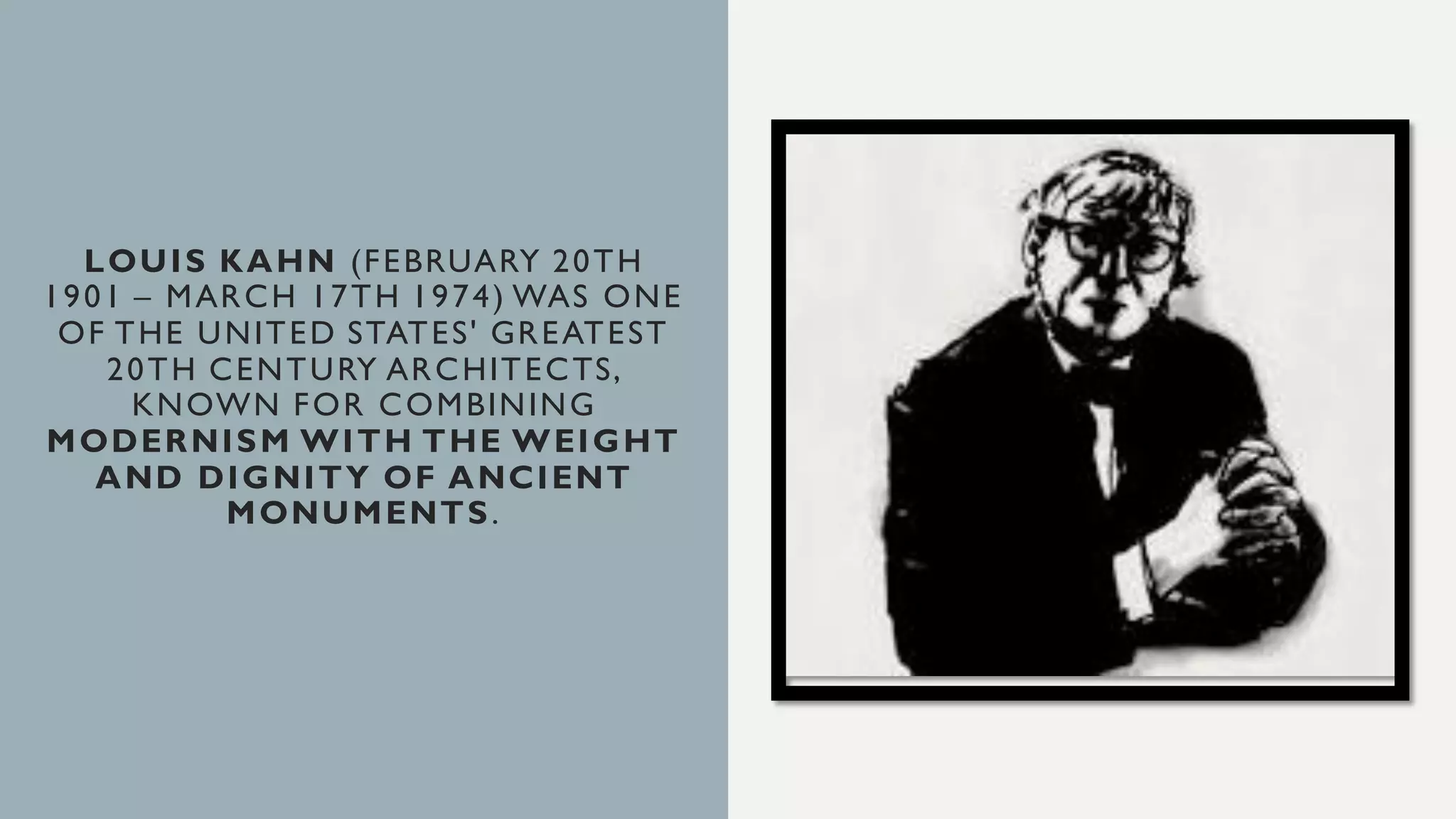
LOUIS KAHN (FEBRUARY 20TH
1901 – MARCH 17TH 1974) WAS ONE
OF THE UNITED STATES' GREATEST
20TH CENTURY ARCHITECTS,
KNOWN FOR COMBINING
MODERNISM WITH THE WEIGHT
AND DIGNITY OF ANCIENT
MONUMENTS.
BIOGRAPHY
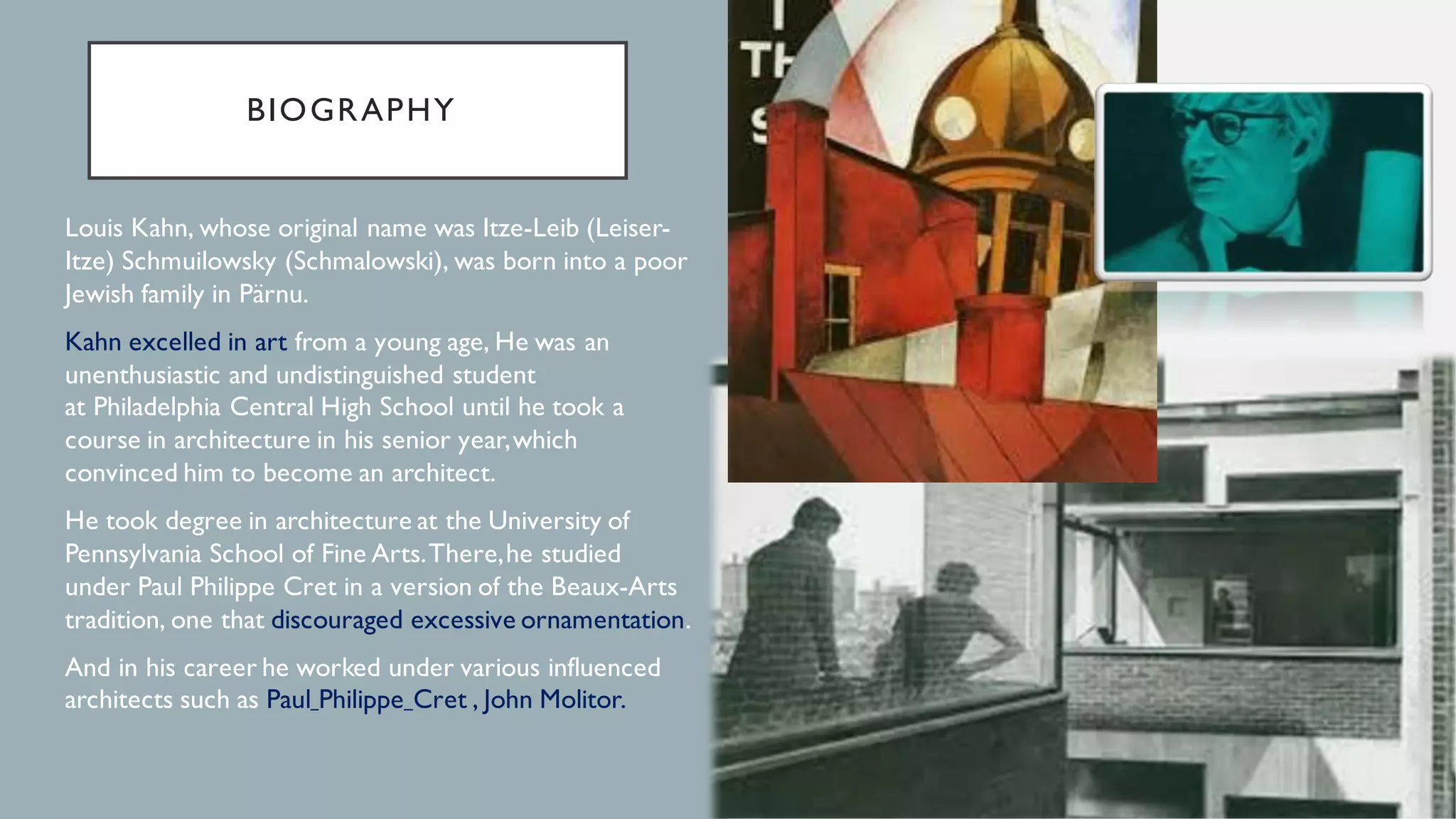
1. Louis Kahn, whose original name was Itze-Leib (Leiser-
Itze) Schmuilowsky (Schmalowski), was born into a poor
Jewish family in Pärnu.
2. Kahn excelled in art from a young age, He was an
unenthusiastic and undistinguished student
at Philadelphia Central High School until he took a
course in architecture in his senior year,which
convinced him to become an architect.
3. He took degree in architecture at the University of
Pennsylvania School of Fine Arts.There,he studied
under Paul Philippe Cret in a version of the Beaux-Arts
tradition, one that discouraged excessive ornamentation.
4. And in his career he worked under various influenced
architects such as Paul Philippe Cret , John Molitor.
INSPIRATION
-Egyptian, Greek and Roman ruins
-The sense of symmetry, order, magnificence
and strength that he felt facing the pyramids,
-The Greek temples and Roman building
heritage made him understand that the
meaning of the architecture was to be found
in its timelessness, in its way of being eternal
monument.
-Beaux-Arts tradition
-Louis Kahn made his own distinctive style
working outside the Modern Movement,
and his architecture are modern yet eternal,
like the Roman ruins that he desperately fell in
love with.
PHILOSOPHY
• “Form followsfunction” the slogan associated with
the International Style was reversed by Kahn: the
function follows the form because the form has its
primary role of conveying a sense of balance that
is apart from the activity hosted inside.
• Beyond its functional role, Louis Isadore
Kahn believed architecture must also evoke the
feeling and symbolism of timeless human values.
"The Sun does not realize how wonderful it is until after a room is
made."
""ARCHITECTURE ISTHETHOUGHTFUL
MAKING OF SPACES"
• Louis I. Kahn evolved an original theoretical and
formal language that revitalized
modern architecture.
• Beaux -arts tradition - Neoclassical architectural
style, sculptural decoration along conservative
modern lines.
• Natural Light -Brought architecture to life.
• Modernism
• To design is to plan and to organize , to order , to
relate and to control in short it embraces all means
opposing disorder and accident.
PHILOSOPHY
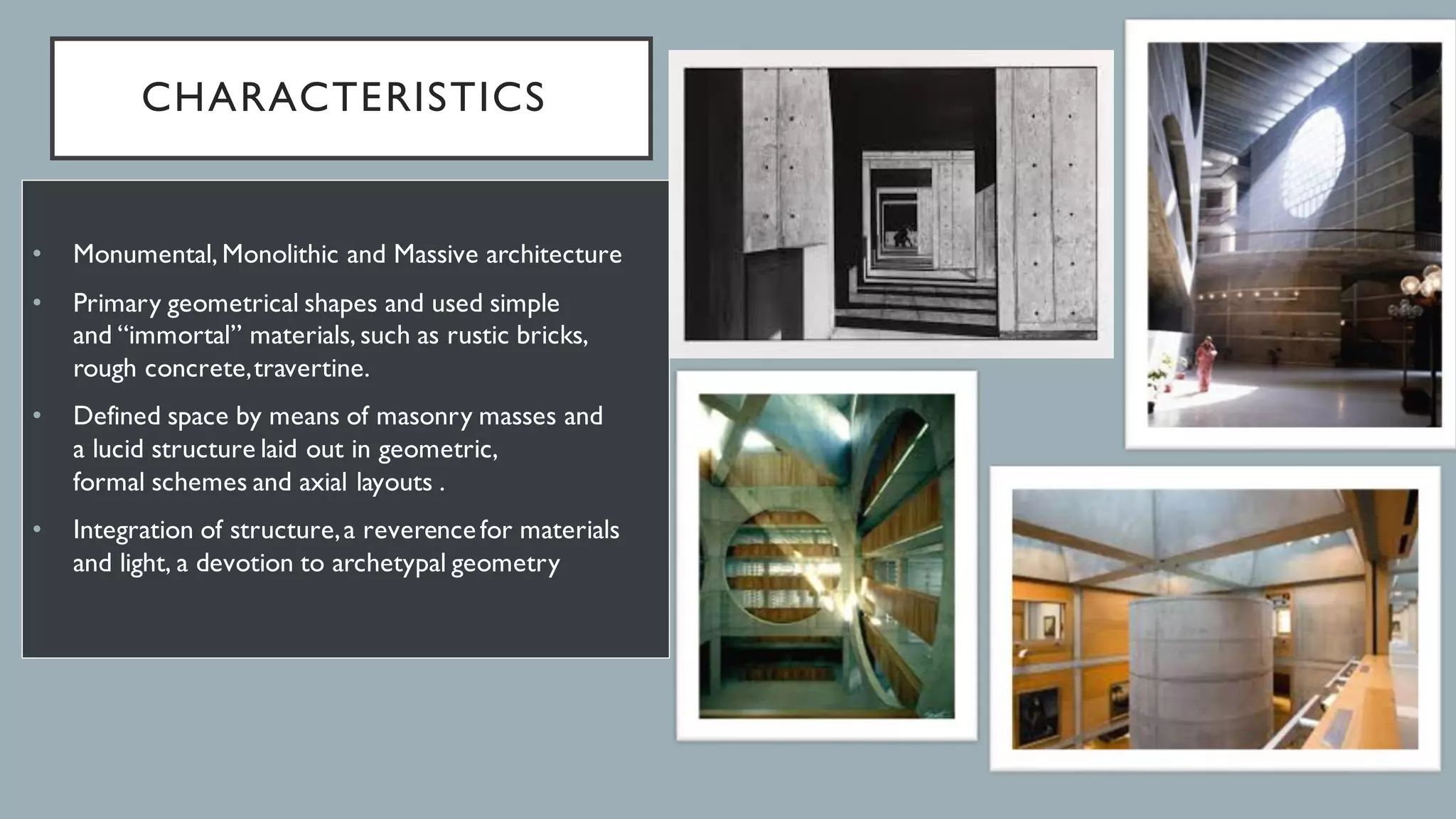
• Monumental, Monolithic and Massive architecture
• Primary geometrical shapes and used simple
and “immortal” materials, such as rustic bricks,
rough concrete,travertine.
• Defined space by means of masonry masses and
a lucid structure laid out in geometric,
formal schemes and axial layouts .
• Integration of structure,a reverencefor materials
and light, a devotion to archetypal geometry
CHARACTERISTICS
CHARACTERISTICS
• Stairs and aisles are shaped into circles
and triangles,as well as the geometrical
coffered ceilings where sometimes the
artificial lighting system is set or, more often,
the natural light passes through,giving back
interior spaces with an extraordinary
intimate privacy,nearly sacred.
• That in the purity of shapes and materials
researches the solemnity and the essence of
architecture,
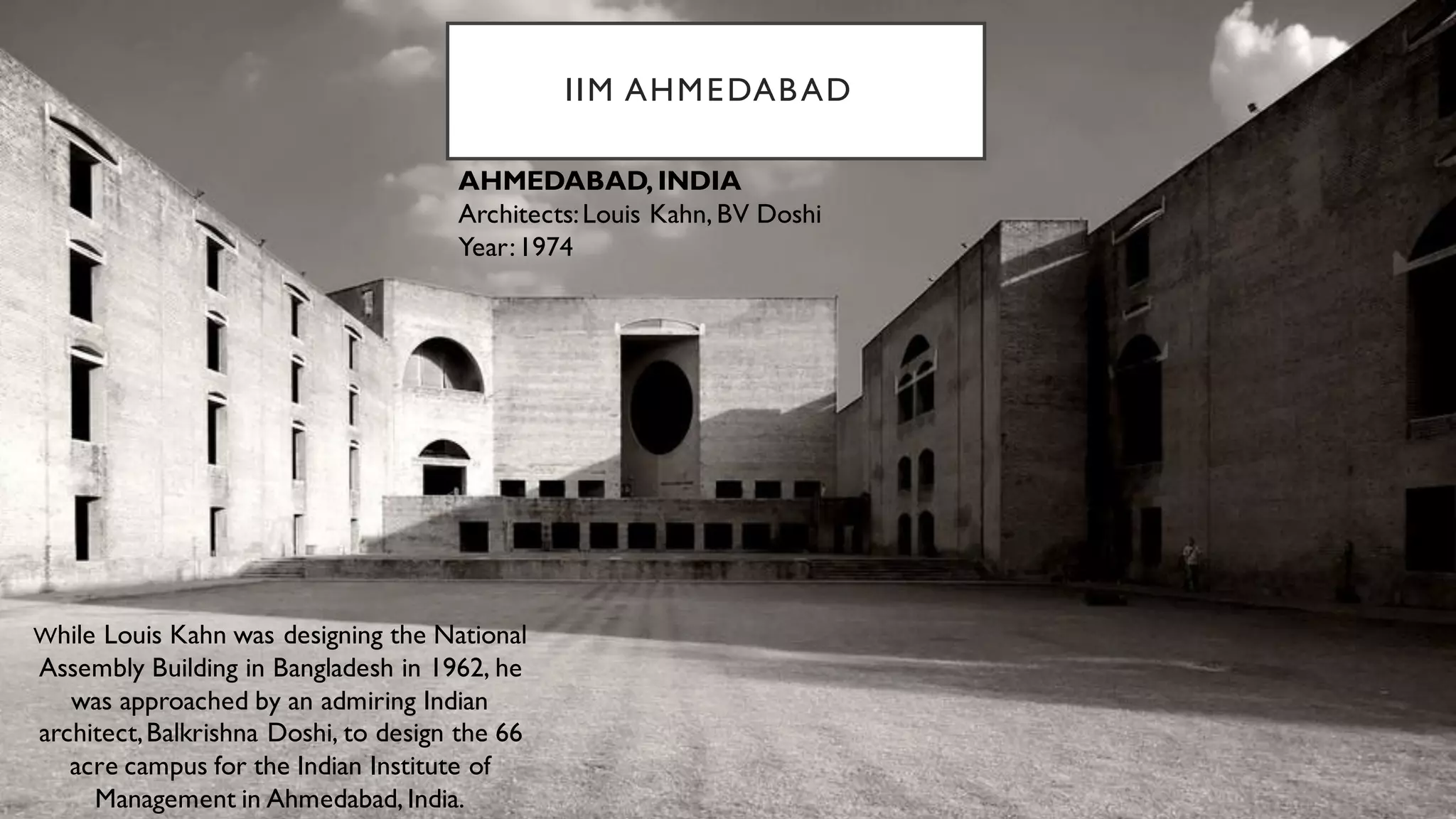
IIM AHMEDABAD
While Louis Kahn was designing the National
Assembly Building in Bangladesh in 1962, he
was approached by an admiring Indian
architect,Balkrishna Doshi, to design the 66
acre campus for the Indian Institute of
Management in Ahmedabad, India.
AHMEDABAD, INDIA
Architects:Louis Kahn, BV Doshi
Year:1974
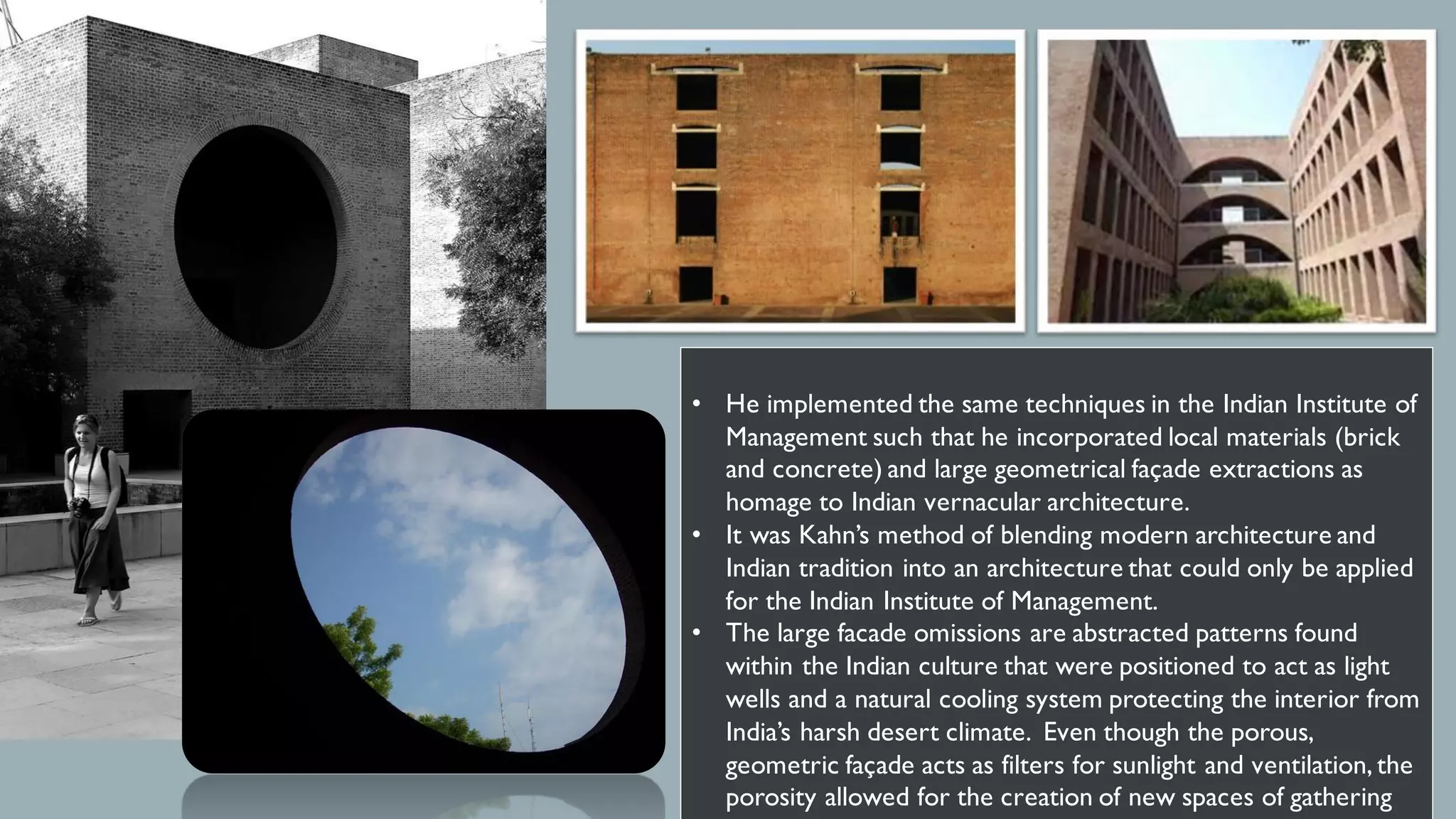
• He implemented the same techniques in the Indian Institute of
Management such that he incorporated local materials (brick
and concrete) and large geometrical façade extractions as
homage to Indian vernacular architecture.
• It was Kahn’s method of blending modern architecture and
Indian tradition into an architecture that could only be applied
for the Indian Institute of Management.
• The large facade omissions are abstracted patterns found
within the Indian culture that were positioned to act as light
wells and a natural cooling system protecting the interior from
India’s harsh desert climate. Even though the porous,
geometric façade acts as filters for sunlight and ventilation, the
porosity allowed for the creation of new spaces of gathering
NATIONAL ASSEMBLY
BUILDING OF BANGLADESH
• Jatiyo Sangsad Bhaban is the
National Assembly Building of
Bangladesh, located in the capital
Dhaka. Is one of the largest
legislative complexes in the world. It
houses all parliamentary activities of
Bangladesh.
• Louis Kahn’s National Assembly Building of
Bangladesh in Dhaka is an extraordinary example of
modern architecture being transcribed as a part of
Bangali vernacular architecture.
• The architect drew upon and assimilated both the
vernacular and monumental archetypes of the
region, and abstracted and transformed,to a degree
of utter purity, lasting architectural ideas from many
eras and civilisations.
• The core of the composition is the assembly
chamber,a 300-seat, 30-meters high, domed
amphitheatre and the library.These spaces alternate
among eight "light and air courts" and a restaurant,
as well as entrances to the garden and mosque.
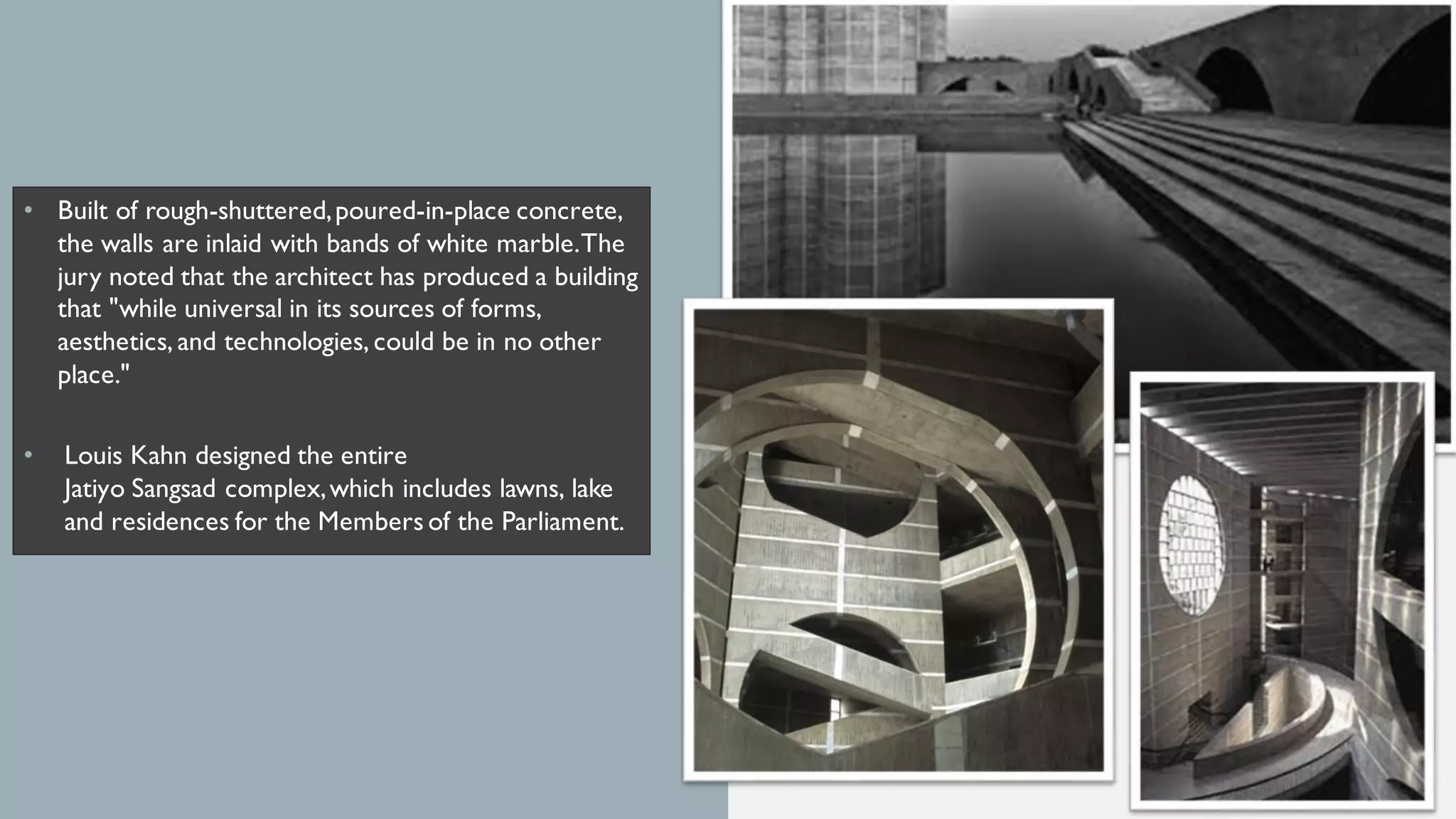
• Built of rough-shuttered,poured-in-place concrete,
the walls are inlaid with bands of white marble.The
jury noted that the architect has produced a building
that "while universal in its sources of forms,
aesthetics, and technologies, could be in no other
place."
• Louis Kahn designed the entire
Jatiyo Sangsad complex,which includes lawns, lake
and residences for the Members of the Parliament.
LOUIS KAHN'S WORK INFUSED THE INTERNATIONAL
STYLE WITH A FASTIDIOUS, HIGHLY PERSONAL TASTE,
A POETRY OF LIGHT.
THANK YOU!
309109 GAYATRI GIRAM
309110 MOHINI JADHAV
309111 RADHIKA JADHAV
309112 SHRUTI JADHAV

Louis i kahn architecture

  • 1.
  • 2.
    LOUIS KAHN (FEBRUARY20TH 1901 – MARCH 17TH 1974) WAS ONE OF THE UNITED STATES' GREATEST 20TH CENTURY ARCHITECTS, KNOWN FOR COMBINING MODERNISM WITH THE WEIGHT AND DIGNITY OF ANCIENT MONUMENTS.
  • 3.
    BIOGRAPHY 1. Louis Kahn,whose original name was Itze-Leib (Leiser- Itze) Schmuilowsky (Schmalowski), was born into a poor Jewish family in Pärnu. 2. Kahn excelled in art from a young age, He was an unenthusiastic and undistinguished student at Philadelphia Central High School until he took a course in architecture in his senior year,which convinced him to become an architect. 3. He took degree in architecture at the University of Pennsylvania School of Fine Arts.There,he studied under Paul Philippe Cret in a version of the Beaux-Arts tradition, one that discouraged excessive ornamentation. 4. And in his career he worked under various influenced architects such as Paul Philippe Cret , John Molitor.
  • 4.
    INSPIRATION -Egyptian, Greek andRoman ruins -The sense of symmetry, order, magnificence and strength that he felt facing the pyramids, -The Greek temples and Roman building heritage made him understand that the meaning of the architecture was to be found in its timelessness, in its way of being eternal monument. -Beaux-Arts tradition -Louis Kahn made his own distinctive style working outside the Modern Movement, and his architecture are modern yet eternal, like the Roman ruins that he desperately fell in love with.
  • 5.
    PHILOSOPHY • “Form followsfunction”the slogan associated with the International Style was reversed by Kahn: the function follows the form because the form has its primary role of conveying a sense of balance that is apart from the activity hosted inside. • Beyond its functional role, Louis Isadore Kahn believed architecture must also evoke the feeling and symbolism of timeless human values. "The Sun does not realize how wonderful it is until after a room is made."
  • 6.
    ""ARCHITECTURE ISTHETHOUGHTFUL MAKING OFSPACES" • Louis I. Kahn evolved an original theoretical and formal language that revitalized modern architecture. • Beaux -arts tradition - Neoclassical architectural style, sculptural decoration along conservative modern lines. • Natural Light -Brought architecture to life. • Modernism • To design is to plan and to organize , to order , to relate and to control in short it embraces all means opposing disorder and accident. PHILOSOPHY
  • 7.
    • Monumental, Monolithicand Massive architecture • Primary geometrical shapes and used simple and “immortal” materials, such as rustic bricks, rough concrete,travertine. • Defined space by means of masonry masses and a lucid structure laid out in geometric, formal schemes and axial layouts . • Integration of structure,a reverencefor materials and light, a devotion to archetypal geometry CHARACTERISTICS
  • 8.
    CHARACTERISTICS • Stairs andaisles are shaped into circles and triangles,as well as the geometrical coffered ceilings where sometimes the artificial lighting system is set or, more often, the natural light passes through,giving back interior spaces with an extraordinary intimate privacy,nearly sacred. • That in the purity of shapes and materials researches the solemnity and the essence of architecture,
  • 9.
    IIM AHMEDABAD While LouisKahn was designing the National Assembly Building in Bangladesh in 1962, he was approached by an admiring Indian architect,Balkrishna Doshi, to design the 66 acre campus for the Indian Institute of Management in Ahmedabad, India. AHMEDABAD, INDIA Architects:Louis Kahn, BV Doshi Year:1974
  • 10.
    • He implementedthe same techniques in the Indian Institute of Management such that he incorporated local materials (brick and concrete) and large geometrical façade extractions as homage to Indian vernacular architecture. • It was Kahn’s method of blending modern architecture and Indian tradition into an architecture that could only be applied for the Indian Institute of Management. • The large facade omissions are abstracted patterns found within the Indian culture that were positioned to act as light wells and a natural cooling system protecting the interior from India’s harsh desert climate. Even though the porous, geometric façade acts as filters for sunlight and ventilation, the porosity allowed for the creation of new spaces of gathering
  • 11.
    NATIONAL ASSEMBLY BUILDING OFBANGLADESH • Jatiyo Sangsad Bhaban is the National Assembly Building of Bangladesh, located in the capital Dhaka. Is one of the largest legislative complexes in the world. It houses all parliamentary activities of Bangladesh.
  • 12.
    • Louis Kahn’sNational Assembly Building of Bangladesh in Dhaka is an extraordinary example of modern architecture being transcribed as a part of Bangali vernacular architecture. • The architect drew upon and assimilated both the vernacular and monumental archetypes of the region, and abstracted and transformed,to a degree of utter purity, lasting architectural ideas from many eras and civilisations. • The core of the composition is the assembly chamber,a 300-seat, 30-meters high, domed amphitheatre and the library.These spaces alternate among eight "light and air courts" and a restaurant, as well as entrances to the garden and mosque.
  • 13.
    • Built ofrough-shuttered,poured-in-place concrete, the walls are inlaid with bands of white marble.The jury noted that the architect has produced a building that "while universal in its sources of forms, aesthetics, and technologies, could be in no other place." • Louis Kahn designed the entire Jatiyo Sangsad complex,which includes lawns, lake and residences for the Members of the Parliament.
  • 14.
    LOUIS KAHN'S WORKINFUSED THE INTERNATIONAL STYLE WITH A FASTIDIOUS, HIGHLY PERSONAL TASTE, A POETRY OF LIGHT.
  • 15.
    THANK YOU! 309109 GAYATRIGIRAM 309110 MOHINI JADHAV 309111 RADHIKA JADHAV 309112 SHRUTI JADHAV