Dr. Benedetto Gesmundo
MIR Occupational Medicine
Health Surveillance Area
CENTE FOR OCCUPATIONAL HEALTH AND SAFETY OF HUELVA
Course “First Aid” Item 3 3 March, 2015
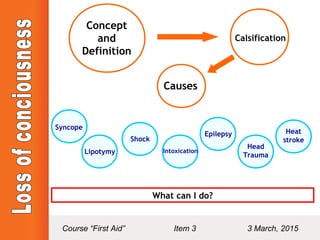
Concept
and
Definition
Calsification
Causes
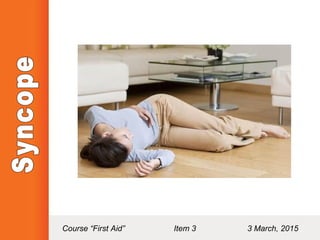
Syncope
Lipotymy
Shock
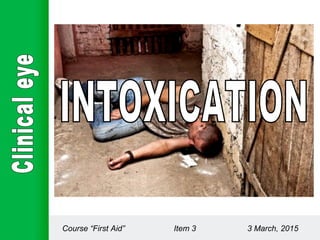
Intoxication
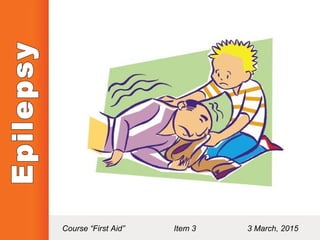
Epilepsy
Head
Trauma
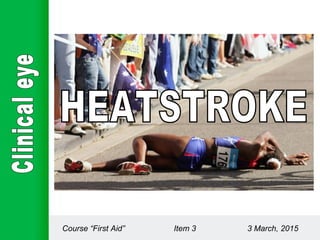
Heat
stroke
What can I do?
Course “First Aid” Item 3 3 March, 2015
Concience
Course “First Aid” Item 3 3 March, 2015
Philosophy
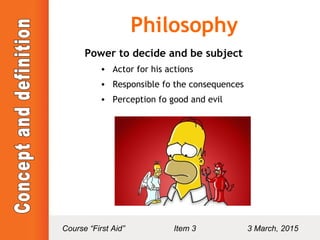
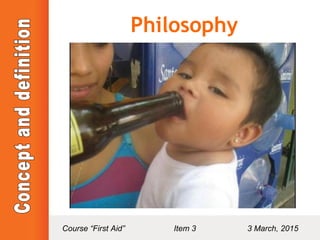
Power to decide and be subject
• Actor for his actions
• Responsible fo the consequences
• Perception fo good and evil
Course “First Aid” Item 3 3 March, 2015
Facultad de decidir y hacerse sujeto
• Actor de sus actos
• Responsable de las consecuencia
• Percepción del bien y mal
Philosophy
Course “First Aid” Item 3 3 March, 2015
Psyquiatry
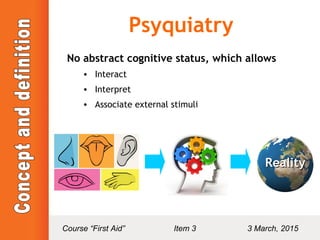
No abstract cognitive status, which allows
• Interact
• Interpret
• Associate external stimuli
RealityReality
Course “First Aid” Item 3 3 March, 2015
General definition
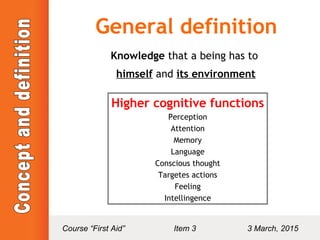
Knowledge that a being has to
himself and its environment
Higher cognitive functions
Perception
Attention
Memory
Language
Conscious thought
Targetes actions
Feeling
Intellingence
Course “First Aid” Item 3 3 March, 2015
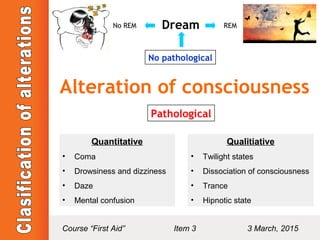
Alteration of consciousness
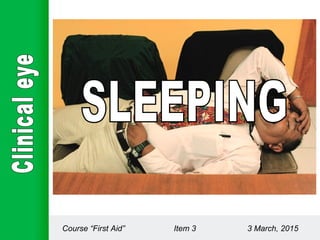
No pathological
DreamNo REM REM
Pathological
Quantitative
• Coma
• Drowsiness and dizziness
• Daze
• Mental confusion
Qualitiative
• Twilight states
• Dissociation of consciousness
• Trance
• Hipnotic state
Course “First Aid” Item 3 3 March, 2015
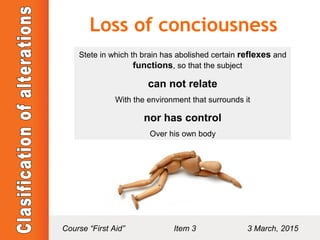
Loss of conciousness
Stete in which th brain has abolished certain reflexes and
functions, so that the subject
can not relate
With the environment that surrounds it
nor has control
Over his own body
Course “First Aid” Item 3 3 March, 2015
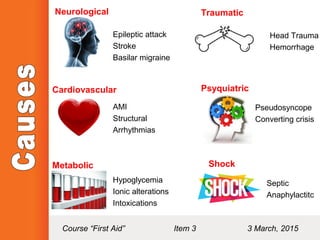
Neurological
Cardiovascular
Metabolic
Traumatic
Psyquiatric
Shock
Epileptic attack
Stroke
Basilar migraine
AMI
Structural
Arrhythmias
Hypoglycemia
Ionic alterations
Intoxications
Head Trauma
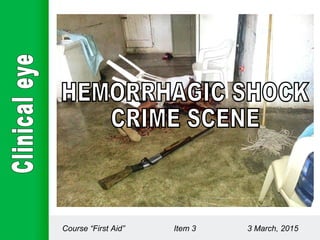
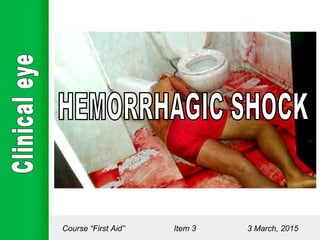
Hemorrhage
Pseudosyncope
Converting crisis
Septic
Anaphylactitc
Course “First Aid” Item 3 3 March, 2015
Sudden loss of conciousness
and usually brief and
reversible
1. Loss of conciousness
2. Quick start
3. Short
4. No neurological sequelae
Course “First Aid” Item 3 3 March, 2015
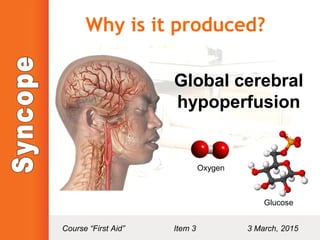
Why is it produced?
Global cerebral
hypoperfusion
Oxygen
Glucose
Course “First Aid” Item 3 3 March, 2015
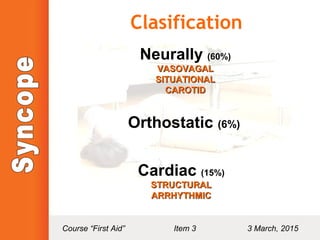
Clasification
Neurally (60%)
VASOVAGALVASOVAGAL
SITUATIONALSITUATIONAL
CAROTIDCAROTID
Orthostatic (6%)
Cardiac (15%)
STRUCTURALSTRUCTURAL
ARRHYTHMICARRHYTHMIC
Course “First Aid” Item 3 3 March, 2015
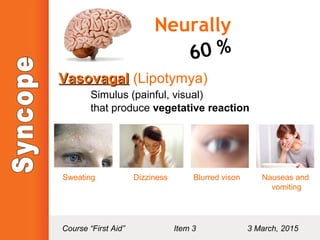
Neurally
60 %
VasovagalVasovagal (Lipotymya)
Simulus (painful, visual)
that produce vegetative reaction
Sweating Dizziness Blurred vison Nauseas and
vomiting
Course “First Aid” Item 3 3 March, 2015
Neurally
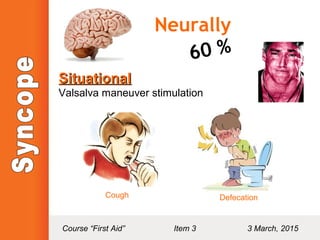
60 %
SituationalSituational
Valsalva maneuver stimulation
Cough Defecation
Course “First Aid” Item 3 3 March, 2015
Neurally
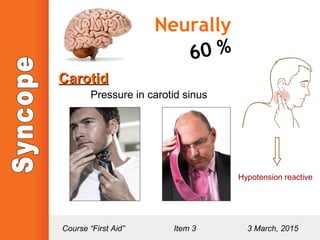
60 %
CarotidCarotid
Pressure in carotid sinus
Hypotension reactive
Course “First Aid” Item 3 3 March, 2015
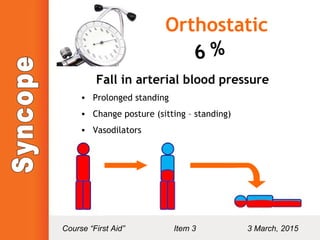
Orthostatic
6 %
Fall in arterial blood pressure
• Prolonged standing
• Change posture (sitting – standing)
• Vasodilators
Course “First Aid” Item 3 3 March, 2015
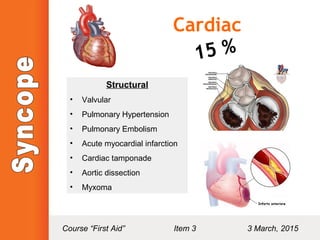
Cardiac
15 %
Structural
• Valvular
• Pulmonary Hypertension
• Pulmonary Embolism
• Acute myocardial infarction
• Cardiac tamponade
• Aortic dissection
• Myxoma
Course “First Aid” Item 3 3 March, 2015
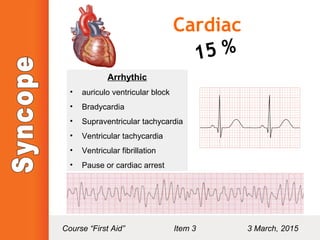
Cardiac
15 %
Arrhythic
• auriculo ventricular block
• Bradycardia
• Supraventricular tachycardia
• Ventricular tachycardia
• Ventricular fibrillation
• Pause or cardiac arrest
Course “First Aid” Item 3 3 March, 2015
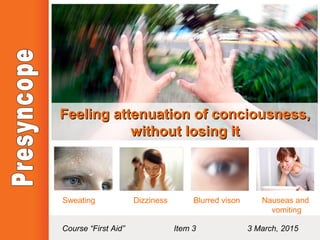
Feeling attenuation of conciousness,Feeling attenuation of conciousness,
without losing itwithout losing it
Course “First Aid” Item 3 3 March, 2015
Sweating Dizziness Blurred vison Nauseas and
vomiting
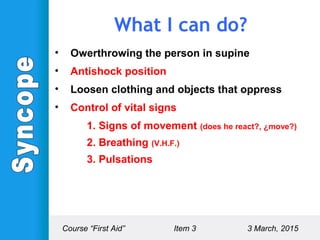
What I can do?
• Owerthrowing the person in supine
• Antishock position
• Loosen clothing and objects that oppress
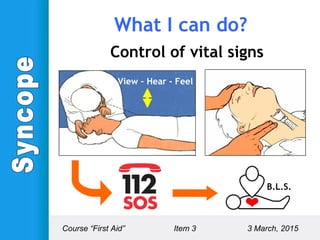
• Control of vital signs
1. Signs of movement (does he react?, ¿move?)
2. Breathing (V.H.F.)
3. Pulsations
Course “First Aid” Item 3 3 March, 2015
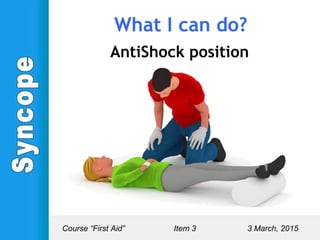
AntiShock position
Course “First Aid” Item 3 3 March, 2015
What I can do?
Control of vital signs
View – Hear - Feel
B.L.S.
Course “First Aid” Item 3 3 March, 2015
What I can do?
Course “First Aid” Item 3 3 March, 2015
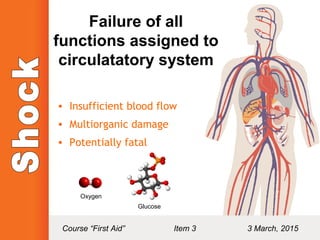
Failure of all
functions assigned to
circulatatory system
• Insufficient blood flow
• Multiorganic damage
• Potentially fatal
Oxygen
Glucose
Course “First Aid” Item 3 3 March, 2015
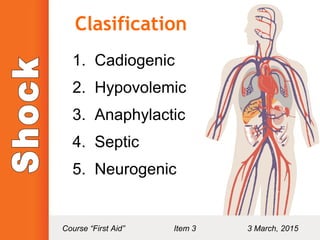
Clasification
1. Cadiogenic
2. Hypovolemic
3. Anaphylactic
4. Septic
5. Neurogenic
Course “First Aid” Item 3 3 March, 2015
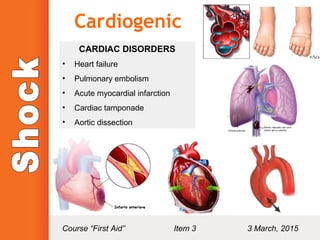
Cardiogenic
CARDIAC DISORDERS
• Heart failure
• Pulmonary embolism
• Acute myocardial infarction
• Cardiac tamponade
• Aortic dissection
Course “First Aid” Item 3 3 March, 2015
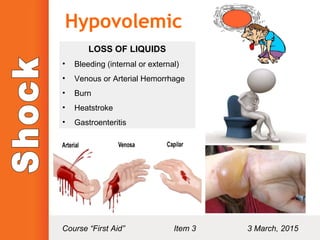
Hypovolemic
LOSS OF LIQUIDS
• Bleeding (internal or external)
• Venous or Arterial Hemorrhage
• Burn
• Heatstroke
• Gastroenteritis
Course “First Aid” Item 3 3 March, 2015
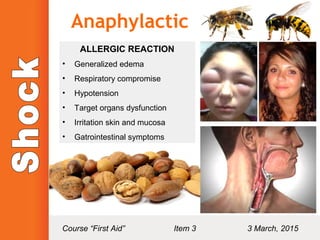
Anaphylactic
ALLERGIC REACTION
• Generalized edema
• Respiratory compromise
• Hypotension
• Target organs dysfunction
• Irritation skin and mucosa
• Gatrointestinal symptoms
Course “First Aid” Item 3 3 March, 2015
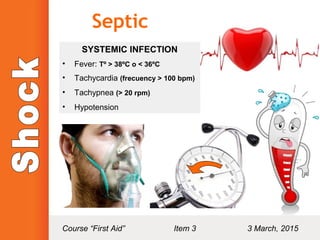
Septic
SYSTEMIC INFECTION
• Fever: Tº > 38ºC o < 36ºC
• Tachycardia (frecuency > 100 bpm)
• Tachypnea (> 20 rpm)
• Hypotension
Course “First Aid” Item 3 3 March, 2015
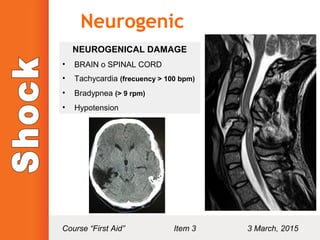
Neurogenic
NEUROGENICAL DAMAGE
• BRAIN o SPINAL CORD
• Tachycardia (frecuency > 100 bpm)
• Bradypnea (> 9 rpm)
• Hypotension
Course “First Aid” Item 3 3 March, 2015
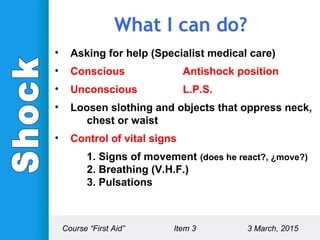
• Asking for help (Specialist medical care)
• Conscious Antishock position
• Unconscious L.P.S.
• Loosen slothing and objects that oppress neck,
chest or waist
• Control of vital signs
1. Signs of movement (does he react?, ¿move?)
2. Breathing (V.H.F.)
3. Pulsations
What I can do?
Course “First Aid” Item 3 3 March, 2015
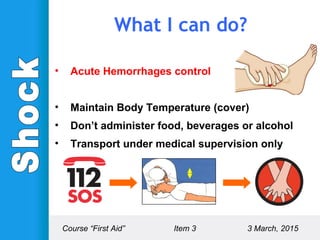
• Acute Hemorrhages control
• Maintain Body Temperature (cover)
• Don’t administer food, beverages or alcohol
• Transport under medical supervision only
What I can do?
Course “First Aid” Item 3 3 March, 2015
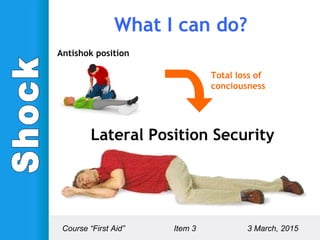
Antishok position
Lateral Position Security
Total loss of
conciousness
What I can do?
Course “First Aid” Item 3 3 March, 2015
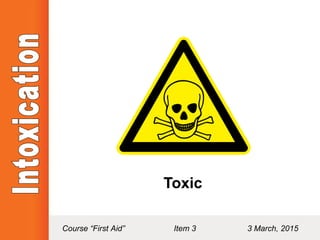
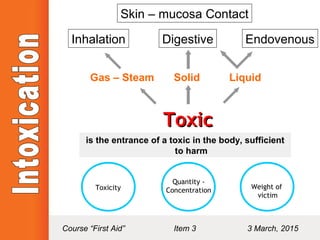
ToxicToxic
Inhalation Digestive Endovenous
Gas – Steam Solid Liquid
Skin – mucosa Contact
is the entrance of a toxic in the body, sufficient
to harm
Toxicity
Quantity -
Concentration Weight of
victim
Course “First Aid” Item 3 3 March, 2015
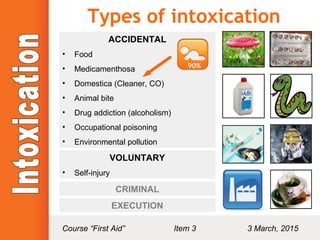
Types of intoxication
ACCIDENTAL
• Food
• Medicamenthosa
• Domestica (Cleaner, CO)
• Animal bite
• Drug addiction (alcoholism)
• Occupational poisoning
• Environmental pollution
VOLUNTARY
• Self-injury
CRIMINAL
EXECUTION
90%
Course “First Aid” Item 3 3 March, 2015
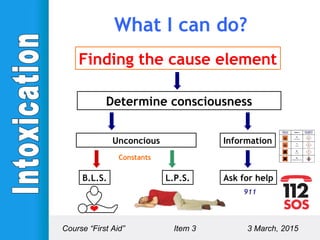
Finding the cause element
Determine consciousness
Unconcious Information
Ask for helpL.P.S.
Constants
B.L.S.
911
Course “First Aid” Item 3 3 March, 2015
What I can do?
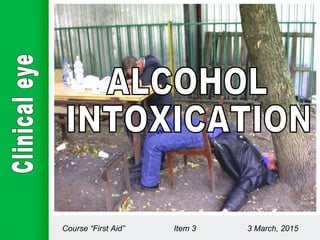
Alcoholic intoxication
Breath alcohol
Loss of conciousness or convulsions
Nauseas y vomiting
Dilated pupils
Rapid Eyes Moviment
Rapid heartbeat
Slow breathing
Loss of balance (Kinetic-Static)
Slurred speech
Rapid mood swings (Agressiveness)
Course “First Aid” Item 3 3 March, 2015
Alcohol withdrawal
Sweat
Tachycardia
Trembling hands
Insomnia
Nausea y vomiting
Hallucinations (tactile, visual, auditory)
Psychomotor agitation
Anxiety
Tonic – clonic convulsions
Course “First Aid” Item 3 3 March, 2015
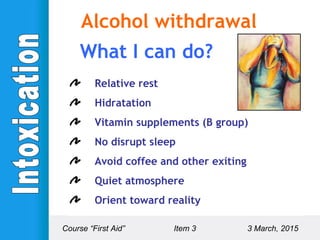
Relative rest
Hidratation
Vitamin supplements (B group)
No disrupt sleep
Avoid coffee and other exiting
Quiet atmosphere
Orient toward reality
Course “First Aid” Item 3 3 March, 2015
Alcohol withdrawal
What I can do?
Course “First Aid” Item 3 3 March, 2015
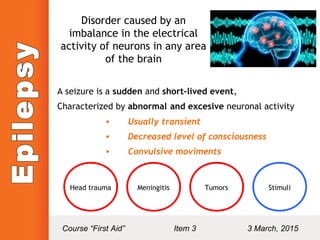
Disorder caused by an
imbalance in the electrical
activity of neurons in any area
of the brain
A seizure is a sudden and short-lived event,
Characterized by abnormal and excesive neuronal activity
• Usually transient
• Decreased level of consciousness
• Convulsive moviments
Head trauma Meningitis Tumors Stimuli
Course “First Aid” Item 3 3 March, 2015
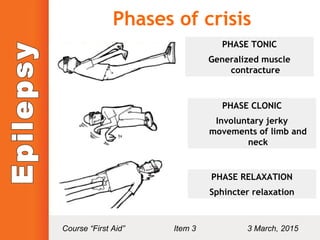
PHASE TONIC
Generalized muscle
contracture
PHASE CLONIC
Involuntary jerky
movements of limb and
neck
PHASE RELAXATION
Sphincter relaxation
Phases of crisis
Course “First Aid” Item 3 3 March, 2015
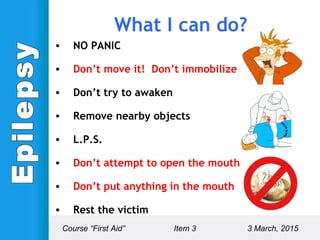
• NO PANIC
• Don’t move it! Don’t immobilize it!
• Don’t try to awaken
• Remove nearby objects
• L.P.S.
• Don’t attempt to open the mouth
• Don’t put anything in the mouth
• Rest the victim
Course “First Aid” Item 3 3 March, 2015
What I can do?
Course “First Aid” Item 3 3 March, 2015
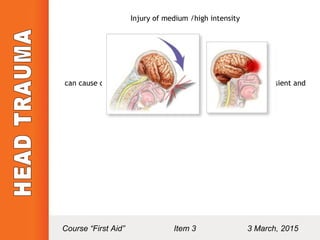
Injury of medium /high intensity
can cause concussion: Impaired conciousness of character transient and
reversible
It can last from minutes to hours
Course “First Aid” Item 3 3 March, 2015
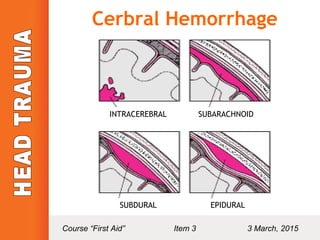
INTRACEREBRAL SUBARACHNOID
SUBDURAL EPIDURAL
Cerbral Hemorrhage
Course “First Aid” Item 3 3 March, 2015
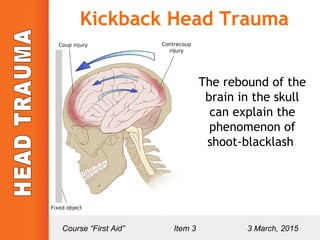
Kickback Head Trauma
The rebound of the
brain in the skull
can explain the
phenomenon of
shoot-blacklash
Course “First Aid” Item 3 3 March, 2015
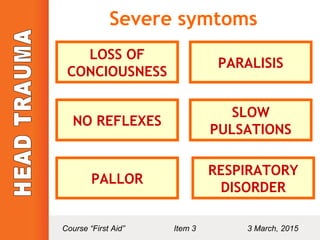
Severe symtoms
LOSS OF
CONCIOUSNESS
PARALISIS
NO REFLEXES
SLOW
PULSATIONS
PALLOR
RESPIRATORY
DISORDER
Course “First Aid” Item 3 3 March, 2015
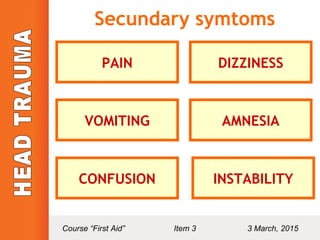
Secundary symtoms
PAIN DIZZINESS
VOMITING AMNESIA
CONFUSION INSTABILITY
Course “First Aid” Item 3 3 March, 2015
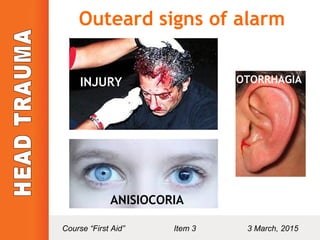
Outeard signs of alarm
ANISIOCORIA
OTORRHAGIAINJURY
Course “First Aid” Item 3 3 March, 2015
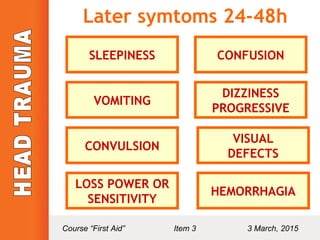
Later symtoms 24-48h
SLEEPINESS CONFUSION
VOMITING
DIZZINESS
PROGRESSIVE
CONVULSION
VISUAL
DEFECTS
LOSS POWER OR
SENSITIVITY
HEMORRHAGIA
Course “First Aid” Item 3 3 March, 2015
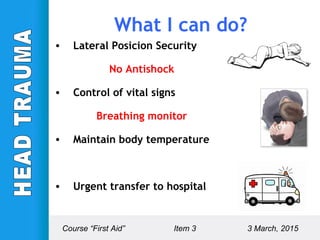
• Lateral Posicion Security
No Antishock
• Control of vital signs
Breathing monitor
• Maintain body temperature
• Urgent transfer to hospital
Course “First Aid” Item 3 3 March, 2015
What I can do?
Course “First Aid” Item 3 3 March, 2015
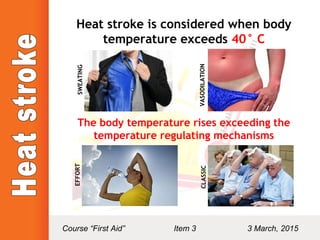
Heat stroke is considered when body
temperature exceeds 40° C
The body temperature rises exceeding the
temperature regulating mechanisms
SWEATING
VASODILATION
EFFORT
CLASSIC
Course “First Aid” Item 3 3 March, 2015
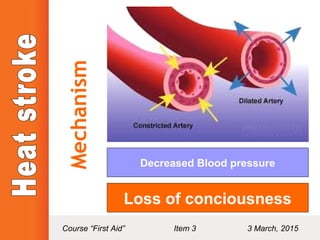
Decreased Blood pressure
Loss of conciousness
Mechanism
Course “First Aid” Item 3 3 March, 2015
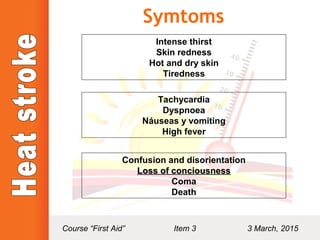
Symtoms
Intense thirst
Skin redness
Hot and dry skin
Tiredness
Tachycardia
Dyspnoea
Náuseas y vomiting
High fever
Confusion and disorientation
Loss of conciousnessLoss of conciousness
Coma
Death
Course “First Aid” Item 3 3 March, 2015
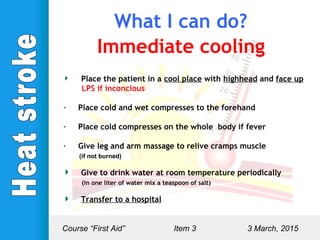
Immediate cooling
Place the patient in a cool place with highhead and face up
LPS if inconcious
- Place cold and wet compresses to the forehand
- Place cold compresses on the whole body if fever
- Give leg and arm massage to relive cramps muscle
(if not burned)
Give to drink water at room temperature periodically
(in one liter of water mix a teaspoon of salt)
Transfer to a hospital
Course “First Aid” Item 3 3 March, 2015
What I can do?
Loss of conciousnessLoss of conciousness
NO WITNESSED
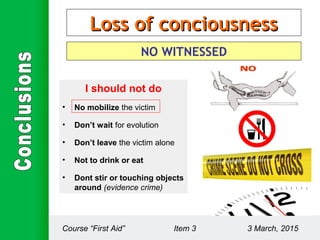
I should not do
• No mobilize the victim
• Don’t wait for evolution
• Don’t leave the victim alone
• Not to drink or eat
• Dont stir or touching objects
around (evidence crime)
Course “First Aid” Item 3 3 March, 2015
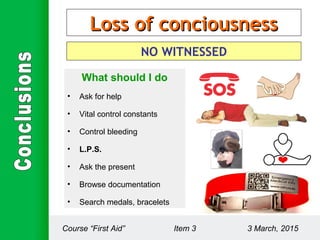
What should I do
• Ask for help
• Vital control constants
• Control bleeding
• L.P.S.
• Ask the present
• Browse documentation
• Search medals, bracelets
Course “First Aid” Item 3 3 March, 2015
Loss of conciousnessLoss of conciousness
NO WITNESSED
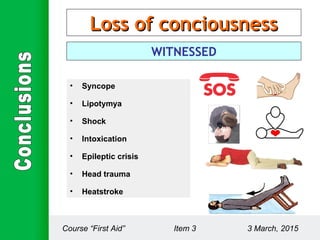
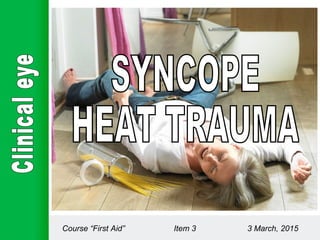
• Syncope
• Lipotymya
• Shock
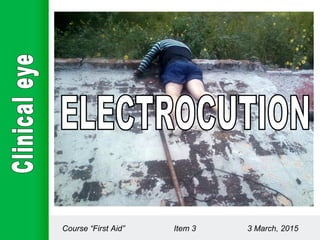
• Intoxication
• Epileptic crisis
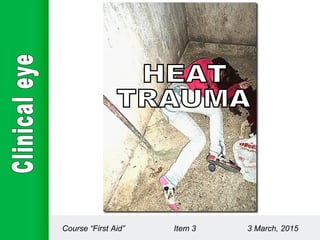
• Head trauma
• Heatstroke
Course “First Aid” Item 3 3 March, 2015
Loss of conciousnessLoss of conciousness
WITNESSED
Course “First Aid” Item 3 3 March, 2015

Loss of Consciousness

  • 1.
    Dr. Benedetto Gesmundo MIROccupational Medicine Health Surveillance Area CENTE FOR OCCUPATIONAL HEALTH AND SAFETY OF HUELVA Course “First Aid” Item 3 3 March, 2015
  • 2.
  • 3.
  • 4.
    Philosophy Power to decideand be subject • Actor for his actions • Responsible fo the consequences • Perception fo good and evil Course “First Aid” Item 3 3 March, 2015
  • 5.
    Facultad de decidiry hacerse sujeto • Actor de sus actos • Responsable de las consecuencia • Percepción del bien y mal Philosophy Course “First Aid” Item 3 3 March, 2015
  • 6.
    Psyquiatry No abstract cognitivestatus, which allows • Interact • Interpret • Associate external stimuli RealityReality Course “First Aid” Item 3 3 March, 2015
  • 7.
    General definition Knowledge thata being has to himself and its environment Higher cognitive functions Perception Attention Memory Language Conscious thought Targetes actions Feeling Intellingence Course “First Aid” Item 3 3 March, 2015
  • 8.
    Alteration of consciousness Nopathological DreamNo REM REM Pathological Quantitative • Coma • Drowsiness and dizziness • Daze • Mental confusion Qualitiative • Twilight states • Dissociation of consciousness • Trance • Hipnotic state Course “First Aid” Item 3 3 March, 2015
  • 9.
    Loss of conciousness Stetein which th brain has abolished certain reflexes and functions, so that the subject can not relate With the environment that surrounds it nor has control Over his own body Course “First Aid” Item 3 3 March, 2015
  • 10.
    Neurological Cardiovascular Metabolic Traumatic Psyquiatric Shock Epileptic attack Stroke Basilar migraine AMI Structural Arrhythmias Hypoglycemia Ionicalterations Intoxications Head Trauma Hemorrhage Pseudosyncope Converting crisis Septic Anaphylactitc Course “First Aid” Item 3 3 March, 2015
  • 11.
    Course “First Aid”Item 3 3 March, 2015
  • 12.
    Sudden loss ofconciousness and usually brief and reversible 1. Loss of conciousness 2. Quick start 3. Short 4. No neurological sequelae Course “First Aid” Item 3 3 March, 2015
  • 13.
    Why is itproduced? Global cerebral hypoperfusion Oxygen Glucose Course “First Aid” Item 3 3 March, 2015
  • 14.
    Clasification Neurally (60%) VASOVAGALVASOVAGAL SITUATIONALSITUATIONAL CAROTIDCAROTID Orthostatic (6%) Cardiac(15%) STRUCTURALSTRUCTURAL ARRHYTHMICARRHYTHMIC Course “First Aid” Item 3 3 March, 2015
  • 15.
    Neurally 60 % VasovagalVasovagal (Lipotymya) Simulus(painful, visual) that produce vegetative reaction Sweating Dizziness Blurred vison Nauseas and vomiting Course “First Aid” Item 3 3 March, 2015
  • 16.
    Neurally 60 % SituationalSituational Valsalva maneuverstimulation Cough Defecation Course “First Aid” Item 3 3 March, 2015
  • 17.
    Neurally 60 % CarotidCarotid Pressure incarotid sinus Hypotension reactive Course “First Aid” Item 3 3 March, 2015
  • 18.
    Orthostatic 6 % Fall inarterial blood pressure • Prolonged standing • Change posture (sitting – standing) • Vasodilators Course “First Aid” Item 3 3 March, 2015
  • 19.
    Cardiac 15 % Structural • Valvular •Pulmonary Hypertension • Pulmonary Embolism • Acute myocardial infarction • Cardiac tamponade • Aortic dissection • Myxoma Course “First Aid” Item 3 3 March, 2015
  • 20.
    Cardiac 15 % Arrhythic • auriculoventricular block • Bradycardia • Supraventricular tachycardia • Ventricular tachycardia • Ventricular fibrillation • Pause or cardiac arrest Course “First Aid” Item 3 3 March, 2015
  • 21.
    Feeling attenuation ofconciousness,Feeling attenuation of conciousness, without losing itwithout losing it Course “First Aid” Item 3 3 March, 2015 Sweating Dizziness Blurred vison Nauseas and vomiting
  • 22.
    What I cando? • Owerthrowing the person in supine • Antishock position • Loosen clothing and objects that oppress • Control of vital signs 1. Signs of movement (does he react?, ¿move?) 2. Breathing (V.H.F.) 3. Pulsations Course “First Aid” Item 3 3 March, 2015
  • 23.
    AntiShock position Course “FirstAid” Item 3 3 March, 2015 What I can do?
  • 24.
    Control of vitalsigns View – Hear - Feel B.L.S. Course “First Aid” Item 3 3 March, 2015 What I can do?
  • 25.
    Course “First Aid”Item 3 3 March, 2015
  • 26.
    Failure of all functionsassigned to circulatatory system • Insufficient blood flow • Multiorganic damage • Potentially fatal Oxygen Glucose Course “First Aid” Item 3 3 March, 2015
  • 27.
    Clasification 1. Cadiogenic 2. Hypovolemic 3.Anaphylactic 4. Septic 5. Neurogenic Course “First Aid” Item 3 3 March, 2015
  • 28.
    Cardiogenic CARDIAC DISORDERS • Heartfailure • Pulmonary embolism • Acute myocardial infarction • Cardiac tamponade • Aortic dissection Course “First Aid” Item 3 3 March, 2015
  • 29.
    Hypovolemic LOSS OF LIQUIDS •Bleeding (internal or external) • Venous or Arterial Hemorrhage • Burn • Heatstroke • Gastroenteritis Course “First Aid” Item 3 3 March, 2015
  • 30.
    Anaphylactic ALLERGIC REACTION • Generalizededema • Respiratory compromise • Hypotension • Target organs dysfunction • Irritation skin and mucosa • Gatrointestinal symptoms Course “First Aid” Item 3 3 March, 2015
  • 31.
    Septic SYSTEMIC INFECTION • Fever:Tº > 38ºC o < 36ºC • Tachycardia (frecuency > 100 bpm) • Tachypnea (> 20 rpm) • Hypotension Course “First Aid” Item 3 3 March, 2015
  • 32.
    Neurogenic NEUROGENICAL DAMAGE • BRAINo SPINAL CORD • Tachycardia (frecuency > 100 bpm) • Bradypnea (> 9 rpm) • Hypotension Course “First Aid” Item 3 3 March, 2015
  • 33.
    • Asking forhelp (Specialist medical care) • Conscious Antishock position • Unconscious L.P.S. • Loosen slothing and objects that oppress neck, chest or waist • Control of vital signs 1. Signs of movement (does he react?, ¿move?) 2. Breathing (V.H.F.) 3. Pulsations What I can do? Course “First Aid” Item 3 3 March, 2015
  • 34.
    • Acute Hemorrhagescontrol • Maintain Body Temperature (cover) • Don’t administer food, beverages or alcohol • Transport under medical supervision only What I can do? Course “First Aid” Item 3 3 March, 2015
  • 35.
    Antishok position Lateral PositionSecurity Total loss of conciousness What I can do? Course “First Aid” Item 3 3 March, 2015
  • 36.
    Course “First Aid”Item 3 3 March, 2015
  • 37.
    ToxicToxic Inhalation Digestive Endovenous Gas– Steam Solid Liquid Skin – mucosa Contact is the entrance of a toxic in the body, sufficient to harm Toxicity Quantity - Concentration Weight of victim Course “First Aid” Item 3 3 March, 2015
  • 38.
    Types of intoxication ACCIDENTAL •Food • Medicamenthosa • Domestica (Cleaner, CO) • Animal bite • Drug addiction (alcoholism) • Occupational poisoning • Environmental pollution VOLUNTARY • Self-injury CRIMINAL EXECUTION 90% Course “First Aid” Item 3 3 March, 2015
  • 39.
    Finding the causeelement Determine consciousness Unconcious Information Ask for helpL.P.S. Constants B.L.S. 911 Course “First Aid” Item 3 3 March, 2015 What I can do?
  • 40.
    Alcoholic intoxication Breath alcohol Lossof conciousness or convulsions Nauseas y vomiting Dilated pupils Rapid Eyes Moviment Rapid heartbeat Slow breathing Loss of balance (Kinetic-Static) Slurred speech Rapid mood swings (Agressiveness) Course “First Aid” Item 3 3 March, 2015
  • 41.
    Alcohol withdrawal Sweat Tachycardia Trembling hands Insomnia Nauseay vomiting Hallucinations (tactile, visual, auditory) Psychomotor agitation Anxiety Tonic – clonic convulsions Course “First Aid” Item 3 3 March, 2015
  • 42.
    Relative rest Hidratation Vitamin supplements(B group) No disrupt sleep Avoid coffee and other exiting Quiet atmosphere Orient toward reality Course “First Aid” Item 3 3 March, 2015 Alcohol withdrawal What I can do?
  • 43.
    Course “First Aid”Item 3 3 March, 2015
  • 44.
    Disorder caused byan imbalance in the electrical activity of neurons in any area of the brain A seizure is a sudden and short-lived event, Characterized by abnormal and excesive neuronal activity • Usually transient • Decreased level of consciousness • Convulsive moviments Head trauma Meningitis Tumors Stimuli Course “First Aid” Item 3 3 March, 2015
  • 45.
    PHASE TONIC Generalized muscle contracture PHASECLONIC Involuntary jerky movements of limb and neck PHASE RELAXATION Sphincter relaxation Phases of crisis Course “First Aid” Item 3 3 March, 2015
  • 46.
    • NO PANIC •Don’t move it! Don’t immobilize it! • Don’t try to awaken • Remove nearby objects • L.P.S. • Don’t attempt to open the mouth • Don’t put anything in the mouth • Rest the victim Course “First Aid” Item 3 3 March, 2015 What I can do?
  • 47.
    Course “First Aid”Item 3 3 March, 2015
  • 48.
    Injury of medium/high intensity can cause concussion: Impaired conciousness of character transient and reversible It can last from minutes to hours Course “First Aid” Item 3 3 March, 2015
  • 49.
    Course “First Aid”Item 3 3 March, 2015
  • 50.
    INTRACEREBRAL SUBARACHNOID SUBDURAL EPIDURAL CerbralHemorrhage Course “First Aid” Item 3 3 March, 2015
  • 51.
    Kickback Head Trauma Therebound of the brain in the skull can explain the phenomenon of shoot-blacklash Course “First Aid” Item 3 3 March, 2015
  • 52.
    Severe symtoms LOSS OF CONCIOUSNESS PARALISIS NOREFLEXES SLOW PULSATIONS PALLOR RESPIRATORY DISORDER Course “First Aid” Item 3 3 March, 2015
  • 53.
    Secundary symtoms PAIN DIZZINESS VOMITINGAMNESIA CONFUSION INSTABILITY Course “First Aid” Item 3 3 March, 2015
  • 54.
    Outeard signs ofalarm ANISIOCORIA OTORRHAGIAINJURY Course “First Aid” Item 3 3 March, 2015
  • 55.
    Later symtoms 24-48h SLEEPINESSCONFUSION VOMITING DIZZINESS PROGRESSIVE CONVULSION VISUAL DEFECTS LOSS POWER OR SENSITIVITY HEMORRHAGIA Course “First Aid” Item 3 3 March, 2015
  • 56.
    • Lateral PosicionSecurity No Antishock • Control of vital signs Breathing monitor • Maintain body temperature • Urgent transfer to hospital Course “First Aid” Item 3 3 March, 2015 What I can do?
  • 57.
    Course “First Aid”Item 3 3 March, 2015
  • 58.
    Heat stroke isconsidered when body temperature exceeds 40° C The body temperature rises exceeding the temperature regulating mechanisms SWEATING VASODILATION EFFORT CLASSIC Course “First Aid” Item 3 3 March, 2015
  • 59.
    Decreased Blood pressure Lossof conciousness Mechanism Course “First Aid” Item 3 3 March, 2015
  • 60.
    Symtoms Intense thirst Skin redness Hotand dry skin Tiredness Tachycardia Dyspnoea Náuseas y vomiting High fever Confusion and disorientation Loss of conciousnessLoss of conciousness Coma Death Course “First Aid” Item 3 3 March, 2015
  • 61.
    Immediate cooling Place thepatient in a cool place with highhead and face up LPS if inconcious - Place cold and wet compresses to the forehand - Place cold compresses on the whole body if fever - Give leg and arm massage to relive cramps muscle (if not burned) Give to drink water at room temperature periodically (in one liter of water mix a teaspoon of salt) Transfer to a hospital Course “First Aid” Item 3 3 March, 2015 What I can do?
  • 62.
    Loss of conciousnessLossof conciousness NO WITNESSED I should not do • No mobilize the victim • Don’t wait for evolution • Don’t leave the victim alone • Not to drink or eat • Dont stir or touching objects around (evidence crime) Course “First Aid” Item 3 3 March, 2015
  • 63.
    What should Ido • Ask for help • Vital control constants • Control bleeding • L.P.S. • Ask the present • Browse documentation • Search medals, bracelets Course “First Aid” Item 3 3 March, 2015 Loss of conciousnessLoss of conciousness NO WITNESSED
  • 64.
    • Syncope • Lipotymya •Shock • Intoxication • Epileptic crisis • Head trauma • Heatstroke Course “First Aid” Item 3 3 March, 2015 Loss of conciousnessLoss of conciousness WITNESSED
  • 65.
    Course “First Aid”Item 3 3 March, 2015
  • 66.
    Course “First Aid”Item 3 3 March, 2015
  • 67.
    Course “First Aid”Item 3 3 March, 2015
  • 68.
    Course “First Aid”Item 3 3 March, 2015
  • 69.
    Course “First Aid”Item 3 3 March, 2015
  • 70.
    Course “First Aid”Item 3 3 March, 2015
  • 71.
    Course “First Aid”Item 3 3 March, 2015
  • 72.
    Course “First Aid”Item 3 3 March, 2015
  • 73.
    Course “First Aid”Item 3 3 March, 2015
  • 74.
    Course “First Aid”Item 3 3 March, 2015
  • 75.
    Course “First Aid”Item 3 3 March, 2015
  • 76.
    Course “First Aid”Item 3 3 March, 2015

Editor's Notes