Association Of
South East Asian
Nations
Presented By:-
Anish kataria
Presented To:
Mr.Apurav jain
OBJECTIVES OF THE STUDY
•To study how ASEAN was formed by knowing when
the nations became members of ASEAN.
•To study the import export trade of ASEAN with
other nations or Unions.
•To study the pace of increase in population, trade
and GDP of ASEAN group.
•To study the level of contribution by each member
nation towards growing GDP.
About ASEAN
ESTABLISHMENT
The Association of Southeast Asian Nations, or ASEAN, was
established on 8 August 1967.
It took place in Bangkok with the signing of the ASEAN
Declaration (Bangkok Declaration) by the Founding Fathers of
ASEAN, namely Indonesia, Malaysia, Philippines, Singapore and
Thailand.
AIMS AND PURPOSES
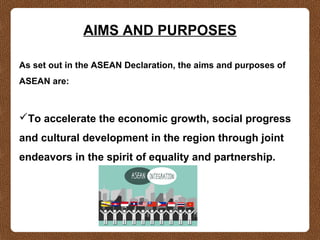
As set out in the ASEAN Declaration, the aims and purposes of
ASEAN are:
To accelerate the economic growth, social progress
and cultural development in the region through joint
endeavors in the spirit of equality and partnership.
 To promote regional peace and stability through abiding
respect for justice and the rule of law in the relationship among
countries
 To promote active collaboration and mutual assistance on
matters of common interest in the economic, social, cultural,
technical, scientific and administrative fields;
 To provide assistance to each other in the form of training and
research facilities in the educational, professional, technical and
administrative spheres;
 To collaborate more effectively for the greater utilisation of
their agriculture and industries,expansion of their trade,
improvement of their transportation and communications
facilities and the raising of the living standards of their peoples;
 To promote Southeast Asian studies; and
To maintain close and beneficial cooperation with existing
international and regional organisations with similar aims and
purposes, and explore all avenues for even closer cooperation
among themselves.
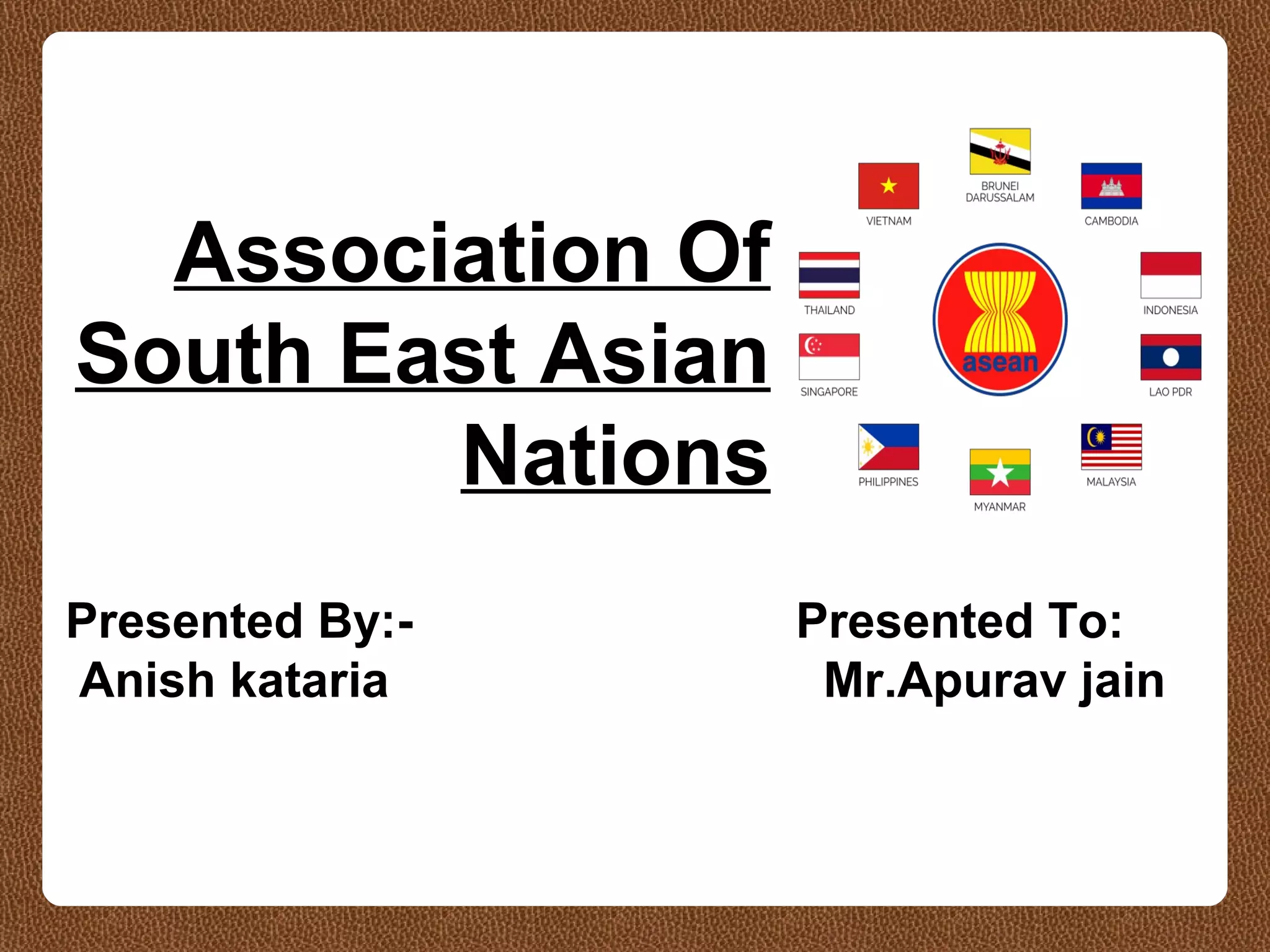
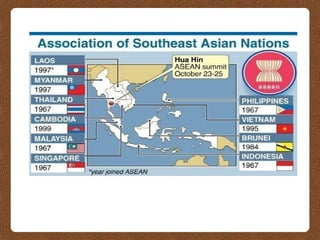
The ASEAN is a result of joining of 10 SOUTH EAST ASIAN
NATIONS.
The population of ASEAN counts to 9% of the world’s total
population.
It would be the 7th
largest economy in the world if it were a single
country.
Its GDP in 2015 was $ 2.4 tri and it is assumed that it would get
doubled i.e. $ 4.7 tri by 2020.
According to the projections its is found that it would become 4th
largest economy in the world by 2050.
FACTS ON ASEAN
QUIZ
when was ASEAN established?
who are the founding fathers of ASEAM?
ANSWERS
when was ASEAN established?
8 August 1967
who are the founding fathers of ASEAM?
 Indonesia, Malaysia, Philippines, Singapore
and Thailand.
ECONOMY OF ASEAN:
ASEAN is built on three pillars:
The ASEAN Political-Security Community (APSC),
The ASEAN Economic Community (AEC),
The ASEAN Socio-Cultural Community (ASCC).
The ASEAN Free Trade Area (AFTA), which was established on 28
January 1992When the AFTA agreement was originally signed,
ASEAN had only six members: Brunei, Indonesia, Malaysia, the
Philippines, Singapore, and Thailand. Vietnam joined in 1995, Laos
and Burma in 1997, and Cambodia in 1999.
The next steps are to create a single market and production base, a
competitive economic region, a region of equitable economic
development, and a region that is fully integrated into the global
economy.
Since 2007, ASEAN countries have gradually lowered
their import duties to member nations.
The target is zero import duties by 2016. ASEAN
countries have many economic zones (industrial parks,
eco-industrial parks, special economic zones, technology
parks, and innovation districts).
Until the end of 2010, intra-ASEAN trade was still low.
Trade involved mainly exports to countries outside the
region, with the exception of Laos and Myanmar, whose
foreign trade was ASEAN-oriented, with 80% and 50%
respectively of their exports going to other ASEAN
countries.
Singapore – ASEAN’s Biggest Opportunity <ul><li>Singapore, one of
the most developed members of ASEAN and located at the h...
SINGAPORE-ASEAN'S BIGGEST
OPPORTUNITY
Singapore one of the most developed members of
ASEAN and located at the heart of ASEAN.
It offers a world class business
infrastructure,enterprise eco-system,legal regime and
more importantly a highly attractive tax regime.
With no natural resourse and very small population
it has managed to be in top 5 richest countries in the
world.
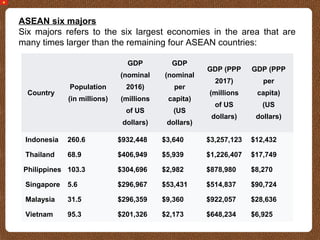
ASEAN six majors
Six majors refers to the six largest economies in the area that are
many times larger than the remaining four ASEAN countries:
Country
Population
(in millions)
GDP
(nominal
2016)
(millions
of US
dollars)
GDP
(nominal
per
capita)
(US
dollars)
GDP (PPP
2017)
(millions
of US
dollars)
GDP (PPP
per
capita)
(US
dollars)
Indonesia 260.6 $932,448 $3,640 $3,257,123 $12,432
Thailand 68.9 $406,949 $5,939 $1,226,407 $17,749
Philippines 103.3 $304,696 $2,982 $878,980 $8,270
Singapore 5.6 $296,967 $53,431 $514,837 $90,724
Malaysia 31.5 $296,359 $9,360 $922,057 $28,636
Vietnam 95.3 $201,326 $2,173 $648,234 $6,925
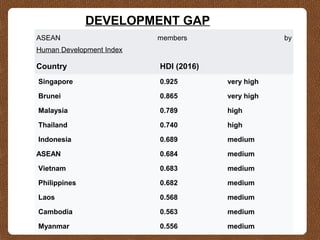
ASEAN members by
Human Development Index
Country HDI (2016)
Singapore 0.925 very high
Brunei 0.865 very high
Malaysia 0.789 high
Thailand 0.740 high
Indonesia 0.689 medium
ASEAN 0.684 medium
Vietnam 0.683 medium
Philippines 0.682 medium
Laos 0.568 medium
Cambodia 0.563 medium
Myanmar 0.556 medium
DEVELOPMENT GAP
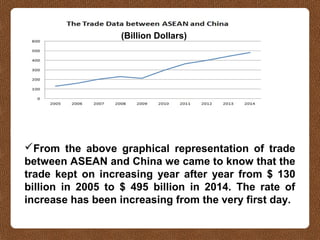
From the above graphical representation of trade
between ASEAN and China we came to know that the
trade kept on increasing year after year from $ 130
billion in 2005 to $ 495 billion in 2014. The rate of
increase has been increasing from the very first day.
(Billion Dollars)
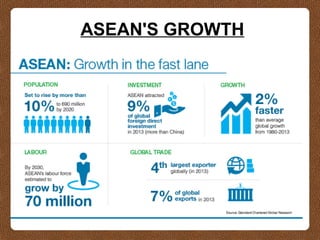
ASEAN'S GROWTH
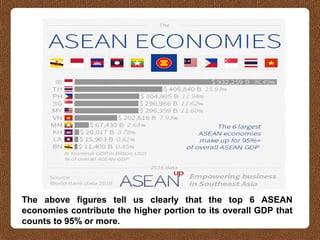
The above figures tell us clearly that the top 6 ASEAN
economies contribute the higher portion to its overall GDP that
counts to 95% or more.
CONCLUSION
After the thorough study of secondary sources we came to the
following conclusions:
ASEAN is growing at the increasing rate in each
and every terms weather its population, wealth, GDP
etc.
ASEAN tend to open the way for trade with
Britishers due to increasing population.
ASEAN tend to import and export with various other
nations such as China and Europe.
The trade of payment i.e. negative tends to be
reducing due to increasing exports and decreasing
exports from EU.
 ASEAN has become the world’s 3rd
largest
consumer market.
 The rate of FDI is increasing day by day in
ASEAN and on the other hand trade within the
ASEAN nations is also increasing.
 Last not least I want to conclude that all the
nations are not equally contributing towards its
growth top 6 nations of ASEAN contribute 95%
of GDP and rest 4 nations contribute just 5%.
Asean

Asean

  • 1.
    Association Of South EastAsian Nations Presented By:- Anish kataria Presented To: Mr.Apurav jain
  • 2.
    OBJECTIVES OF THESTUDY •To study how ASEAN was formed by knowing when the nations became members of ASEAN. •To study the import export trade of ASEAN with other nations or Unions. •To study the pace of increase in population, trade and GDP of ASEAN group. •To study the level of contribution by each member nation towards growing GDP.
  • 3.
    About ASEAN ESTABLISHMENT The Associationof Southeast Asian Nations, or ASEAN, was established on 8 August 1967. It took place in Bangkok with the signing of the ASEAN Declaration (Bangkok Declaration) by the Founding Fathers of ASEAN, namely Indonesia, Malaysia, Philippines, Singapore and Thailand.
  • 5.
    AIMS AND PURPOSES Asset out in the ASEAN Declaration, the aims and purposes of ASEAN are: To accelerate the economic growth, social progress and cultural development in the region through joint endeavors in the spirit of equality and partnership.
  • 6.
     To promoteregional peace and stability through abiding respect for justice and the rule of law in the relationship among countries  To promote active collaboration and mutual assistance on matters of common interest in the economic, social, cultural, technical, scientific and administrative fields;
  • 7.
     To provideassistance to each other in the form of training and research facilities in the educational, professional, technical and administrative spheres;  To collaborate more effectively for the greater utilisation of their agriculture and industries,expansion of their trade, improvement of their transportation and communications facilities and the raising of the living standards of their peoples;
  • 8.
     To promoteSoutheast Asian studies; and To maintain close and beneficial cooperation with existing international and regional organisations with similar aims and purposes, and explore all avenues for even closer cooperation among themselves.
  • 9.
    The ASEAN isa result of joining of 10 SOUTH EAST ASIAN NATIONS. The population of ASEAN counts to 9% of the world’s total population. It would be the 7th largest economy in the world if it were a single country. Its GDP in 2015 was $ 2.4 tri and it is assumed that it would get doubled i.e. $ 4.7 tri by 2020. According to the projections its is found that it would become 4th largest economy in the world by 2050. FACTS ON ASEAN
  • 10.
    QUIZ when was ASEANestablished? who are the founding fathers of ASEAM?
  • 11.
    ANSWERS when was ASEANestablished? 8 August 1967 who are the founding fathers of ASEAM?  Indonesia, Malaysia, Philippines, Singapore and Thailand.
  • 12.
    ECONOMY OF ASEAN: ASEANis built on three pillars: The ASEAN Political-Security Community (APSC), The ASEAN Economic Community (AEC), The ASEAN Socio-Cultural Community (ASCC). The ASEAN Free Trade Area (AFTA), which was established on 28 January 1992When the AFTA agreement was originally signed, ASEAN had only six members: Brunei, Indonesia, Malaysia, the Philippines, Singapore, and Thailand. Vietnam joined in 1995, Laos and Burma in 1997, and Cambodia in 1999. The next steps are to create a single market and production base, a competitive economic region, a region of equitable economic development, and a region that is fully integrated into the global economy.
  • 13.
    Since 2007, ASEANcountries have gradually lowered their import duties to member nations. The target is zero import duties by 2016. ASEAN countries have many economic zones (industrial parks, eco-industrial parks, special economic zones, technology parks, and innovation districts). Until the end of 2010, intra-ASEAN trade was still low. Trade involved mainly exports to countries outside the region, with the exception of Laos and Myanmar, whose foreign trade was ASEAN-oriented, with 80% and 50% respectively of their exports going to other ASEAN countries.
  • 14.
    Singapore – ASEAN’sBiggest Opportunity <ul><li>Singapore, one of the most developed members of ASEAN and located at the h... SINGAPORE-ASEAN'S BIGGEST OPPORTUNITY Singapore one of the most developed members of ASEAN and located at the heart of ASEAN. It offers a world class business infrastructure,enterprise eco-system,legal regime and more importantly a highly attractive tax regime. With no natural resourse and very small population it has managed to be in top 5 richest countries in the world.
  • 15.
    ASEAN six majors Sixmajors refers to the six largest economies in the area that are many times larger than the remaining four ASEAN countries: Country Population (in millions) GDP (nominal 2016) (millions of US dollars) GDP (nominal per capita) (US dollars) GDP (PPP 2017) (millions of US dollars) GDP (PPP per capita) (US dollars) Indonesia 260.6 $932,448 $3,640 $3,257,123 $12,432 Thailand 68.9 $406,949 $5,939 $1,226,407 $17,749 Philippines 103.3 $304,696 $2,982 $878,980 $8,270 Singapore 5.6 $296,967 $53,431 $514,837 $90,724 Malaysia 31.5 $296,359 $9,360 $922,057 $28,636 Vietnam 95.3 $201,326 $2,173 $648,234 $6,925
  • 16.
    ASEAN members by HumanDevelopment Index Country HDI (2016) Singapore 0.925 very high Brunei 0.865 very high Malaysia 0.789 high Thailand 0.740 high Indonesia 0.689 medium ASEAN 0.684 medium Vietnam 0.683 medium Philippines 0.682 medium Laos 0.568 medium Cambodia 0.563 medium Myanmar 0.556 medium DEVELOPMENT GAP
  • 17.
    From the abovegraphical representation of trade between ASEAN and China we came to know that the trade kept on increasing year after year from $ 130 billion in 2005 to $ 495 billion in 2014. The rate of increase has been increasing from the very first day. (Billion Dollars)
  • 18.
  • 19.
    The above figurestell us clearly that the top 6 ASEAN economies contribute the higher portion to its overall GDP that counts to 95% or more.
  • 20.
    CONCLUSION After the thoroughstudy of secondary sources we came to the following conclusions: ASEAN is growing at the increasing rate in each and every terms weather its population, wealth, GDP etc. ASEAN tend to open the way for trade with Britishers due to increasing population. ASEAN tend to import and export with various other nations such as China and Europe. The trade of payment i.e. negative tends to be reducing due to increasing exports and decreasing exports from EU.
  • 21.
     ASEAN hasbecome the world’s 3rd largest consumer market.  The rate of FDI is increasing day by day in ASEAN and on the other hand trade within the ASEAN nations is also increasing.  Last not least I want to conclude that all the nations are not equally contributing towards its growth top 6 nations of ASEAN contribute 95% of GDP and rest 4 nations contribute just 5%.