The following is intended to outline our general product
direction. It is intended for information purposes only, and
may not be incorporated into any contract. It is not a
commitment to deliver any material, code, or functionality,
and should not be relied upon in making purchasing
decisions. The development, release, and timing of any
features or functionality described for Oracle’s products
remains at the sole discretion of Oracle.
1
Copyright © 2013, Oracle and/or its affiliates. All rights reserved.2
The Long and Winding Road
Thomas Kyte
http://asktom.oracle.com/
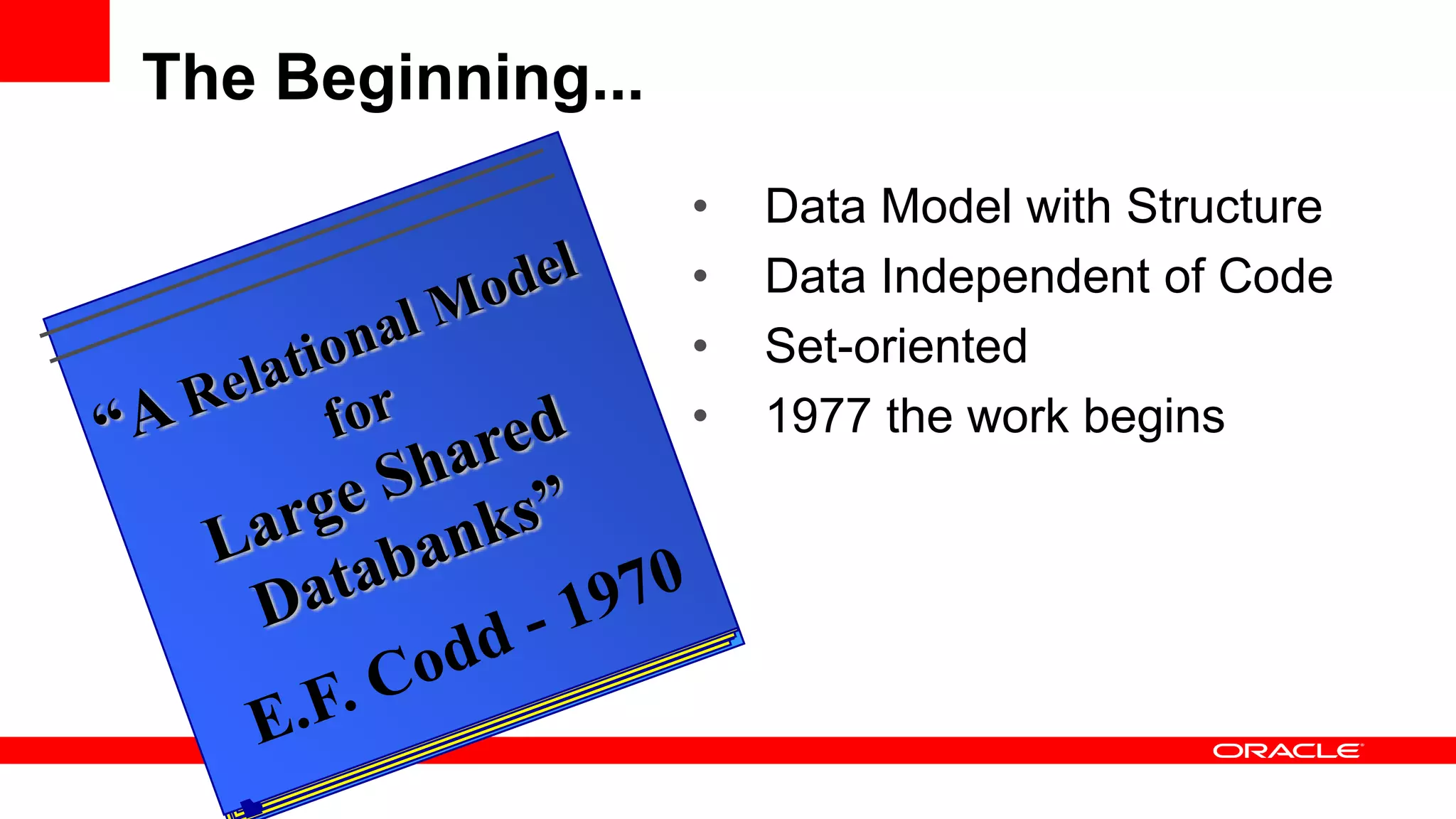
The Beginning...
• Data Model with Structure
• Data Independent of Code
• Set-oriented
• 1977 the work begins
GPS
1978
GPS
1978
First RDBMS: Version 2
June 1979
• FIRST Commercial SQL RDBMS
• Impressive First SQL
• Joins, Subqueries
• Outer Joins, Connect By
• A Simple Server
• No transactions, ‘Limited’ Reliability
• Portability from the Start
• multi-platform – PDP11, Dec VAX
IBM PC – 1981
IBM model
number
5150,
introduced
on August
12, 1981.
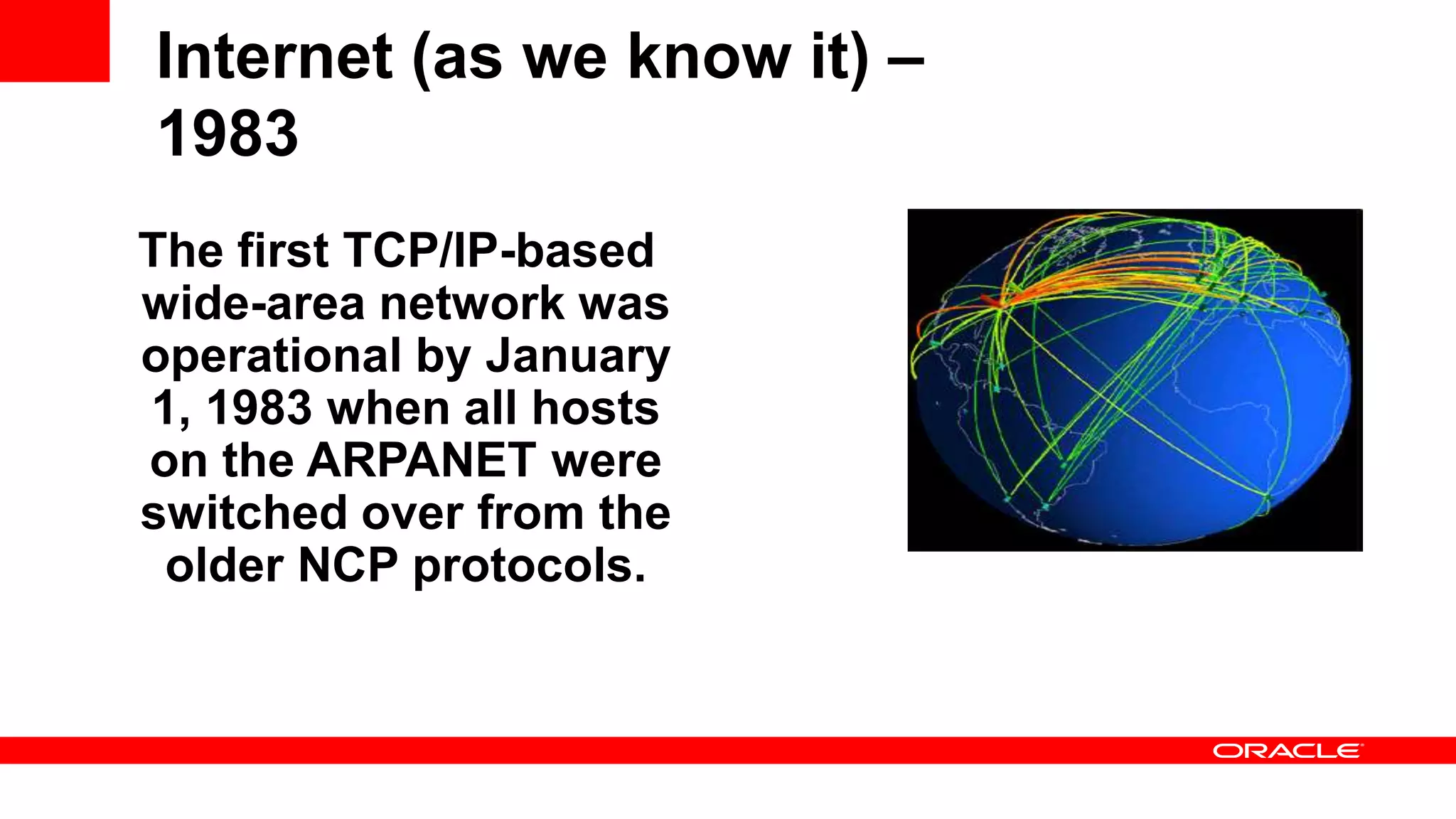
Internet (as we know it) –
1983
The first TCP/IP-based
wide-area network was
operational by January
1, 1983 when all hosts
on the ARPANET were
switched over from the
older NCP protocols.
Portability: Version 3
March 1983
• New Implementation Designed for Portability
• Written in ‘C’
• Single Source
• Architectural Changes
• Transactions, multi-versioning, no read consistency
• AI/BI files
• Oracle Corporation – name established
Reliability: Version 4
October 1984
• Larger Installed Base (well, it had one)
• Architectural Improvements
• Read Consistency
Cooperative Server: Version 5
April 1985
• My First Oracle Experience
• 1st Client/Server
• Cooperative Server
• Distributed Processing
• Parallel Server
• Portability
• V5 was first to go beyond 640K memory on PCs
• Single-user for Macintosh o/s
• SQL_TRACE
• select trace('sql',1),1 from dual;
Transaction Processing: Version 6
July 1988
• New Architecture
• Performance (first SMP)
• Availability
• TPO
• PL/SQL
• V6 Lays Architectural Groundwork for the Future
• This was a rewrite of the entire database fundamentally
World Wide Web – 1990’ish
The World Wide Web was
created in 1989 by British
scientist Tim Berners-Lee,
working at the European
Organization for Nuclear
Research (CERN) in
Geneva, Switzerland, and
released in 1992.
Oracle7.3
February 1996
• Partitioned Views
• Bitmapped Indexes
• Asynchronous read ahead for table
scans
• Standby Database
• Deferred transaction recovery on
instance startup
• Updatable Join View
• SQLDBA no longer shipped.
• Index rebuilds
• DBV introduced
• Context Option
• PL/SQL - UTL_FILE
 Spatial Data Option
 Tablespaces changes - Coalesce,
Temporary Permanent,
 Trigger compilation, debug
 Unlimited extents on STORAGE clause.
 Some init.ora parameters modifiable -
TIMED_STATISTICS
 HASH Joins, Antijoins
 Histograms
 Oracle Trace
 Advanced Replication Object Groups
Data Warehouses Growing Rapidly
Tripling In Size Every Two Years
Source: Winter TopTen Survey, Winter Corporation, Waltham MA, 2008.
200
400
600
800
1000
1998 2000 2002 2004 2006 2008 2010 2012 …
TerabytesofData
Size of the Largest Data Warehouses
Enabling the Private Database Cloud
Years of continuous Oracle innovation
Oracle Database 10g
Oracle Database 11g
Oracle Exadata
Oracle9i Database
Real Application Clusters
Database Services
CPU Resource Management
Automatic Storage Management
Dynamic Database Services
Instance caging
I/O resource management
Server Pools
Quality of Service Management
InfiniBand support
Smart Scans
Smart Flash Cache
Hybrid Columnar Compression
© 2011 Oracle Corporation
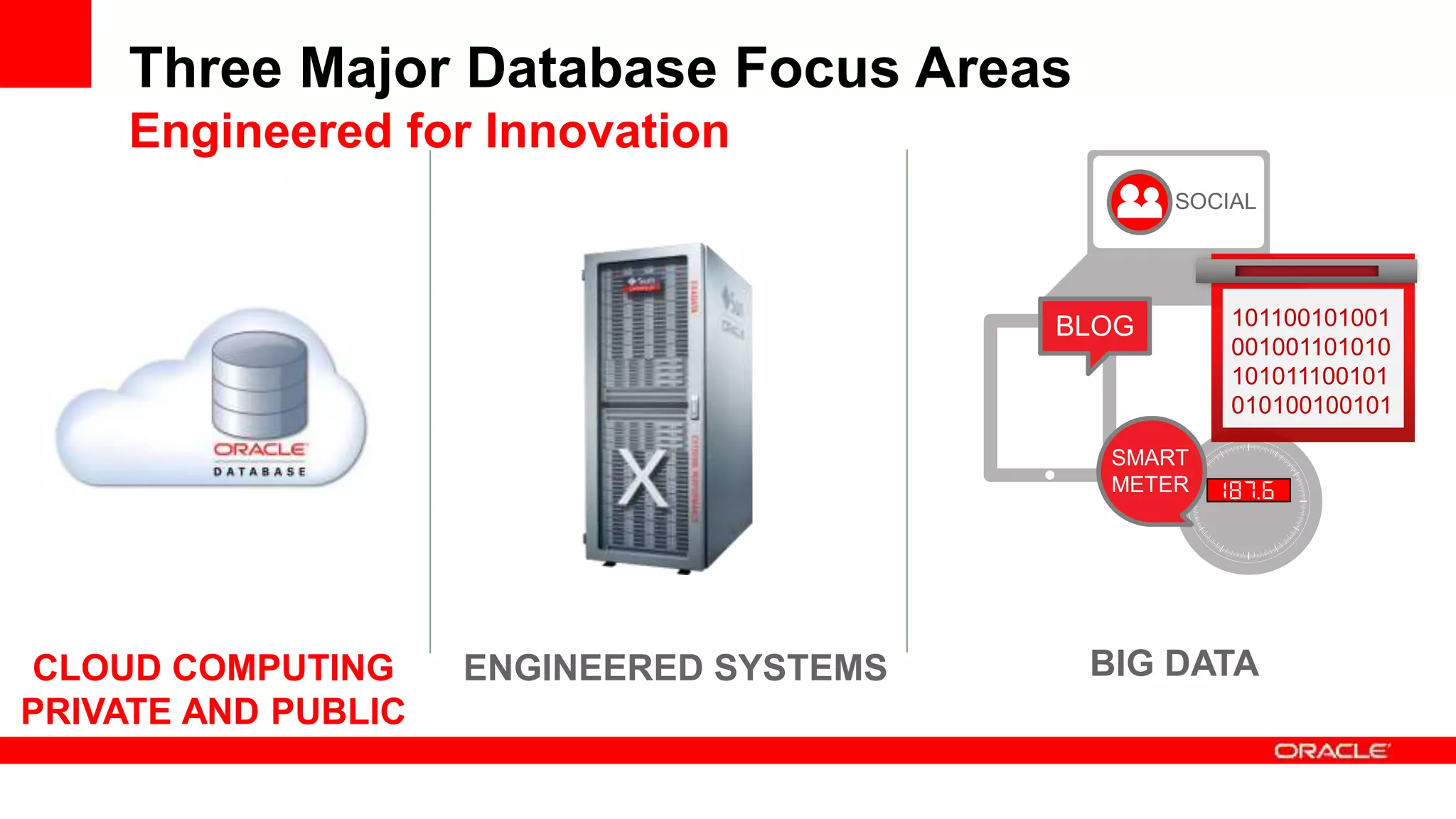
Three Major Database Focus Areas
Engineered for Innovation
CLOUD COMPUTING
PRIVATE AND PUBLIC
ENGINEERED SYSTEMS BIG DATA
SOCIAL
BLOG
SMART
METER
101100101001
001001101010
101011100101
010100100101
Three Major Database Focus Areas
Engineered for Innovation
CLOUD COMPUTING
PRIVATE AND PUBLIC
ENGINEERED SYSTEMS BIG DATA
SOCIAL
BLOG
SMART
METER
101100101001
001001101010
101011100101
010100100101
Copyright © 2013, Oracle and/or its affiliates. All rights reserved.23
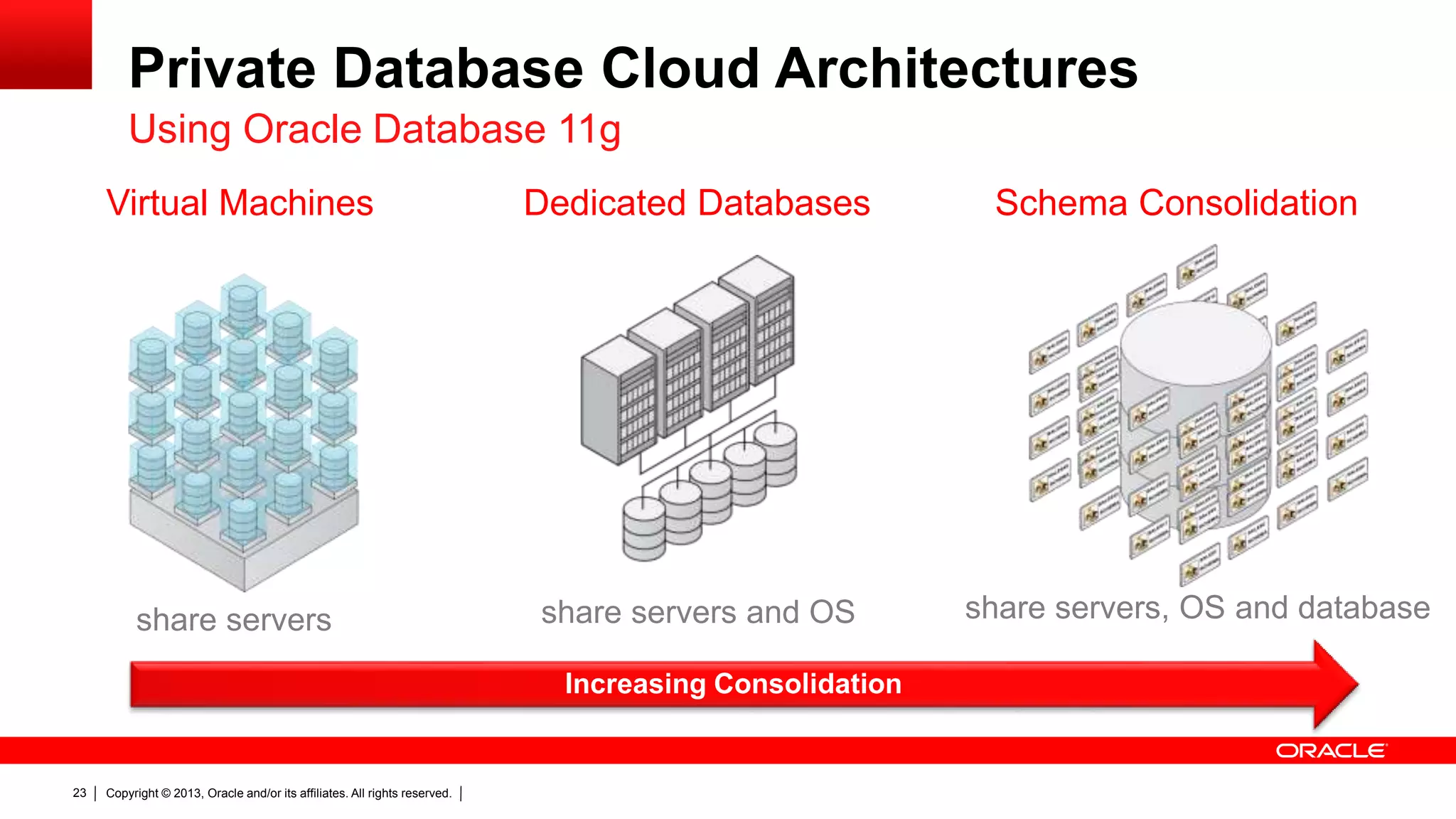
Private Database Cloud Architectures
Using Oracle Database 11g
Dedicated Databases
share servers and OS
Virtual Machines
share servers
Schema Consolidation
share servers, OS and database
Increasing Consolidation
Copyright © 2013, Oracle and/or its affiliates. All rights reserved.24
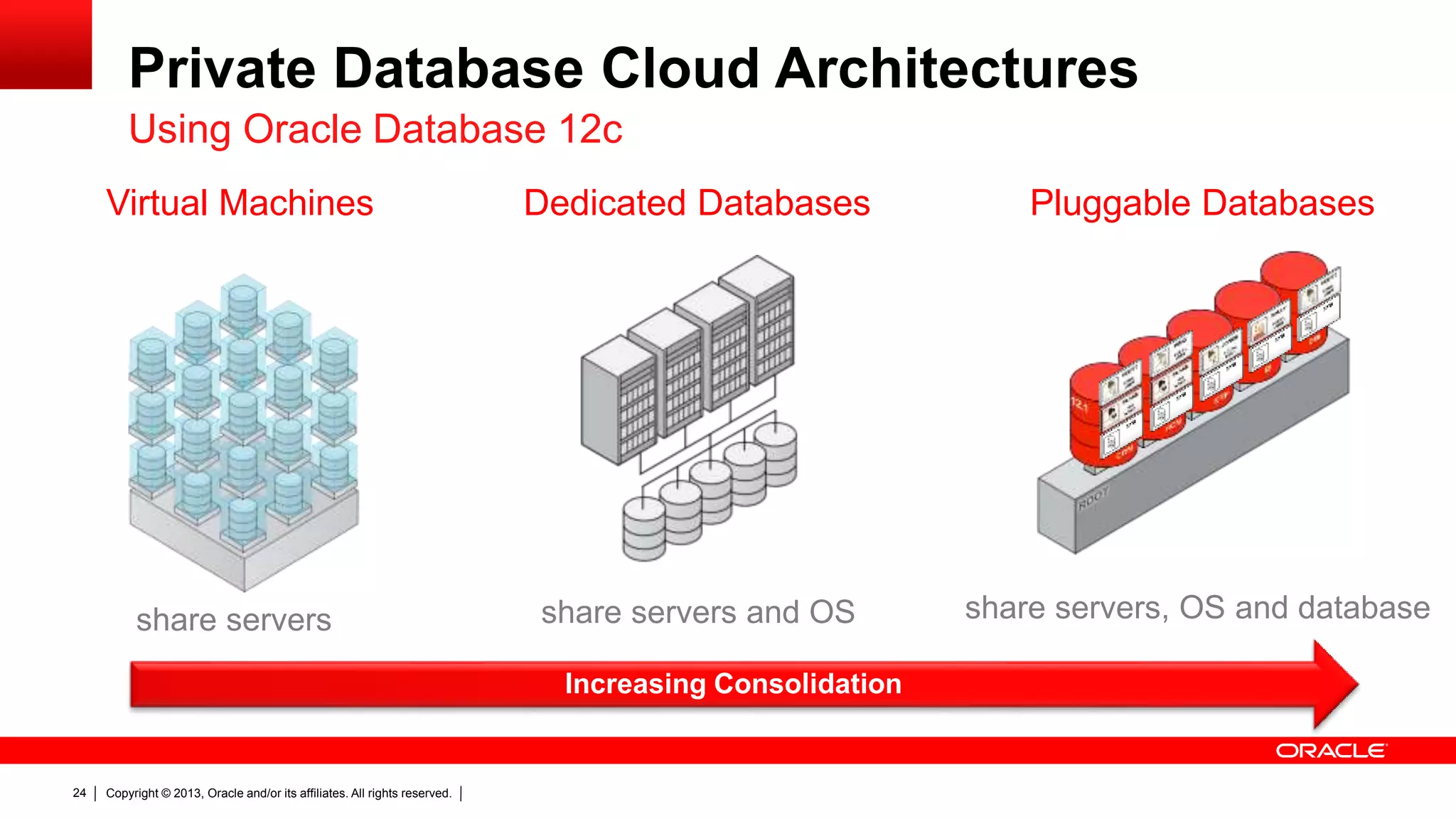
Private Database Cloud Architectures
Using Oracle Database 12c
Dedicated Databases
share servers and OS
Virtual Machines
share servers
Pluggable Databases
share servers, OS and database
Increasing Consolidation
Copyright © 2013, Oracle and/or its affiliates. All rights reserved.25
Isolation and multitenancy
Fast provisioning and cloning
Secure and highly available
No application changes
Manage many as one
Greater resource utilization
Performant and scalable
Lower IT costs
Consolidating Databases on Clouds
Key requirements…
Copyright © 2013, Oracle and/or its affiliates. All rights reserved.26
Three Major Database Focus Areas
Engineered for Innovation
CLOUD COMPUTING
PRIVATE AND PUBLIC
ENGINEERED SYSTEMS BIG DATA
SOCIAL
BLOG
SMART
METER
101100101001
001001101010
101011100101
010100100101
Copyright © 2013, Oracle and/or its affiliates. All rights reserved.27
Copyright © 2013, Oracle and/or its affiliates. All rights reserved.28
In a Warehouse
environment – how many
DBA’s can tell you how
many GB’s/sec they can
transfer from disk to
server?
Copyright © 2013, Oracle and/or its affiliates. All rights reserved.29
In an OLTP environment,
what would happen if log
writes on a busy system
went from an average of 3-
5ms to 7-10ms (or longer)?
Copyright © 2013, Oracle and/or its affiliates. All rights reserved.30
Getting cross domain expertise to work together…
Copyright © 2013, Oracle and/or its affiliates. All rights reserved.31
Three Major Database Focus Areas
Engineered for Innovation
CLOUD COMPUTING
PRIVATE AND PUBLIC
ENGINEERED SYSTEMS BIG DATA
SOCIAL
BLOG
SMART
METER
101100101001
001001101010
101011100101
010100100101
32 Copyright © 2013, Oracle and/or its affiliates. All rights reserved. Confidential – Oracle InternalCopyright © 2013, Oracle and/or its affiliates. All rights reserved.
Until Now You Choose One Format and Suffer Tradeoffs
Optimizing Transaction and Query Performance
Row Format Databases versus Column Format Databases
Row
 Transactions run faster on row format
– Fast for processing few rows, many columns
– Example: Insert or query a sales order
Column
 Analytics run faster on column format
– Fast for processing few columns, many rows
– Example: Report on sales totals by state
ORDER
SALES
SALES
S
T
A
T
E
32
33 Copyright © 2013, Oracle and/or its affiliates. All rights reserved. Confidential – Oracle InternalCopyright © 2013, Oracle and/or its affiliates. All rights reserved.
The Long and Winding Road
Thomas Kyte
http://asktom.oracle.com

Long and winding road - Chile 2014

  • 1.
    The following isintended to outline our general product direction. It is intended for information purposes only, and may not be incorporated into any contract. It is not a commitment to deliver any material, code, or functionality, and should not be relied upon in making purchasing decisions. The development, release, and timing of any features or functionality described for Oracle’s products remains at the sole discretion of Oracle. 1
  • 2.
    Copyright © 2013,Oracle and/or its affiliates. All rights reserved.2 The Long and Winding Road Thomas Kyte http://asktom.oracle.com/
  • 3.
    The Beginning... • DataModel with Structure • Data Independent of Code • Set-oriented • 1977 the work begins
  • 4.
  • 5.
  • 6.
    First RDBMS: Version2 June 1979 • FIRST Commercial SQL RDBMS • Impressive First SQL • Joins, Subqueries • Outer Joins, Connect By • A Simple Server • No transactions, ‘Limited’ Reliability • Portability from the Start • multi-platform – PDP11, Dec VAX
  • 7.
    IBM PC –1981 IBM model number 5150, introduced on August 12, 1981.
  • 8.
    Internet (as weknow it) – 1983 The first TCP/IP-based wide-area network was operational by January 1, 1983 when all hosts on the ARPANET were switched over from the older NCP protocols.
  • 9.
    Portability: Version 3 March1983 • New Implementation Designed for Portability • Written in ‘C’ • Single Source • Architectural Changes • Transactions, multi-versioning, no read consistency • AI/BI files • Oracle Corporation – name established
  • 11.
    Reliability: Version 4 October1984 • Larger Installed Base (well, it had one) • Architectural Improvements • Read Consistency
  • 13.
    Cooperative Server: Version5 April 1985 • My First Oracle Experience • 1st Client/Server • Cooperative Server • Distributed Processing • Parallel Server • Portability • V5 was first to go beyond 640K memory on PCs • Single-user for Macintosh o/s • SQL_TRACE • select trace('sql',1),1 from dual;
  • 14.
    Transaction Processing: Version6 July 1988 • New Architecture • Performance (first SMP) • Availability • TPO • PL/SQL • V6 Lays Architectural Groundwork for the Future • This was a rewrite of the entire database fundamentally
  • 15.
    World Wide Web– 1990’ish The World Wide Web was created in 1989 by British scientist Tim Berners-Lee, working at the European Organization for Nuclear Research (CERN) in Geneva, Switzerland, and released in 1992.
  • 16.
    Oracle7.3 February 1996 • PartitionedViews • Bitmapped Indexes • Asynchronous read ahead for table scans • Standby Database • Deferred transaction recovery on instance startup • Updatable Join View • SQLDBA no longer shipped. • Index rebuilds • DBV introduced • Context Option • PL/SQL - UTL_FILE  Spatial Data Option  Tablespaces changes - Coalesce, Temporary Permanent,  Trigger compilation, debug  Unlimited extents on STORAGE clause.  Some init.ora parameters modifiable - TIMED_STATISTICS  HASH Joins, Antijoins  Histograms  Oracle Trace  Advanced Replication Object Groups
  • 19.
    Data Warehouses GrowingRapidly Tripling In Size Every Two Years Source: Winter TopTen Survey, Winter Corporation, Waltham MA, 2008. 200 400 600 800 1000 1998 2000 2002 2004 2006 2008 2010 2012 … TerabytesofData Size of the Largest Data Warehouses
  • 20.
    Enabling the PrivateDatabase Cloud Years of continuous Oracle innovation Oracle Database 10g Oracle Database 11g Oracle Exadata Oracle9i Database Real Application Clusters Database Services CPU Resource Management Automatic Storage Management Dynamic Database Services Instance caging I/O resource management Server Pools Quality of Service Management InfiniBand support Smart Scans Smart Flash Cache Hybrid Columnar Compression © 2011 Oracle Corporation
  • 21.
    Three Major DatabaseFocus Areas Engineered for Innovation CLOUD COMPUTING PRIVATE AND PUBLIC ENGINEERED SYSTEMS BIG DATA SOCIAL BLOG SMART METER 101100101001 001001101010 101011100101 010100100101
  • 22.
    Three Major DatabaseFocus Areas Engineered for Innovation CLOUD COMPUTING PRIVATE AND PUBLIC ENGINEERED SYSTEMS BIG DATA SOCIAL BLOG SMART METER 101100101001 001001101010 101011100101 010100100101
  • 23.
    Copyright © 2013,Oracle and/or its affiliates. All rights reserved.23 Private Database Cloud Architectures Using Oracle Database 11g Dedicated Databases share servers and OS Virtual Machines share servers Schema Consolidation share servers, OS and database Increasing Consolidation
  • 24.
    Copyright © 2013,Oracle and/or its affiliates. All rights reserved.24 Private Database Cloud Architectures Using Oracle Database 12c Dedicated Databases share servers and OS Virtual Machines share servers Pluggable Databases share servers, OS and database Increasing Consolidation
  • 25.
    Copyright © 2013,Oracle and/or its affiliates. All rights reserved.25 Isolation and multitenancy Fast provisioning and cloning Secure and highly available No application changes Manage many as one Greater resource utilization Performant and scalable Lower IT costs Consolidating Databases on Clouds Key requirements…
  • 26.
    Copyright © 2013,Oracle and/or its affiliates. All rights reserved.26 Three Major Database Focus Areas Engineered for Innovation CLOUD COMPUTING PRIVATE AND PUBLIC ENGINEERED SYSTEMS BIG DATA SOCIAL BLOG SMART METER 101100101001 001001101010 101011100101 010100100101
  • 27.
    Copyright © 2013,Oracle and/or its affiliates. All rights reserved.27
  • 28.
    Copyright © 2013,Oracle and/or its affiliates. All rights reserved.28 In a Warehouse environment – how many DBA’s can tell you how many GB’s/sec they can transfer from disk to server?
  • 29.
    Copyright © 2013,Oracle and/or its affiliates. All rights reserved.29 In an OLTP environment, what would happen if log writes on a busy system went from an average of 3- 5ms to 7-10ms (or longer)?
  • 30.
    Copyright © 2013,Oracle and/or its affiliates. All rights reserved.30 Getting cross domain expertise to work together…
  • 31.
    Copyright © 2013,Oracle and/or its affiliates. All rights reserved.31 Three Major Database Focus Areas Engineered for Innovation CLOUD COMPUTING PRIVATE AND PUBLIC ENGINEERED SYSTEMS BIG DATA SOCIAL BLOG SMART METER 101100101001 001001101010 101011100101 010100100101
  • 32.
    32 Copyright ©2013, Oracle and/or its affiliates. All rights reserved. Confidential – Oracle InternalCopyright © 2013, Oracle and/or its affiliates. All rights reserved. Until Now You Choose One Format and Suffer Tradeoffs Optimizing Transaction and Query Performance Row Format Databases versus Column Format Databases Row  Transactions run faster on row format – Fast for processing few rows, many columns – Example: Insert or query a sales order Column  Analytics run faster on column format – Fast for processing few columns, many rows – Example: Report on sales totals by state ORDER SALES SALES S T A T E 32
  • 33.
    33 Copyright ©2013, Oracle and/or its affiliates. All rights reserved. Confidential – Oracle InternalCopyright © 2013, Oracle and/or its affiliates. All rights reserved. The Long and Winding Road Thomas Kyte http://asktom.oracle.com