XXXX Industries Limited
Database
    comparison


Oracle x MySql
Oracle
(Since 1977)

Produced and marketed by Oracle Corporation
Larry Ellison and his friends started the consultancy Software Development
Laboratories (SDL) in 1977
1979 - Oracle release 2
1983 - Oracle release 3
1984 - Oracle release 4
1985 - Oracle release 5
1988 - Oracle release 6
1992 - Oracle release 7
1997 - Oracle release 8
1998 - Oracle release 8i
2001 - Oracle release 9i
2003 - Oracle release 10g
2007 - Oracle release 11g
Oracle
(Now)


Oracle Corporation is an American multinational computer
technology corporation headquartered in Redwood City, California,
The United States.


The company specializes in developing and marketing computer
hardware systems and enterprise software products –
particularly its own brands of database management systems.


Oracle is the third-largest software maker by revenue,
after Microsoft and IBM
MySQL is a powerful and the most popular Open Source Software
relational database management system (RDBMS) that uses SQL
(Structured Query Language).
MySQL is named after co-founder Monty Widenius's daughter, My .
MySQL is officially pronounced "My esquel".
It is popular for web applications.
Previously, MySQL was developed, distributed, and supported by
MySQL AB then acquired by Sun Microsystems. And now since
January 2010 accquired by Oracle Corporation.
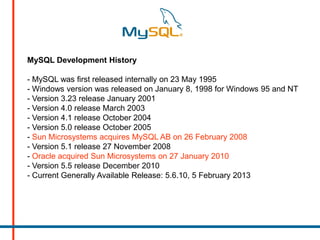
MySQL Development History

- MySQL was first released internally on 23 May 1995
- Windows version was released on January 8, 1998 for Windows 95 and NT
- Version 3.23 release January 2001
- Version 4.0 release March 2003
- Version 4.1 release October 2004
- Version 5.0 release October 2005
- Sun Microsystems acquires MySQL AB on 26 February 2008
- Version 5.1 release 27 November 2008
- Oracle acquired Sun Microsystems on 27 January 2010
- Version 5.5 release December 2010
- Current Generally Available Release: 5.6.10, 5 February 2013
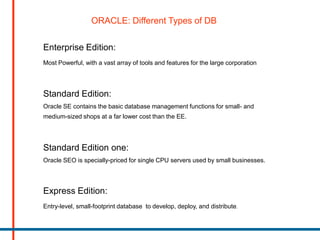
ORACLE: Different Types of DB

Enterprise Edition:
Most Powerful, with a vast array of tools and features for the large corporation


Standard Edition:
Oracle SE contains the basic database management functions for small- and
medium-sized shops at a far lower cost than the EE.


Standard Edition one:
Oracle SEO is specially-priced for single CPU servers used by small businesses.


Express Edition:
Entry-level, small-footprint database to develop, deploy, and distribute.
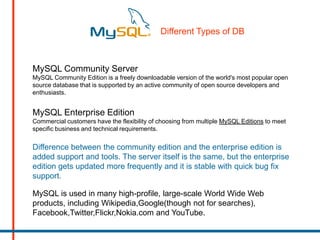
Different Types of DB


MySQL Community Server
MySQL Community Edition is a freely downloadable version of the world's most popular open
source database that is supported by an active community of open source developers and
enthusiasts.


MySQL Enterprise Edition
Commercial customers have the flexibility of choosing from multiple MySQL Editions to meet
specific business and technical requirements.


Difference between the community edition and the enterprise edition is
added support and tools. The server itself is the same, but the enterprise
edition gets updated more frequently and it is stable with quick bug fix
support.

MySQL is used in many high-profile, large-scale World Wide Web
products, including Wikipedia,Google(though not for searches),
Facebook,Twitter,Flickr,Nokia.com and YouTube.
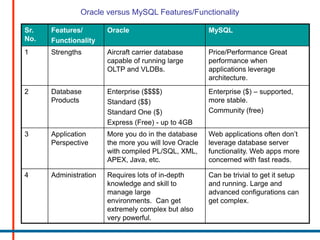
Oracle versus MySQL Features/Functionality

Sr.   Features/        Oracle                          MySQL
No.   Functionality
1     Strengths        Aircraft carrier database       Price/Performance Great
                       capable of running large        performance when
                       OLTP and VLDBs.                 applications leverage
                                                       architecture.
2     Database         Enterprise ($$$$)               Enterprise ($) – supported,
      Products         Standard ($$)                   more stable.
                       Standard One ($)                Community (free)
                       Express (Free) - up to 4GB
3     Application      More you do in the database     Web applications often don’t
      Perspective      the more you will love Oracle   leverage database server
                       with compiled PL/SQL, XML,      functionality. Web apps more
                       APEX, Java, etc.                concerned with fast reads.

4     Administration   Requires lots of in-depth       Can be trivial to get it setup
                       knowledge and skill to          and running. Large and
                       manage large                    advanced configurations can
                       environments. Can get           get complex.
                       extremely complex but also
                       very powerful.
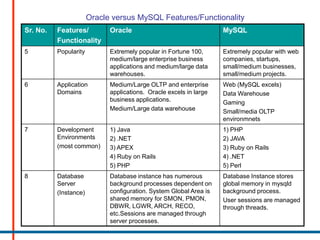
Oracle versus MySQL Features/Functionality
Sr. No.   Features/          Oracle                                 MySQL
          Functionality
5         Popularity         Extremely popular in Fortune 100,      Extremely popular with web
                             medium/large enterprise business       companies, startups,
                             applications and medium/large data     small/medium businesses,
                             warehouses.                            small/medium projects.
6         Application        Medium/Large OLTP and enterprise       Web (MySQL excels)
          Domains            applications. Oracle excels in large   Data Warehouse
                             business applications.                 Gaming
                             Medium/Large data warehouse            Small/media OLTP
                                                                    environmnets
7         Development        1) Java                                1) PHP
          Environments       2) .NET                                2) JAVA
          (most common)      3) APEX                                3) Ruby on Rails
                             4) Ruby on Rails                       4) .NET
                             5) PHP                                 5) Perl
8         Database           Database instance has numerous         Database Instance stores
          Server             background processes dependent on      global memory in mysqld
          (Instance)         configuration. System Global Area is   background process.
                             shared memory for SMON, PMON,          User sessions are managed
                             DBWR, LGWR, ARCH, RECO,                through threads.
                             etc.Sessions are managed through
                             server processes.
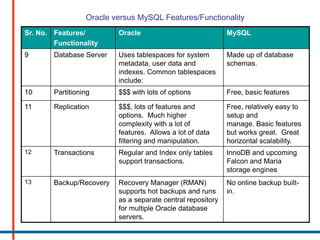
Oracle versus MySQL Features/Functionality
Sr. No. Features/         Oracle                             MySQL
        Functionality
9       Database Server   Uses tablespaces for system        Made up of database
                          metadata, user data and            schemas.
                          indexes. Common tablespaces
                          include:
10      Partitioning      $$$ with lots of options           Free, basic features

11      Replication       $$$, lots of features and          Free, relatively easy to
                          options. Much higher               setup and
                          complexity with a lot of           manage. Basic features
                          features. Allows a lot of data     but works great. Great
                          filtering and manipulation.        horizontal scalability.
12      Transactions      Regular and Index only tables      InnoDB and upcoming
                          support transactions.              Falcon and Maria
                                                             storage engines
13      Backup/Recovery   Recovery Manager (RMAN)            No online backup built-
                          supports hot backups and runs      in.
                          as a separate central repository
                          for multiple Oracle database
                          servers.
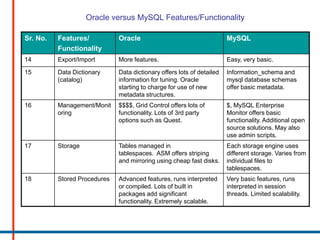
Oracle versus MySQL Features/Functionality

Sr. No.   Features/           Oracle                                    MySQL
          Functionality
14        Export/Import       More features.                            Easy, very basic.

15        Data Dictionary     Data dictionary offers lots of detailed   Information_schema and
          (catalog)           information for tuning. Oracle            mysql database schemas
                              starting to charge for use of new         offer basic metadata.
                              metadata structures.
16        Management/Monit    $$$$, Grid Control offers lots of         $, MySQL Enterprise
          oring               functionality. Lots of 3rd party          Monitor offers basic
                              options such as Quest.                    functionality. Additional open
                                                                        source solutions. May also
                                                                        use admin scripts.
17        Storage             Tables managed in                         Each storage engine uses
                              tablespaces. ASM offers striping          different storage. Varies from
                              and mirroring using cheap fast disks.     individual files to
                                                                        tablespaces.
18        Stored Procedures   Advanced features, runs interpreted       Very basic features, runs
                              or compiled. Lots of built in             interpreted in session
                              packages add significant                  threads. Limited scalability.
                              functionality. Extremely scalable.
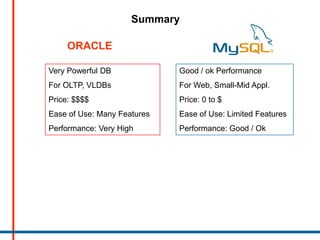
Summary

     ORACLE

Very Powerful DB             Good / ok Performance
For OLTP, VLDBs              For Web, Small-Mid Appl.
Price: $$$$                  Price: 0 to $
Ease of Use: Many Features   Ease of Use: Limited Features
Performance: Very High       Performance: Good / Ok
?
Thank You


The End

arunnsharma@gmail.com

Oracle mysql comparison

  • 1.
  • 2.
    Database comparison Oracle x MySql
  • 3.
    Oracle (Since 1977) Produced andmarketed by Oracle Corporation Larry Ellison and his friends started the consultancy Software Development Laboratories (SDL) in 1977 1979 - Oracle release 2 1983 - Oracle release 3 1984 - Oracle release 4 1985 - Oracle release 5 1988 - Oracle release 6 1992 - Oracle release 7 1997 - Oracle release 8 1998 - Oracle release 8i 2001 - Oracle release 9i 2003 - Oracle release 10g 2007 - Oracle release 11g
  • 4.
    Oracle (Now) Oracle Corporation isan American multinational computer technology corporation headquartered in Redwood City, California, The United States. The company specializes in developing and marketing computer hardware systems and enterprise software products – particularly its own brands of database management systems. Oracle is the third-largest software maker by revenue, after Microsoft and IBM
  • 5.
    MySQL is apowerful and the most popular Open Source Software relational database management system (RDBMS) that uses SQL (Structured Query Language). MySQL is named after co-founder Monty Widenius's daughter, My . MySQL is officially pronounced "My esquel". It is popular for web applications. Previously, MySQL was developed, distributed, and supported by MySQL AB then acquired by Sun Microsystems. And now since January 2010 accquired by Oracle Corporation.
  • 6.
    MySQL Development History -MySQL was first released internally on 23 May 1995 - Windows version was released on January 8, 1998 for Windows 95 and NT - Version 3.23 release January 2001 - Version 4.0 release March 2003 - Version 4.1 release October 2004 - Version 5.0 release October 2005 - Sun Microsystems acquires MySQL AB on 26 February 2008 - Version 5.1 release 27 November 2008 - Oracle acquired Sun Microsystems on 27 January 2010 - Version 5.5 release December 2010 - Current Generally Available Release: 5.6.10, 5 February 2013
  • 7.
    ORACLE: Different Typesof DB Enterprise Edition: Most Powerful, with a vast array of tools and features for the large corporation Standard Edition: Oracle SE contains the basic database management functions for small- and medium-sized shops at a far lower cost than the EE. Standard Edition one: Oracle SEO is specially-priced for single CPU servers used by small businesses. Express Edition: Entry-level, small-footprint database to develop, deploy, and distribute.
  • 8.
    Different Types ofDB MySQL Community Server MySQL Community Edition is a freely downloadable version of the world's most popular open source database that is supported by an active community of open source developers and enthusiasts. MySQL Enterprise Edition Commercial customers have the flexibility of choosing from multiple MySQL Editions to meet specific business and technical requirements. Difference between the community edition and the enterprise edition is added support and tools. The server itself is the same, but the enterprise edition gets updated more frequently and it is stable with quick bug fix support. MySQL is used in many high-profile, large-scale World Wide Web products, including Wikipedia,Google(though not for searches), Facebook,Twitter,Flickr,Nokia.com and YouTube.
  • 9.
    Oracle versus MySQLFeatures/Functionality Sr. Features/ Oracle MySQL No. Functionality 1 Strengths Aircraft carrier database Price/Performance Great capable of running large performance when OLTP and VLDBs. applications leverage architecture. 2 Database Enterprise ($$$$) Enterprise ($) – supported, Products Standard ($$) more stable. Standard One ($) Community (free) Express (Free) - up to 4GB 3 Application More you do in the database Web applications often don’t Perspective the more you will love Oracle leverage database server with compiled PL/SQL, XML, functionality. Web apps more APEX, Java, etc. concerned with fast reads. 4 Administration Requires lots of in-depth Can be trivial to get it setup knowledge and skill to and running. Large and manage large advanced configurations can environments. Can get get complex. extremely complex but also very powerful.
  • 10.
    Oracle versus MySQLFeatures/Functionality Sr. No. Features/ Oracle MySQL Functionality 5 Popularity Extremely popular in Fortune 100, Extremely popular with web medium/large enterprise business companies, startups, applications and medium/large data small/medium businesses, warehouses. small/medium projects. 6 Application Medium/Large OLTP and enterprise Web (MySQL excels) Domains applications. Oracle excels in large Data Warehouse business applications. Gaming Medium/Large data warehouse Small/media OLTP environmnets 7 Development 1) Java 1) PHP Environments 2) .NET 2) JAVA (most common) 3) APEX 3) Ruby on Rails 4) Ruby on Rails 4) .NET 5) PHP 5) Perl 8 Database Database instance has numerous Database Instance stores Server background processes dependent on global memory in mysqld (Instance) configuration. System Global Area is background process. shared memory for SMON, PMON, User sessions are managed DBWR, LGWR, ARCH, RECO, through threads. etc.Sessions are managed through server processes.
  • 11.
    Oracle versus MySQLFeatures/Functionality Sr. No. Features/ Oracle MySQL Functionality 9 Database Server Uses tablespaces for system Made up of database metadata, user data and schemas. indexes. Common tablespaces include: 10 Partitioning $$$ with lots of options Free, basic features 11 Replication $$$, lots of features and Free, relatively easy to options. Much higher setup and complexity with a lot of manage. Basic features features. Allows a lot of data but works great. Great filtering and manipulation. horizontal scalability. 12 Transactions Regular and Index only tables InnoDB and upcoming support transactions. Falcon and Maria storage engines 13 Backup/Recovery Recovery Manager (RMAN) No online backup built- supports hot backups and runs in. as a separate central repository for multiple Oracle database servers.
  • 12.
    Oracle versus MySQLFeatures/Functionality Sr. No. Features/ Oracle MySQL Functionality 14 Export/Import More features. Easy, very basic. 15 Data Dictionary Data dictionary offers lots of detailed Information_schema and (catalog) information for tuning. Oracle mysql database schemas starting to charge for use of new offer basic metadata. metadata structures. 16 Management/Monit $$$$, Grid Control offers lots of $, MySQL Enterprise oring functionality. Lots of 3rd party Monitor offers basic options such as Quest. functionality. Additional open source solutions. May also use admin scripts. 17 Storage Tables managed in Each storage engine uses tablespaces. ASM offers striping different storage. Varies from and mirroring using cheap fast disks. individual files to tablespaces. 18 Stored Procedures Advanced features, runs interpreted Very basic features, runs or compiled. Lots of built in interpreted in session packages add significant threads. Limited scalability. functionality. Extremely scalable.
  • 13.
    Summary ORACLE Very Powerful DB Good / ok Performance For OLTP, VLDBs For Web, Small-Mid Appl. Price: $$$$ Price: 0 to $ Ease of Use: Many Features Ease of Use: Limited Features Performance: Very High Performance: Good / Ok
  • 14.
  • 15.