(Mt) – Chaptere discussion questions
2 Global Logistics Management For my wife, Susan, whose love, support, and hard work
allowed me to complete the second edition (and the first as well). Kent N. Gourdin 3
GLOBAL LOGISTICS MANAGEMENT A Competitive Advantage for the 21st Century Second
Edition 4 5 CONTENTS Preface xiii Acknowledgments xv 1 Introduction to Logistics 1
Logistics: The Historical Perspective 1 Logistics: The Modern Perspective 2 Components of a
logistics system 4 The role of logistics in the organization 7 Logistics as a Source of
Competitive Advantage 8 Why Is Management Interest in Logistics Growing? 10 Trends in
global trade 10 Customers are demanding greater value 10 Transportation privatization
and liberalization 11 Transportation security 12 Environmental concerns 12 Changing view
of inventory 13 Continuing advances in information technology 14 Electronic commerce 15
Logistics in the Global Organization 15 Conceptual Model and Statement of Purpose 17 6
Chapter Summary 18 Study Questions 19 2 Logistics in the Organization 21 Introduction 21
The Marketing/Logistics Partnership 22 Marketing and Logistics Channels 22 Alternative
channel structures 22 Why do channels develop? 23 Channel flows 23 Designing effective
channels 25 Environmental Issues 25 Marketing Issues 26 Channel management issues 31
Formal and informal channel relationships 32 Domestic versus global channels 33 Future
trends in channel structures 35 Managing the Logistics System 36 Tradeoff Analysis 37
Enhancing Corporate Profitability with Logistics 39 Chapter Summary 41 Study Questions
42 7 3 Customer Service 44 Introduction 44 What Is Customer Service? 45 Elements of
Customer Service 45 Customer Service in a Global Setting 49 How Much Service Should Be
Offered? 50 Barriers to Quality Customer Service 52 Controllable factors 52 Uncontrollable
factors 53 Improving Customer Service Performance 54 The Consequences of Poor
Customer Service 55 Improving Customer Service in Comparison to its Costs 59 Customer
Service and the Internal Customer 59 Chapter Summary 60 Study Questions 60 4 Inventory
Management 62 Introduction 62 Inventory and Customer Service 63 Purposes of Inventory
64 Types of Inventory 64 Objectives of Inventory Management 65 8 Inventory costs 65
Managing inventory costs 66 Classic Inventory Models 66 Economic order quantity (EOO)
model 66 Modifications to the basic EOO model 67 Model limitations 68 Fixed order
point/fixed order quantity model 68 Fixed order interval model 68 Safety stock
requirements 70 Inventory Management: Signs of Trouble 71 Improving Inventory
Management 74 Materials Requirements Planning (MRP) 77 Distribution Resource Planning
(DRP) 77 Just-In-Time (JIT) Inventory Management 77 Basic tenets of JIT 78 Advantages of
JIT 79 Disadvantages of JIT 79 JIT II/vendor managed inventory (VMI) 80 The reality of JIT
81 Integrated Inventory Management: DRP, MRP, and JIT 82 Inventory Management in a
Global Market 83 9 Chapter Summary 85 Study Questions 86 5 Global Transportation
Systems 87 Introduction 87 The Five Modes of Transportation 88 Rail 89 Road transport 91
Pipelines 93 Air 93 Water carriage 94 Deregulation and Privatization of Transportation 97
Deregulation 97 Privatization 98 Future directions 99 Government’s Role in Transportation
100 Direct control and regulation of transport firms 100 Provision of transport
infrastructure 101 Promulgating and enforcing environmental, safety, and security laws
101 Transportation Security 102 Intermodal Transportation 103 10 Rail 104 Ocean
transport 104 Air 105 Motor transport 105 Infrastructure issues 106 Concluding comments
106 Chapter Summary 106 Study Questions 107 6 Transportation Management Issues 109
Introduction 109 Developing Win/Win Shipper/Carrier Relationships 109 Transport
Pricing 111 Market structure models 111 Relevant market area 112 Shipper demand 113
Carrier costs 113 Pricing in Practice 115 Price negotiation: the carrier’s perspective 115
Price negotiation: the shipper’s perspective 116 Private Transportation 116 Other Issues
Affecting Transportation Cost and Service 117 11 Infrastructure availability and condition
117 Environmental and quality of life issues 121 Customs and cargo security 125 Carrier
safety 125 Conclusions 126 Chapter Summary 126 Study Questions 127 7 Warehousing 129
Introduction 129 The Strategic Role of Warehousing in Logistics 131 Functions of
Warehousing 132 Warehouse Roles 134 Warehouse Location Issues 135 Centralized versus
decentralized warehouses 135 Selecting specific sites 137 Warehousing Alternatives 139
Private warehousing 139 Contract warehousing 139 Public warehouses 139 Warehousing
Strategies 140 Warehousing Concerns in Overseas Markets 141 12 Chapter Summary 143
Study Questions 143 8 Materials Handling and Packaging 145 Introduction 145 Basic
Warehouse Design 145 Manual Versus Automated Materials Handling Systems 146 Manual
warehouses 146 Automated warehouses 147 Manual versus automated: making the choice
147 Trends in Materials Handling 150 Reliability 150 Total integration 151 Flexibility and
modularity 151 Upgrade ability 151 Automated identification 152 Ease of use 155
Maintainability 155 Conclusions 155 Product Packaging 156 Types of packaging 156
Organizational influences on packaging 156 13 The role of packaging 157 Logistics
packaging materials 157 Environmental issues 158 Packaging for global markets 159 Bar
coding 160 Developments in packaging 161 Tradeoffs with other components of the
logistics system 161 Chapter Summary 163 Study Questions 163 9 Managing Logistics
Information 166 Introduction 166 The Order Processing System 167 Logistics Information
Systems 168 Environmental scanning 169 LIS and information management 169
Forecasting Methods 170 Qualitative forecasts 170 Time-series methods 170 Causal
methods 171 Forecasting logistics needs 172 Selecting the right forecasting technique 172
14 Using Information to Link a Global Logistics System Together 172 Electronic data
interchange (EDI) 172 Impediments to global implementation of EDI procedures 178
Developments in Logistics Information Systems 178 The Internet and electronic commerce
179 Open-systems computer networks 180 Wireless communication 180 Multidimensional
bar codes 180 Radio frequency identification (RFID) technology 180 Other advances in
communications 182 Chapter Summary 182 Study Questions 183 10 Inbound Logistics and
Purchasing 185 Introduction 185 The Growing Importance of Inbound Logistics 186
Inbound Logistics Activities 187 Customer service 187 Transportation 187 Inventory
management 187 Warehousing and storage 188 Maintenance 188 15 Information
management 188 Salvage and waste disposal 189 Production 189 Summary 189 Purchasing
190 Goals of purchasing 191 Purchasing tasks 191 Improving purchasing productivity 194
Organize for enhanced productivity 197 Management Techniques for Improving Materials
Management 200 Chapter Summary 200 Study Questions 200 11 The Global Logistics
Environment 203 Introduction 203 The Global Supply Chain 204 Changing Market
Opportunities 205 Emerging nations 205 Multilateral trade organizations 205 Global
sourcing 208 Cultural Issues in Logistics 208 Alternative Global Distribution Strategies 209
16 International Documentation 211 Customs Regulations 212 Foreign Trade Zones 214
Logistics Intermediaries and Facilitators 215 Third-Party Logistics Providers 217
Controlling the Global Logistics System 219 Chapter Summary 220 Study Questions 221 12
Logistics Strategies 224 Introduction 224 Corporate Strategic Planning 225 Formulating
Logistics Strategy 226 Integrating the Logistics Channel 230 Implementing Logistics
Strategies 232 Centralization of logistics activities versus decentralization 233 Third-party
service providers 234 Logistics strategy and improved corporate performance 237 Future
Issues That Will Affect Logistics 237 Implications for Logistics Managers 241 Chapter
Summary 242 Study Questions 242 17 13 Developing High-Quality Logistics Systems 245
Introduction 245 Basic Quality Concepts: The Internal Perspective 246 Leadership 247
Cooperation 247 Learning 248 Process management 248 Employee outcomes 248
Organizational performances 248 Basic Quality Concepts: The External View 249 The
Service Quality Model 250 Total Quality Management (TOM) in Logistics 253 Developing a
Formal Quality Process 254 Quality Process Success Factors for Logistics Management 256
ISO 9001:2000 The International Quality Standard 259 The Cost of Quality 260 Chapter
Summary 260 Study Questions 261 14 Improving Logistics Performance 263 Introduction
263 Improving Organizational Performance 264 18 Continuous and breakthrough
improvements 265 Basic Tools for Improving Logistics Performance 266 Process analysis
tools 266 Statistical analysis tools 268 Benchmarking 268 Activity-based costing 2 70
Effecting Meaningful Change 2 74 Logistics service quality 2 74 Productivity 275 Process
effectiveness 276 Impediments to Improved Logistics Performance 276 Failure to adopt the
customer’s viewpoint 276 Lack of requisite cost data 277 Lack of broad-based management
skills 278 Failure to think of logistics as a system 278 Need for cultural change within the
organization 2 79 Creating a World-Class Logistics System 2 79 Chapter Summary 281
Study Questions 282 15 Organizing for Logistics Effectiveness 284 Introduction 284 19
Overview of Logistics Organizations 285 Building an Effective Logistics Organization 288
Centralization 288 Scope of responsibility/ span of control 289 Formalization 289
Integration 289 The Role of Logistics in the Firm 289 Inter-organizational effectiveness 290
Variables Influencing Organizational Structure 291 Organization size 292 Corporate
structure 292 Corporate strategy 292 The importance of logistics 293 Corporate
information technology 293 Environmental uncertainty 293 Environmental heterogeneity
294 Summary 297 Reconciling Intra- and Inter-Organizational Issues 298 Moving Towards
the “Best” Organizational Structure 299 Chapter Summary 299 Study Questions 300 20
Index 303 21 PREFACE There have been dramatic changes in the world since the first
edition of the book was published. Security has come to the forefront as a logistics concern
where, prior to September 11, 2001, it was a peripheral interest at best. The growing use of
radio frequency identification technologies has made it possible to know in real time where
a shipment is in the supply chain. Similarly, the quantum advances in information
technology have increased the manager’s ability to manage both the firm’s logistics systems
and the supply chain in general. However, some things have not changed. The ability of the
firm to consistently deliver its products, when and where its customers demand them, at a
reasonable price has become just as important as the quality of the products themselves.
Second, the globalization of trade continues, with the result that companies face rising
levels of competition, both within their home markets and around the world. China and
India are finally emerging as powerhouses in the world arena, both as producers and
consumers of goods. Finally, logistics is assuming a great corporate role as companies strive
to serve and satisfy customers in increasingly diverse markets wherever they may be.
Global Logistics Management is intended to accomplish three objectives: (1) to educate
students and managers on the nature of individual logistics activities in general and how
these tasks function in a global setting; (2) to show how these activities can be woven
together both internally to form an integrated logistics system and externally with business
partners to form a single unified supply chain; and (3) to provide present and future
business leaders with the knowledge and skills necessary to turn their corporate logistics
activities into a source of sustainable competitive advantage in the global business arena. To
accomplish these objectives, Global Logistics Management is organized into three parts. Part
I provides an overview of logistics and how it fits into the organization as a whole. Part II
deals with managing specific logistics activities such as customer service, inventory
management, transportation, warehousing, materials handling and packaging, information
systems, and inbound logistics. Finally, Part III brings that functional discussion together
into a cohesive examination of how to 22 manage the total logistics process. Topics covered
in this section include the global business environment, strategy formulation, quality,
performance improvement, and organizational issues impacting logistics. To keep students
with little or no knowledge of logistics focused on the topic, the book is written in a
straightforward and uncomplicated way. For those who, after reading this text, become
believers in the power of logistics, there are several books available that will provide a more
indepth look at the mathematical and analytical tools available to assist the more
experienced logistician in dealing with specific problems. As often as possible, the concepts
presented are illustrated with practical examples drawn from the real world of logistics. To
that end, examples from the passenger transport industry are included where they
reinforce a particular point because, after all, firms in that industry are very much involved
in logistics as well. They simply move people rather than boxes. Furthermore, in an effort to
retain a global view, no one country or region has been singled out for special attention. But
regardless of what is being moved or where it is going, today is an exciting time to be in
logistics. Hopefully, readers of Global Logistics Management will learn enough to appreciate
all that integrated logistics management can offer as a source of competitive advantage. A
series of PowerPoint slides to accompany this text for teaching purposes is available at
www.blackwellpublishing.com/gourdin. 23 ACKNOWLEDGMENTS The editor and publisher
gratefully acknowledge the permission granted to reproduce the copyright material in this
book. Figure 1.4 Porter, Michael E., “The value chain,” p. 41 from The Competitive
Advantage of Nations. New York: The Free Press, 1990. Figure 1.5 Kotler, Philip,
“Determinants of customer added value,” p. 38 from Marketing Management, 8th edn.
Englewood Cliffs, NJ: PrenticeHall, 1994. 12th Edition, © 2006, p. 141. Adapted by
permission of Pearson Education, Inc, Upper Saddle River, NJ. Logistics Profile 1.1 Hickey,
Kathleen, “McDonald’s Tall Order,” pp. 810 from Traffic World January 5, 2004. © Copyright
2005 Commonwealth Business Media. All rights reserved. Published with copyright
permission from Commonwealth Business Media. http://www.joc.com/copyrights. Figure
2.2 Jain Subash, C., “Alternative channel structures,” p. 564 from International Marketing
Management. Belmont, CA: Wadsworth, Inc., 1993. Logistics Profile 2.1 Seideman, Tony,
“Despite Globalization Traumas, Flower Industry Blooms,” from World Trade June 1, 2004.
Figure 3.5 Ploos van Amstel, M. J., “Pipeline lead-times from Taiwan to central warehouse in
the Netherlands” in “Managing the Pipeline Effectively,” p. 9 from journal of Business
Logistics 11(1), 1990. Reprinted by permission of the Council of Supply Management
Professionals (formerly CLM). Figure 3.6 Ploos van Amstel, M. J., adapted from “Improved
lead-times from Taiwan to central warehouse in the Netherlands” in “Managing the Pipeline
Effectively,” p. 9 from journal of Business Logistics 11(1), 1990. Reprinted by permission of
the Council of Supply Management Professionals (formerly CLM). 24 Logistics Profile 3.1
Hansen Harps, Leslie, “Office Depot Targets Europe for Growth,” from Inbound Logistics
August, 2002. Reprinted with permission from Inbound Logistics magazine, August 2002.
www.inboundlogistics.com/subscribe. Copyright Inbound Logistics 2002. Logistics Profile
3.2 Hoffman, William, “Dell Gets Domestic,” p. 16 from Traffic World November 29, 2004. ©
Copyright 2005 Commonwealth Business Media. All rights reserved. Published with
copyright permission from Commonwealth Business Media.
http://www.joc.com/copyrights. Figure 4.5 Lambert, Douglas M., Stock, James R., “A
statistical presentation of safetystock,” p. 418 from Strategic Logistics Management.
Homewood, IL: Richard D. Irwin, 1993. Reprinted by permission of Douglas M. Lambert,
PhD. Logistics Profile 4.1 Cottrill, Ken, “Saving by Postponing,” p. 15 from Traffic World
February 23, 2004. © Copyright 2005 Commonwealth Business Media. All rights reserved.
Published with copyright permission from Commonwealth Business Media.
http://www.joc.com/copyrights. Logistics Profile 4.2 Hickey, Kathleen, “A Logistics
Nightmare,” p. 15 from Traffic World September 13, 2003. © Copyright 2005
Commonwealth Business Media. All rights reserved. Published with copyright permission
from Commonwealth Business Media. http://www.joc.com/copyrights. Logistics Profile 4.3
“Carrefour Technology Revs Up Distribution System,” p. 14 from MMR 26/07/2005, 21(11),
2004. Logistics Profile 5.1 Agence France-Presse, “Estonia: End of the Line for Europe’s
Passenger Rail Network,” August 22, 2004. Logistics Profile 5.3 Leach, Peter T, “End of the
Line?” p. 22 from journal of Commerce May 17, 2004. 0 Copyright 2005 Commonwealth
Business Media. All rights reserved. Published with copyright permission from
Commonwealth Business Media. http://www.joc.com/copyrights. Figure 6.1 Canna,
Elizabeth, “Important transportation factors for Volvo” 25 in “Taking JIT to new limits,” p.
54 from American Shipper February, 1995. © 1995 Howard Publications Inc.,
(www.AmericanShipper.com). Published with the permission of the publisher. Logistics
Profile 6.1 Baasch, Henrik, “Which intermodal technique for Europe?” p. 34(2) from
American Shipper February, 1999. 0 1999 Howard Publications Inc.,
(www.AmericanShipper.com). Published with the permission of the publisher. Logistics
Profile 6.2 Merle, Renae, “Rapid rail network grows at snail’s pace: Trans-European
network of high-speed trains faces many obstacles, technology being one of them: Too many
standards,” from The America’s Intelligence Wire January 2, 2004. Figure 7.2 Byrne, Patrick
M., “Basic warehousing functions,” p. 318 from Improving Quality and Productivity in the
Logistics Process. Oak Brook, IL: Council of Logistics Management, 1991. Reprinted by
permission of the Council of Supply Management Professionals (formerly CLM). Logistics
Profile 7.1 Smith, Jeremy N., “The New Warehouse,” from World Trade October 1, 2004.
Logistics Profile 7.2 Chung, Hanna, “EU expansion to bring more Eastern European
warehouses,” p. 22(1) from Logistics Management (Highlands Ranch, CO. September) Reed
Business Information, 2004. Figure 8.1 Coyle, John J., Bardi, Edward J., and Langley, C. John
Jr, “Principles of warehouse layout design,” p. 257 from The Management of Business
Logistics 6th edn. St. Paul, MN: West Publishing Company, 1996. From Management of
Business Logistics 6th edition by Coyle/Bardi/Langley. © 1996. Reprinted with permission
of SouthWestern, a division of Thomson Learning: www.thomsonrights.com. Fax 800 730-
2215. Logistics Profile 8.1 “Logistics: Automated Warehousing and Rapid Distribution is the
Solution,” p. S22(3) from Quick Frozen Foods International October, 2004. Reprinted by
permission of the author John M. Saulnier and Quick Frozen Foods International magazine,
October 2004. 26 Logistics Profile 8.2 Zuckerman, Amy, “RFID Leaves the Warehouse for
`Real World’ Supply Chain Laboratories,” from World Trade April 1, 2001. Figure 9.2
Emmelhainz, Margaret A., “How EDI works,” p. 5 from EDI: A Total Management Guide, 2nd
edn. New York: Van Nostrand Reinhold, 1993. Logistics Profile 9.1 “UPS Suite of New
Technologies Promises Better Customer Service, Operating Efficiency; Latest Network
Software Unveiled at UPS Technology Summit,” from Business Wire September 23, 2003.
Logistics Profile 9.2 “Keeping an Eye on RFID Challenges,” p. 21 from Inbound Logistics
February, 2005. Reprinted with permission from Inbound Logistics magazine February
2005. www.inboundlogistics.com/subscribe. Copyright Inbound Logistics 2005. Logistics
Profile 10.1 Hoffman, William, “Driving Production Changes,” p. 16 from Traffic World
March 14, 2005. © Copyright 2005 Commonwealth Business Media. All rights reserved.
Published with copyright permission from Commonwealth Business Media.
http://www.joc.com/copyrights. Logistics Profile 10.2 Smock, Doug, “General Motors
Launches New Purchasing Approach,” from Purchasing February 22, 2001. Reprinted by
permission of Purchasing magazine. All rights reserved. Logistics Profile 11.1 Harman,
Danna, “More Roadblocks for Truckers,” p. 7B from USA Today February 22, 2005. Logistics
Profile 11.2 “Guanxi Rules,” p. 84 from Inbound Logistics. October, 2004. Reprinted with
permission from Inbound Logistics magazine October 2004. Figure 12.1 Rao, Kant, Stenger,
Alan J., and Wu, Haw-Jan, “Corporate strategy formulation” in “Training Future Logistics
Managers: Logistics Strategies within the Corporate Planning Framework,” p. 255 from
Journal of Business Logistics 15(2), 1994. Reprinted by permission of the 27 Council of
Supply Management Professionals (formerly CLM). Figure 12.3 Copacino, William C., and
Lambert, Douglas M., “Integrated channel management strategies,” p. 748 from Douglas M.
Lambert and James R. Stock, Strategic Logistics Management, 3rd edn. Homewood, IL:
Richard D. Irwin, 1993. Reprinted by permission of Douglas M. Lambert PhD. Table 12.1
Lieb, Robert C. and Bentz, Brooks A., “The most frequently used third-party logistics
services,” from The Use of Third Party Logistics Services by Large American Manufacturers,
The 2004 Survey. http://web.cba.neu.edu/-rlieb/2004UserSurvey.doc. Reprinted by
permission of Dr Robert Lieb. Table 12.2 Lieb, Robert C. and Bentz, Brooks A., “Impact of the
use of 3PL services on various corporate issues, 2004,” from The Use of Third Party
Logistics Services by Large American Manufacturers, The 2004 Survey.
http://web.cba.neu.edu/-rlieb/ 2004UserSurvey.doc. Reprinted by permission of Dr. Robert
Lieb. Logistics Profile 12.1 “Suppliers: Gear Up!” p. 34 from Aviation Week and Space
Technology November 15, 2004. Logistics Profile 12.2 Barnard Bruce, “Road to Perdition:
Congestion, Rapid Container Growth Strain Europe’s Intermodal Network,” p. 42(2) from
Journal of Commerce November 10, 2003. 0 Copyright 2005 Commonwealth Business
Media. All rights reserved. Published with copyright permission from Commonwealth
Business Media. http://www.joc.com/copyrights. Figure 13.1 Zeithaml V. A., Berry, L. L. and
Parasuraman, A., “Service quality model” in “Communication and control processes in the
delivery of service quality,” p. 36 from Journal of Marketing 52 (April) 1988. Reprinted with
permission from the Journal of Marketing, published by the American Marketing
Association. Figure 13.3 Langley, C. John Jr, “Logistics quality process” in “Quality in
logistics: A competitive advantage,” from Proceedings: R. Hadly Waters Logistics and
Transportation Symposium. University Park, PA: Pennsylvania State University, The Center
for Logistics Research, 1990. 28 Table 13.1 Coyle, John J., Bardi, Edward J., and Langley, C.
John Jr, “Implementation stages in a quality process,” p. 53 7 from The Management of
Business Logistics 6th edn. St. Paul, MN: West Publishing Company, 1996. From
Management of Business Logistics 6th edition by Coyle/Bardi/Langley. © 1996. Reprinted
with permission of South-Western, a division of Thomson Learning:
www.thomsonrights.com. Fax 800 730-2215. Logistics Profile 13.1 McHugh, Mark, “Back to
Basics,” from American Shipper January, 44(1), 2002. (02002, Howard Publications, Inc.
(www.AmericanShipper.com). Published with the permission of the publisher. Figure 14.1
Byrne, Patrick M. and Markham, William J., “PDCA cycle of improvement,” p. 110 from
Improving Quality and Productivity in Logistics. Oak Brook, IL: Council of Logistics
Management, 1991. Reprinted by permission of the Council of Supply Management
Professional (formerly CLM). Figure 14.2 Byrne, Patrick M. and Markham, William J.,
“General structure of a cause and effect diagram,” pp. 117 from Improving Quality and
Productivity in Logistics. Oak Brook, IL: Council of Logistics Management, 1991. Reprinted
by permission of the Council of Supply Management Professional (formerly CLM). Figure
14.3 Byrne Patrick M. and Markham, William J., “Flow chart example,” p. 121 from
Improving Quality and Productivity in Logistics. Oak Brook, IL: Council of Logistics
Management, 1991. Reprinted by permission of the Council of Supply Management
Professional (formerly CLM). Figure 14.4 Pohlen, Terrance L. and LaLonde, Bernard J, “Two-
stage activity-based cost allocation process” in “Implementing activity-based costing (ABC)
in logistics,” p. 7 from journal of Business Logistics 15(2), 1994. Reprinted by permission of
the Council of Supply Management Professional (formerly CLM). Figure 14.5 Byrne, Patrick
M. and Markham, William J., “Different types of quality measures,” pp. 152 from Improving
Quality and Productivity in Logistics. Oak Brook, IL: Council of Logistics Management, 1991.
29 Reprinted by permission of the Council of Supply Management Professional (formerly
CLM). Table 14.1 Liberatore, Matthew J. and Miller, Tan, “An example of channel
profitability as measured by traditional accounting versus ABC methods” in “A framework
for integrating activity-based costing and the balanced scorecard into the logistics strategy
development and monitoring process,” p. 133 from journal of Business Logistics 19(2),
1998. Reprinted by permission of the Council of Supply Management Professional (formerly
CLM). Logistics Profile 14.1 Cooke, James, “Best-in-class go beyond four walls of the
warehouse,” from Logistics Management November 1, 2004. Logistics Profile 15.1
Richardson, Helen L, “Shape up your supply chain: with rigorous attention to industry
trends and market changes, effective supply chain planning can sharpen your competitive
edge,” p. 26(4) from Logistics Today January, 2005. Reprinted by permission of Logistics
Today, a Penton Media Inc. publication, www.logisticstoday.com. Logistics Profile 15.2 Kerr,
John, “10 Key Challenges for the Chinese Logistics Industry,” p. S64(4) from Logistics
Management February, 2005. Every effort has been made to trace copyright holders and to
obtain their permission for the use of copyright material. The publisher apologizes for any
errors or omissions in the above list and would be grateful if notified of any corrections that
should be incorporated in future reprints or editions of this book. 30 Chapter 1
INTRODUCTION TO LOGISTICS Logistics: The Historical Perspective Logistics: The Modern
Perspective Logistics as a Source of Competitive Advantage Why Is Management Interest in
Logistics Growing? Logistics in the Global Organization Conceptual Model and Statement of
Purpose Chapter Summary Study Questions Logistics: The Historical Perspective Logistics is
a term that many people have heard of but few can define. It is a word that is most often
associated with the military, where it has come to stand for all of the activities associated
with the wartime deployment and ongoing support of a nation’s armed forces. In fact, the
importance of logistics to the ultimate success of a military campaign has been well
recognized and documented. As early as 500 BC, Sun Tzu Wu in The Art of War referred to
logistical functions and their relationships with strategy and tactics. Alexander the Great
was perhaps the first military leader to develop an actual logistics system to support his
troops rather than relying on the more common practice of living off the land as the army
31 progressed. The Romans carried a great deal of their equipment and supplies with them,
relying on a baggage train incorporating hundreds of pack animals as well as the soldiers
themselves for transport. They also utilized a system of fortified supply depots stationed
throughout their empire at approximately 30 kilometer intervals (1 day’s march for the
army) which contained food and fodder. Napoleon Bonaparte was also a logistician at heart;
his preplanning and respect for support factors were instrumental in allowing him to move
and maneuver more quickly than his enemies.’ However, ultimately Napoleon and, later,
Hitler, learned a hard lesson about logistics: the longer the supply line, the greater the
chance it will be disrupted. Both men attempted invasions of Russia that failed at least
partially because harsh winter weather disrupted resupply efforts. Certainly there are many
more modern examples of logistics issues ultimately determining the success or failure of
military endeavors. But it should be clear at this point that logistics is firmly rooted in the
historical doctrine of war. 32 Logistics: The Modern Perspective At its heart, logistics deals
with satisfying the customer. This implies that management must first understand what
those requirements are before a logistics strategy can be developed and implemented to
meet them. As will be discussed in more detail later, customer service is the most important
output of an organization’s logistics system. This focus on customer satisfaction will be
emphasized throughout the text, just as it should be in the firm. In a more practical sense,
logistics refers to the systematic management of the various activities required to move
benefits from their point of production to the customer. Often these benefits are in the form
of a tangible product that must be manufactured and moved to the user. Sometimes these
benefits are intangible and are known as services; they too must be produced and made
available to the final consumer. But logistics encompasses much more than just the
transport of goods. The concept of benefits is a multifaceted one that goes beyond the
product or service itself to include issues regarding timing, quantity, supporting services,
location, and cost. So a basic definition of logistics is the continuous process of meeting
customer needs by ensuring the availability of the right benefits for the right customer, in
the quantity and condition desired by that customer, at the time and place the customer
wants them, all for a price the buyer is willing to pay.’ These concepts apply equally well to
for-profit industries and non-profit organizations, as the earlier discussion on military
requirements illustrated. However, logistics can mean different things to different
organizations. Some firms are more concerned with producing the benefits; that is, their
management focus is on the flow of raw materials into the production process rather than
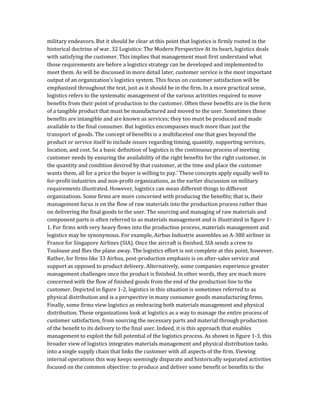
on delivering the final goods to the user. The sourcing and managing of raw materials and
component parts is often referred to as materials management and is illustrated in figure 1-
1. For firms with very heavy flows into the production process, materials management and
logistics may be synonymous. For example, Airbus Industrie assembles an A-380 airliner in
France for Singapore Airlines (SIA). Once the aircraft is finished, SIA sends a crew to
Toulouse and flies the plane away. The logistics effort is not complete at this point, however.
Rather, for firms like 33 Airbus, post-production emphasis is on after-sales service and
support as opposed to product delivery. Alternatively, some companies experience greater
management challenges once the product is finished. In other words, they are much more
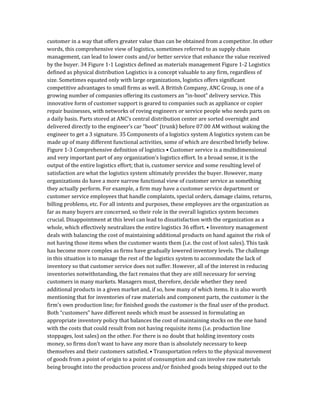
concerned with the flow of finished goods from the end of the production line to the
customer. Depicted in figure 1-2, logistics in this situation is sometimes referred to as
physical distribution and is a perspective in many consumer goods manufacturing firms.
Finally, some firms view logistics as embracing both materials management and physical
distribution. These organizations look at logistics as a way to manage the entire process of
customer satisfaction, from sourcing the necessary parts and material through production
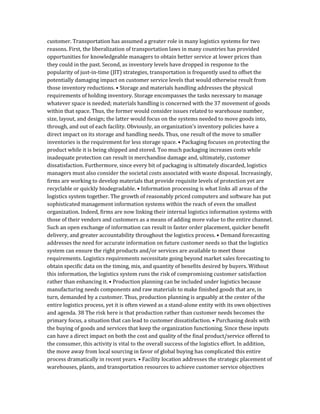
of the benefit to its delivery to the final user. Indeed, it is this approach that enables
management to exploit the full potential of the logistics process. As shown in figure 1-3, this
broader view of logistics integrates materials management and physical distribution tasks
into a single supply chain that links the customer with all aspects of the firm. Viewing
internal operations this way keeps seemingly disparate and historically separated activities
focused on the common objective: to produce and deliver some benefit or benefits to the
customer in a way that offers greater value than can be obtained from a competitor. In other
words, this comprehensive view of logistics, sometimes referred to as supply chain
management, can lead to lower costs and/or better service that enhance the value received
by the buyer. 34 Figure 1-1 Logistics defined as materials management Figure 1-2 Logistics
defined as physical distribution Logistics is a concept valuable to any firm, regardless of
size. Sometimes equated only with large organizations, logistics offers significant
competitive advantages to small firms as well. A British Company, ANC Group, is one of a
growing number of companies offering its customers an “in-boot” delivery service. This
innovative form of customer support is geared to companies such as appliance or copier
repair businesses, with networks of roving engineers or service people who needs parts on
a daily basis. Parts stored at ANC’s central distribution center are sorted overnight and
delivered directly to the engineer’s car “boot” (trunk) before 07:00 AM without waking the
engineer to get a 3 signature. 35 Components of a logistics system A logistics system can be
made up of many different functional activities, some of which are described briefly below.
Figure 1-3 Comprehensive definition of logistics • Customer service is a multidimensional
and very important part of any organization’s logistics effort. In a broad sense, it is the
output of the entire logistics effort; that is, customer service and some resulting level of
satisfaction are what the logistics system ultimately provides the buyer. However, many
organizations do have a more narrow functional view of customer service as something
they actually perform. For example, a firm may have a customer service department or
customer service employees that handle complaints, special orders, damage claims, returns,
billing problems, etc. For all intents and purposes, these employees are the organization as
far as many buyers are concerned, so their role in the overall logistics system becomes
crucial. Disappointment at this level can lead to dissatisfaction with the organization as a
whole, which effectively neutralizes the entire logistics 36 effort. • Inventory management
deals with balancing the cost of maintaining additional products on hand against the risk of
not having those items when the customer wants them (i.e. the cost of lost sales). This task
has become more complex as firms have gradually lowered inventory levels. The challenge
in this situation is to manage the rest of the logistics system to accommodate the lack of
inventory so that customer service does not suffer. However, all of the interest in reducing
inventories notwithstanding, the fact remains that they are still necessary for serving
customers in many markets. Managers must, therefore, decide whether they need
additional products in a given market and, if so, how many of which items. It is also worth
mentioning that for inventories of raw materials and component parts, the customer is the
firm’s own production line; for finished goods the customer is the final user of the product.
Both “customers” have different needs which must be assessed in formulating an
appropriate inventory policy that balances the cost of maintaining stocks on the one hand
with the costs that could result from not having requisite items (i.e. production line
stoppages, lost sales) on the other. For there is no doubt that holding inventory costs
money, so firms don’t want to have any more than is absolutely necessary to keep
themselves and their customers satisfied. • Transportation refers to the physical movement
of goods from a point of origin to a point of consumption and can involve raw materials
being brought into the production process and/or finished goods being shipped out to the
customer. Transportation has assumed a greater role in many logistics systems for two
reasons. First, the liberalization of transportation laws in many countries has provided
opportunities for knowledgeable managers to obtain better service at lower prices than
they could in the past. Second, as inventory levels have dropped in response to the
popularity of just-in-time (JIT) strategies, transportation is frequently used to offset the
potentially damaging impact on customer service levels that would otherwise result from
those inventory reductions. • Storage and materials handling addresses the physical
requirements of holding inventory. Storage encompasses the tasks necessary to manage
whatever space is needed; materials handling is concerned with the 37 movement of goods
within that space. Thus, the former would consider issues related to warehouse number,
size, layout, and design; the latter would focus on the systems needed to move goods into,
through, and out of each facility. Obviously, an organization’s inventory policies have a
direct impact on its storage and handling needs. Thus, one result of the move to smaller
inventories is the requirement for less storage space. • Packaging focuses on protecting the
product while it is being shipped and stored. Too much packaging increases costs while
inadequate protection can result in merchandise damage and, ultimately, customer
dissatisfaction. Furthermore, since every bit of packaging is ultimately discarded, logistics
managers must also consider the societal costs associated with waste disposal. Increasingly,
firms are working to develop materials that provide requisite levels of protection yet are
recyclable or quickly biodegradable. • Information processing is what links all areas of the
logistics system together. The growth of reasonably priced computers and software has put
sophisticated management information systems within the reach of even the smallest
organization. Indeed, firms are now linking their internal logistics information systems with
those of their vendors and customers as a means of adding more value to the entire channel.
Such an open exchange of information can result in faster order placement, quicker benefit
delivery, and greater accountability throughout the logistics process. • Demand forecasting
addresses the need for accurate information on future customer needs so that the logistics
system can ensure the right products and/or services are available to meet those
requirements. Logistics requirements necessitate going beyond market sales forecasting to
obtain specific data on the timing, mix, and quantity of benefits desired by buyers. Without
this information, the logistics system runs the risk of compromising customer satisfaction
rather than enhancing it. • Production planning can be included under logistics because
manufacturing needs components and raw materials to make finished goods that are, in
turn, demanded by a customer. Thus, production planning is arguably at the center of the
entire logistics process, yet it is often viewed as a stand-alone entity with its own objectives
and agenda. 38 The risk here is that production rather than customer needs becomes the
primary focus, a situation that can lead to customer dissatisfaction. • Purchasing deals with
the buying of goods and services that keep the organization functioning. Since these inputs
can have a direct impact on both the cost and quality of the final product/service offered to
the consumer, this activity is vital to the overall success of the logistics effort. In addition,
the move away from local sourcing in favor of global buying has complicated this entire
process dramatically in recent years. • Facility location addresses the strategic placement of
warehouses, plants, and transportation resources to achieve customer service objectives
and minimize cost. Although not necessarily made often, these decisions can have very long-
term and potentially costly implications for the organization. • Other activities for a specific
organization could include tasks such as after-sales parts and service support, maintenance
functions, return goods handling, and recycling operations. Clearly, any one organization is
unlikely to require the accomplishment of all these specific tasks. For example, a service
firm such as an airline might combine elements from the information processing,
maintenance, demand forecasting, customer service, and purchasing functions discussed
above into a logistics system designed to reach its customers. On the other hand, in addition
to customer service, purchasing, and demand forecasting, a manufacturer of consumer
goods may draw from transportation, inventory management, storage, materials handling,
and packaging for its logistics support. The point is that every organization, be it
manufacturer or service provider, for-profit or non-profit, has customers that they want to
reach. By integrating the appropriate functions into a customer-focused logistics system, the
enterprise can develop a sustainable advantage that is very difficult for a competitor to
imitate. Some of these activities have traditionally had a well-defined stand-alone role
within a company (purchasing, production, information processing), while others have
generally been more closely associated with logistics (transportation, warehousing,
packaging). What ties all of these functions together is their ability to impact customer
satisfaction. This is not to say that production, for example, should be subordinate to
logistics. Rather, 39 top management should utilize logistics as a way to integrate these
corporate activities and keep them focused on the customer rather than on internal
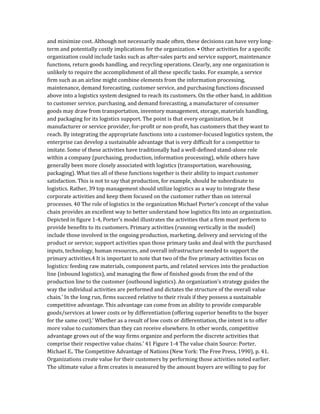
processes. 40 The role of logistics in the organization Michael Porter’s concept of the value
chain provides an excellent way to better understand how logistics fits into an organization.
Depicted in figure 1-4, Porter’s model illustrates the activities that a firm must perform to
provide benefits to its customers. Primary activities (running vertically in the model)
include those involved in the ongoing production, marketing, delivery and servicing of the
product or service; support activities span those primary tasks and deal with the purchased
inputs, technology, human resources, and overall infrastructure needed to support the
primary activities.4 It is important to note that two of the five primary activities focus on
logistics: feeding raw materials, component parts, and related services into the production
line (inbound logistics), and managing the flow of finished goods from the end of the
production line to the customer (outbound logistics). An organization’s strategy guides the
way the individual activities are performed and dictates the structure of the overall value
chain.’ In the long run, firms succeed relative to their rivals if they possess a sustainable
competitive advantage. This advantage can come from an ability to provide comparable
goods/services at lower costs or by differentiation (offering superior benefits to the buyer
for the same cost).’ Whether as a result of low costs or differentiation, the intent is to offer
more value to customers than they can receive elsewhere. In other words, competitive
advantage grows out of the way firms organize and perform the discrete activities that
comprise their respective value chains.’ 41 Figure 1-4 The value chain Source: Porter.
Michael E.. The Competitive Advantage of Nations (New York: The Free Press, 1990), p. 41.
Organizations create value for their customers by performing those activities noted earlier.
The ultimate value a firm creates is measured by the amount buyers are willing to pay for
its product or service. A firm is profitable if this value exceeds the total cost of performing
all the required activities. To gain competitive advantage over its rivals, a firm must either
provide comparable buyer value by performing activities more efficiently than its
competition (lower cost), or accomplishing those tasks in a unique way that creates greater
customer value and commands a premium price (differentiation).” (It is generally risky to
attempt to do both since differentiation implies higher costs.) The key is to find sources of
advantage that cannot be easily duplicated by the competition.9 For example, the Industrial
Division of Toshiba International Corporation (TIC) builds motors, drives, uninterruptible
power supplies, and other industrial equipment. It ships these products from its main
finished goods warehouse in Houston, Texas, and from a distribution center in Erlanger,
Kentucky, to distributors, original equipment manufacturers (OEMs), and end users
throughout the United States and overseas. Many of its customers require just-in-time
deliveries. If a late shipment idles the engineers scheduled to install the incoming
equipment, the customer may assess a penalty. In late 1998, the company was utilizing 23
different motor carriers to meet its transportation needs and lacked a standardized 42
agreement for dealing with them. The company realized that it had to reduce its domestic
freight costs and improve its on-time delivery rate. To help minimize breakage, it wanted
more direct, point-to-point shipments and fewer stops. TIC began using performance
scorecards to evaluate the carriers, and eventually reduced the number used from 23 to six.
It also started utilizing a web-based trading network to tender loads to carriers. As a result,
the company now pays less to move its freight, its carriers provide higher levels of service,
and customers are much more likely to received their goods undamaged and on time.’° 43
Logistics as a Source of Competitive Advantage Managers are increasingly becoming aware
that a well-run logistics system can provide the organization with a sustainable competitive
advantage. However, this appreciation for logistics is a relatively recent phenomenon.
Traditional sources of advantage centered around factors such as access to low labor costs,
natural resources, large captive markets, or some unique technological expertise.
Unfortunately, while still critically important to corporate success, these elements are
declining in importance as sustainable advantages. New technologies are shrinking direct
labor costs as a percentage of total costs; many nations with historically low labor costs are
finding that emerging countries can undercut them; the rate of advancement in some
industries seems to make technological developments obsolete almost as soon as new
products reach the marketplace. Finally, the availability of natural resources and
inexpensive components has become increasingly global, largely eliminating access to them
as an advantage.” Throughout the 1970s and early 1980s, some companies tried to achieve
competitive advantage by improving productivity and reducing costs. As the 1980s
unfolded, competitive advantage meant delivering flawless product quality, while in the
1990s, providing superior customer service became the objective of leading-edge firms.12
The new millennium saw the focus on customer service continue, but the emphasis is now
on adding value by helping them to do their tasks better. However, this discussion
highlights two points regarding competitive advantage. First, even the most successful
advances lose their individual determinance over time so that yesterday’s competitive
advantage becomes today’s minimum acceptable standard. Second, the window of
opportunity for any given strategic innovation may be relatively narrow, so organizations
must constantly be searching for new ways to meet their customers’ needs better than the
competition can. Though the topic will be discussed in some detail later, it is worth
mentioning here that a competitive advantage built on a well-planned and successfully
executed logistics strategy can be sustainable because it is very difficult for a competitor to
copy. What might be sources of competitive advantage in the next decade? Unfortunately,
there is no easy answer to this question. Achieving 44 meaningful competitive advantage
requires an organization to have a thorough understanding of its customers and the
additional value that they seek. In addition, the firm must have the internal skills (or
competencies) necessary to exploit that knowledge in ways that no rival can duplicate. For
example, there is a growing demand for time-based logistics management in developed
markets where customers are relatively sophisticated and resultant competitive pressures
are high. Speeding up the process means streamlining the flow of goods from the supplier to
the customer by reducing or eliminating activities that add time but no value.” Customer
demands for faster delivery, continuous shipment tracking, and electronic transfer of
information reflect this desire to minimize wasted time. Kauppatalo Hansel Oy, a Finnish
distributor of maintenance, repair, and operations (MRO) goods, is addressing this demand
in an innovative way. Located in Helsinki, the capital of Finland, Hansel offers 2.5 million
product variants to its customers, 6,000 of which it stores in its own warehouse in Helsinki.
The rest are stored by 500 suppliers included in their supply network. A customer’s order
will typically involve products coming from several locations. Rather than sending multiple
shipments that can arrive at different times, each item is shipped to a central distribution
center where it is consolidated into one shipment that is then delivered to the customer.
This system adds value to the customer by minimizing the number of shipments that must
be tracked and lowering the chance for service disruption.14 Alternatively, customers in
less-developed or emerging markets may not see rapid replenishment as a particular
advantage given that it also implies higher costs. Indeed, a significant competitive
advantage in this situation might be realized simply by having the ability to get the product
to that customer on a regular basis at some reasonable cost. The challenge for any
organization is to focus its skills on satisfying those customer needs that offer the greatest
opportunities for obtaining a sustainable competitive advantage. 45 Why Is Management
Interest in Logistics Growing? Porter’s theory of competitive advantage and the value chain
is not new, yet, in general, logistics has remained a rather underappreciated part of many
firms. However, dramatic changes in the international business environment in recent years
have led to an increased role for logistics in firms operating globally. Several of these events
and their impact on logistics will be discussed below. Trends in global trade Firms are
searching for ways to capitalize on the growing demand for goods in markets such as
Central and Eastern Europe, China, and the Commonwealth of Independent States (CIS).
Indeed, with more than 1.2 billion consumers and increasing disposable income, China’s
retail sales during the first half of 2003 alone totaled 2.1556 trillion Yuan (US$260.3
billion), up 8 percent over the previous year.” Similarly, a 2003 A. T. Kearney study
identified Russia and Eastern European countries as offering the best opportunities for food
and general merchandise retailers with international expansion plans.16 At the same time,
new and cheaper sources for raw materials, manufacturing capability, and other inputs are
encouraging firms to explore purchasing arrangements in countries they have never
considered before. Exploiting these opportunities will inevitably require logistics systems
that are different from those serving more developed markets. Trade blocs are emerging as
a way to give smaller countries economic power against their larger, more developed
counterparts around the world. These arrangements have the added benefit of simplifying
business transactions among the member states. At a more fundamental level, these
economic unions are reshaping the entire perception of domestic versus international
markets. For example, a British firm may realistically consider its “domestic” market to
include all nations in the European Union (EU), while a Canadian firm may view other
members of the North American Free Trade Agreement (NAFTA) in the same way. Of
course, significant country-to-country differences continue to exist. But a well-run logistics
system can provide the organization with a mechanism for dealing with those disparities so
that customers’ needs can be satisfied 46 regardless of the market’s geographic location.
Customers are demanding greater value Customers prefer to buy from the firm that they
perceive to offer the highest customer delivered value. As depicted in figure 1-5, customer
delivered value is the difference between total customer value and total customer cost,
where total customer value is the bundle of benefits customers expect from a given product
or service and total customer cost represents all direct and indirect costs associated with
obtaining those benefits.” As mentioned above, to increase the customer delivered value,
the firm must either dispense more benefits (increase total customer value) for the same
cost; give the same total customer value at a lower cost; or provide some combination of the
two. The difficulty for global companies is that customers in different markets define value
in dramatically different ways. Management, then, must have a clear idea of what is
important to their various customer groups so that the appropriate benefits can be
delivered to each one. Unfortunately, people rarely lower their desired level of delivered
value. For example, firms doing business in Europe used to routinely serve all of those
customers from a distribution center situated in the southeastern part of England or the
Benelux area (Belgium, the Netherlands, and Luxembourg). Today, however, to provide the
fast service that customers are demanding, smaller, regional distribution centers (RDCs) are
being opened in a variety of locations throughout Europe. For example, an RDC in Lyon,
France, might service customers in southern France, Italy and Spain.18 47 Transportation
privatization and liberalization Because of the key role played by transportation in a
nation’s economy, governments have historically taken a great interest in how it is
accomplished. For some nations, this involvement has taken the form of outright national
ownership of transport resources such as airlines, steamship lines, and railways; other
countries have chosen to rely on the private sector to provide these services. However,
regardless of location, transportation services have almost always taken place within a
complex framework of laws and regulations seemingly intended to protect the industries
themselves at the expense of efficient resource utilization and customer service. 48 Figure
1-5 Determinants of customer delivered value Source: Kotler. Philip. Marketing
Management. 11th edn (Englewood Cliffs. NJ: Prentice Hall. 2003), p. 38. In 1968, the United
Kingdom was one of the first to reduce government’s involvement in the provision of
transportation services, specifically road freight movement. This reduction of government’s
role in the business affairs of transportation companies has come to be known as
deregulation. The United States followed the British lead, starting with the all-cargo airline
in 19 77. Since then, other countries have gradually moved to sell their government-owned
or controlled transport companies to private interests while simultaneously reducing their
involvement in the business of transportation. China, for example, began opening up its
national railway to private operators in early 1998 and, by the end of 2004, started
permitting foreign companies to operate wholly owned road transportation companies.19
Similar interest in improving rail efficiency in Europe has led the EU to advocate splitting
railway infrastructure and operational capacities into two separate entities so that private
operators such as the Dutch company Railion can compete with state-owned railroads. In
fact, the Netherlands and Germany have aggressively moved to dismantle state monopolies.
The Dutch have actually seen freight volumes increase since commercial firms began
providing service, while Germany now has approximately 25 private rail freight companies
of which ten are ‘° considered serious competitors for the state-run Deutsche Bahn Group.
Invariably such a reorientation towards more competitive transport systems provides
opportunities for shippers to obtain better service and lower prices. However, the reality is
that managing the transport function today has become more complex as logistics managers
must now deal with an ever-changing array of cost/service options. 49 Transportation
security Since late 2001, transportation security has become a major concern for several
reasons. First, companies now realize that the definition of a highrisk cargo has changed. In
the past, high-value consumer goods, for example, were typical of products most susceptible
to theft. Today, many types of industrial cargoes may be targets as well. Second,
governments around the world are increasing their scrutiny of freight moving through their
ports, which means that new documentation and handling procedures must be followed by
all parties engaged in the transport process. Mistakes can delay shipments, raise costs, and
generally disrupt customer supply chains. Finally, nervous shippers now want to know at
any time where their shipments are in the transit chain, a demand that has led to innovative
identification technologies that will be discussed below. Environmental concerns Well-to-do
nations and their citizens are becoming more concerned with actions that adversely affect
the environment and society’s quality of life. Air, water, and noise pollution, solid waste
disposal, energy conservation, and product-safety issues can all be viewed as public costs
associated with meeting individual customer needs. For example, providing buyers with the
goods they want requires the use of transport vehicles that pollute the air, create noise, add
to traffic congestion, and consume scarce energy resources. Furthermore, these products
must be packaged to protect them from damage while in transit, but very often the packing
material that offers the most reasonably priced protection is the slowest to decompose once
it is discarded. In response to customer concerns about packaging waste, logistics
companies in the United Kingdom distributing to supermarkets are now collecting
cardboard waste from their customers and selling it for pulping. The transport costs are
minimal and a disposal cost to the retailer is avoided. On the other hand, developing nations
in which a competitive marketplace is still emerging tend to have a lower level of concern
for these issues. They are more interested in raising their standard of living and acquiring
the goods and services that their more advanced neighbors already possess. Customers in
these markets are not willing to pay higher 50 prices for environmentally friendly goods,
despite the long-term benefits of doing so. Thus, the challenge for the logistics manager is to
satisfy the customer while minimizing the adverse impact on the environment of doing so.
51 Changing view of inventory The perception of inventory has changed dramatically over
the years. Historically, inventory was used to compensate for internal problems that could
ultimately result in a dissatisfied customer. In fact, from a purely functional point of view,
everyone (other than the accountants) liked inventory. Manufacturing managers desired
long production runs of similar products on lines that did not stop: work-in-process and
finished goods inventories made that possible. The sales force relied on large inventories to
back up promises of rapid goods delivery to the customer. Finally, customers liked
inventory because it meant that items were always available on the shelf. Unfortunately,
what became obvious to many managers in the early 1980s is that holding inventory costs
money. As firms became more concerned with controlling costs, inventory levels fell as
firms adopted some form of a JIT system. But, over the longer term, many of these same
firms found that while their overall costs fell, customer service deteriorated as stockouts
increased. Eventually, sales and profits declined as well, more than offsetting any cost
savings. Managing inventory becomes an especially crucial issue when selling globally
because holding goods in nondomestic markets is virtually a necessity if customer service
levels are to be maintained. So the issue of inventory management continues to be of great
importance. Specifically, managers must decide how much (if any) to hold and how to
administer the rest of the logistics system more creatively to ensure that customer service
does not suffer as a result of lower inventory levels. Coles Meyer, Australia’s largest retailer,
plans to save up to $1 billion by making its 65,000 suppliers shoulder more of its supply
chain costs in a program designed to close the performance gap with arch-rival
Woolworths. The firm is changing the way it buys about $18 billion of food, liquor,
consumer goods, and clothing each year, cutting the amount of stock it holds in warehouses
and back rooms and forcing its suppliers to move to a just-in-time approach to delivering
goods. The project will increase the pressure on the 65,000 suppliers to the retailer, who
are being asked to shoulder more of the back-end operations, including picking and packing
goods on to pallets, which retailers would traditionally undertake. Coles Meyer’s broad
strategy is to cut its inventory levels by moving to a system where suppliers deliver stocks
just before they are needed on the shelves. 52 This cuts the amount of warehouse space the
retailer needs and lowers the costs of holding inventory. It wants to remove slow-selling
product lines to maximize profitability by selling more often from the same shelf space and
reduce the amount of wastage in lines such as groceries.21 53 Continuing advances in
information technology Information systems are the glue that holds the logistics system
together. Indeed, the dramatic improvement in computer technology over the past 3 0 years
has made it possible to systematically manage logistics at all. As computing power has
grown and prices have dropped, sophisticated computer resources are now within reach of
even the smallest organization. Information transfer can occur instantaneously, not only
within single organizations, but also between them. This capability means that data are
captured and analyzed more quickly, leading to better decision making. In fact, the
capability to fully automate the logistics system is now available. A customer’s order can be
generated automatically as on-hand inventory drops to a certain level. The order is
transmitted via electronic data interchange (EDI) to the supplier’s computer, which then
directs the required amount of the needed product be pulled automatically from the
warehouse and shipped to the customer. Inventory levels are updated, billing initiated, and
necessary documents generated at each appropriate step in the process. Theoretically, this
entire process can occur without human intervention and with virtually no waiting time.
Other developments are taking place in the use of global positioning systems (GPS) and
radio frequency identification (RFID) tags. GPS utilize satellites to monitor vehicles (and the
shipments they are carrying) in real time, a capability that allows the carrier not only to tell
customers where their cargo is at any given time, but also to reroute vehicles should the
need arise. RFID utilizes a small transmitter to send radio frequencies from pallets and
cases that allow those items to be instantaneously located by the customer or the carrier.
The giant United States railroad Burlington Northern and Santa Fe Railway Co. (BNSF) has
increased productivity and efficiency by investing in both technologies to automate the flow
of information and shipping containers to and from customers. Both systems have been
used for years to track company equipment as it moves around the country. Today,
however, containers are loaded and unloaded in intermodal hubs with a series of overhead
cranes equipped with satellitelinked GPS equipment. This capability provides a precise
geographic location of a container at the moment it’s being loaded or unloaded and 54
creates a precise, 3-D image of where a given container is located in the yard. Similarly,
BNSF’s systems can handle RFID-enabled packaging as well. For example, if they are
transporting RFID-capable freight from a retailer’s wholesalers, they can associate the
individual RFID-packaged goods with the container to provide a precise description of the
freight’s location as it makes its way across the country.’ 55 Electronic commerce Electronic
commerce, or e-commerce, is rapidly taking hold as a retail selling venue. Customers can
now shop and order virtually any merchandise on-line from the comfort of their own
homes. Security issues regarding the transmission of credit card information are being
resolved, so buyers are becoming more comfortable with the Internet as a shopping tool.
However, if the full promise of e-commerce is to be realized, the goods must reach the buyer
just as quickly. Thus, firms have had to reassess their logistics systems to ensure that their
customers receive the goods that they have ordered in an expeditious manner. In other
words, logistics is an essential element of a successful e-commerce venture. Logistics in the
Global Organization As the world’s markets become more open, managers are finding that
new ways of doing business are necessary to both fully exploit the opportunities available
as well as guard against emerging threats to corporate success. The traditional international
or multinational approach to business concentrates largely on geographic markets,
developing a distinct marketing mix for each one.3 This strategy, in turn, implies a primary
focus on some domestic market, with international efforts a subordinate concern. Global
organizations, on the other hand, look at the whole world as one potential market –
sourcing, manufacturing, researching, raising capital, and selling wherever the job can be
done best.24 One of General Motors’ newest American models is the Pontiac GTO, which is
actually a slightly modified Australian car known as the Holden Monero. The GTO is built in
Adelaide and shipped to the United States where it is marketed as the successor to the
wildly popular 1960s era “muscle” car of the same name.25 The challenge is how to manage
this network of far-flung overseas activities as a single, effective unit. Firms are searching
for ways to convert worldwide production, marketing, research and development, and
financial presence into a 56 competitive advantage .2′ There are two ways in which a firm
can achieve that goal. The first is in the way a global organization can spread activities
among nations to serve the world market. The second is via the ability of a global company
to coordinate among those dispersed activities. In some instances these activities may be
placed close to the buyer in the value chain. Outbound logistics, after-sales service, and
marketing are usually tied to the buyer’s location. In contrast, tasks such as sourcing,
inbound logistics, and manufacturing can be performed anywhere. But geography is
generally becoming less of a constraint. A firm with a global strategy locates such activities
to optimize its cost position or differentiation from a worldwide perspective. For instance,
Dell Computers in the United States is the second largest computer company in the world in
terms of number of shipments. Dell has factories in the USA, Ireland, Malaysia, and China; it
also commissions an original equipment manufacturer (OEM) in Taiwan to produce
computers with the Dell brand name. The OEM is not just in charge of assembly; it also
designs, tests and produces new machines, carries out inspections and manages stock.
Furthermore, over the last few years, the Taiwanese OEM has been rapidly transferring part
of the production of motherboards and peripherals to China; these are then exported from
China as semi-manufactured goods. Finally, a hard-disk drive assembly plant in Thailand
exports its products to the United States, Malaysia, Taiwan, and China. In this way, the
mechanism of production and distribution has spread across Asia .2′ As can be seen,
competitive advantage from an international presence comes from locating activities
utilizing a global perspective and coordinating actively among them.28 Logistics is a
particularly powerful management tool in a global organization because it is an approach to
doing business that works anywhere. Clearly, fulfilling customer needs in North America or
Europe requires different skills and resources than satisfying buyers in rural China or
Azerbaijan. The objective, however, is the same: to meet those needs better than the
competition. By understanding the basics of logistics management and how to put together
a logistics system responsive to customer requirements, managers will be better able to
deal with the unique challenges inherent in doing business outside the confines of their own
country. Logistics profile 1-1 discusses McDonald’s and illustrates just how important a
resource logistics can be. 57 LOGISTICS PROFILE 1-1 McDonald’s When McDonald’s a few
years ago offered to add an extra strip of bacon on its burgers for (US) 35 cents, it
misjudged customer appetites. The promotion proved so popular the fast-food giant had to
rush order a few more rashers, triggering a bit of a ripple impact across part of the
economy. “We closed the spot market for pork bellies and increased our costs greatly,” said
Robert Bauer, information technology director for McDonald’s global supply chain. It also
forced McDonald’s to rethink the way it manages purchasing, inventory, and replenishment.
Now the company wants its franchisees and corporate managers to use an online ordering
system that will help it plan exactly what to purchase, pack, and ship – and how many trucks
it will need to do it. “McDonald’s already has seen dramatic improvements in its European
operations using this technology. The company has reduced raw waste by 30 percent,
inventory by 30 percent and store transfers from eight to four,” said Bauer. “Order times
were halved, saving 60 minutes per week,” he said. “Annual savings per store are
approximately (US)$5,585, which sounds like little to a big corporation except that it adds
up to at least $11.5 million in savings at just the 2,072 McDonald’s restaurants in France and
Germany. McDonald’s online ordering program reflects the shift toward “demand chain
planning” under way across many industries. Product life cycles are getting shorter,
competition more intense, and even global giants need to be nimble. Waste has to be cut out
of supply chains, whether it is too many plastic spoons or too many shipments using too
many trucks, trains, planes, and ships. In 2003, only 12 percent of restaurants ordered food
supplies electronically – 10 percent for nonfood supplies, according to the National
Restaurant Association. Some twothirds purchased perishable foods and nonfood supplies
primarily through a distributor. McDonald’s, however, is one of a handful of companies with
the power to get thousands of franchisees – its business partners and customers – to sign up
for such a 58 system. The company serves more people by Tuesday than WalMart serves
each week. More than 31,000 McDonald’s restaurants serve 46 million customers each day
in 119 countries. In the United States, thousands of trucks are on the road each day
delivering food and supplies to McDonald’s franchises. Those trucks are hauling more than
just all-beef patties and sesame seed buns. McDonald’s is one of the largest toy distributors
in the United States, selling toys, clothing, footwear, accessories, books, DVDs, and videos –
and you still can get fries with that. In the United States, where McDonald’s has about
13,000 restaurants, nearly 12,100 are on-line. “It is unlikely it will ever hit 100 percent,”
said Bauer, “because the franchisees don’t have to sign up if they don’t want to. Planning the
right amount to ship to restaurants each week is critical, however, because McDonald’s
wants its inventory to be `invisible.’ It wants deliveries to its stores at night so that workers
aren’t tied up dodging handcarts and large trucks are not parked in front of the restaurants.
McDonald’s delivers supplies between one to three times per week per store, sometimes
more often in urban areas. Each truck makes two to three stops per route.” For 2004,
McDonald’s plans to complete implementation of online ordering in Germany and France,
where it is using the system for all food and supplies. McDonald’s has 1,100 restaurants in
Germany and 972 in France, where the company says it has generated positive comparable
sales and profit increases each of the past six years, despite much publicized protests by
French farmers and activists. McDonald’s is one-third of the way through the project in
Germany and half-way through the project in France, said Bauer. McDonald’s plans to
expand the system to the United Kingdom, Hungary, Austria, Spain, the Czech Republic and
the Netherlands. (Source: Hickey, Kathleen, “McDonald’s Tall Order,” Traffic World, January
5, 2004, pp. 8-10.) 59 Conceptual Model and Statement of Purpose This text is structured
around the logistics system model shown in figure 1-6. The logistics system provides the
means for moving goods from their point of origin to their point of consumption. The
various activities discussed earlier must be performed together to meet customers’ needs at
the lowest total cost, a systems approach that involves weighing the impact of individual
decisions on the logistics effort as a whole. The premise is that failing to adopt such a
systematic view of logistics will impede the flow of value to customers either through poor
service, increased costs, or both. Thus, while subsequent chapters will examine many of
these activities in detail, their overall role as parts of a larger whole must not be forgotten.
As noted in the Preface, the purpose of this book is threefold. First, it will provide the reader
with a concise description of individual logistics activities and how they function in a global
setting. Second, the reader will be able to understand how those separate activities can be
made to function as a cohesive system that adds great value to the firm’s customers. Finally,
this basic knowledge will enable managers to effectively utilize logistics as a competitive
weapon in the continual fight for marketplace advantage. 60 Logistics is a concept familiar
to students of military history. Long associated with the deployment and resupply of armed
forces in wartime, logistics is proving to be a source of sustainable competitive advantage
for firms competing in the global arena. Those firms view logistics as the process of moving
benefits from their point of production to the customers whose needs they are intended to
satisfy. Organizations tend to define logistics differently depending on whether they are for-
profit or non-profit manufacturers of products or providers of services. But the overall
objective remains the same: to satisfy the customer better than the competition. The
remainder of the book will utilize the logistics system model to illustrate how logistics can
be utilized to do just that. Figure 1-6 The logistics system 61 STUDY QUESTIONS 1.
Distinguish between logistics defined as materials management and logistics defined as
physical distribution. What are the similarities in each situation? Differences? 2. Discuss the
concept of customer benefits. What does logistics have to do with providing them? 3. How
do customers define value? How does price affect that definition? 4. How has the nature of
competitive advantage changed over the past 30 years? 5. What is the value chain and why
is it relevant to a firm today? 6. How has the role of inventory in an organization changed
over the years? 7. Should production be included as a logistics function? Defend your
answer. 8. Why is it important for managers of global organizations to understand logistics?
9. How do environmental issues such as air pollution, fuel efficiency, and solid waste
disposal influence logistics? 10. Refer to logistics profile 1-1 and figure 1-6. How are other
logistics activities affected by the McDonald’s automated ordering initiative? What are the
advantages/disadvantages of implementing the new system in more countries? Notes 1.
Rutenberg, David C. and Allen, Jane S., The Logistics of Waging War (Gunter Air Force
Station, AL. USA: Air Force Logistics Management Center, 1986), p. 2. 62 2. Adapted from
Shapiro. Roy D. and Heskett, James L., Logistics Strategy: Cases and Concepts (St. Paul, MN:
West Publishing, 1985), p. 6. 3. “The Boot Leg.” Traffic World, July 19, 2004, p. 15. 4. Porter,
Michael E., The Competitive Advantage of Nations (New York: The Free Press. 1990), p. 40.
5. Ibid., p. 41. 6. Ibid., p. 3 7. 7. Ibid., p. 38. 8. Ibid., p. 40. 9 . Ibid., p. 43. 10. Douglas, Merrill,
“Toshiba’s Public-Private Partnership,” Inbound Logistics, October 2002,
http://www.inboundlogistics.com/.trticles/toolkit/toolkitl 00 2. html 11. Porter, Michael E.,
Competition in Global Industries (Boston, MA: Harvard Business School Press. 1986). p. 4.
12. Byrne. Patrick M.. “Going Beyond Quality For Competitive Advantage.” Transportation
and Distribution. vol. 32. no. 12. December 1991. p. 5. 13. Murphy, David J. and Farris.
Martin T., “Time-Based Strategy and Carrier Selection.” Journal of Business Logistics. vol. 15.
no. 2. 1993. p. 27. 14. Karkkainen. Mikko. Ala-Risku. Timo. and Holmstrom. Jan, “Increasing
Customer Value and Decreasing Distribution Costs with Merge-In-Transit.” International
journal of Physical Distribution and Logistics Management. vol. 33. no. 2. 2003. pp. 13 5-7.
15. “Retail sales strong, but sector has problems.” China Daily. October S. 2003. http://
wwwlchinadaily.com.cn/en’doc/2003-10-08/content63 269953.htm 16. “Russia. Eastern
Europe Most Attractive Expansion Targets for Food and General Merchandise Retailers.
According to A.T. Kearney Study,” http://www.atkearney.com/ main.taf?p=1,5.1.134 17.
Kotler. Philip. Marketing Management, 11th edn (Englewood Cliffs. NJ: Prentice Hall. 2003).
p. 60. 18. Harps. Leslie Hansen. “Europe’s Evolving Logistics Landscape.” Inbound Logistics.
August 2003. as presented at inboundlogistics.com.
http://www.inboundlogistics.com/articles/ features/0802-featureO2.html 19. Lee, Jane
Lanhee, “Tortured Logistics Take Toll on Growth,” Wall Street Journal, June 29, 2004, p. A12.
20. Stares, Justin, “Pain of getting Europe back on the rails: Many problems plague Europe’s
rail freight industry, but the biggest of these appears to be government ownership,” Lloyds
List International, issue 58626, March 29, 2004. p. 10. 21. Evans, Simon, “Coles Targets
$1BN Squeeze on Suppliers,” Australian Financial Review, September 15, 2003. p. 1. 22.
Campbell, Jeffrey and Draper, Fritz, “Best Practices-Railroad Revitalizes Freight Industry,”
Optimize, July 1, 2001, p. 53. 23. Cateora, Philip R. and Graham, John L., International
Marketing (New York: McGrawHill/Irwin, 2005), p. 23. 24. Ibid. 25. Crain, K. C.. “Dull Styling.
Price Hobble Sales of GTO.” Automotive News. May 24, 2004, p. 1. 26. Porter, 1986, p. 2. 27.
“Interview with Akiro Suehiro,” Asia Pacific Perspectives. July 2004, as presented at
http://www.jijigaho.or.jp/app/0407/eng/interviewO2.html 28. Porter, 1990, pp. 54-5. 64
65 Chapter 2 LOGISTICS IN THE ORGANIZATION Introduction The Marketing/Logistics
Partnership Marketing and Logistics Channels Environmental Issues Marketing Issues
Managing the Logistics System Tradeoff Analysis Enhancing Corporate Profitability with
Logistics Chapter Summary Study Questions Introduction As a part of their marketing
strategy, managers must develop what is known as a channel of distribution that links the
organization with their customers. Based on the channel design selected, the logistics
system is then structured to support that channel. This chapter will examine that crucial
relationship between marketing and logistics. First, channels and their role in the firm’s
marketing strategy will be explained. Next, issues 66 related to channel design and
management will be covered. Finally, the importance of systematically managing logistics to
support channel objectives will be explored in detail. Figure 2-1 The marketing mix 67 The
Marketing/Logistics Partnership Logistics decisions cannot be made until management has
decided on an appropriate marketing strategy for the organization. Far-sighted managers
realize that they must first determine what their customers need and want, then develop an
integrated marketing strategy that will satisfy those desires better than the competition.
Their goal is to maintain a customer orientation; that is, conceiving of and then making the
business do what suits the interests of the customer. Once a marketing strategy has been
developed, managers utilize a mix of four key variables to implement it. As shown in figure
2-1, these variables are referred to as the firm’s marketing mix. The most fundamental of
these elements is the product or service being offered to the customer. Based on the
product, management must develop a price, communicate the value of their good or service
to the market (promotion), and deliver the product to the consumer (place). Each of these
variables interacts with the others. For example, improving the quality of a product may
necessitate raising the price, which could reduce demand. Initiating a large promotional
campaign should cause sales to increase, which means additional product will have to be
manufactured and moved to the marketplace. However, the component of the marketing
mix of greatest concern in the marketing/logistics partnership is place, because it
encompasses logistics decisions regarding how to best supply the product to the customer.
Because the firm’s logistics strategy must support its overall marketing plan, it cannot by
definition be formulated until marketing objectives have been established. After the
fundamental marketing goals have been developed, management can then address issues
pertaining to logistics. Marketing and Logistics Channels Alternative channel structures 68
In a macro sense, one of the first decisions that must be made is how to get the goods to the
customer. This process involves designing a channel of distribution or logistics channel to
connect the manufacturer to the customer. Various channel structures are shown in figure
2-2. Sometimes a channel can be very simple, almost to the point of being nonexistent. In
Peru, for example, street markets and ambulatory sellers make up an informal distribution
network that accounts for a quarter of all retail cash sales.’ In the former case, sellers bring
products that they have made, grown, or obtained in some other way to the market and
customers come to buy (hopefully) what they need. This structure is also known as a direct
channel and frequently requires that buyers perform a number of logistics activities. In the
previous example, customers must go to the market without really knowing what will be
available. Assuming they find items to purchase, buyers must then transport them to the
place of consumption, store them, and finance the purchase. Likewise, when dealing with a
roving salesperson, just finding the individual can be a challenge, and buyers must bear
considerable risk regarding the quality of the goods purchased. Alternatively, a channel may
be extremely complex involving numerous intermediaries or middlemen between the
producer and the buyer. The more intermediaries there are, the longer the channel. 69 Why
do channels develop? Historically, barter was the way people satisfied needs that could not
be met through their own efforts. Because trading quickly becomes untenable as needs
increase, channels have evolved to facilitate the entire exchange process by performing all
of the functions associated with product marketing: selling, storing, transporting, financing,
risk-bearing, promotion, etc. More specifically, intermediaries work to present customers
with the selection of goods they desire. For example, a wholesaler might gather different
items together into an assortment that appeals to retailers. Alternatively, a middleman
might break down large quantities into smaller lots. For instance, a wholesaler might buy in
container-load lots that are then broken down into case lots that are sold to retailers.
Retailers, in turn, break down cases into the individual units sold to consumers. At least
initially, the producer may accomplish most of these activities via a direct channel, relying
on the customer to perform the rest. However, at some point it may become more efficient
to rely on intermediaries to perform these tasks simply because they can do them better
than either the manufacturer or the buyer. Channel flows The channel can be visualized as a
pipeline connecting the manufacturer and the customer. Downward movement from the
producer to the buyer includes the product itself, ownership, promotional information, and
service. Upward flows from the market to the manufacturer can include money, market-
research information, and even the product if it is being returned for some reason.
Occasionally, firms might require different channels for the same product if, for example,
they sell to both consumers and industrial customers. 70 71 Designing effective channels
Management must consider both environmental (external) and marketing (internal) factors
to structure an effective channel. Environmental Issues The firm’s global presence
profoundly impacts the channel structure chosen. Indeed, very few companies today have
the luxury of defining their missions as domestic corporations. Foreign suppliers, global
communication technology, and foreign competition affect even companies that market
their products solely within the borders of one country.’ Today, firms are attempting to
exploit opportunities in nations that have historically been closed to foreign goods.
However, penetrating those emerging markets can prove extremely challenging. For
example, in China, trucking cargoes from Chengdu to Shanghai now requires five days.
When the Chengdu-Shanghai highway is completed, the required time will be reduced to
three days. This will let the remote western region have easier access to other provinces
and ports on the coast. In fact, to increase the region’s overall accessibility, there are plans
to build an efficient integrated transportation system under the “go west” campaign. The
government’s hope is that as transportation time and costs decrease, the region will be able
to better realize its economic potential, creating a natural synergy among provinces with
higher economic return.3 The complexity of channel relations and the cost of logistics
operations increase dramatically as the firm’s global supplier/intermediary/customer
networks expand. Attention must be paid to the fact that cultural preferences impact both
the way customers in other countries shop and how channel members do business. In
reality, cultural variations increase the probability of conflict between channel members
and complicate the process of managing channel flows. Therefore, the more global the
organization’s operations, the more complex their channels become as distance and market
diversity combine to increase the risk of failure. This evolution implies a greater need for
cross-cultural channel management initiatives that can successfully deal with the formal
and implied etiquette 72 of each nation’s business culture. The government regulatory
environment can be especially intimidating for a global organization operating in many
countries. Deregulation of a number of industries in many nations has created an
environment in which the rules of managing channel relationships are constantly changing.
While US logistics managers have lived with the deregulation of their domestic
transportation, financial, and communications industries for a number of years, they must
now deal with growing international deregulation movements. In addition, ongoing
integration efforts among nations belonging to economic partnerships, such as the
European Union and NAFTA, will continue to alter the international transportation,
communications, and financial environments within which channel management tasks must
be performed. Managers must develop flexible channel systems that survive and thrive in a
constantly changing regulatory environment. Developing relationships that emphasize
adaptability while maintaining a value focus in the face of fundamental environmental
changes is a challenge channel managers cannot ignore.4 Corporate reconfiguration, both
domestically and internationally, is evidenced by the growth of vertical and horizontal
channel mergers, acquisitions, leveraged buyouts, and spinoffs, all of which can complicate
the structural decisions within many channels. A former competitor is suddenly a part of
the same corporate umbrella, while a former supplier is now owned by a major competitor.
While forecasting such structural changes can be virtually impossible, management must
develop channel systems that can be molded to the changing corporate situation so that
customer service is maintained.’ The rate of technological innovation shows no signs of
decreasing. Comparing the technology of the 2000s with that of the 1970s reveals a number
of innovations that influence channels today that did not exist 30 years ago: instantaneous
satellite order transmission, precise satellite tracking of transport vehicles, immediate
customer feedback on order status, robotic materials handling systems, personal
computeraided logistics systems analysis, radio frequency identification (RFID), and
electronic data interchange (EDI), just to name a few. The most significant impact of
technology on channels is the use of these innovations for one channel to establish a
competitive advantage over its competitors.6 73 Total quality management (TOM) is a
critical component of the channeldesign process since it implies that the pipeline is focused
on providing a quality offering as defined by customers. As more channels adopt a TOM
approach, quality will cease to be a basis for competitive advantage and evolve into a
standard of performance. Channels that cannot identify and deliver the quality demanded
by customers will lose them to channels that can.’ 74 Marketing Issues Primarily, managers
must decide what type of distribution is most supportive of their marketing strategies.
Intensive distribution involves selling through as many outlets as possible and is typically
used with products like soft drinks, cigarettes, and confectionery. This approach generally
leads to a very wide channel because of the large number of intermediaries that must be
dealt with. Exclusive distribution, on the other hand, results in a very narrow channel
because only one outlet, or a very limited number of them, is used. The automobile industry
tends to utilize this channel approach, having only one dealer in all but the largest cities.
Selective distribution, somewhere in between these two extremes, incorporates some but
not all possible outlets and is the method by which most consumer goods are handled. In
addition, managers must factor in the characteristics of the product itself. For example,
high-value items imply a large inventory investment that may limit the number or
availability of intermediaries. Also, technical products may require demonstration by
knowledgeable salespeople as well as the provision of after-sales maintenance and spare
parts support. Finally, customer service objectives must be considered. Issues with respect
to product availability, return policy, and delivery times must be analyzed. Logistics profile
2-1 illustrates how thoroughly considering these issues can result in a strong and flexible
channel structure handling a very delicate product. LOGISTICS PROFILE 2-1 Despite
Globalization Traumas, Flower Industry Blooms All over the world, the flower industry is
blossoming. Despite a sluggish global economy, estimates are that the sales of floral
products increased significantly in the first years of the new century. In many homes in the
developed world, flowers seem less a luxury than a lovely necessity. Yet behind the
beautiful images is an industry that’s been whipsawed by some of globalization’s most
ferocious forces. As new suppliers have come on line, old ones have had to adapt or perish.
Basic distribution patterns have altered and mass retailers have 75 transformed the basic
rules of the game. This has created and extinguished opportunities at an almost frenzied
pace, while at the same time giving consumers greater access to a wider variety of product
at lower price than ever before. A market transformed “There certainly has been a big
change in the market in the last ten years,” says Phil Armellini, Vice President of Sales and
Marketing at Palm City, Florida-based Armellini Industries Inc., one of the USA’s top
providers of logistics services to the flower industry. What is almost as surprising as the
pace of change that is taking place is the adaptability of the myriad different players
involved. Although the floral industry’s products may look beautiful and peaceful, behind
them battles rage over billions of dollars in sales, in fights that are having an impact on the
financial fates of nations. Yet, at the same time, there are buffers built into the floral
industry that seem to help protect players from some of the more egregious economic
swings. Part of this is due to the very nature of the flower industry. Because its products are
so perishable, location is more important in the floral business than in many other fields.
Europe leads/US, Canada, and Japan also top consumers While flower production is
spreading into more and more countries, world consumption is concentrated in just a few
nations and regions. Europe leads the pack at 44 percent of global volume. Next comes the
United States and Canada at 21 percent and Japan at 15 percent. That’s one reason why
producers that would probably have seen a significant decrease in business because of
changing market conditions have held on and even seen increases in volume in the
tumultuous market conditions of recent years. Europe’s overwhelming dominance is one
reason that Holland has been able to maintain some prosperity in the face of bruising
competition. Holland has been one of the world’s leading centers of floral production since
it invented the greenhouse in the 1600s. Still, 76 the country is facing voracious competition
from developing nations whose costs are a minute fraction of those encountered in Europe.
Dutch growers have maintained their competitive edge in the marketplace by doing
everything from implementing new marketing approaches to putting advanced logistics
technology to work. These strategies had significant success, according to the Flower
Council of Holland, the industry’s leading trade group. Given the increases scored with other
countries, however, that could be a serious blow – except for some fascinating mitigating
factors. In the floral business, the kind of products Holland deals in are known as bulb
goods, with the tulip being the best example. American flower providers tended to stay out
of the bulb market, in part because of the intensity of the Dutch dominance. Instead, they
focused on roses and similar products, an area in which they wound up proving highly
vulnerable. New countries emerge as key producers “A major production shift took place in
the latter part of the twentieth century,” says Dr. Terri Starman, Associate Professor in the
Department of Horticultural Sciences at Texas A&M University. Though the attack took
years to materialize, it has proven devastatingly effective. It came from South America,
which was a negligible force in the flower market in the 19 70s, and is today a world leader.
“Flowers just started coming from South America back in the late ’70s, and now about 80
percent of the roses in the US are imported, mainly from South America,” Armellini says.
Most South American production is occurring in the northern part of the continent. “There
are flowers coming out of Colombia, Ecuador, Peru, Chile, Costa Rica, and Guatemala, while
you have tropicals coming out of the Dominican Republic,” says Larry Landry, manager of
American Airlines Cargo’s perishables express program. Other areas are also emerging as
production centers, Starman says. The Ivory Coast and Kenya are exporting a great deal of
product to Europe, while Thailand and Taiwan are serving a growing Asian marketplace. 77
Many of the South American countries are selling product that directly undercuts
California’s producers. “They’re suffering through a bit of a change in things,” Landry says.
“They’re dealing with competitive issues of product produced in Ecuador and Colombia that
are similar varieties to what California was producing in the US market.” Economic
difficulties in Ecuador are making the situation even more challenging for California, Landry
says. “It’s my understanding that a lot of farms in Ecuador, where a lot of the primo roses
are grown, are in receivership or are in fact owned by the bank. That creates a cost
structure or price strategy that makes it even harder to compete,” he says. Grocery stores
take a special interest A generation ago, the floral industry was overwhelmingly dominated
by mom and pop stores. Small, independently owned florists were pretty much the only
place to buy quality flowers. Then, mass merchants realized that flowers could prove a high-
margin, highvolume product. Since they were already used to dealing with perishables,
grocery stores took special interest in the category. This has had a tremendous impact on
the floral marketplace in two basic ways. Where the industry once had a stable chain of
distribution that ran from grower/ importers to wholesalers to free-standing retailers to
consumers, close to 50 percent of flowers are now sold by massmarket vendors. A new
market has been created for impulse purchasing, because it is easier than ever before to buy
floral products. At the same time, flower shops have almost completely lost the impulse
purchaser. “The mom and pop retailers are being squeezed out of the business by the
massmarket stores,” Armellini says. “You have the traditional grocery stores – the Kroger’s
and Publix of the world – then you have the Wal-Mart and K-Mart, and they’re getting bigger
and bigger.” Prices go down, service goes up This has transformed the retail landscape and
proven to be both good 78 and bad news for co…

Chaptere questions.docx

  • 1.
    (Mt) – Chapterediscussion questions 2 Global Logistics Management For my wife, Susan, whose love, support, and hard work allowed me to complete the second edition (and the first as well). Kent N. Gourdin 3 GLOBAL LOGISTICS MANAGEMENT A Competitive Advantage for the 21st Century Second Edition 4 5 CONTENTS Preface xiii Acknowledgments xv 1 Introduction to Logistics 1 Logistics: The Historical Perspective 1 Logistics: The Modern Perspective 2 Components of a logistics system 4 The role of logistics in the organization 7 Logistics as a Source of Competitive Advantage 8 Why Is Management Interest in Logistics Growing? 10 Trends in global trade 10 Customers are demanding greater value 10 Transportation privatization and liberalization 11 Transportation security 12 Environmental concerns 12 Changing view of inventory 13 Continuing advances in information technology 14 Electronic commerce 15 Logistics in the Global Organization 15 Conceptual Model and Statement of Purpose 17 6 Chapter Summary 18 Study Questions 19 2 Logistics in the Organization 21 Introduction 21 The Marketing/Logistics Partnership 22 Marketing and Logistics Channels 22 Alternative channel structures 22 Why do channels develop? 23 Channel flows 23 Designing effective channels 25 Environmental Issues 25 Marketing Issues 26 Channel management issues 31 Formal and informal channel relationships 32 Domestic versus global channels 33 Future trends in channel structures 35 Managing the Logistics System 36 Tradeoff Analysis 37 Enhancing Corporate Profitability with Logistics 39 Chapter Summary 41 Study Questions 42 7 3 Customer Service 44 Introduction 44 What Is Customer Service? 45 Elements of Customer Service 45 Customer Service in a Global Setting 49 How Much Service Should Be Offered? 50 Barriers to Quality Customer Service 52 Controllable factors 52 Uncontrollable factors 53 Improving Customer Service Performance 54 The Consequences of Poor Customer Service 55 Improving Customer Service in Comparison to its Costs 59 Customer Service and the Internal Customer 59 Chapter Summary 60 Study Questions 60 4 Inventory Management 62 Introduction 62 Inventory and Customer Service 63 Purposes of Inventory 64 Types of Inventory 64 Objectives of Inventory Management 65 8 Inventory costs 65 Managing inventory costs 66 Classic Inventory Models 66 Economic order quantity (EOO) model 66 Modifications to the basic EOO model 67 Model limitations 68 Fixed order point/fixed order quantity model 68 Fixed order interval model 68 Safety stock requirements 70 Inventory Management: Signs of Trouble 71 Improving Inventory Management 74 Materials Requirements Planning (MRP) 77 Distribution Resource Planning (DRP) 77 Just-In-Time (JIT) Inventory Management 77 Basic tenets of JIT 78 Advantages of JIT 79 Disadvantages of JIT 79 JIT II/vendor managed inventory (VMI) 80 The reality of JIT
  • 2.
    81 Integrated InventoryManagement: DRP, MRP, and JIT 82 Inventory Management in a Global Market 83 9 Chapter Summary 85 Study Questions 86 5 Global Transportation Systems 87 Introduction 87 The Five Modes of Transportation 88 Rail 89 Road transport 91 Pipelines 93 Air 93 Water carriage 94 Deregulation and Privatization of Transportation 97 Deregulation 97 Privatization 98 Future directions 99 Government’s Role in Transportation 100 Direct control and regulation of transport firms 100 Provision of transport infrastructure 101 Promulgating and enforcing environmental, safety, and security laws 101 Transportation Security 102 Intermodal Transportation 103 10 Rail 104 Ocean transport 104 Air 105 Motor transport 105 Infrastructure issues 106 Concluding comments 106 Chapter Summary 106 Study Questions 107 6 Transportation Management Issues 109 Introduction 109 Developing Win/Win Shipper/Carrier Relationships 109 Transport Pricing 111 Market structure models 111 Relevant market area 112 Shipper demand 113 Carrier costs 113 Pricing in Practice 115 Price negotiation: the carrier’s perspective 115 Price negotiation: the shipper’s perspective 116 Private Transportation 116 Other Issues Affecting Transportation Cost and Service 117 11 Infrastructure availability and condition 117 Environmental and quality of life issues 121 Customs and cargo security 125 Carrier safety 125 Conclusions 126 Chapter Summary 126 Study Questions 127 7 Warehousing 129 Introduction 129 The Strategic Role of Warehousing in Logistics 131 Functions of Warehousing 132 Warehouse Roles 134 Warehouse Location Issues 135 Centralized versus decentralized warehouses 135 Selecting specific sites 137 Warehousing Alternatives 139 Private warehousing 139 Contract warehousing 139 Public warehouses 139 Warehousing Strategies 140 Warehousing Concerns in Overseas Markets 141 12 Chapter Summary 143 Study Questions 143 8 Materials Handling and Packaging 145 Introduction 145 Basic Warehouse Design 145 Manual Versus Automated Materials Handling Systems 146 Manual warehouses 146 Automated warehouses 147 Manual versus automated: making the choice 147 Trends in Materials Handling 150 Reliability 150 Total integration 151 Flexibility and modularity 151 Upgrade ability 151 Automated identification 152 Ease of use 155 Maintainability 155 Conclusions 155 Product Packaging 156 Types of packaging 156 Organizational influences on packaging 156 13 The role of packaging 157 Logistics packaging materials 157 Environmental issues 158 Packaging for global markets 159 Bar coding 160 Developments in packaging 161 Tradeoffs with other components of the logistics system 161 Chapter Summary 163 Study Questions 163 9 Managing Logistics Information 166 Introduction 166 The Order Processing System 167 Logistics Information Systems 168 Environmental scanning 169 LIS and information management 169 Forecasting Methods 170 Qualitative forecasts 170 Time-series methods 170 Causal methods 171 Forecasting logistics needs 172 Selecting the right forecasting technique 172 14 Using Information to Link a Global Logistics System Together 172 Electronic data interchange (EDI) 172 Impediments to global implementation of EDI procedures 178 Developments in Logistics Information Systems 178 The Internet and electronic commerce 179 Open-systems computer networks 180 Wireless communication 180 Multidimensional bar codes 180 Radio frequency identification (RFID) technology 180 Other advances in communications 182 Chapter Summary 182 Study Questions 183 10 Inbound Logistics and Purchasing 185 Introduction 185 The Growing Importance of Inbound Logistics 186
  • 3.
    Inbound Logistics Activities187 Customer service 187 Transportation 187 Inventory management 187 Warehousing and storage 188 Maintenance 188 15 Information management 188 Salvage and waste disposal 189 Production 189 Summary 189 Purchasing 190 Goals of purchasing 191 Purchasing tasks 191 Improving purchasing productivity 194 Organize for enhanced productivity 197 Management Techniques for Improving Materials Management 200 Chapter Summary 200 Study Questions 200 11 The Global Logistics Environment 203 Introduction 203 The Global Supply Chain 204 Changing Market Opportunities 205 Emerging nations 205 Multilateral trade organizations 205 Global sourcing 208 Cultural Issues in Logistics 208 Alternative Global Distribution Strategies 209 16 International Documentation 211 Customs Regulations 212 Foreign Trade Zones 214 Logistics Intermediaries and Facilitators 215 Third-Party Logistics Providers 217 Controlling the Global Logistics System 219 Chapter Summary 220 Study Questions 221 12 Logistics Strategies 224 Introduction 224 Corporate Strategic Planning 225 Formulating Logistics Strategy 226 Integrating the Logistics Channel 230 Implementing Logistics Strategies 232 Centralization of logistics activities versus decentralization 233 Third-party service providers 234 Logistics strategy and improved corporate performance 237 Future Issues That Will Affect Logistics 237 Implications for Logistics Managers 241 Chapter Summary 242 Study Questions 242 17 13 Developing High-Quality Logistics Systems 245 Introduction 245 Basic Quality Concepts: The Internal Perspective 246 Leadership 247 Cooperation 247 Learning 248 Process management 248 Employee outcomes 248 Organizational performances 248 Basic Quality Concepts: The External View 249 The Service Quality Model 250 Total Quality Management (TOM) in Logistics 253 Developing a Formal Quality Process 254 Quality Process Success Factors for Logistics Management 256 ISO 9001:2000 The International Quality Standard 259 The Cost of Quality 260 Chapter Summary 260 Study Questions 261 14 Improving Logistics Performance 263 Introduction 263 Improving Organizational Performance 264 18 Continuous and breakthrough improvements 265 Basic Tools for Improving Logistics Performance 266 Process analysis tools 266 Statistical analysis tools 268 Benchmarking 268 Activity-based costing 2 70 Effecting Meaningful Change 2 74 Logistics service quality 2 74 Productivity 275 Process effectiveness 276 Impediments to Improved Logistics Performance 276 Failure to adopt the customer’s viewpoint 276 Lack of requisite cost data 277 Lack of broad-based management skills 278 Failure to think of logistics as a system 278 Need for cultural change within the organization 2 79 Creating a World-Class Logistics System 2 79 Chapter Summary 281 Study Questions 282 15 Organizing for Logistics Effectiveness 284 Introduction 284 19 Overview of Logistics Organizations 285 Building an Effective Logistics Organization 288 Centralization 288 Scope of responsibility/ span of control 289 Formalization 289 Integration 289 The Role of Logistics in the Firm 289 Inter-organizational effectiveness 290 Variables Influencing Organizational Structure 291 Organization size 292 Corporate structure 292 Corporate strategy 292 The importance of logistics 293 Corporate information technology 293 Environmental uncertainty 293 Environmental heterogeneity 294 Summary 297 Reconciling Intra- and Inter-Organizational Issues 298 Moving Towards the “Best” Organizational Structure 299 Chapter Summary 299 Study Questions 300 20 Index 303 21 PREFACE There have been dramatic changes in the world since the first
  • 4.
    edition of thebook was published. Security has come to the forefront as a logistics concern where, prior to September 11, 2001, it was a peripheral interest at best. The growing use of radio frequency identification technologies has made it possible to know in real time where a shipment is in the supply chain. Similarly, the quantum advances in information technology have increased the manager’s ability to manage both the firm’s logistics systems and the supply chain in general. However, some things have not changed. The ability of the firm to consistently deliver its products, when and where its customers demand them, at a reasonable price has become just as important as the quality of the products themselves. Second, the globalization of trade continues, with the result that companies face rising levels of competition, both within their home markets and around the world. China and India are finally emerging as powerhouses in the world arena, both as producers and consumers of goods. Finally, logistics is assuming a great corporate role as companies strive to serve and satisfy customers in increasingly diverse markets wherever they may be. Global Logistics Management is intended to accomplish three objectives: (1) to educate students and managers on the nature of individual logistics activities in general and how these tasks function in a global setting; (2) to show how these activities can be woven together both internally to form an integrated logistics system and externally with business partners to form a single unified supply chain; and (3) to provide present and future business leaders with the knowledge and skills necessary to turn their corporate logistics activities into a source of sustainable competitive advantage in the global business arena. To accomplish these objectives, Global Logistics Management is organized into three parts. Part I provides an overview of logistics and how it fits into the organization as a whole. Part II deals with managing specific logistics activities such as customer service, inventory management, transportation, warehousing, materials handling and packaging, information systems, and inbound logistics. Finally, Part III brings that functional discussion together into a cohesive examination of how to 22 manage the total logistics process. Topics covered in this section include the global business environment, strategy formulation, quality, performance improvement, and organizational issues impacting logistics. To keep students with little or no knowledge of logistics focused on the topic, the book is written in a straightforward and uncomplicated way. For those who, after reading this text, become believers in the power of logistics, there are several books available that will provide a more indepth look at the mathematical and analytical tools available to assist the more experienced logistician in dealing with specific problems. As often as possible, the concepts presented are illustrated with practical examples drawn from the real world of logistics. To that end, examples from the passenger transport industry are included where they reinforce a particular point because, after all, firms in that industry are very much involved in logistics as well. They simply move people rather than boxes. Furthermore, in an effort to retain a global view, no one country or region has been singled out for special attention. But regardless of what is being moved or where it is going, today is an exciting time to be in logistics. Hopefully, readers of Global Logistics Management will learn enough to appreciate all that integrated logistics management can offer as a source of competitive advantage. A series of PowerPoint slides to accompany this text for teaching purposes is available at www.blackwellpublishing.com/gourdin. 23 ACKNOWLEDGMENTS The editor and publisher
  • 5.
    gratefully acknowledge thepermission granted to reproduce the copyright material in this book. Figure 1.4 Porter, Michael E., “The value chain,” p. 41 from The Competitive Advantage of Nations. New York: The Free Press, 1990. Figure 1.5 Kotler, Philip, “Determinants of customer added value,” p. 38 from Marketing Management, 8th edn. Englewood Cliffs, NJ: PrenticeHall, 1994. 12th Edition, © 2006, p. 141. Adapted by permission of Pearson Education, Inc, Upper Saddle River, NJ. Logistics Profile 1.1 Hickey, Kathleen, “McDonald’s Tall Order,” pp. 810 from Traffic World January 5, 2004. © Copyright 2005 Commonwealth Business Media. All rights reserved. Published with copyright permission from Commonwealth Business Media. http://www.joc.com/copyrights. Figure 2.2 Jain Subash, C., “Alternative channel structures,” p. 564 from International Marketing Management. Belmont, CA: Wadsworth, Inc., 1993. Logistics Profile 2.1 Seideman, Tony, “Despite Globalization Traumas, Flower Industry Blooms,” from World Trade June 1, 2004. Figure 3.5 Ploos van Amstel, M. J., “Pipeline lead-times from Taiwan to central warehouse in the Netherlands” in “Managing the Pipeline Effectively,” p. 9 from journal of Business Logistics 11(1), 1990. Reprinted by permission of the Council of Supply Management Professionals (formerly CLM). Figure 3.6 Ploos van Amstel, M. J., adapted from “Improved lead-times from Taiwan to central warehouse in the Netherlands” in “Managing the Pipeline Effectively,” p. 9 from journal of Business Logistics 11(1), 1990. Reprinted by permission of the Council of Supply Management Professionals (formerly CLM). 24 Logistics Profile 3.1 Hansen Harps, Leslie, “Office Depot Targets Europe for Growth,” from Inbound Logistics August, 2002. Reprinted with permission from Inbound Logistics magazine, August 2002. www.inboundlogistics.com/subscribe. Copyright Inbound Logistics 2002. Logistics Profile 3.2 Hoffman, William, “Dell Gets Domestic,” p. 16 from Traffic World November 29, 2004. © Copyright 2005 Commonwealth Business Media. All rights reserved. Published with copyright permission from Commonwealth Business Media. http://www.joc.com/copyrights. Figure 4.5 Lambert, Douglas M., Stock, James R., “A statistical presentation of safetystock,” p. 418 from Strategic Logistics Management. Homewood, IL: Richard D. Irwin, 1993. Reprinted by permission of Douglas M. Lambert, PhD. Logistics Profile 4.1 Cottrill, Ken, “Saving by Postponing,” p. 15 from Traffic World February 23, 2004. © Copyright 2005 Commonwealth Business Media. All rights reserved. Published with copyright permission from Commonwealth Business Media. http://www.joc.com/copyrights. Logistics Profile 4.2 Hickey, Kathleen, “A Logistics Nightmare,” p. 15 from Traffic World September 13, 2003. © Copyright 2005 Commonwealth Business Media. All rights reserved. Published with copyright permission from Commonwealth Business Media. http://www.joc.com/copyrights. Logistics Profile 4.3 “Carrefour Technology Revs Up Distribution System,” p. 14 from MMR 26/07/2005, 21(11), 2004. Logistics Profile 5.1 Agence France-Presse, “Estonia: End of the Line for Europe’s Passenger Rail Network,” August 22, 2004. Logistics Profile 5.3 Leach, Peter T, “End of the Line?” p. 22 from journal of Commerce May 17, 2004. 0 Copyright 2005 Commonwealth Business Media. All rights reserved. Published with copyright permission from Commonwealth Business Media. http://www.joc.com/copyrights. Figure 6.1 Canna, Elizabeth, “Important transportation factors for Volvo” 25 in “Taking JIT to new limits,” p. 54 from American Shipper February, 1995. © 1995 Howard Publications Inc.,
  • 6.
    (www.AmericanShipper.com). Published withthe permission of the publisher. Logistics Profile 6.1 Baasch, Henrik, “Which intermodal technique for Europe?” p. 34(2) from American Shipper February, 1999. 0 1999 Howard Publications Inc., (www.AmericanShipper.com). Published with the permission of the publisher. Logistics Profile 6.2 Merle, Renae, “Rapid rail network grows at snail’s pace: Trans-European network of high-speed trains faces many obstacles, technology being one of them: Too many standards,” from The America’s Intelligence Wire January 2, 2004. Figure 7.2 Byrne, Patrick M., “Basic warehousing functions,” p. 318 from Improving Quality and Productivity in the Logistics Process. Oak Brook, IL: Council of Logistics Management, 1991. Reprinted by permission of the Council of Supply Management Professionals (formerly CLM). Logistics Profile 7.1 Smith, Jeremy N., “The New Warehouse,” from World Trade October 1, 2004. Logistics Profile 7.2 Chung, Hanna, “EU expansion to bring more Eastern European warehouses,” p. 22(1) from Logistics Management (Highlands Ranch, CO. September) Reed Business Information, 2004. Figure 8.1 Coyle, John J., Bardi, Edward J., and Langley, C. John Jr, “Principles of warehouse layout design,” p. 257 from The Management of Business Logistics 6th edn. St. Paul, MN: West Publishing Company, 1996. From Management of Business Logistics 6th edition by Coyle/Bardi/Langley. © 1996. Reprinted with permission of SouthWestern, a division of Thomson Learning: www.thomsonrights.com. Fax 800 730- 2215. Logistics Profile 8.1 “Logistics: Automated Warehousing and Rapid Distribution is the Solution,” p. S22(3) from Quick Frozen Foods International October, 2004. Reprinted by permission of the author John M. Saulnier and Quick Frozen Foods International magazine, October 2004. 26 Logistics Profile 8.2 Zuckerman, Amy, “RFID Leaves the Warehouse for `Real World’ Supply Chain Laboratories,” from World Trade April 1, 2001. Figure 9.2 Emmelhainz, Margaret A., “How EDI works,” p. 5 from EDI: A Total Management Guide, 2nd edn. New York: Van Nostrand Reinhold, 1993. Logistics Profile 9.1 “UPS Suite of New Technologies Promises Better Customer Service, Operating Efficiency; Latest Network Software Unveiled at UPS Technology Summit,” from Business Wire September 23, 2003. Logistics Profile 9.2 “Keeping an Eye on RFID Challenges,” p. 21 from Inbound Logistics February, 2005. Reprinted with permission from Inbound Logistics magazine February 2005. www.inboundlogistics.com/subscribe. Copyright Inbound Logistics 2005. Logistics Profile 10.1 Hoffman, William, “Driving Production Changes,” p. 16 from Traffic World March 14, 2005. © Copyright 2005 Commonwealth Business Media. All rights reserved. Published with copyright permission from Commonwealth Business Media. http://www.joc.com/copyrights. Logistics Profile 10.2 Smock, Doug, “General Motors Launches New Purchasing Approach,” from Purchasing February 22, 2001. Reprinted by permission of Purchasing magazine. All rights reserved. Logistics Profile 11.1 Harman, Danna, “More Roadblocks for Truckers,” p. 7B from USA Today February 22, 2005. Logistics Profile 11.2 “Guanxi Rules,” p. 84 from Inbound Logistics. October, 2004. Reprinted with permission from Inbound Logistics magazine October 2004. Figure 12.1 Rao, Kant, Stenger, Alan J., and Wu, Haw-Jan, “Corporate strategy formulation” in “Training Future Logistics Managers: Logistics Strategies within the Corporate Planning Framework,” p. 255 from Journal of Business Logistics 15(2), 1994. Reprinted by permission of the 27 Council of Supply Management Professionals (formerly CLM). Figure 12.3 Copacino, William C., and
  • 7.
    Lambert, Douglas M.,“Integrated channel management strategies,” p. 748 from Douglas M. Lambert and James R. Stock, Strategic Logistics Management, 3rd edn. Homewood, IL: Richard D. Irwin, 1993. Reprinted by permission of Douglas M. Lambert PhD. Table 12.1 Lieb, Robert C. and Bentz, Brooks A., “The most frequently used third-party logistics services,” from The Use of Third Party Logistics Services by Large American Manufacturers, The 2004 Survey. http://web.cba.neu.edu/-rlieb/2004UserSurvey.doc. Reprinted by permission of Dr Robert Lieb. Table 12.2 Lieb, Robert C. and Bentz, Brooks A., “Impact of the use of 3PL services on various corporate issues, 2004,” from The Use of Third Party Logistics Services by Large American Manufacturers, The 2004 Survey. http://web.cba.neu.edu/-rlieb/ 2004UserSurvey.doc. Reprinted by permission of Dr. Robert Lieb. Logistics Profile 12.1 “Suppliers: Gear Up!” p. 34 from Aviation Week and Space Technology November 15, 2004. Logistics Profile 12.2 Barnard Bruce, “Road to Perdition: Congestion, Rapid Container Growth Strain Europe’s Intermodal Network,” p. 42(2) from Journal of Commerce November 10, 2003. 0 Copyright 2005 Commonwealth Business Media. All rights reserved. Published with copyright permission from Commonwealth Business Media. http://www.joc.com/copyrights. Figure 13.1 Zeithaml V. A., Berry, L. L. and Parasuraman, A., “Service quality model” in “Communication and control processes in the delivery of service quality,” p. 36 from Journal of Marketing 52 (April) 1988. Reprinted with permission from the Journal of Marketing, published by the American Marketing Association. Figure 13.3 Langley, C. John Jr, “Logistics quality process” in “Quality in logistics: A competitive advantage,” from Proceedings: R. Hadly Waters Logistics and Transportation Symposium. University Park, PA: Pennsylvania State University, The Center for Logistics Research, 1990. 28 Table 13.1 Coyle, John J., Bardi, Edward J., and Langley, C. John Jr, “Implementation stages in a quality process,” p. 53 7 from The Management of Business Logistics 6th edn. St. Paul, MN: West Publishing Company, 1996. From Management of Business Logistics 6th edition by Coyle/Bardi/Langley. © 1996. Reprinted with permission of South-Western, a division of Thomson Learning: www.thomsonrights.com. Fax 800 730-2215. Logistics Profile 13.1 McHugh, Mark, “Back to Basics,” from American Shipper January, 44(1), 2002. (02002, Howard Publications, Inc. (www.AmericanShipper.com). Published with the permission of the publisher. Figure 14.1 Byrne, Patrick M. and Markham, William J., “PDCA cycle of improvement,” p. 110 from Improving Quality and Productivity in Logistics. Oak Brook, IL: Council of Logistics Management, 1991. Reprinted by permission of the Council of Supply Management Professional (formerly CLM). Figure 14.2 Byrne, Patrick M. and Markham, William J., “General structure of a cause and effect diagram,” pp. 117 from Improving Quality and Productivity in Logistics. Oak Brook, IL: Council of Logistics Management, 1991. Reprinted by permission of the Council of Supply Management Professional (formerly CLM). Figure 14.3 Byrne Patrick M. and Markham, William J., “Flow chart example,” p. 121 from Improving Quality and Productivity in Logistics. Oak Brook, IL: Council of Logistics Management, 1991. Reprinted by permission of the Council of Supply Management Professional (formerly CLM). Figure 14.4 Pohlen, Terrance L. and LaLonde, Bernard J, “Two- stage activity-based cost allocation process” in “Implementing activity-based costing (ABC) in logistics,” p. 7 from journal of Business Logistics 15(2), 1994. Reprinted by permission of
  • 8.
    the Council ofSupply Management Professional (formerly CLM). Figure 14.5 Byrne, Patrick M. and Markham, William J., “Different types of quality measures,” pp. 152 from Improving Quality and Productivity in Logistics. Oak Brook, IL: Council of Logistics Management, 1991. 29 Reprinted by permission of the Council of Supply Management Professional (formerly CLM). Table 14.1 Liberatore, Matthew J. and Miller, Tan, “An example of channel profitability as measured by traditional accounting versus ABC methods” in “A framework for integrating activity-based costing and the balanced scorecard into the logistics strategy development and monitoring process,” p. 133 from journal of Business Logistics 19(2), 1998. Reprinted by permission of the Council of Supply Management Professional (formerly CLM). Logistics Profile 14.1 Cooke, James, “Best-in-class go beyond four walls of the warehouse,” from Logistics Management November 1, 2004. Logistics Profile 15.1 Richardson, Helen L, “Shape up your supply chain: with rigorous attention to industry trends and market changes, effective supply chain planning can sharpen your competitive edge,” p. 26(4) from Logistics Today January, 2005. Reprinted by permission of Logistics Today, a Penton Media Inc. publication, www.logisticstoday.com. Logistics Profile 15.2 Kerr, John, “10 Key Challenges for the Chinese Logistics Industry,” p. S64(4) from Logistics Management February, 2005. Every effort has been made to trace copyright holders and to obtain their permission for the use of copyright material. The publisher apologizes for any errors or omissions in the above list and would be grateful if notified of any corrections that should be incorporated in future reprints or editions of this book. 30 Chapter 1 INTRODUCTION TO LOGISTICS Logistics: The Historical Perspective Logistics: The Modern Perspective Logistics as a Source of Competitive Advantage Why Is Management Interest in Logistics Growing? Logistics in the Global Organization Conceptual Model and Statement of Purpose Chapter Summary Study Questions Logistics: The Historical Perspective Logistics is a term that many people have heard of but few can define. It is a word that is most often associated with the military, where it has come to stand for all of the activities associated with the wartime deployment and ongoing support of a nation’s armed forces. In fact, the importance of logistics to the ultimate success of a military campaign has been well recognized and documented. As early as 500 BC, Sun Tzu Wu in The Art of War referred to logistical functions and their relationships with strategy and tactics. Alexander the Great was perhaps the first military leader to develop an actual logistics system to support his troops rather than relying on the more common practice of living off the land as the army 31 progressed. The Romans carried a great deal of their equipment and supplies with them, relying on a baggage train incorporating hundreds of pack animals as well as the soldiers themselves for transport. They also utilized a system of fortified supply depots stationed throughout their empire at approximately 30 kilometer intervals (1 day’s march for the army) which contained food and fodder. Napoleon Bonaparte was also a logistician at heart; his preplanning and respect for support factors were instrumental in allowing him to move and maneuver more quickly than his enemies.’ However, ultimately Napoleon and, later, Hitler, learned a hard lesson about logistics: the longer the supply line, the greater the chance it will be disrupted. Both men attempted invasions of Russia that failed at least partially because harsh winter weather disrupted resupply efforts. Certainly there are many more modern examples of logistics issues ultimately determining the success or failure of
  • 9.
    military endeavors. Butit should be clear at this point that logistics is firmly rooted in the historical doctrine of war. 32 Logistics: The Modern Perspective At its heart, logistics deals with satisfying the customer. This implies that management must first understand what those requirements are before a logistics strategy can be developed and implemented to meet them. As will be discussed in more detail later, customer service is the most important output of an organization’s logistics system. This focus on customer satisfaction will be emphasized throughout the text, just as it should be in the firm. In a more practical sense, logistics refers to the systematic management of the various activities required to move benefits from their point of production to the customer. Often these benefits are in the form of a tangible product that must be manufactured and moved to the user. Sometimes these benefits are intangible and are known as services; they too must be produced and made available to the final consumer. But logistics encompasses much more than just the transport of goods. The concept of benefits is a multifaceted one that goes beyond the product or service itself to include issues regarding timing, quantity, supporting services, location, and cost. So a basic definition of logistics is the continuous process of meeting customer needs by ensuring the availability of the right benefits for the right customer, in the quantity and condition desired by that customer, at the time and place the customer wants them, all for a price the buyer is willing to pay.’ These concepts apply equally well to for-profit industries and non-profit organizations, as the earlier discussion on military requirements illustrated. However, logistics can mean different things to different organizations. Some firms are more concerned with producing the benefits; that is, their management focus is on the flow of raw materials into the production process rather than on delivering the final goods to the user. The sourcing and managing of raw materials and component parts is often referred to as materials management and is illustrated in figure 1- 1. For firms with very heavy flows into the production process, materials management and logistics may be synonymous. For example, Airbus Industrie assembles an A-380 airliner in France for Singapore Airlines (SIA). Once the aircraft is finished, SIA sends a crew to Toulouse and flies the plane away. The logistics effort is not complete at this point, however. Rather, for firms like 33 Airbus, post-production emphasis is on after-sales service and support as opposed to product delivery. Alternatively, some companies experience greater management challenges once the product is finished. In other words, they are much more concerned with the flow of finished goods from the end of the production line to the customer. Depicted in figure 1-2, logistics in this situation is sometimes referred to as physical distribution and is a perspective in many consumer goods manufacturing firms. Finally, some firms view logistics as embracing both materials management and physical distribution. These organizations look at logistics as a way to manage the entire process of customer satisfaction, from sourcing the necessary parts and material through production of the benefit to its delivery to the final user. Indeed, it is this approach that enables management to exploit the full potential of the logistics process. As shown in figure 1-3, this broader view of logistics integrates materials management and physical distribution tasks into a single supply chain that links the customer with all aspects of the firm. Viewing internal operations this way keeps seemingly disparate and historically separated activities focused on the common objective: to produce and deliver some benefit or benefits to the
  • 10.
    customer in away that offers greater value than can be obtained from a competitor. In other words, this comprehensive view of logistics, sometimes referred to as supply chain management, can lead to lower costs and/or better service that enhance the value received by the buyer. 34 Figure 1-1 Logistics defined as materials management Figure 1-2 Logistics defined as physical distribution Logistics is a concept valuable to any firm, regardless of size. Sometimes equated only with large organizations, logistics offers significant competitive advantages to small firms as well. A British Company, ANC Group, is one of a growing number of companies offering its customers an “in-boot” delivery service. This innovative form of customer support is geared to companies such as appliance or copier repair businesses, with networks of roving engineers or service people who needs parts on a daily basis. Parts stored at ANC’s central distribution center are sorted overnight and delivered directly to the engineer’s car “boot” (trunk) before 07:00 AM without waking the engineer to get a 3 signature. 35 Components of a logistics system A logistics system can be made up of many different functional activities, some of which are described briefly below. Figure 1-3 Comprehensive definition of logistics • Customer service is a multidimensional and very important part of any organization’s logistics effort. In a broad sense, it is the output of the entire logistics effort; that is, customer service and some resulting level of satisfaction are what the logistics system ultimately provides the buyer. However, many organizations do have a more narrow functional view of customer service as something they actually perform. For example, a firm may have a customer service department or customer service employees that handle complaints, special orders, damage claims, returns, billing problems, etc. For all intents and purposes, these employees are the organization as far as many buyers are concerned, so their role in the overall logistics system becomes crucial. Disappointment at this level can lead to dissatisfaction with the organization as a whole, which effectively neutralizes the entire logistics 36 effort. • Inventory management deals with balancing the cost of maintaining additional products on hand against the risk of not having those items when the customer wants them (i.e. the cost of lost sales). This task has become more complex as firms have gradually lowered inventory levels. The challenge in this situation is to manage the rest of the logistics system to accommodate the lack of inventory so that customer service does not suffer. However, all of the interest in reducing inventories notwithstanding, the fact remains that they are still necessary for serving customers in many markets. Managers must, therefore, decide whether they need additional products in a given market and, if so, how many of which items. It is also worth mentioning that for inventories of raw materials and component parts, the customer is the firm’s own production line; for finished goods the customer is the final user of the product. Both “customers” have different needs which must be assessed in formulating an appropriate inventory policy that balances the cost of maintaining stocks on the one hand with the costs that could result from not having requisite items (i.e. production line stoppages, lost sales) on the other. For there is no doubt that holding inventory costs money, so firms don’t want to have any more than is absolutely necessary to keep themselves and their customers satisfied. • Transportation refers to the physical movement of goods from a point of origin to a point of consumption and can involve raw materials being brought into the production process and/or finished goods being shipped out to the
  • 11.
    customer. Transportation hasassumed a greater role in many logistics systems for two reasons. First, the liberalization of transportation laws in many countries has provided opportunities for knowledgeable managers to obtain better service at lower prices than they could in the past. Second, as inventory levels have dropped in response to the popularity of just-in-time (JIT) strategies, transportation is frequently used to offset the potentially damaging impact on customer service levels that would otherwise result from those inventory reductions. • Storage and materials handling addresses the physical requirements of holding inventory. Storage encompasses the tasks necessary to manage whatever space is needed; materials handling is concerned with the 37 movement of goods within that space. Thus, the former would consider issues related to warehouse number, size, layout, and design; the latter would focus on the systems needed to move goods into, through, and out of each facility. Obviously, an organization’s inventory policies have a direct impact on its storage and handling needs. Thus, one result of the move to smaller inventories is the requirement for less storage space. • Packaging focuses on protecting the product while it is being shipped and stored. Too much packaging increases costs while inadequate protection can result in merchandise damage and, ultimately, customer dissatisfaction. Furthermore, since every bit of packaging is ultimately discarded, logistics managers must also consider the societal costs associated with waste disposal. Increasingly, firms are working to develop materials that provide requisite levels of protection yet are recyclable or quickly biodegradable. • Information processing is what links all areas of the logistics system together. The growth of reasonably priced computers and software has put sophisticated management information systems within the reach of even the smallest organization. Indeed, firms are now linking their internal logistics information systems with those of their vendors and customers as a means of adding more value to the entire channel. Such an open exchange of information can result in faster order placement, quicker benefit delivery, and greater accountability throughout the logistics process. • Demand forecasting addresses the need for accurate information on future customer needs so that the logistics system can ensure the right products and/or services are available to meet those requirements. Logistics requirements necessitate going beyond market sales forecasting to obtain specific data on the timing, mix, and quantity of benefits desired by buyers. Without this information, the logistics system runs the risk of compromising customer satisfaction rather than enhancing it. • Production planning can be included under logistics because manufacturing needs components and raw materials to make finished goods that are, in turn, demanded by a customer. Thus, production planning is arguably at the center of the entire logistics process, yet it is often viewed as a stand-alone entity with its own objectives and agenda. 38 The risk here is that production rather than customer needs becomes the primary focus, a situation that can lead to customer dissatisfaction. • Purchasing deals with the buying of goods and services that keep the organization functioning. Since these inputs can have a direct impact on both the cost and quality of the final product/service offered to the consumer, this activity is vital to the overall success of the logistics effort. In addition, the move away from local sourcing in favor of global buying has complicated this entire process dramatically in recent years. • Facility location addresses the strategic placement of warehouses, plants, and transportation resources to achieve customer service objectives
  • 12.
    and minimize cost.Although not necessarily made often, these decisions can have very long- term and potentially costly implications for the organization. • Other activities for a specific organization could include tasks such as after-sales parts and service support, maintenance functions, return goods handling, and recycling operations. Clearly, any one organization is unlikely to require the accomplishment of all these specific tasks. For example, a service firm such as an airline might combine elements from the information processing, maintenance, demand forecasting, customer service, and purchasing functions discussed above into a logistics system designed to reach its customers. On the other hand, in addition to customer service, purchasing, and demand forecasting, a manufacturer of consumer goods may draw from transportation, inventory management, storage, materials handling, and packaging for its logistics support. The point is that every organization, be it manufacturer or service provider, for-profit or non-profit, has customers that they want to reach. By integrating the appropriate functions into a customer-focused logistics system, the enterprise can develop a sustainable advantage that is very difficult for a competitor to imitate. Some of these activities have traditionally had a well-defined stand-alone role within a company (purchasing, production, information processing), while others have generally been more closely associated with logistics (transportation, warehousing, packaging). What ties all of these functions together is their ability to impact customer satisfaction. This is not to say that production, for example, should be subordinate to logistics. Rather, 39 top management should utilize logistics as a way to integrate these corporate activities and keep them focused on the customer rather than on internal processes. 40 The role of logistics in the organization Michael Porter’s concept of the value chain provides an excellent way to better understand how logistics fits into an organization. Depicted in figure 1-4, Porter’s model illustrates the activities that a firm must perform to provide benefits to its customers. Primary activities (running vertically in the model) include those involved in the ongoing production, marketing, delivery and servicing of the product or service; support activities span those primary tasks and deal with the purchased inputs, technology, human resources, and overall infrastructure needed to support the primary activities.4 It is important to note that two of the five primary activities focus on logistics: feeding raw materials, component parts, and related services into the production line (inbound logistics), and managing the flow of finished goods from the end of the production line to the customer (outbound logistics). An organization’s strategy guides the way the individual activities are performed and dictates the structure of the overall value chain.’ In the long run, firms succeed relative to their rivals if they possess a sustainable competitive advantage. This advantage can come from an ability to provide comparable goods/services at lower costs or by differentiation (offering superior benefits to the buyer for the same cost).’ Whether as a result of low costs or differentiation, the intent is to offer more value to customers than they can receive elsewhere. In other words, competitive advantage grows out of the way firms organize and perform the discrete activities that comprise their respective value chains.’ 41 Figure 1-4 The value chain Source: Porter. Michael E.. The Competitive Advantage of Nations (New York: The Free Press, 1990), p. 41. Organizations create value for their customers by performing those activities noted earlier. The ultimate value a firm creates is measured by the amount buyers are willing to pay for
  • 13.
    its product orservice. A firm is profitable if this value exceeds the total cost of performing all the required activities. To gain competitive advantage over its rivals, a firm must either provide comparable buyer value by performing activities more efficiently than its competition (lower cost), or accomplishing those tasks in a unique way that creates greater customer value and commands a premium price (differentiation).” (It is generally risky to attempt to do both since differentiation implies higher costs.) The key is to find sources of advantage that cannot be easily duplicated by the competition.9 For example, the Industrial Division of Toshiba International Corporation (TIC) builds motors, drives, uninterruptible power supplies, and other industrial equipment. It ships these products from its main finished goods warehouse in Houston, Texas, and from a distribution center in Erlanger, Kentucky, to distributors, original equipment manufacturers (OEMs), and end users throughout the United States and overseas. Many of its customers require just-in-time deliveries. If a late shipment idles the engineers scheduled to install the incoming equipment, the customer may assess a penalty. In late 1998, the company was utilizing 23 different motor carriers to meet its transportation needs and lacked a standardized 42 agreement for dealing with them. The company realized that it had to reduce its domestic freight costs and improve its on-time delivery rate. To help minimize breakage, it wanted more direct, point-to-point shipments and fewer stops. TIC began using performance scorecards to evaluate the carriers, and eventually reduced the number used from 23 to six. It also started utilizing a web-based trading network to tender loads to carriers. As a result, the company now pays less to move its freight, its carriers provide higher levels of service, and customers are much more likely to received their goods undamaged and on time.’° 43 Logistics as a Source of Competitive Advantage Managers are increasingly becoming aware that a well-run logistics system can provide the organization with a sustainable competitive advantage. However, this appreciation for logistics is a relatively recent phenomenon. Traditional sources of advantage centered around factors such as access to low labor costs, natural resources, large captive markets, or some unique technological expertise. Unfortunately, while still critically important to corporate success, these elements are declining in importance as sustainable advantages. New technologies are shrinking direct labor costs as a percentage of total costs; many nations with historically low labor costs are finding that emerging countries can undercut them; the rate of advancement in some industries seems to make technological developments obsolete almost as soon as new products reach the marketplace. Finally, the availability of natural resources and inexpensive components has become increasingly global, largely eliminating access to them as an advantage.” Throughout the 1970s and early 1980s, some companies tried to achieve competitive advantage by improving productivity and reducing costs. As the 1980s unfolded, competitive advantage meant delivering flawless product quality, while in the 1990s, providing superior customer service became the objective of leading-edge firms.12 The new millennium saw the focus on customer service continue, but the emphasis is now on adding value by helping them to do their tasks better. However, this discussion highlights two points regarding competitive advantage. First, even the most successful advances lose their individual determinance over time so that yesterday’s competitive advantage becomes today’s minimum acceptable standard. Second, the window of
  • 14.
    opportunity for anygiven strategic innovation may be relatively narrow, so organizations must constantly be searching for new ways to meet their customers’ needs better than the competition can. Though the topic will be discussed in some detail later, it is worth mentioning here that a competitive advantage built on a well-planned and successfully executed logistics strategy can be sustainable because it is very difficult for a competitor to copy. What might be sources of competitive advantage in the next decade? Unfortunately, there is no easy answer to this question. Achieving 44 meaningful competitive advantage requires an organization to have a thorough understanding of its customers and the additional value that they seek. In addition, the firm must have the internal skills (or competencies) necessary to exploit that knowledge in ways that no rival can duplicate. For example, there is a growing demand for time-based logistics management in developed markets where customers are relatively sophisticated and resultant competitive pressures are high. Speeding up the process means streamlining the flow of goods from the supplier to the customer by reducing or eliminating activities that add time but no value.” Customer demands for faster delivery, continuous shipment tracking, and electronic transfer of information reflect this desire to minimize wasted time. Kauppatalo Hansel Oy, a Finnish distributor of maintenance, repair, and operations (MRO) goods, is addressing this demand in an innovative way. Located in Helsinki, the capital of Finland, Hansel offers 2.5 million product variants to its customers, 6,000 of which it stores in its own warehouse in Helsinki. The rest are stored by 500 suppliers included in their supply network. A customer’s order will typically involve products coming from several locations. Rather than sending multiple shipments that can arrive at different times, each item is shipped to a central distribution center where it is consolidated into one shipment that is then delivered to the customer. This system adds value to the customer by minimizing the number of shipments that must be tracked and lowering the chance for service disruption.14 Alternatively, customers in less-developed or emerging markets may not see rapid replenishment as a particular advantage given that it also implies higher costs. Indeed, a significant competitive advantage in this situation might be realized simply by having the ability to get the product to that customer on a regular basis at some reasonable cost. The challenge for any organization is to focus its skills on satisfying those customer needs that offer the greatest opportunities for obtaining a sustainable competitive advantage. 45 Why Is Management Interest in Logistics Growing? Porter’s theory of competitive advantage and the value chain is not new, yet, in general, logistics has remained a rather underappreciated part of many firms. However, dramatic changes in the international business environment in recent years have led to an increased role for logistics in firms operating globally. Several of these events and their impact on logistics will be discussed below. Trends in global trade Firms are searching for ways to capitalize on the growing demand for goods in markets such as Central and Eastern Europe, China, and the Commonwealth of Independent States (CIS). Indeed, with more than 1.2 billion consumers and increasing disposable income, China’s retail sales during the first half of 2003 alone totaled 2.1556 trillion Yuan (US$260.3 billion), up 8 percent over the previous year.” Similarly, a 2003 A. T. Kearney study identified Russia and Eastern European countries as offering the best opportunities for food and general merchandise retailers with international expansion plans.16 At the same time,
  • 15.
    new and cheapersources for raw materials, manufacturing capability, and other inputs are encouraging firms to explore purchasing arrangements in countries they have never considered before. Exploiting these opportunities will inevitably require logistics systems that are different from those serving more developed markets. Trade blocs are emerging as a way to give smaller countries economic power against their larger, more developed counterparts around the world. These arrangements have the added benefit of simplifying business transactions among the member states. At a more fundamental level, these economic unions are reshaping the entire perception of domestic versus international markets. For example, a British firm may realistically consider its “domestic” market to include all nations in the European Union (EU), while a Canadian firm may view other members of the North American Free Trade Agreement (NAFTA) in the same way. Of course, significant country-to-country differences continue to exist. But a well-run logistics system can provide the organization with a mechanism for dealing with those disparities so that customers’ needs can be satisfied 46 regardless of the market’s geographic location. Customers are demanding greater value Customers prefer to buy from the firm that they perceive to offer the highest customer delivered value. As depicted in figure 1-5, customer delivered value is the difference between total customer value and total customer cost, where total customer value is the bundle of benefits customers expect from a given product or service and total customer cost represents all direct and indirect costs associated with obtaining those benefits.” As mentioned above, to increase the customer delivered value, the firm must either dispense more benefits (increase total customer value) for the same cost; give the same total customer value at a lower cost; or provide some combination of the two. The difficulty for global companies is that customers in different markets define value in dramatically different ways. Management, then, must have a clear idea of what is important to their various customer groups so that the appropriate benefits can be delivered to each one. Unfortunately, people rarely lower their desired level of delivered value. For example, firms doing business in Europe used to routinely serve all of those customers from a distribution center situated in the southeastern part of England or the Benelux area (Belgium, the Netherlands, and Luxembourg). Today, however, to provide the fast service that customers are demanding, smaller, regional distribution centers (RDCs) are being opened in a variety of locations throughout Europe. For example, an RDC in Lyon, France, might service customers in southern France, Italy and Spain.18 47 Transportation privatization and liberalization Because of the key role played by transportation in a nation’s economy, governments have historically taken a great interest in how it is accomplished. For some nations, this involvement has taken the form of outright national ownership of transport resources such as airlines, steamship lines, and railways; other countries have chosen to rely on the private sector to provide these services. However, regardless of location, transportation services have almost always taken place within a complex framework of laws and regulations seemingly intended to protect the industries themselves at the expense of efficient resource utilization and customer service. 48 Figure 1-5 Determinants of customer delivered value Source: Kotler. Philip. Marketing Management. 11th edn (Englewood Cliffs. NJ: Prentice Hall. 2003), p. 38. In 1968, the United Kingdom was one of the first to reduce government’s involvement in the provision of
  • 16.
    transportation services, specificallyroad freight movement. This reduction of government’s role in the business affairs of transportation companies has come to be known as deregulation. The United States followed the British lead, starting with the all-cargo airline in 19 77. Since then, other countries have gradually moved to sell their government-owned or controlled transport companies to private interests while simultaneously reducing their involvement in the business of transportation. China, for example, began opening up its national railway to private operators in early 1998 and, by the end of 2004, started permitting foreign companies to operate wholly owned road transportation companies.19 Similar interest in improving rail efficiency in Europe has led the EU to advocate splitting railway infrastructure and operational capacities into two separate entities so that private operators such as the Dutch company Railion can compete with state-owned railroads. In fact, the Netherlands and Germany have aggressively moved to dismantle state monopolies. The Dutch have actually seen freight volumes increase since commercial firms began providing service, while Germany now has approximately 25 private rail freight companies of which ten are ‘° considered serious competitors for the state-run Deutsche Bahn Group. Invariably such a reorientation towards more competitive transport systems provides opportunities for shippers to obtain better service and lower prices. However, the reality is that managing the transport function today has become more complex as logistics managers must now deal with an ever-changing array of cost/service options. 49 Transportation security Since late 2001, transportation security has become a major concern for several reasons. First, companies now realize that the definition of a highrisk cargo has changed. In the past, high-value consumer goods, for example, were typical of products most susceptible to theft. Today, many types of industrial cargoes may be targets as well. Second, governments around the world are increasing their scrutiny of freight moving through their ports, which means that new documentation and handling procedures must be followed by all parties engaged in the transport process. Mistakes can delay shipments, raise costs, and generally disrupt customer supply chains. Finally, nervous shippers now want to know at any time where their shipments are in the transit chain, a demand that has led to innovative identification technologies that will be discussed below. Environmental concerns Well-to-do nations and their citizens are becoming more concerned with actions that adversely affect the environment and society’s quality of life. Air, water, and noise pollution, solid waste disposal, energy conservation, and product-safety issues can all be viewed as public costs associated with meeting individual customer needs. For example, providing buyers with the goods they want requires the use of transport vehicles that pollute the air, create noise, add to traffic congestion, and consume scarce energy resources. Furthermore, these products must be packaged to protect them from damage while in transit, but very often the packing material that offers the most reasonably priced protection is the slowest to decompose once it is discarded. In response to customer concerns about packaging waste, logistics companies in the United Kingdom distributing to supermarkets are now collecting cardboard waste from their customers and selling it for pulping. The transport costs are minimal and a disposal cost to the retailer is avoided. On the other hand, developing nations in which a competitive marketplace is still emerging tend to have a lower level of concern for these issues. They are more interested in raising their standard of living and acquiring
  • 17.
    the goods andservices that their more advanced neighbors already possess. Customers in these markets are not willing to pay higher 50 prices for environmentally friendly goods, despite the long-term benefits of doing so. Thus, the challenge for the logistics manager is to satisfy the customer while minimizing the adverse impact on the environment of doing so. 51 Changing view of inventory The perception of inventory has changed dramatically over the years. Historically, inventory was used to compensate for internal problems that could ultimately result in a dissatisfied customer. In fact, from a purely functional point of view, everyone (other than the accountants) liked inventory. Manufacturing managers desired long production runs of similar products on lines that did not stop: work-in-process and finished goods inventories made that possible. The sales force relied on large inventories to back up promises of rapid goods delivery to the customer. Finally, customers liked inventory because it meant that items were always available on the shelf. Unfortunately, what became obvious to many managers in the early 1980s is that holding inventory costs money. As firms became more concerned with controlling costs, inventory levels fell as firms adopted some form of a JIT system. But, over the longer term, many of these same firms found that while their overall costs fell, customer service deteriorated as stockouts increased. Eventually, sales and profits declined as well, more than offsetting any cost savings. Managing inventory becomes an especially crucial issue when selling globally because holding goods in nondomestic markets is virtually a necessity if customer service levels are to be maintained. So the issue of inventory management continues to be of great importance. Specifically, managers must decide how much (if any) to hold and how to administer the rest of the logistics system more creatively to ensure that customer service does not suffer as a result of lower inventory levels. Coles Meyer, Australia’s largest retailer, plans to save up to $1 billion by making its 65,000 suppliers shoulder more of its supply chain costs in a program designed to close the performance gap with arch-rival Woolworths. The firm is changing the way it buys about $18 billion of food, liquor, consumer goods, and clothing each year, cutting the amount of stock it holds in warehouses and back rooms and forcing its suppliers to move to a just-in-time approach to delivering goods. The project will increase the pressure on the 65,000 suppliers to the retailer, who are being asked to shoulder more of the back-end operations, including picking and packing goods on to pallets, which retailers would traditionally undertake. Coles Meyer’s broad strategy is to cut its inventory levels by moving to a system where suppliers deliver stocks just before they are needed on the shelves. 52 This cuts the amount of warehouse space the retailer needs and lowers the costs of holding inventory. It wants to remove slow-selling product lines to maximize profitability by selling more often from the same shelf space and reduce the amount of wastage in lines such as groceries.21 53 Continuing advances in information technology Information systems are the glue that holds the logistics system together. Indeed, the dramatic improvement in computer technology over the past 3 0 years has made it possible to systematically manage logistics at all. As computing power has grown and prices have dropped, sophisticated computer resources are now within reach of even the smallest organization. Information transfer can occur instantaneously, not only within single organizations, but also between them. This capability means that data are captured and analyzed more quickly, leading to better decision making. In fact, the
  • 18.
    capability to fullyautomate the logistics system is now available. A customer’s order can be generated automatically as on-hand inventory drops to a certain level. The order is transmitted via electronic data interchange (EDI) to the supplier’s computer, which then directs the required amount of the needed product be pulled automatically from the warehouse and shipped to the customer. Inventory levels are updated, billing initiated, and necessary documents generated at each appropriate step in the process. Theoretically, this entire process can occur without human intervention and with virtually no waiting time. Other developments are taking place in the use of global positioning systems (GPS) and radio frequency identification (RFID) tags. GPS utilize satellites to monitor vehicles (and the shipments they are carrying) in real time, a capability that allows the carrier not only to tell customers where their cargo is at any given time, but also to reroute vehicles should the need arise. RFID utilizes a small transmitter to send radio frequencies from pallets and cases that allow those items to be instantaneously located by the customer or the carrier. The giant United States railroad Burlington Northern and Santa Fe Railway Co. (BNSF) has increased productivity and efficiency by investing in both technologies to automate the flow of information and shipping containers to and from customers. Both systems have been used for years to track company equipment as it moves around the country. Today, however, containers are loaded and unloaded in intermodal hubs with a series of overhead cranes equipped with satellitelinked GPS equipment. This capability provides a precise geographic location of a container at the moment it’s being loaded or unloaded and 54 creates a precise, 3-D image of where a given container is located in the yard. Similarly, BNSF’s systems can handle RFID-enabled packaging as well. For example, if they are transporting RFID-capable freight from a retailer’s wholesalers, they can associate the individual RFID-packaged goods with the container to provide a precise description of the freight’s location as it makes its way across the country.’ 55 Electronic commerce Electronic commerce, or e-commerce, is rapidly taking hold as a retail selling venue. Customers can now shop and order virtually any merchandise on-line from the comfort of their own homes. Security issues regarding the transmission of credit card information are being resolved, so buyers are becoming more comfortable with the Internet as a shopping tool. However, if the full promise of e-commerce is to be realized, the goods must reach the buyer just as quickly. Thus, firms have had to reassess their logistics systems to ensure that their customers receive the goods that they have ordered in an expeditious manner. In other words, logistics is an essential element of a successful e-commerce venture. Logistics in the Global Organization As the world’s markets become more open, managers are finding that new ways of doing business are necessary to both fully exploit the opportunities available as well as guard against emerging threats to corporate success. The traditional international or multinational approach to business concentrates largely on geographic markets, developing a distinct marketing mix for each one.3 This strategy, in turn, implies a primary focus on some domestic market, with international efforts a subordinate concern. Global organizations, on the other hand, look at the whole world as one potential market – sourcing, manufacturing, researching, raising capital, and selling wherever the job can be done best.24 One of General Motors’ newest American models is the Pontiac GTO, which is actually a slightly modified Australian car known as the Holden Monero. The GTO is built in
  • 19.
    Adelaide and shippedto the United States where it is marketed as the successor to the wildly popular 1960s era “muscle” car of the same name.25 The challenge is how to manage this network of far-flung overseas activities as a single, effective unit. Firms are searching for ways to convert worldwide production, marketing, research and development, and financial presence into a 56 competitive advantage .2′ There are two ways in which a firm can achieve that goal. The first is in the way a global organization can spread activities among nations to serve the world market. The second is via the ability of a global company to coordinate among those dispersed activities. In some instances these activities may be placed close to the buyer in the value chain. Outbound logistics, after-sales service, and marketing are usually tied to the buyer’s location. In contrast, tasks such as sourcing, inbound logistics, and manufacturing can be performed anywhere. But geography is generally becoming less of a constraint. A firm with a global strategy locates such activities to optimize its cost position or differentiation from a worldwide perspective. For instance, Dell Computers in the United States is the second largest computer company in the world in terms of number of shipments. Dell has factories in the USA, Ireland, Malaysia, and China; it also commissions an original equipment manufacturer (OEM) in Taiwan to produce computers with the Dell brand name. The OEM is not just in charge of assembly; it also designs, tests and produces new machines, carries out inspections and manages stock. Furthermore, over the last few years, the Taiwanese OEM has been rapidly transferring part of the production of motherboards and peripherals to China; these are then exported from China as semi-manufactured goods. Finally, a hard-disk drive assembly plant in Thailand exports its products to the United States, Malaysia, Taiwan, and China. In this way, the mechanism of production and distribution has spread across Asia .2′ As can be seen, competitive advantage from an international presence comes from locating activities utilizing a global perspective and coordinating actively among them.28 Logistics is a particularly powerful management tool in a global organization because it is an approach to doing business that works anywhere. Clearly, fulfilling customer needs in North America or Europe requires different skills and resources than satisfying buyers in rural China or Azerbaijan. The objective, however, is the same: to meet those needs better than the competition. By understanding the basics of logistics management and how to put together a logistics system responsive to customer requirements, managers will be better able to deal with the unique challenges inherent in doing business outside the confines of their own country. Logistics profile 1-1 discusses McDonald’s and illustrates just how important a resource logistics can be. 57 LOGISTICS PROFILE 1-1 McDonald’s When McDonald’s a few years ago offered to add an extra strip of bacon on its burgers for (US) 35 cents, it misjudged customer appetites. The promotion proved so popular the fast-food giant had to rush order a few more rashers, triggering a bit of a ripple impact across part of the economy. “We closed the spot market for pork bellies and increased our costs greatly,” said Robert Bauer, information technology director for McDonald’s global supply chain. It also forced McDonald’s to rethink the way it manages purchasing, inventory, and replenishment. Now the company wants its franchisees and corporate managers to use an online ordering system that will help it plan exactly what to purchase, pack, and ship – and how many trucks it will need to do it. “McDonald’s already has seen dramatic improvements in its European
  • 20.
    operations using thistechnology. The company has reduced raw waste by 30 percent, inventory by 30 percent and store transfers from eight to four,” said Bauer. “Order times were halved, saving 60 minutes per week,” he said. “Annual savings per store are approximately (US)$5,585, which sounds like little to a big corporation except that it adds up to at least $11.5 million in savings at just the 2,072 McDonald’s restaurants in France and Germany. McDonald’s online ordering program reflects the shift toward “demand chain planning” under way across many industries. Product life cycles are getting shorter, competition more intense, and even global giants need to be nimble. Waste has to be cut out of supply chains, whether it is too many plastic spoons or too many shipments using too many trucks, trains, planes, and ships. In 2003, only 12 percent of restaurants ordered food supplies electronically – 10 percent for nonfood supplies, according to the National Restaurant Association. Some twothirds purchased perishable foods and nonfood supplies primarily through a distributor. McDonald’s, however, is one of a handful of companies with the power to get thousands of franchisees – its business partners and customers – to sign up for such a 58 system. The company serves more people by Tuesday than WalMart serves each week. More than 31,000 McDonald’s restaurants serve 46 million customers each day in 119 countries. In the United States, thousands of trucks are on the road each day delivering food and supplies to McDonald’s franchises. Those trucks are hauling more than just all-beef patties and sesame seed buns. McDonald’s is one of the largest toy distributors in the United States, selling toys, clothing, footwear, accessories, books, DVDs, and videos – and you still can get fries with that. In the United States, where McDonald’s has about 13,000 restaurants, nearly 12,100 are on-line. “It is unlikely it will ever hit 100 percent,” said Bauer, “because the franchisees don’t have to sign up if they don’t want to. Planning the right amount to ship to restaurants each week is critical, however, because McDonald’s wants its inventory to be `invisible.’ It wants deliveries to its stores at night so that workers aren’t tied up dodging handcarts and large trucks are not parked in front of the restaurants. McDonald’s delivers supplies between one to three times per week per store, sometimes more often in urban areas. Each truck makes two to three stops per route.” For 2004, McDonald’s plans to complete implementation of online ordering in Germany and France, where it is using the system for all food and supplies. McDonald’s has 1,100 restaurants in Germany and 972 in France, where the company says it has generated positive comparable sales and profit increases each of the past six years, despite much publicized protests by French farmers and activists. McDonald’s is one-third of the way through the project in Germany and half-way through the project in France, said Bauer. McDonald’s plans to expand the system to the United Kingdom, Hungary, Austria, Spain, the Czech Republic and the Netherlands. (Source: Hickey, Kathleen, “McDonald’s Tall Order,” Traffic World, January 5, 2004, pp. 8-10.) 59 Conceptual Model and Statement of Purpose This text is structured around the logistics system model shown in figure 1-6. The logistics system provides the means for moving goods from their point of origin to their point of consumption. The various activities discussed earlier must be performed together to meet customers’ needs at the lowest total cost, a systems approach that involves weighing the impact of individual decisions on the logistics effort as a whole. The premise is that failing to adopt such a systematic view of logistics will impede the flow of value to customers either through poor
  • 21.
    service, increased costs,or both. Thus, while subsequent chapters will examine many of these activities in detail, their overall role as parts of a larger whole must not be forgotten. As noted in the Preface, the purpose of this book is threefold. First, it will provide the reader with a concise description of individual logistics activities and how they function in a global setting. Second, the reader will be able to understand how those separate activities can be made to function as a cohesive system that adds great value to the firm’s customers. Finally, this basic knowledge will enable managers to effectively utilize logistics as a competitive weapon in the continual fight for marketplace advantage. 60 Logistics is a concept familiar to students of military history. Long associated with the deployment and resupply of armed forces in wartime, logistics is proving to be a source of sustainable competitive advantage for firms competing in the global arena. Those firms view logistics as the process of moving benefits from their point of production to the customers whose needs they are intended to satisfy. Organizations tend to define logistics differently depending on whether they are for- profit or non-profit manufacturers of products or providers of services. But the overall objective remains the same: to satisfy the customer better than the competition. The remainder of the book will utilize the logistics system model to illustrate how logistics can be utilized to do just that. Figure 1-6 The logistics system 61 STUDY QUESTIONS 1. Distinguish between logistics defined as materials management and logistics defined as physical distribution. What are the similarities in each situation? Differences? 2. Discuss the concept of customer benefits. What does logistics have to do with providing them? 3. How do customers define value? How does price affect that definition? 4. How has the nature of competitive advantage changed over the past 30 years? 5. What is the value chain and why is it relevant to a firm today? 6. How has the role of inventory in an organization changed over the years? 7. Should production be included as a logistics function? Defend your answer. 8. Why is it important for managers of global organizations to understand logistics? 9. How do environmental issues such as air pollution, fuel efficiency, and solid waste disposal influence logistics? 10. Refer to logistics profile 1-1 and figure 1-6. How are other logistics activities affected by the McDonald’s automated ordering initiative? What are the advantages/disadvantages of implementing the new system in more countries? Notes 1. Rutenberg, David C. and Allen, Jane S., The Logistics of Waging War (Gunter Air Force Station, AL. USA: Air Force Logistics Management Center, 1986), p. 2. 62 2. Adapted from Shapiro. Roy D. and Heskett, James L., Logistics Strategy: Cases and Concepts (St. Paul, MN: West Publishing, 1985), p. 6. 3. “The Boot Leg.” Traffic World, July 19, 2004, p. 15. 4. Porter, Michael E., The Competitive Advantage of Nations (New York: The Free Press. 1990), p. 40. 5. Ibid., p. 41. 6. Ibid., p. 3 7. 7. Ibid., p. 38. 8. Ibid., p. 40. 9 . Ibid., p. 43. 10. Douglas, Merrill, “Toshiba’s Public-Private Partnership,” Inbound Logistics, October 2002, http://www.inboundlogistics.com/.trticles/toolkit/toolkitl 00 2. html 11. Porter, Michael E., Competition in Global Industries (Boston, MA: Harvard Business School Press. 1986). p. 4. 12. Byrne. Patrick M.. “Going Beyond Quality For Competitive Advantage.” Transportation and Distribution. vol. 32. no. 12. December 1991. p. 5. 13. Murphy, David J. and Farris. Martin T., “Time-Based Strategy and Carrier Selection.” Journal of Business Logistics. vol. 15. no. 2. 1993. p. 27. 14. Karkkainen. Mikko. Ala-Risku. Timo. and Holmstrom. Jan, “Increasing Customer Value and Decreasing Distribution Costs with Merge-In-Transit.” International
  • 22.
    journal of PhysicalDistribution and Logistics Management. vol. 33. no. 2. 2003. pp. 13 5-7. 15. “Retail sales strong, but sector has problems.” China Daily. October S. 2003. http:// wwwlchinadaily.com.cn/en’doc/2003-10-08/content63 269953.htm 16. “Russia. Eastern Europe Most Attractive Expansion Targets for Food and General Merchandise Retailers. According to A.T. Kearney Study,” http://www.atkearney.com/ main.taf?p=1,5.1.134 17. Kotler. Philip. Marketing Management, 11th edn (Englewood Cliffs. NJ: Prentice Hall. 2003). p. 60. 18. Harps. Leslie Hansen. “Europe’s Evolving Logistics Landscape.” Inbound Logistics. August 2003. as presented at inboundlogistics.com. http://www.inboundlogistics.com/articles/ features/0802-featureO2.html 19. Lee, Jane Lanhee, “Tortured Logistics Take Toll on Growth,” Wall Street Journal, June 29, 2004, p. A12. 20. Stares, Justin, “Pain of getting Europe back on the rails: Many problems plague Europe’s rail freight industry, but the biggest of these appears to be government ownership,” Lloyds List International, issue 58626, March 29, 2004. p. 10. 21. Evans, Simon, “Coles Targets $1BN Squeeze on Suppliers,” Australian Financial Review, September 15, 2003. p. 1. 22. Campbell, Jeffrey and Draper, Fritz, “Best Practices-Railroad Revitalizes Freight Industry,” Optimize, July 1, 2001, p. 53. 23. Cateora, Philip R. and Graham, John L., International Marketing (New York: McGrawHill/Irwin, 2005), p. 23. 24. Ibid. 25. Crain, K. C.. “Dull Styling. Price Hobble Sales of GTO.” Automotive News. May 24, 2004, p. 1. 26. Porter, 1986, p. 2. 27. “Interview with Akiro Suehiro,” Asia Pacific Perspectives. July 2004, as presented at http://www.jijigaho.or.jp/app/0407/eng/interviewO2.html 28. Porter, 1990, pp. 54-5. 64 65 Chapter 2 LOGISTICS IN THE ORGANIZATION Introduction The Marketing/Logistics Partnership Marketing and Logistics Channels Environmental Issues Marketing Issues Managing the Logistics System Tradeoff Analysis Enhancing Corporate Profitability with Logistics Chapter Summary Study Questions Introduction As a part of their marketing strategy, managers must develop what is known as a channel of distribution that links the organization with their customers. Based on the channel design selected, the logistics system is then structured to support that channel. This chapter will examine that crucial relationship between marketing and logistics. First, channels and their role in the firm’s marketing strategy will be explained. Next, issues 66 related to channel design and management will be covered. Finally, the importance of systematically managing logistics to support channel objectives will be explored in detail. Figure 2-1 The marketing mix 67 The Marketing/Logistics Partnership Logistics decisions cannot be made until management has decided on an appropriate marketing strategy for the organization. Far-sighted managers realize that they must first determine what their customers need and want, then develop an integrated marketing strategy that will satisfy those desires better than the competition. Their goal is to maintain a customer orientation; that is, conceiving of and then making the business do what suits the interests of the customer. Once a marketing strategy has been developed, managers utilize a mix of four key variables to implement it. As shown in figure 2-1, these variables are referred to as the firm’s marketing mix. The most fundamental of these elements is the product or service being offered to the customer. Based on the product, management must develop a price, communicate the value of their good or service to the market (promotion), and deliver the product to the consumer (place). Each of these variables interacts with the others. For example, improving the quality of a product may
  • 23.
    necessitate raising theprice, which could reduce demand. Initiating a large promotional campaign should cause sales to increase, which means additional product will have to be manufactured and moved to the marketplace. However, the component of the marketing mix of greatest concern in the marketing/logistics partnership is place, because it encompasses logistics decisions regarding how to best supply the product to the customer. Because the firm’s logistics strategy must support its overall marketing plan, it cannot by definition be formulated until marketing objectives have been established. After the fundamental marketing goals have been developed, management can then address issues pertaining to logistics. Marketing and Logistics Channels Alternative channel structures 68 In a macro sense, one of the first decisions that must be made is how to get the goods to the customer. This process involves designing a channel of distribution or logistics channel to connect the manufacturer to the customer. Various channel structures are shown in figure 2-2. Sometimes a channel can be very simple, almost to the point of being nonexistent. In Peru, for example, street markets and ambulatory sellers make up an informal distribution network that accounts for a quarter of all retail cash sales.’ In the former case, sellers bring products that they have made, grown, or obtained in some other way to the market and customers come to buy (hopefully) what they need. This structure is also known as a direct channel and frequently requires that buyers perform a number of logistics activities. In the previous example, customers must go to the market without really knowing what will be available. Assuming they find items to purchase, buyers must then transport them to the place of consumption, store them, and finance the purchase. Likewise, when dealing with a roving salesperson, just finding the individual can be a challenge, and buyers must bear considerable risk regarding the quality of the goods purchased. Alternatively, a channel may be extremely complex involving numerous intermediaries or middlemen between the producer and the buyer. The more intermediaries there are, the longer the channel. 69 Why do channels develop? Historically, barter was the way people satisfied needs that could not be met through their own efforts. Because trading quickly becomes untenable as needs increase, channels have evolved to facilitate the entire exchange process by performing all of the functions associated with product marketing: selling, storing, transporting, financing, risk-bearing, promotion, etc. More specifically, intermediaries work to present customers with the selection of goods they desire. For example, a wholesaler might gather different items together into an assortment that appeals to retailers. Alternatively, a middleman might break down large quantities into smaller lots. For instance, a wholesaler might buy in container-load lots that are then broken down into case lots that are sold to retailers. Retailers, in turn, break down cases into the individual units sold to consumers. At least initially, the producer may accomplish most of these activities via a direct channel, relying on the customer to perform the rest. However, at some point it may become more efficient to rely on intermediaries to perform these tasks simply because they can do them better than either the manufacturer or the buyer. Channel flows The channel can be visualized as a pipeline connecting the manufacturer and the customer. Downward movement from the producer to the buyer includes the product itself, ownership, promotional information, and service. Upward flows from the market to the manufacturer can include money, market- research information, and even the product if it is being returned for some reason.
  • 24.
    Occasionally, firms mightrequire different channels for the same product if, for example, they sell to both consumers and industrial customers. 70 71 Designing effective channels Management must consider both environmental (external) and marketing (internal) factors to structure an effective channel. Environmental Issues The firm’s global presence profoundly impacts the channel structure chosen. Indeed, very few companies today have the luxury of defining their missions as domestic corporations. Foreign suppliers, global communication technology, and foreign competition affect even companies that market their products solely within the borders of one country.’ Today, firms are attempting to exploit opportunities in nations that have historically been closed to foreign goods. However, penetrating those emerging markets can prove extremely challenging. For example, in China, trucking cargoes from Chengdu to Shanghai now requires five days. When the Chengdu-Shanghai highway is completed, the required time will be reduced to three days. This will let the remote western region have easier access to other provinces and ports on the coast. In fact, to increase the region’s overall accessibility, there are plans to build an efficient integrated transportation system under the “go west” campaign. The government’s hope is that as transportation time and costs decrease, the region will be able to better realize its economic potential, creating a natural synergy among provinces with higher economic return.3 The complexity of channel relations and the cost of logistics operations increase dramatically as the firm’s global supplier/intermediary/customer networks expand. Attention must be paid to the fact that cultural preferences impact both the way customers in other countries shop and how channel members do business. In reality, cultural variations increase the probability of conflict between channel members and complicate the process of managing channel flows. Therefore, the more global the organization’s operations, the more complex their channels become as distance and market diversity combine to increase the risk of failure. This evolution implies a greater need for cross-cultural channel management initiatives that can successfully deal with the formal and implied etiquette 72 of each nation’s business culture. The government regulatory environment can be especially intimidating for a global organization operating in many countries. Deregulation of a number of industries in many nations has created an environment in which the rules of managing channel relationships are constantly changing. While US logistics managers have lived with the deregulation of their domestic transportation, financial, and communications industries for a number of years, they must now deal with growing international deregulation movements. In addition, ongoing integration efforts among nations belonging to economic partnerships, such as the European Union and NAFTA, will continue to alter the international transportation, communications, and financial environments within which channel management tasks must be performed. Managers must develop flexible channel systems that survive and thrive in a constantly changing regulatory environment. Developing relationships that emphasize adaptability while maintaining a value focus in the face of fundamental environmental changes is a challenge channel managers cannot ignore.4 Corporate reconfiguration, both domestically and internationally, is evidenced by the growth of vertical and horizontal channel mergers, acquisitions, leveraged buyouts, and spinoffs, all of which can complicate the structural decisions within many channels. A former competitor is suddenly a part of
  • 25.
    the same corporateumbrella, while a former supplier is now owned by a major competitor. While forecasting such structural changes can be virtually impossible, management must develop channel systems that can be molded to the changing corporate situation so that customer service is maintained.’ The rate of technological innovation shows no signs of decreasing. Comparing the technology of the 2000s with that of the 1970s reveals a number of innovations that influence channels today that did not exist 30 years ago: instantaneous satellite order transmission, precise satellite tracking of transport vehicles, immediate customer feedback on order status, robotic materials handling systems, personal computeraided logistics systems analysis, radio frequency identification (RFID), and electronic data interchange (EDI), just to name a few. The most significant impact of technology on channels is the use of these innovations for one channel to establish a competitive advantage over its competitors.6 73 Total quality management (TOM) is a critical component of the channeldesign process since it implies that the pipeline is focused on providing a quality offering as defined by customers. As more channels adopt a TOM approach, quality will cease to be a basis for competitive advantage and evolve into a standard of performance. Channels that cannot identify and deliver the quality demanded by customers will lose them to channels that can.’ 74 Marketing Issues Primarily, managers must decide what type of distribution is most supportive of their marketing strategies. Intensive distribution involves selling through as many outlets as possible and is typically used with products like soft drinks, cigarettes, and confectionery. This approach generally leads to a very wide channel because of the large number of intermediaries that must be dealt with. Exclusive distribution, on the other hand, results in a very narrow channel because only one outlet, or a very limited number of them, is used. The automobile industry tends to utilize this channel approach, having only one dealer in all but the largest cities. Selective distribution, somewhere in between these two extremes, incorporates some but not all possible outlets and is the method by which most consumer goods are handled. In addition, managers must factor in the characteristics of the product itself. For example, high-value items imply a large inventory investment that may limit the number or availability of intermediaries. Also, technical products may require demonstration by knowledgeable salespeople as well as the provision of after-sales maintenance and spare parts support. Finally, customer service objectives must be considered. Issues with respect to product availability, return policy, and delivery times must be analyzed. Logistics profile 2-1 illustrates how thoroughly considering these issues can result in a strong and flexible channel structure handling a very delicate product. LOGISTICS PROFILE 2-1 Despite Globalization Traumas, Flower Industry Blooms All over the world, the flower industry is blossoming. Despite a sluggish global economy, estimates are that the sales of floral products increased significantly in the first years of the new century. In many homes in the developed world, flowers seem less a luxury than a lovely necessity. Yet behind the beautiful images is an industry that’s been whipsawed by some of globalization’s most ferocious forces. As new suppliers have come on line, old ones have had to adapt or perish. Basic distribution patterns have altered and mass retailers have 75 transformed the basic rules of the game. This has created and extinguished opportunities at an almost frenzied pace, while at the same time giving consumers greater access to a wider variety of product
  • 26.
    at lower pricethan ever before. A market transformed “There certainly has been a big change in the market in the last ten years,” says Phil Armellini, Vice President of Sales and Marketing at Palm City, Florida-based Armellini Industries Inc., one of the USA’s top providers of logistics services to the flower industry. What is almost as surprising as the pace of change that is taking place is the adaptability of the myriad different players involved. Although the floral industry’s products may look beautiful and peaceful, behind them battles rage over billions of dollars in sales, in fights that are having an impact on the financial fates of nations. Yet, at the same time, there are buffers built into the floral industry that seem to help protect players from some of the more egregious economic swings. Part of this is due to the very nature of the flower industry. Because its products are so perishable, location is more important in the floral business than in many other fields. Europe leads/US, Canada, and Japan also top consumers While flower production is spreading into more and more countries, world consumption is concentrated in just a few nations and regions. Europe leads the pack at 44 percent of global volume. Next comes the United States and Canada at 21 percent and Japan at 15 percent. That’s one reason why producers that would probably have seen a significant decrease in business because of changing market conditions have held on and even seen increases in volume in the tumultuous market conditions of recent years. Europe’s overwhelming dominance is one reason that Holland has been able to maintain some prosperity in the face of bruising competition. Holland has been one of the world’s leading centers of floral production since it invented the greenhouse in the 1600s. Still, 76 the country is facing voracious competition from developing nations whose costs are a minute fraction of those encountered in Europe. Dutch growers have maintained their competitive edge in the marketplace by doing everything from implementing new marketing approaches to putting advanced logistics technology to work. These strategies had significant success, according to the Flower Council of Holland, the industry’s leading trade group. Given the increases scored with other countries, however, that could be a serious blow – except for some fascinating mitigating factors. In the floral business, the kind of products Holland deals in are known as bulb goods, with the tulip being the best example. American flower providers tended to stay out of the bulb market, in part because of the intensity of the Dutch dominance. Instead, they focused on roses and similar products, an area in which they wound up proving highly vulnerable. New countries emerge as key producers “A major production shift took place in the latter part of the twentieth century,” says Dr. Terri Starman, Associate Professor in the Department of Horticultural Sciences at Texas A&M University. Though the attack took years to materialize, it has proven devastatingly effective. It came from South America, which was a negligible force in the flower market in the 19 70s, and is today a world leader. “Flowers just started coming from South America back in the late ’70s, and now about 80 percent of the roses in the US are imported, mainly from South America,” Armellini says. Most South American production is occurring in the northern part of the continent. “There are flowers coming out of Colombia, Ecuador, Peru, Chile, Costa Rica, and Guatemala, while you have tropicals coming out of the Dominican Republic,” says Larry Landry, manager of American Airlines Cargo’s perishables express program. Other areas are also emerging as production centers, Starman says. The Ivory Coast and Kenya are exporting a great deal of
  • 27.
    product to Europe,while Thailand and Taiwan are serving a growing Asian marketplace. 77 Many of the South American countries are selling product that directly undercuts California’s producers. “They’re suffering through a bit of a change in things,” Landry says. “They’re dealing with competitive issues of product produced in Ecuador and Colombia that are similar varieties to what California was producing in the US market.” Economic difficulties in Ecuador are making the situation even more challenging for California, Landry says. “It’s my understanding that a lot of farms in Ecuador, where a lot of the primo roses are grown, are in receivership or are in fact owned by the bank. That creates a cost structure or price strategy that makes it even harder to compete,” he says. Grocery stores take a special interest A generation ago, the floral industry was overwhelmingly dominated by mom and pop stores. Small, independently owned florists were pretty much the only place to buy quality flowers. Then, mass merchants realized that flowers could prove a high- margin, highvolume product. Since they were already used to dealing with perishables, grocery stores took special interest in the category. This has had a tremendous impact on the floral marketplace in two basic ways. Where the industry once had a stable chain of distribution that ran from grower/ importers to wholesalers to free-standing retailers to consumers, close to 50 percent of flowers are now sold by massmarket vendors. A new market has been created for impulse purchasing, because it is easier than ever before to buy floral products. At the same time, flower shops have almost completely lost the impulse purchaser. “The mom and pop retailers are being squeezed out of the business by the massmarket stores,” Armellini says. “You have the traditional grocery stores – the Kroger’s and Publix of the world – then you have the Wal-Mart and K-Mart, and they’re getting bigger and bigger.” Prices go down, service goes up This has transformed the retail landscape and proven to be both good 78 and bad news for co…