Disadvantaged Students
Those eligible for FSM in the last six years
(Ever 6 FSM)
Children looked after by the local authority and now
those who have been adopted from care
Children whose parents are currently serving in the
armed forces
Ryedale Federation
Disadvantaged Student Policy
1. Consistent high quality teaching and learning in classrooms, which meets the
needs of all students, is key to maximising progress.
2. For students to access the curriculum it is essential they have mastered the basic
skills of literacy and numeracy. Targeted interventions should be focussed
primarily in these areas. Data should be used regularly to monitor impact and
adapt interventions if necessary.
3. The most effective staff, with a proven track record of achieving success with
students, should be deployed to support disadvantaged pupils.
4. Disadvantaged students have a range of needs and must not be treated as a single
group. Specifically eligibility should not be confused with ability! Able
disadvantaged students must be challenged to achieve their potential.
5. Individual barriers to learning including behaviour, attendance, welfare and access
to extracurricular opportunities must be identified early.
6. Transition from Primary school must include identification of the basic skills gaps
that exist among eligible pupils so that appropriate early intervention can be
delivered.
7. Disadvantaged students should have a high profile with all staff and be at the
centre of planning decisions at all levels of leadership.
8. Disadvantaged students must be given opportunities to develop their aspirations
and be provided with clear advice and guidance on future pathways.
9. Effective links with the parents of disadvantaged students should be established
to help them support their child’s learning.
10.Pupil Premium funding allocation must be carefully coordinated with a strategic
overview by SLT and the Ryedale Federation’s link governor for Pupil Premium.
There is no single ‘one size fits all’ solution to closing
the attainment gap. A number of measures are
required, including: setting a culture of high
expectations for all pupils…and selecting a range of
evidenced based strategies tailored to meet the
needs of individual schools and pupils, and
implementing them well.
DfE Research Report
November 2015
Disadvantaged students – the
research into what works
The research is in the early stages.
It is important to note that, according to a DfE report
that questioned 49 schools…
“None of the headteachers and senior leaders in
more successful schools felt able to identify a single
approach which they believed had led to raising
attainment among disadvantaged pupils.”
Closing the gap
• Most approaches ‘work’ for the majority of learners
• Most approaches may therefore increase the gap.
• The “Matthew Effect” – ‘advantage begets further
advantage’ or “to them that hath shall more be
given.”
• Reducing the gap is a significant challenge
Disadvantaged students – the
research into what works
“For every complex problem there is a solution that
is simple, neat… and wrong.”
H.L. Mencken
Disadvantaged students – the
research into what works
What do you think might work for a teacher in the
classroom?
Sort your cards into “less effective” and “more
effective”.
All of the strategies may have a positive effect, but
some effects are greater than others, and some
disproportionately benefit disadvantaged students.
Classroom strategies
Improving the classroom
environment
Raising aspirations
Changing the homework policy Improving behaviour
Cooperative learning Increasing the use of ICT
Metacognitive strategies Incentives/ rewards for good
performance
Frequent assessment Peer tutoring
Contacting parents Changing the curriculum
Classroom strategies
More effective Less effective
Cooperative learning Changing the homework policy
Metacognitive strategies Improving the classroom
environment
Raising aspirations Incentives/ rewards for good
performance
Peer tutoring Increasing the use of ICT
Frequent assessment Changing the curriculum
Contacting parents
Improving behaviour
• “Peer tutoring includes a range of approaches in
which learners work in pairs or small groups to
provide each other with explicit teaching support. ”
• “Studies have identified benefits for both tutors
and tutees, and for a wide range of age groups.
Though all types of pupils appear to benefit from
peer tutoring, there is some evidence that children
from disadvantaged backgrounds and low attaining
pupils make the biggest gains.”
EEF
‘Metacognition - what’s that? I imagine we’re
probably doing it.’
Headteacher of a less successful school interviewed
by the DfE
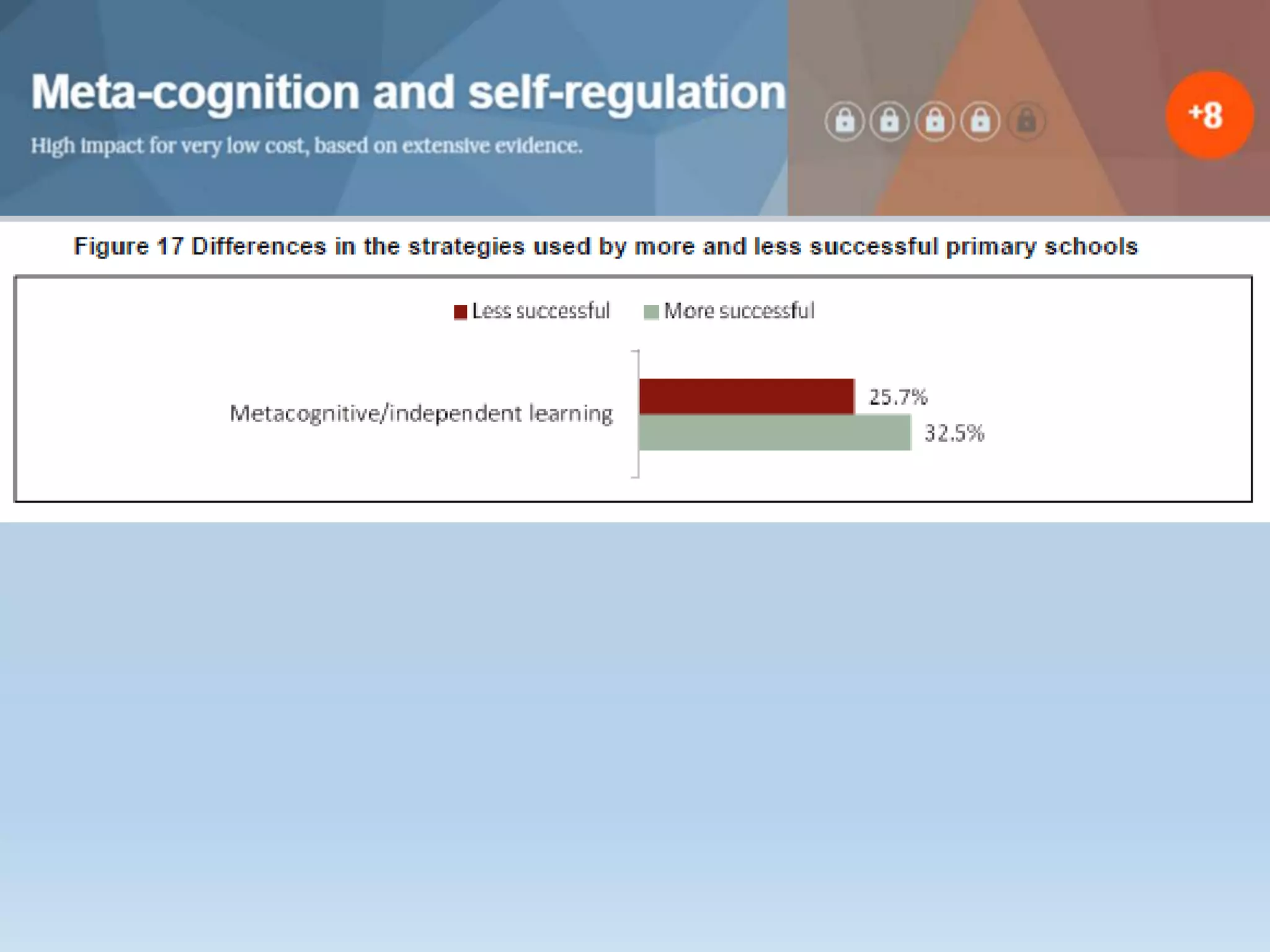
• Thinking about one’s own learning and thought
processes.
• A strategy that appears throughout the literature as
having a positive effect.
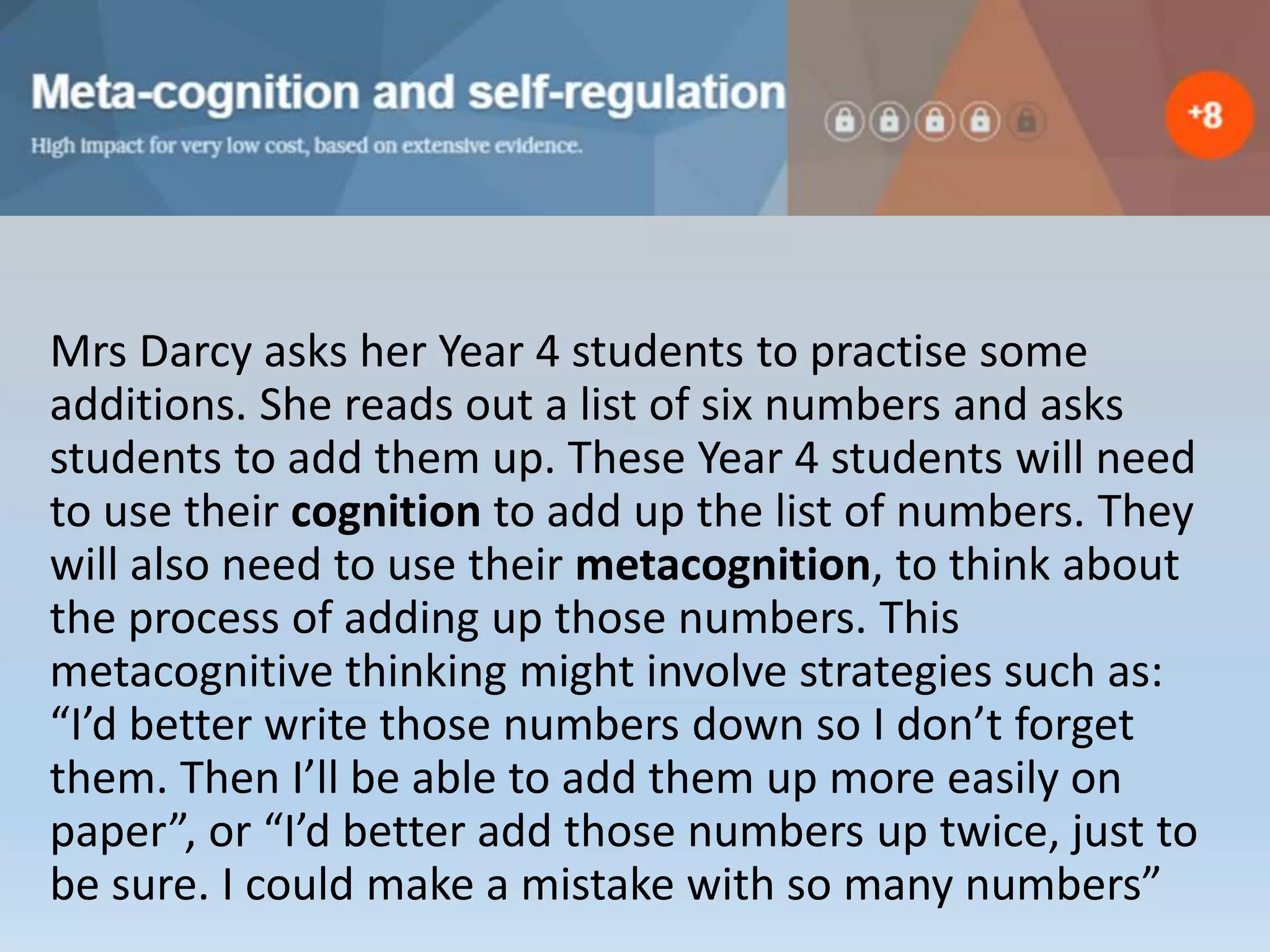
• “Meta-cognition and self-regulation approaches have
consistently high levels of impact, with pupils making
an average of eight months’ additional progress. The
evidence indicates that teaching these strategies can be
particularly effective for low achieving and older
pupils.” EEF
• The strategy seems to be particularly effective for
disadvantaged students.
“Across the studies we reviewed, parental
involvement in school, and their aspirations for their
children, emerged as some of the most important
factors associated with lower educational
achievement… A key characteristic of children from
poor families that ‘buck the trend’ is extensive
parental engagement from an early age ”
Centre for Excellence and Outcomes in Children and
Young People’s Services
• Almost 16,000 students in 36 English secondary schools
took part in a trial. Parents were sent an average of 30
texts over one school year (roughly one per week) with
content ranging from dates of upcoming tests and
warnings about missed homework, to conversation
prompts on what their child had learnt that day.
• They found that pupils receiving the intervention made
an additional month’s progress in maths compared with
a similar group whose parents didn’t get the texts.
Absenteeism was reduced too.
EEF
Students think about their own learning and thought
processes.
Used in three sections for a task:
• Develop a plan before approaching a learning task,
such as reading for comprehension or solving a maths
problem.
• Monitor their understanding; use “fix-up” strategies
when meaning breaks down.
• Evaluate their thinking after completing the task.
In order to apply a metacognitive approach, learners
need access to a set of strategies. Better learners
automatically use a lot of these already.
Mrs Darcy asks her Year 4 students to practise some
additions. She reads out a list of six numbers and asks
students to add them up. These Year 4 students will need
to use their cognition to add up the list of numbers. They
will also need to use their metacognition, to think about
the process of adding up those numbers. This
metacognitive thinking might involve strategies such as:
“I’d better write those numbers down so I don’t forget
them. Then I’ll be able to add them up more easily on
paper”, or “I’d better add those numbers up twice, just to
be sure. I could make a mistake with so many numbers”
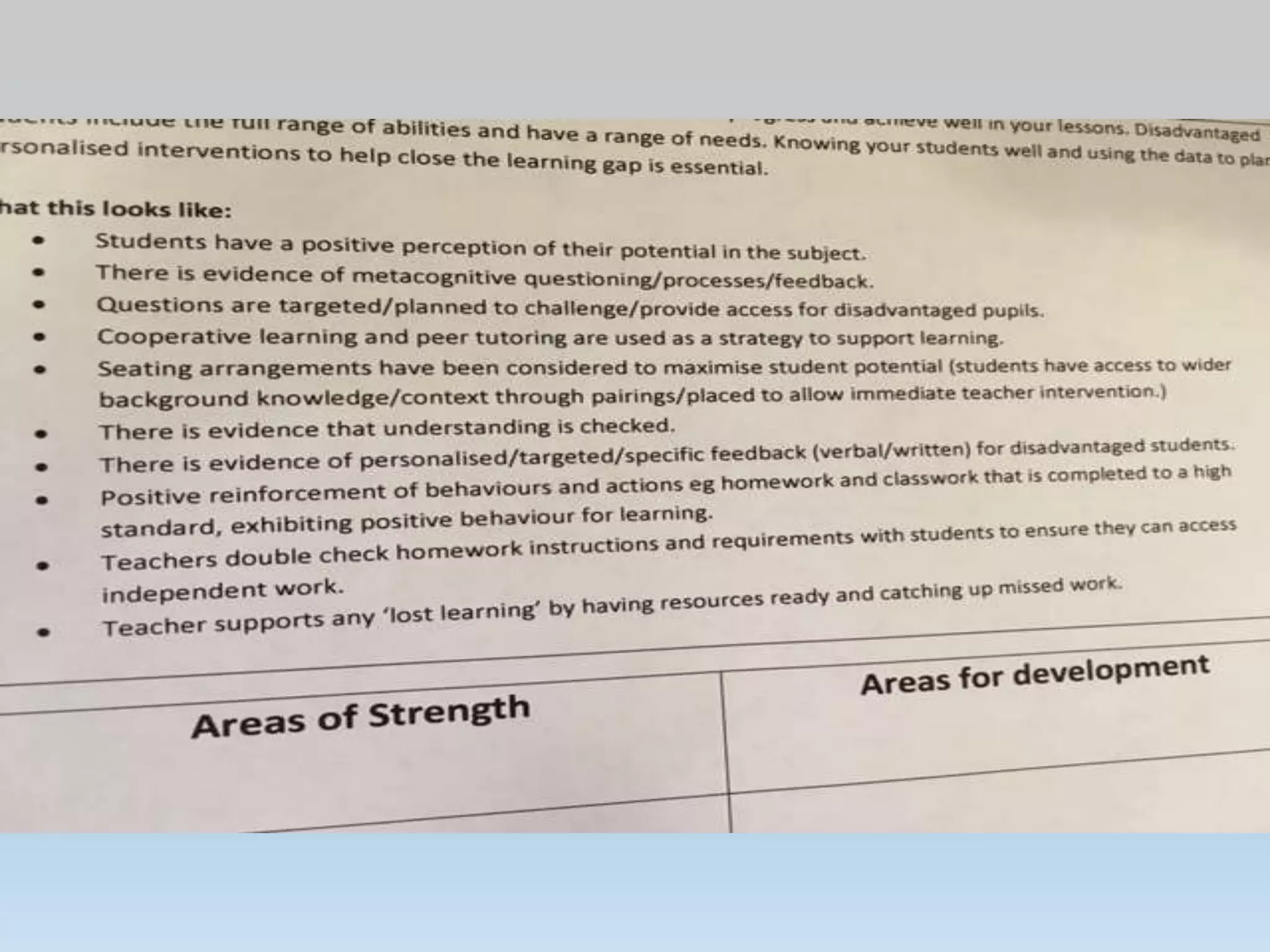
• When could you use metacognitive strategies?
• Look at the sheet.
• With a colleague try to identify when you could use
planning, monitoring and evaluating strategies
within your lessons.
• Peer tutoring includes a range of approaches in
which learners work in pairs or small groups to
provide each other with explicit teaching support.
• In reciprocal peer tutoring, learners alternate
between the role of tutor and tutee.
• Learners take on responsibility for aspects of
teaching and for evaluating their success.
• Peer tutoring involves learners providing each other with explicit
teaching support.
• In reciprocal peer tutoring, learners alternate between the role of
tutor and tutee.
• Can be cross-age.
• Learners take on responsibility for aspects of teaching and for
evaluating their success.
• Can be within lessons or as part of a large programme within
school.
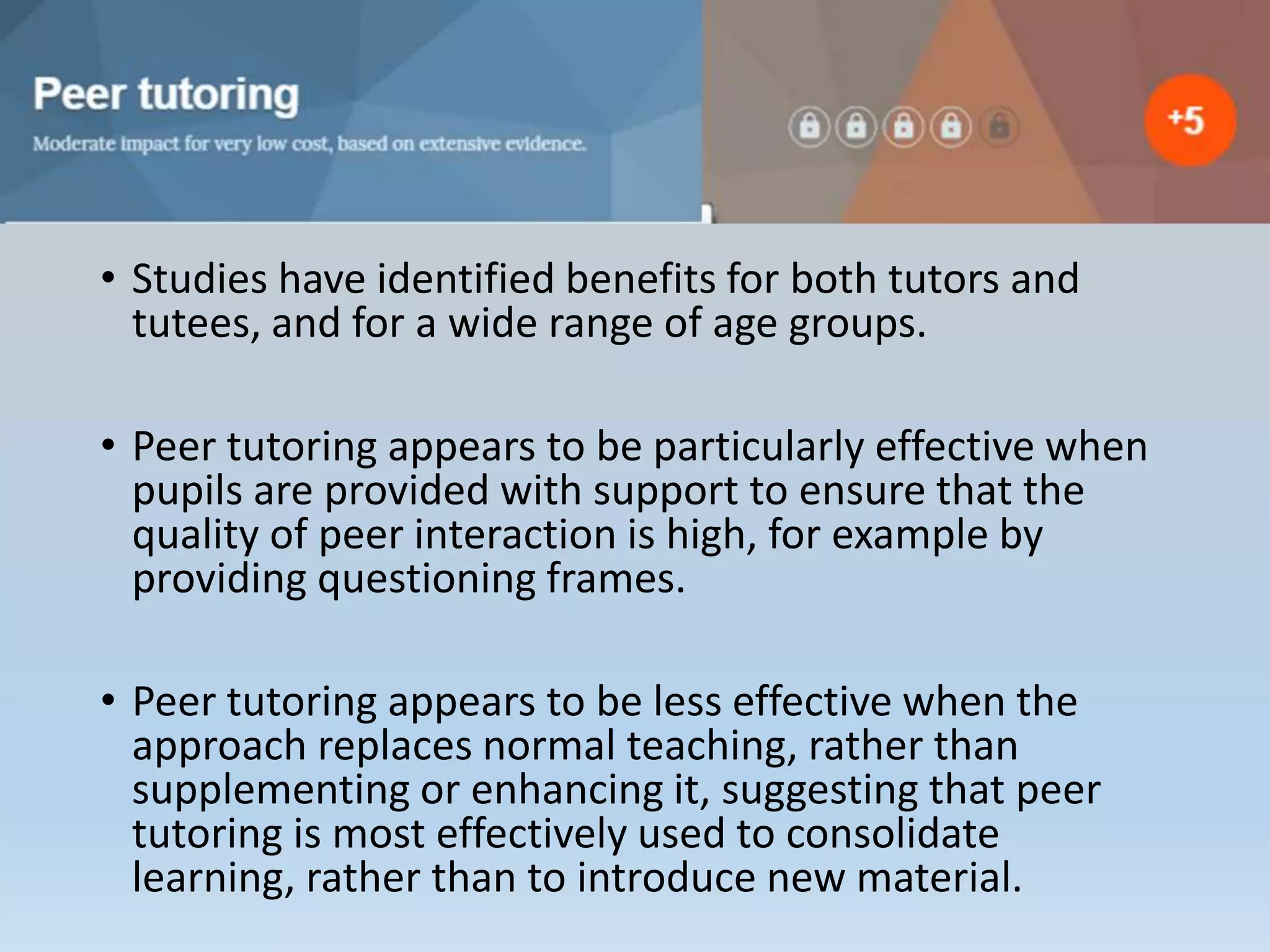
• Studies have identified benefits for both tutors and
tutees, and for a wide range of age groups.
• Peer tutoring appears to be particularly effective when
pupils are provided with support to ensure that the
quality of peer interaction is high, for example by
providing questioning frames.
• Peer tutoring appears to be less effective when the
approach replaces normal teaching, rather than
supplementing or enhancing it, suggesting that peer
tutoring is most effectively used to consolidate
learning, rather than to introduce new material.
• Are the activities sufficiently challenging for the
tutee to benefit from the tutor’s support?
• What support will the tutor receive to ensure that
the quality of peer interaction is high?
Key Questions for our Schools…
As a Federation
• How can we further support reading for pleasure? Disadvantaged students need to read
more books!! (The academic dividends are linked to aspiration and self-belief)
• How can we invest in staff training and resources to deliver high quality reading
comprehension programmes and strategies. All staff need to be committed to improving
reading levels in their subject areas – a consistent approach is required.
• How can we further promote parental involvement on a whole school scale? (Early Years
is vital). How can we increase communication and target parents of disadvantaged
students, providing support for parents to support learning from home?
• How can we develop coordinated approaches to teaching students self-regulated study.
High quality programmes that equip students with the skills to achieve this are evidenced
to have very high impact (8mths+ of learning) for relatively low cost.
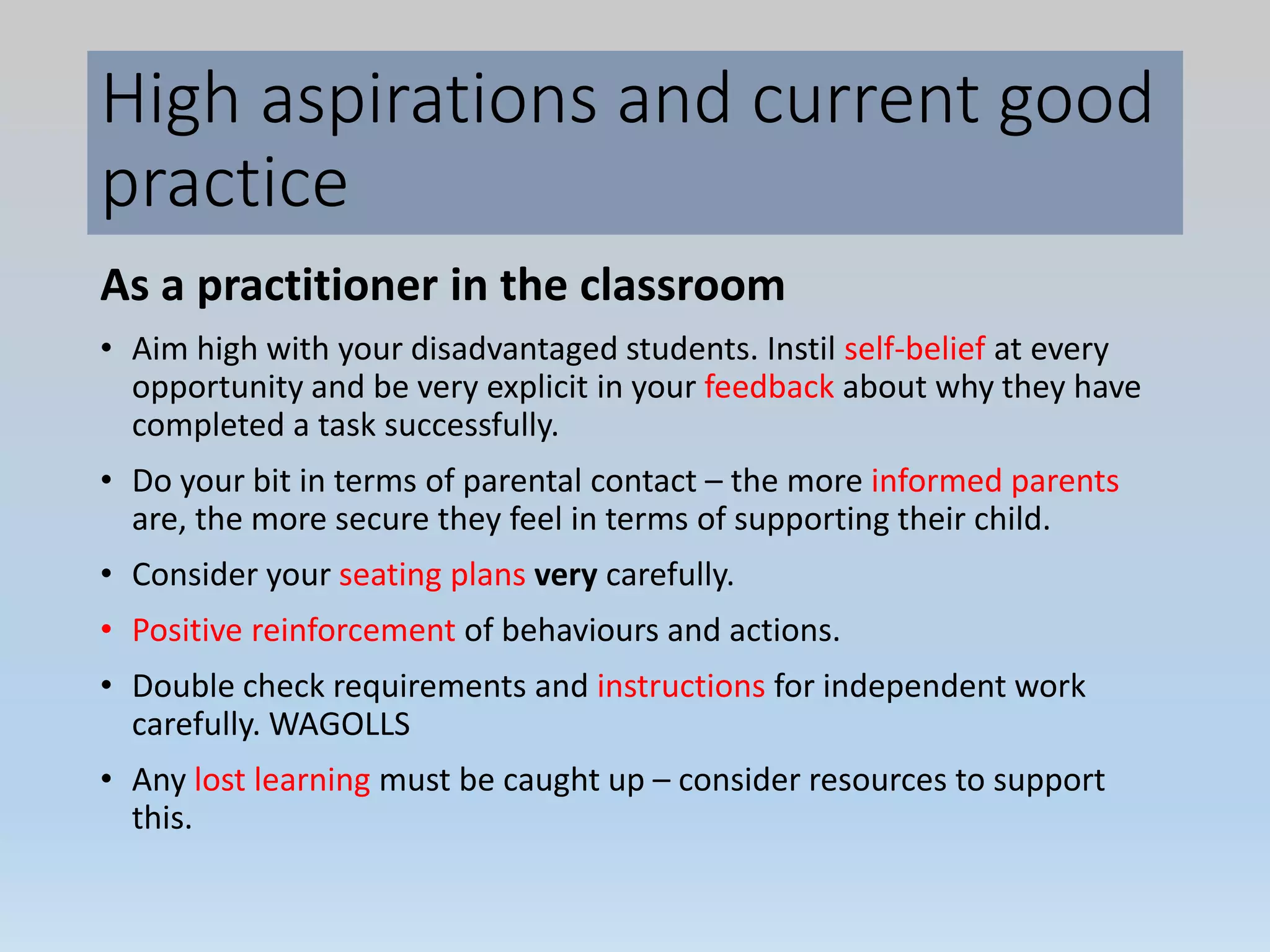
High aspirations and current good
practice
As a practitioner in the classroom
• Aim high with your disadvantaged students. Instil self-belief at every
opportunity and be very explicit in your feedback about why they have
completed a task successfully.
• Do your bit in terms of parental contact – the more informed parents
are, the more secure they feel in terms of supporting their child.
• Consider your seating plans very carefully.
• Positive reinforcement of behaviours and actions.
• Double check requirements and instructions for independent work
carefully. WAGOLLS
• Any lost learning must be caught up – consider resources to support
this.
Ryedale Federation

Ryedale Federation

  • 1.
    Disadvantaged Students Those eligiblefor FSM in the last six years (Ever 6 FSM) Children looked after by the local authority and now those who have been adopted from care Children whose parents are currently serving in the armed forces
  • 2.
    Ryedale Federation Disadvantaged StudentPolicy 1. Consistent high quality teaching and learning in classrooms, which meets the needs of all students, is key to maximising progress. 2. For students to access the curriculum it is essential they have mastered the basic skills of literacy and numeracy. Targeted interventions should be focussed primarily in these areas. Data should be used regularly to monitor impact and adapt interventions if necessary. 3. The most effective staff, with a proven track record of achieving success with students, should be deployed to support disadvantaged pupils. 4. Disadvantaged students have a range of needs and must not be treated as a single group. Specifically eligibility should not be confused with ability! Able disadvantaged students must be challenged to achieve their potential. 5. Individual barriers to learning including behaviour, attendance, welfare and access to extracurricular opportunities must be identified early. 6. Transition from Primary school must include identification of the basic skills gaps that exist among eligible pupils so that appropriate early intervention can be delivered. 7. Disadvantaged students should have a high profile with all staff and be at the centre of planning decisions at all levels of leadership. 8. Disadvantaged students must be given opportunities to develop their aspirations and be provided with clear advice and guidance on future pathways. 9. Effective links with the parents of disadvantaged students should be established to help them support their child’s learning. 10.Pupil Premium funding allocation must be carefully coordinated with a strategic overview by SLT and the Ryedale Federation’s link governor for Pupil Premium.
  • 3.
    There is nosingle ‘one size fits all’ solution to closing the attainment gap. A number of measures are required, including: setting a culture of high expectations for all pupils…and selecting a range of evidenced based strategies tailored to meet the needs of individual schools and pupils, and implementing them well. DfE Research Report November 2015
  • 4.
    Disadvantaged students –the research into what works The research is in the early stages. It is important to note that, according to a DfE report that questioned 49 schools… “None of the headteachers and senior leaders in more successful schools felt able to identify a single approach which they believed had led to raising attainment among disadvantaged pupils.”
  • 5.
    Closing the gap •Most approaches ‘work’ for the majority of learners • Most approaches may therefore increase the gap. • The “Matthew Effect” – ‘advantage begets further advantage’ or “to them that hath shall more be given.” • Reducing the gap is a significant challenge
  • 6.
    Disadvantaged students –the research into what works “For every complex problem there is a solution that is simple, neat… and wrong.” H.L. Mencken
  • 7.
    Disadvantaged students –the research into what works What do you think might work for a teacher in the classroom? Sort your cards into “less effective” and “more effective”. All of the strategies may have a positive effect, but some effects are greater than others, and some disproportionately benefit disadvantaged students.
  • 8.
    Classroom strategies Improving theclassroom environment Raising aspirations Changing the homework policy Improving behaviour Cooperative learning Increasing the use of ICT Metacognitive strategies Incentives/ rewards for good performance Frequent assessment Peer tutoring Contacting parents Changing the curriculum
  • 9.
    Classroom strategies More effectiveLess effective Cooperative learning Changing the homework policy Metacognitive strategies Improving the classroom environment Raising aspirations Incentives/ rewards for good performance Peer tutoring Increasing the use of ICT Frequent assessment Changing the curriculum Contacting parents Improving behaviour
  • 10.
    • “Peer tutoringincludes a range of approaches in which learners work in pairs or small groups to provide each other with explicit teaching support. ” • “Studies have identified benefits for both tutors and tutees, and for a wide range of age groups. Though all types of pupils appear to benefit from peer tutoring, there is some evidence that children from disadvantaged backgrounds and low attaining pupils make the biggest gains.” EEF
  • 11.
    ‘Metacognition - what’sthat? I imagine we’re probably doing it.’ Headteacher of a less successful school interviewed by the DfE
  • 12.
    • Thinking aboutone’s own learning and thought processes. • A strategy that appears throughout the literature as having a positive effect. • “Meta-cognition and self-regulation approaches have consistently high levels of impact, with pupils making an average of eight months’ additional progress. The evidence indicates that teaching these strategies can be particularly effective for low achieving and older pupils.” EEF • The strategy seems to be particularly effective for disadvantaged students.
  • 14.
    “Across the studieswe reviewed, parental involvement in school, and their aspirations for their children, emerged as some of the most important factors associated with lower educational achievement… A key characteristic of children from poor families that ‘buck the trend’ is extensive parental engagement from an early age ” Centre for Excellence and Outcomes in Children and Young People’s Services
  • 15.
    • Almost 16,000students in 36 English secondary schools took part in a trial. Parents were sent an average of 30 texts over one school year (roughly one per week) with content ranging from dates of upcoming tests and warnings about missed homework, to conversation prompts on what their child had learnt that day. • They found that pupils receiving the intervention made an additional month’s progress in maths compared with a similar group whose parents didn’t get the texts. Absenteeism was reduced too. EEF
  • 16.
    Students think abouttheir own learning and thought processes. Used in three sections for a task: • Develop a plan before approaching a learning task, such as reading for comprehension or solving a maths problem. • Monitor their understanding; use “fix-up” strategies when meaning breaks down. • Evaluate their thinking after completing the task. In order to apply a metacognitive approach, learners need access to a set of strategies. Better learners automatically use a lot of these already.
  • 17.
    Mrs Darcy asksher Year 4 students to practise some additions. She reads out a list of six numbers and asks students to add them up. These Year 4 students will need to use their cognition to add up the list of numbers. They will also need to use their metacognition, to think about the process of adding up those numbers. This metacognitive thinking might involve strategies such as: “I’d better write those numbers down so I don’t forget them. Then I’ll be able to add them up more easily on paper”, or “I’d better add those numbers up twice, just to be sure. I could make a mistake with so many numbers”
  • 19.
    • When couldyou use metacognitive strategies? • Look at the sheet. • With a colleague try to identify when you could use planning, monitoring and evaluating strategies within your lessons.
  • 20.
    • Peer tutoringincludes a range of approaches in which learners work in pairs or small groups to provide each other with explicit teaching support. • In reciprocal peer tutoring, learners alternate between the role of tutor and tutee. • Learners take on responsibility for aspects of teaching and for evaluating their success.
  • 21.
    • Peer tutoringinvolves learners providing each other with explicit teaching support. • In reciprocal peer tutoring, learners alternate between the role of tutor and tutee. • Can be cross-age. • Learners take on responsibility for aspects of teaching and for evaluating their success. • Can be within lessons or as part of a large programme within school.
  • 22.
    • Studies haveidentified benefits for both tutors and tutees, and for a wide range of age groups. • Peer tutoring appears to be particularly effective when pupils are provided with support to ensure that the quality of peer interaction is high, for example by providing questioning frames. • Peer tutoring appears to be less effective when the approach replaces normal teaching, rather than supplementing or enhancing it, suggesting that peer tutoring is most effectively used to consolidate learning, rather than to introduce new material.
  • 23.
    • Are theactivities sufficiently challenging for the tutee to benefit from the tutor’s support? • What support will the tutor receive to ensure that the quality of peer interaction is high?
  • 25.
    Key Questions forour Schools… As a Federation • How can we further support reading for pleasure? Disadvantaged students need to read more books!! (The academic dividends are linked to aspiration and self-belief) • How can we invest in staff training and resources to deliver high quality reading comprehension programmes and strategies. All staff need to be committed to improving reading levels in their subject areas – a consistent approach is required. • How can we further promote parental involvement on a whole school scale? (Early Years is vital). How can we increase communication and target parents of disadvantaged students, providing support for parents to support learning from home? • How can we develop coordinated approaches to teaching students self-regulated study. High quality programmes that equip students with the skills to achieve this are evidenced to have very high impact (8mths+ of learning) for relatively low cost.
  • 28.
    High aspirations andcurrent good practice As a practitioner in the classroom • Aim high with your disadvantaged students. Instil self-belief at every opportunity and be very explicit in your feedback about why they have completed a task successfully. • Do your bit in terms of parental contact – the more informed parents are, the more secure they feel in terms of supporting their child. • Consider your seating plans very carefully. • Positive reinforcement of behaviours and actions. • Double check requirements and instructions for independent work carefully. WAGOLLS • Any lost learning must be caught up – consider resources to support this.