 The concept of power involves the ability to control or influence people's
behavior.
 Politics and power in the 21st century has been defined through the culture
of innovation and openness
 This is in relation to how contemporary culture and politics has been
intertwined.
 Politics and power rely on content and style
 It has to be relevant and visible to the visions and how the society social
relations are structured.
 Political sociology in such respect revolves around cultural politics.
 This is to assist in understanding how social identities and relations face
consistent challenges.
 Empirical changes in the contemporary society have been sufficient in
defining the course of politics and power
 This is through creating new approaches.
 It is in relation to the paradigm shift away from state-centered towards the
basis of social experience.
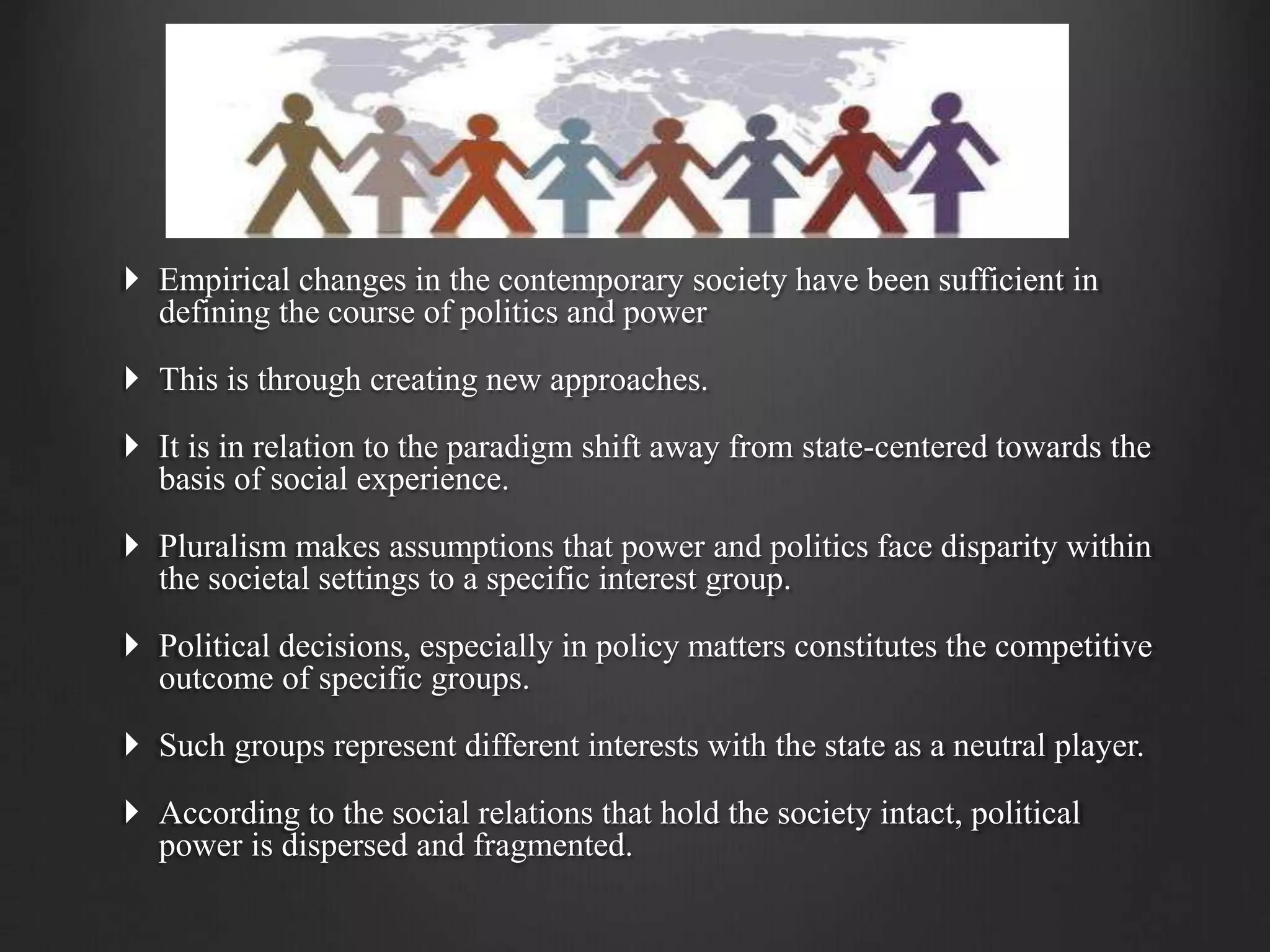
 Pluralism makes assumptions that power and politics face disparity within
the societal settings to a specific interest group.
 Political decisions, especially in policy matters constitutes the competitive
outcome of specific groups.
 Such groups represent different interests with the state as a neutral player.
 According to the social relations that hold the society intact, political
power is dispersed and fragmented.
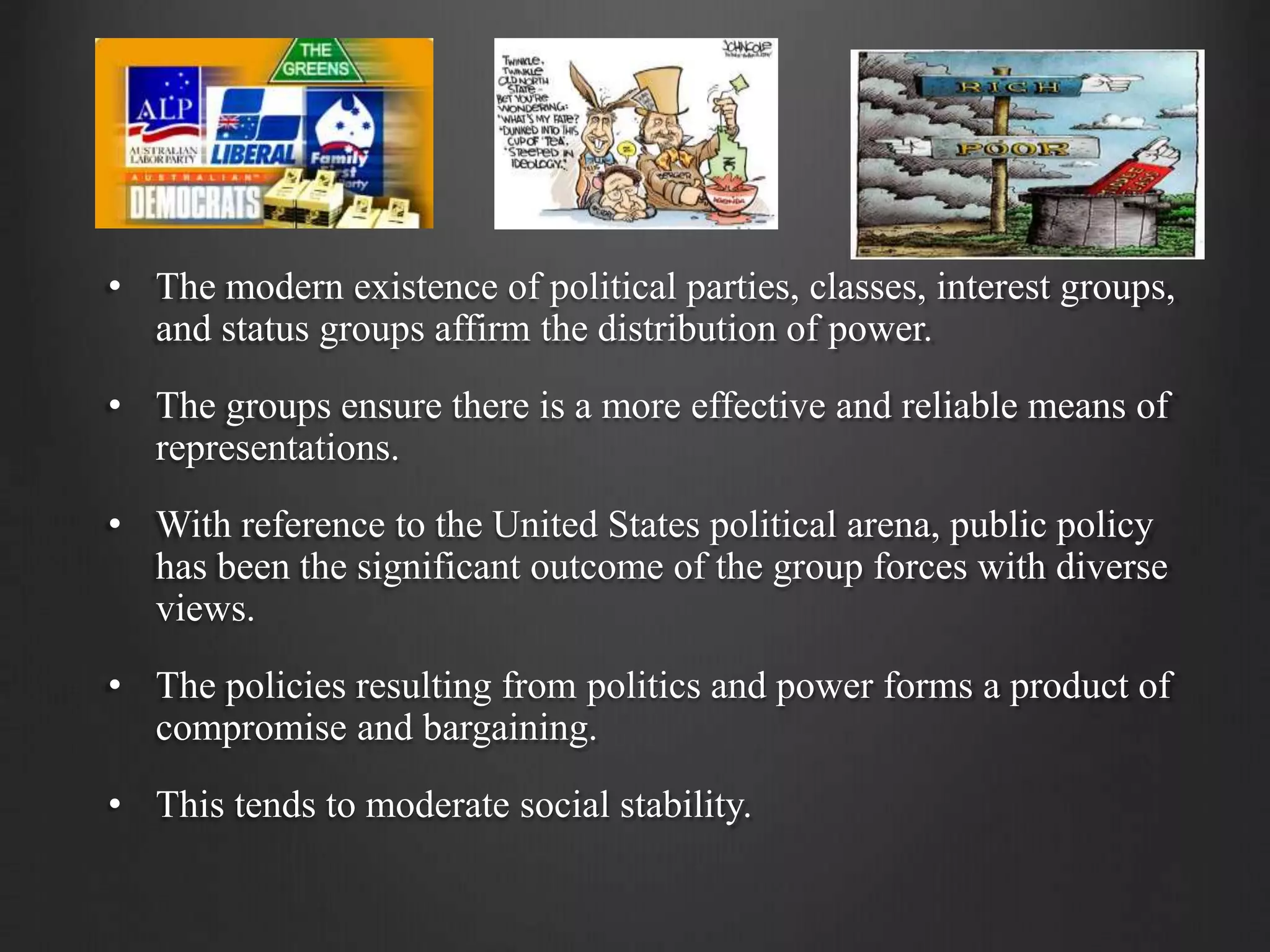
• The modern existence of political parties, classes, interest groups,
and status groups affirm the distribution of power.
• The groups ensure there is a more effective and reliable means of
representations.
• With reference to the United States political arena, public policy
has been the significant outcome of the group forces with diverse
views.
• The policies resulting from politics and power forms a product of
compromise and bargaining.
• This tends to moderate social stability.
 According to Elitist theory, every societal setting and political blocks
involves small classes of significant decision makers and leaders.
 They have the key political functions that monopolize power and the
larger class.
 This is with passive approaches that marginalizes political affairs.
 In power, the ruling elite comes from higher echelons, the military and
corporate sectors.
 Based on the approach of democratic elitism, there are democratic
elections involved in creating political leadership
 It involves opportunities offered to the passive masses to vote.
 The society make choices about the kinds of leaders they want to be in
power
 This defines the concept of democracy in the modern liberal capitalist
states.
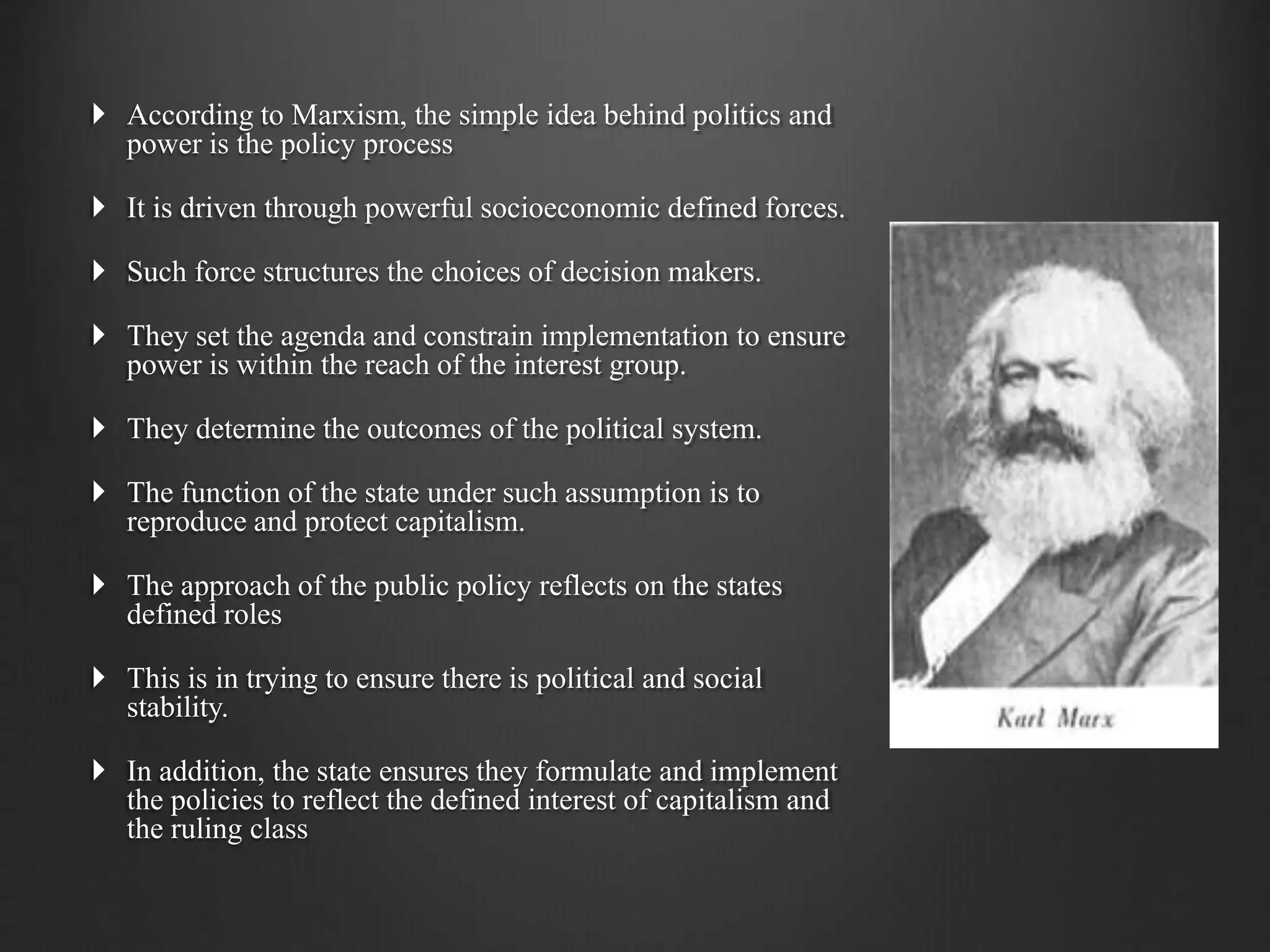
 According to Marxism, the simple idea behind politics and
power is the policy process
 It is driven through powerful socioeconomic defined forces.
 Such force structures the choices of decision makers.
 They set the agenda and constrain implementation to ensure
power is within the reach of the interest group.
 They determine the outcomes of the political system.
 The function of the state under such assumption is to
reproduce and protect capitalism.
 The approach of the public policy reflects on the states
defined roles
 This is in trying to ensure there is political and social
stability.
 In addition, the state ensures they formulate and implement
the policies to reflect the defined interest of capitalism and
the ruling class
Nash, K. (2010). Contemporary Political Sociology:
Globalization, Politics and Power. Chichester: John Wiley &
Sons.
Newton, K., & Deth, J. W. (2006). Foundations of comparative
politics: Democracies of the modern world. Cambridge [u.a.:
Cambridge Univ. Press.
Pye, L. W., & Pye, M. W. (2009). Asian power and politics: The
cultural dimensions of authority. Cambridge, Mass: Belknap
Press of Harvard University Press.

Theories of power

  • 1.
     The conceptof power involves the ability to control or influence people's behavior.  Politics and power in the 21st century has been defined through the culture of innovation and openness  This is in relation to how contemporary culture and politics has been intertwined.  Politics and power rely on content and style  It has to be relevant and visible to the visions and how the society social relations are structured.  Political sociology in such respect revolves around cultural politics.  This is to assist in understanding how social identities and relations face consistent challenges.
  • 2.
     Empirical changesin the contemporary society have been sufficient in defining the course of politics and power  This is through creating new approaches.  It is in relation to the paradigm shift away from state-centered towards the basis of social experience.  Pluralism makes assumptions that power and politics face disparity within the societal settings to a specific interest group.  Political decisions, especially in policy matters constitutes the competitive outcome of specific groups.  Such groups represent different interests with the state as a neutral player.  According to the social relations that hold the society intact, political power is dispersed and fragmented.
  • 3.
    • The modernexistence of political parties, classes, interest groups, and status groups affirm the distribution of power. • The groups ensure there is a more effective and reliable means of representations. • With reference to the United States political arena, public policy has been the significant outcome of the group forces with diverse views. • The policies resulting from politics and power forms a product of compromise and bargaining. • This tends to moderate social stability.
  • 4.
     According toElitist theory, every societal setting and political blocks involves small classes of significant decision makers and leaders.  They have the key political functions that monopolize power and the larger class.  This is with passive approaches that marginalizes political affairs.  In power, the ruling elite comes from higher echelons, the military and corporate sectors.  Based on the approach of democratic elitism, there are democratic elections involved in creating political leadership  It involves opportunities offered to the passive masses to vote.  The society make choices about the kinds of leaders they want to be in power  This defines the concept of democracy in the modern liberal capitalist states.
  • 5.
     According toMarxism, the simple idea behind politics and power is the policy process  It is driven through powerful socioeconomic defined forces.  Such force structures the choices of decision makers.  They set the agenda and constrain implementation to ensure power is within the reach of the interest group.  They determine the outcomes of the political system.  The function of the state under such assumption is to reproduce and protect capitalism.  The approach of the public policy reflects on the states defined roles  This is in trying to ensure there is political and social stability.  In addition, the state ensures they formulate and implement the policies to reflect the defined interest of capitalism and the ruling class
  • 6.
    Nash, K. (2010).Contemporary Political Sociology: Globalization, Politics and Power. Chichester: John Wiley & Sons. Newton, K., & Deth, J. W. (2006). Foundations of comparative politics: Democracies of the modern world. Cambridge [u.a.: Cambridge Univ. Press. Pye, L. W., & Pye, M. W. (2009). Asian power and politics: The cultural dimensions of authority. Cambridge, Mass: Belknap Press of Harvard University Press.

Editor's Notes

  • #3 Empirical changes in the contemporary society have been sufficient in defining the course of politics and power through creating new approaches (Newton & Deth, 2006). This is in relation to the paradigm shift away from state-centered towards the basis of social experience. Pluralism makes assumptions that power and politics face disparity within the societal settings to a specific interest group. It also elaborates that political decisions, especially in policy matters constitutes the competitive outcome of the groups representing different interests with the state as a neutral player (Newton & Deth, 2006). According to the social relations that hold the society intact, political power is dispersed and fragmented.
  • #4 The modern existence of political parties, classes, interest groups, and status groups affirm the distribution of power (Nash, 2010). The groups ensure there is a more effective and reliable means of representing compared to the election. With reference to the United States political arena, public policy in most cases has been the significant outcome of the group forces with diverse views (Nash, 2010). The policies resulting from politics and power forms the product of the compromise and bargaining that tends to moderate social stability.
  • #5 The Elitist theory explains that in every societal setting and political blocks involves small classes of significant decision makers and leaders with key political functions that monopolize power and the larger class with passive approaches that marginalizes political affairs (Newton & Deth, 2006). The theory ascertains that, in power, the ruling elite comes from higher echelons, the military and corporate sectors. Based on the approach of democratic elitism, there are democratic elections involved in creating political leadership with opportunities offered to the passive masses to vote. Therefore, the participation of the society in making choices about the kinds of leaders they want to be in power defines the concept of democracy in the modern liberal capitalist states (Newton & Deth, 2006).
  • #6 According to Marxism, the simple idea behind politics and power is the policy process which is driven through powerful socioeconomic defined forces (Pye & Pye, 2009). Such force structures the choices of decision makers to set the agenda and constrain implementation to ensure power is within the reach of the interest group since they determine the outcomes of the political system. The function of the state under such assumption is to reproduce and protect capitalism (Nash, 2010). The approach of the public policy, therefore, reflects on the states defined roles in trying to ensure there is political and social stability. In addition, the state ensures they formulate and implement the policies to reflect the defined interest of capitalism and the ruling class (Pye & Pye, 2009).