Digital Electronics
Part I – Combinational and
Sequential Logic
Dr. I. J. Wassell
Introduction
Aims
• To familiarise students with
– Combinational logic circuits
– Sequential logic circuits
– How digital logic gates are built using
transistors
– Design and build of digital logic systems
Course Structure
• 11 Lectures
• Hardware Labs
– 6 Workshops
– 7 sessions, each one 3h, alternate weeks
– Thu. 10.00 or 2.00 start, beginning week 3
– In Cockroft 4 (New Museum Site)
– In groups of 2
Objectives
• At the end of the course you should
– Be able to design and construct simple
digital electronic systems
– Be able to understand and apply Boolean
logic and algebra – a core competence in
Computer Science
– Be able to understand and build state
machines
Books
• Lots of books on digital electronics, e.g.,
– D. M. Harris and S. L. Harris, ‘Digital Design
and Computer Architecture,’ Morgan Kaufmann,
2007.
– R. H. Katz, ‘Contemporary Logic Design,’
Benjamin/Cummings, 1994.
– J. P. Hayes, ‘Introduction to Digital Logic
Design,’ Addison-Wesley, 1993.
• Electronics in general (inc. digital)
– P. Horowitz and W. Hill, ‘The Art of Electronics,’
CUP, 1989.
Other Points
• This course is a prerequisite for
– ECAD (Part IB)
– VLSI Design (Part II)
• Keep up with lab work and get it ticked.
• Have a go at supervision questions plus
any others your supervisor sets.
• Remember to try questions from past
papers
Semiconductors to Computers
• Increasing levels of complexity
– Transistors built from semiconductors
– Logic gates built from transistors
– Logic functions built from gates
– Flip-flops built from logic
– Counters and sequencers from flip-flops
– Microprocessors from sequencers
– Computers from microprocessors
Semiconductors to Computers
• Increasing levels of abstraction:
– Physics
– Transistors
– Gates
– Logic
– Microprogramming (Computer Design Course)
– Assembler (Computer Design Course)
– Programming Languages (Compilers Course)
– Applications
Combinational Logic
Introduction to Logic Gates
• We will introduce Boolean algebra and
logic gates
• Logic gates are the building blocks of
digital circuits
Logic Variables
• Different names for the same thing
– Logic variables
– Binary variables
– Boolean variables
• Can only take on 2 values, e.g.,
– TRUE or False
– ON or OFF
– 1 or 0
Logic Variables
• In electronic circuits the two values can
be represented by e.g.,
– High voltage for a 1
– Low voltage for a 0
• Note that since only 2 voltage levels are
used, the circuits have greater immunity
to electrical noise
Uses of Simple Logic
• Example – Heating Boiler
– If chimney is not blocked and the house is cold
and the pilot light is lit, then open the main fuel
valve to start boiler.
b = chimney blocked
c = house is cold
p = pilot light lit
v = open fuel valve
– So in terms of a logical (Boolean) expression
v = (NOT b) AND c AND p
Logic Gates
• Basic logic circuits with one or more
inputs and one output are known as
gates
• Gates are used as the building blocks in
the design of more complex digital logic
circuits
Representing Logic Functions
• There are several ways of representing
logic functions:
– Symbols to represent the gates
– Truth tables
– Boolean algebra
• We will now describe commonly used
gates
NOT Gate
Symbol
a y
Truth-table
a y
0 1
1 0
Boolean
a
y 
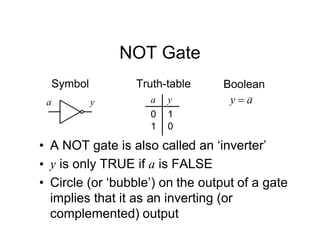
• A NOT gate is also called an ‘inverter’
• y is only TRUE if a is FALSE
• Circle (or ‘bubble’) on the output of a gate
implies that it as an inverting (or
complemented) output
AND Gate
Symbol Truth-table Boolean
b
a
y .

a
y
b
a y
0
1
1
0
b
0
0
1
0
0 0
1 1
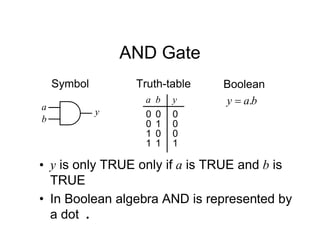
• y is only TRUE only if a is TRUE and b is
TRUE
• In Boolean algebra AND is represented by
a dot .
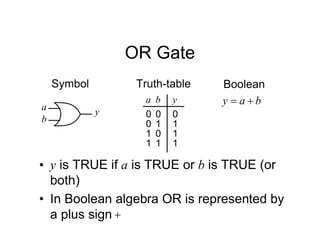
OR Gate
Symbol
a
y
Truth-table Boolean
b
a
y 

b
a y
0
1
1
0
b
0
0
1
1
0 1
1 1
• y is TRUE if a is TRUE or b is TRUE (or
both)
• In Boolean algebra OR is represented by
a plus sign 
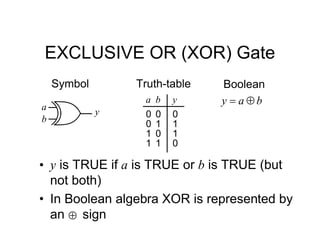
EXCLUSIVE OR (XOR) Gate
Symbol Truth-table Boolean
b
a
y 

a y
0
0
1
0
b
0
0
1
1
0 1
1 1
• y is TRUE if a is TRUE or b is TRUE (but
not both)
• In Boolean algebra XOR is represented by
an sign

a
y
b
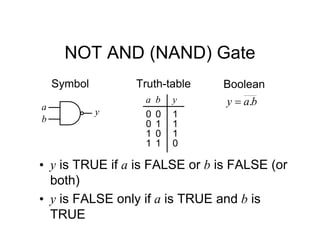
NOT AND (NAND) Gate
Symbol
a
y
Truth-table Boolean
b
a
y .

b
a y
0
0
1
1
b
0
0
1
1
0 1
1 1
• y is TRUE if a is FALSE or b is FALSE (or
both)
• y is FALSE only if a is TRUE and b is
TRUE
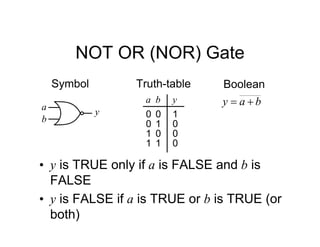
NOT OR (NOR) Gate
Symbol
a
y
Truth-table Boolean
b
a
y 

b
a y
0
0
1
1
b
0
0
1
0
0 0
1 1
• y is TRUE only if a is FALSE and b is
FALSE
• y is FALSE if a is TRUE or b is TRUE (or
both)
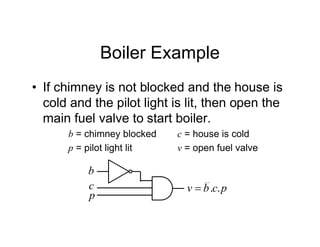
Boiler Example
• If chimney is not blocked and the house is
cold and the pilot light is lit, then open the
main fuel valve to start boiler.
b = chimney blocked c = house is cold
p = pilot light lit v = open fuel valve
p
c
b
v .
.

b
c
p
Boolean Algebra
• In this section we will introduce the laws
of Boolean Algebra
• We will then see how it can be used to
design combinational logic circuits
• Combinational logic circuits do not have
an internal stored state, i.e., they have
no memory. Consequently the output is
solely a function of the current inputs.
• Later, we will study circuits having a
stored internal state, i.e., sequential
logic circuits.
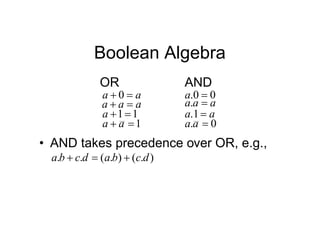
Boolean Algebra
OR AND
a
a 
 0
a
a
a 

1
1

a
1

 a
a
0
0
. 
a
a
a
a 
.
a
a 
1
.
0
. 
a
a
• AND takes precedence over OR, e.g.,
)
.
(
)
.
(
.
. d
c
b
a
d
c
b
a 


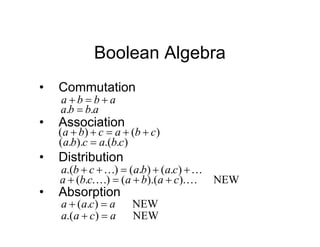
Boolean Algebra
• Commutation
• Association
• Distribution
• Absorption
a
b
b
a 


a
b
b
a .
. 
)
(
)
( c
b
a
c
b
a 




)
.
.(
).
.
( c
b
a
c
b
a 

 



 )
.
(
)
.
(
)
.( c
a
b
a
c
b
a
NEW
).
).(
(
)
.
.
( 
 c
a
b
a
c
b
a 



NEW
)
.
( a
c
a
a 

NEW
)
.( a
c
a
a 

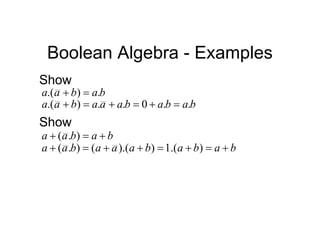
Boolean Algebra - Examples
Show
b
a
b
a
a .
)
.( 

b
a
b
a
b
a
a
a
b
a
a .
.
0
.
.
)
.( 





Show
b
a
b
a
a 

 )
.
(
b
a
b
a
b
a
a
a
b
a
a 






 )
.(
1
)
).(
(
)
.
(
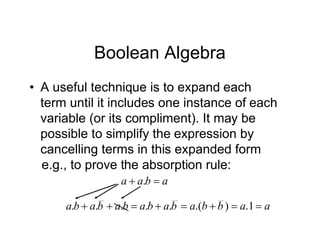
Boolean Algebra
• A useful technique is to expand each
term until it includes one instance of each
variable (or its compliment). It may be
possible to simplify the expression by
cancelling terms in this expanded form
e.g., to prove the absorption rule:
a
b
a
a 
 .
a
a
b
b
a
b
a
b
a
b
a
b
a
b
a 






 1
.
)
.(
.
.
.
.
.
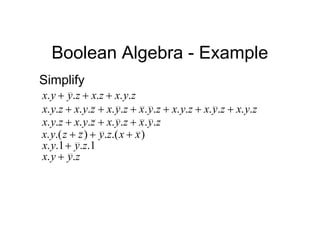
Boolean Algebra - Example
Simplify
z
y
x
z
x
z
y
y
x .
.
.
.
. 


z
y
x
z
y
x
z
y
x
z
y
x
z
y
x
z
y
x
z
y
x .
.
.
.
.
.
.
.
.
.
.
.
.
. 





z
y
x
z
y
x
z
y
x
z
y
x .
.
.
.
.
.
.
. 


)
.(
.
)
.(
. x
x
z
y
z
z
y
x 


1
.
.
1
.
. z
y
y
x 
z
y
y
x .
. 
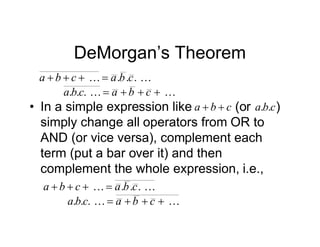
DeMorgan’s Theorem

 .
.
. c
b
a
c
b
a 





.
.
. 


 c
b
a
c
b
a

 .
.
. c
b
a
c
b
a 





.
.
. 


 c
b
a
c
b
a
• In a simple expression like (or )
simply change all operators from OR to
AND (or vice versa), complement each
term (put a bar over it) and then
complement the whole expression, i.e.,
c
b
a 
 c
b
a .
.
DeMorgan’s Theorem
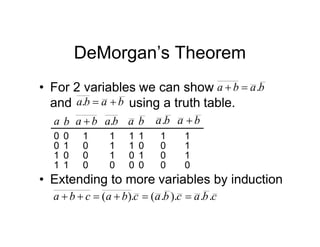
• For 2 variables we can show
and using a truth table.
b
a
b
a .


b
a
b
a 

.
0
1
0
0
1 0
0
0
1
0
1 1
b
a 
a b b
a. a b b
a. b
a 
0
1
1
1
0
1
1
0
0
0
1
1
0
0
1
0
0
1
1
1
• Extending to more variables by induction
c
b
a
c
b
a
c
b
a
c
b
a .
.
).
.
(
.
)
( 





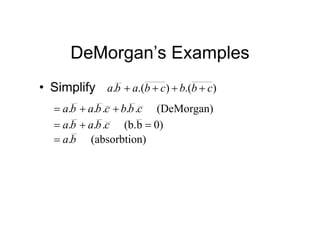
DeMorgan’s Examples
• Simplify )
.(
)
.(
. c
b
b
c
b
a
b
a 



(DeMorgan)
.
.
.
.
. c
b
b
c
b
a
b
a 


0)
b
(b.
.
.
. 

 c
b
a
b
a
n)
(absorbtio
.b
a

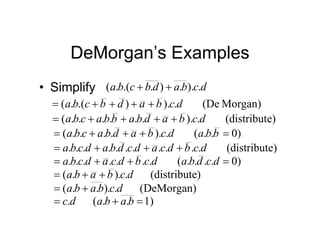
DeMorgan’s Examples
• Simplify d
c
b
a
d
b
c
b
a .
).
.
)
.
.(
.
( 

Morgan)
(De
.
).
)
.(
.
( d
c
b
a
d
b
c
b
a 




e)
(distribut
.
).
.
.
.
.
.
.
( d
c
b
a
d
b
a
b
b
a
c
b
a 




)
0
.
.
(
.
).
.
.
.
.
( 



 b
b
a
d
c
b
a
d
b
a
c
b
a
e)
(distribut
.
.
.
.
.
.
.
.
.
.
. d
c
b
d
c
a
d
c
d
b
a
d
c
b
a 



)
0
.
.
.
.
(
.
.
.
.
.
.
. 


 d
c
d
b
a
d
c
b
d
c
a
d
c
b
a
e)
(distribut
.
.
)
.
( d
c
b
a
b
a 


(DeMorgan)
.
.
)
.
.
( d
c
b
a
b
a 

1)
.
.
(
. 

 b
a
b
a
d
c
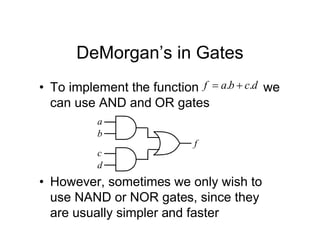
DeMorgan’s in Gates
• To implement the function we
can use AND and OR gates
d
c
b
a
f .
. 

a
b
c
d
f
• However, sometimes we only wish to
use NAND or NOR gates, since they
are usually simpler and faster
DeMorgan’s in Gates
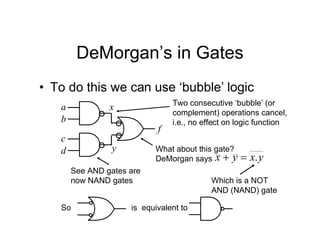
• To do this we can use ‘bubble’ logic
a
b
c
d
f
x
y
Two consecutive ‘bubble’ (or
complement) operations cancel,
i.e., no effect on logic function
See AND gates are
now NAND gates
What about this gate?
DeMorgan says y
x
y
x .


Which is a NOT
AND (NAND) gate
So is equivalent to
DeMorgan’s in Gates
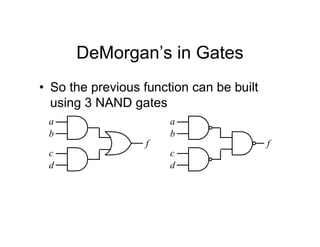
• So the previous function can be built
using 3 NAND gates
a
b
c
d
f
a
b
c
d
f
DeMorgan’s in Gates
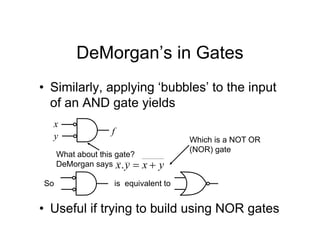
• Similarly, applying ‘bubbles’ to the input
of an AND gate yields
x
y
f
What about this gate?
DeMorgan says y
x
y
x 

.
Which is a NOT OR
(NOR) gate
So is equivalent to
• Useful if trying to build using NOR gates
Logic Minimisation
• Any Boolean function can be implemented
directly using combinational logic (gates)
• However, simplifying the Boolean function will
enable the number of gates required to be
reduced. Techniques available include:
– Algebraic manipulation (as seen in examples)
– Karnaugh (K) mapping (a visual approach)
– Tabular approaches (usually implemented by
computer, e.g., Quine-McCluskey)
• K mapping is the preferred technique for up to
about 5 variables
Truth Tables
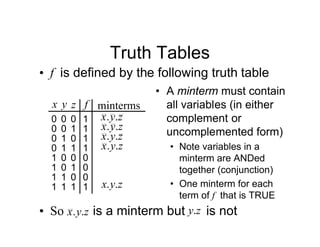
• f is defined by the following truth table
x y z f minterms
0 0 0 1 z
y
x .
.
0 0 1 1 z
y
x .
.
0 1 0 1 z
y
x .
.
0 1 1 1 z
y
x .
.
1 0 0 0
1 0 1 0
1 1 0 0
1 1 1 1 z
y
x .
.
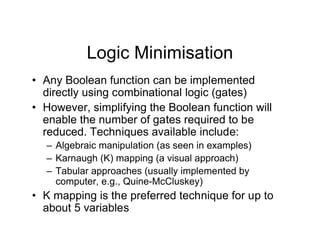
• A minterm must contain
all variables (in either
complement or
uncomplemented form)
• Note variables in a
minterm are ANDed
together (conjunction)
• One minterm for each
term of f that is TRUE
• So is a minterm but is not
z
y
x .
. z
y.
Disjunctive Normal Form
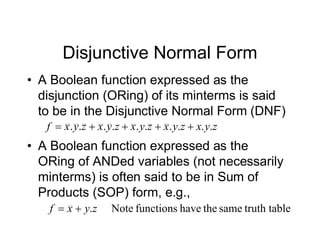
• A Boolean function expressed as the
disjunction (ORing) of its minterms is said
to be in the Disjunctive Normal Form (DNF)
• A Boolean function expressed as the
ORing of ANDed variables (not necessarily
minterms) is often said to be in Sum of
Products (SOP) form, e.g.,
z
y
x
z
y
x
z
y
x
z
y
x
z
y
x
f .
.
.
.
.
.
.
.
.
. 




le
truth tab
same
the
have
functions
Note
.z
y
x
f 

Maxterms
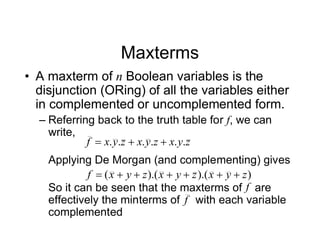
• A maxterm of n Boolean variables is the
disjunction (ORing) of all the variables either
in complemented or uncomplemented form.
– Referring back to the truth table for f, we can
write,
Applying De Morgan (and complementing) gives
So it can be seen that the maxterms of are
effectively the minterms of with each variable
complemented
z
y
x
z
y
x
z
y
x
f .
.
.
.
.
. 


)
).(
).(
( z
y
x
z
y
x
z
y
x
f 






f
f
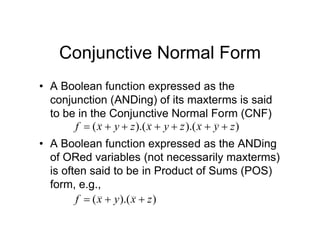
Conjunctive Normal Form
• A Boolean function expressed as the
conjunction (ANDing) of its maxterms is said
to be in the Conjunctive Normal Form (CNF)
• A Boolean function expressed as the ANDing
of ORed variables (not necessarily maxterms)
is often said to be in Product of Sums (POS)
form, e.g.,
)
).(
).(
( z
y
x
z
y
x
z
y
x
f 






)
).(
( z
x
y
x
f 


Logic Simplification
• As we have seen previously, Boolean
algebra can be used to simplify logical
expressions. This results in easier
implementation
Note: The DNF and CNF forms are not
simplified.
• However, it is often easier to use a
technique known as Karnaugh mapping
Karnaugh Maps
• Karnaugh Maps (or K-maps) are a
powerful visual tool for carrying out
simplification and manipulation of logical
expressions having up to 5 variables
• The K-map is a rectangular array of
cells
– Each possible state of the input variables
corresponds uniquely to one of the cells
– The corresponding output state is written in
each cell
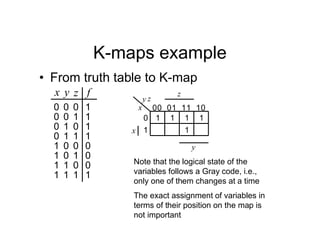
K-maps example
x y z f
0 0 0 1
0 0 1 1
0 1 0 1
0 1 1 1
1 0 0 0
1 0 1 0
1 1 0 0
1 1 1 1
• From truth table to K-map
y z
11
00 01 10
0
1
x
1 1 1
1
1
x
z
y
Note that the logical state of the
variables follows a Gray code, i.e.,
only one of them changes at a time
The exact assignment of variables in
terms of their position on the map is
not important
K-maps example
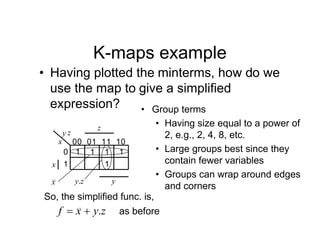
• Having plotted the minterms, how do we
use the map to give a simplified
expression? • Group terms
• Having size equal to a power of
2, e.g., 2, 4, 8, etc.
• Large groups best since they
contain fewer variables
• Groups can wrap around edges
and corners
y z
11
00 01 10
0
1
x
1 1 1
1
1
x
z
y
x z
y.
So, the simplified func. is,
.z
y
x
f 
 as before
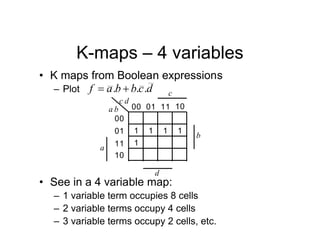
K-maps – 4 variables
• K maps from Boolean expressions
– Plot .
.
. d
c
b
b
a
f 

11
00 01 10
00
01
11
10
b
a
d
c
1 1 1 1
1
a
b
c
d
• See in a 4 variable map:
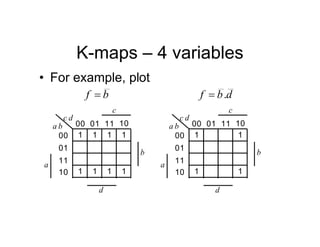
– 1 variable term occupies 8 cells
– 2 variable terms occupy 4 cells
– 3 variable terms occupy 2 cells, etc.
K-maps – 4 variables
• For example, plot
b
f  .d
b
f 
11
00 01 10
00
01
11
10
b
a
d
c
1
1
1
1
a
b
c
d
11
00 01 10
00
01
11
10
b
a
d
c
1
1
1 1
1
a
b
c
d
1
1
1
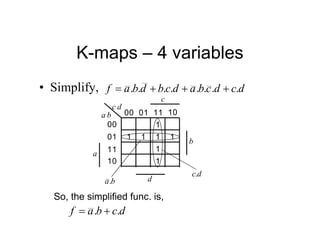
K-maps – 4 variables
• Simplify, .
.
.
.
.
.
.
. d
c
d
c
b
a
d
c
b
d
b
a
f 



11
00 01 10
00
01
11
10
b
a
d
c
1
a
b
c
d
1
1
1
1
1
1
b
a.
d
c.
So, the simplified func. is,
.
. d
c
b
a
f 

POS Simplification
• Note that the previous examples have
yielded simplified expressions in the
SOP form
– Suitable for implementations using AND
followed by OR gates, or only NAND gates
(using DeMorgans to transform the result –
see previous Bubble logic slides)
• However, sometimes we may wish to
get a simplified expression in POS form
– Suitable for implementations using OR
followed by AND gates, or only NOR gates
POS Simplification
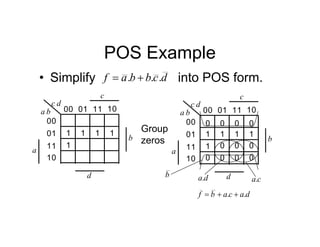
• To do this we group the zeros in the map
– i.e., we simplify the complement of the function
• Then we apply DeMorgans and
complement
• Use ‘bubble’ logic if NOR only
implementation is required
POS Example
• Simplify into POS form.
.
.
. d
c
b
b
a
f 

11
00 01 10
00
01
11
10
b
a
d
c
1 1 1 1
1
a
b
c
d
Group
zeros
11
00 01 10
00
01
11
10
b
a
d
c
1 1 1 1
1
a
b
c
d
0 0 0 0
0 0 0
0 0 0 0
b d
a. c
a.
.
. d
a
c
a
b
f 


POS Example
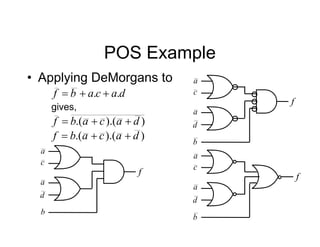
• Applying DeMorgans to
.
. d
a
c
a
b
f 


)
).(
.( d
a
c
a
b
f 


)
).(
.( d
a
c
a
b
f 


f
a
c
a
d
b
f
a
c
a
d
b
gives,
f
a
c
a
d
b
Expression in POS form
• Apply DeMorgans and take
complement, i.e., is now in SOP form
• Fill in zeros in table, i.e., plot
• Fill remaining cells with ones, i.e., plot
• Simplify in usual way by grouping ones
to simplify
f
f
f
f
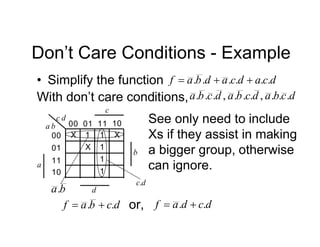
Don’t Care Conditions
• Sometimes we do not care about the
output value of a combinational logic
circuit, i.e., if certain input combinations
can never occur, then these are known
as don’t care conditions.
• In any simplification they may be treated
as 0 or 1, depending upon which gives
the simplest result.
– For example, in a K-map they are entered
as Xs
Don’t Care Conditions - Example
• Simplify the function .
.
.
.
.
. d
c
a
d
c
a
d
b
a
f 


With don’t care conditions, .
.
.
,
.
.
.
,
.
.
. d
c
b
a
d
c
b
a
d
c
b
a
11
00 01 10
00
01
11
10
b
a
d
c
1
a
b
c
d
X 1
1
1
1
X
X
b
a.
d
c.
d
c
b
a
f .
. 

See only need to include
Xs if they assist in making
a bigger group, otherwise
can ignore.
or, d
c
d
a
f .
. 

Some Definitions
• Cover – A term is said to cover a minterm if that
minterm is part of that term
• Prime Implicant – a term that cannot be further
combined
• Essential Term – a prime implicant that covers a
minterm that no other prime implicant covers
• Covering Set – a minimum set of prime
implicants which includes all essential terms plus
any other prime implicants required to cover all
minterms
Number Representation,
Addition and Subtraction
Binary Numbers
• It is important to be able to represent
numbers in digital logic circuits
– for example, the output of a analogue to digital
converter (ADC) is an n-bit number, where n is
typically in the range from 8 to 16
• Various representations are used, e.g.,
– unsigned integers
– 2’s complement to represent negative numbers
Binary Numbers
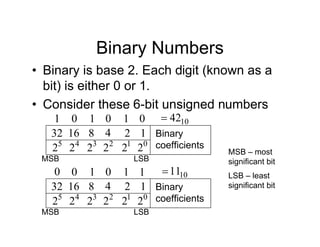
• Binary is base 2. Each digit (known as a
bit) is either 0 or 1.
• Consider these 6-bit unsigned numbers
32
5
2
1 0
16
4
2
1 0 0
1
3
2 2
2 1
2 0
2
8 4 2 1 Binary
coefficients
10
42

MSB LSB
32
5
2
0 0
16
4
2
1 0 1
1
3
2 2
2 1
2 0
2
8 4 2 1 Binary
coefficients
10
11

MSB LSB
MSB – most
significant bit
LSB – least
significant bit
Unsigned Binary Numbers
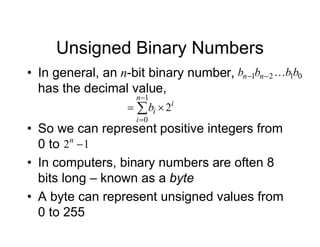
• In general, an n-bit binary number,
has the decimal value,
i
n
i
i
b 2
1
0

 


0
1
2
1 b
b
b
b n
n 


• So we can represent positive integers from
0 to
• In computers, binary numbers are often 8
bits long – known as a byte
• A byte can represent unsigned values from
0 to 255
1
2 
n
Unsigned Binary Numbers
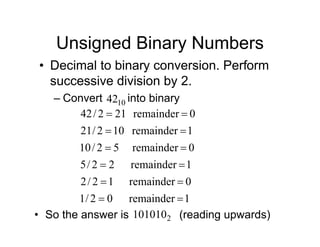
• Decimal to binary conversion. Perform
successive division by 2.
– Convert into binary
10
42
1
remainder
0
2
/
1
0
remainder
1
2
/
2
1
remainder
2
2
/
5
0
remainder
5
2
/
10
1
remainder
10
2
/
21
0
remainder
21
2
/
42












• So the answer is (reading upwards)
2
101010
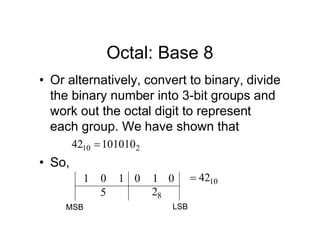
Octal: Base 8
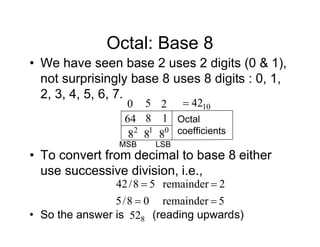
• We have seen base 2 uses 2 digits (0 & 1),
not surprisingly base 8 uses 8 digits : 0, 1,
2, 3, 4, 5, 6, 7.
0 2
5
1
8 0
8
8 1 Octal
coefficients
10
42

MSB LSB
64
2
8
• To convert from decimal to base 8 either
use successive division, i.e.,
5
remainder
0
8
/
5
2
remainder
5
8
/
42




• So the answer is (reading upwards)
8
52
Octal: Base 8
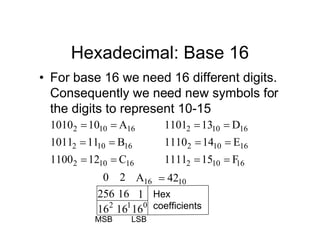
• Or alternatively, convert to binary, divide
the binary number into 3-bit groups and
work out the octal digit to represent
each group. We have shown that
2
10 101010
42 
• So,
1 0 1 0 0
1
5 8
2
10
42

MSB LSB
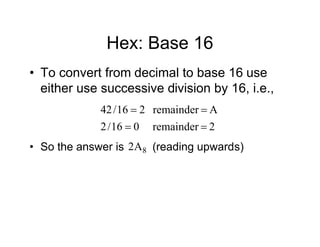
Hexadecimal: Base 16
• For base 16 we need 16 different digits.
Consequently we need new symbols for
the digits to represent 10-15
16
10
2
16
10
2
16
10
2
C
12
1100
B
11
1011
A
10
1010






16
10
2
16
10
2
16
10
2
F
15
1111
E
14
1110
D
13
1101






0 16
A
2
1
16 0
16
16 1 Hex
coefficients
10
42

MSB LSB
256
2
16
Hex: Base 16
• To convert from decimal to base 16 use
either use successive division by 16, i.e.,
2
remainder
0
16
/
2
A
remainder
2
16
/
42




• So the answer is (reading upwards)
8
A
2
Hex: Base 16
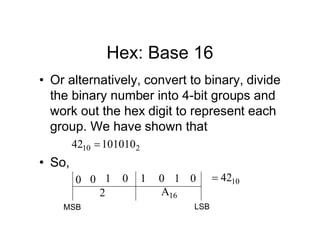
• Or alternatively, convert to binary, divide
the binary number into 4-bit groups and
work out the hex digit to represent each
group. We have shown that
2
10 101010
42 
• So,
1 0 1 0 0
1
2 16
A
10
42

MSB LSB
0
0
Hex: Base 16
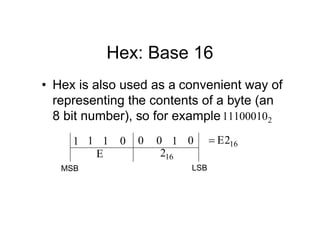
• Hex is also used as a convenient way of
representing the contents of a byte (an
8 bit number), so for example 2
11100010
1 0 0 0 0
1
E 16
2
16
2
E

MSB LSB
1
1
Negative numbers
• So far we have only been able to represent
positive numbers. For example, we have
seen an 8-bit byte can represent from 0 to
255, i.e., 28 = 256 different combinations of
bits in a byte
• If we want to represent negative numbers,
we have to give up some of the range of
positive numbers we had before
– A popular approach to do this is called 2’s
complement
2’s Complement
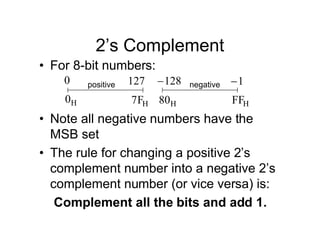
• For 8-bit numbers:
0 127 128
 1

H
0 H
F
7
positive negative
H
80 H
FF
• Note all negative numbers have the
MSB set
• The rule for changing a positive 2’s
complement number into a negative 2’s
complement number (or vice versa) is:
Complement all the bits and add 1.
2’s Complement
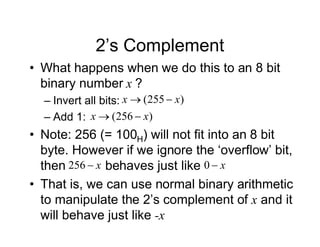
• What happens when we do this to an 8 bit
binary number x ?
– Invert all bits:
– Add 1:
• Note: 256 (= 100H) will not fit into an 8 bit
byte. However if we ignore the ‘overflow’ bit,
then behaves just like
• That is, we can use normal binary arithmetic
to manipulate the 2’s complement of x and it
will behave just like -x
)
255
( x
x 

)
256
( x
x 

x

256 x

0
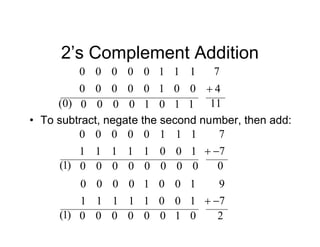
2’s Complement Addition
0
0
1
0
0
0
0
0
1
1
1
0
0
0
0
0 7
1
1
0
1
0
0
0
0 11
)
0
(
4

• To subtract, negate the second number, then add:
1
0
0
1
1
1
1
1
1
1
1
0
0
0
0
0 7
0
)
1
(
7


0
0
0
0
0
0
0
0
1
0
0
1
1
1
1
1
1
0
0
1
0
0
0
0 9
2
)
1
(
7


0
1
0
0
0
0
0
0
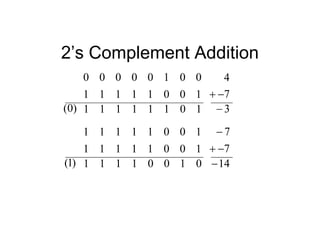
2’s Complement Addition
1
0
0
1
1
1
1
1
0
0
1
0
0
0
0
0 4
3

)
0
(
7


1
0
1
1
1
1
1
1
1
0
0
1
1
1
1
1
1
0
0
1
1
1
1
1 7

14

)
1
(
7


0
1
0
0
1
1
1
1
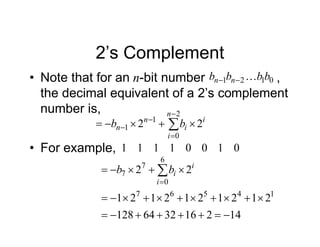
2’s Complement
• Note that for an n-bit number ,
the decimal equivalent of a 2’s complement
number is,
i
n
i
i
n
n b
b 2
2
2
0
1
1 



 




0
1
2
1 b
b
b
b n
n 


• For example, 0
1
0
0
1
1
1
1
14
2
16
32
64
128
2
1
2
1
2
1
2
1
2
1
2
2
1
4
5
6
7
6
0
7
7























 

i
i
i
b
b
2’s Complement Overflow
• For example, when working with 8-bit
unsigned numbers, we can use the
‘carry’ from the 8th bit (MSB) to indicate
that the number has got too big.
• With signed numbers we deliberately
ignore any carry from the MSB,
consequently we need a new rule to
detect when a result is out of range.
2’s Complement Overflow
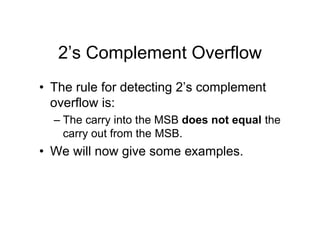
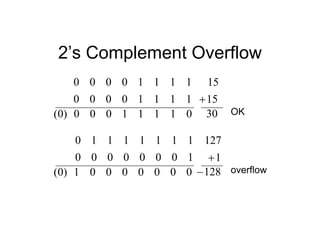
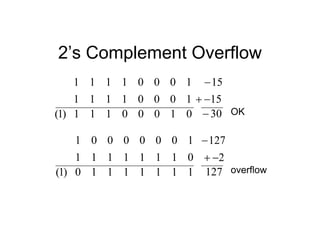
• The rule for detecting 2’s complement
overflow is:
– The carry into the MSB does not equal the
carry out from the MSB.
• We will now give some examples.
2’s Complement Overflow
1
1
1
1
0
0
0
0
1
1
1
1
0
0
0
0 15
30
)
0
(
15

0
1
1
1
1
0
0
0 OK
1
0
0
0
0
0
0
0
1
1
1
1
1
1
1
0 127
128

)
0
(
1

0
0
0
0
0
0
0
1 overflow
2’s Complement Overflow
1
0
0
0
1
1
1
1
1
0
0
0
1
1
1
1 15

30

)
1
(
15


0
1
0
0
0
1
1
1 OK
0
1
1
1
1
1
1
1
1
0
0
0
0
0
0
1 127

127
)
1
(
2


1
1
1
1
1
1
1
0 overflow
Binary Coded Decimal (BCD)
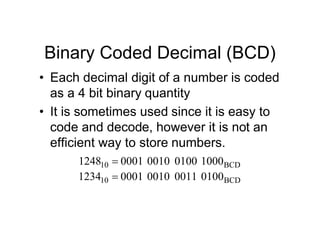
• Each decimal digit of a number is coded
as a 4 bit binary quantity
• It is sometimes used since it is easy to
code and decode, however it is not an
efficient way to store numbers.
1000
0100
0010
0001
1248 BCD
10 
0100
0011
0010
0001
1234 BCD
10 
Alphanumeric Character Codes
• ASCII: American Standard Code for
Information Exchange:
– Standard version is a 7 bit code with the
remaining bit usually set to zero
– The first 32 are ‘control codes’ originally used
for controlling modems
– The rest are upper and lower case letters,
numbers and punctuation.
– An extended version uses all 8 bits to
provide additional graphics characters
Alphanumeric Character Codes
• EBCDIC – a legacy IBM scheme, now little
used
• Unicode – a 16 bit scheme, includes
Chinese characters etc.
Binary Adding Circuits
• We will now look at how binary addition
may be implemented using combinational
logic circuits. We will consider:
– Half adder
– Full adder
– Ripple carry adder
Half Adder
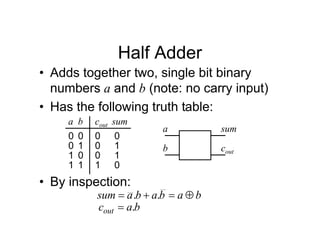
• Adds together two, single bit binary
numbers a and b (note: no carry input)
• Has the following truth table:
a cout
0
1
b
0
0
1 0
1
0
0
0
1 1
sum
0
1
1
0
a
b cout
sum
• By inspection:
b
a
b
a
b
a
sum 


 .
.
b
a
cout .

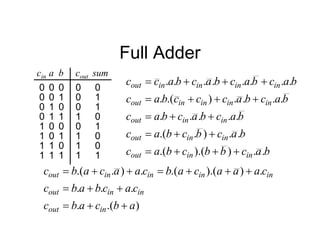
Full Adder
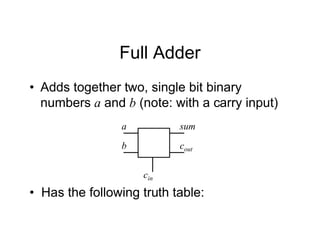
• Adds together two, single bit binary
numbers a and b (note: with a carry input)
a
b cout
sum
cin
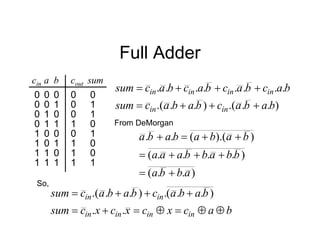
• Has the following truth table:
Full Adder
a cout
b sum
1
0
0
0
0
1
1
0
cin
0
1
0
0
1 0
1 1
0
0
0
0
0
1
0
0
1 0
1 1
1
1
1
1
1
1
1
0
1
0
0
1
)
.
.
.(
)
.
.
.(
.
.
.
.
.
.
.
.
b
a
b
a
c
b
a
b
a
c
sum
b
a
c
b
a
c
b
a
c
b
a
c
sum
in
in
in
in
in
in








From DeMorgan
)
.
.
(
)
.
.
.
.
(
)
).(
(
.
.
a
b
b
a
b
b
a
b
b
a
a
a
b
a
b
a
b
a
b
a










So,
b
a
c
x
c
x
c
x
c
sum
b
a
b
a
c
b
a
b
a
c
sum
in
in
in
in
in
in











.
.
)
.
.
(
.
)
.
.
.(
Full Adder
a cout
b sum
1
0
0
0
0
1
1
0
cin
0
1
0
0
1 0
1 1
0
0
0
0
0
1
0
0
1 0
1 1
1
1
1
1
1
1
1
0
1
0
0
1
b
a
c
b
b
c
b
a
c
b
a
c
b
c
b
a
c
b
a
c
b
a
c
b
a
c
b
a
c
b
a
c
c
c
b
a
c
b
a
c
b
a
c
b
a
c
b
a
c
c
in
in
out
in
in
out
in
in
out
in
in
in
in
out
in
in
in
in
out
.
.
)
).(
.(
.
.
)
.
.(
.
.
.
.
.
.
.
.
.
)
.(
.
.
.
.
.
.
.
.
.


















)
.(
.
.
.
.
.
)
).(
.(
.
)
.
.(
a
b
c
a
b
c
c
a
c
b
a
b
c
c
a
a
a
c
a
b
c
a
a
c
a
b
c
in
out
in
in
out
in
in
in
in
out













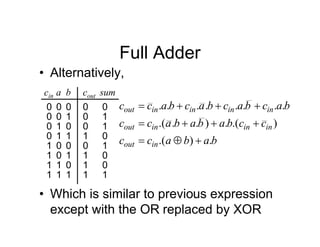
Full Adder
• Alternatively,
a cout
b sum
1
0
0
0
0
1
1
0
cin
0
1
0
0
1 0
1 1
0
0
0
0
0
1
0
0
1 0
1 1
1
1
1
1
1
1
1
0
1
0
0
1
b
a
b
a
c
c
c
c
b
a
b
a
b
a
c
c
b
a
c
b
a
c
b
a
c
b
a
c
c
in
out
in
in
in
out
in
in
in
in
out
.
)
.(
)
.(
.
)
.
.
.(
.
.
.
.
.
.
.
.











• Which is similar to previous expression
except with the OR replaced by XOR
Ripple Carry Adder
• We have seen how we can implement a
logic to add two, one bit binary numbers
(inc. carry-in).
• However, in general we need to add
together two, n bit binary numbers.
• One possible solution is known as the
Ripple Carry Adder
– This is simply n, full adders cascaded
together
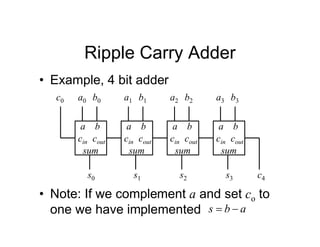
Ripple Carry Adder
a0 b0
c0
a b
cout
sum
cin
s0
a b
cout
sum
cin
s1
a b
cout
sum
cin
s2
a b
cout
sum
cin
s3
a1 b1 a2 b2 a3 b3
c4
• Example, 4 bit adder
• Note: If we complement a and set co to
one we have implemented a
b
s 

Combinational Logic Design
Further Considerations
Multilevel Logic
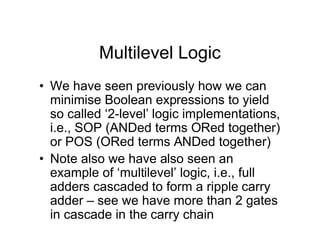
• We have seen previously how we can
minimise Boolean expressions to yield
so called ‘2-level’ logic implementations,
i.e., SOP (ANDed terms ORed together)
or POS (ORed terms ANDed together)
• Note also we have also seen an
example of ‘multilevel’ logic, i.e., full
adders cascaded to form a ripple carry
adder – see we have more than 2 gates
in cascade in the carry chain
Multilevel Logic
• Why use multilevel logic?
– Commercially available logic gates usually
only available with a restricted number of
inputs, typically, 2 or 3.
– System composition from sub-systems
reduces design complexity, e.g., a ripple
adder made from full adders
– Allows Boolean optimisation across multiple
outputs, e.g., common sub-expression
elimination
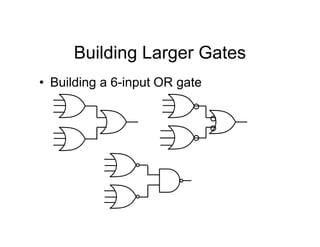
Building Larger Gates
• Building a 6-input OR gate
Common Expression Elimination
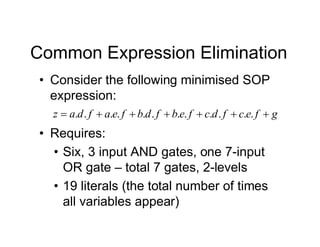
• Consider the following minimised SOP
expression:
g
f
e
c
f
d
c
f
e
b
f
d
b
f
e
a
f
d
a
z 





 .
.
.
.
.
.
.
.
.
.
.
.
• Requires:
• Six, 3 input AND gates, one 7-input
OR gate – total 7 gates, 2-levels
• 19 literals (the total number of times
all variables appear)
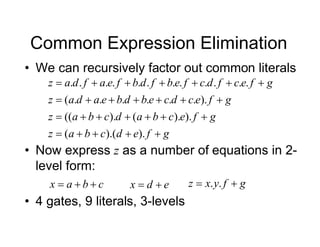
• We can recursively factor out common literals
Common Expression Elimination
g
f
e
d
c
b
a
z
g
f
e
c
b
a
d
c
b
a
z
g
f
e
c
d
c
e
b
d
b
e
a
d
a
z
g
f
e
c
f
d
c
f
e
b
f
d
b
f
e
a
f
d
a
z


























).
).(
(
).
).
(
).
((
).
.
.
.
.
.
.
(
.
.
.
.
.
.
.
.
.
.
.
.
• Now express z as a number of equations in 2-
level form:
c
b
a
x 

 e
d
x 
 g
f
y
x
z 
 .
.
• 4 gates, 9 literals, 3-levels
Gate Propagation Delay
• So, multilevel logic can produce reductions
in implementation complexity. What is the
downside?
• We need to remember that the logic gates
are implemented using electronic
components (essentially transistors) which
have a finite switching speed.
• Consequently, there will be a finite delay
before the output of a gate responds to a
change in its inputs – propagation delay
Gate Propagation Delay
• The cumulative delay owing to a number of
gates in cascade can increase the time
before the output of a combinational logic
circuit becomes valid
• For example, in the Ripple Carry Adder, the
sum at its output will not be valid until any
carry has ‘rippled’ through possibly every full
adder in the chain – clearly the MSB will
experience the greatest potential delay
Gate Propagation Delay
• As well as slowing down the operation of
combinational logic circuits, gate delay can
also give rise to so called ‘Hazards’ at the
output
• These Hazards manifest themselves as
unwanted brief logic level changes (or
glitches) at the output in response to
changing inputs
• We will now describe how we can address
these problems
Hazards
• Hazards are classified into two types,
namely, static and dynamic
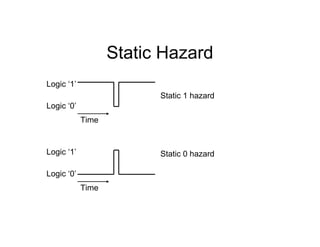
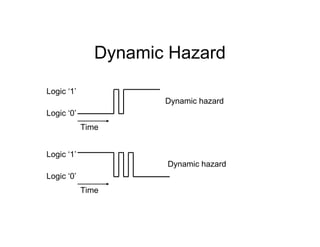
• Static Hazard – The output undergoes a
momentary transition when it is
supposed to remain unchanged
• Dynamic Hazard – The output changes
more than once when it is supposed to
change just once
Timing Diagrams
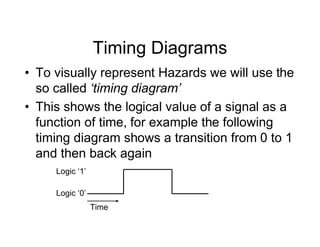
• To visually represent Hazards we will use the
so called ‘timing diagram’
• This shows the logical value of a signal as a
function of time, for example the following
timing diagram shows a transition from 0 to 1
and then back again
Logic ‘0’
Time
Logic ‘1’
Timing Diagrams
• Note that the timing diagram makes a number
simplifying assumptions (to aid clarity)
compared with a diagram which accurately
shows the actual voltage against time
– The signal only has 2 levels. In reality the signal
may well look more ‘wobbly’ owing to electrical
noise pick-up etc.
– The transitions between logic levels takes place
instantaneously, in reality this will take a finite
time.
Static Hazard
Logic ‘0’
Time
Logic ‘1’
Static 1 hazard
Logic ‘0’
Time
Logic ‘1’ Static 0 hazard
Dynamic Hazard
Logic ‘0’
Time
Logic ‘1’
Dynamic hazard
Logic ‘0’
Time
Logic ‘1’
Dynamic hazard
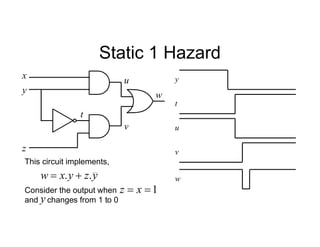
Static 1 Hazard
x
y
z
t
u
v
w
y
t
u
v
w
This circuit implements,
y
z
y
x
w .
. 

Consider the output when
and changes from 1 to 0
1

 x
z
y
Hazard Removal
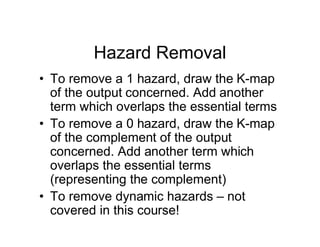
• To remove a 1 hazard, draw the K-map
of the output concerned. Add another
term which overlaps the essential terms
• To remove a 0 hazard, draw the K-map
of the complement of the output
concerned. Add another term which
overlaps the essential terms
(representing the complement)
• To remove dynamic hazards – not
covered in this course!
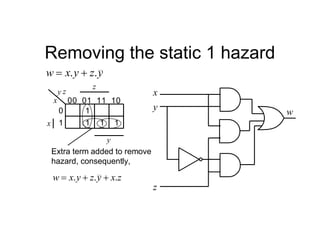
Removing the static 1 hazard
y
z
y
x
w .
. 

y z
11
00 01 10
0
1
x
1
1
1 1
x
z
y
Extra term added to remove
hazard, consequently,
z
x
y
z
y
x
w .
.
. 


x
y
z
w
To Speed up Ripple Carry Adder
• Abandon compositional approach to the adder
design, i.e., do not build the design up from
full-adders, but instead design the adder as a
block of 2-level combinational logic with 2n
inputs (+1 for carry in) and n outputs (+1 for
carry out).
• Features
– Low delay (2 gate delays)
– Need some gates with large numbers of inputs
(which are not available)
– Very complex to design and implement (imagine
the truth table!
To Speed up Ripple Carry Adder
• Clearly the 2-level approach is not
feasible
• One possible approach is to make use
of the full-adder blocks, but to generate
the carry signals independently, using
fast carry generation logic
• Now we do not have to wait for the carry
signals to ripple from full-adder to full-
adder before output becomes valid
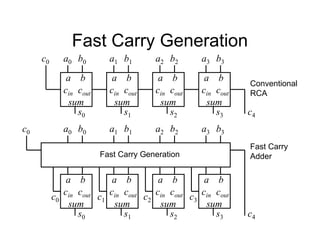
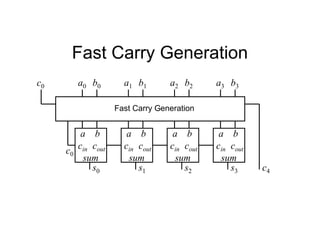
Fast Carry Generation
a0 b0
c0
a b
cout
sum
cin
s0
a b
cout
sum
cin
s1
a b
cout
sum
cin
s2
a b
cout
sum
cin
s3
a1 b1 a2 b2 a3 b3
c4
Conventional
RCA
Fast Carry
Adder
a0 b0
c0
a b
cout
sum
cin
s0
a b
cout
sum
cin
s1
a b
cout
sum
cin
s2
a b
cout
sum
cin
s3
a1 b1 a2 b2 a3 b3
c4
Fast Carry Generation
c0 c1 c2 c3
Fast Carry Generation
• We will now determine the Boolean
equations required to generate the fast
carry signals
• To do this we will consider the carry out
signal, cout, generated by a full-adder
stage (say i), which conventionally gives
rise to the carry in (cin) to the next stage,
i.e., ci+1.
Fast Carry Generation
a b si
ci
0 0
0 0
1 1
0 1
0
1 0
0 0
1
1
0
0 0
1
0
1 0
1 1
1
1
1
1
1
0
1
0
1 1
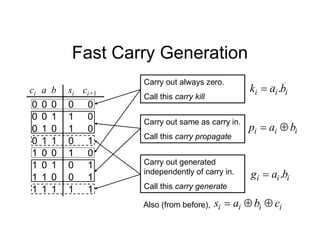
0
0 0
1 0
1
ci+1
Carry out same as carry in.
Call this carry propagate
Carry out generated
independently of carry in.
Call this carry generate
Carry out always zero.
Call this carry kill
i
i
i b
a
g .

i
i
i b
a
p 

i
i
i b
a
k .

Also (from before), i
i
i
i c
b
a
s 


Fast Carry Generation
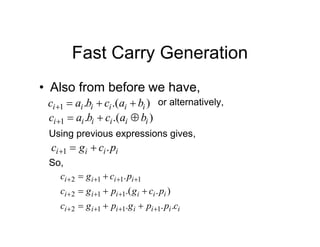
• Also from before we have,
)
.(
.
1 i
i
i
i
i
i b
a
c
b
a
c 



or alternatively,
)
.(
.
1 i
i
i
i
i
i b
a
c
b
a
c 



Using previous expressions gives,
i
i
i
i p
c
g
c .
1 


So,
i
i
i
i
i
i
i
i
i
i
i
i
i
i
i
i
i
c
p
p
g
p
g
c
p
c
g
p
g
c
p
c
g
c
.
.
.
)
.
.(
.
1
1
1
2
1
1
2
1
1
1
2



















Fast Carry Generation
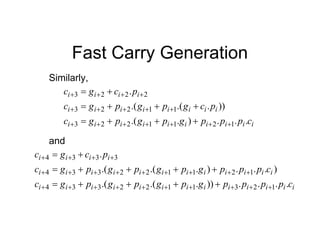
Similarly,
i
i
i
i
i
i
i
i
i
i
i
i
i
i
i
i
i
i
i
i
i
i
c
p
p
p
g
p
g
p
g
c
p
c
g
p
g
p
g
c
p
c
g
c
.
.
.
)
.
.(
))
.
.(
.(
.
1
2
1
1
2
2
3
1
1
2
2
3
2
2
2
3


























and
i
i
i
i
i
i
i
i
i
i
i
i
i
i
i
i
i
i
i
i
i
i
i
i
i
i
i
i
i
c
p
p
p
p
g
p
g
p
g
p
g
c
c
p
p
p
g
p
g
p
g
p
g
c
p
c
g
c
.
.
.
.
))
.
.(
.(
)
.
.
.
)
.
.(
.(
.
1
2
3
1
1
2
2
3
3
4
1
2
1
1
2
2
3
3
4
3
3
3
4



































Fast Carry Generation
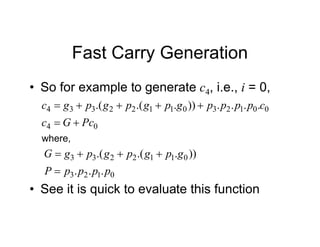
• So for example to generate c4, i.e., i = 0,
0
4
0
0
1
2
3
0
1
1
2
2
3
3
4 .
.
.
.
))
.
.(
.(
Pc
G
c
c
p
p
p
p
g
p
g
p
g
p
g
c







where,
0
1
2
3
0
1
1
2
2
3
3
.
.
.
))
.
.(
.(
p
p
p
p
P
g
p
g
p
g
p
g
G





• See it is quick to evaluate this function
Fast Carry Generation
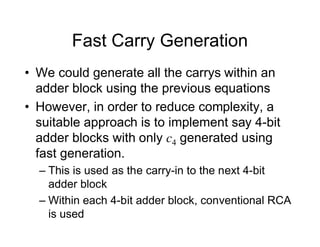
• We could generate all the carrys within an
adder block using the previous equations
• However, in order to reduce complexity, a
suitable approach is to implement say 4-bit
adder blocks with only c4 generated using
fast generation.
– This is used as the carry-in to the next 4-bit
adder block
– Within each 4-bit adder block, conventional RCA
is used
Fast Carry Generation
a0 b0
c0
a b
cout
sum
cin
s0
a b
cout
sum
cin
s1
a b
cout
sum
cin
s2
a b
cout
sum
cin
s3
a1 b1 a2 b2 a3 b3
c4
Fast Carry Generation
c0
Other Ways to Implement
Combinational Logic
• We have seen how combinational logic
can be implemented using logic gates,
e.g., AND, OR etc.
• However, it is also possible to generate
combinational logic functions using
memory devices, e.g., Read Only
Memories (ROMs)
ROM Overview
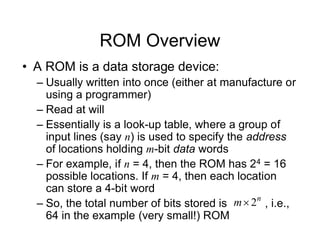
• A ROM is a data storage device:
– Usually written into once (either at manufacture or
using a programmer)
– Read at will
– Essentially is a look-up table, where a group of
input lines (say n) is used to specify the address
of locations holding m-bit data words
– For example, if n = 4, then the ROM has 24 = 16
possible locations. If m = 4, then each location
can store a 4-bit word
– So, the total number of bits stored is , i.e.,
64 in the example (very small!) ROM
n
m 2

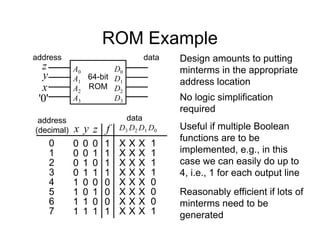
ROM Example
data
x y z f
0 0 0 1
0 0 1 1
0 1 0 1
0 1 1 1
1 0 0 0
1 0 1 0
1 1 0 0
1 1 1 1
address
(decimal)
0
1
2
3
4
5
6
7
D0
D1
D2
D3
X X X 1
X X X 1
X X X 1
X X X 1
X X X 0
X X X 0
X X X 0
X X X 1
64-bit
ROM
A0
A1
A2
A3
D0
D1
D2
D3
address data
z
y
x
'
0
'
Design amounts to putting
minterms in the appropriate
address location
No logic simplification
required
Useful if multiple Boolean
functions are to be
implemented, e.g., in this
case we can easily do up to
4, i.e., 1 for each output line
Reasonably efficient if lots of
minterms need to be
generated
ROM Implementation
• Can be quite inefficient, i.e., become large in
size with only a few non-zero entries, if the
number of minterms in the function to be
implemented is quite small
• Devices which can overcome these problems
are known as programmable array logic (PAL)
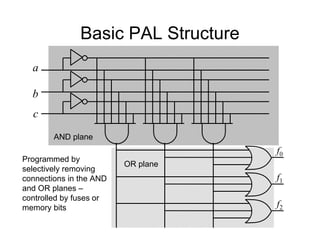
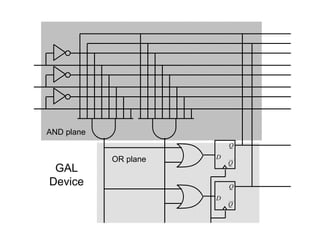
• In PALs, only the required minterms are
generated using a separate AND plane. The
outputs from this plane are ORed together in
a separate OR plane to produce the final
output
Basic PAL Structure
Programmed by
selectively removing
connections in the AND
and OR planes –
controlled by fuses or
memory bits
f0
a
c
b
f1
f2
AND plane
OR plane
Other Memory Devices
• Non-volatile storage is offered by ROMs (and
some other memory technologies, e.g.,
FLASH), i.e., the data remains intact, even
when the power supply is removed
• Volatile storage is offered by Static Random
Access Memory (SRAM) technology
– Data can be written into and read out of the
SRAM, but is lost once power is removed
Memory Application
• Memory devices are often used in computer
systems
• The central processing unit (CPU) often
makes use of busses (a bunch of wires in
parallel) to access external memory devices
• The address bus is used to specify the
memory location that is being read or written
and the data bus conveys the data too and
from that location
• So, more than one memory device will often
be connected to the same data bus
Bus Contention
• In this case, if the output from the data pin of
one memory was a 0 and the output from the
corresponding data pin of another memory
was a 1, the data on that line of the data bus
would be invalid
• So, how do we arrange for the data from
multiple memories to be connected to the
some bus wires?
Bus Contention
• The answer is:
– Tristate buffers (or drivers)
– Control signals
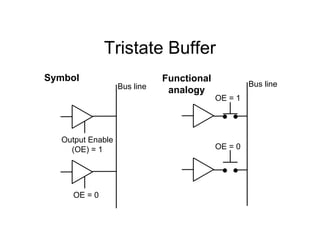
• A tristate buffer is used on the data output of
the memory devices
– In contrast to a normal buffer which is either 1
or 0 at its output, a tristate buffer can be
electrically disconnected from the bus wire, i.e.,
it will have no effect on any other data currently
on the bus – known as the ‘high impedance’
condition
Tristate Buffer
Output Enable
(OE) = 1
OE = 0
Bus line
OE = 1
Bus line
OE = 0
Symbol Functional
analogy
Control Signals
• We have already seen that the memory
devices have an additional control input (OE)
that determines whether the output buffers are
enabled.
• Other control inputs are also provided:
– Write enable (WE). Determines whether data is
written or read (clearly not needed on a ROM)
– Chip select (CS) – determines if the chip is
activated
• Note that these signals can be active low,
depending upon the particular device
Sequential Logic
Flip-flops and Latches
Sequential Logic
• The logic circuits discussed previously
are known as combinational, in that the
output depends only on the condition of
the latest inputs
• However, we will now introduce a type
of logic where the output depends not
only on the latest inputs, but also on the
condition of earlier inputs. These circuits
are known as sequential, and implicitly
they contain memory elements
Memory Elements
• A memory stores data – usually one bit per
element
• A snapshot of the memory is called the state
• A one bit memory is often called a bistable,
i.e., it has 2 stable internal states
• Flip-flops and latches are particular
implementations of bistables
RS Latch
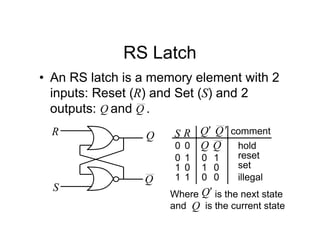
• An RS latch is a memory element with 2
inputs: Reset (R) and Set (S) and 2
outputs: and .
Q Q
Q
Q
R
S
Q
0
0
1
0
0
1
0
0 1
1 1
Q
R
S comment
Q Q
1
0
0
hold
reset
set
illegal
Where is the next state
and is the current state
Q
Q
RS Latch - Operation
Q
Q
R
S
1
2
a y
0
1
1
b
0
0 0
0
1 0 0
1 1
b complemented
NOR truth table
always 0
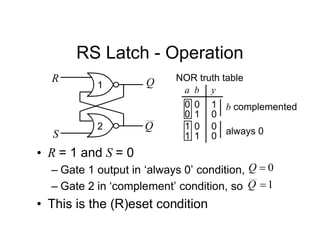
• R = 1 and S = 0
– Gate 1 output in ‘always 0’ condition,
– Gate 2 in ‘complement’ condition, so
• This is the (R)eset condition
0

Q
1

Q
RS Latch - Operation
Q
Q
R
S
1
2
a y
0
1
1
b
0
0 0
0
1 0 0
1 1
b complemented
NOR truth table
always 0
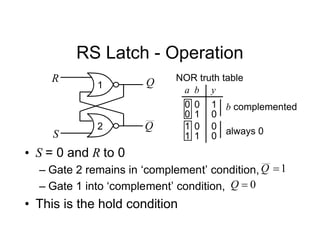
• S = 0 and R to 0
– Gate 2 remains in ‘complement’ condition,
– Gate 1 into ‘complement’ condition,
• This is the hold condition
0

Q
1

Q
RS Latch - Operation
Q
Q
R
S
1
2
a y
0
1
1
b
0
0 0
0
1 0 0
1 1
b complemented
NOR truth table
always 0
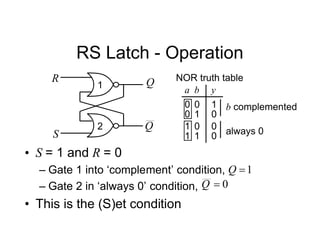
• S = 1 and R = 0
– Gate 1 into ‘complement’ condition,
– Gate 2 in ‘always 0’ condition,
• This is the (S)et condition
1

Q
0

Q
RS Latch - Operation
Q
Q
R
S
1
2
a y
0
1
1
b
0
0 0
0
1 0 0
1 1
b complemented
NOR truth table
always 0
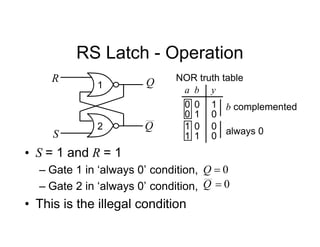
• S = 1 and R = 1
– Gate 1 in ‘always 0’ condition,
– Gate 2 in ‘always 0’ condition,
• This is the illegal condition
0

Q
0

Q
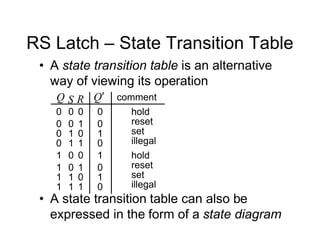
RS Latch – State Transition Table
• A state transition table is an alternative
way of viewing its operation
1
0
0
1
Q
R
S comment
hold
reset
set
illegal
1
0
0
0
0
1
1
0
0
1
1 1
Q
0
0
0
0
1
1
1
1
0
0
1
0
1
0
1
0
hold
reset
set
illegal
• A state transition table can also be
expressed in the form of a state diagram
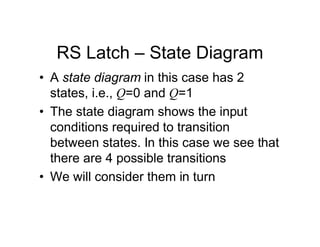
RS Latch – State Diagram
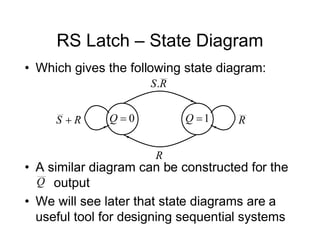
• A state diagram in this case has 2
states, i.e., Q=0 and Q=1
• The state diagram shows the input
conditions required to transition
between states. In this case we see that
there are 4 possible transitions
• We will consider them in turn
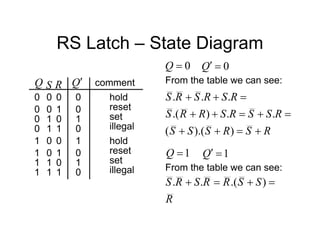
RS Latch – State Diagram
1
0
0
1
Q
R
S comment
hold
reset
set
illegal
1
0
0
0
0
1
1
0
0
1
1 1
Q
0
0
0
0
1
1
1
1
0
0
1
0
1
0
1
0
hold
reset
set
illegal
0

Q 0


Q
From the table we can see:
R
S
R
S
S
S
R
S
S
R
S
R
R
S
R
S
R
S
R
S












)
).(
(
.
.
)
.(
.
.
.
1

Q 1


Q
From the table we can see:
R
S
S
R
R
S
R
S 


 )
.(
.
.
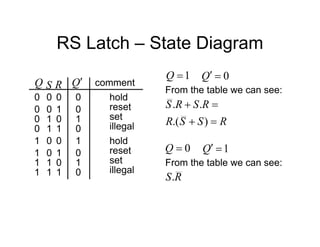
RS Latch – State Diagram
1
0
0
1
Q
R
S comment
hold
reset
set
illegal
1
0
0
0
0
1
1
0
0
1
1 1
Q
0
0
0
0
1
1
1
1
0
0
1
0
1
0
1
0
hold
reset
set
illegal
1

Q 0


Q
From the table we can see:
R
S
S
R
R
S
R
S




)
.(
.
.
0

Q 1


Q
From the table we can see:
R
S.
RS Latch – State Diagram
• Which gives the following state diagram:
0

Q 1

Q
R
S  R
R
S.
R
• A similar diagram can be constructed for the
output
• We will see later that state diagrams are a
useful tool for designing sequential systems
Q
Clocks and Synchronous Circuits
• For the RS latch we have just described, we
can see that the output state changes occur
directly in response to changes in the inputs.
This is called asynchronous operation
• However, virtually all sequential circuits
currently employ the notion of synchronous
operation, that is, the output of a sequential
circuit is constrained to change only at a time
specified by a global enabling signal. This
signal is generally known as the system clock
Clocks and Synchronous Circuits
• The Clock: What is it and what is it for?
– Typically it is a square wave signal at a
particular frequency
– It imposes order on the state changes
– Allows lots of states to appear to update
simultaneously
• How can we modify an asynchronous
circuit to act synchronously, i.e., in
synchronism with a clock signal?
Transparent D Latch
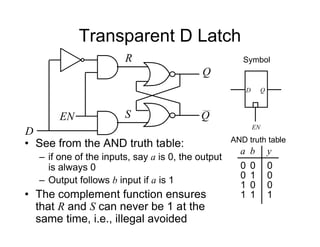
• We now modify the RS Latch such that its
output state is only permitted to change when
a valid enable signal (which could be the
system clock) is present
• This is achieved by introducing a couple of
AND gates in cascade with the R and S inputs
that are controlled by an additional input
known as the enable (EN) input.
Transparent D Latch
Q
Q
R
S
D
EN
D Q
EN
Symbol
a y
0
1
1
0
b
0
0
1
0
0 0
1 1
AND truth table
• See from the AND truth table:
– if one of the inputs, say a is 0, the output
is always 0
– Output follows b input if a is 1
• The complement function ensures
that R and S can never be 1 at the
same time, i.e., illegal avoided
Transparent D Latch
Q
Q
R
S
D
EN
RS hold
Q
0
1
0
1 1
Q
D comment
Q Q
1
0
RS reset
RS set
EN
0
X
1
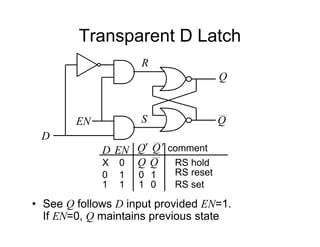
• See Q follows D input provided EN=1.
If EN=0, Q maintains previous state
Master-Slave Flip-Flops
• The transparent D latch is so called ‘level’
triggered. We can see it exhibits transparent
behaviour if EN=1. It is often more simple to
design sequential circuits if the outputs
change only on the either rising (positive
going) or falling (negative going) ‘edges’ of
the clock (i.e., enable) signal
• We can achieve this kind of operation by
combining 2 transparent D latches in a so
called Master-Slave configuration
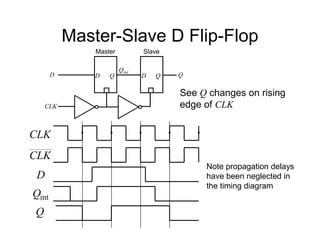
Master-Slave D Flip-Flop
Symbol
D Q
D Q D Q
D
CLK
Q
Master Slave
Qint
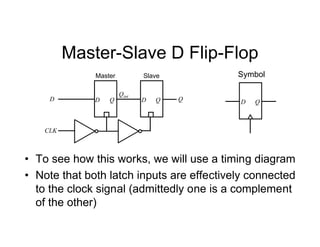
• To see how this works, we will use a timing diagram
• Note that both latch inputs are effectively connected
to the clock signal (admittedly one is a complement
of the other)
Master-Slave D Flip-Flop
D Q D Q
D
CLK
Q
Master Slave
Qint
CLK
CLK
D
int
Q
Q
Note propagation delays
have been neglected in
the timing diagram
See Q changes on rising
edge of CLK
D Flip-Flops
• The Master-Slave configuration has
now been superseded by new F-F
circuits which are easier to implement
and have better performance
• When designing synchronous circuits it
is best to use truly edge triggered F-F
devices
• We will not consider the design of such
F-Fs on this course
Other Types of Flip-Flops
• Historically, other types of Flip-Flops
have been important, e.g., J-K Flip-
Flops and T-Flip-Flops
• However, J-K FFs are a lot more
complex to build than D-types and so
have fallen out of favour in modern
designs, e.g., for field programmable
gate arrays (FPGAs) and VLSI chips
Other Types of Flip-Flops
• Consequently we will only consider
synchronous circuit design using D-type
FFs
• However for completeness we will
briefly look at the truth table for J-K and
T type FFs
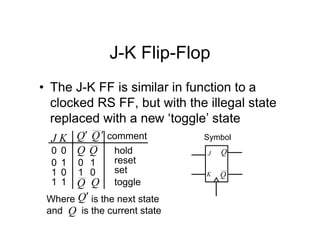
J-K Flip-Flop
• The J-K FF is similar in function to a
clocked RS FF, but with the illegal state
replaced with a new ‘toggle’ state
Q
0
1
0
0
1
0
0 1
1 1
Q
K
J comment
Q Q
1
0
hold
reset
set
toggle
Where is the next state
and is the current state
Q
Q
Q Q
Symbol
J
K Q
Q
T Flip-Flop
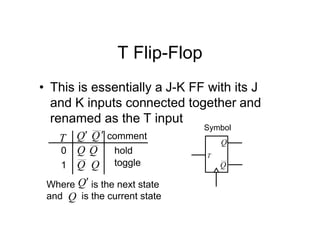
• This is essentially a J-K FF with its J
and K inputs connected together and
renamed as the T input
Q
0
1
Q
T comment
Q Q hold
toggle
Where is the next state
and is the current state
Q
Q
Q Q
Symbol
T
Q
Q
Asynchronous Inputs
• It is common for the FF types we have mentioned
to also have additional so called ‘asynchronous’
inputs
• They are called asynchronous since they take
effect independently of any clock or enable inputs
• Reset/Clear – force Q to 0
• Preset/Set – force Q to 1
• Often used to force a synchronous circuit into a
known state, say at start-up.
Timing
• Various timings must be satisfied if a FF
is to operate properly:
– Setup time: Is the minimum duration that
the data must be stable at the input before
the clock edge
– Hold time: Is the minimum duration that the
data must remain stable on the FF input
after the clock edge
Applications of Flip-Flops
• Counters
– A clocked sequential circuit that goes through a
predetermined sequence of states
– A commonly used counter is an n-bit binary
counter. This has n FFs and 2
n
states which are
passed through in the order 0, 1, 2, ….2
n
-1, 0, 1, .
– Uses include:
• Counting
• Producing delays of a particular duration
• Sequencers for control logic in a processor
• Divide by m counter (a divider), as used in a digital
watch
Applications of Flip-Flops
• Memories, e.g.,
– Shift register
• Parallel loading shift register : can be used for
parallel to serial conversion in serial data
communication
• Serial in, parallel out shift register: can be used
for serial to parallel conversion in a serial data
communication system.
Counters
• In most books you will see 2 basic types
of counters, namely ripple counters and
synchronous counters
• In this course we are concerned with
synchronous design principles. Ripple
counters do not follow these principles
and should generally be avoided if at all
possible. We will now look at the
problems with ripple counters
Ripple Counters
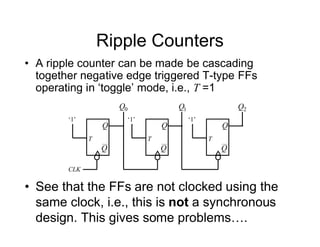
• A ripple counter can be made be cascading
together negative edge triggered T-type FFs
operating in ‘toggle’ mode, i.e., T =1
• See that the FFs are not clocked using the
same clock, i.e., this is not a synchronous
design. This gives some problems….
T
Q
Q
‘1’
CLK
T
Q
Q
‘1’
T
Q
Q
‘1’
0
Q 1
Q 2
Q
Ripple Counters
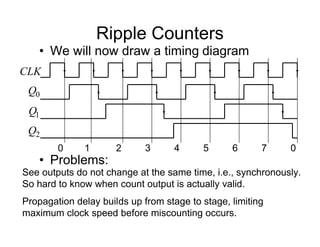
• We will now draw a timing diagram
0
Q
CLK
1
Q
2
Q
0 1 2 3 4 5 6 7 0
• Problems:
See outputs do not change at the same time, i.e., synchronously.
So hard to know when count output is actually valid.
Propagation delay builds up from stage to stage, limiting
maximum clock speed before miscounting occurs.
Ripple Counters
• If you observe the frequency of the counter
output signals you will note that each has half
the frequency, i.e., double the repetition
period of the previous one. This is why
counters are often known as dividers
• Often we wish to have a count which is not a
power of 2, e.g., for a BCD counter (0 to 9).To
do this:
– use FFs having a Reset/Clear input
– Use an AND gate to detect the count of 10 and
use its output to Reset the FFs
Synchronous Counters
• Owing to the problems identified with ripple
counters, they should not usually be used to
implement counter functions
• It is recommended that synchronous counter
designs be used
• In a synchronous design
– all the FF clock inputs are directly connected to the clock
signal and so all FF outputs change at the same time, i.e.,
synchronously
– more complex combinational logic is now needed to
generate the appropriate FF input signals (which will be
different depending upon the type of FF chosen)
Synchronous Counters
• We will now investigate the design of
synchronous counters
• We will consider the use of D-type FFs
only, although the technique can be
extended to cover other FF types.
• As an example, we will consider a 0 to 7
up-counter
Synchronous Counters
• To assist in the design of the counter we will make
use of a modified state transition table. This table
has additional columns that define the required FF
inputs (or excitation as it is known)
– Note we have used a state transition table previously
when determining the state diagram for an RS latch
• We will also make use of the so called ‘excitation
table’ for a D-type FF
• First however, we will investigate the so called
characteristic table and characteristic equation for a
D-type FF
Characteristic Table
• In general, a characteristic table for a FF
gives the next state of the output, i.e., in
terms of its current state and current inputs
Q
Q
1
0
0
1
Q
D
Q
0
0
1
1
0
1
0
1
Which gives the characteristic equation,
D
Q 
'
i.e., the next output state is equal to the
current input value
Since is independent of
the characteristic table can
be rewritten as 1
0
Q
D
0
1
Q Q
Excitation Table
• The characteristic table can be modified to
give the excitation table. This table tells us
the required FF input value required to
achieve a particular next state from a given
current state
1
0
0
1
Q D
Q
0
0
1
1
0
1
0
1
As with the characteristic table it can
be seen that , does not depend
upon, , however this is not
generally true for other FF types, in
which case, the excitation table is
more useful. Clearly for a D-FF,
Q
Q
'
Q
D 
Characteristic and Excitation
Tables
• Characteristic and excitation tables can
be determined for other FF types.
• These should be used in the design
process if D-type FFs are not used
• We will now determine the modified
state transition table for the example 0
to 7 up-counter
Modified State Transition
Table
• In addition to columns representing the
current and desired next states (as in a
conventional state transition table), the
modified table has additional columns
representing the required FF inputs to
achieve the next desired FF states
Modified State Transition Table
• For a 0 to 7 counter, 3 D-type FFs are needed
Current
state
0
Q
1
Q
2
Q
0
0
0
1
0
1
0
1 1
1
0
0
0
1
0
0
1
1
0
1
0
1
1
1
'
0
Q
'
1
Q
'
2
Q 0
D
1
D
2
D
1
0
1
1
0
0
0
1
1
0
0
1
1 1
0
0
0
1
1
1
1
0
0
0
1
0
1
1
0
0
0
1
1
0
0
1
1 1
0
0
0
1
1
1
1
0
0
0
Next
state
FF
inputs
Note: Since (or ) for a D-FF, the
required FF inputs are identical to the Next state
D
Q 
'
The procedure is to:
Write down the desired
count sequence in the
current state columns
Write down the required
next states in the next
state columns
Fill in the FF inputs
required to give the
defined next state
'
Q
D 
Synchronous Counter Example
• Also note that if we are using D-type FFs, it
is not necessary to explicitly write out the
FF input columns, since we know they are
identical to those for the next state
• To complete the design we now have to
determine appropriate combinational logic
circuits which will generate the required FF
inputs from the current states
• We can do this from inspection, using
Boolean algebra or using K-maps.
Synchronous Counter Example
Current
state
0
Q
1
Q
2
Q
0
0
0
1
0
1
0
1 1
1
0
0
0
1
0
0
1
1
0
1
0
1
1
1
'
0
Q
'
1
Q
'
2
Q 0
D
1
D
2
D
1
0
1
1
0
0
0
1
1
0
0
1
1 1
0
0
0
1
1
1
1
0
0
0
1
0
1
1
0
0
0
1
1
0
0
1
1 1
0
0
0
1
1
1
1
0
0
0
Next
state
FF
inputs
By inspection,
0
0 Q
D 
Note: FF0 is toggling
Also, 1
0
1 Q
Q
D 

Use a K-map for ,
2
D
1
Q 0
Q
11
00 01 10
0
1 1
1
1
1
2
Q
2
0.Q
Q
2
Q
1
Q
0
Q
2
1.Q
Q 2
1
0 .
. Q
Q
Q
Synchronous Counter Example
1
Q 0
Q
11
00 01 10
0
1 1
1
1
1
2
Q
2
0.Q
Q
2
Q
1
Q
0
Q
2
1.Q
Q 2
1
0 .
. Q
Q
Q
So,
2
1
0
1
0
2
2
2
1
0
2
1
2
0
2
.
.
)
.
.(
.
.
.
.
Q
Q
Q
Q
Q
Q
D
Q
Q
Q
Q
Q
Q
Q
D






D
Q
Q
CLK
0
Q
0
D
D
Q
Q
1
Q
1
D
D
Q
Q
2
Q
2
D
Combinati-
onal logic
0
Q
0
Q
1
Q
1
Q
2
Q
2
Q
Synchronous Counter
• A similar procedure can be used to design
counters having an arbitrary count sequence
– Write down the state transition table
– Determine the FF excitation (easy for D-types)
– Determine the combinational logic necessary to
generate the required FF excitation from the
current states – Note: remember to take into
account any unused counts since these can be
used as don’t care states when determining the
combinational logic circuits
Shift Register
• A shift register can be implemented
using a chain of D-type FFs
D
Q
Q
D
Q
Q
0
Q 1
Q 2
Q
D
Q
Q
Din
CLK
• Has a serial input, Din and parallel
output Q0, Q1 and Q2.
• See data moves one position to the
right on application of clock edge
Shift Register
• Preset and Clear inputs on the FFs can
be utilised to provide a parallel data
input feature
• Data can then be clocked out through
Q2 in a serial fashion, i.e., we now have
a parallel in, serial out arrangement
• This along with the previous serial in,
parallel out shift register arrangement
can be used as the basis for a serial
data link
Serial Data Link
CLK
0
Q 1
Q 2
Q
Parallel in
serial out
0
Q 1
Q 2
Q
Serial in
parallel out
Serial Data
• One data bit at a time is sent across the serial
data link
• See less wires are required than for a parallel
data link
Synchronous State Machines
• We have seen how we can use FFs (D-types
in particular) to design synchronous counters
• We will now investigate how these principles
can be extended to the design of synchronous
state machines (of which counters are a
subset)
• We will begin with some definitions and then
introduce two popular types of machines
Definitions
• Finite State Machine (FSM) – a deterministic
machine (circuit) that produces outputs which
depend on its internal state and external inputs
• States – the set of internal memorised values,
shown as circles on the state diagram
• Inputs – External stimuli, labelled as arcs on the
state diagram
• Outputs – Results from the FSM
Types of State Machines
• Two types of state machines are in
general use, namely Moore machines
and Mealy machines
• In this course we will only look in detail
at FSM design using Moore machines,
although for completeness we will
briefly describe the structure of Mealy
machines
Machine Schematics
Outputs
Next state
combinational
logic m
CLK
Optional
combinational
logic
D
Q
Q
m
Inputs
n
Current state
Moore
Machine
Mealy
Machine
Next state
combinational
logic
D
Q
Q
m
CLK
combinational
logic
m
Inputs
n
Current state
Outputs
Moore vs. Mealy Machines
• Outputs from Mealy Machines depend upon
the timing of the inputs
• Outputs from Moore machines come directly
from clocked FFs so:
– They have guaranteed timing characteristics
– They are glitch free
• Any Mealy machine can be converted to a
Moore machine and vice versa, though their
timing properties will be different
Moore Machine - Example
• We will design a Moore Machine to implement
a traffic light controller
• In order to visualise the problem it is often
helpful to draw the state transition diagram
• This is used to generate the state transition
table
• The state transition table is used to generate
– The next state combinational logic
– The output combinational logic (if required)
Example – Traffic Light Controller
R
R
G
A
A
See we have 4 states
So in theory we could
use a minimum of 2 FFs
However, by using 3 FFs
we will see that we do not
need to use any output
combinational logic
So, we will only use 4 of
the 8 possible states
In general, state assignment is a
difficult problem and the optimum
choice is not always obvious
Example – Traffic Light Controller
By using 3 FFs (we will use
D-types), we can assign one
to each of the required
outputs (R, A, G), eliminating
the need for output logic
State
010
R
R
G
A
A
State
100
State
001
State
110
We now need to write down
the state transition table
We will label the FF outputs
R, A and G
Remember we do not need to
explicitly include columns for FF
excitation since if we use D-types
these are identical to the next state
Example – Traffic Light Controller
Current
state
G
A
R
0
0
1
0
1
0
1
1
1
0
0
0
'
G
'
A
'
R
0
1
0
0
1
0
1
0
1
0
0
1
Next
state
R
R
G
A
A
State
100
State
001
State
110
State
010
Unused states, 000, 011, 101 and
111. Since these states will never
occur, we don’t care what output
the next state combinational logic
gives for these inputs. These don’t
care conditions can be used to
simplify the required next state
combinational logic
Example – Traffic Light Controller
Current
state
G
A
R
0
0
1
0
1
0
1
1
1
0
0
0
'
G
'
A
'
R
0
1
0
0
1
0
1
0
1
0
0
1
Next
state
Unused states, 000,
011, 101 and 111.
We now need to determine the next
state combinational logic
For the R FF, we need to determine DR
To do this we will use a K-map
A G
11
00 01 10
0
1
1
1 X
A
R.
R
R
G
A
X
X
X
A
R.
A
R
A
R
A
R
DR 


 .
.
Example – Traffic Light Controller
Current
state
G
A
R
0
0
1
0
1
0
1
1
1
0
0
0
'
G
'
A
'
R
0
1
0
0
1
0
1
0
1
0
0
1
Next
state
Unused states, 000,
011, 101 and 111.
By inspection we can also see:
A
DA 
and,
A
R
DG .

Example – Traffic Light Controller
D
Q
Q
CLK
A
A
D
D
Q
Q
R
R
D
D
Q
Q
G
G
D
FSM Problems
• Consider what could happen on power-up
• The state of the FFs could by chance be in
one of the unused states
– This could potentially cause the machine to
become stuck in some unanticipated sequence of
states which never goes back to a used state
FSM Problems
• What can be done?
– Check to see if the FSM can eventually
enter a known state from any of the
unused states
– If not, add additional logic to do this, i.e.,
include unused states in the state transition
table along with a valid next state
– Alternatively use asynchronous Clear and
Preset FF inputs to set a known (used)
state at power up
Example – Traffic Light Controller
• Does the example FSM self-start?
• Check what the next state logic outputs
if we begin in any of the unused states
• Turns out:
Start
state
Next state
logic output
000 010
011 100
101 110
111 001
Which are all
valid states
So it does
self start
Example 2
• We extend Example 1 so that the traffic
signals spend extra time for the R and G
lights
• Essentially, we need 2 additional states, i.e.,
6 in total.
• In theory, the 3 FF machine gives us the
potential for sufficient states
• However, to make the machine combinational
logic easier, it is more convenient to add
another FF (labelled S), making 4 in total
Example 2
FF labels
R A G S
R
G
R
A
A
State
1000
State
0010
State
1100
State
0101
R
G
State
1001
State
0011
See that new FF
toggles which
makes the next
state logic easier
As before, the first
step is to write
down the state
transition table
Example 2
FF
labels
R A G S
R
G
R
A
A
State
1000
State
0010
State
1100
State
0101
R
G
State
1001
State
0011
Current
state
A
R G '
G
'
A
'
R
Next
state
S
0
1 0 0
0
1
0
'
S
1
0
1
1 1
0
0
0
0
1
0 0
0
1
1 0
1
1
0
0 1
0
0
1 0
0
1 0 0
1
1
1 0
1
0
0 0
1
0
0 1
Clearly a lot of unused states.
When plotting k-maps to determine
the next state logic it is probably
easier to plot 0s and 1s in the map
and then mark the unused states
Example 2
We will now use k-maps to determine
the next state combinational logic
Current
state
A
R G '
G
'
A
'
R
Next
state
S
0
1 0 0
0
1
0
'
S
1
0
1
1 1
0
0
0
0
1
0 0
0
1
1 0
1
1
0
0 1
0
0
1 0
0
1 0 0
1
1
1 0
1
0
0 0
1
0
0 1
For the R FF, we need to determine DR
11
00 01 10
00
01
11
10
A
R
S
G
1
R
A
G
S
1
0
1
A
R.
A
R.
0 0
X
X
X
X
X
X
X
X
X
X
A
R
A
R
A
R
DR 


 .
.
Example 2
We can plot k-maps for DA and DG
to give:
Current
state
A
R G '
G
'
A
'
R
Next
state
S
0
1 0 0
0
1
0
'
S
1
0
1
1 1
0
0
0
0
1
0 0
0
1
1 0
1
1
0
0 1
0
0
1 0
0
1 0 0
1
1
1 0
1
0
0 0
1
0
0 1
By inspection we can also see:
S
G
S
R
DA .
. 
 or
S
R
S
R
S
R
DA 


 .
.
S
G
A
R
DG .
. 
 or
S
A
S
G
DG .
. 

S
DS 
State Assignment
• As we have mentioned previously, state
assignment is not necessarily obvious or
straightforward
– Depends what we are trying to optimise, e.g.,
• Complexity (which also depends on the
implementation technology, e.g., FPGA, 74 series
logic chips).
– FF implementation may take less chip area than you may
think given their gate level representation
– Wiring complexity can be as big an issue as gate complexity
• Speed
– Algorithms do exist for selecting the ‘optimising’
state assignment, but are not suitable for manual
execution
State Assignment
• If we have m states, we need at least
FFs (or more informally, bits) to encode the
states, e.g., for 8 states we need a min of 3
FFs
• We will now present an example giving
various potential state assignments, some
using more FFs than the minimum
m
2
log
Example Problem
• We wish to investigate some state
assignment options to implement a divide by
5 counter which gives a 1 output for 2 clock
edges and is low for 3 clock edges
CLK
Output
Sequential State Assignment
• Here we simply assign the states in an
increasing natural binary count
• As usual we need to write down the
state transition table. In this case we
need 5 states, i.e., a minimum of 3 FFs
(or state bits). We will designate the 3
FF outputs as c, b, and a
• We can then determine the necessary
next state logic and any output logic.
Sequential State Assignment
Unused states, 101,
110 and 111.
Current
state
a
b
c
0
0
0
1
0
0
0
1
0
a
b
c
1
0
1
0
1
1
0
0
0
1
1
0 0
0
1
Next
state
0
0
1 0
0
0
By inspection we can see:
The required output is from FF b
Plot k-maps to determine the
next state logic:
For FF a:
b a
11
00 01 10
0
1
1
1
X
c X X
c
a
b
c
a.
c
a
Da .

Sequential State Assignment
Unused states, 101,
110 and 111.
Current
state
a
b
c
0
0
0
1
0
0
0
1
0
a
b
c
1
0
1
0
1
1
0
0
0
1
1
0 0
0
1
Next
state
0
0
1 0
0
0
For FF b:
b a
11
00 01 10
0
1
1
X
c X X
c
a
b
b
a.
b
a
b
a
b
a
Db 


 .
.
1
b
a.
For FF c:
b a
11
00 01 10
0
1
1
X
c X X
c
a
b
b
a.
b
a
Dc .

Sliding State Assignment
Unused states, 010,
101, and 111.
Current
state
a
b
c
0
0
0
1
0
0
1
1
0
a
b
c
1
1
0
0
1
1
0
0
1
0
1
1 0
0
1
Next
state
0
0
1 0
0
0
For FF a:
b a
11
00 01 10
0
1
1
1
X
c X
X
c
a
b
c
b.
c
b
Da .

Plot k-maps to determine the
next state logic:
By inspection we can see that
we can use any of the FF
outputs as the wanted output
Sliding State Assignment
Unused states, 010,
101, and 111.
Current
state
a
b
c
0
0
0
1
0
0
1
1
0
a
b
c
1
1
0
0
1
1
0
0
1
0
1
1 0
0
1
Next
state
0
0
1 0
0
0
By inspection we can see that:
For FF b:
For FF c:
a
Db 
b
Dc 
Shift Register Assignment
• As the name implies, the FFs are connected
together to form a shift register. In addition,
the output from the final shift register in the
chain is connected to the input of the first
FF:
– Consequently the data continuously cycles
through the register
Shift Register Assignment
Unused states. Lots!
Current
state
a
1
0
0
0
Next
state
1
b
c
1
0
1
1
0
1
0
0
0
0
a
b
c
0
0
0
1
0
0
1
1
0
1
0
0
1
1
0
0
0
1
1
0
d
e
0
0
0
1
1
0
1
1
0
0
d
e
0
0
1
1
0
Because of the shift register
configuration and also from the
state table we can see that:
e
Da 
a
Db 
b
Dc 
c
Dd 
d
De 
By inspection we can see that
we can use any of the FF
outputs as the wanted output
See needs 2 more FFs, but no logic and simple wiring
One Hot State Encoding
• This is a shift register design style where only
FF at a time holds a 1
• Consequently we have 1 FF per state,
compared with for sequential assignment
• However, can result in simple fast state
machines
• Outputs are generated by ORing together
appropriate FF outputs
m
2
log
One Hot - Example
• We will return to the traffic signal example,
which recall has 4 states
R
R
G
A
A
For 1 hot, we need 1 FF for
each state, i.e., 4 in this case
The FFs are connected to form
a shift register as in the
previous shift register example,
however in 1 hot, only 1 FF
holds a 1 at any time
We can write down the state
transition table as follows
One Hot - Example
R
R
G
A
A
Unused states. Lots!
Current
state
Next
state
a
0
0
0
1
g
0
0
1
0
ra
0
1
0
0
1
0
0
0
r a
0
0
1
0
g
0
1
0
0
a
r 
1
0
0
0
0
0
0
1
r
Because of the shift register configuration
and also from the state table we can see
that: g
Da  ra
Dg  r
Dra  a
Dr 
To generate the R, A and G outputs we do the following ORing:
ra
r
R 
 a
ra
A 
 g
G 
One Hot - Example
g
Da  ra
Dg  r
Dra  a
Dr 
ra
r
R 
 a
ra
A 
 g
G 
D
Q
Q
r ra
D
Q
Q
g
D
Q
Q
Dr
CLK
D
Q
Q a
Dra Dg Da
R A G
Tripos Example
• The state diagram for a synchroniser is shown.
It has 3 states and 2 inputs, namely e and r.
The states are mapped using sequential
assignment as shown.
[s1 s0]
FF labels
Sync Hunt
Sight
[10] [00]
[01]
r
r
r
e.
r
e.
r
e. r
e.
e
e
An output, s should be
true if in Sync state
Tripos Example
Sync Hunt
Sight
[10] [00]
[01]
r
r
r
e.
r
e.
r
e. r
e.
e
e
Unused state 11
Current
state
r
e
0
X
1
X
'
1
s '
0
s
0
1
0
0
Next
state
0
s
0
0
0
0
Input
1
s
X
0 1
0
0
1 0
0
1
0
1
0
1
1 0
1
1
0
0
1 0
0
0
1
X
0 0
1
0
1
1
1 0
1
0
1
X
X X
X
1
1
From inspection, 1
s
s 
Tripos Example
Plot k-maps to determine the
next state logic
Current
state
r
e
0
X
1
X
'
1
s '
0
s
0
1
0
0
Next
state
0
s
0
0
0
0
Input
1
s
X
0 1
0
0
1 0
0
1
0
1
0
1
1 0
1
1
0
0
1 0
0
0
1
X
0 0
1
0
1
1
1 0
1
0
1
X
X X
X
1
1
For FF 1:
11
00 01 10
00
01
11
10
0
1 s
s
r
e
1
1
s
0
s
e
r
1
1
r
e
s .
.
0
e
s .
1
X X
X X
1
r
s .
1
r
e
s
r
s
e
s
D .
.
.
. 0
1
1
1 


Tripos Example
Plot k-maps to determine the
next state logic
Current
state
r
e
0
X
1
X
'
1
s '
0
s
0
1
0
0
Next
state
0
s
0
0
0
0
Input
1
s
X
0 1
0
0
1 0
0
1
0
1
0
1
1 0
1
1
0
0
1 0
0
0
1
X
0 0
1
0
1
1
1 0
1
0
1
X
X X
X
1
1
For FF 0:
11
00 01 10
00
01
11
10
0
1 s
s
r
e
1
1
s
0
s
e
r
1
1
r
s
s .
. 0
1
e
s .
0
X X
X X
1
r
s
s
e
s
D .
.
. 0
1
0
0 

Tripos Example
• We will now re-implement the synchroniser
using a 1 hot approach
• In this case we will need 3 FFs
Sync Hunt
Sight
[100] [001]
[010]
r
r
r
e.
r
e.
r
e. r
e.
e
e
[s2 s1 s0]
FF labels
An output, s should be
true if in Sync state
From inspection, 2
s
s 
Tripos Example
Sync Hunt
Sight
[100] [001]
[010]
r
r
r
e.
r
e.
r
e. r
e.
e
e
Current
state
r
e
0
X
1
X
'
2
s
0
0
Next
state
0
s
1
1
Input
X
0 0
0
1 0
0
0
1
1 1
0
0
1 0
0
X
0 1
0
1
1 1
0
'
1
s
0
1
1
0
0
0
0
0
0
0
1
s
1
1
1
0
0
0
'
0
s
1
0
0
1
0
1
0
0
0
0
2
s
0
0
0
1
1
1
Remember when interpreting this table, because of the 1-
hot shift structure, only 1 FF is 1 at a time, consequently it
is straightforward to write down the next state equations
Tripos Example
Current
state
r
e
0
X
1
X
'
2
s
0
0
Next
state
0
s
1
1
Input
X
0 0
0
1 0
0
0
1
1 1
0
0
1 0
0
X
0 1
0
1
1 1
0
'
1
s
0
1
1
0
0
0
0
0
0
0
1
s
1
1
1
0
0
0
'
0
s
1
0
0
1
0
1
0
0
0
0
2
s
0
0
0
1
1
1
For FF 2:
r
e
s
e
s
r
e
s
D .
.
.
.
. 2
2
1
2 


For FF 1:
e
s
r
s
D .
. 1
0
1 

For FF 0:
r
e
s
r
e
s
r
s
D .
.
.
.
. 2
1
0
0 


Tripos Example
Sync Hunt
Sight
[100] [001]
[010]
r
r
r
e.
r
e.
r
e. r
e.
e
e
Note that it is not strictly
necessary to write down the
state table, since the next state
equations can be obtained from
the state diagram
It can be seen that for each
state variable, the required
equation is given by terms
representing the incoming arcs
on the graph
For example, for FF 2: r
e
s
e
s
r
e
s
D .
.
.
.
. 2
2
1
2 


Also note some simplification is possible by noting that:
1
0
1
2 

 s
s
s (which is equivalent to e.g., )
0
1
2 s
s
s 

Tripos Example
• So in this example, the 1 hot is easier to
design, but it results in more hardware
compared with the sequential state
assignment design
Implementation of FSMs
• We saw previously that programmable logic
can be used to implement combinational logic
circuits, i.e., using PAL devices
• PAL style devices have been modified to
include D-type FFs to permit FSMs to be
implemented using programmable logic
• One particular style is known as Generic
Array Logic (GAL)
GAL Devices
• They are similar in concept to PALs, but
have the option to make use of a D-type flip-
flops in the OR plane (one following each OR
gate). In addition, the outputs from the D-
types are also made available to the AND
plane (in addition to the usual inputs)
– Consequently it becomes possible to build
programmable sequential logic circuits
AND plane
OR plane D
Q
Q
D
Q
Q
GAL
Device
FPGA
• Field Programmable Gate Array (FPGA)
devices are the latest type of programmable
logic
• Are a sea of programmable wiring and
function blocks controlled by bits downloaded
from memory
• Function units contain a 4-input 1 output look-
up table with an optional D-FF on the output

Digital Electronics basics book1_pdf.pdf

  • 1.
    Digital Electronics Part I– Combinational and Sequential Logic Dr. I. J. Wassell
  • 2.
  • 3.
    Aims • To familiarisestudents with – Combinational logic circuits – Sequential logic circuits – How digital logic gates are built using transistors – Design and build of digital logic systems
  • 4.
    Course Structure • 11Lectures • Hardware Labs – 6 Workshops – 7 sessions, each one 3h, alternate weeks – Thu. 10.00 or 2.00 start, beginning week 3 – In Cockroft 4 (New Museum Site) – In groups of 2
  • 5.
    Objectives • At theend of the course you should – Be able to design and construct simple digital electronic systems – Be able to understand and apply Boolean logic and algebra – a core competence in Computer Science – Be able to understand and build state machines
  • 6.
    Books • Lots ofbooks on digital electronics, e.g., – D. M. Harris and S. L. Harris, ‘Digital Design and Computer Architecture,’ Morgan Kaufmann, 2007. – R. H. Katz, ‘Contemporary Logic Design,’ Benjamin/Cummings, 1994. – J. P. Hayes, ‘Introduction to Digital Logic Design,’ Addison-Wesley, 1993. • Electronics in general (inc. digital) – P. Horowitz and W. Hill, ‘The Art of Electronics,’ CUP, 1989.
  • 7.
    Other Points • Thiscourse is a prerequisite for – ECAD (Part IB) – VLSI Design (Part II) • Keep up with lab work and get it ticked. • Have a go at supervision questions plus any others your supervisor sets. • Remember to try questions from past papers
  • 8.
    Semiconductors to Computers •Increasing levels of complexity – Transistors built from semiconductors – Logic gates built from transistors – Logic functions built from gates – Flip-flops built from logic – Counters and sequencers from flip-flops – Microprocessors from sequencers – Computers from microprocessors
  • 9.
    Semiconductors to Computers •Increasing levels of abstraction: – Physics – Transistors – Gates – Logic – Microprogramming (Computer Design Course) – Assembler (Computer Design Course) – Programming Languages (Compilers Course) – Applications
  • 10.
  • 11.
    Introduction to LogicGates • We will introduce Boolean algebra and logic gates • Logic gates are the building blocks of digital circuits
  • 12.
    Logic Variables • Differentnames for the same thing – Logic variables – Binary variables – Boolean variables • Can only take on 2 values, e.g., – TRUE or False – ON or OFF – 1 or 0
  • 13.
    Logic Variables • Inelectronic circuits the two values can be represented by e.g., – High voltage for a 1 – Low voltage for a 0 • Note that since only 2 voltage levels are used, the circuits have greater immunity to electrical noise
  • 14.
    Uses of SimpleLogic • Example – Heating Boiler – If chimney is not blocked and the house is cold and the pilot light is lit, then open the main fuel valve to start boiler. b = chimney blocked c = house is cold p = pilot light lit v = open fuel valve – So in terms of a logical (Boolean) expression v = (NOT b) AND c AND p
  • 15.
    Logic Gates • Basiclogic circuits with one or more inputs and one output are known as gates • Gates are used as the building blocks in the design of more complex digital logic circuits
  • 16.
    Representing Logic Functions •There are several ways of representing logic functions: – Symbols to represent the gates – Truth tables – Boolean algebra • We will now describe commonly used gates
  • 17.
    NOT Gate Symbol a y Truth-table ay 0 1 1 0 Boolean a y  • A NOT gate is also called an ‘inverter’ • y is only TRUE if a is FALSE • Circle (or ‘bubble’) on the output of a gate implies that it as an inverting (or complemented) output
  • 18.
    AND Gate Symbol Truth-tableBoolean b a y .  a y b a y 0 1 1 0 b 0 0 1 0 0 0 1 1 • y is only TRUE only if a is TRUE and b is TRUE • In Boolean algebra AND is represented by a dot .
  • 19.
    OR Gate Symbol a y Truth-table Boolean b a y  b a y 0 1 1 0 b 0 0 1 1 0 1 1 1 • y is TRUE if a is TRUE or b is TRUE (or both) • In Boolean algebra OR is represented by a plus sign 
  • 20.
    EXCLUSIVE OR (XOR)Gate Symbol Truth-table Boolean b a y   a y 0 0 1 0 b 0 0 1 1 0 1 1 1 • y is TRUE if a is TRUE or b is TRUE (but not both) • In Boolean algebra XOR is represented by an sign  a y b
  • 21.
    NOT AND (NAND)Gate Symbol a y Truth-table Boolean b a y .  b a y 0 0 1 1 b 0 0 1 1 0 1 1 1 • y is TRUE if a is FALSE or b is FALSE (or both) • y is FALSE only if a is TRUE and b is TRUE
  • 22.
    NOT OR (NOR)Gate Symbol a y Truth-table Boolean b a y   b a y 0 0 1 1 b 0 0 1 0 0 0 1 1 • y is TRUE only if a is FALSE and b is FALSE • y is FALSE if a is TRUE or b is TRUE (or both)
  • 23.
    Boiler Example • Ifchimney is not blocked and the house is cold and the pilot light is lit, then open the main fuel valve to start boiler. b = chimney blocked c = house is cold p = pilot light lit v = open fuel valve p c b v . .  b c p
  • 24.
    Boolean Algebra • Inthis section we will introduce the laws of Boolean Algebra • We will then see how it can be used to design combinational logic circuits • Combinational logic circuits do not have an internal stored state, i.e., they have no memory. Consequently the output is solely a function of the current inputs. • Later, we will study circuits having a stored internal state, i.e., sequential logic circuits.
  • 25.
    Boolean Algebra OR AND a a  0 a a a   1 1  a 1   a a 0 0 .  a a a a  . a a  1 . 0 .  a a • AND takes precedence over OR, e.g., ) . ( ) . ( . . d c b a d c b a   
  • 26.
    Boolean Algebra • Commutation •Association • Distribution • Absorption a b b a    a b b a . .  ) ( ) ( c b a c b a      ) . .( ). . ( c b a c b a         ) . ( ) . ( ) .( c a b a c b a NEW ). ).( ( ) . . (   c a b a c b a     NEW ) . ( a c a a   NEW ) .( a c a a  
  • 27.
    Boolean Algebra -Examples Show b a b a a . ) .(   b a b a b a a a b a a . . 0 . . ) .(       Show b a b a a    ) . ( b a b a b a a a b a a         ) .( 1 ) ).( ( ) . (
  • 28.
    Boolean Algebra • Auseful technique is to expand each term until it includes one instance of each variable (or its compliment). It may be possible to simplify the expression by cancelling terms in this expanded form e.g., to prove the absorption rule: a b a a   . a a b b a b a b a b a b a b a         1 . ) .( . . . . .
  • 29.
    Boolean Algebra -Example Simplify z y x z x z y y x . . . . .    z y x z y x z y x z y x z y x z y x z y x . . . . . . . . . . . . . .       z y x z y x z y x z y x . . . . . . . .    ) .( . ) .( . x x z y z z y x    1 . . 1 . . z y y x  z y y x . . 
  • 30.
    DeMorgan’s Theorem   . . .c b a c b a       . . .     c b a c b a   . . . c b a c b a       . . .     c b a c b a • In a simple expression like (or ) simply change all operators from OR to AND (or vice versa), complement each term (put a bar over it) and then complement the whole expression, i.e., c b a   c b a . .
  • 31.
    DeMorgan’s Theorem • For2 variables we can show and using a truth table. b a b a .   b a b a   . 0 1 0 0 1 0 0 0 1 0 1 1 b a  a b b a. a b b a. b a  0 1 1 1 0 1 1 0 0 0 1 1 0 0 1 0 0 1 1 1 • Extending to more variables by induction c b a c b a c b a c b a . . ). . ( . ) (      
  • 32.
    DeMorgan’s Examples • Simplify) .( ) .( . c b b c b a b a     (DeMorgan) . . . . . c b b c b a b a    0) b (b. . . .    c b a b a n) (absorbtio .b a 
  • 33.
    DeMorgan’s Examples • Simplifyd c b a d b c b a . ). . ) . .( . (   Morgan) (De . ). ) .( . ( d c b a d b c b a      e) (distribut . ). . . . . . . ( d c b a d b a b b a c b a      ) 0 . . ( . ). . . . . (      b b a d c b a d b a c b a e) (distribut . . . . . . . . . . . d c b d c a d c d b a d c b a     ) 0 . . . . ( . . . . . . .     d c d b a d c b d c a d c b a e) (distribut . . ) . ( d c b a b a    (DeMorgan) . . ) . . ( d c b a b a   1) . . ( .    b a b a d c
  • 34.
    DeMorgan’s in Gates •To implement the function we can use AND and OR gates d c b a f . .   a b c d f • However, sometimes we only wish to use NAND or NOR gates, since they are usually simpler and faster
  • 35.
    DeMorgan’s in Gates •To do this we can use ‘bubble’ logic a b c d f x y Two consecutive ‘bubble’ (or complement) operations cancel, i.e., no effect on logic function See AND gates are now NAND gates What about this gate? DeMorgan says y x y x .   Which is a NOT AND (NAND) gate So is equivalent to
  • 36.
    DeMorgan’s in Gates •So the previous function can be built using 3 NAND gates a b c d f a b c d f
  • 37.
    DeMorgan’s in Gates •Similarly, applying ‘bubbles’ to the input of an AND gate yields x y f What about this gate? DeMorgan says y x y x   . Which is a NOT OR (NOR) gate So is equivalent to • Useful if trying to build using NOR gates
  • 38.
    Logic Minimisation • AnyBoolean function can be implemented directly using combinational logic (gates) • However, simplifying the Boolean function will enable the number of gates required to be reduced. Techniques available include: – Algebraic manipulation (as seen in examples) – Karnaugh (K) mapping (a visual approach) – Tabular approaches (usually implemented by computer, e.g., Quine-McCluskey) • K mapping is the preferred technique for up to about 5 variables
  • 39.
    Truth Tables • fis defined by the following truth table x y z f minterms 0 0 0 1 z y x . . 0 0 1 1 z y x . . 0 1 0 1 z y x . . 0 1 1 1 z y x . . 1 0 0 0 1 0 1 0 1 1 0 0 1 1 1 1 z y x . . • A minterm must contain all variables (in either complement or uncomplemented form) • Note variables in a minterm are ANDed together (conjunction) • One minterm for each term of f that is TRUE • So is a minterm but is not z y x . . z y.
  • 40.
    Disjunctive Normal Form •A Boolean function expressed as the disjunction (ORing) of its minterms is said to be in the Disjunctive Normal Form (DNF) • A Boolean function expressed as the ORing of ANDed variables (not necessarily minterms) is often said to be in Sum of Products (SOP) form, e.g., z y x z y x z y x z y x z y x f . . . . . . . . . .      le truth tab same the have functions Note .z y x f  
  • 41.
    Maxterms • A maxtermof n Boolean variables is the disjunction (ORing) of all the variables either in complemented or uncomplemented form. – Referring back to the truth table for f, we can write, Applying De Morgan (and complementing) gives So it can be seen that the maxterms of are effectively the minterms of with each variable complemented z y x z y x z y x f . . . . . .    ) ).( ).( ( z y x z y x z y x f        f f
  • 42.
    Conjunctive Normal Form •A Boolean function expressed as the conjunction (ANDing) of its maxterms is said to be in the Conjunctive Normal Form (CNF) • A Boolean function expressed as the ANDing of ORed variables (not necessarily maxterms) is often said to be in Product of Sums (POS) form, e.g., ) ).( ).( ( z y x z y x z y x f        ) ).( ( z x y x f   
  • 43.
    Logic Simplification • Aswe have seen previously, Boolean algebra can be used to simplify logical expressions. This results in easier implementation Note: The DNF and CNF forms are not simplified. • However, it is often easier to use a technique known as Karnaugh mapping
  • 44.
    Karnaugh Maps • KarnaughMaps (or K-maps) are a powerful visual tool for carrying out simplification and manipulation of logical expressions having up to 5 variables • The K-map is a rectangular array of cells – Each possible state of the input variables corresponds uniquely to one of the cells – The corresponding output state is written in each cell
  • 45.
    K-maps example x yz f 0 0 0 1 0 0 1 1 0 1 0 1 0 1 1 1 1 0 0 0 1 0 1 0 1 1 0 0 1 1 1 1 • From truth table to K-map y z 11 00 01 10 0 1 x 1 1 1 1 1 x z y Note that the logical state of the variables follows a Gray code, i.e., only one of them changes at a time The exact assignment of variables in terms of their position on the map is not important
  • 46.
    K-maps example • Havingplotted the minterms, how do we use the map to give a simplified expression? • Group terms • Having size equal to a power of 2, e.g., 2, 4, 8, etc. • Large groups best since they contain fewer variables • Groups can wrap around edges and corners y z 11 00 01 10 0 1 x 1 1 1 1 1 x z y x z y. So, the simplified func. is, .z y x f   as before
  • 47.
    K-maps – 4variables • K maps from Boolean expressions – Plot . . . d c b b a f   11 00 01 10 00 01 11 10 b a d c 1 1 1 1 1 a b c d • See in a 4 variable map: – 1 variable term occupies 8 cells – 2 variable terms occupy 4 cells – 3 variable terms occupy 2 cells, etc.
  • 48.
    K-maps – 4variables • For example, plot b f  .d b f  11 00 01 10 00 01 11 10 b a d c 1 1 1 1 a b c d 11 00 01 10 00 01 11 10 b a d c 1 1 1 1 1 a b c d 1 1 1
  • 49.
    K-maps – 4variables • Simplify, . . . . . . . . d c d c b a d c b d b a f     11 00 01 10 00 01 11 10 b a d c 1 a b c d 1 1 1 1 1 1 b a. d c. So, the simplified func. is, . . d c b a f  
  • 50.
    POS Simplification • Notethat the previous examples have yielded simplified expressions in the SOP form – Suitable for implementations using AND followed by OR gates, or only NAND gates (using DeMorgans to transform the result – see previous Bubble logic slides) • However, sometimes we may wish to get a simplified expression in POS form – Suitable for implementations using OR followed by AND gates, or only NOR gates
  • 51.
    POS Simplification • Todo this we group the zeros in the map – i.e., we simplify the complement of the function • Then we apply DeMorgans and complement • Use ‘bubble’ logic if NOR only implementation is required
  • 52.
    POS Example • Simplifyinto POS form. . . . d c b b a f   11 00 01 10 00 01 11 10 b a d c 1 1 1 1 1 a b c d Group zeros 11 00 01 10 00 01 11 10 b a d c 1 1 1 1 1 a b c d 0 0 0 0 0 0 0 0 0 0 0 b d a. c a. . . d a c a b f   
  • 53.
    POS Example • ApplyingDeMorgans to . . d a c a b f    ) ).( .( d a c a b f    ) ).( .( d a c a b f    f a c a d b f a c a d b gives, f a c a d b
  • 54.
    Expression in POSform • Apply DeMorgans and take complement, i.e., is now in SOP form • Fill in zeros in table, i.e., plot • Fill remaining cells with ones, i.e., plot • Simplify in usual way by grouping ones to simplify f f f f
  • 55.
    Don’t Care Conditions •Sometimes we do not care about the output value of a combinational logic circuit, i.e., if certain input combinations can never occur, then these are known as don’t care conditions. • In any simplification they may be treated as 0 or 1, depending upon which gives the simplest result. – For example, in a K-map they are entered as Xs
  • 56.
    Don’t Care Conditions- Example • Simplify the function . . . . . . d c a d c a d b a f    With don’t care conditions, . . . , . . . , . . . d c b a d c b a d c b a 11 00 01 10 00 01 11 10 b a d c 1 a b c d X 1 1 1 1 X X b a. d c. d c b a f . .   See only need to include Xs if they assist in making a bigger group, otherwise can ignore. or, d c d a f . .  
  • 57.
    Some Definitions • Cover– A term is said to cover a minterm if that minterm is part of that term • Prime Implicant – a term that cannot be further combined • Essential Term – a prime implicant that covers a minterm that no other prime implicant covers • Covering Set – a minimum set of prime implicants which includes all essential terms plus any other prime implicants required to cover all minterms
  • 58.
  • 59.
    Binary Numbers • Itis important to be able to represent numbers in digital logic circuits – for example, the output of a analogue to digital converter (ADC) is an n-bit number, where n is typically in the range from 8 to 16 • Various representations are used, e.g., – unsigned integers – 2’s complement to represent negative numbers
  • 60.
    Binary Numbers • Binaryis base 2. Each digit (known as a bit) is either 0 or 1. • Consider these 6-bit unsigned numbers 32 5 2 1 0 16 4 2 1 0 0 1 3 2 2 2 1 2 0 2 8 4 2 1 Binary coefficients 10 42  MSB LSB 32 5 2 0 0 16 4 2 1 0 1 1 3 2 2 2 1 2 0 2 8 4 2 1 Binary coefficients 10 11  MSB LSB MSB – most significant bit LSB – least significant bit
  • 61.
    Unsigned Binary Numbers •In general, an n-bit binary number, has the decimal value, i n i i b 2 1 0      0 1 2 1 b b b b n n    • So we can represent positive integers from 0 to • In computers, binary numbers are often 8 bits long – known as a byte • A byte can represent unsigned values from 0 to 255 1 2  n
  • 62.
    Unsigned Binary Numbers •Decimal to binary conversion. Perform successive division by 2. – Convert into binary 10 42 1 remainder 0 2 / 1 0 remainder 1 2 / 2 1 remainder 2 2 / 5 0 remainder 5 2 / 10 1 remainder 10 2 / 21 0 remainder 21 2 / 42             • So the answer is (reading upwards) 2 101010
  • 63.
    Octal: Base 8 •We have seen base 2 uses 2 digits (0 & 1), not surprisingly base 8 uses 8 digits : 0, 1, 2, 3, 4, 5, 6, 7. 0 2 5 1 8 0 8 8 1 Octal coefficients 10 42  MSB LSB 64 2 8 • To convert from decimal to base 8 either use successive division, i.e., 5 remainder 0 8 / 5 2 remainder 5 8 / 42     • So the answer is (reading upwards) 8 52
  • 64.
    Octal: Base 8 •Or alternatively, convert to binary, divide the binary number into 3-bit groups and work out the octal digit to represent each group. We have shown that 2 10 101010 42  • So, 1 0 1 0 0 1 5 8 2 10 42  MSB LSB
  • 65.
    Hexadecimal: Base 16 •For base 16 we need 16 different digits. Consequently we need new symbols for the digits to represent 10-15 16 10 2 16 10 2 16 10 2 C 12 1100 B 11 1011 A 10 1010       16 10 2 16 10 2 16 10 2 F 15 1111 E 14 1110 D 13 1101       0 16 A 2 1 16 0 16 16 1 Hex coefficients 10 42  MSB LSB 256 2 16
  • 66.
    Hex: Base 16 •To convert from decimal to base 16 use either use successive division by 16, i.e., 2 remainder 0 16 / 2 A remainder 2 16 / 42     • So the answer is (reading upwards) 8 A 2
  • 67.
    Hex: Base 16 •Or alternatively, convert to binary, divide the binary number into 4-bit groups and work out the hex digit to represent each group. We have shown that 2 10 101010 42  • So, 1 0 1 0 0 1 2 16 A 10 42  MSB LSB 0 0
  • 68.
    Hex: Base 16 •Hex is also used as a convenient way of representing the contents of a byte (an 8 bit number), so for example 2 11100010 1 0 0 0 0 1 E 16 2 16 2 E  MSB LSB 1 1
  • 69.
    Negative numbers • Sofar we have only been able to represent positive numbers. For example, we have seen an 8-bit byte can represent from 0 to 255, i.e., 28 = 256 different combinations of bits in a byte • If we want to represent negative numbers, we have to give up some of the range of positive numbers we had before – A popular approach to do this is called 2’s complement
  • 70.
    2’s Complement • For8-bit numbers: 0 127 128  1  H 0 H F 7 positive negative H 80 H FF • Note all negative numbers have the MSB set • The rule for changing a positive 2’s complement number into a negative 2’s complement number (or vice versa) is: Complement all the bits and add 1.
  • 71.
    2’s Complement • Whathappens when we do this to an 8 bit binary number x ? – Invert all bits: – Add 1: • Note: 256 (= 100H) will not fit into an 8 bit byte. However if we ignore the ‘overflow’ bit, then behaves just like • That is, we can use normal binary arithmetic to manipulate the 2’s complement of x and it will behave just like -x ) 255 ( x x   ) 256 ( x x   x  256 x  0
  • 72.
    2’s Complement Addition 0 0 1 0 0 0 0 0 1 1 1 0 0 0 0 07 1 1 0 1 0 0 0 0 11 ) 0 ( 4  • To subtract, negate the second number, then add: 1 0 0 1 1 1 1 1 1 1 1 0 0 0 0 0 7 0 ) 1 ( 7   0 0 0 0 0 0 0 0 1 0 0 1 1 1 1 1 1 0 0 1 0 0 0 0 9 2 ) 1 ( 7   0 1 0 0 0 0 0 0
  • 73.
    2’s Complement Addition 1 0 0 1 1 1 1 1 0 0 1 0 0 0 0 04 3  ) 0 ( 7   1 0 1 1 1 1 1 1 1 0 0 1 1 1 1 1 1 0 0 1 1 1 1 1 7  14  ) 1 ( 7   0 1 0 0 1 1 1 1
  • 74.
    2’s Complement • Notethat for an n-bit number , the decimal equivalent of a 2’s complement number is, i n i i n n b b 2 2 2 0 1 1           0 1 2 1 b b b b n n    • For example, 0 1 0 0 1 1 1 1 14 2 16 32 64 128 2 1 2 1 2 1 2 1 2 1 2 2 1 4 5 6 7 6 0 7 7                           i i i b b
  • 75.
    2’s Complement Overflow •For example, when working with 8-bit unsigned numbers, we can use the ‘carry’ from the 8th bit (MSB) to indicate that the number has got too big. • With signed numbers we deliberately ignore any carry from the MSB, consequently we need a new rule to detect when a result is out of range.
  • 76.
    2’s Complement Overflow •The rule for detecting 2’s complement overflow is: – The carry into the MSB does not equal the carry out from the MSB. • We will now give some examples.
  • 77.
    2’s Complement Overflow 1 1 1 1 0 0 0 0 1 1 1 1 0 0 0 015 30 ) 0 ( 15  0 1 1 1 1 0 0 0 OK 1 0 0 0 0 0 0 0 1 1 1 1 1 1 1 0 127 128  ) 0 ( 1  0 0 0 0 0 0 0 1 overflow
  • 78.
    2’s Complement Overflow 1 0 0 0 1 1 1 1 1 0 0 0 1 1 1 115  30  ) 1 ( 15   0 1 0 0 0 1 1 1 OK 0 1 1 1 1 1 1 1 1 0 0 0 0 0 0 1 127  127 ) 1 ( 2   1 1 1 1 1 1 1 0 overflow
  • 79.
    Binary Coded Decimal(BCD) • Each decimal digit of a number is coded as a 4 bit binary quantity • It is sometimes used since it is easy to code and decode, however it is not an efficient way to store numbers. 1000 0100 0010 0001 1248 BCD 10  0100 0011 0010 0001 1234 BCD 10 
  • 80.
    Alphanumeric Character Codes •ASCII: American Standard Code for Information Exchange: – Standard version is a 7 bit code with the remaining bit usually set to zero – The first 32 are ‘control codes’ originally used for controlling modems – The rest are upper and lower case letters, numbers and punctuation. – An extended version uses all 8 bits to provide additional graphics characters
  • 81.
    Alphanumeric Character Codes •EBCDIC – a legacy IBM scheme, now little used • Unicode – a 16 bit scheme, includes Chinese characters etc.
  • 82.
    Binary Adding Circuits •We will now look at how binary addition may be implemented using combinational logic circuits. We will consider: – Half adder – Full adder – Ripple carry adder
  • 83.
    Half Adder • Addstogether two, single bit binary numbers a and b (note: no carry input) • Has the following truth table: a cout 0 1 b 0 0 1 0 1 0 0 0 1 1 sum 0 1 1 0 a b cout sum • By inspection: b a b a b a sum     . . b a cout . 
  • 84.
    Full Adder • Addstogether two, single bit binary numbers a and b (note: with a carry input) a b cout sum cin • Has the following truth table:
  • 85.
    Full Adder a cout bsum 1 0 0 0 0 1 1 0 cin 0 1 0 0 1 0 1 1 0 0 0 0 0 1 0 0 1 0 1 1 1 1 1 1 1 1 1 0 1 0 0 1 ) . . .( ) . . .( . . . . . . . . b a b a c b a b a c sum b a c b a c b a c b a c sum in in in in in in         From DeMorgan ) . . ( ) . . . . ( ) ).( ( . . a b b a b b a b b a a a b a b a b a b a           So, b a c x c x c x c sum b a b a c b a b a c sum in in in in in in            . . ) . . ( . ) . . .(
  • 86.
    Full Adder a cout bsum 1 0 0 0 0 1 1 0 cin 0 1 0 0 1 0 1 1 0 0 0 0 0 1 0 0 1 0 1 1 1 1 1 1 1 1 1 0 1 0 0 1 b a c b b c b a c b a c b c b a c b a c b a c b a c b a c b a c c c b a c b a c b a c b a c b a c c in in out in in out in in out in in in in out in in in in out . . ) ).( .( . . ) . .( . . . . . . . . . ) .( . . . . . . . . .                   ) .( . . . . . ) ).( .( . ) . .( a b c a b c c a c b a b c c a a a c a b c a a c a b c in out in in out in in in in out             
  • 87.
    Full Adder • Alternatively, acout b sum 1 0 0 0 0 1 1 0 cin 0 1 0 0 1 0 1 1 0 0 0 0 0 1 0 0 1 0 1 1 1 1 1 1 1 1 1 0 1 0 0 1 b a b a c c c c b a b a b a c c b a c b a c b a c b a c c in out in in in out in in in in out . ) .( ) .( . ) . . .( . . . . . . . .            • Which is similar to previous expression except with the OR replaced by XOR
  • 88.
    Ripple Carry Adder •We have seen how we can implement a logic to add two, one bit binary numbers (inc. carry-in). • However, in general we need to add together two, n bit binary numbers. • One possible solution is known as the Ripple Carry Adder – This is simply n, full adders cascaded together
  • 89.
    Ripple Carry Adder a0b0 c0 a b cout sum cin s0 a b cout sum cin s1 a b cout sum cin s2 a b cout sum cin s3 a1 b1 a2 b2 a3 b3 c4 • Example, 4 bit adder • Note: If we complement a and set co to one we have implemented a b s  
  • 90.
  • 91.
    Multilevel Logic • Wehave seen previously how we can minimise Boolean expressions to yield so called ‘2-level’ logic implementations, i.e., SOP (ANDed terms ORed together) or POS (ORed terms ANDed together) • Note also we have also seen an example of ‘multilevel’ logic, i.e., full adders cascaded to form a ripple carry adder – see we have more than 2 gates in cascade in the carry chain
  • 92.
    Multilevel Logic • Whyuse multilevel logic? – Commercially available logic gates usually only available with a restricted number of inputs, typically, 2 or 3. – System composition from sub-systems reduces design complexity, e.g., a ripple adder made from full adders – Allows Boolean optimisation across multiple outputs, e.g., common sub-expression elimination
  • 93.
    Building Larger Gates •Building a 6-input OR gate
  • 94.
    Common Expression Elimination •Consider the following minimised SOP expression: g f e c f d c f e b f d b f e a f d a z        . . . . . . . . . . . . • Requires: • Six, 3 input AND gates, one 7-input OR gate – total 7 gates, 2-levels • 19 literals (the total number of times all variables appear)
  • 95.
    • We canrecursively factor out common literals Common Expression Elimination g f e d c b a z g f e c b a d c b a z g f e c d c e b d b e a d a z g f e c f d c f e b f d b f e a f d a z                           ). ).( ( ). ). ( ). (( ). . . . . . . ( . . . . . . . . . . . . • Now express z as a number of equations in 2- level form: c b a x    e d x   g f y x z   . . • 4 gates, 9 literals, 3-levels
  • 96.
    Gate Propagation Delay •So, multilevel logic can produce reductions in implementation complexity. What is the downside? • We need to remember that the logic gates are implemented using electronic components (essentially transistors) which have a finite switching speed. • Consequently, there will be a finite delay before the output of a gate responds to a change in its inputs – propagation delay
  • 97.
    Gate Propagation Delay •The cumulative delay owing to a number of gates in cascade can increase the time before the output of a combinational logic circuit becomes valid • For example, in the Ripple Carry Adder, the sum at its output will not be valid until any carry has ‘rippled’ through possibly every full adder in the chain – clearly the MSB will experience the greatest potential delay
  • 98.
    Gate Propagation Delay •As well as slowing down the operation of combinational logic circuits, gate delay can also give rise to so called ‘Hazards’ at the output • These Hazards manifest themselves as unwanted brief logic level changes (or glitches) at the output in response to changing inputs • We will now describe how we can address these problems
  • 99.
    Hazards • Hazards areclassified into two types, namely, static and dynamic • Static Hazard – The output undergoes a momentary transition when it is supposed to remain unchanged • Dynamic Hazard – The output changes more than once when it is supposed to change just once
  • 100.
    Timing Diagrams • Tovisually represent Hazards we will use the so called ‘timing diagram’ • This shows the logical value of a signal as a function of time, for example the following timing diagram shows a transition from 0 to 1 and then back again Logic ‘0’ Time Logic ‘1’
  • 101.
    Timing Diagrams • Notethat the timing diagram makes a number simplifying assumptions (to aid clarity) compared with a diagram which accurately shows the actual voltage against time – The signal only has 2 levels. In reality the signal may well look more ‘wobbly’ owing to electrical noise pick-up etc. – The transitions between logic levels takes place instantaneously, in reality this will take a finite time.
  • 102.
    Static Hazard Logic ‘0’ Time Logic‘1’ Static 1 hazard Logic ‘0’ Time Logic ‘1’ Static 0 hazard
  • 103.
    Dynamic Hazard Logic ‘0’ Time Logic‘1’ Dynamic hazard Logic ‘0’ Time Logic ‘1’ Dynamic hazard
  • 104.
    Static 1 Hazard x y z t u v w y t u v w Thiscircuit implements, y z y x w . .   Consider the output when and changes from 1 to 0 1   x z y
  • 105.
    Hazard Removal • Toremove a 1 hazard, draw the K-map of the output concerned. Add another term which overlaps the essential terms • To remove a 0 hazard, draw the K-map of the complement of the output concerned. Add another term which overlaps the essential terms (representing the complement) • To remove dynamic hazards – not covered in this course!
  • 106.
    Removing the static1 hazard y z y x w . .   y z 11 00 01 10 0 1 x 1 1 1 1 x z y Extra term added to remove hazard, consequently, z x y z y x w . . .    x y z w
  • 107.
    To Speed upRipple Carry Adder • Abandon compositional approach to the adder design, i.e., do not build the design up from full-adders, but instead design the adder as a block of 2-level combinational logic with 2n inputs (+1 for carry in) and n outputs (+1 for carry out). • Features – Low delay (2 gate delays) – Need some gates with large numbers of inputs (which are not available) – Very complex to design and implement (imagine the truth table!
  • 108.
    To Speed upRipple Carry Adder • Clearly the 2-level approach is not feasible • One possible approach is to make use of the full-adder blocks, but to generate the carry signals independently, using fast carry generation logic • Now we do not have to wait for the carry signals to ripple from full-adder to full- adder before output becomes valid
  • 109.
    Fast Carry Generation a0b0 c0 a b cout sum cin s0 a b cout sum cin s1 a b cout sum cin s2 a b cout sum cin s3 a1 b1 a2 b2 a3 b3 c4 Conventional RCA Fast Carry Adder a0 b0 c0 a b cout sum cin s0 a b cout sum cin s1 a b cout sum cin s2 a b cout sum cin s3 a1 b1 a2 b2 a3 b3 c4 Fast Carry Generation c0 c1 c2 c3
  • 110.
    Fast Carry Generation •We will now determine the Boolean equations required to generate the fast carry signals • To do this we will consider the carry out signal, cout, generated by a full-adder stage (say i), which conventionally gives rise to the carry in (cin) to the next stage, i.e., ci+1.
  • 111.
    Fast Carry Generation ab si ci 0 0 0 0 1 1 0 1 0 1 0 0 0 1 1 0 0 0 1 0 1 0 1 1 1 1 1 1 1 0 1 0 1 1 0 0 0 1 0 1 ci+1 Carry out same as carry in. Call this carry propagate Carry out generated independently of carry in. Call this carry generate Carry out always zero. Call this carry kill i i i b a g .  i i i b a p   i i i b a k .  Also (from before), i i i i c b a s   
  • 112.
    Fast Carry Generation •Also from before we have, ) .( . 1 i i i i i i b a c b a c     or alternatively, ) .( . 1 i i i i i i b a c b a c     Using previous expressions gives, i i i i p c g c . 1    So, i i i i i i i i i i i i i i i i i c p p g p g c p c g p g c p c g c . . . ) . .( . 1 1 1 2 1 1 2 1 1 1 2                   
  • 113.
  • 114.
    Fast Carry Generation •So for example to generate c4, i.e., i = 0, 0 4 0 0 1 2 3 0 1 1 2 2 3 3 4 . . . . )) . .( .( Pc G c c p p p p g p g p g p g c        where, 0 1 2 3 0 1 1 2 2 3 3 . . . )) . .( .( p p p p P g p g p g p g G      • See it is quick to evaluate this function
  • 115.
    Fast Carry Generation •We could generate all the carrys within an adder block using the previous equations • However, in order to reduce complexity, a suitable approach is to implement say 4-bit adder blocks with only c4 generated using fast generation. – This is used as the carry-in to the next 4-bit adder block – Within each 4-bit adder block, conventional RCA is used
  • 116.
    Fast Carry Generation a0b0 c0 a b cout sum cin s0 a b cout sum cin s1 a b cout sum cin s2 a b cout sum cin s3 a1 b1 a2 b2 a3 b3 c4 Fast Carry Generation c0
  • 117.
    Other Ways toImplement Combinational Logic • We have seen how combinational logic can be implemented using logic gates, e.g., AND, OR etc. • However, it is also possible to generate combinational logic functions using memory devices, e.g., Read Only Memories (ROMs)
  • 118.
    ROM Overview • AROM is a data storage device: – Usually written into once (either at manufacture or using a programmer) – Read at will – Essentially is a look-up table, where a group of input lines (say n) is used to specify the address of locations holding m-bit data words – For example, if n = 4, then the ROM has 24 = 16 possible locations. If m = 4, then each location can store a 4-bit word – So, the total number of bits stored is , i.e., 64 in the example (very small!) ROM n m 2 
  • 119.
    ROM Example data x yz f 0 0 0 1 0 0 1 1 0 1 0 1 0 1 1 1 1 0 0 0 1 0 1 0 1 1 0 0 1 1 1 1 address (decimal) 0 1 2 3 4 5 6 7 D0 D1 D2 D3 X X X 1 X X X 1 X X X 1 X X X 1 X X X 0 X X X 0 X X X 0 X X X 1 64-bit ROM A0 A1 A2 A3 D0 D1 D2 D3 address data z y x ' 0 ' Design amounts to putting minterms in the appropriate address location No logic simplification required Useful if multiple Boolean functions are to be implemented, e.g., in this case we can easily do up to 4, i.e., 1 for each output line Reasonably efficient if lots of minterms need to be generated
  • 120.
    ROM Implementation • Canbe quite inefficient, i.e., become large in size with only a few non-zero entries, if the number of minterms in the function to be implemented is quite small • Devices which can overcome these problems are known as programmable array logic (PAL) • In PALs, only the required minterms are generated using a separate AND plane. The outputs from this plane are ORed together in a separate OR plane to produce the final output
  • 121.
    Basic PAL Structure Programmedby selectively removing connections in the AND and OR planes – controlled by fuses or memory bits f0 a c b f1 f2 AND plane OR plane
  • 122.
    Other Memory Devices •Non-volatile storage is offered by ROMs (and some other memory technologies, e.g., FLASH), i.e., the data remains intact, even when the power supply is removed • Volatile storage is offered by Static Random Access Memory (SRAM) technology – Data can be written into and read out of the SRAM, but is lost once power is removed
  • 123.
    Memory Application • Memorydevices are often used in computer systems • The central processing unit (CPU) often makes use of busses (a bunch of wires in parallel) to access external memory devices • The address bus is used to specify the memory location that is being read or written and the data bus conveys the data too and from that location • So, more than one memory device will often be connected to the same data bus
  • 124.
    Bus Contention • Inthis case, if the output from the data pin of one memory was a 0 and the output from the corresponding data pin of another memory was a 1, the data on that line of the data bus would be invalid • So, how do we arrange for the data from multiple memories to be connected to the some bus wires?
  • 125.
    Bus Contention • Theanswer is: – Tristate buffers (or drivers) – Control signals • A tristate buffer is used on the data output of the memory devices – In contrast to a normal buffer which is either 1 or 0 at its output, a tristate buffer can be electrically disconnected from the bus wire, i.e., it will have no effect on any other data currently on the bus – known as the ‘high impedance’ condition
  • 126.
    Tristate Buffer Output Enable (OE)= 1 OE = 0 Bus line OE = 1 Bus line OE = 0 Symbol Functional analogy
  • 127.
    Control Signals • Wehave already seen that the memory devices have an additional control input (OE) that determines whether the output buffers are enabled. • Other control inputs are also provided: – Write enable (WE). Determines whether data is written or read (clearly not needed on a ROM) – Chip select (CS) – determines if the chip is activated • Note that these signals can be active low, depending upon the particular device
  • 128.
  • 129.
    Sequential Logic • Thelogic circuits discussed previously are known as combinational, in that the output depends only on the condition of the latest inputs • However, we will now introduce a type of logic where the output depends not only on the latest inputs, but also on the condition of earlier inputs. These circuits are known as sequential, and implicitly they contain memory elements
  • 130.
    Memory Elements • Amemory stores data – usually one bit per element • A snapshot of the memory is called the state • A one bit memory is often called a bistable, i.e., it has 2 stable internal states • Flip-flops and latches are particular implementations of bistables
  • 131.
    RS Latch • AnRS latch is a memory element with 2 inputs: Reset (R) and Set (S) and 2 outputs: and . Q Q Q Q R S Q 0 0 1 0 0 1 0 0 1 1 1 Q R S comment Q Q 1 0 0 hold reset set illegal Where is the next state and is the current state Q Q
  • 132.
    RS Latch -Operation Q Q R S 1 2 a y 0 1 1 b 0 0 0 0 1 0 0 1 1 b complemented NOR truth table always 0 • R = 1 and S = 0 – Gate 1 output in ‘always 0’ condition, – Gate 2 in ‘complement’ condition, so • This is the (R)eset condition 0  Q 1  Q
  • 133.
    RS Latch -Operation Q Q R S 1 2 a y 0 1 1 b 0 0 0 0 1 0 0 1 1 b complemented NOR truth table always 0 • S = 0 and R to 0 – Gate 2 remains in ‘complement’ condition, – Gate 1 into ‘complement’ condition, • This is the hold condition 0  Q 1  Q
  • 134.
    RS Latch -Operation Q Q R S 1 2 a y 0 1 1 b 0 0 0 0 1 0 0 1 1 b complemented NOR truth table always 0 • S = 1 and R = 0 – Gate 1 into ‘complement’ condition, – Gate 2 in ‘always 0’ condition, • This is the (S)et condition 1  Q 0  Q
  • 135.
    RS Latch -Operation Q Q R S 1 2 a y 0 1 1 b 0 0 0 0 1 0 0 1 1 b complemented NOR truth table always 0 • S = 1 and R = 1 – Gate 1 in ‘always 0’ condition, – Gate 2 in ‘always 0’ condition, • This is the illegal condition 0  Q 0  Q
  • 136.
    RS Latch –State Transition Table • A state transition table is an alternative way of viewing its operation 1 0 0 1 Q R S comment hold reset set illegal 1 0 0 0 0 1 1 0 0 1 1 1 Q 0 0 0 0 1 1 1 1 0 0 1 0 1 0 1 0 hold reset set illegal • A state transition table can also be expressed in the form of a state diagram
  • 137.
    RS Latch –State Diagram • A state diagram in this case has 2 states, i.e., Q=0 and Q=1 • The state diagram shows the input conditions required to transition between states. In this case we see that there are 4 possible transitions • We will consider them in turn
  • 138.
    RS Latch –State Diagram 1 0 0 1 Q R S comment hold reset set illegal 1 0 0 0 0 1 1 0 0 1 1 1 Q 0 0 0 0 1 1 1 1 0 0 1 0 1 0 1 0 hold reset set illegal 0  Q 0   Q From the table we can see: R S R S S S R S S R S R R S R S R S R S             ) ).( ( . . ) .( . . . 1  Q 1   Q From the table we can see: R S S R R S R S     ) .( . .
  • 139.
    RS Latch –State Diagram 1 0 0 1 Q R S comment hold reset set illegal 1 0 0 0 0 1 1 0 0 1 1 1 Q 0 0 0 0 1 1 1 1 0 0 1 0 1 0 1 0 hold reset set illegal 1  Q 0   Q From the table we can see: R S S R R S R S     ) .( . . 0  Q 1   Q From the table we can see: R S.
  • 140.
    RS Latch –State Diagram • Which gives the following state diagram: 0  Q 1  Q R S  R R S. R • A similar diagram can be constructed for the output • We will see later that state diagrams are a useful tool for designing sequential systems Q
  • 141.
    Clocks and SynchronousCircuits • For the RS latch we have just described, we can see that the output state changes occur directly in response to changes in the inputs. This is called asynchronous operation • However, virtually all sequential circuits currently employ the notion of synchronous operation, that is, the output of a sequential circuit is constrained to change only at a time specified by a global enabling signal. This signal is generally known as the system clock
  • 142.
    Clocks and SynchronousCircuits • The Clock: What is it and what is it for? – Typically it is a square wave signal at a particular frequency – It imposes order on the state changes – Allows lots of states to appear to update simultaneously • How can we modify an asynchronous circuit to act synchronously, i.e., in synchronism with a clock signal?
  • 143.
    Transparent D Latch •We now modify the RS Latch such that its output state is only permitted to change when a valid enable signal (which could be the system clock) is present • This is achieved by introducing a couple of AND gates in cascade with the R and S inputs that are controlled by an additional input known as the enable (EN) input.
  • 144.
    Transparent D Latch Q Q R S D EN DQ EN Symbol a y 0 1 1 0 b 0 0 1 0 0 0 1 1 AND truth table • See from the AND truth table: – if one of the inputs, say a is 0, the output is always 0 – Output follows b input if a is 1 • The complement function ensures that R and S can never be 1 at the same time, i.e., illegal avoided
  • 145.
    Transparent D Latch Q Q R S D EN RShold Q 0 1 0 1 1 Q D comment Q Q 1 0 RS reset RS set EN 0 X 1 • See Q follows D input provided EN=1. If EN=0, Q maintains previous state
  • 146.
    Master-Slave Flip-Flops • Thetransparent D latch is so called ‘level’ triggered. We can see it exhibits transparent behaviour if EN=1. It is often more simple to design sequential circuits if the outputs change only on the either rising (positive going) or falling (negative going) ‘edges’ of the clock (i.e., enable) signal • We can achieve this kind of operation by combining 2 transparent D latches in a so called Master-Slave configuration
  • 147.
    Master-Slave D Flip-Flop Symbol DQ D Q D Q D CLK Q Master Slave Qint • To see how this works, we will use a timing diagram • Note that both latch inputs are effectively connected to the clock signal (admittedly one is a complement of the other)
  • 148.
    Master-Slave D Flip-Flop DQ D Q D CLK Q Master Slave Qint CLK CLK D int Q Q Note propagation delays have been neglected in the timing diagram See Q changes on rising edge of CLK
  • 149.
    D Flip-Flops • TheMaster-Slave configuration has now been superseded by new F-F circuits which are easier to implement and have better performance • When designing synchronous circuits it is best to use truly edge triggered F-F devices • We will not consider the design of such F-Fs on this course
  • 150.
    Other Types ofFlip-Flops • Historically, other types of Flip-Flops have been important, e.g., J-K Flip- Flops and T-Flip-Flops • However, J-K FFs are a lot more complex to build than D-types and so have fallen out of favour in modern designs, e.g., for field programmable gate arrays (FPGAs) and VLSI chips
  • 151.
    Other Types ofFlip-Flops • Consequently we will only consider synchronous circuit design using D-type FFs • However for completeness we will briefly look at the truth table for J-K and T type FFs
  • 152.
    J-K Flip-Flop • TheJ-K FF is similar in function to a clocked RS FF, but with the illegal state replaced with a new ‘toggle’ state Q 0 1 0 0 1 0 0 1 1 1 Q K J comment Q Q 1 0 hold reset set toggle Where is the next state and is the current state Q Q Q Q Symbol J K Q Q
  • 153.
    T Flip-Flop • Thisis essentially a J-K FF with its J and K inputs connected together and renamed as the T input Q 0 1 Q T comment Q Q hold toggle Where is the next state and is the current state Q Q Q Q Symbol T Q Q
  • 154.
    Asynchronous Inputs • Itis common for the FF types we have mentioned to also have additional so called ‘asynchronous’ inputs • They are called asynchronous since they take effect independently of any clock or enable inputs • Reset/Clear – force Q to 0 • Preset/Set – force Q to 1 • Often used to force a synchronous circuit into a known state, say at start-up.
  • 155.
    Timing • Various timingsmust be satisfied if a FF is to operate properly: – Setup time: Is the minimum duration that the data must be stable at the input before the clock edge – Hold time: Is the minimum duration that the data must remain stable on the FF input after the clock edge
  • 156.
    Applications of Flip-Flops •Counters – A clocked sequential circuit that goes through a predetermined sequence of states – A commonly used counter is an n-bit binary counter. This has n FFs and 2 n states which are passed through in the order 0, 1, 2, ….2 n -1, 0, 1, . – Uses include: • Counting • Producing delays of a particular duration • Sequencers for control logic in a processor • Divide by m counter (a divider), as used in a digital watch
  • 157.
    Applications of Flip-Flops •Memories, e.g., – Shift register • Parallel loading shift register : can be used for parallel to serial conversion in serial data communication • Serial in, parallel out shift register: can be used for serial to parallel conversion in a serial data communication system.
  • 158.
    Counters • In mostbooks you will see 2 basic types of counters, namely ripple counters and synchronous counters • In this course we are concerned with synchronous design principles. Ripple counters do not follow these principles and should generally be avoided if at all possible. We will now look at the problems with ripple counters
  • 159.
    Ripple Counters • Aripple counter can be made be cascading together negative edge triggered T-type FFs operating in ‘toggle’ mode, i.e., T =1 • See that the FFs are not clocked using the same clock, i.e., this is not a synchronous design. This gives some problems…. T Q Q ‘1’ CLK T Q Q ‘1’ T Q Q ‘1’ 0 Q 1 Q 2 Q
  • 160.
    Ripple Counters • Wewill now draw a timing diagram 0 Q CLK 1 Q 2 Q 0 1 2 3 4 5 6 7 0 • Problems: See outputs do not change at the same time, i.e., synchronously. So hard to know when count output is actually valid. Propagation delay builds up from stage to stage, limiting maximum clock speed before miscounting occurs.
  • 161.
    Ripple Counters • Ifyou observe the frequency of the counter output signals you will note that each has half the frequency, i.e., double the repetition period of the previous one. This is why counters are often known as dividers • Often we wish to have a count which is not a power of 2, e.g., for a BCD counter (0 to 9).To do this: – use FFs having a Reset/Clear input – Use an AND gate to detect the count of 10 and use its output to Reset the FFs
  • 162.
    Synchronous Counters • Owingto the problems identified with ripple counters, they should not usually be used to implement counter functions • It is recommended that synchronous counter designs be used • In a synchronous design – all the FF clock inputs are directly connected to the clock signal and so all FF outputs change at the same time, i.e., synchronously – more complex combinational logic is now needed to generate the appropriate FF input signals (which will be different depending upon the type of FF chosen)
  • 163.
    Synchronous Counters • Wewill now investigate the design of synchronous counters • We will consider the use of D-type FFs only, although the technique can be extended to cover other FF types. • As an example, we will consider a 0 to 7 up-counter
  • 164.
    Synchronous Counters • Toassist in the design of the counter we will make use of a modified state transition table. This table has additional columns that define the required FF inputs (or excitation as it is known) – Note we have used a state transition table previously when determining the state diagram for an RS latch • We will also make use of the so called ‘excitation table’ for a D-type FF • First however, we will investigate the so called characteristic table and characteristic equation for a D-type FF
  • 165.
    Characteristic Table • Ingeneral, a characteristic table for a FF gives the next state of the output, i.e., in terms of its current state and current inputs Q Q 1 0 0 1 Q D Q 0 0 1 1 0 1 0 1 Which gives the characteristic equation, D Q  ' i.e., the next output state is equal to the current input value Since is independent of the characteristic table can be rewritten as 1 0 Q D 0 1 Q Q
  • 166.
    Excitation Table • Thecharacteristic table can be modified to give the excitation table. This table tells us the required FF input value required to achieve a particular next state from a given current state 1 0 0 1 Q D Q 0 0 1 1 0 1 0 1 As with the characteristic table it can be seen that , does not depend upon, , however this is not generally true for other FF types, in which case, the excitation table is more useful. Clearly for a D-FF, Q Q ' Q D 
  • 167.
    Characteristic and Excitation Tables •Characteristic and excitation tables can be determined for other FF types. • These should be used in the design process if D-type FFs are not used • We will now determine the modified state transition table for the example 0 to 7 up-counter
  • 168.
    Modified State Transition Table •In addition to columns representing the current and desired next states (as in a conventional state transition table), the modified table has additional columns representing the required FF inputs to achieve the next desired FF states
  • 169.
    Modified State TransitionTable • For a 0 to 7 counter, 3 D-type FFs are needed Current state 0 Q 1 Q 2 Q 0 0 0 1 0 1 0 1 1 1 0 0 0 1 0 0 1 1 0 1 0 1 1 1 ' 0 Q ' 1 Q ' 2 Q 0 D 1 D 2 D 1 0 1 1 0 0 0 1 1 0 0 1 1 1 0 0 0 1 1 1 1 0 0 0 1 0 1 1 0 0 0 1 1 0 0 1 1 1 0 0 0 1 1 1 1 0 0 0 Next state FF inputs Note: Since (or ) for a D-FF, the required FF inputs are identical to the Next state D Q  ' The procedure is to: Write down the desired count sequence in the current state columns Write down the required next states in the next state columns Fill in the FF inputs required to give the defined next state ' Q D 
  • 170.
    Synchronous Counter Example •Also note that if we are using D-type FFs, it is not necessary to explicitly write out the FF input columns, since we know they are identical to those for the next state • To complete the design we now have to determine appropriate combinational logic circuits which will generate the required FF inputs from the current states • We can do this from inspection, using Boolean algebra or using K-maps.
  • 171.
    Synchronous Counter Example Current state 0 Q 1 Q 2 Q 0 0 0 1 0 1 0 11 1 0 0 0 1 0 0 1 1 0 1 0 1 1 1 ' 0 Q ' 1 Q ' 2 Q 0 D 1 D 2 D 1 0 1 1 0 0 0 1 1 0 0 1 1 1 0 0 0 1 1 1 1 0 0 0 1 0 1 1 0 0 0 1 1 0 0 1 1 1 0 0 0 1 1 1 1 0 0 0 Next state FF inputs By inspection, 0 0 Q D  Note: FF0 is toggling Also, 1 0 1 Q Q D   Use a K-map for , 2 D 1 Q 0 Q 11 00 01 10 0 1 1 1 1 1 2 Q 2 0.Q Q 2 Q 1 Q 0 Q 2 1.Q Q 2 1 0 . . Q Q Q
  • 172.
    Synchronous Counter Example 1 Q0 Q 11 00 01 10 0 1 1 1 1 1 2 Q 2 0.Q Q 2 Q 1 Q 0 Q 2 1.Q Q 2 1 0 . . Q Q Q So, 2 1 0 1 0 2 2 2 1 0 2 1 2 0 2 . . ) . .( . . . . Q Q Q Q Q Q D Q Q Q Q Q Q Q D       D Q Q CLK 0 Q 0 D D Q Q 1 Q 1 D D Q Q 2 Q 2 D Combinati- onal logic 0 Q 0 Q 1 Q 1 Q 2 Q 2 Q
  • 173.
    Synchronous Counter • Asimilar procedure can be used to design counters having an arbitrary count sequence – Write down the state transition table – Determine the FF excitation (easy for D-types) – Determine the combinational logic necessary to generate the required FF excitation from the current states – Note: remember to take into account any unused counts since these can be used as don’t care states when determining the combinational logic circuits
  • 174.
    Shift Register • Ashift register can be implemented using a chain of D-type FFs D Q Q D Q Q 0 Q 1 Q 2 Q D Q Q Din CLK • Has a serial input, Din and parallel output Q0, Q1 and Q2. • See data moves one position to the right on application of clock edge
  • 175.
    Shift Register • Presetand Clear inputs on the FFs can be utilised to provide a parallel data input feature • Data can then be clocked out through Q2 in a serial fashion, i.e., we now have a parallel in, serial out arrangement • This along with the previous serial in, parallel out shift register arrangement can be used as the basis for a serial data link
  • 176.
    Serial Data Link CLK 0 Q1 Q 2 Q Parallel in serial out 0 Q 1 Q 2 Q Serial in parallel out Serial Data • One data bit at a time is sent across the serial data link • See less wires are required than for a parallel data link
  • 177.
  • 178.
    Synchronous State Machines •We have seen how we can use FFs (D-types in particular) to design synchronous counters • We will now investigate how these principles can be extended to the design of synchronous state machines (of which counters are a subset) • We will begin with some definitions and then introduce two popular types of machines
  • 179.
    Definitions • Finite StateMachine (FSM) – a deterministic machine (circuit) that produces outputs which depend on its internal state and external inputs • States – the set of internal memorised values, shown as circles on the state diagram • Inputs – External stimuli, labelled as arcs on the state diagram • Outputs – Results from the FSM
  • 180.
    Types of StateMachines • Two types of state machines are in general use, namely Moore machines and Mealy machines • In this course we will only look in detail at FSM design using Moore machines, although for completeness we will briefly describe the structure of Mealy machines
  • 181.
    Machine Schematics Outputs Next state combinational logicm CLK Optional combinational logic D Q Q m Inputs n Current state Moore Machine Mealy Machine Next state combinational logic D Q Q m CLK combinational logic m Inputs n Current state Outputs
  • 182.
    Moore vs. MealyMachines • Outputs from Mealy Machines depend upon the timing of the inputs • Outputs from Moore machines come directly from clocked FFs so: – They have guaranteed timing characteristics – They are glitch free • Any Mealy machine can be converted to a Moore machine and vice versa, though their timing properties will be different
  • 183.
    Moore Machine -Example • We will design a Moore Machine to implement a traffic light controller • In order to visualise the problem it is often helpful to draw the state transition diagram • This is used to generate the state transition table • The state transition table is used to generate – The next state combinational logic – The output combinational logic (if required)
  • 184.
    Example – TrafficLight Controller R R G A A See we have 4 states So in theory we could use a minimum of 2 FFs However, by using 3 FFs we will see that we do not need to use any output combinational logic So, we will only use 4 of the 8 possible states In general, state assignment is a difficult problem and the optimum choice is not always obvious
  • 185.
    Example – TrafficLight Controller By using 3 FFs (we will use D-types), we can assign one to each of the required outputs (R, A, G), eliminating the need for output logic State 010 R R G A A State 100 State 001 State 110 We now need to write down the state transition table We will label the FF outputs R, A and G Remember we do not need to explicitly include columns for FF excitation since if we use D-types these are identical to the next state
  • 186.
    Example – TrafficLight Controller Current state G A R 0 0 1 0 1 0 1 1 1 0 0 0 ' G ' A ' R 0 1 0 0 1 0 1 0 1 0 0 1 Next state R R G A A State 100 State 001 State 110 State 010 Unused states, 000, 011, 101 and 111. Since these states will never occur, we don’t care what output the next state combinational logic gives for these inputs. These don’t care conditions can be used to simplify the required next state combinational logic
  • 187.
    Example – TrafficLight Controller Current state G A R 0 0 1 0 1 0 1 1 1 0 0 0 ' G ' A ' R 0 1 0 0 1 0 1 0 1 0 0 1 Next state Unused states, 000, 011, 101 and 111. We now need to determine the next state combinational logic For the R FF, we need to determine DR To do this we will use a K-map A G 11 00 01 10 0 1 1 1 X A R. R R G A X X X A R. A R A R A R DR     . .
  • 188.
    Example – TrafficLight Controller Current state G A R 0 0 1 0 1 0 1 1 1 0 0 0 ' G ' A ' R 0 1 0 0 1 0 1 0 1 0 0 1 Next state Unused states, 000, 011, 101 and 111. By inspection we can also see: A DA  and, A R DG . 
  • 189.
    Example – TrafficLight Controller D Q Q CLK A A D D Q Q R R D D Q Q G G D
  • 190.
    FSM Problems • Considerwhat could happen on power-up • The state of the FFs could by chance be in one of the unused states – This could potentially cause the machine to become stuck in some unanticipated sequence of states which never goes back to a used state
  • 191.
    FSM Problems • Whatcan be done? – Check to see if the FSM can eventually enter a known state from any of the unused states – If not, add additional logic to do this, i.e., include unused states in the state transition table along with a valid next state – Alternatively use asynchronous Clear and Preset FF inputs to set a known (used) state at power up
  • 192.
    Example – TrafficLight Controller • Does the example FSM self-start? • Check what the next state logic outputs if we begin in any of the unused states • Turns out: Start state Next state logic output 000 010 011 100 101 110 111 001 Which are all valid states So it does self start
  • 193.
    Example 2 • Weextend Example 1 so that the traffic signals spend extra time for the R and G lights • Essentially, we need 2 additional states, i.e., 6 in total. • In theory, the 3 FF machine gives us the potential for sufficient states • However, to make the machine combinational logic easier, it is more convenient to add another FF (labelled S), making 4 in total
  • 194.
    Example 2 FF labels RA G S R G R A A State 1000 State 0010 State 1100 State 0101 R G State 1001 State 0011 See that new FF toggles which makes the next state logic easier As before, the first step is to write down the state transition table
  • 195.
    Example 2 FF labels R AG S R G R A A State 1000 State 0010 State 1100 State 0101 R G State 1001 State 0011 Current state A R G ' G ' A ' R Next state S 0 1 0 0 0 1 0 ' S 1 0 1 1 1 0 0 0 0 1 0 0 0 1 1 0 1 1 0 0 1 0 0 1 0 0 1 0 0 1 1 1 0 1 0 0 0 1 0 0 1 Clearly a lot of unused states. When plotting k-maps to determine the next state logic it is probably easier to plot 0s and 1s in the map and then mark the unused states
  • 196.
    Example 2 We willnow use k-maps to determine the next state combinational logic Current state A R G ' G ' A ' R Next state S 0 1 0 0 0 1 0 ' S 1 0 1 1 1 0 0 0 0 1 0 0 0 1 1 0 1 1 0 0 1 0 0 1 0 0 1 0 0 1 1 1 0 1 0 0 0 1 0 0 1 For the R FF, we need to determine DR 11 00 01 10 00 01 11 10 A R S G 1 R A G S 1 0 1 A R. A R. 0 0 X X X X X X X X X X A R A R A R DR     . .
  • 197.
    Example 2 We canplot k-maps for DA and DG to give: Current state A R G ' G ' A ' R Next state S 0 1 0 0 0 1 0 ' S 1 0 1 1 1 0 0 0 0 1 0 0 0 1 1 0 1 1 0 0 1 0 0 1 0 0 1 0 0 1 1 1 0 1 0 0 0 1 0 0 1 By inspection we can also see: S G S R DA . .   or S R S R S R DA     . . S G A R DG . .   or S A S G DG . .   S DS 
  • 198.
    State Assignment • Aswe have mentioned previously, state assignment is not necessarily obvious or straightforward – Depends what we are trying to optimise, e.g., • Complexity (which also depends on the implementation technology, e.g., FPGA, 74 series logic chips). – FF implementation may take less chip area than you may think given their gate level representation – Wiring complexity can be as big an issue as gate complexity • Speed – Algorithms do exist for selecting the ‘optimising’ state assignment, but are not suitable for manual execution
  • 199.
    State Assignment • Ifwe have m states, we need at least FFs (or more informally, bits) to encode the states, e.g., for 8 states we need a min of 3 FFs • We will now present an example giving various potential state assignments, some using more FFs than the minimum m 2 log
  • 200.
    Example Problem • Wewish to investigate some state assignment options to implement a divide by 5 counter which gives a 1 output for 2 clock edges and is low for 3 clock edges CLK Output
  • 201.
    Sequential State Assignment •Here we simply assign the states in an increasing natural binary count • As usual we need to write down the state transition table. In this case we need 5 states, i.e., a minimum of 3 FFs (or state bits). We will designate the 3 FF outputs as c, b, and a • We can then determine the necessary next state logic and any output logic.
  • 202.
    Sequential State Assignment Unusedstates, 101, 110 and 111. Current state a b c 0 0 0 1 0 0 0 1 0 a b c 1 0 1 0 1 1 0 0 0 1 1 0 0 0 1 Next state 0 0 1 0 0 0 By inspection we can see: The required output is from FF b Plot k-maps to determine the next state logic: For FF a: b a 11 00 01 10 0 1 1 1 X c X X c a b c a. c a Da . 
  • 203.
    Sequential State Assignment Unusedstates, 101, 110 and 111. Current state a b c 0 0 0 1 0 0 0 1 0 a b c 1 0 1 0 1 1 0 0 0 1 1 0 0 0 1 Next state 0 0 1 0 0 0 For FF b: b a 11 00 01 10 0 1 1 X c X X c a b b a. b a b a b a Db     . . 1 b a. For FF c: b a 11 00 01 10 0 1 1 X c X X c a b b a. b a Dc . 
  • 204.
    Sliding State Assignment Unusedstates, 010, 101, and 111. Current state a b c 0 0 0 1 0 0 1 1 0 a b c 1 1 0 0 1 1 0 0 1 0 1 1 0 0 1 Next state 0 0 1 0 0 0 For FF a: b a 11 00 01 10 0 1 1 1 X c X X c a b c b. c b Da .  Plot k-maps to determine the next state logic: By inspection we can see that we can use any of the FF outputs as the wanted output
  • 205.
    Sliding State Assignment Unusedstates, 010, 101, and 111. Current state a b c 0 0 0 1 0 0 1 1 0 a b c 1 1 0 0 1 1 0 0 1 0 1 1 0 0 1 Next state 0 0 1 0 0 0 By inspection we can see that: For FF b: For FF c: a Db  b Dc 
  • 206.
    Shift Register Assignment •As the name implies, the FFs are connected together to form a shift register. In addition, the output from the final shift register in the chain is connected to the input of the first FF: – Consequently the data continuously cycles through the register
  • 207.
    Shift Register Assignment Unusedstates. Lots! Current state a 1 0 0 0 Next state 1 b c 1 0 1 1 0 1 0 0 0 0 a b c 0 0 0 1 0 0 1 1 0 1 0 0 1 1 0 0 0 1 1 0 d e 0 0 0 1 1 0 1 1 0 0 d e 0 0 1 1 0 Because of the shift register configuration and also from the state table we can see that: e Da  a Db  b Dc  c Dd  d De  By inspection we can see that we can use any of the FF outputs as the wanted output See needs 2 more FFs, but no logic and simple wiring
  • 208.
    One Hot StateEncoding • This is a shift register design style where only FF at a time holds a 1 • Consequently we have 1 FF per state, compared with for sequential assignment • However, can result in simple fast state machines • Outputs are generated by ORing together appropriate FF outputs m 2 log
  • 209.
    One Hot -Example • We will return to the traffic signal example, which recall has 4 states R R G A A For 1 hot, we need 1 FF for each state, i.e., 4 in this case The FFs are connected to form a shift register as in the previous shift register example, however in 1 hot, only 1 FF holds a 1 at any time We can write down the state transition table as follows
  • 210.
    One Hot -Example R R G A A Unused states. Lots! Current state Next state a 0 0 0 1 g 0 0 1 0 ra 0 1 0 0 1 0 0 0 r a 0 0 1 0 g 0 1 0 0 a r  1 0 0 0 0 0 0 1 r Because of the shift register configuration and also from the state table we can see that: g Da  ra Dg  r Dra  a Dr  To generate the R, A and G outputs we do the following ORing: ra r R   a ra A   g G 
  • 211.
    One Hot -Example g Da  ra Dg  r Dra  a Dr  ra r R   a ra A   g G  D Q Q r ra D Q Q g D Q Q Dr CLK D Q Q a Dra Dg Da R A G
  • 212.
    Tripos Example • Thestate diagram for a synchroniser is shown. It has 3 states and 2 inputs, namely e and r. The states are mapped using sequential assignment as shown. [s1 s0] FF labels Sync Hunt Sight [10] [00] [01] r r r e. r e. r e. r e. e e An output, s should be true if in Sync state
  • 213.
    Tripos Example Sync Hunt Sight [10][00] [01] r r r e. r e. r e. r e. e e Unused state 11 Current state r e 0 X 1 X ' 1 s ' 0 s 0 1 0 0 Next state 0 s 0 0 0 0 Input 1 s X 0 1 0 0 1 0 0 1 0 1 0 1 1 0 1 1 0 0 1 0 0 0 1 X 0 0 1 0 1 1 1 0 1 0 1 X X X X 1 1 From inspection, 1 s s 
  • 214.
    Tripos Example Plot k-mapsto determine the next state logic Current state r e 0 X 1 X ' 1 s ' 0 s 0 1 0 0 Next state 0 s 0 0 0 0 Input 1 s X 0 1 0 0 1 0 0 1 0 1 0 1 1 0 1 1 0 0 1 0 0 0 1 X 0 0 1 0 1 1 1 0 1 0 1 X X X X 1 1 For FF 1: 11 00 01 10 00 01 11 10 0 1 s s r e 1 1 s 0 s e r 1 1 r e s . . 0 e s . 1 X X X X 1 r s . 1 r e s r s e s D . . . . 0 1 1 1   
  • 215.
    Tripos Example Plot k-mapsto determine the next state logic Current state r e 0 X 1 X ' 1 s ' 0 s 0 1 0 0 Next state 0 s 0 0 0 0 Input 1 s X 0 1 0 0 1 0 0 1 0 1 0 1 1 0 1 1 0 0 1 0 0 0 1 X 0 0 1 0 1 1 1 0 1 0 1 X X X X 1 1 For FF 0: 11 00 01 10 00 01 11 10 0 1 s s r e 1 1 s 0 s e r 1 1 r s s . . 0 1 e s . 0 X X X X 1 r s s e s D . . . 0 1 0 0  
  • 216.
    Tripos Example • Wewill now re-implement the synchroniser using a 1 hot approach • In this case we will need 3 FFs Sync Hunt Sight [100] [001] [010] r r r e. r e. r e. r e. e e [s2 s1 s0] FF labels An output, s should be true if in Sync state From inspection, 2 s s 
  • 217.
    Tripos Example Sync Hunt Sight [100][001] [010] r r r e. r e. r e. r e. e e Current state r e 0 X 1 X ' 2 s 0 0 Next state 0 s 1 1 Input X 0 0 0 1 0 0 0 1 1 1 0 0 1 0 0 X 0 1 0 1 1 1 0 ' 1 s 0 1 1 0 0 0 0 0 0 0 1 s 1 1 1 0 0 0 ' 0 s 1 0 0 1 0 1 0 0 0 0 2 s 0 0 0 1 1 1 Remember when interpreting this table, because of the 1- hot shift structure, only 1 FF is 1 at a time, consequently it is straightforward to write down the next state equations
  • 218.
    Tripos Example Current state r e 0 X 1 X ' 2 s 0 0 Next state 0 s 1 1 Input X 0 0 0 10 0 0 1 1 1 0 0 1 0 0 X 0 1 0 1 1 1 0 ' 1 s 0 1 1 0 0 0 0 0 0 0 1 s 1 1 1 0 0 0 ' 0 s 1 0 0 1 0 1 0 0 0 0 2 s 0 0 0 1 1 1 For FF 2: r e s e s r e s D . . . . . 2 2 1 2    For FF 1: e s r s D . . 1 0 1   For FF 0: r e s r e s r s D . . . . . 2 1 0 0   
  • 219.
    Tripos Example Sync Hunt Sight [100][001] [010] r r r e. r e. r e. r e. e e Note that it is not strictly necessary to write down the state table, since the next state equations can be obtained from the state diagram It can be seen that for each state variable, the required equation is given by terms representing the incoming arcs on the graph For example, for FF 2: r e s e s r e s D . . . . . 2 2 1 2    Also note some simplification is possible by noting that: 1 0 1 2    s s s (which is equivalent to e.g., ) 0 1 2 s s s  
  • 220.
    Tripos Example • Soin this example, the 1 hot is easier to design, but it results in more hardware compared with the sequential state assignment design
  • 221.
    Implementation of FSMs •We saw previously that programmable logic can be used to implement combinational logic circuits, i.e., using PAL devices • PAL style devices have been modified to include D-type FFs to permit FSMs to be implemented using programmable logic • One particular style is known as Generic Array Logic (GAL)
  • 222.
    GAL Devices • Theyare similar in concept to PALs, but have the option to make use of a D-type flip- flops in the OR plane (one following each OR gate). In addition, the outputs from the D- types are also made available to the AND plane (in addition to the usual inputs) – Consequently it becomes possible to build programmable sequential logic circuits
  • 223.
    AND plane OR planeD Q Q D Q Q GAL Device
  • 224.
    FPGA • Field ProgrammableGate Array (FPGA) devices are the latest type of programmable logic • Are a sea of programmable wiring and function blocks controlled by bits downloaded from memory • Function units contain a 4-input 1 output look- up table with an optional D-FF on the output