Logarithm
A logarithm is the power to which a
number must be raised in order to
get some other number.
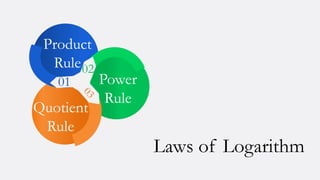
Product
Rule
Power
Rule
Quotient
Rule
01
02
Laws of Logarithm
Laws of Logarithm
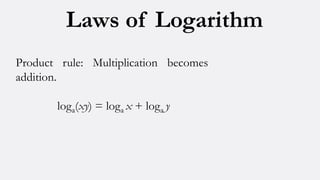
Product rule: Multiplication becomes
addition.
loga(xy) = loga x + loga y
Laws of Logarithm
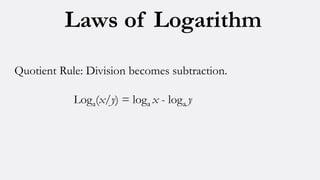
Quotient Rule: Division becomes subtraction.
Loga(x/y) = loga x - loga y
Laws of Logarithm
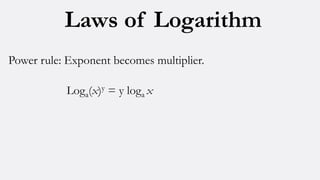
Power rule: Exponent becomes multiplier.
Loga(x)y = y loga x
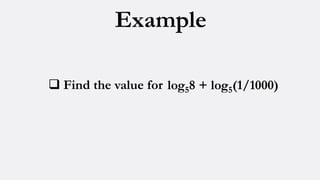
Example
 Find the value for log58 + log5(1/1000)
Solution
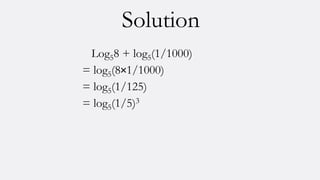
Log58 + log5(1/1000)
= log5(8×1/1000)
= log5(1/125)
= log5(1/5)3
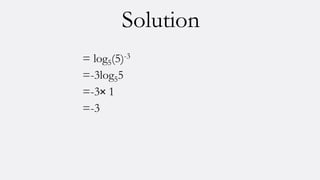
= log5(5)-3
=-3log55
=-3× 1
=-3
Solution
Matrix
Matrix
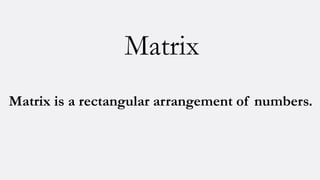
Matrix is a rectangular arrangement of numbers.
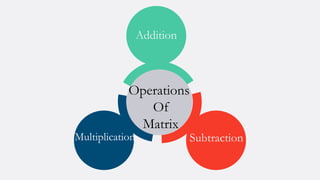
Operations
Of
Matrix
Addition
SubtractionMultiplication
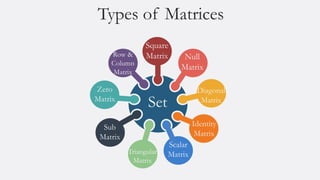
Set
Square
Matrix Null
Matrix
Diagonal
Matrix
Identity
Matrix
Scalar
MatrixTriangular
Matrix
Sub
Matrix
Zero
Matrix
Row &
Column
Matrix
Types of Matrices
Inverse
Matrix
The square matrix A is invertible if there is
a matrix B such that AB = BA =I , where I
is the identity matrix. The matrix B is called
the inverse of A and is denoted by A-1
Inverse Matrix
Method
Two methods to find the inverse
matrix.
 Crammer’s Method
 Gauss Method
What is Set
Sets are used to define the concepts of relations and
functions. A set is a collection of objects.
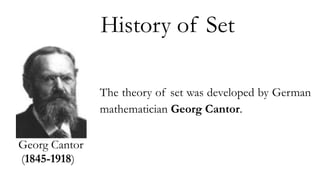
Georg Cantor
(1845-1918)
History of Set
The theory of set was developed by German
mathematician Georg Cantor.
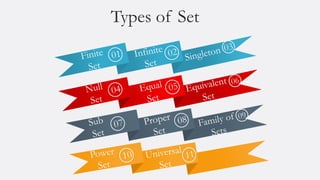
Types of Set
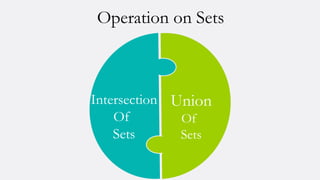
Operation on Sets
Intersection
Of
Sets
Union
Of
Sets
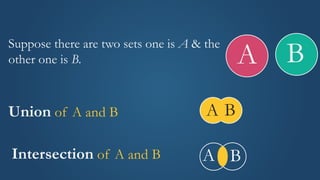
Suppose there are two sets one is A & the
other one is B.
Union of A and B
Intersection of A and B
A B
A B
A B
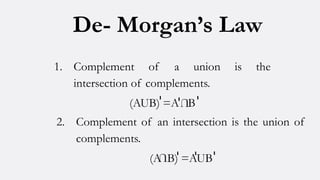
De- Morgan’s Law
1. Complement of a union is the
intersection of complements.
(AUB) =A B
2. Complement of an intersection is the union of
complements.
(A B) =AUB
THE
END

Logarithm, Matrix, Set theory: A Brief Discussion