Digital Electronics
Digital
Electronics
Lesson 2 : Logic Gates and
Boolean Algebra
Sukriti Dhang
19/06/2020
Part 1
Content
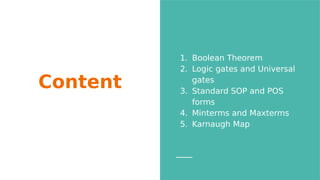
1. Boolean Theorem
2. Logic gates and Universal
gates
3. Standard SOP and POS
forms
4. Minterms and Maxterms
5. Karnaugh Map
Boolean Logic Operations
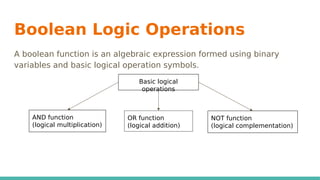
A boolean function is an algebraic expression formed using binary
variables and basic logical operation symbols.
Basic logical
operations
AND function
(logical multiplication)
OR function
(logical addition)
NOT function
(logical complementation)
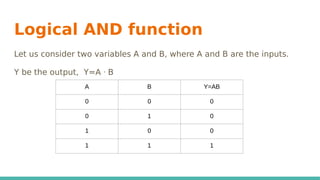
Logical AND function
Let us consider two variables A and B, where A and B are the inputs.
Y be the output, Y=A ᐧ B
A B Y=AB
0 0 0
0 1 0
1 0 0
1 1 1
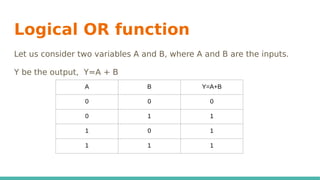
Logical OR function
Let us consider two variables A and B, where A and B are the inputs.
Y be the output, Y=A + B
A B Y=A+B
0 0 0
0 1 1
1 0 1
1 1 1
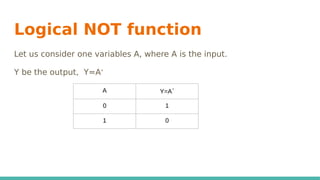
Logical NOT function
Let us consider one variables A, where A is the input.
Y be the output, Y=A’
A Y=A’
0 1
1 0
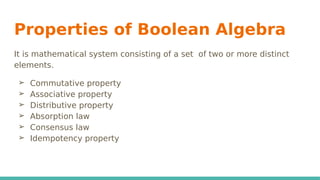
Properties of Boolean Algebra
It is mathematical system consisting of a set of two or more distinct
elements.
➢ Commutative property
➢ Associative property
➢ Distributive property
➢ Absorption law
➢ Consensus law
➢ Idempotency property
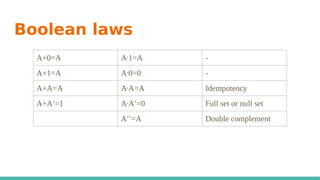
Boolean laws
A+0=A A 1=Aᐧ -
A+1=A A 0=0ᐧ -
A+A=A A A=Aᐧ Idempotency
A+A’=1 A Aᐧ ’=0 Full set or null set
A’’=A Double complement
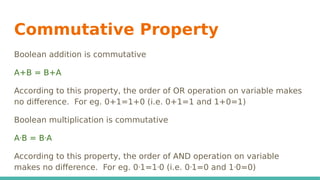
Commutative Property
Boolean addition is commutative
A+B = B+A
According to this property, the order of OR operation on variable makes
no diference. For eg. 0+1=1+0 (i.e. 0+1=1 and 1+0=1)
Boolean multiplication is commutative
AᐧB = BᐧA
According to this property, the order of AND operation on variable
makes no diference. For eg. 0ᐧ1=1ᐧ0 (i.e. 0ᐧ1=0 and 1ᐧ0=0)
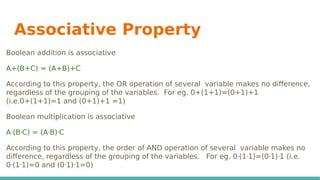
Associative Property
Boolean addition is associative
A+(B+C) = (A+B)+C
According to this property, the OR operation of several variable makes no diference,
regardless of the grouping of the variables. For eg. 0+(1+1)=(0+1)+1
(i.e.0+(1+1)=1 and (0+1)+1 =1)
Boolean multiplication is associative
Aᐧ(BᐧC) = (AᐧB)ᐧC
According to this property, the order of AND operation of several variable makes no
diference, regardless of the grouping of the variables. For eg. 0ᐧ(1ᐧ1)=(0ᐧ1)ᐧ1 (i.e.
0ᐧ(1ᐧ1)=0 and (0ᐧ1)ᐧ1=0)
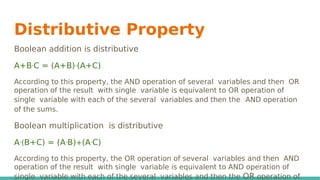
Distributive Property
Boolean addition is distributive
A+BᐧC = (A+B)ᐧ(A+C)
According to this property, the AND operation of several variables and then OR
operation of the result with single variable is equivalent to OR operation of
single variable with each of the several variables and then the AND operation
of the sums.
Boolean multiplication is distributive
Aᐧ(B+C) = (AᐧB)+(AᐧC)
According to this property, the OR operation of several variables and then AND
operation of the result with single variable is equivalent to AND operation of
single variable with each of the several variables and then the OR operation of
Absorption Law
Boolean addition is absorption
A+AᐧB = A
Proof: A+AᐧB=Aᐧ1+AᐧB
=Aᐧ(1+B) [since 1+B=1]
=Aᐧ1=A
Boolean multiplication is absorption
Aᐧ(A+B) = A
Proof: Aᐧ(A+B)=AᐧA+AᐧB
=A+(AᐧB)
=Aᐧ(1+B) [since 1+B=1]
=Aᐧ1=A
A+A’ᐧB=A+B
Proof : A+A’ᐧB=(A+A’)ᐧ(A+B)
=1ᐧ(A+B) [since A+A’=1 ]
=(A+B)
Aᐧ(A’+B)=AᐧB
Proof : Aᐧ(A’+B)=(AᐧA’)+(AᐧB)
=0+(AᐧB) [since AᐧA’=0 ]
=(AᐧB)
Consensus laws
AᐧB+A’ᐧC+BᐧC= AᐧB + A’ᐧC
Proof: AᐧB+A’ᐧC+BᐧC=AᐧB+A’ᐧC+BᐧCᐧ1
=AᐧB+A’ᐧC+BᐧCᐧ(A+A’) [since A+A’=1]
=AᐧB+A’ᐧC+AᐧBᐧC+A’ᐧBᐧC
=AᐧBᐧ(1+C) +A’ᐧCᐧ(1+B) [since 1+C=1, 1+B=1 ]
=AᐧB+A’ᐧC
(A+B)ᐧ(A’+C)ᐧ(B+C)=( A+B) ᐧ (A’+C)
Proof:(A+B)ᐧ(A’+C)ᐧ(B+C) =(A+B)ᐧ(A’+C)ᐧ(B+C+0)
=(A+B)ᐧ(A’+C)ᐧ(B+C+AᐧA’)
=(A+B)ᐧ(A’+C)ᐧ(B+C+A)ᐧ(B+C+A’) [since A+BC=(A+B)(A+C)]
=(A+B)ᐧ(A+B+C)ᐧ(A’+C)ᐧ(A’+B+C)
=(A+B)ᐧ(A’+C)
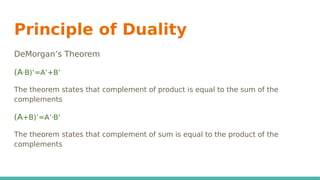
Principle of Duality
DeMorgan’s Theorem
(AᐧB)’=A’+B’
The theorem states that complement of product is equal to the sum of the
complements
(A+B)’=A’ᐧB’
The theorem states that complement of sum is equal to the product of the
complements
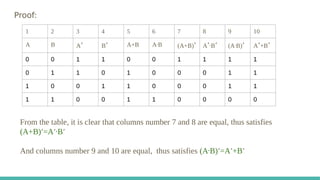
Proof:
1 2 3 4 5 6 7 8 9 10
A B A’ B’ A+B A Bᐧ (A+B)’ A’ Bᐧ ’ (A B)ᐧ ’ A’+B’
0 0 1 1 0 0 1 1 1 1
0 1 1 0 1 0 0 0 1 1
1 0 0 1 1 0 0 0 1 1
1 1 0 0 1 1 0 0 0 0
From the table, it is clear that columns number 7 and 8 are equal, thus satisfies
(A+B)’=A’ Bᐧ ’
And columns number 9 and 10 are equal, thus satisfies (A B)ᐧ ’=A’+B’
Examples
Y=A’B’C’+A’BC’+AB’C’+ABC’
Proof: A’B’C’+A’BC’+AB’C’+ABC’
=A’C’(B+B’)+AC’(B+B’)
=A’C’+AC’ [since B+B’=1]
=(A’+A)C’
=C’
Y=(A’+B)(A+B)
Proof: (A’+B)(A+B)
=B+AA’
=B+0 [since AA’=0]
=B
Examples contd.
Y=A+A’B’+A’B’C+A’B’C’D
Proof: A+A’B’+A’B’C+A’B’C’D
= A+A’B’C+B+A’B’C’D [since A+A’X=A+X, here X=B’C]
= A+B’C+B+A’B’C’D
= A+A’B’C’D+B+B’C [since A+A’X=A+X, here X=B’C’D; B+B’C=B+C]
= A+B’C’D +B+C
= A+C+B+B’C’D [since B+B’X=B+X, here X=C’D]
= A+C+B+C’D
=A+B+C+C’D [since C+C’D=C+D]
= A+B+C+D
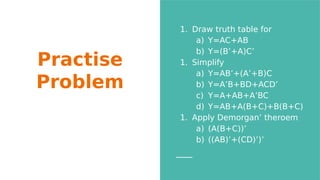
Practise
Problem
1. Draw truth table for
a) Y=AC+AB
b) Y=(B’+A)C’
1. Simplify
a) Y=AB’+(A’+B)C
b) Y=A’B+BD+ACD’
c) Y=A+AB+A’BC
d) Y=AB+A(B+C)+B(B+C)
1. Apply Demorgan’ theroem
a) (A(B+C))’
b) ((AB)’+(CD)’)’
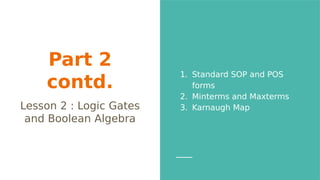
Part 2
contd.
Lesson 2 : Logic Gates
and Boolean Algebra
1. Standard SOP and POS
forms
2. Minterms and Maxterms
3. Karnaugh Map
ThankYou

Digital electronics lesson 2

  • 1.
    Digital Electronics Digital Electronics Lesson 2: Logic Gates and Boolean Algebra Sukriti Dhang 19/06/2020
  • 2.
  • 3.
    Content 1. Boolean Theorem 2.Logic gates and Universal gates 3. Standard SOP and POS forms 4. Minterms and Maxterms 5. Karnaugh Map
  • 4.
    Boolean Logic Operations Aboolean function is an algebraic expression formed using binary variables and basic logical operation symbols. Basic logical operations AND function (logical multiplication) OR function (logical addition) NOT function (logical complementation)
  • 5.
    Logical AND function Letus consider two variables A and B, where A and B are the inputs. Y be the output, Y=A ᐧ B A B Y=AB 0 0 0 0 1 0 1 0 0 1 1 1
  • 6.
    Logical OR function Letus consider two variables A and B, where A and B are the inputs. Y be the output, Y=A + B A B Y=A+B 0 0 0 0 1 1 1 0 1 1 1 1
  • 7.
    Logical NOT function Letus consider one variables A, where A is the input. Y be the output, Y=A’ A Y=A’ 0 1 1 0
  • 8.
    Properties of BooleanAlgebra It is mathematical system consisting of a set of two or more distinct elements. ➢ Commutative property ➢ Associative property ➢ Distributive property ➢ Absorption law ➢ Consensus law ➢ Idempotency property
  • 9.
    Boolean laws A+0=A A1=Aᐧ - A+1=A A 0=0ᐧ - A+A=A A A=Aᐧ Idempotency A+A’=1 A Aᐧ ’=0 Full set or null set A’’=A Double complement
  • 10.
    Commutative Property Boolean additionis commutative A+B = B+A According to this property, the order of OR operation on variable makes no diference. For eg. 0+1=1+0 (i.e. 0+1=1 and 1+0=1) Boolean multiplication is commutative AᐧB = BᐧA According to this property, the order of AND operation on variable makes no diference. For eg. 0ᐧ1=1ᐧ0 (i.e. 0ᐧ1=0 and 1ᐧ0=0)
  • 11.
    Associative Property Boolean additionis associative A+(B+C) = (A+B)+C According to this property, the OR operation of several variable makes no diference, regardless of the grouping of the variables. For eg. 0+(1+1)=(0+1)+1 (i.e.0+(1+1)=1 and (0+1)+1 =1) Boolean multiplication is associative Aᐧ(BᐧC) = (AᐧB)ᐧC According to this property, the order of AND operation of several variable makes no diference, regardless of the grouping of the variables. For eg. 0ᐧ(1ᐧ1)=(0ᐧ1)ᐧ1 (i.e. 0ᐧ(1ᐧ1)=0 and (0ᐧ1)ᐧ1=0)
  • 12.
    Distributive Property Boolean additionis distributive A+BᐧC = (A+B)ᐧ(A+C) According to this property, the AND operation of several variables and then OR operation of the result with single variable is equivalent to OR operation of single variable with each of the several variables and then the AND operation of the sums. Boolean multiplication is distributive Aᐧ(B+C) = (AᐧB)+(AᐧC) According to this property, the OR operation of several variables and then AND operation of the result with single variable is equivalent to AND operation of single variable with each of the several variables and then the OR operation of
  • 13.
    Absorption Law Boolean additionis absorption A+AᐧB = A Proof: A+AᐧB=Aᐧ1+AᐧB =Aᐧ(1+B) [since 1+B=1] =Aᐧ1=A Boolean multiplication is absorption Aᐧ(A+B) = A Proof: Aᐧ(A+B)=AᐧA+AᐧB =A+(AᐧB) =Aᐧ(1+B) [since 1+B=1] =Aᐧ1=A
  • 14.
    A+A’ᐧB=A+B Proof : A+A’ᐧB=(A+A’)ᐧ(A+B) =1ᐧ(A+B)[since A+A’=1 ] =(A+B) Aᐧ(A’+B)=AᐧB Proof : Aᐧ(A’+B)=(AᐧA’)+(AᐧB) =0+(AᐧB) [since AᐧA’=0 ] =(AᐧB)
  • 15.
    Consensus laws AᐧB+A’ᐧC+BᐧC= AᐧB+ A’ᐧC Proof: AᐧB+A’ᐧC+BᐧC=AᐧB+A’ᐧC+BᐧCᐧ1 =AᐧB+A’ᐧC+BᐧCᐧ(A+A’) [since A+A’=1] =AᐧB+A’ᐧC+AᐧBᐧC+A’ᐧBᐧC =AᐧBᐧ(1+C) +A’ᐧCᐧ(1+B) [since 1+C=1, 1+B=1 ] =AᐧB+A’ᐧC (A+B)ᐧ(A’+C)ᐧ(B+C)=( A+B) ᐧ (A’+C) Proof:(A+B)ᐧ(A’+C)ᐧ(B+C) =(A+B)ᐧ(A’+C)ᐧ(B+C+0) =(A+B)ᐧ(A’+C)ᐧ(B+C+AᐧA’) =(A+B)ᐧ(A’+C)ᐧ(B+C+A)ᐧ(B+C+A’) [since A+BC=(A+B)(A+C)] =(A+B)ᐧ(A+B+C)ᐧ(A’+C)ᐧ(A’+B+C) =(A+B)ᐧ(A’+C)
  • 16.
    Principle of Duality DeMorgan’sTheorem (AᐧB)’=A’+B’ The theorem states that complement of product is equal to the sum of the complements (A+B)’=A’ᐧB’ The theorem states that complement of sum is equal to the product of the complements
  • 17.
    Proof: 1 2 34 5 6 7 8 9 10 A B A’ B’ A+B A Bᐧ (A+B)’ A’ Bᐧ ’ (A B)ᐧ ’ A’+B’ 0 0 1 1 0 0 1 1 1 1 0 1 1 0 1 0 0 0 1 1 1 0 0 1 1 0 0 0 1 1 1 1 0 0 1 1 0 0 0 0 From the table, it is clear that columns number 7 and 8 are equal, thus satisfies (A+B)’=A’ Bᐧ ’ And columns number 9 and 10 are equal, thus satisfies (A B)ᐧ ’=A’+B’
  • 18.
  • 19.
    Examples contd. Y=A+A’B’+A’B’C+A’B’C’D Proof: A+A’B’+A’B’C+A’B’C’D =A+A’B’C+B+A’B’C’D [since A+A’X=A+X, here X=B’C] = A+B’C+B+A’B’C’D = A+A’B’C’D+B+B’C [since A+A’X=A+X, here X=B’C’D; B+B’C=B+C] = A+B’C’D +B+C = A+C+B+B’C’D [since B+B’X=B+X, here X=C’D] = A+C+B+C’D =A+B+C+C’D [since C+C’D=C+D] = A+B+C+D
  • 20.
    Practise Problem 1. Draw truthtable for a) Y=AC+AB b) Y=(B’+A)C’ 1. Simplify a) Y=AB’+(A’+B)C b) Y=A’B+BD+ACD’ c) Y=A+AB+A’BC d) Y=AB+A(B+C)+B(B+C) 1. Apply Demorgan’ theroem a) (A(B+C))’ b) ((AB)’+(CD)’)’
  • 21.
    Part 2 contd. Lesson 2: Logic Gates and Boolean Algebra 1. Standard SOP and POS forms 2. Minterms and Maxterms 3. Karnaugh Map
  • 22.