PROGRESSION TO THE
FINAL PRODUCT
Comparing the preliminary task and full product
PRE-PRODUCTION
When producing our prelim, it is noticeable, that we had very little
knowledge of techniques in all sections of production that would enable our film to
look professional.
In our prelim we were unaware of how essential the pre-production
planning was, therefore our prelim was very obviously planned inadequately and this
prevented our production stages from being as successful as they could’ve been.
Therefore, in the pre-production stages of our final opening sequence we
understood how necessary the use of storyboarding and a timetoast would be.
MISE EN SCENE
After receiving feedback regarding our prelim, we recognised the
importance of all the things that can be seen within the frame. These features such as
props, clothing and setting aid the audiences understanding of the film and therefore
reduce the amount of information that has to be provided through dialogue; thus
making the film more realistic. In our prelim, our lack of understanding about the need
for good props prevented our film from being successful.
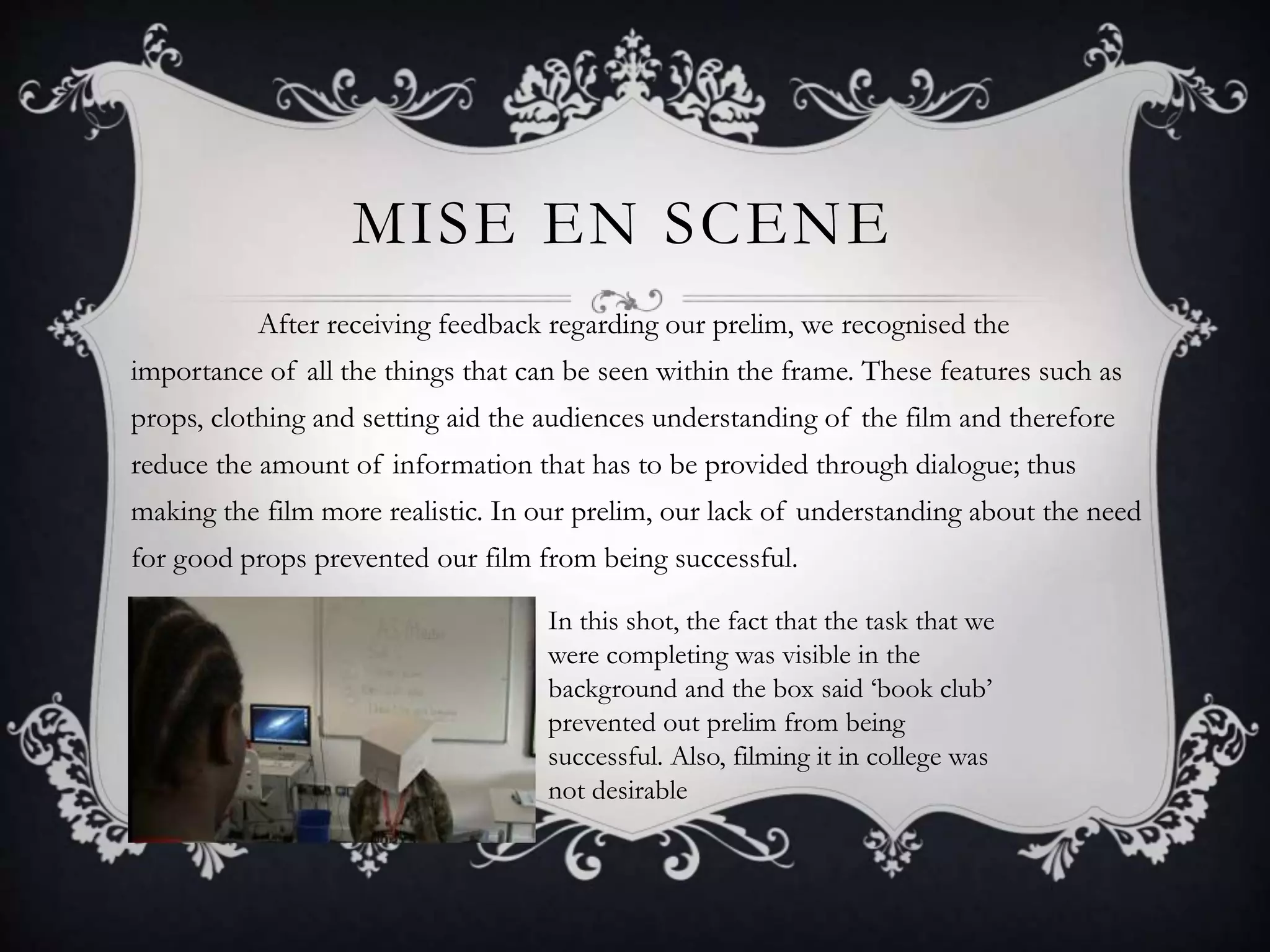
In this shot, the fact that the task that we
were completing was visible in the
background and the box said ‘book club’
prevented out prelim from being
successful. Also, filming it in college was
not desirable
MISE EN SCENE
In our full product, we ensured that all locations were planned and we
created a digital storyboard so that we could assess all mise en scene
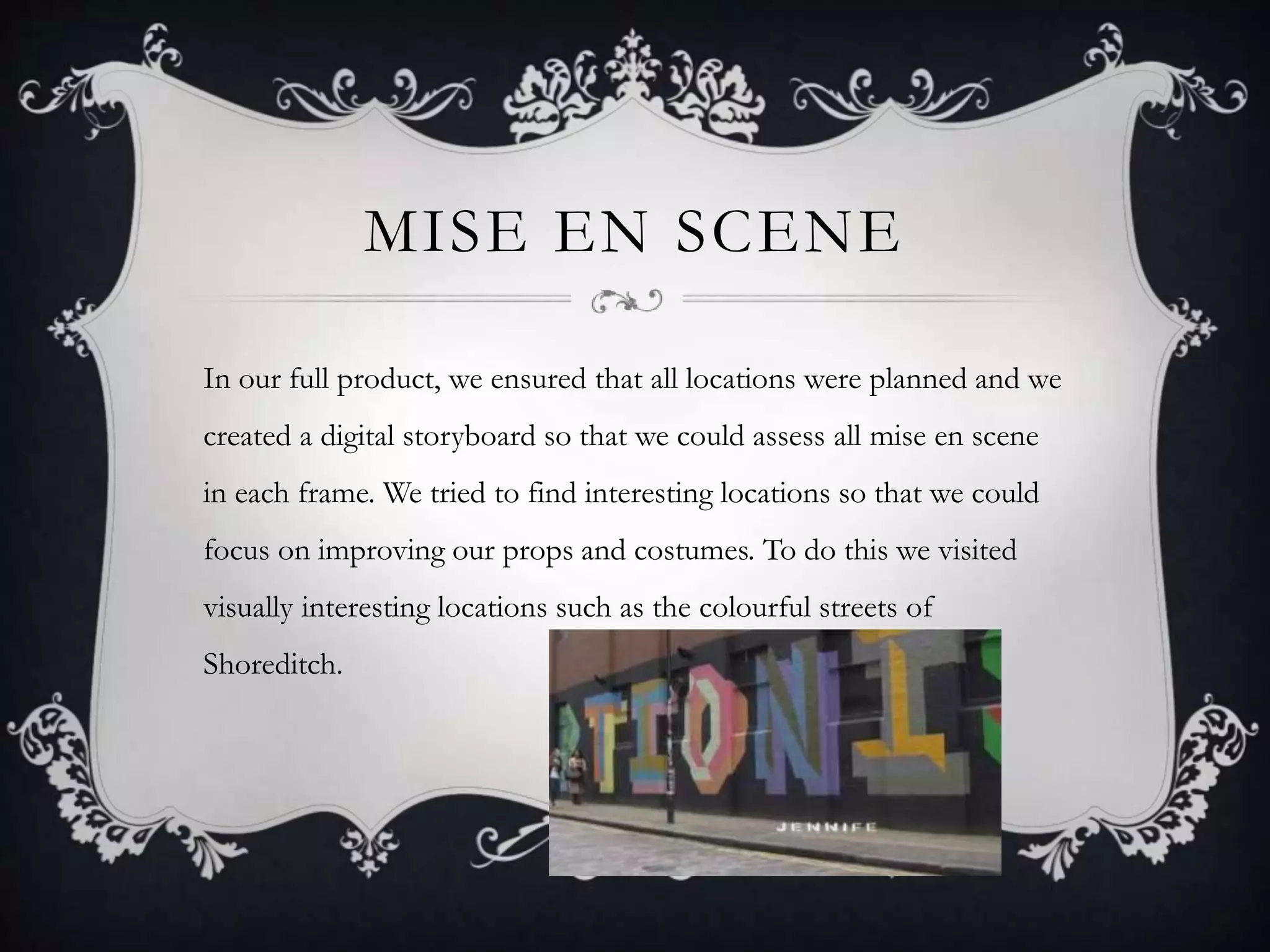
in each frame. We tried to find interesting locations so that we could
focus on improving our props and costumes. To do this we visited
visually interesting locations such as the colourful streets of
Shoreditch.
LIGHTING
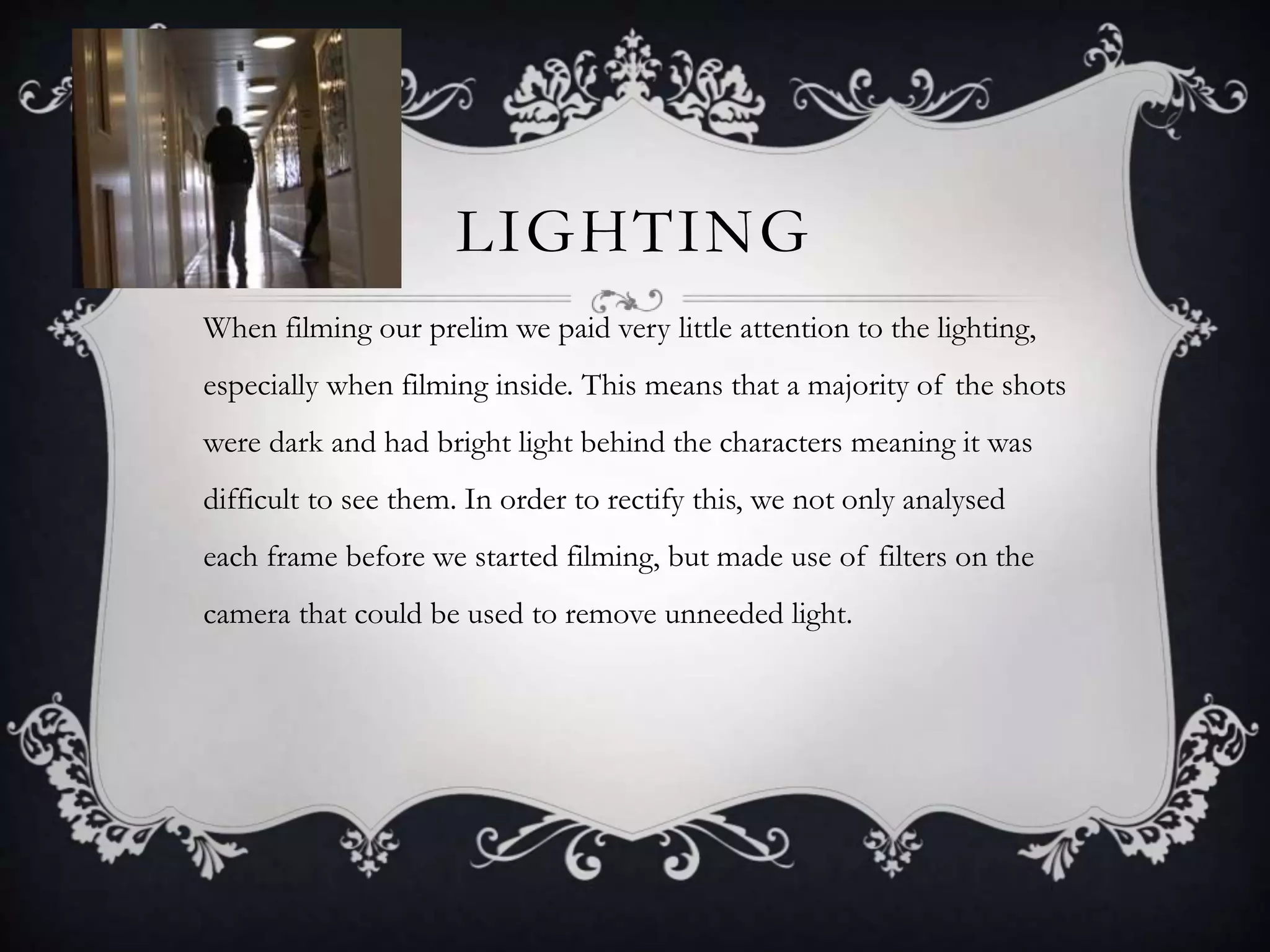
When filming our prelim we paid very little attention to the lighting,
especially when filming inside. This means that a majority of the shots
were dark and had bright light behind the characters meaning it was
difficult to see them. In order to rectify this, we not only analysed
each frame before we started filming, but made use of filters on the
camera that could be used to remove unneeded light.
CAMERA SKILLS
During the production of our prelim, we learnt about the importance of
specific camera kills. Understanding the 180 degree rule was essential as it
is a way to prevent the audience from being confuse about where people
are positioned. Also, the use of smooth panning shots is important as it
makes editing easier as well as making the product look better. During the
production of our prelim we had knowledge of these skills but by the
time we began filming our full product these skills had progressed
drastically, therefore allowing us to create a better quality product.
SOUND
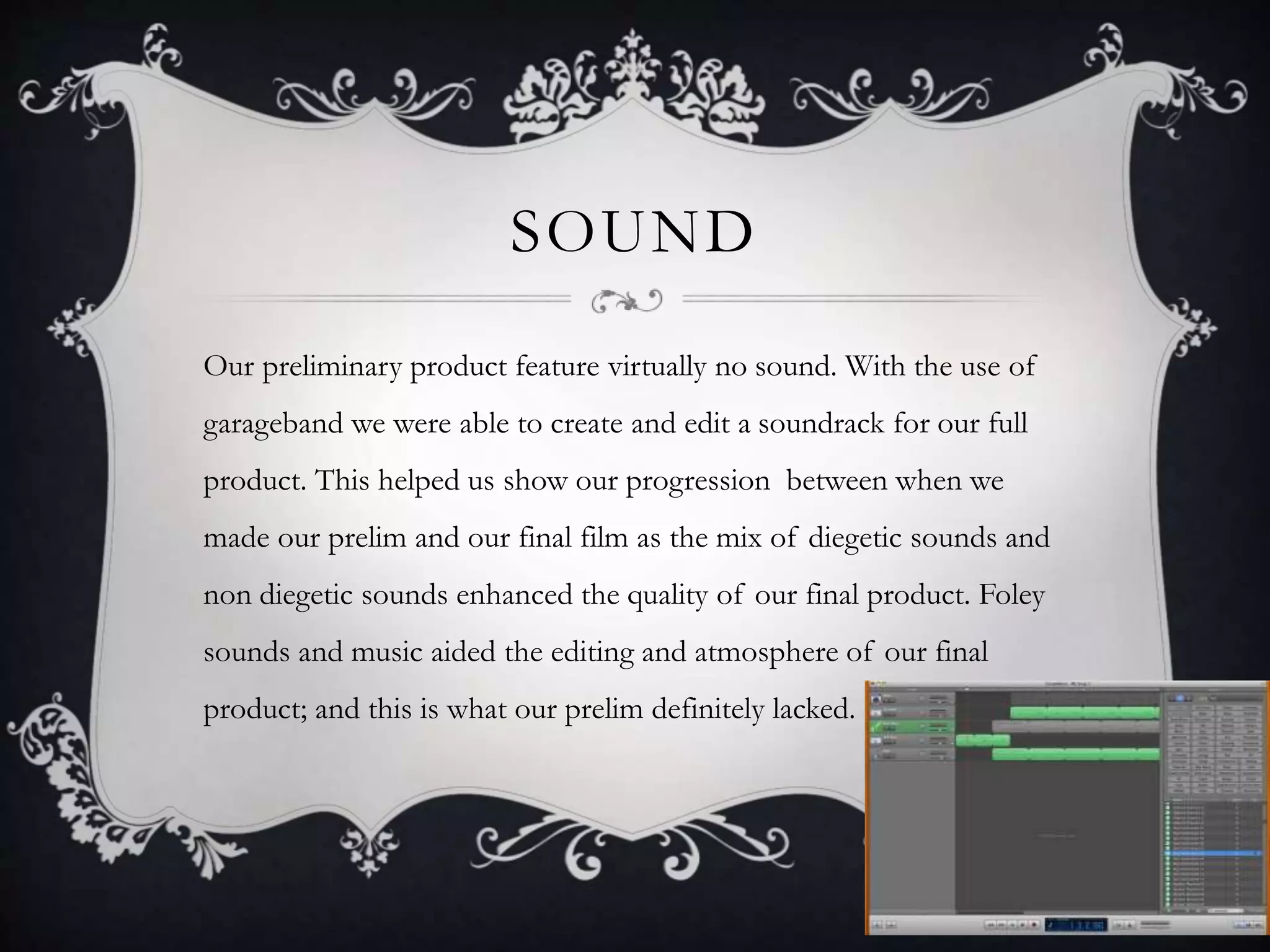
Our preliminary product feature virtually no sound. With the use of
garageband we were able to create and edit a soundrack for our full
product. This helped us show our progression between when we
made our prelim and our final film as the mix of diegetic sounds and
non diegetic sounds enhanced the quality of our final product. Foley
sounds and music aided the editing and atmosphere of our final
product; and this is what our prelim definitely lacked.
TITLES
Our prelim included no titles! Titles are necessary to inform the audience
of the institutions and people involved in the production of the product.
After watching various teen dramas, we noticed that even within the
subgenres, all films had titles. As we felt they were the most important,
the institutions (production and distribution companies) we written in
white and laid over a black screen. We formulated an order for our titles
to go into and laid them over the moving image that we had filmed.
During the production of our full film, we used software that we
hadn’t used in the production of our prelim. This includes motion,
that I used to create the titles, and garageband, which was used to
create the sound.
WHAT ELSE HAVE WE
LEARNT?
I feel as though we have learnt the importance of working as a collective.
The input of each individual in the group allowed us to make a title
sequence that was relatable to a wide audience as it explored multiple
perspectives. Having more than one opinion made decision making easier
and meant we came to more informed decisions regarding the plot and
characters. Producing a blog allowed us to document almost everything
we did, which helped us follow our plan.
HOW HAVE YOU DEVELOPED
ACROSS BOTH PRODUCTIONS?
During the production of our prelim, our camera skills began to progress
as we were able to see what wasn’t working and what didn’t look effective
in relation to what we were trying to put across. Having these skills
already developed after the production of our prelim meant that during
the production we had time to develop other skills such as our editing
work. During the process of creating both media texts we have learnt the
importance of mise en scene and costume in portraying an idea without
actually saying it.

Loe yourz question 7

  • 1.
    PROGRESSION TO THE FINALPRODUCT Comparing the preliminary task and full product
  • 2.
    PRE-PRODUCTION When producing ourprelim, it is noticeable, that we had very little knowledge of techniques in all sections of production that would enable our film to look professional. In our prelim we were unaware of how essential the pre-production planning was, therefore our prelim was very obviously planned inadequately and this prevented our production stages from being as successful as they could’ve been. Therefore, in the pre-production stages of our final opening sequence we understood how necessary the use of storyboarding and a timetoast would be.
  • 3.
    MISE EN SCENE Afterreceiving feedback regarding our prelim, we recognised the importance of all the things that can be seen within the frame. These features such as props, clothing and setting aid the audiences understanding of the film and therefore reduce the amount of information that has to be provided through dialogue; thus making the film more realistic. In our prelim, our lack of understanding about the need for good props prevented our film from being successful. In this shot, the fact that the task that we were completing was visible in the background and the box said ‘book club’ prevented out prelim from being successful. Also, filming it in college was not desirable
  • 4.
    MISE EN SCENE Inour full product, we ensured that all locations were planned and we created a digital storyboard so that we could assess all mise en scene in each frame. We tried to find interesting locations so that we could focus on improving our props and costumes. To do this we visited visually interesting locations such as the colourful streets of Shoreditch.
  • 5.
    LIGHTING When filming ourprelim we paid very little attention to the lighting, especially when filming inside. This means that a majority of the shots were dark and had bright light behind the characters meaning it was difficult to see them. In order to rectify this, we not only analysed each frame before we started filming, but made use of filters on the camera that could be used to remove unneeded light.
  • 6.
    CAMERA SKILLS During theproduction of our prelim, we learnt about the importance of specific camera kills. Understanding the 180 degree rule was essential as it is a way to prevent the audience from being confuse about where people are positioned. Also, the use of smooth panning shots is important as it makes editing easier as well as making the product look better. During the production of our prelim we had knowledge of these skills but by the time we began filming our full product these skills had progressed drastically, therefore allowing us to create a better quality product.
  • 7.
    SOUND Our preliminary productfeature virtually no sound. With the use of garageband we were able to create and edit a soundrack for our full product. This helped us show our progression between when we made our prelim and our final film as the mix of diegetic sounds and non diegetic sounds enhanced the quality of our final product. Foley sounds and music aided the editing and atmosphere of our final product; and this is what our prelim definitely lacked.
  • 8.
    TITLES Our prelim includedno titles! Titles are necessary to inform the audience of the institutions and people involved in the production of the product. After watching various teen dramas, we noticed that even within the subgenres, all films had titles. As we felt they were the most important, the institutions (production and distribution companies) we written in white and laid over a black screen. We formulated an order for our titles to go into and laid them over the moving image that we had filmed.
  • 9.
    During the productionof our full film, we used software that we hadn’t used in the production of our prelim. This includes motion, that I used to create the titles, and garageband, which was used to create the sound.
  • 10.
    WHAT ELSE HAVEWE LEARNT? I feel as though we have learnt the importance of working as a collective. The input of each individual in the group allowed us to make a title sequence that was relatable to a wide audience as it explored multiple perspectives. Having more than one opinion made decision making easier and meant we came to more informed decisions regarding the plot and characters. Producing a blog allowed us to document almost everything we did, which helped us follow our plan.
  • 11.
    HOW HAVE YOUDEVELOPED ACROSS BOTH PRODUCTIONS? During the production of our prelim, our camera skills began to progress as we were able to see what wasn’t working and what didn’t look effective in relation to what we were trying to put across. Having these skills already developed after the production of our prelim meant that during the production we had time to develop other skills such as our editing work. During the process of creating both media texts we have learnt the importance of mise en scene and costume in portraying an idea without actually saying it.