By : Sanjeeb Sainju
?
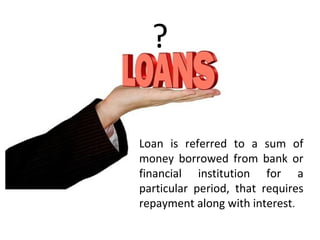
Loan is referred to a sum of
money borrowed from bank or
financial institution for a
particular period, that requires
repayment along with interest.
3
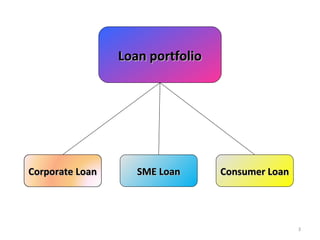
Loan portfolioLoan portfolio
SME LoanSME Loan Consumer LoanConsumer LoanCorporate LoanCorporate Loan
Consumer Loan
4
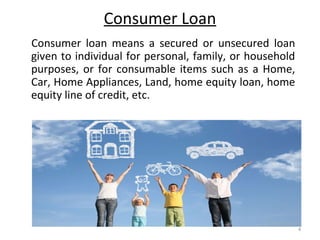
Consumer loan means a secured or unsecured loan
given to individual for personal, family, or household
purposes, or for consumable items such as a Home,
Car, Home Appliances, Land, home equity loan, home
equity line of credit, etc.
Secured / Unsecured
Depending on the amount to be
borrowed and type of product , the
consumer loans can come in the form of
5
Secured / Unsecured
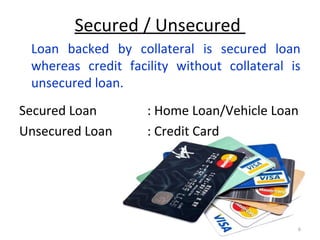
Loan backed by collateral is secured loan
whereas credit facility without collateral is
unsecured loan.
Secured Loan : Home Loan/Vehicle Loan
Unsecured Loan : Credit Card
6
Secured vs Unsecured
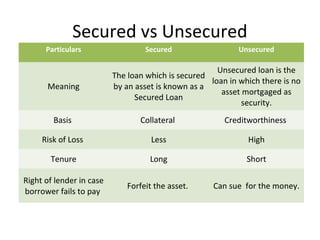
Particulars Secured Unsecured
Meaning
The loan which is secured
by an asset is known as a
Secured Loan
Unsecured loan is the
loan in which there is no
asset mortgaged as
security.
Basis Collateral Creditworthiness
Risk of Loss Less High
Tenure Long Short
Right of lender in case
borrower fails to pay
Forfeit the asset. Can sue for the money.
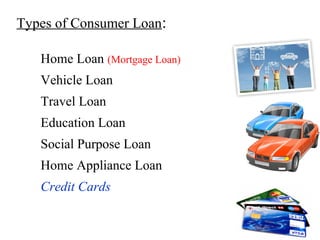
Types of Consumer Loan:
Home Loan (Mortgage Loan)
Vehicle Loan
Travel Loan
Education Loan
Social Purpose Loan
Home Appliance Loan
Credit Cards
Home Loan (Mortgage Loan)
HOME (Mortgage) Loan
A Home (mortgage) loan is a loan product,
secured by the collateral of real estate
property.
The borrower is obliged to pay back with a
predetermined set of payments till
settlement of total loan.
10
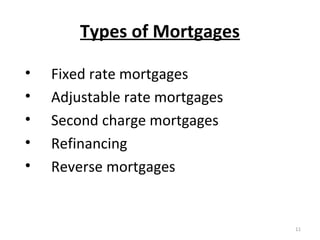
Types of Mortgages
• Fixed rate mortgages
• Adjustable rate mortgages
• Second charge mortgages
• Refinancing
• Reverse mortgages
11
Government-backed mortgage types
( backed by insurance and or government guarantee )
• FHA Loan
(The Federal Housing Administration)
3.5% down payment
• VA Loans
(The U.S. Department of Veterans Affairs (VA)
100% financing
• USDA / RHS Loans
(The United States Department of Agriculture / Rural
Housing Service)
For rural residents
12
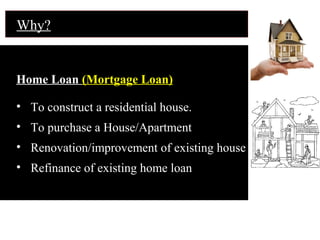
Home Loan (Mortgage Loan)
• To construct a residential house.
• To purchase a House/Apartment
• Renovation/improvement of existing house
• Refinance of existing home loan
Why?
Reverse Mortgage (Life Time Mortgage)
• It is available to senior.
• Must be at least 62 years old in United State
• Older senior can receive more money.
• Must pay off exiting mortgage loan from reverse mortgage
proceeds, if any.
• Loan ends after death of the home owner, sell the property,
move out from the property for 12 consecutive months.
• Reverse mortgage can be paid off with the sales proceeds of
home. If the borrower dies the heirs can refinance into
regular mortgage.
• If sales proceeds exceeds loan amount, remaining amount
will be refunded to borrower or their heirs.
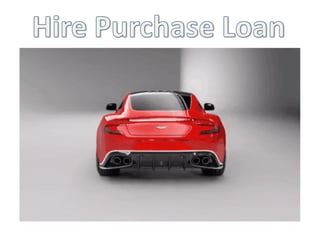
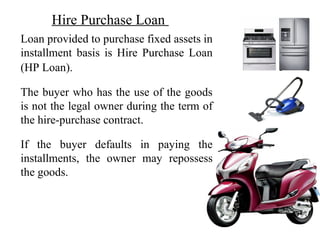
Hire Purchase Loan
•Loan provided to purchase fixed assets in
installment basis is Hire Purchase Loan
(HP Loan).
•The buyer who has the use of the goods
is not the legal owner during the term of
the hire-purchase contract.
•If the buyer defaults in paying the
installments, the owner may repossess
the goods.
For any hire purchase loan the
intended purchase must be
offered as security, specially
vehicle loan
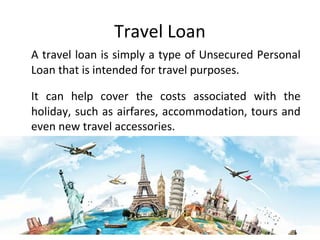
Travel Loan
A travel loan is simply a type of Unsecured Personal
Loan that is intended for travel purposes.
It can help cover the costs associated with the
holiday, such as airfares, accommodation, tours and
even new travel accessories.
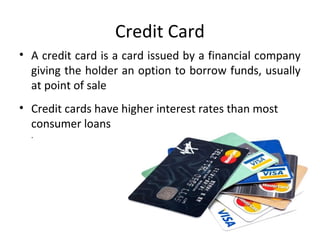
Credit Card
• A credit card is a card issued by a financial company
giving the holder an option to borrow funds, usually
at point of sale
• Credit cards have higher interest rates than most
consumer loans
.
Types of Credit Card
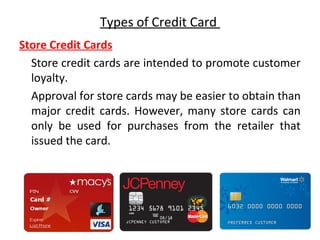
Store Credit Cards
Store credit cards are intended to promote customer
loyalty.
Approval for store cards may be easier to obtain than
major credit cards. However, many store cards can
only be used for purchases from the retailer that
issued the card.
Types of Credit Card
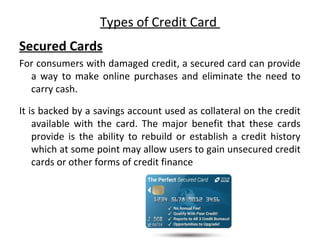
Secured Cards
For consumers with damaged credit, a secured card can provide
a way to make online purchases and eliminate the need to
carry cash.
It is backed by a savings account used as collateral on the credit
available with the card. The major benefit that these cards
provide is the ability to rebuild or establish a credit history
which at some point may allow users to gain unsecured credit
cards or other forms of credit finance
Other types of credit card
• Reward Credit Card
• Travel Reward Card
• Student Card
• Prepaid Card
23
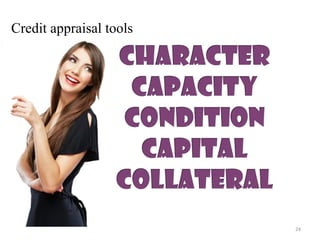
Credit appraisal tools
24
Credit appraisal tools
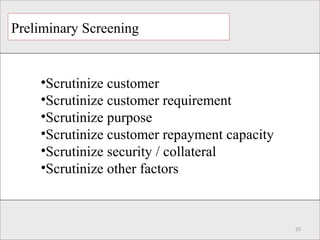
Preliminary Screening
25
•Scrutinize customer
•Scrutinize customer requirement
•Scrutinize purpose
•Scrutinize customer repayment capacity
•Scrutinize security / collateral
•Scrutinize other factors
Credit Scoring
• Credit scoring is statistical analysis used by
credit bureaus to evaluate individual
worthiness to receive credit.
• The agencies select certain statistical
characteristics found in a person’s credit
payment patterns, analyze them and come up
with a credit score.
26
27
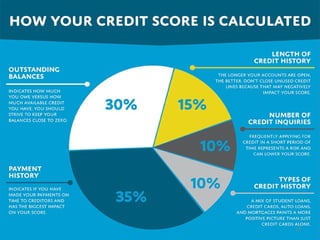
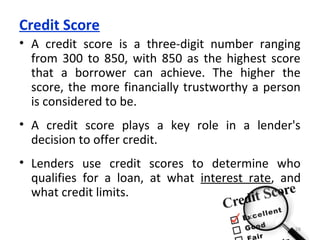
Credit Score
• A credit score is a three-digit number ranging
from 300 to 850, with 850 as the highest score
that a borrower can achieve. The higher the
score, the more financially trustworthy a person
is considered to be.
• A credit score plays a key role in a lender's
decision to offer credit.
• Lenders use credit scores to determine who
qualifies for a loan, at what interest rate, and
what credit limits.
28
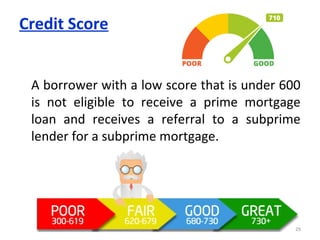
Credit Score
A borrower with a low score that is under 600
is not eligible to receive a prime mortgage
loan and receives a referral to a subprime
lender for a subprime mortgage.
29
Finance Charge
• Total cost of borrowing, including interest
charges, commitment fees, and other
charges paid by the borrower for availing
the loan facility.
- Interest
- Processing fee
- Documentation fee
- Credit Information fee
- Valuation fee
- Late payment fee
- Prepayment fee
30
The Truth in Lending Act (TILA)
• The Truth in Lending Act (TILA) is
a federal law passed in 1968 to
ensure that consumers are
treated fairly by businesses in
the lending marketplace and are
informed about the true cost of
credit.
• The TILA requires lenders to
disclose credit terms in an easily
understood manner so that
consumers can confidently
comparison shop interest rates
and conditions.
31
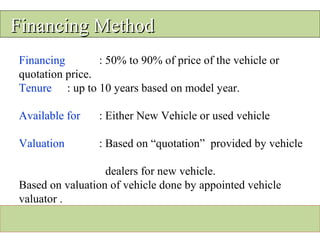
Financing MethodFinancing Method
Financing : 50% to 90% of price of the vehicle or
quotation price.
Tenure : up to 10 years based on model year.
Available for : Either New Vehicle or used vehicle
Valuation : Based on “quotation” provided by vehicle
dealers for new vehicle.
Based on valuation of vehicle done by appointed vehicle
valuator .
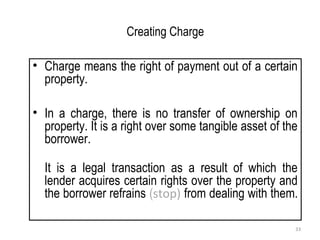
Creating Charge
• Charge means the right of payment out of a certain
property.
• In a charge, there is no transfer of ownership on
property. It is a right over some tangible asset of the
borrower.
It is a legal transaction as a result of which the
lender acquires certain rights over the property and
the borrower refrains (stop) from dealing with them.
33
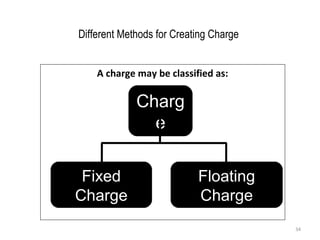
Different Methods for Creating Charge
A charge may be classified as:
34
Charg
e
Fixed
Charge
Floating
Charge
Fixed charge:
A charge is said to be fixed if it is made
specificallyspecifically to cover definite and ascertained
assets of a permanent nature or assets
capable of being ascertained and defined,
e.g., a charge on land and building or heavy
machinery.
It prevents the loan from dealing with the
property charge without a consent of the
charge holder.
35
Floating charge:
It is a charge on property which is
constantly changing, e.g., stock. Thus, it is
a charge on the assets of a company in
“General”“General”.
36
Different Methods for Creating Charge
• There are a number of methods by which
banker can obtain a charge over the
borrower’s property.
• The method used depends on upon.
– The type of property to be charged
– The nature of the advance
– The degree of control over the debtor’s property
required by the banker.
37
Different Methods for Creating Charge
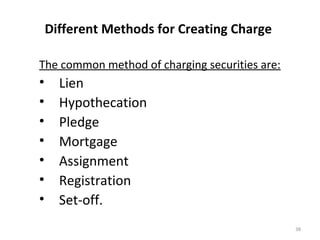
The common method of charging securities are:
• Lien
• Hypothecation
• Pledge
• Mortgage
• Assignment
• Registration
• Set-off.
38
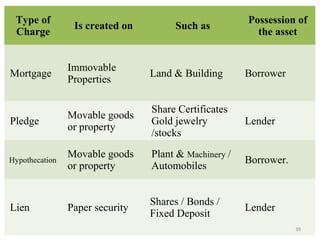
Type of
Charge
Is created on Such as
Possession of
the asset
Mortgage
Immovable
Properties
Land & Building Borrower
Pledge
Movable goods
or property
Share Certificates
Gold jewelry
/stocks
Lender
Hypothecation
Movable goods
or property
Plant & Machinery /
Automobiles
Borrower.
Lien Paper security
Shares / Bonds /
Fixed Deposit
Lender
39
Repayment / Interest servicing
Monthly Basis / EMI
Quarterly Basis / EQI
Repayment based on cash Flow
Ballooning repayment
Bullet repayment
Moratorium / Interest capitalized
Loan Servicing
40
41
THANK YOU
QUESTIONS ?
42

Consumer Financing

  • 1.
  • 2.
    ? Loan is referredto a sum of money borrowed from bank or financial institution for a particular period, that requires repayment along with interest.
  • 3.
    3 Loan portfolioLoan portfolio SMELoanSME Loan Consumer LoanConsumer LoanCorporate LoanCorporate Loan
  • 4.
    Consumer Loan 4 Consumer loanmeans a secured or unsecured loan given to individual for personal, family, or household purposes, or for consumable items such as a Home, Car, Home Appliances, Land, home equity loan, home equity line of credit, etc.
  • 5.
    Secured / Unsecured Dependingon the amount to be borrowed and type of product , the consumer loans can come in the form of 5
  • 6.
    Secured / Unsecured Loanbacked by collateral is secured loan whereas credit facility without collateral is unsecured loan. Secured Loan : Home Loan/Vehicle Loan Unsecured Loan : Credit Card 6
  • 7.
    Secured vs Unsecured ParticularsSecured Unsecured Meaning The loan which is secured by an asset is known as a Secured Loan Unsecured loan is the loan in which there is no asset mortgaged as security. Basis Collateral Creditworthiness Risk of Loss Less High Tenure Long Short Right of lender in case borrower fails to pay Forfeit the asset. Can sue for the money.
  • 8.
    Types of ConsumerLoan: Home Loan (Mortgage Loan) Vehicle Loan Travel Loan Education Loan Social Purpose Loan Home Appliance Loan Credit Cards
  • 9.
  • 10.
    HOME (Mortgage) Loan AHome (mortgage) loan is a loan product, secured by the collateral of real estate property. The borrower is obliged to pay back with a predetermined set of payments till settlement of total loan. 10
  • 11.
    Types of Mortgages •Fixed rate mortgages • Adjustable rate mortgages • Second charge mortgages • Refinancing • Reverse mortgages 11
  • 12.
    Government-backed mortgage types (backed by insurance and or government guarantee ) • FHA Loan (The Federal Housing Administration) 3.5% down payment • VA Loans (The U.S. Department of Veterans Affairs (VA) 100% financing • USDA / RHS Loans (The United States Department of Agriculture / Rural Housing Service) For rural residents 12
  • 13.
    Home Loan (MortgageLoan) • To construct a residential house. • To purchase a House/Apartment • Renovation/improvement of existing house • Refinance of existing home loan Why?
  • 14.
    Reverse Mortgage (LifeTime Mortgage) • It is available to senior. • Must be at least 62 years old in United State • Older senior can receive more money. • Must pay off exiting mortgage loan from reverse mortgage proceeds, if any. • Loan ends after death of the home owner, sell the property, move out from the property for 12 consecutive months. • Reverse mortgage can be paid off with the sales proceeds of home. If the borrower dies the heirs can refinance into regular mortgage. • If sales proceeds exceeds loan amount, remaining amount will be refunded to borrower or their heirs.
  • 16.
    Hire Purchase Loan •Loanprovided to purchase fixed assets in installment basis is Hire Purchase Loan (HP Loan). •The buyer who has the use of the goods is not the legal owner during the term of the hire-purchase contract. •If the buyer defaults in paying the installments, the owner may repossess the goods.
  • 17.
    For any hirepurchase loan the intended purchase must be offered as security, specially vehicle loan
  • 18.
    Travel Loan A travelloan is simply a type of Unsecured Personal Loan that is intended for travel purposes. It can help cover the costs associated with the holiday, such as airfares, accommodation, tours and even new travel accessories.
  • 19.
    Credit Card • Acredit card is a card issued by a financial company giving the holder an option to borrow funds, usually at point of sale • Credit cards have higher interest rates than most consumer loans .
  • 20.
    Types of CreditCard Store Credit Cards Store credit cards are intended to promote customer loyalty. Approval for store cards may be easier to obtain than major credit cards. However, many store cards can only be used for purchases from the retailer that issued the card.
  • 21.
    Types of CreditCard Secured Cards For consumers with damaged credit, a secured card can provide a way to make online purchases and eliminate the need to carry cash. It is backed by a savings account used as collateral on the credit available with the card. The major benefit that these cards provide is the ability to rebuild or establish a credit history which at some point may allow users to gain unsecured credit cards or other forms of credit finance
  • 22.
    Other types ofcredit card • Reward Credit Card • Travel Reward Card • Student Card • Prepaid Card
  • 23.
  • 24.
  • 25.
    Preliminary Screening 25 •Scrutinize customer •Scrutinizecustomer requirement •Scrutinize purpose •Scrutinize customer repayment capacity •Scrutinize security / collateral •Scrutinize other factors
  • 26.
    Credit Scoring • Creditscoring is statistical analysis used by credit bureaus to evaluate individual worthiness to receive credit. • The agencies select certain statistical characteristics found in a person’s credit payment patterns, analyze them and come up with a credit score. 26
  • 27.
  • 28.
    Credit Score • Acredit score is a three-digit number ranging from 300 to 850, with 850 as the highest score that a borrower can achieve. The higher the score, the more financially trustworthy a person is considered to be. • A credit score plays a key role in a lender's decision to offer credit. • Lenders use credit scores to determine who qualifies for a loan, at what interest rate, and what credit limits. 28
  • 29.
    Credit Score A borrowerwith a low score that is under 600 is not eligible to receive a prime mortgage loan and receives a referral to a subprime lender for a subprime mortgage. 29
  • 30.
    Finance Charge • Totalcost of borrowing, including interest charges, commitment fees, and other charges paid by the borrower for availing the loan facility. - Interest - Processing fee - Documentation fee - Credit Information fee - Valuation fee - Late payment fee - Prepayment fee 30
  • 31.
    The Truth inLending Act (TILA) • The Truth in Lending Act (TILA) is a federal law passed in 1968 to ensure that consumers are treated fairly by businesses in the lending marketplace and are informed about the true cost of credit. • The TILA requires lenders to disclose credit terms in an easily understood manner so that consumers can confidently comparison shop interest rates and conditions. 31
  • 32.
    Financing MethodFinancing Method Financing: 50% to 90% of price of the vehicle or quotation price. Tenure : up to 10 years based on model year. Available for : Either New Vehicle or used vehicle Valuation : Based on “quotation” provided by vehicle dealers for new vehicle. Based on valuation of vehicle done by appointed vehicle valuator .
  • 33.
    Creating Charge • Chargemeans the right of payment out of a certain property. • In a charge, there is no transfer of ownership on property. It is a right over some tangible asset of the borrower. It is a legal transaction as a result of which the lender acquires certain rights over the property and the borrower refrains (stop) from dealing with them. 33
  • 34.
    Different Methods forCreating Charge A charge may be classified as: 34 Charg e Fixed Charge Floating Charge
  • 35.
    Fixed charge: A chargeis said to be fixed if it is made specificallyspecifically to cover definite and ascertained assets of a permanent nature or assets capable of being ascertained and defined, e.g., a charge on land and building or heavy machinery. It prevents the loan from dealing with the property charge without a consent of the charge holder. 35
  • 36.
    Floating charge: It isa charge on property which is constantly changing, e.g., stock. Thus, it is a charge on the assets of a company in “General”“General”. 36
  • 37.
    Different Methods forCreating Charge • There are a number of methods by which banker can obtain a charge over the borrower’s property. • The method used depends on upon. – The type of property to be charged – The nature of the advance – The degree of control over the debtor’s property required by the banker. 37
  • 38.
    Different Methods forCreating Charge The common method of charging securities are: • Lien • Hypothecation • Pledge • Mortgage • Assignment • Registration • Set-off. 38
  • 39.
    Type of Charge Is createdon Such as Possession of the asset Mortgage Immovable Properties Land & Building Borrower Pledge Movable goods or property Share Certificates Gold jewelry /stocks Lender Hypothecation Movable goods or property Plant & Machinery / Automobiles Borrower. Lien Paper security Shares / Bonds / Fixed Deposit Lender 39
  • 40.
    Repayment / Interestservicing Monthly Basis / EMI Quarterly Basis / EQI Repayment based on cash Flow Ballooning repayment Bullet repayment Moratorium / Interest capitalized Loan Servicing 40
  • 41.
  • 42.

Editor's Notes

  • #12 Handout – types of mortgage to be sent