Confused With Credit Lingos?
A Guide to Help Understand Credit Terms Better

Let’s face it. Finance and credit lingos can be tough to understand for those who do not have the
necessary background. Do you find yourself feeling ill equipped when talking to a bank representative
or when reading credit card and other financial brochures? With plastic money becoming
commonplace, it may be a good idea to familiarise yourself with the terms in use.


We bring to you a comprehensive list of terms that are used in personal and corporate finance
regularly.
Accrued Interest The interest that is earned but has not yet been received.
Actual Payment Amount The actual sum of the last payment as compared with the
expected payment amount.
Adverse Information Information that could cause rejection or decline of the credit
application according to the lending bank’s policy.
Asset Risk A risk that present obligations cannot be met with the current
assets available.
Available Balance Funds available in customer’s account that have no
restrictions from the bank and is available for immediate withdrawals.
Balance Total amount owned as on the date reported by the credit grantor.
Balance Sheet Statement of assets and liabilities at any particular given time.
Balloon Payment Amount A final amount that may be levied at the end of a loan term. This
sum is larger than the regular periodic payments. Balloon payment
is applicable when a portion of the loan's principal balance is repaid
over the fixed term. The remaining balance is due as a final repayment at
the end of the period.
Balloon Payment Date Date on which the balloon payment is due.
Bank Rate Rate of interest paid by all major banks if they borrow from RBI, the
Central Bank of the country.
Bankruptcy A situation in which an individual/firm is unable to meet his/its
obligations and hence all his/its assets are surrendered to a court for
administration.
of1 6
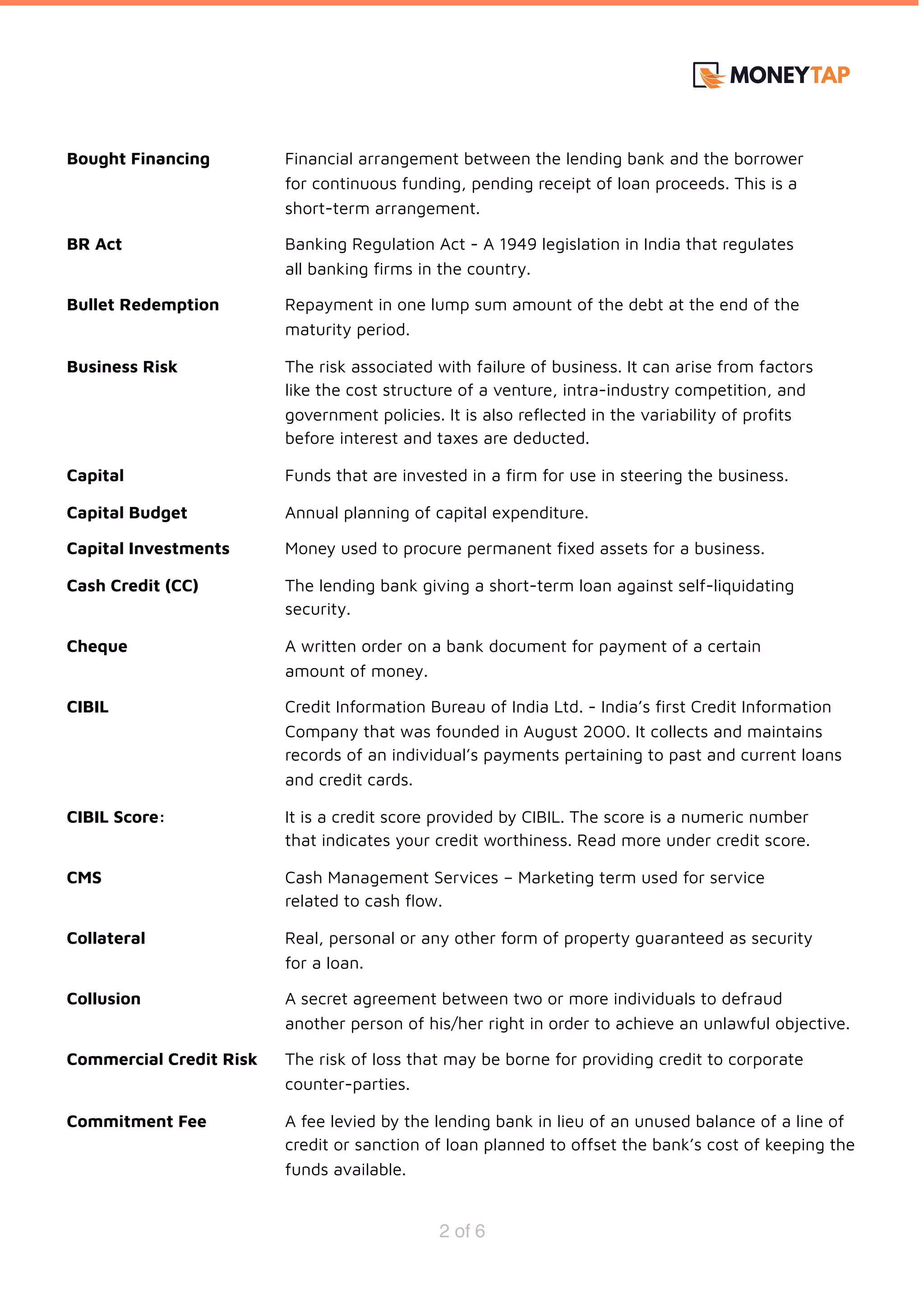
Bought Financing Financial arrangement between the lending bank and the borrower
for continuous funding, pending receipt of loan proceeds. This is a
short-term arrangement.
BR Act Banking Regulation Act - A 1949 legislation in India that regulates
all banking firms in the country.
Bullet Redemption Repayment in one lump sum amount of the debt at the end of the
maturity period.
Business Risk The risk associated with failure of business. It can arise from factors
like the cost structure of a venture, intra-industry competition, and
government policies. It is also reflected in the variability of profits
before interest and taxes are deducted.
Capital Funds that are invested in a firm for use in steering the business.
Capital Budget Annual planning of capital expenditure.
Capital Investments Money used to procure permanent fixed assets for a business.
Cash Credit (CC) The lending bank giving a short-term loan against self-liquidating
security.
Cheque A written order on a bank document for payment of a certain
amount of money.
CIBIL Credit Information Bureau of India Ltd. - India’s first Credit Information
Company that was founded in August 2000. It collects and maintains
records of an individual’s payments pertaining to past and current loans
and credit cards.
CIBIL Score: It is a credit score provided by CIBIL. The score is a numeric number
that indicates your credit worthiness. Read more under credit score.
CMS Cash Management Services – Marketing term used for service
related to cash flow.
Collateral Real, personal or any other form of property guaranteed as security
for a loan.
Collusion A secret agreement between two or more individuals to defraud
another person of his/her right in order to achieve an unlawful objective.
Commercial Credit Risk The risk of loss that may be borne for providing credit to corporate
counter-parties.
Commitment Fee A fee levied by the lending bank in lieu of an unused balance of a line of
credit or sanction of loan planned to offset the bank’s cost of keeping the
funds available.
of2 6
Compound Interest Compound or compounding Interest is interest payable on the
accumulated interest in addition to the initial principal amount. The
principal amount may be a loan or a deposit.
Credit A promise to buy or avail services now and pay later under set terms
for goods and services.
Credit Crunch The period when the supply of credit falls even though there is
sufficient demand for it.
Credit History A record of the borrower’s performance with credit. It shows how a
user has borrowed and repaid his loans in the past.
Credit Limit The maximum amount that a lending bank or a financial institution
approves for a customer to be used as credit. This may be applicable
as maximum amount approved for line of credits or maximum amount
that can be spent through a credit card.
Credit Report A report communicated by a credit reporting agency like CIBIL,
Experian and Equifax of the borrower. Credit report includes borrower’s
name, address, credit history, inquires, repayment schedules, and other
important information related to credit.
Credit Score A number assigned to an individual by a credit reporting agency.
The number is generated with the help of algorithms and statistical
models that analyse an individual’s financial health and credit history,
to establish their credit worthiness. Banks and other lending institutions
depend on the credit score to assess loan applications.
Creditworthiness A creditor’s measure of the borrower’s past and future ability, and
willingness to repay debts.
Customer ID A unique identification number given by the lending bank to the
borrower.
Debt/equity ratio A comparative ratio of a company’s liabilities and it’s stockholder’s
equity. This ratio is used to measure the health of a business. A high
D/E ratio indicates that the company maybe over leveraged and
potentially risky for investment,
Default Failure to make a loan payment on or before the due date.
Default Risk The risk that a borrower might not repay the principal and/or interest
as originally agreed upon.
Depreciation The annual deduction of the cost of an asset.
Down Payment The amount paid directly by the borrower to the dealer while
purchasing the product. This amount is not part of the loan amount.
of3 6
DRT Debt Recovery Tribunal - Established under the Recovery of Debts
Due to Banks and Financial Institutions Act, 1993.
Due Date The fixed date of every month by which (on or before) the borrower
has to pay the monthly instalment to the lending bank to avoid late
payment charges.
Effective Rate of Interest Derived by calculating the percentage rate of return on an annual
basis. It reflects the effect of intra-year compounding. This is an
important measure to note while borrowing because it gives a clearer
picture of the total cost of taking a loan or credit aa compared to the
interest rate.
Electronic Clearing System (ECS) A written instruction by the borrower to his/her bank to debit
his/her account with the amount of monthly instalment on or before
the due date. This amount is then automatically credited to the loan
account ensuring timely repayment
Exchange Rate Also known as foreign exchange rate (FOREX), is the rate at which
one currency is exchanged for another type of currency.
Face Value The specified principal amount of a financial instrument.
Financial Instrument Assets that can be traded are known as financial instruments.
Sometimes, it can also be the capital that can be traded. These assets
include cash, a contractual right to transact cash or any sort of evidence
in regard to one’s ownership of an entity.
Fixed Assets Assets like land, buildings, machinery or property that will not be
converted into cash during the current accounting period.
Fixed Rate A predetermined rate of interest effective on the principal of a loan
or credit arrangement.
Funded debt A short-term liability that has been converted into long-term debt
funding.
Guaranty A third-party undertaking responsibility by one party’s debt. The
guarantor becomes liable in the event of a default by the original debtor.
Insufficient Funds When an account has inadequate balance to cover a cheque that has
been issued against a repayment of the loan amount.
Insurance A legal contract between two parties. In such contracts, one party
agrees to pay a sum to another party for a premium in the event that the
latter suffers a specific loss.
Intangible Assets Assets that cannot be touched like reputation and patent rights.
of4 6
Late Payment Charges The extra charge levied on the borrower in case he/she fails to pay the
monthly instalment on or before the due date.
Lien A lender making a claim on assets which were offered as security for a
loan.
Line of Credit A pre-approved credit facility that enables a bank customer to borrow up
to the specified maximum amount, during the relevant period of time, at
any time.
Loan Document A legal business contract through which a borrower and the lender enter
into an agreement.
Loan Risk The risk of loss on approving and releasing loan and having the borrower
fail to repay, for whatsoever reason.
Loan Summary A document issued by the lending bank confirming the grant of loan
amount and terms and conditions as decided by the two parties – lending
bank and the borrower. Loan summary generally contains details like loan
amount, rate of interest, interest amount, due date, processing fee, down
payment, tenure of loan, monthly instalment amount and number of
monthly instalments.
Long-term Liabilities Money that one owes over a period more than 12 months.
Monthly Instalment A fixed amount that a borrower pays to the lending bank each month
during the loan period in lieu of a loan availed. The instalment amount
consists of the principal loan amount and the interest component.
NBFC Non-Banking Financial Company - A company engaged in the business of
loans and advances, acquisition of shares, stock, insurance business and/
or chit business.
Obligation The responsibility to complete some act or pay when due.
Outstanding Balance Unpaid loan amount outstanding on a particular date along with all
payments payable by the borrower to the lending bank.
Overdraft A deficit in a bank account caused due to drawing more money than the
account actually holds.
PLR Prime Lending Rate - The rate of interest banks charge on loans given to
their most creditworthy customers.
Prepayment Payment of the principal amount of a loan done ahead of the scheduled
date.
Principal The amount of debt that must be repaid by the borrower.
Processing Fee Non-refundable fee charged by the lending bank to the borrower for
processing the loan application.
of5 6
PSB Public Sector Bank - Banks whose majority of stake is held by a
government.
PSE Public Sector Enterprise - A state-owned enterprise in India.
PSU Public Sector Undertaking - A state-owned enterprise in India.
Rate of Interest The rate used for calculating amount of interest charged upon the loan
amount during the loan period.
RBI Reserve Bank of India - India's central banking institution.
Redemption Paying off all the money that has been borrowed under an agreement.
Risk Assessment A process that is used to identify and consequently evaluate risks and
their potential effect.
SEBI Securities and Exchange Board of India - The regulator for the securities
market in India.
Service Charge A fee charged for using a service.
Statement Record of all transactions in a bank account for a period of time.
Statements are generally given once a month by the bank to its
customers.
Tangible Assets Any physical assets like plant, machinery, factories, and offices.
Transaction Financial movement in a bank account. It could be a deposit, withdrawal,
debit card payment, service charge or interest payment.
Variable Rate Rate of interest that may fluctuate over the period of the loan
agreement.
X X X
of6 6

MoneyTap Credit Glossary

  • 1.
    Confused With CreditLingos? A Guide to Help Understand Credit Terms Better
 Let’s face it. Finance and credit lingos can be tough to understand for those who do not have the necessary background. Do you find yourself feeling ill equipped when talking to a bank representative or when reading credit card and other financial brochures? With plastic money becoming commonplace, it may be a good idea to familiarise yourself with the terms in use. 
 We bring to you a comprehensive list of terms that are used in personal and corporate finance regularly. Accrued Interest The interest that is earned but has not yet been received. Actual Payment Amount The actual sum of the last payment as compared with the expected payment amount. Adverse Information Information that could cause rejection or decline of the credit application according to the lending bank’s policy. Asset Risk A risk that present obligations cannot be met with the current assets available. Available Balance Funds available in customer’s account that have no restrictions from the bank and is available for immediate withdrawals. Balance Total amount owned as on the date reported by the credit grantor. Balance Sheet Statement of assets and liabilities at any particular given time. Balloon Payment Amount A final amount that may be levied at the end of a loan term. This sum is larger than the regular periodic payments. Balloon payment is applicable when a portion of the loan's principal balance is repaid over the fixed term. The remaining balance is due as a final repayment at the end of the period. Balloon Payment Date Date on which the balloon payment is due. Bank Rate Rate of interest paid by all major banks if they borrow from RBI, the Central Bank of the country. Bankruptcy A situation in which an individual/firm is unable to meet his/its obligations and hence all his/its assets are surrendered to a court for administration. of1 6
  • 2.
    Bought Financing Financialarrangement between the lending bank and the borrower for continuous funding, pending receipt of loan proceeds. This is a short-term arrangement. BR Act Banking Regulation Act - A 1949 legislation in India that regulates all banking firms in the country. Bullet Redemption Repayment in one lump sum amount of the debt at the end of the maturity period. Business Risk The risk associated with failure of business. It can arise from factors like the cost structure of a venture, intra-industry competition, and government policies. It is also reflected in the variability of profits before interest and taxes are deducted. Capital Funds that are invested in a firm for use in steering the business. Capital Budget Annual planning of capital expenditure. Capital Investments Money used to procure permanent fixed assets for a business. Cash Credit (CC) The lending bank giving a short-term loan against self-liquidating security. Cheque A written order on a bank document for payment of a certain amount of money. CIBIL Credit Information Bureau of India Ltd. - India’s first Credit Information Company that was founded in August 2000. It collects and maintains records of an individual’s payments pertaining to past and current loans and credit cards. CIBIL Score: It is a credit score provided by CIBIL. The score is a numeric number that indicates your credit worthiness. Read more under credit score. CMS Cash Management Services – Marketing term used for service related to cash flow. Collateral Real, personal or any other form of property guaranteed as security for a loan. Collusion A secret agreement between two or more individuals to defraud another person of his/her right in order to achieve an unlawful objective. Commercial Credit Risk The risk of loss that may be borne for providing credit to corporate counter-parties. Commitment Fee A fee levied by the lending bank in lieu of an unused balance of a line of credit or sanction of loan planned to offset the bank’s cost of keeping the funds available. of2 6
  • 3.
    Compound Interest Compoundor compounding Interest is interest payable on the accumulated interest in addition to the initial principal amount. The principal amount may be a loan or a deposit. Credit A promise to buy or avail services now and pay later under set terms for goods and services. Credit Crunch The period when the supply of credit falls even though there is sufficient demand for it. Credit History A record of the borrower’s performance with credit. It shows how a user has borrowed and repaid his loans in the past. Credit Limit The maximum amount that a lending bank or a financial institution approves for a customer to be used as credit. This may be applicable as maximum amount approved for line of credits or maximum amount that can be spent through a credit card. Credit Report A report communicated by a credit reporting agency like CIBIL, Experian and Equifax of the borrower. Credit report includes borrower’s name, address, credit history, inquires, repayment schedules, and other important information related to credit. Credit Score A number assigned to an individual by a credit reporting agency. The number is generated with the help of algorithms and statistical models that analyse an individual’s financial health and credit history, to establish their credit worthiness. Banks and other lending institutions depend on the credit score to assess loan applications. Creditworthiness A creditor’s measure of the borrower’s past and future ability, and willingness to repay debts. Customer ID A unique identification number given by the lending bank to the borrower. Debt/equity ratio A comparative ratio of a company’s liabilities and it’s stockholder’s equity. This ratio is used to measure the health of a business. A high D/E ratio indicates that the company maybe over leveraged and potentially risky for investment, Default Failure to make a loan payment on or before the due date. Default Risk The risk that a borrower might not repay the principal and/or interest as originally agreed upon. Depreciation The annual deduction of the cost of an asset. Down Payment The amount paid directly by the borrower to the dealer while purchasing the product. This amount is not part of the loan amount. of3 6
  • 4.
    DRT Debt RecoveryTribunal - Established under the Recovery of Debts Due to Banks and Financial Institutions Act, 1993. Due Date The fixed date of every month by which (on or before) the borrower has to pay the monthly instalment to the lending bank to avoid late payment charges. Effective Rate of Interest Derived by calculating the percentage rate of return on an annual basis. It reflects the effect of intra-year compounding. This is an important measure to note while borrowing because it gives a clearer picture of the total cost of taking a loan or credit aa compared to the interest rate. Electronic Clearing System (ECS) A written instruction by the borrower to his/her bank to debit his/her account with the amount of monthly instalment on or before the due date. This amount is then automatically credited to the loan account ensuring timely repayment Exchange Rate Also known as foreign exchange rate (FOREX), is the rate at which one currency is exchanged for another type of currency. Face Value The specified principal amount of a financial instrument. Financial Instrument Assets that can be traded are known as financial instruments. Sometimes, it can also be the capital that can be traded. These assets include cash, a contractual right to transact cash or any sort of evidence in regard to one’s ownership of an entity. Fixed Assets Assets like land, buildings, machinery or property that will not be converted into cash during the current accounting period. Fixed Rate A predetermined rate of interest effective on the principal of a loan or credit arrangement. Funded debt A short-term liability that has been converted into long-term debt funding. Guaranty A third-party undertaking responsibility by one party’s debt. The guarantor becomes liable in the event of a default by the original debtor. Insufficient Funds When an account has inadequate balance to cover a cheque that has been issued against a repayment of the loan amount. Insurance A legal contract between two parties. In such contracts, one party agrees to pay a sum to another party for a premium in the event that the latter suffers a specific loss. Intangible Assets Assets that cannot be touched like reputation and patent rights. of4 6
  • 5.
    Late Payment ChargesThe extra charge levied on the borrower in case he/she fails to pay the monthly instalment on or before the due date. Lien A lender making a claim on assets which were offered as security for a loan. Line of Credit A pre-approved credit facility that enables a bank customer to borrow up to the specified maximum amount, during the relevant period of time, at any time. Loan Document A legal business contract through which a borrower and the lender enter into an agreement. Loan Risk The risk of loss on approving and releasing loan and having the borrower fail to repay, for whatsoever reason. Loan Summary A document issued by the lending bank confirming the grant of loan amount and terms and conditions as decided by the two parties – lending bank and the borrower. Loan summary generally contains details like loan amount, rate of interest, interest amount, due date, processing fee, down payment, tenure of loan, monthly instalment amount and number of monthly instalments. Long-term Liabilities Money that one owes over a period more than 12 months. Monthly Instalment A fixed amount that a borrower pays to the lending bank each month during the loan period in lieu of a loan availed. The instalment amount consists of the principal loan amount and the interest component. NBFC Non-Banking Financial Company - A company engaged in the business of loans and advances, acquisition of shares, stock, insurance business and/ or chit business. Obligation The responsibility to complete some act or pay when due. Outstanding Balance Unpaid loan amount outstanding on a particular date along with all payments payable by the borrower to the lending bank. Overdraft A deficit in a bank account caused due to drawing more money than the account actually holds. PLR Prime Lending Rate - The rate of interest banks charge on loans given to their most creditworthy customers. Prepayment Payment of the principal amount of a loan done ahead of the scheduled date. Principal The amount of debt that must be repaid by the borrower. Processing Fee Non-refundable fee charged by the lending bank to the borrower for processing the loan application. of5 6
  • 6.
    PSB Public SectorBank - Banks whose majority of stake is held by a government. PSE Public Sector Enterprise - A state-owned enterprise in India. PSU Public Sector Undertaking - A state-owned enterprise in India. Rate of Interest The rate used for calculating amount of interest charged upon the loan amount during the loan period. RBI Reserve Bank of India - India's central banking institution. Redemption Paying off all the money that has been borrowed under an agreement. Risk Assessment A process that is used to identify and consequently evaluate risks and their potential effect. SEBI Securities and Exchange Board of India - The regulator for the securities market in India. Service Charge A fee charged for using a service. Statement Record of all transactions in a bank account for a period of time. Statements are generally given once a month by the bank to its customers. Tangible Assets Any physical assets like plant, machinery, factories, and offices. Transaction Financial movement in a bank account. It could be a deposit, withdrawal, debit card payment, service charge or interest payment. Variable Rate Rate of interest that may fluctuate over the period of the loan agreement. X X X of6 6