Load Balancing
Algorithms
Aditya Kamat
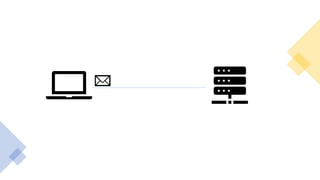
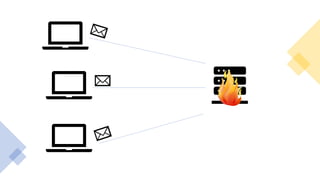
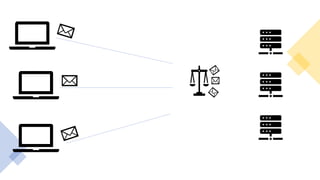
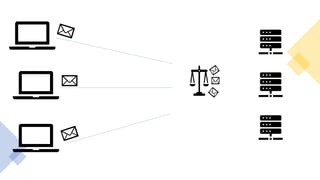
Load Balancing?
Load Balancing
Algorithms => {}
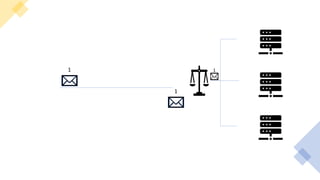
1. Random
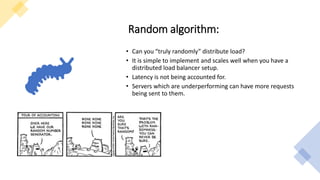
Random algorithm:
• Can you “truly randomly” distribute load?
• It is simple to implement and scales well when you have a
distributed load balancer setup.
• Latency is not being accounted for.
• Servers which are underperforming can have more requests
being sent to them.
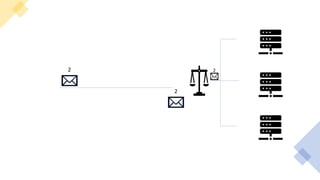
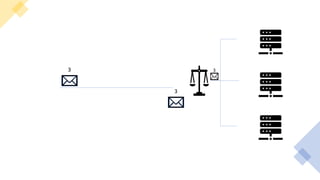
2. Round Robin
1 1
1
2 2
2
3 3
3
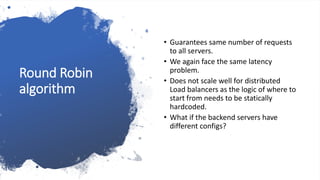
Round Robin
algorithm
• Guarantees same number of requests
to all servers.
• We again face the same latency
problem.
• Does not scale well for distributed
Load balancers as the logic of where to
start from needs to be statically
hardcoded.
• What if the backend servers have
different configs?
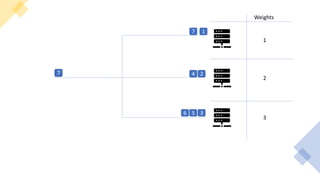
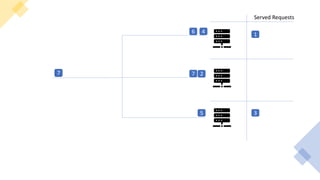
3. Weighted Round Robin
Weights
1
2
3
1
1
2 23
3
456
7
4
56
7
Weighted
Round Robin
algorithm
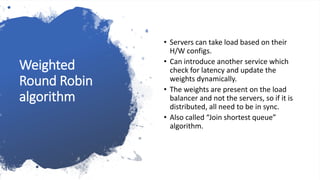
• Servers can take load based on their
H/W configs.
• Can introduce another service which
check for latency and update the
weights dynamically.
• The weights are present on the load
balancer and not the servers, so if it is
distributed, all need to be in sync.
• Also called “Join shortest queue”
algorithm.
4. Least connections
Served Requests
1
1
2 23
3
456 7
4
5
6
7
1
3
Least
Connections
algorithm
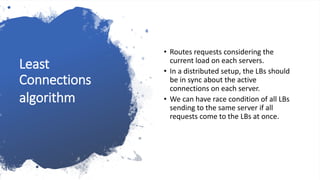
• Routes requests considering the
current load on each servers.
• In a distributed setup, the LBs should
be in sync about the active
connections on each server.
• We can have race condition of all LBs
sending to the same server if all
requests come to the LBs at once.
5. Least connections with
randomness
Each LB, when receives a request
chooses a set of random servers.
Then, the least connection algorithm
is applied to those servers and the
backend server is chosen for the
request.
Least
connections
with
randomness
• We are trying to solve the problem of race
condition in Least connections algorithm by using
this approach.
• This works only in a distributed LB setup.
• Adds one more layer of complexity to choose
random set of servers.
• The number of random servers that need to be
chosen needs to be hardcoded in each LB. This
number cannot be too close to the actual number
of servers ? And cannot be too less as well?
• All the techniques that we have looked at so
far assume that the application is stateless
and any of the servers can serve requests.
• Maintaining persistent connections is a
much more difficult task and shall be
discussed in the future videos.
• Join idle queue algorithm – Link
• Source IP hash algorithm, based on consistent hashing –
Link1, Link2
• This is used for maintaining persistent connections.
• Global Server Load Balancing – Link
Further reading:
References
• Comparison between basic LB algorithms: Link
• Tyler McMullen - Load Balancing is Impossible: Link
• “Balls into Bins” — A Simple and Tight Analysis - Link
• The Power of Two Choices in Randomized Load Balancing - Link

Load Balancing Algorithms - Which one to choose?

  • 1.
  • 2.
  • 6.
  • 7.
  • 9.
    Random algorithm: • Canyou “truly randomly” distribute load? • It is simple to implement and scales well when you have a distributed load balancer setup. • Latency is not being accounted for. • Servers which are underperforming can have more requests being sent to them.
  • 10.
  • 11.
  • 12.
  • 13.
  • 14.
    Round Robin algorithm • Guaranteessame number of requests to all servers. • We again face the same latency problem. • Does not scale well for distributed Load balancers as the logic of where to start from needs to be statically hardcoded. • What if the backend servers have different configs?
  • 15.
  • 16.
  • 17.
    Weighted Round Robin algorithm • Serverscan take load based on their H/W configs. • Can introduce another service which check for latency and update the weights dynamically. • The weights are present on the load balancer and not the servers, so if it is distributed, all need to be in sync. • Also called “Join shortest queue” algorithm.
  • 18.
  • 19.
  • 20.
    Least Connections algorithm • Routes requestsconsidering the current load on each servers. • In a distributed setup, the LBs should be in sync about the active connections on each server. • We can have race condition of all LBs sending to the same server if all requests come to the LBs at once.
  • 21.
    5. Least connectionswith randomness
  • 22.
    Each LB, whenreceives a request chooses a set of random servers. Then, the least connection algorithm is applied to those servers and the backend server is chosen for the request.
  • 23.
    Least connections with randomness • We aretrying to solve the problem of race condition in Least connections algorithm by using this approach. • This works only in a distributed LB setup. • Adds one more layer of complexity to choose random set of servers. • The number of random servers that need to be chosen needs to be hardcoded in each LB. This number cannot be too close to the actual number of servers ? And cannot be too less as well?
  • 24.
    • All thetechniques that we have looked at so far assume that the application is stateless and any of the servers can serve requests. • Maintaining persistent connections is a much more difficult task and shall be discussed in the future videos.
  • 25.
    • Join idlequeue algorithm – Link • Source IP hash algorithm, based on consistent hashing – Link1, Link2 • This is used for maintaining persistent connections. • Global Server Load Balancing – Link Further reading:
  • 26.
    References • Comparison betweenbasic LB algorithms: Link • Tyler McMullen - Load Balancing is Impossible: Link • “Balls into Bins” — A Simple and Tight Analysis - Link • The Power of Two Choices in Randomized Load Balancing - Link