Physics 101 Learning Object #10:
Wave Interference & Beats Worksheet
1. Considering we have two waves with the same frequency and add them together we get an
constructive interference, which of the following are TRUE:
a) We get an constructive interference when the waves and perfectly in phase and when we
add the amplitudes of the two waves we get a wave that has a smaller amplitude.
b) We get an constructive interference when the waves are perfectly out of phase and when we
add the amplitudes of the two waves we get a wave that has a smaller amplitude.
c) We get an constructive interference when the waves are perfectly in phase and when we
add the amplitudes of the two waves we get a wave that has a larger amplitude.
d) We get an constructive interference when the waves are perfectly out of phase and when we
add the amplitudes of the two waves we get a wave that has a larger amplitude.
2. What happens when two waves have the same amplitude, same frequency, travelling in the
same direction but have perfectly opposite phases? Explain.
3. 3. A beat is defined as:

a) waves that have same frequency, same amplitude and travelling in the same direction
b) intervals of multiple constructive interferences and only constructive interferences separated
by an interval of space
c) A single wave with varying levels of amplitude
d) two waves with different frequencies with increasing and decreasing amplitudes as a
function of time
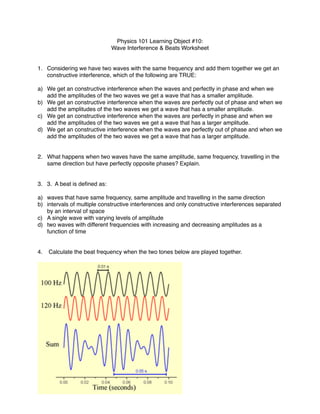
4. Calculate the beat frequency when the two tones below are played together.
Physics 101 Learning Object #10:
Wave Interference & Beats Worksheet Solutions
1. C - We get an constructive interference when the waves are perfectly in phase and when
we add the amplitudes of the two waves we get a wave that has a larger amplitude.
2. When two waves have the same amplitude, same frequency, travelling in the same direction
but have perfectly opposite phases there is an destructive interference. The two waves are
perfectly out of phase. When on one wave is at it’s maximum amplitude the other is at its
minimum. When added together their sums could be even zero.
3. D - Two waves with different frequencies with increasing and decreasing amplitudes as a
function of time.
4. The beat frequency is just the difference of the two frequencies. So the answer would be
120Hz - 100Hz = 20 Hz. We don’t use the formula for angular frequency difference (subtract
the two and divide by 2) because the effect of this is to modulate the amplitude. The
amplitude for both will be larger positively and negatively so we only need to find the
difference between the two frequencies in this case

Wave Interference & Beats Worksheet

  • 1.
    Physics 101 LearningObject #10: Wave Interference & Beats Worksheet 1. Considering we have two waves with the same frequency and add them together we get an constructive interference, which of the following are TRUE: a) We get an constructive interference when the waves and perfectly in phase and when we add the amplitudes of the two waves we get a wave that has a smaller amplitude. b) We get an constructive interference when the waves are perfectly out of phase and when we add the amplitudes of the two waves we get a wave that has a smaller amplitude. c) We get an constructive interference when the waves are perfectly in phase and when we add the amplitudes of the two waves we get a wave that has a larger amplitude. d) We get an constructive interference when the waves are perfectly out of phase and when we add the amplitudes of the two waves we get a wave that has a larger amplitude. 2. What happens when two waves have the same amplitude, same frequency, travelling in the same direction but have perfectly opposite phases? Explain. 3. 3. A beat is defined as:
 a) waves that have same frequency, same amplitude and travelling in the same direction b) intervals of multiple constructive interferences and only constructive interferences separated by an interval of space c) A single wave with varying levels of amplitude d) two waves with different frequencies with increasing and decreasing amplitudes as a function of time 4. Calculate the beat frequency when the two tones below are played together.
  • 2.
    Physics 101 LearningObject #10: Wave Interference & Beats Worksheet Solutions 1. C - We get an constructive interference when the waves are perfectly in phase and when we add the amplitudes of the two waves we get a wave that has a larger amplitude. 2. When two waves have the same amplitude, same frequency, travelling in the same direction but have perfectly opposite phases there is an destructive interference. The two waves are perfectly out of phase. When on one wave is at it’s maximum amplitude the other is at its minimum. When added together their sums could be even zero. 3. D - Two waves with different frequencies with increasing and decreasing amplitudes as a function of time. 4. The beat frequency is just the difference of the two frequencies. So the answer would be 120Hz - 100Hz = 20 Hz. We don’t use the formula for angular frequency difference (subtract the two and divide by 2) because the effect of this is to modulate the amplitude. The amplitude for both will be larger positively and negatively so we only need to find the difference between the two frequencies in this case