the 
intuitive appeal of 
learning styles
Classroom perceptions
and strategies in
addressing different
learning patterns
Luis Manuel Pinto
MSc in Educational Sciences

Master Thesis Proposal
Promotor Prof Dr. Katrien Struyven
the growing 
challenge of
diversity
•  Common agreement about
existence of individual
learning difference (e.g. pacing
and timing)
•  Push for strategies to address
learner variance in the
classroom
•  Differentiated instruction on
the basis of readiness, interest
and learning profile
the Beast…
•  “solutions” for improving attainment,
motivation, attitudes and attendance of
students paired with a culture of
increased benchmarking
•  Explanation as to why traditional
methods of schooling, based on teacher-
to-student transmission are failing
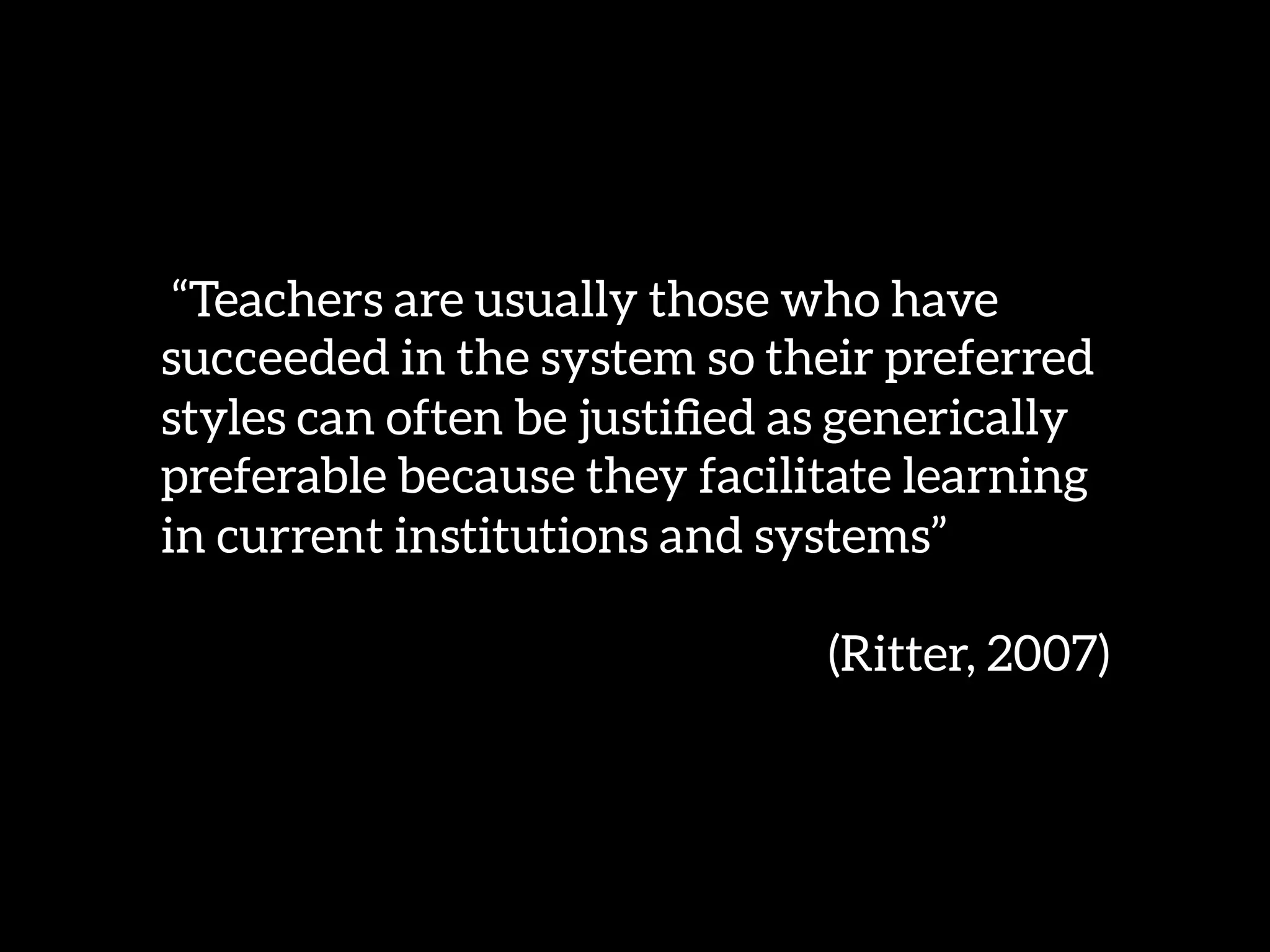
“Teachers are usually those who have
succeeded in the system so their preferred
styles can often be justified as generically
preferable because they facilitate learning
in current institutions and systems” 

(Ritter, 2007)
…and the
Beauty
•  helping professionals to notice and focus on
how students learn (or fail to learn 
•  a re-categorization of students previously
considered uneducable, now teacher fail to
teach adequately
•  a “lexicon” for talking about learning and
improving meta-cognition of students.
•  Instrument bound
•  “Balkanisation” of style research
•  Discrepancies of theory and practice
(including commercial)
•  Confusion of terminology
•  Criticism of “style” based mainly on
achievement and testing
Style research:
Divide & Conquer?
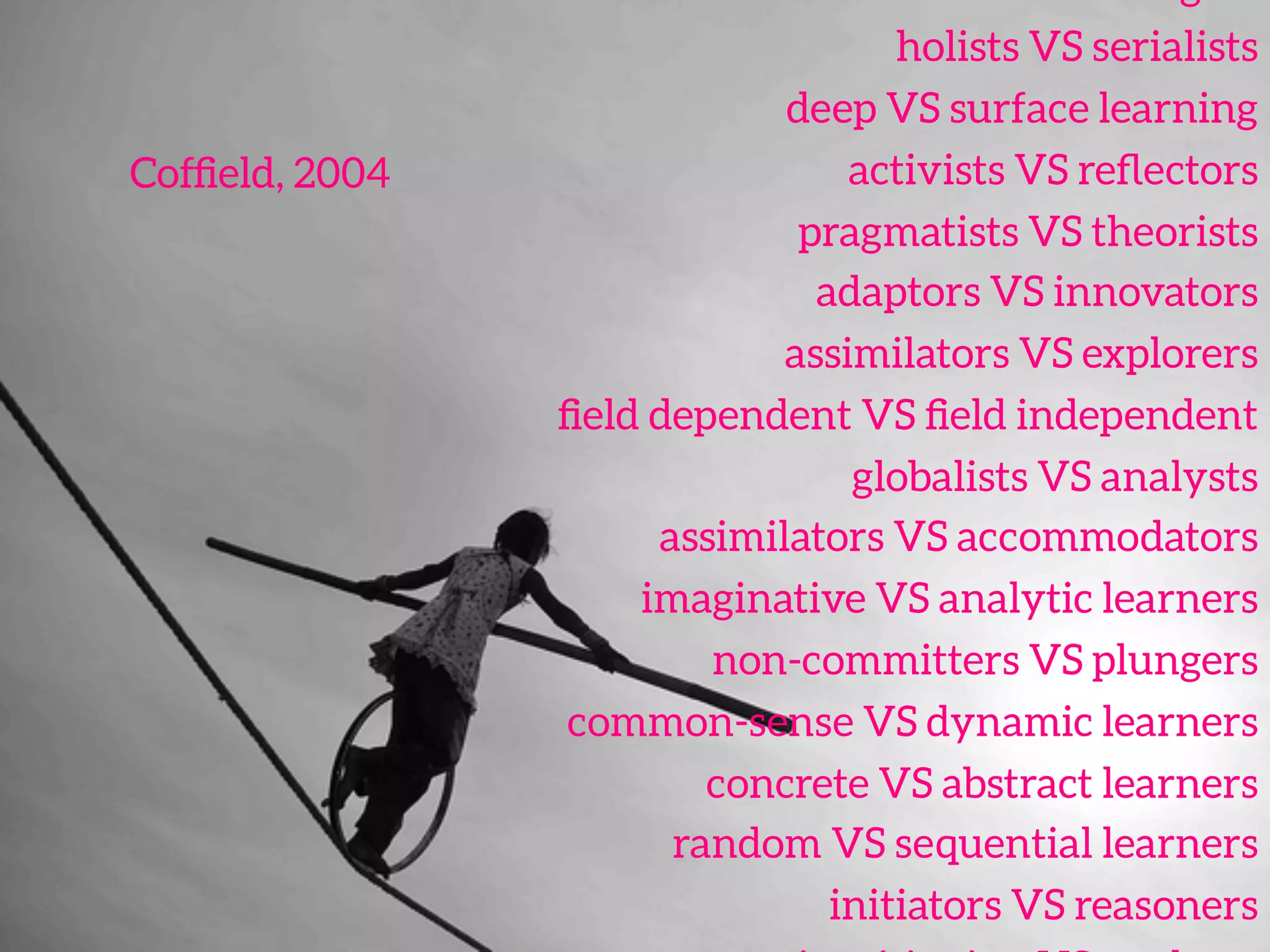
holists VS serialists 
deep VS surface learning 
activists VS reflectors 
pragmatists VS theorists 
adaptors VS innovators
assimilators VS explorers 
field dependent VS field independent 
globalists VS analysts 
assimilators VS accommodators 
imaginative VS analytic learners 
non-committers VS plungers 
common-sense VS dynamic learners 
concrete VS abstract learners 
random VS sequential learners 
initiators VS reasoners 
Coffield, 2004	
  
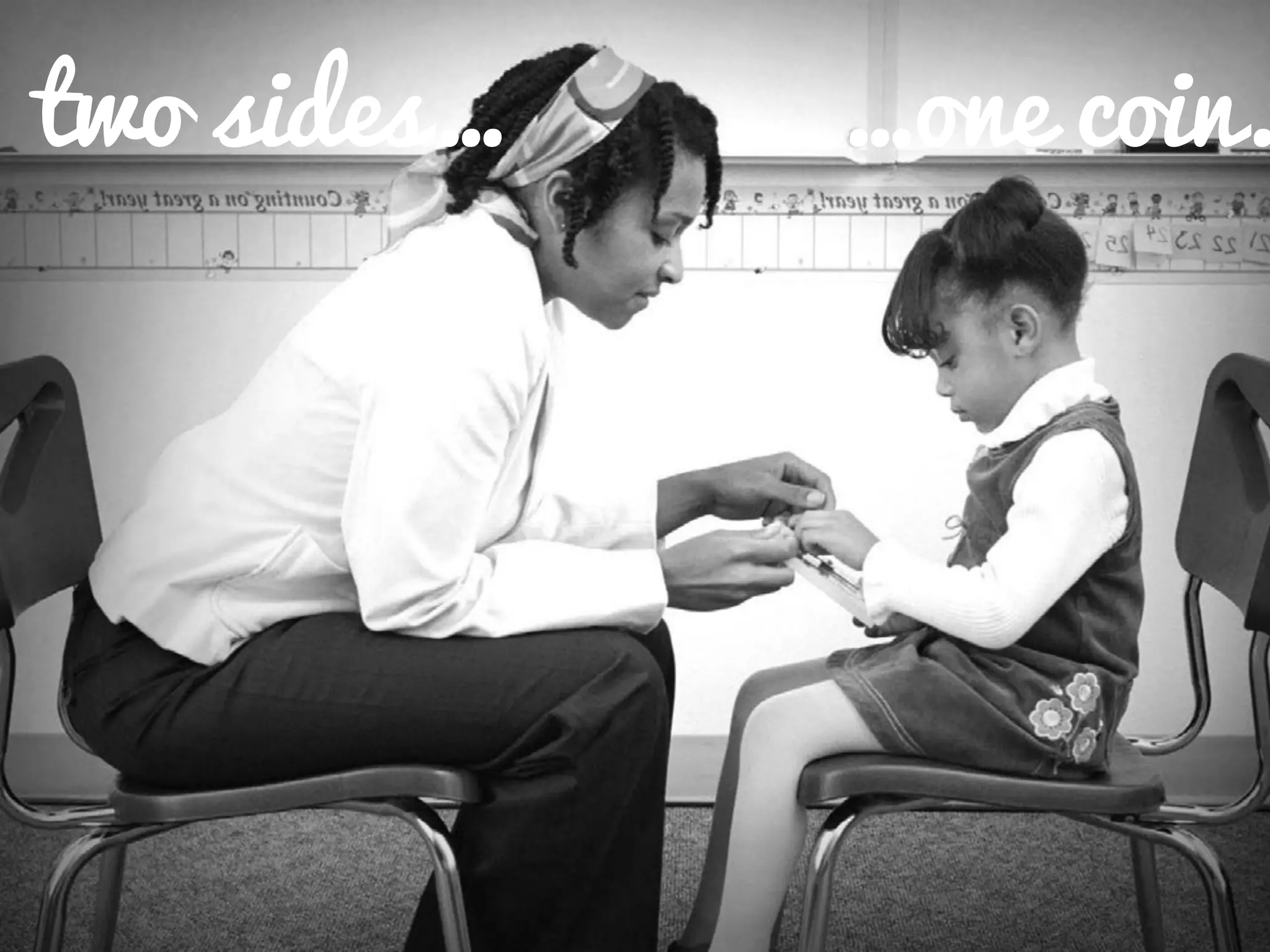
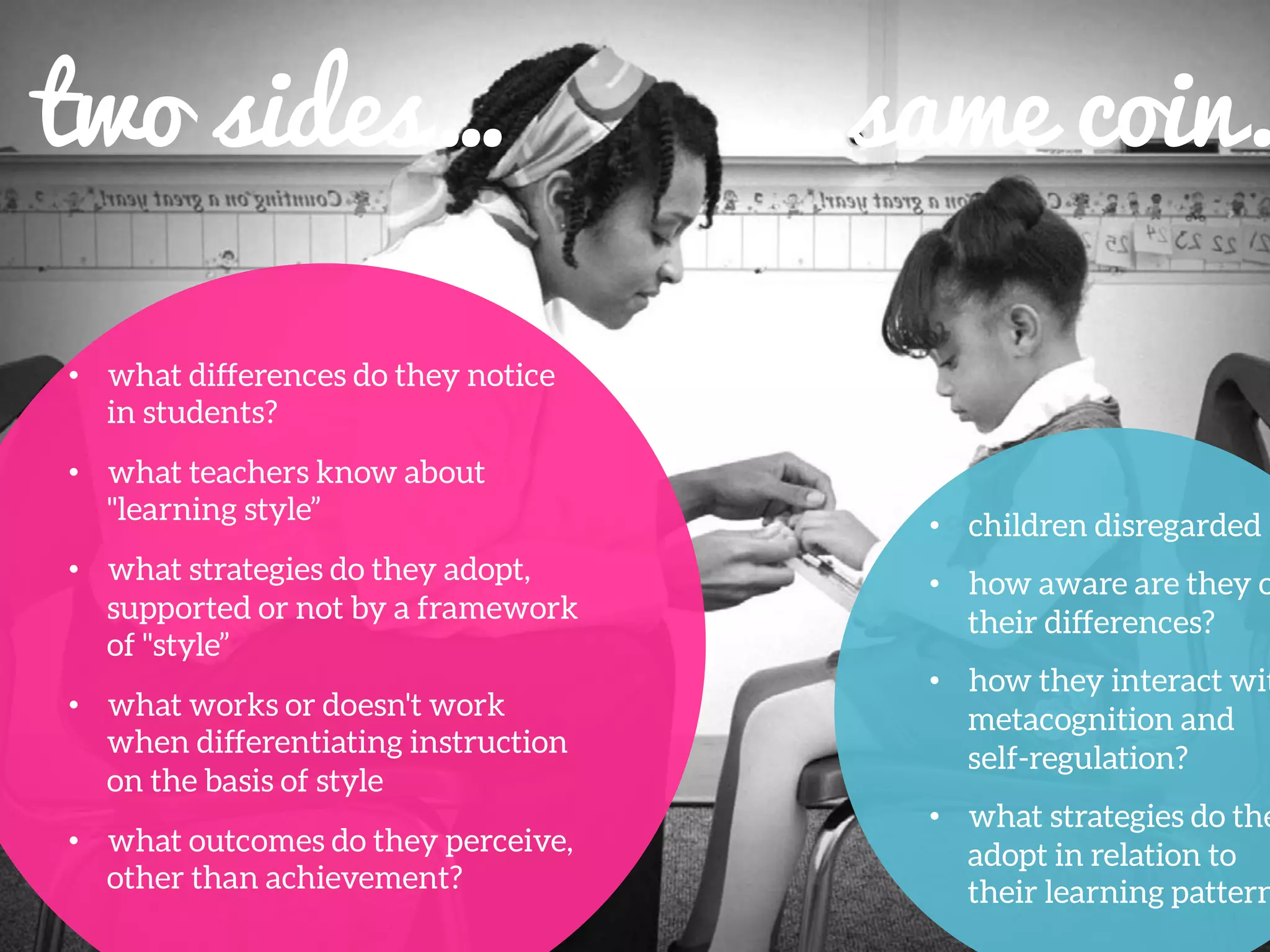
two sides…	
   …one coin.
•  what differences do they notice
in students?
•  what teachers know about
"learning style”
•  what strategies do they adopt,
supported or not by a framework
of "style”
•  what works or doesn't work
when differentiating instruction
on the basis of style
•  what outcomes do they perceive,
other than achievement?
	
  
two sides…	
   …same coin.
•  children disregarded
•  how aware are they o
their differences?
•  how they interact wit
metacognition and
self-regulation?
•  what strategies do the
adopt in relation to
their learning pattern
We need…

A reinterpretation in terms of conceptions of learning style
to encompass the interrelations among cognitive, affective
and regulative learning activities, mental models of learning
and learning orientations. 

A more holistic understanding and "a stronger experiential
underpinning to the notion of learning styles” to render it
“more attractive to practitioners and to students themselves" 

Richardson, 2011
Purpose
Describe the perceptions of
teachers and students in primary
school classrooms of student's
individual learning differences
and patterns, and how according
to their subjective experience,
they affect their learning process
and outcomes.
General Question
How do teachers and students
in primary school classrooms
address student’s individual
learning patterns (learning
styles)?
Learning style construct comprehends
innumerous dimensions that are not
necessarily observable in students'
nonverbal behavior but have to be
inferred from their self-reports in either
interviews or questionnaire surveys.
•  What outcomes do teachers and students
experience from instruction that
addresses individual learning patterns?
•  What strategies do teachers and students
use to address learning styles and how
do they support learning outcomes?
•  What are the differences in perception
of teachers and students between
classroom experiences which adopt a
specific approach to addressing learning
styles and those who do not?
Specific Questions
Methods
The units of study in this research
proposal are primary school
classrooms in Belgium using French
or English as instruction language.
The proposal is to conduct case
studies of classrooms in different
grades of primary schools,
accompanied by semi-structured
interviews (to teachers and students)
and classroom observations.
Timeline
Preparation:
•  Screening and recruitment of primary school teachers willing to participate in
research (September-January 2014)
•  Sending instructions to participant teachers (January 2014)
•  Sending invitation and consent forms to legal guardians of students taught by
participating teachers (January-March 2015)
•  Information session for guardians of participating children (March 2015)
Data Collection:
•  Classroom observations; ice-breaking activities with participant classrooms
(March-April 2014)
•  Pilot interviews with teachers and students (March-April 2015)
•  Interviews to teachers and students (April-May 2015)
•  Data analysis and interpretation of data (May-June 2015)
Presentation:
•  Presentation of Results (June 2015)
Results and significance

Unique, detailed, personal accounts of teacher and student
perceptions, strategies and outcomes connected with addressing
learning styles in the classroom.

•  Perceptions of individual learning differences / learning
patterns and how they relate to current models of learning style
•  Personal and professional strategies of addressing learning style
•  Identify some of the reasons why teachers may adopt or not a
particular model or approach to learning style
•  Explore children's metacognitive abilities in describing own
learning patterns and how these may influence their self-
regulation
•  Holistic perspective on learning style and explore possible
connections, from the subjective perspective of the teacher and
the student
Limitations

•  Recruitment of children requires for
parental support
•  Recruitment of teacher criteria is wide
•  Interview is somewhat an “intervention”
•  Metacognition in earlier years is less
developed
•  Rapport between interviewer and subject
will strongly influence the outcome
•  Low interrater reliability
“Everybody is a genius. But if you judge a
fish by its ability to climb a tree, it will live
its whole life believing that it is stupid.”


― Albert Einstein

Intuitive Appeal of Learning Styles

  • 1.
    the intuitive appealof learning styles Classroom perceptions and strategies in addressing different learning patterns Luis Manuel Pinto MSc in Educational Sciences Master Thesis Proposal Promotor Prof Dr. Katrien Struyven
  • 3.
    the growing challengeof diversity •  Common agreement about existence of individual learning difference (e.g. pacing and timing) •  Push for strategies to address learner variance in the classroom •  Differentiated instruction on the basis of readiness, interest and learning profile
  • 4.
    the Beast… •  “solutions”for improving attainment, motivation, attitudes and attendance of students paired with a culture of increased benchmarking •  Explanation as to why traditional methods of schooling, based on teacher- to-student transmission are failing
  • 5.
    “Teachers are usuallythose who have succeeded in the system so their preferred styles can often be justified as generically preferable because they facilitate learning in current institutions and systems” (Ritter, 2007)
  • 6.
    …and the Beauty •  helpingprofessionals to notice and focus on how students learn (or fail to learn •  a re-categorization of students previously considered uneducable, now teacher fail to teach adequately •  a “lexicon” for talking about learning and improving meta-cognition of students.
  • 7.
    •  Instrument bound • “Balkanisation” of style research •  Discrepancies of theory and practice (including commercial) •  Confusion of terminology •  Criticism of “style” based mainly on achievement and testing Style research: Divide & Conquer?
  • 8.
    holists VS serialists deep VS surface learning activists VS reflectors pragmatists VS theorists adaptors VS innovators assimilators VS explorers field dependent VS field independent globalists VS analysts assimilators VS accommodators imaginative VS analytic learners non-committers VS plungers common-sense VS dynamic learners concrete VS abstract learners random VS sequential learners initiators VS reasoners Coffield, 2004  
  • 9.
    two sides…  …one coin.
  • 10.
    •  what differencesdo they notice in students? •  what teachers know about "learning style” •  what strategies do they adopt, supported or not by a framework of "style” •  what works or doesn't work when differentiating instruction on the basis of style •  what outcomes do they perceive, other than achievement?   two sides…   …same coin. •  children disregarded •  how aware are they o their differences? •  how they interact wit metacognition and self-regulation? •  what strategies do the adopt in relation to their learning pattern
  • 11.
    We need… A reinterpretationin terms of conceptions of learning style to encompass the interrelations among cognitive, affective and regulative learning activities, mental models of learning and learning orientations. A more holistic understanding and "a stronger experiential underpinning to the notion of learning styles” to render it “more attractive to practitioners and to students themselves" Richardson, 2011
  • 12.
    Purpose Describe the perceptionsof teachers and students in primary school classrooms of student's individual learning differences and patterns, and how according to their subjective experience, they affect their learning process and outcomes.
  • 13.
    General Question How doteachers and students in primary school classrooms address student’s individual learning patterns (learning styles)?
  • 14.
    Learning style constructcomprehends innumerous dimensions that are not necessarily observable in students' nonverbal behavior but have to be inferred from their self-reports in either interviews or questionnaire surveys.
  • 15.
    •  What outcomesdo teachers and students experience from instruction that addresses individual learning patterns? •  What strategies do teachers and students use to address learning styles and how do they support learning outcomes? •  What are the differences in perception of teachers and students between classroom experiences which adopt a specific approach to addressing learning styles and those who do not? Specific Questions
  • 17.
    Methods The units ofstudy in this research proposal are primary school classrooms in Belgium using French or English as instruction language. The proposal is to conduct case studies of classrooms in different grades of primary schools, accompanied by semi-structured interviews (to teachers and students) and classroom observations.
  • 18.
    Timeline Preparation: •  Screening andrecruitment of primary school teachers willing to participate in research (September-January 2014) •  Sending instructions to participant teachers (January 2014) •  Sending invitation and consent forms to legal guardians of students taught by participating teachers (January-March 2015) •  Information session for guardians of participating children (March 2015) Data Collection: •  Classroom observations; ice-breaking activities with participant classrooms (March-April 2014) •  Pilot interviews with teachers and students (March-April 2015) •  Interviews to teachers and students (April-May 2015) •  Data analysis and interpretation of data (May-June 2015) Presentation: •  Presentation of Results (June 2015)
  • 19.
    Results and significance Unique,detailed, personal accounts of teacher and student perceptions, strategies and outcomes connected with addressing learning styles in the classroom. •  Perceptions of individual learning differences / learning patterns and how they relate to current models of learning style •  Personal and professional strategies of addressing learning style •  Identify some of the reasons why teachers may adopt or not a particular model or approach to learning style •  Explore children's metacognitive abilities in describing own learning patterns and how these may influence their self- regulation •  Holistic perspective on learning style and explore possible connections, from the subjective perspective of the teacher and the student
  • 20.
    Limitations •  Recruitment ofchildren requires for parental support •  Recruitment of teacher criteria is wide •  Interview is somewhat an “intervention” •  Metacognition in earlier years is less developed •  Rapport between interviewer and subject will strongly influence the outcome •  Low interrater reliability
  • 22.
    “Everybody is agenius. But if you judge a fish by its ability to climb a tree, it will live its whole life believing that it is stupid.” ― Albert Einstein