“Living in a Microbial World”
Global Health Program
Council on Foreign Relations
New York, NY
April 10, 2014
Dr. Larry Smarr
Director, California Institute for Telecommunications and Information Technology
Harry E. Gruber Professor,
Dept. of Computer Science and Engineering
Jacobs School of Engineering, UCSD
http://lsmarr.calit2.net 1
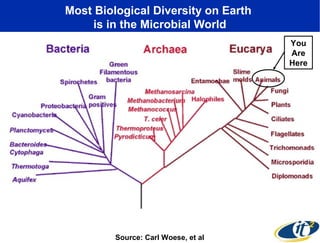
Most Biological Diversity on Earth
is in the Microbial World
Source: Carl Woese, et al
You
Are
Here
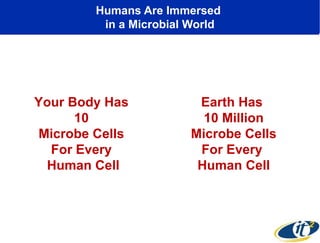
Humans Are Immersed
in a Microbial World
Your Body Has
10
Microbe Cells
For Every
Human Cell
Earth Has
10 Million
Microbe Cells
For Every
Human Cell
Major Projects are Genetically Sequencing
The Two Realms
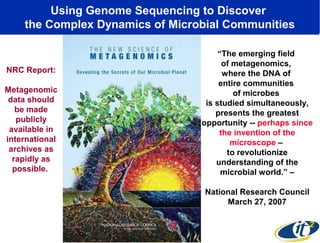
Using Genome Sequencing to Discover
the Complex Dynamics of Microbial Communities
“The emerging field
of metagenomics,
where the DNA of
entire communities
of microbes
is studied simultaneously,
presents the greatest
opportunity -- perhaps since
the invention of the
microscope –
to revolutionize
understanding of the
microbial world.” –
National Research Council
March 27, 2007
NRC Report:
Metagenomic
data should
be made
publicly
available in
international
archives as
rapidly as
possible.
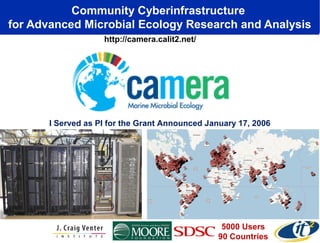
Community Cyberinfrastructure
for Advanced Microbial Ecology Research and Analysis
5000 Users
90 Countries
http://camera.calit2.net/
I Served as PI for the Grant Announced January 17, 2006
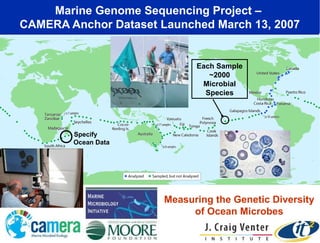
Marine Genome Sequencing Project –
CAMERA Anchor Dataset Launched March 13, 2007
Measuring the Genetic Diversity
of Ocean Microbes
Specify
Ocean Data
Each Sample
~2000
Microbial
Species
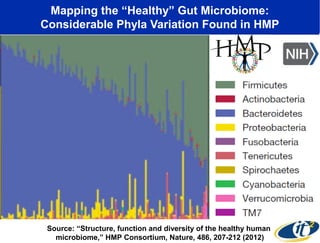
Mapping the “Healthy” Gut Microbiome:
Considerable Phyla Variation Found in HMP
Source: “Structure, function and diversity of the healthy human
microbiome,” HMP Consortium, Nature, 486, 207-212 (2012)
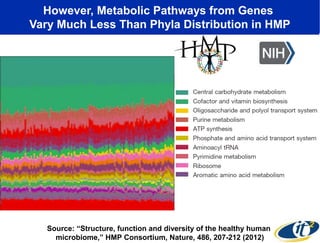
However, Metabolic Pathways from Genes
Vary Much Less Than Phyla Distribution in HMP
Source: “Structure, function and diversity of the healthy human
microbiome,” HMP Consortium, Nature, 486, 207-212 (2012)
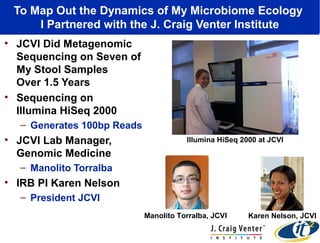
To Map Out the Dynamics of My Microbiome Ecology
I Partnered with the J. Craig Venter Institute
• JCVI Did Metagenomic
Sequencing on Seven of
My Stool Samples
Over 1.5 Years
• Sequencing on
Illumina HiSeq 2000
– Generates 100bp Reads
• JCVI Lab Manager,
Genomic Medicine
– Manolito Torralba
• IRB PI Karen Nelson
– President JCVI
Illumina HiSeq 2000 at JCVI
Manolito Torralba, JCVI Karen Nelson, JCVI
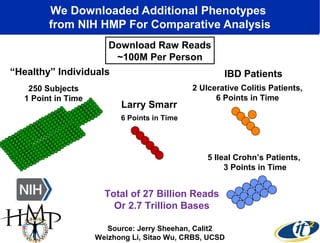
We Downloaded Additional Phenotypes
from NIH HMP For Comparative Analysis
5 Ileal Crohn’s Patients,
3 Points in Time
2 Ulcerative Colitis Patients,
6 Points in Time
“Healthy” Individuals
Download Raw Reads
~100M Per Person
Source: Jerry Sheehan, Calit2
Weizhong Li, Sitao Wu, CRBS, UCSD
Total of 27 Billion Reads
Or 2.7 Trillion Bases
IBD Patients
250 Subjects
1 Point in Time
Larry Smarr
6 Points in Time
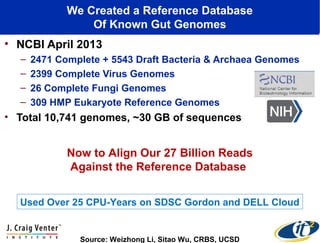
We Created a Reference Database
Of Known Gut Genomes
• NCBI April 2013
– 2471 Complete + 5543 Draft Bacteria & Archaea Genomes
– 2399 Complete Virus Genomes
– 26 Complete Fungi Genomes
– 309 HMP Eukaryote Reference Genomes
• Total 10,741 genomes, ~30 GB of sequences
Now to Align Our 27 Billion Reads
Against the Reference Database
Source: Weizhong Li, Sitao Wu, CRBS, UCSD
Used Over 25 CPU-Years on SDSC Gordon and DELL Cloud
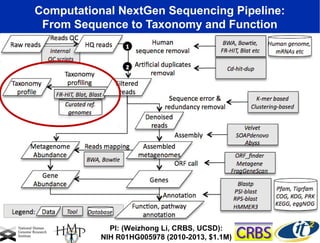
Computational NextGen Sequencing Pipeline:
From Sequence to Taxonomy and Function
PI: (Weizhong Li, CRBS, UCSD):
NIH R01HG005978 (2010-2013, $1.1M)
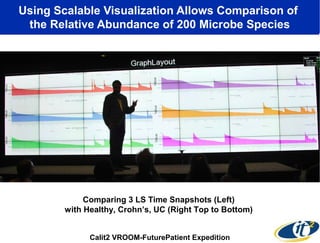
Using Scalable Visualization Allows Comparison of
the Relative Abundance of 200 Microbe Species
Calit2 VROOM-FuturePatient Expedition
Comparing 3 LS Time Snapshots (Left)
with Healthy, Crohn’s, UC (Right Top to Bottom)
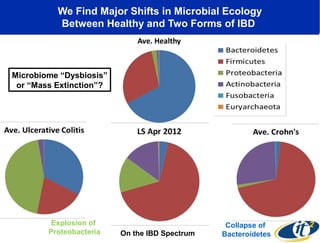
We Find Major Shifts in Microbial Ecology
Between Healthy and Two Forms of IBD
Collapse of
Bacteroidetes
Explosion of
Proteobacteria
Microbiome “Dysbiosis”
or “Mass Extinction”?
On the IBD Spectrum
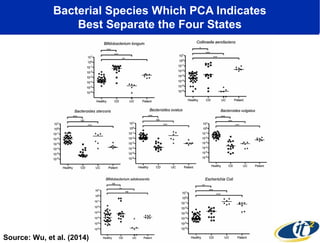
Bacterial Species Which PCA Indicates
Best Separate the Four States
Source: Wu, et al. (2014)
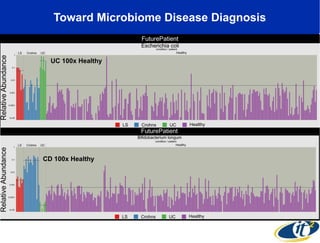
Toward Microbiome Disease Diagnosis
UC 100x Healthy
CD 100x Healthy
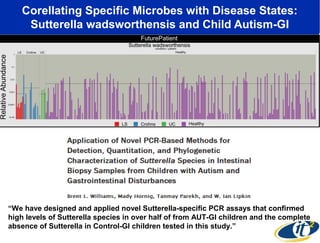
Corellating Specific Microbes with Disease States:
Sutterella wadsworthensis and Child Autism-GI
“We have designed and applied novel Sutterella-specific PCR assays that confirmed
high levels of Sutterella species in over half of from AUT-GI children and the complete
absence of Sutterella in Control-GI children tested in this study.”
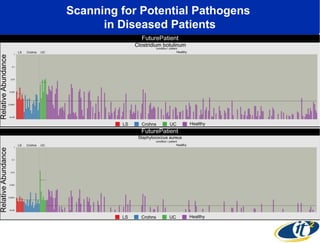
Scanning for Potential Pathogens
in Diseased Patients
Thanks to Our Great Team!
UCSD Metagenomics Team
Weizhong Li
Sitao Wu
Calit2@UCSD
Future Patient Team
Jerry Sheehan
Tom DeFanti
Kevin Patrick
Jurgen Schulze
Andrew Prudhomme
Philip Weber
Fred Raab
Joe Keefe
Ernesto Ramirez
JCVI Team
Karen Nelson
Shibu Yooseph
Manolito Torralba
SDSC Team
Michael Norman
Mahidhar Tatineni
Robert Sinkovits
UCSD Health Sciences Team
William J. Sandborn
Elisabeth Evans
John Chang
Brigid Boland
David Brenner

Living in a Microbial World

  • 1.
    “Living in aMicrobial World” Global Health Program Council on Foreign Relations New York, NY April 10, 2014 Dr. Larry Smarr Director, California Institute for Telecommunications and Information Technology Harry E. Gruber Professor, Dept. of Computer Science and Engineering Jacobs School of Engineering, UCSD http://lsmarr.calit2.net 1
  • 2.
    Most Biological Diversityon Earth is in the Microbial World Source: Carl Woese, et al You Are Here
  • 3.
    Humans Are Immersed ina Microbial World Your Body Has 10 Microbe Cells For Every Human Cell Earth Has 10 Million Microbe Cells For Every Human Cell
  • 4.
    Major Projects areGenetically Sequencing The Two Realms
  • 5.
    Using Genome Sequencingto Discover the Complex Dynamics of Microbial Communities “The emerging field of metagenomics, where the DNA of entire communities of microbes is studied simultaneously, presents the greatest opportunity -- perhaps since the invention of the microscope – to revolutionize understanding of the microbial world.” – National Research Council March 27, 2007 NRC Report: Metagenomic data should be made publicly available in international archives as rapidly as possible.
  • 6.
    Community Cyberinfrastructure for AdvancedMicrobial Ecology Research and Analysis 5000 Users 90 Countries http://camera.calit2.net/ I Served as PI for the Grant Announced January 17, 2006
  • 7.
    Marine Genome SequencingProject – CAMERA Anchor Dataset Launched March 13, 2007 Measuring the Genetic Diversity of Ocean Microbes Specify Ocean Data Each Sample ~2000 Microbial Species
  • 8.
    Mapping the “Healthy”Gut Microbiome: Considerable Phyla Variation Found in HMP Source: “Structure, function and diversity of the healthy human microbiome,” HMP Consortium, Nature, 486, 207-212 (2012)
  • 9.
    However, Metabolic Pathwaysfrom Genes Vary Much Less Than Phyla Distribution in HMP Source: “Structure, function and diversity of the healthy human microbiome,” HMP Consortium, Nature, 486, 207-212 (2012)
  • 10.
    To Map Outthe Dynamics of My Microbiome Ecology I Partnered with the J. Craig Venter Institute • JCVI Did Metagenomic Sequencing on Seven of My Stool Samples Over 1.5 Years • Sequencing on Illumina HiSeq 2000 – Generates 100bp Reads • JCVI Lab Manager, Genomic Medicine – Manolito Torralba • IRB PI Karen Nelson – President JCVI Illumina HiSeq 2000 at JCVI Manolito Torralba, JCVI Karen Nelson, JCVI
  • 11.
    We Downloaded AdditionalPhenotypes from NIH HMP For Comparative Analysis 5 Ileal Crohn’s Patients, 3 Points in Time 2 Ulcerative Colitis Patients, 6 Points in Time “Healthy” Individuals Download Raw Reads ~100M Per Person Source: Jerry Sheehan, Calit2 Weizhong Li, Sitao Wu, CRBS, UCSD Total of 27 Billion Reads Or 2.7 Trillion Bases IBD Patients 250 Subjects 1 Point in Time Larry Smarr 6 Points in Time
  • 12.
    We Created aReference Database Of Known Gut Genomes • NCBI April 2013 – 2471 Complete + 5543 Draft Bacteria & Archaea Genomes – 2399 Complete Virus Genomes – 26 Complete Fungi Genomes – 309 HMP Eukaryote Reference Genomes • Total 10,741 genomes, ~30 GB of sequences Now to Align Our 27 Billion Reads Against the Reference Database Source: Weizhong Li, Sitao Wu, CRBS, UCSD Used Over 25 CPU-Years on SDSC Gordon and DELL Cloud
  • 13.
    Computational NextGen SequencingPipeline: From Sequence to Taxonomy and Function PI: (Weizhong Li, CRBS, UCSD): NIH R01HG005978 (2010-2013, $1.1M)
  • 14.
    Using Scalable VisualizationAllows Comparison of the Relative Abundance of 200 Microbe Species Calit2 VROOM-FuturePatient Expedition Comparing 3 LS Time Snapshots (Left) with Healthy, Crohn’s, UC (Right Top to Bottom)
  • 15.
    We Find MajorShifts in Microbial Ecology Between Healthy and Two Forms of IBD Collapse of Bacteroidetes Explosion of Proteobacteria Microbiome “Dysbiosis” or “Mass Extinction”? On the IBD Spectrum
  • 16.
    Bacterial Species WhichPCA Indicates Best Separate the Four States Source: Wu, et al. (2014)
  • 17.
    Toward Microbiome DiseaseDiagnosis UC 100x Healthy CD 100x Healthy
  • 18.
    Corellating Specific Microbeswith Disease States: Sutterella wadsworthensis and Child Autism-GI “We have designed and applied novel Sutterella-specific PCR assays that confirmed high levels of Sutterella species in over half of from AUT-GI children and the complete absence of Sutterella in Control-GI children tested in this study.”
  • 19.
    Scanning for PotentialPathogens in Diseased Patients
  • 20.
    Thanks to OurGreat Team! UCSD Metagenomics Team Weizhong Li Sitao Wu Calit2@UCSD Future Patient Team Jerry Sheehan Tom DeFanti Kevin Patrick Jurgen Schulze Andrew Prudhomme Philip Weber Fred Raab Joe Keefe Ernesto Ramirez JCVI Team Karen Nelson Shibu Yooseph Manolito Torralba SDSC Team Michael Norman Mahidhar Tatineni Robert Sinkovits UCSD Health Sciences Team William J. Sandborn Elisabeth Evans John Chang Brigid Boland David Brenner