•The liver is the largest internal organ in the body
• Weighing about 1.5 kg and accounting for roughly 2.5%
of the total body weight
•It is reddish brown in color from the rich supply of blood
flowing through it
•The liver is necessary for survival; there is currently no
way to compensate for the absence of liver function
LIVER
LIVER
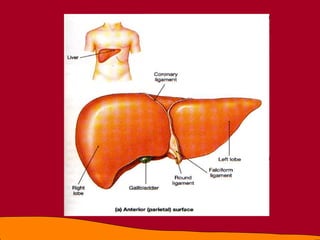
•Liver is located in right upper quadrant of the abdomen,
resting just below the diaphram
•The liver lies to the right of the stomach and overlies
the gall bladder
•Liver is divided into 4 lobes;
- Two large (left and right lobe)
- Two small (caudate and quadrate)
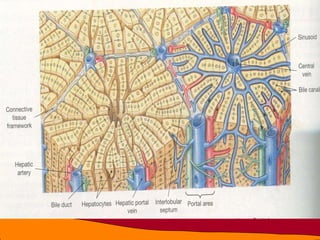
•The liver is composed of numerous functional units
called lobules
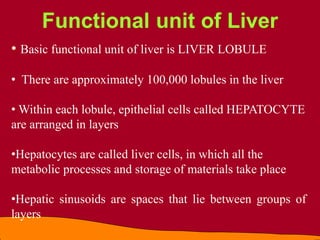
• Basic functional unit of liver is LIVER LOBULE
• There are approximately 100,000 lobules in the liver
• Within each lobule, epithelial cells called HEPATOCYTE
are arranged in layers
•Hepatocytes are called liver cells, in which all the
metabolic processes and storage of materials take place
•Hepatic sinusoids are spaces that lie between groups of
layers
Functional unit of Liver
PHYSIOLOGY OF LIVER
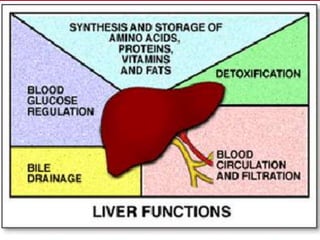
Liver is often referred as “Chemical Factory”
of the body. It has many complex functions.
The body depends on liver to perform a
number of vital functions, and they can be
divided into three basic categories.
1. Regulations, synthesis and secretion
2. Storage
3. Purification, transformation and
clearance.
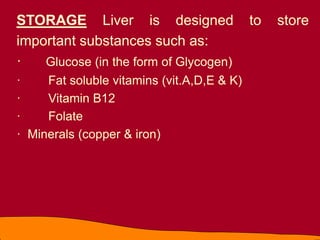
STORAGE Liver is designed to store
important substances such as:
· Glucose (in the form of Glycogen)
· Fat soluble vitamins (vit.A,D,E & K)
· Vitamin B12
· Folate
· Minerals (copper & iron)
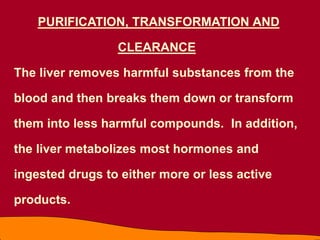
PURIFICATION, TRANSFORMATION AND
CLEARANCE
The liver removes harmful substances from the
blood and then breaks them down or transform
them into less harmful compounds. In addition,
the liver metabolizes most hormones and
ingested drugs to either more or less active
products.
a) Ammonia
The liver converts ammonia to urea, which is
excreted into the urine by the kidneys. In
severe liver disease, ammonia accumulates
in the blood because of both decreased blood
clearance and decreased ability to form urea.
Elevated ammonia levels can be toxic,
especially to the brain.
d) Drugs
Nearly all drugs are modified or degraded in
the liver. In particular, oral drugs are absorbed
by the gut and transported via the portal
circulation to the liver. In the liver, drugs may
undergo first pass metabolism, a process in
which they are modified, activated, or
inactivated before they enter the systemic
circulation, or they may be left unchanged.
In patients with liver disease, drug
detoxification and excretion may be
dangerously altered, resulting in drug
concentrations that are too low or too high or
the production of toxic drug metabolites.
These patients may need lower dose of the
drug.
a) Toxins
Liver is generally responsible for detoxifying
chemical agents and poisons, whether
ingested or inhaled.
IMPORTANCE OF LIVER
Enhancing detoxification primarily involves
promoting improved liver function. The liver
is constantly bombarded with toxic
chemicals, both those produced internally
and those coming from the environment.
The liver plays several roles in
detoxification:
- It filters blood to remove large toxins.
- Synthesizes and secretes bile.
- Enzymatically disassembles unwanted
chemicals.
DISEASE
CONCEPT
LIVER DISEASES
HHEPATITIS
Hepatitis is an inflammatory disease of the liver. The various
forms of hepatitis can be classified as:
1. Acute viral hepatitis
2. Toxic and Drug induced hepatitis
3. Chronic hepatitis
1) ACUTE VIRAL HEPATITIS
Acute viral hepatitis is a systemic infection
affecting the liver predominantly. Almost all
cases of acute viral hepatitis are caused by
one of the five agents:
i. Hepatitis A virus (HAV)
ii. Hepatitis B virus (HBV)
iii. Hepatitis C virus (HCV)
iv. Hepatitis D virus (HDV)
v. Hepatitis E virus (HEV)
FATTY LIVER
It is slight or moderate enlargement of liver due to a
diffuse accumulation of neutral fat (triglycerides) in
hepatocytes. This condition is frequently seen in
· Alcoholism
· Diabetes, Insulin Resistance
· Obesity
· Drugs (methotrexate, aspirin)
· Total parenteral nutrition
Acute fatty liver is caused by a number of
hepatotoxins and is frequently accompanied by
signs and symptoms of liver failure.
SUPPLEMENTS TO SUPPORT THE LIVER
1. MULTIPLE VITAMINS & MINERALS
Antioxidant vitamins like vitamin E, Vitamin C,
beta-carotene are obviously quite important in
protecting the liver from damage, as well as
helping in detoxification mechanism.
Nutrients like B. Complex, calcium and trace
minerals are critical in the elimination of heavy
metals and other toxic compounds from the
body.
2. LIPOTROPIC AGENTS:
Lipotropic agents are compounds, which acts on fat
metabolism, thus decrease the deposits of fat in the
liver. They produce “decongesting” effect on the
liver and promote improved liver function and fat
metabolism.
Formulas containing Lipotropic agents are very
useful in enhancing detoxification reactions and
other liver functions. Lipotropic formulas have
been used for a wide variety of conditions including
a number of liver disorders including hepatitis,
cirrhosis and chemical induced, liver disease.
Important Lipotropic nutrients are METHIONINE,
CHOLINE, BETAINE, FOLIC ACID, VITAMIN B12 & B6.

Liver funcation

  • 1.
    •The liver isthe largest internal organ in the body • Weighing about 1.5 kg and accounting for roughly 2.5% of the total body weight •It is reddish brown in color from the rich supply of blood flowing through it •The liver is necessary for survival; there is currently no way to compensate for the absence of liver function LIVER
  • 2.
    LIVER •Liver is locatedin right upper quadrant of the abdomen, resting just below the diaphram •The liver lies to the right of the stomach and overlies the gall bladder •Liver is divided into 4 lobes; - Two large (left and right lobe) - Two small (caudate and quadrate) •The liver is composed of numerous functional units called lobules
  • 4.
    • Basic functionalunit of liver is LIVER LOBULE • There are approximately 100,000 lobules in the liver • Within each lobule, epithelial cells called HEPATOCYTE are arranged in layers •Hepatocytes are called liver cells, in which all the metabolic processes and storage of materials take place •Hepatic sinusoids are spaces that lie between groups of layers Functional unit of Liver
  • 6.
    PHYSIOLOGY OF LIVER Liveris often referred as “Chemical Factory” of the body. It has many complex functions. The body depends on liver to perform a number of vital functions, and they can be divided into three basic categories. 1. Regulations, synthesis and secretion 2. Storage 3. Purification, transformation and clearance.
  • 7.
    STORAGE Liver isdesigned to store important substances such as: · Glucose (in the form of Glycogen) · Fat soluble vitamins (vit.A,D,E & K) · Vitamin B12 · Folate · Minerals (copper & iron)
  • 8.
    PURIFICATION, TRANSFORMATION AND CLEARANCE Theliver removes harmful substances from the blood and then breaks them down or transform them into less harmful compounds. In addition, the liver metabolizes most hormones and ingested drugs to either more or less active products.
  • 9.
    a) Ammonia The liverconverts ammonia to urea, which is excreted into the urine by the kidneys. In severe liver disease, ammonia accumulates in the blood because of both decreased blood clearance and decreased ability to form urea. Elevated ammonia levels can be toxic, especially to the brain.
  • 10.
    d) Drugs Nearly alldrugs are modified or degraded in the liver. In particular, oral drugs are absorbed by the gut and transported via the portal circulation to the liver. In the liver, drugs may undergo first pass metabolism, a process in which they are modified, activated, or inactivated before they enter the systemic circulation, or they may be left unchanged.
  • 11.
    In patients withliver disease, drug detoxification and excretion may be dangerously altered, resulting in drug concentrations that are too low or too high or the production of toxic drug metabolites. These patients may need lower dose of the drug. a) Toxins Liver is generally responsible for detoxifying chemical agents and poisons, whether ingested or inhaled.
  • 13.
  • 14.
    Enhancing detoxification primarilyinvolves promoting improved liver function. The liver is constantly bombarded with toxic chemicals, both those produced internally and those coming from the environment. The liver plays several roles in detoxification: - It filters blood to remove large toxins. - Synthesizes and secretes bile. - Enzymatically disassembles unwanted chemicals.
  • 15.
  • 16.
    LIVER DISEASES HHEPATITIS Hepatitis isan inflammatory disease of the liver. The various forms of hepatitis can be classified as: 1. Acute viral hepatitis 2. Toxic and Drug induced hepatitis 3. Chronic hepatitis
  • 17.
    1) ACUTE VIRALHEPATITIS Acute viral hepatitis is a systemic infection affecting the liver predominantly. Almost all cases of acute viral hepatitis are caused by one of the five agents: i. Hepatitis A virus (HAV) ii. Hepatitis B virus (HBV) iii. Hepatitis C virus (HCV) iv. Hepatitis D virus (HDV) v. Hepatitis E virus (HEV)
  • 18.
    FATTY LIVER It isslight or moderate enlargement of liver due to a diffuse accumulation of neutral fat (triglycerides) in hepatocytes. This condition is frequently seen in · Alcoholism · Diabetes, Insulin Resistance · Obesity · Drugs (methotrexate, aspirin) · Total parenteral nutrition Acute fatty liver is caused by a number of hepatotoxins and is frequently accompanied by signs and symptoms of liver failure.
  • 19.
    SUPPLEMENTS TO SUPPORTTHE LIVER 1. MULTIPLE VITAMINS & MINERALS Antioxidant vitamins like vitamin E, Vitamin C, beta-carotene are obviously quite important in protecting the liver from damage, as well as helping in detoxification mechanism. Nutrients like B. Complex, calcium and trace minerals are critical in the elimination of heavy metals and other toxic compounds from the body.
  • 20.
    2. LIPOTROPIC AGENTS: Lipotropicagents are compounds, which acts on fat metabolism, thus decrease the deposits of fat in the liver. They produce “decongesting” effect on the liver and promote improved liver function and fat metabolism. Formulas containing Lipotropic agents are very useful in enhancing detoxification reactions and other liver functions. Lipotropic formulas have been used for a wide variety of conditions including a number of liver disorders including hepatitis, cirrhosis and chemical induced, liver disease. Important Lipotropic nutrients are METHIONINE, CHOLINE, BETAINE, FOLIC ACID, VITAMIN B12 & B6.