JG SAMBAD
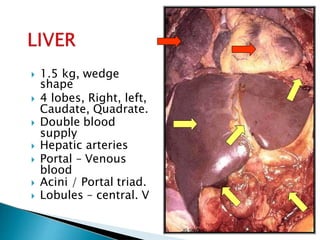
 1.5 kg, wedge
shape
 4 lobes, Right, left,
Caudate, Quadrate.
 Double blood
supply
 Hepatic arteries
 Portal – Venous
blood
 Acini / Portal triad.
 Lobules – central. V
JG SAMBAD
JG SAMBAD
 Metabolism – Carbohydrate, Fat & Protein
 Secretory – bile, Bile acids, salts & pigments
 Excretory – Bilirubin, drugs, toxins
 Synthesis – Albumin, coagulation factors
 Storage – Vitamins, carbohydrates etc.
 Detoxification – toxins, ammonia, etc.
JG SAMBAD
JG SAMBAD

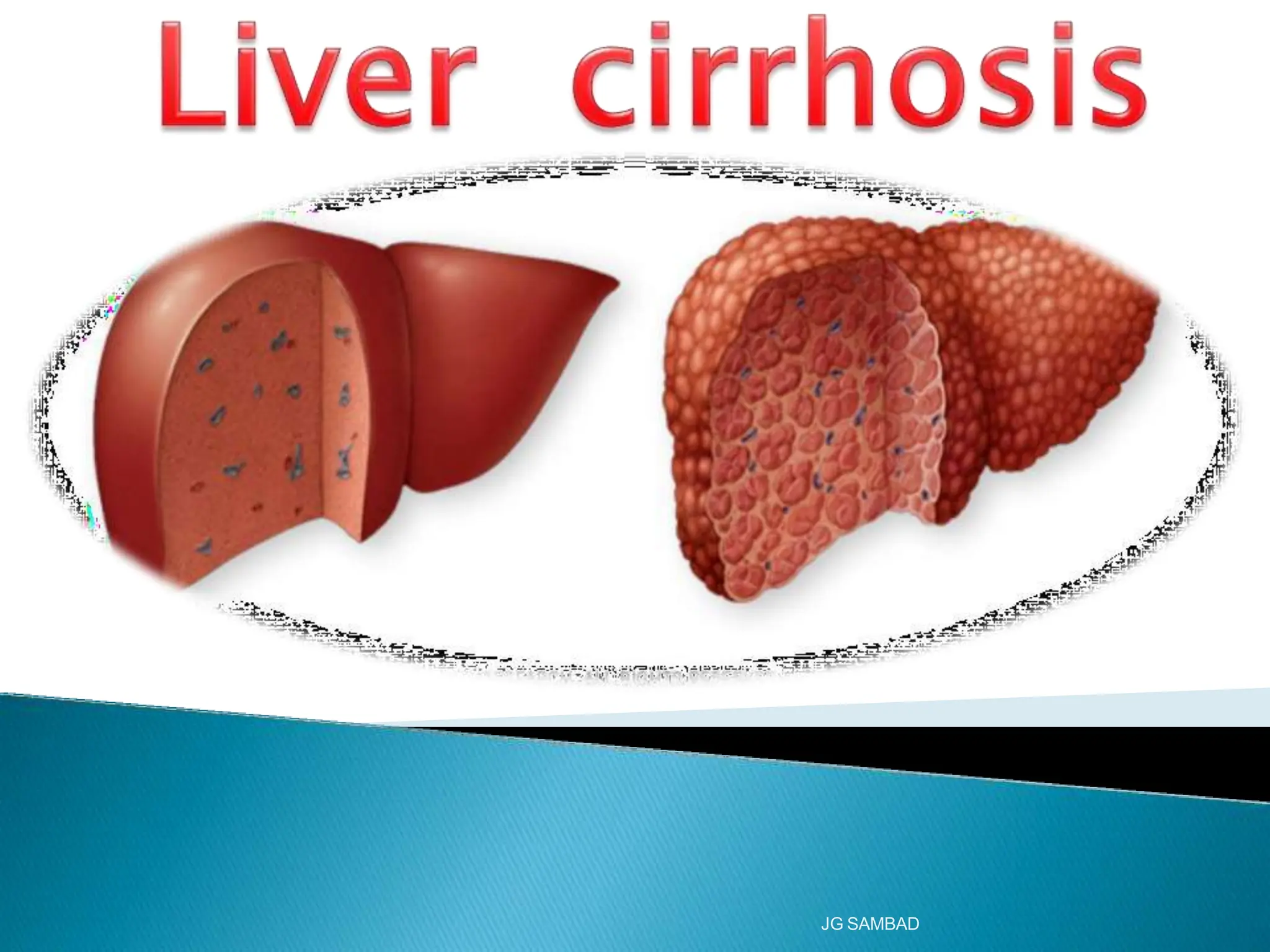
 Cirrhosis is a consequence of chronic
liver disease
• characterized by replacement of liver
tissue by fibrous scar tissue as well as
regenerative nodules (lumps that occur
as a result of a process in which
damaged tissue is regenerated,
leading to progressive loss of liver
function.
JG SAMBAD
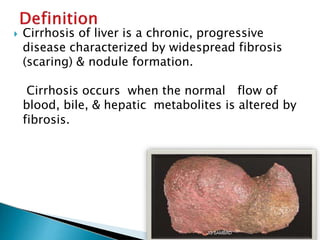
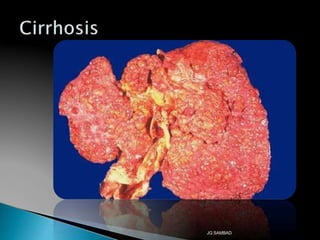
 Cirrhosis of liver is a chronic, progressive
disease characterized by widespread fibrosis
(scaring) & nodule formation.
Cirrhosis occurs when the normal flow of
blood, bile, & hepatic metabolites is altered by
fibrosis.
JG SAMBAD
JG SAMBAD
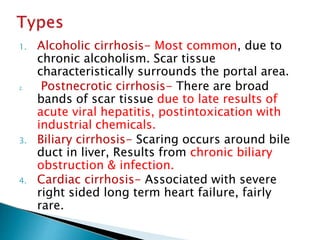
1. Alcoholic cirrhosis- Most common, due to
chronic alcoholism. Scar tissue
characteristically surrounds the portal area.
2. Postnecrotic cirrhosis- There are broad
bands of scar tissue due to late results of
acute viral hepatitis, postintoxication with
industrial chemicals.
3. Biliary cirrhosis- Scaring occurs around bile
duct in liver, Results from chronic biliary
obstruction & infection.
4. Cardiac cirrhosis- Associated with severe
right sided long term heart failure, fairly
rare.
JG SAMBAD
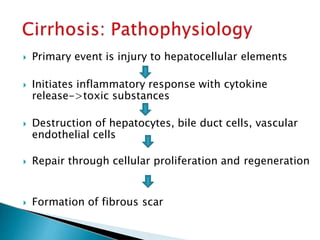
 Primary event is injury to hepatocellular elements
 Initiates inflammatory response with cytokine
release->toxic substances
 Destruction of hepatocytes, bile duct cells, vascular
endothelial cells
 Repair through cellular proliferation and regeneration
 Formation of fibrous scar
JG SAMBAD
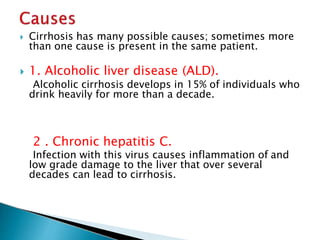
 Cirrhosis has many possible causes; sometimes more
than one cause is present in the same patient.
 1. Alcoholic liver disease (ALD).
Alcoholic cirrhosis develops in 15% of individuals who
drink heavily for more than a decade.
2 . Chronic hepatitis C.
Infection with this virus causes inflammation of and
low grade damage to the liver that over several
decades can lead to cirrhosis.
JG SAMBAD
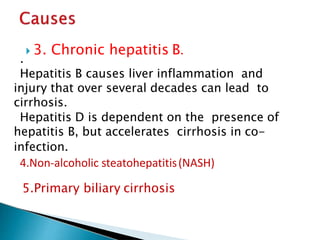
 3. Chronic hepatitis B.
.
Hepatitis B causes liver inflammation and
injury that over several decades can lead to
cirrhosis.
Hepatitis D is dependent on the presence of
hepatitis B, but accelerates cirrhosis in co-
infection.
4.Non-alcoholic steatohepatitis(NASH)
5.Primary biliary cirrhosis
JG SAMBAD
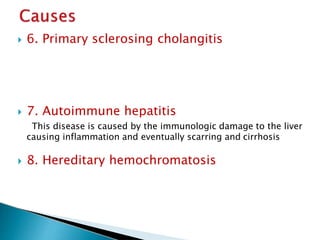
 6. Primary sclerosing cholangitis
 7. Autoimmune hepatitis
This disease is caused by the immunologic damage to the liver
causing inflammation and eventually scarring and cirrhosis
 8. Hereditary hemochromatosis
JG SAMBAD
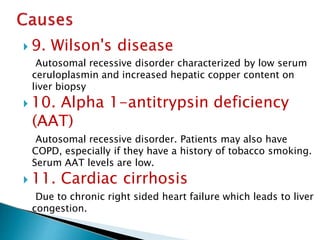
 9. Wilson's disease
Autosomal recessive disorder characterized by low serum
ceruloplasmin and increased hepatic copper content on
liver biopsy
 10. Alpha 1-antitrypsin deficiency
(AAT)
Autosomal recessive disorder. Patients may also have
COPD, especially if they have a history of tobacco smoking.
Serum AAT levels are low.
 11. Cardiac cirrhosis
Due to chronic right sided heart failure which leads to liver
congestion.
JG SAMBAD
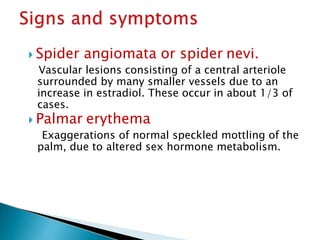
 Spider angiomata or spider nevi.
Vascular lesions consisting of a central arteriole
surrounded by many smaller vessels due to an
increase in estradiol. These occur in about 1/3 of
cases.
 Palmar erythema
Exaggerations of normal speckled mottling of the
palm, due to altered sex hormone metabolism.
JG SAMBAD
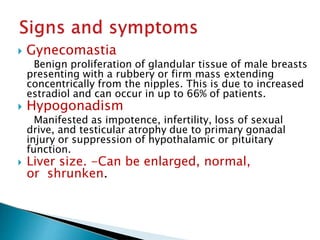
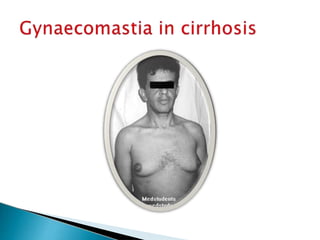
 Gynecomastia
Benign proliferation of glandular tissue of male breasts
presenting with a rubbery or firm mass extending
concentrically from the nipples. This is due to increased
estradiol and can occur in up to 66% of patients.
 Hypogonadism
Manifested as impotence, infertility, loss of sexual
drive, and testicular atrophy due to primary gonadal
injury or suppression of hypothalamic or pituitary
function.
 Liver size. -Can be enlarged, normal,
or shrunken.
JG SAMBAD
JG SAMBAD
JG SAMBAD
 The gold standard for diagnosis of cirrhosis
is a liver biopsy
•  Histologically cirrhosis can be classified
as micronodular,
macronodular,
or mixed.
JG SAMBAD
Lab findings
The following findings are typical in cirrhosis:
 Aminotransferases - AST and ALT are moderately
elevated, with AST > ALT. However, normal
aminotransferases do not preclude cirrhosis.
 Alkaline phosphatase - usually slightly elevated.
 GGT -- correlates with AP levels. Typically much
higher in chronic liver disease from alcohol.
 Bilirubin - may elevate as cirrhosis progresses.
 Albumin - levels fall as the synthetic function of
the liver declines with worsening cirrhosis since
albumin is exclusively synthesized in the liver
JG SAMBAD
 Prothrombin time- increases since the liver synthesizes
clotting factors.
 Globulins - increased due to shunting of bacterial
antigens away from the liver to lymphoid tissue.
 Serum sodium - hyponatremia due to inability to
excrete free water resulting from high levels of ADH
and aldosterone.
 Thrombocytopenia - due to both congestive
splenomegaly as well as decreased thrombopoietin
from the liver. However this rarely results in platelet
count < 50,000/mL.
 Leukopenia and neutropenia- due to splenomegaly
with splenic margination.
 Coagulation defects - the liver produces most of the
coagulation factors and thus coagulopathy correlates
with worsening liver disease.
JG SAMBAD
Other laboratory studies performed in newly
diagnosed cirrhosis may include:
 Serology for hepatitis viruses, autoantibodies (ANA,
anti-smooth muscle, anti-mitochondria, anti-LKM)
 Ferritin and transferrin saturation (markers of iron
overload), copper and ceruloplasmin (markers of
copper overload)
 Immunoglobulin levels (IgG, IgM, IgA) - these are
non-specific but may assist in distinguishing
various causes
 Cholesterol and glucose
 Alpha 1-antitrypsin
JG SAMBAD
 Imaging
 Ultrasound is routinely used in the evaluation of cirrhosis, where it
may show a small and nodular liver in advanced cirrhosis along
with increased echogenicity with irregular appearing areas.
Ultrasound may also screen for hepatocellular carcinoma, portal
hypertension and Budd-Chiari syndrome (by assessing flow in the
hepatic vein).
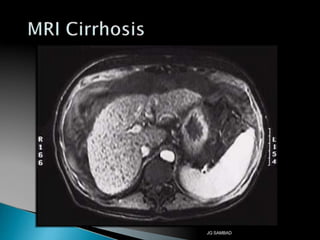
 Other tests performed in particular circumstances include
abdominal CT and liver/bile duct MRI (MRCP).
 Endoscopy
 Gastroscopy (endoscopic examination of the esophagus, stomach
and duodenum is performed in patients with established cirrhosis
to exclude the possibility of esophageal varices. If these are
found, prophylactic local therapy may be applied (sclerotherapy or
banding) and beta blocker treatment may be commenced.
 Rarely diseases of the bile ducts, such as as primary sclerosing,
can be causes of cirrhosis. Imaging of the bile ducts, such as ERCP
or MRCP (MRI of biliary tract and pancreas) can show
abnormalities in these patients, and may aid in the diagnosis.
JG SAMBAD
JG SAMBAD
As the disease progresses, complications may develop. In
some people, these may be the first signs of the disease.
 Bruising and bleeding due to decreased production of
coagulation factors.
 Jaundice due to decreased processing of bilirubin.
 Itching (pruritus) due to bile products deposited in the
skin.
 Hepatic encephalopathy - the liver does not clear
ammonia and related nitrogenous substances from the
blood, which are carried to the brain, affecting cerebral
functioning: neglect of personal appearance,
unresponsiveness, forgetfulness, trouble concentrating,
or changes in sleep habits.
 Sensitivity to medication due to decreased metabolism of
the active compounds.
 Hepatocellular carcinoma is primary liver cancer, a
frequent complication of cirrhosis. It has a high mortality
rate.
JG SAMBAD
 Portal hypertension - blood normally
carried from the intestines and spleen
through the hepatic portal vein flows more
slowly and the pressure increases; this
leads to the following complications:
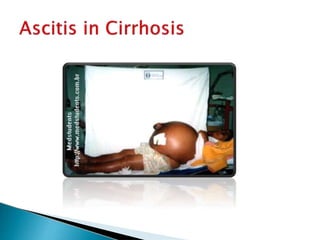
◦ Ascites - fluid leaks through the vasculature into
the abdominal cavity.
◦ Esophageal varices - collateral portal blood flow
through vessels in the stomach and esophagus.
These blood vessels may become enlarged and
are more likely to burst.
JG SAMBAD
 Problems in other organs.
◦ Cirrhosis can cause immune system dysfunction,
leading to infection. Signs and symptoms of infection
may be aspecific are more difficult to recognize (e.g.
worsening encephalopathy but no fever).
◦ Fluid in the abdomen (ascites) may become infected
with bacteria normally present in the intestines
(spontaneous bacterial peritonitis).
◦ Hepatorenal syndrome - insufficient blood supply to
the kidneys, causing acute renal failure. This
complication has a very high mortality (over 50%).
◦ Hepatopulmonary syndrome - blood bypassing the
normal lung circulation (shunting), leading to cyanosis
and dyspnea (shortness of breath), characteristically
worse on sitting up.
◦ Portopulmonary hypertension - increased blood
pressure over the lungs as a consequence of portal
hypertension.
JG SAMBAD

liver cirrhosis- powerpoint presentation

  • 1.
  • 2.
     1.5 kg,wedge shape  4 lobes, Right, left, Caudate, Quadrate.  Double blood supply  Hepatic arteries  Portal – Venous blood  Acini / Portal triad.  Lobules – central. V JG SAMBAD
  • 3.
  • 4.
     Metabolism –Carbohydrate, Fat & Protein  Secretory – bile, Bile acids, salts & pigments  Excretory – Bilirubin, drugs, toxins  Synthesis – Albumin, coagulation factors  Storage – Vitamins, carbohydrates etc.  Detoxification – toxins, ammonia, etc. JG SAMBAD
  • 5.
  • 6.
      Cirrhosis isa consequence of chronic liver disease • characterized by replacement of liver tissue by fibrous scar tissue as well as regenerative nodules (lumps that occur as a result of a process in which damaged tissue is regenerated, leading to progressive loss of liver function. JG SAMBAD
  • 7.
     Cirrhosis ofliver is a chronic, progressive disease characterized by widespread fibrosis (scaring) & nodule formation. Cirrhosis occurs when the normal flow of blood, bile, & hepatic metabolites is altered by fibrosis. JG SAMBAD
  • 8.
  • 9.
    1. Alcoholic cirrhosis-Most common, due to chronic alcoholism. Scar tissue characteristically surrounds the portal area. 2. Postnecrotic cirrhosis- There are broad bands of scar tissue due to late results of acute viral hepatitis, postintoxication with industrial chemicals. 3. Biliary cirrhosis- Scaring occurs around bile duct in liver, Results from chronic biliary obstruction & infection. 4. Cardiac cirrhosis- Associated with severe right sided long term heart failure, fairly rare. JG SAMBAD
  • 10.
     Primary eventis injury to hepatocellular elements  Initiates inflammatory response with cytokine release->toxic substances  Destruction of hepatocytes, bile duct cells, vascular endothelial cells  Repair through cellular proliferation and regeneration  Formation of fibrous scar JG SAMBAD
  • 11.
     Cirrhosis hasmany possible causes; sometimes more than one cause is present in the same patient.  1. Alcoholic liver disease (ALD). Alcoholic cirrhosis develops in 15% of individuals who drink heavily for more than a decade. 2 . Chronic hepatitis C. Infection with this virus causes inflammation of and low grade damage to the liver that over several decades can lead to cirrhosis. JG SAMBAD
  • 12.
     3. Chronichepatitis B. . Hepatitis B causes liver inflammation and injury that over several decades can lead to cirrhosis. Hepatitis D is dependent on the presence of hepatitis B, but accelerates cirrhosis in co- infection. 4.Non-alcoholic steatohepatitis(NASH) 5.Primary biliary cirrhosis JG SAMBAD
  • 13.
     6. Primarysclerosing cholangitis  7. Autoimmune hepatitis This disease is caused by the immunologic damage to the liver causing inflammation and eventually scarring and cirrhosis  8. Hereditary hemochromatosis JG SAMBAD
  • 14.
     9. Wilson'sdisease Autosomal recessive disorder characterized by low serum ceruloplasmin and increased hepatic copper content on liver biopsy  10. Alpha 1-antitrypsin deficiency (AAT) Autosomal recessive disorder. Patients may also have COPD, especially if they have a history of tobacco smoking. Serum AAT levels are low.  11. Cardiac cirrhosis Due to chronic right sided heart failure which leads to liver congestion. JG SAMBAD
  • 15.
     Spider angiomataor spider nevi. Vascular lesions consisting of a central arteriole surrounded by many smaller vessels due to an increase in estradiol. These occur in about 1/3 of cases.  Palmar erythema Exaggerations of normal speckled mottling of the palm, due to altered sex hormone metabolism. JG SAMBAD
  • 16.
     Gynecomastia Benign proliferationof glandular tissue of male breasts presenting with a rubbery or firm mass extending concentrically from the nipples. This is due to increased estradiol and can occur in up to 66% of patients.  Hypogonadism Manifested as impotence, infertility, loss of sexual drive, and testicular atrophy due to primary gonadal injury or suppression of hypothalamic or pituitary function.  Liver size. -Can be enlarged, normal, or shrunken. JG SAMBAD
  • 17.
  • 18.
  • 19.
     The goldstandard for diagnosis of cirrhosis is a liver biopsy •  Histologically cirrhosis can be classified as micronodular, macronodular, or mixed. JG SAMBAD
  • 20.
    Lab findings The followingfindings are typical in cirrhosis:  Aminotransferases - AST and ALT are moderately elevated, with AST > ALT. However, normal aminotransferases do not preclude cirrhosis.  Alkaline phosphatase - usually slightly elevated.  GGT -- correlates with AP levels. Typically much higher in chronic liver disease from alcohol.  Bilirubin - may elevate as cirrhosis progresses.  Albumin - levels fall as the synthetic function of the liver declines with worsening cirrhosis since albumin is exclusively synthesized in the liver JG SAMBAD
  • 21.
     Prothrombin time-increases since the liver synthesizes clotting factors.  Globulins - increased due to shunting of bacterial antigens away from the liver to lymphoid tissue.  Serum sodium - hyponatremia due to inability to excrete free water resulting from high levels of ADH and aldosterone.  Thrombocytopenia - due to both congestive splenomegaly as well as decreased thrombopoietin from the liver. However this rarely results in platelet count < 50,000/mL.  Leukopenia and neutropenia- due to splenomegaly with splenic margination.  Coagulation defects - the liver produces most of the coagulation factors and thus coagulopathy correlates with worsening liver disease. JG SAMBAD
  • 22.
    Other laboratory studiesperformed in newly diagnosed cirrhosis may include:  Serology for hepatitis viruses, autoantibodies (ANA, anti-smooth muscle, anti-mitochondria, anti-LKM)  Ferritin and transferrin saturation (markers of iron overload), copper and ceruloplasmin (markers of copper overload)  Immunoglobulin levels (IgG, IgM, IgA) - these are non-specific but may assist in distinguishing various causes  Cholesterol and glucose  Alpha 1-antitrypsin JG SAMBAD
  • 23.
     Imaging  Ultrasoundis routinely used in the evaluation of cirrhosis, where it may show a small and nodular liver in advanced cirrhosis along with increased echogenicity with irregular appearing areas. Ultrasound may also screen for hepatocellular carcinoma, portal hypertension and Budd-Chiari syndrome (by assessing flow in the hepatic vein).  Other tests performed in particular circumstances include abdominal CT and liver/bile duct MRI (MRCP).  Endoscopy  Gastroscopy (endoscopic examination of the esophagus, stomach and duodenum is performed in patients with established cirrhosis to exclude the possibility of esophageal varices. If these are found, prophylactic local therapy may be applied (sclerotherapy or banding) and beta blocker treatment may be commenced.  Rarely diseases of the bile ducts, such as as primary sclerosing, can be causes of cirrhosis. Imaging of the bile ducts, such as ERCP or MRCP (MRI of biliary tract and pancreas) can show abnormalities in these patients, and may aid in the diagnosis. JG SAMBAD
  • 24.
  • 25.
    As the diseaseprogresses, complications may develop. In some people, these may be the first signs of the disease.  Bruising and bleeding due to decreased production of coagulation factors.  Jaundice due to decreased processing of bilirubin.  Itching (pruritus) due to bile products deposited in the skin.  Hepatic encephalopathy - the liver does not clear ammonia and related nitrogenous substances from the blood, which are carried to the brain, affecting cerebral functioning: neglect of personal appearance, unresponsiveness, forgetfulness, trouble concentrating, or changes in sleep habits.  Sensitivity to medication due to decreased metabolism of the active compounds.  Hepatocellular carcinoma is primary liver cancer, a frequent complication of cirrhosis. It has a high mortality rate. JG SAMBAD
  • 26.
     Portal hypertension- blood normally carried from the intestines and spleen through the hepatic portal vein flows more slowly and the pressure increases; this leads to the following complications: ◦ Ascites - fluid leaks through the vasculature into the abdominal cavity. ◦ Esophageal varices - collateral portal blood flow through vessels in the stomach and esophagus. These blood vessels may become enlarged and are more likely to burst. JG SAMBAD
  • 27.
     Problems inother organs. ◦ Cirrhosis can cause immune system dysfunction, leading to infection. Signs and symptoms of infection may be aspecific are more difficult to recognize (e.g. worsening encephalopathy but no fever). ◦ Fluid in the abdomen (ascites) may become infected with bacteria normally present in the intestines (spontaneous bacterial peritonitis). ◦ Hepatorenal syndrome - insufficient blood supply to the kidneys, causing acute renal failure. This complication has a very high mortality (over 50%). ◦ Hepatopulmonary syndrome - blood bypassing the normal lung circulation (shunting), leading to cyanosis and dyspnea (shortness of breath), characteristically worse on sitting up. ◦ Portopulmonary hypertension - increased blood pressure over the lungs as a consequence of portal hypertension. JG SAMBAD