• Definition:
– Disturbancesin the heart rate, rhythm, impulse generation or
conduction of electrical impulses responsible for membrane
depolarization
– These disturbances can lead to alterations in overall
cardiac function that can be life threatening.
• Antiarrhythmic drugs:
– Compounds used to prevent or treat cardiac arrhythmias
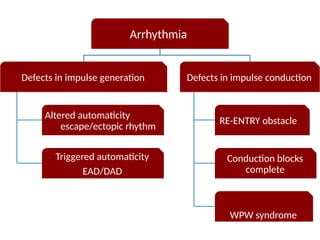
Arrhythmia
3.
Mechanism of arrhythmias
•Disturbances in impulse generation may be due to
– Abnormal automaticity
– Delayed after depolarizations
• Disturbances of impulse conduction
– The impulse may recirculate in heart causing repeated
activation (re-entry)
– Conduction blocks
Causes of Arrhythmias
•Ischemia, hypoxia
• Acidosis or alkalosis, electrolyte abnormalities
• Excessive catecholamine exposure, autonomic influences
• Drug toxicity (eg, digitalis or antiarrhythmic drugs)
• Overstretching of cardiac fibers
6.
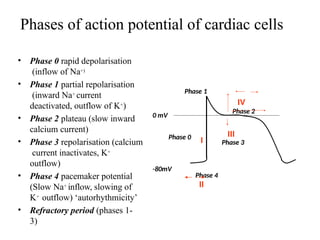
Phases of actionpotential of cardiac cells
• Phase 0 rapid depolarisation
(inflow of Na+)
• Phase 1 partial repolarisation
(inward Na+ current
deactivated, outflow of K+)
• Phase 2 plateau (slow inward
calcium current)
• Phase 3 repolarisation (calcium
current inactivates, K+
outflow)
• Phase 4 pacemaker potential
(Slow Na+ inflow, slowing of
K+ outflow) ‘autorhythmicity’
• Refractory period (phases 1-
3)
Phase 4
II
Phase 0
Phase 1
Phase 3
0 mV
-80mV
I
III
IV
Phase 2
7.
Classification
• Miles VaughnWilliams and Brahma Singh
• ‘Vaughn Williams classification’
• Based on the Predominant Mechanism of Action
• Brahma Singh added class III
• Based on action Na+
, Ca+
and K+
channels
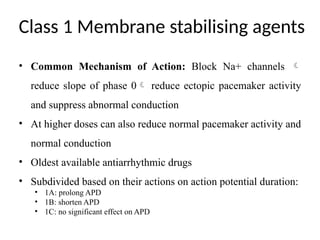
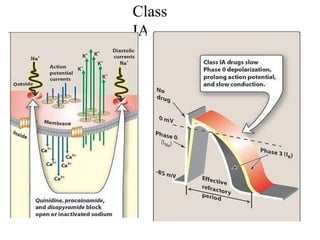
Class 1 Membranestabilising agents
• Common Mechanism of Action: Block Na+ channels
reduce slope of phase 0 reduce ectopic pacemaker activity
and suppress abnormal conduction
• At higher doses can also reduce normal pacemaker activity and
normal conduction
• Oldest available antiarrhythmic drugs
• Subdivided based on their actions on action potential duration:
• 1A: prolong APD
• 1B: shorten APD
• 1C: no significant effect on APD
• Procainamide:
– Derivativeof procaine
– No vagolytic or α-blocking action unlike quinidine
– Better tolerated
– Adverse effects:
• Nausea, vomiting and hypersensitivity reactions
• Higher doses can cause hypotension, heart block and
QT prolongation
• Disopyramide:
– Significant anticholinergic properties:
• Dry mouth, blurred vision, constipation, urinary
retention
13.
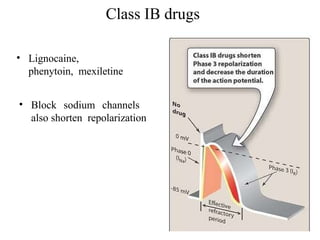
Class IB drugs
•Lignocaine,
phenytoin, mexiletine
• Block sodium channels
also shorten repolarization
14.
Lignocaine
• Local anaesthetic
•Raises threshold for action potential, ↓automaticity
• Suppress electrical activity of normal tissues
• High first pass metabolism if given parenterally
• Use: ventricular arrhythmias
• Adverse effects:
– Drowsiness, hypotension, blurred vision, confusion and
convulsions
15.
• Phenytoin:
– Antiepilepticalso useful in ventricular arrhythmias (not
preferred)
• Mexiletine:
– Can be used orally causes dose related neurological
adverse events like tremors and blurred vision
– Used as alternative to lignocaine in ventricular
arrhythmias
– Additional uses: chronic pain
16.
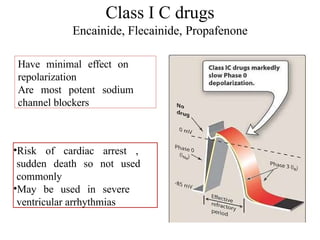
Class I Cdrugs
Encainide, Flecainide, Propafenone
Have minimal effect on
repolarization
Are most potent sodium
channel blockers
•Risk of cardiac arrest ,
sudden death so not used
commonly
•May be used in severe
ventricular arrhythmias
17.
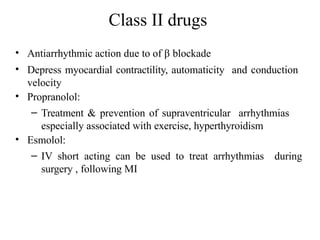
Class II drugs
•Antiarrhythmic action due to of β blockade
• Depress myocardial contractility, automaticity and conduction
velocity
• Propranolol:
– Treatment & prevention of supraventricular arrhythmias
especially associated with exercise, hyperthyroidism
• Esmolol:
– IV short acting can be used to treat arrhythmias during
surgery , following MI
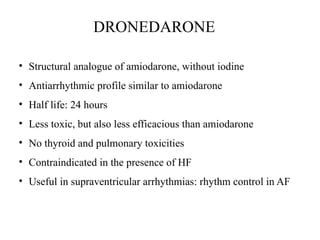
DRONEDARONE
• Structural analogueof amiodarone, without iodine
• Antiarrhythmic profile similar to amiodarone
• Half life: 24 hours
• Less toxic, but also less efficacious than amiodarone
• No thyroid and pulmonary toxicities
• Contraindicated in the presence of HF
• Useful in supraventricular arrhythmias: rhythm control in AF
23.
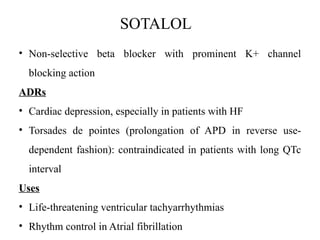
SOTALOL
• Non-selective betablocker with prominent K+ channel
blocking action
ADRs
• Cardiac depression, especially in patients with HF
• Torsades de pointes (prolongation of APD in reverse use-
dependent fashion): contraindicated in patients with long QTc
interval
Uses
• Life-threatening ventricular tachyarrhythmias
• Rhythm control in Atrial fibrillation
24.
OTHER DRUGS:
DOFETILIDE(oral), IBUTILIDE(IV)
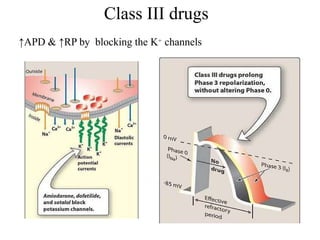
•Pure K+ channel blockers: prolongs APD
• Reverse use-dependent blockade: risk of Torsades de pointes
high
• Contraindicated in patients with prolonged QTc
• Use: Rhythm control in Atrial Fibrillation and Atrial Flutter
25.
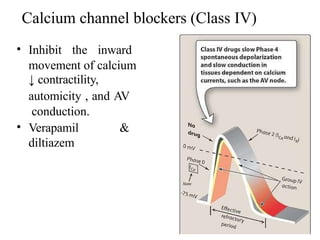
Calcium channel blockers(Class IV)
• Inhibit the inward
movement of calcium
↓ contractility,
automicity , and AV
conduction.
• Verapamil &
diltiazem
26.
Verapamil
• Uses:
– DOC:PSVT
–control ventricular rate in atrial flutter or fibrillation
• Drug interactions:
– Displaces digoxin from binding sites
– ↓ renal clearance of digoxin
27.
OTHER DRUGS: ADENOSINE
•Ultra-short acting Purine Nucleoside
• T ½: 10 seconds: always given Fast/ Rapid IV
MoA
• Acts on A1 Adenosine receptorsActivation of inward rectifier
K+ currentmarked hyperpolarization (SAN, AVN, Atria)
• Inhibition of Ca2+ currentsuppression of calcium dependent
AP (AVN)
Actions
• SAN: Bradycardia; AVN: slowing of conduction; Atria: decrease
excitability
28.
ADRs
• Bronchospasm inasthmatics, Dyspnoea, chest pain, fall in BP,
flushing
Uses
• Drug of choice for PSVT (except in asthmatics: verapamil is
preferred)
• Diagnosis of tachycardias dependent on A-V node
• To produce controlled hypotension during surgery
29.
Other antiarrhythmics
• Digoxin:
–+ve inotropic drug with AVN blocking action
– Used in atrial fibrillation associated with CHF
• Atropine: Used in sinus bradycardia
• Digitalis: Atrial fibrillation and atrial flutter
• Magnesium SO4: digitalis induced arrhythmias
30.
Bibliography
1. Tripathi KD.Essentials of Medical Pharmacology. 8th ed. New
Delhi: Jaypee Brothers Medical Publishers; 2019
2. Padmaja Udaykumar. Medical Pharmacology. CBS Publishers
& Distributors Pvt Limited, India; 2019
 Most read
 Most read