VIRAL HEPATITIS:
ETILOGICAL CLASSIFICATION
CLASSIFICATION
 The term viral hepatitis is used to describe infection of the
liver caused by hepatotropic viruses.
 There are 5 main varieties of these viruses causing distinct types of
viral hepatitis:
 Hepatitis A virus.
 Hepatitis B virus.
 Hepatitis C virus.
 Hepatitis D (delta) virus.
 Hepatitis E virus.
HEPATITIS A
 Hepatitis A is responsible for 20-25% of clinical hepatitis in the
developing countries of the world.
 Hepatitis A is usually a benign, self-limiting disease and has an
incubation period of 15-45 days.
 It is almost exclusively spread by faeco-oral route.
 The spread is related to close personal contact such as in
overcrowding, poor hygienic and sanitary conditions.
 Frequently affected age group is 5-14 years; adults are often infected
by spread from children.
HEPATITIS A VIRUS (HAV)
 The etiologic agent for hepatitis A, HAV, is a small, 27 nm diameter,
icosahedral nonenveloped, single-stranded RNA virus.
PATHOGENESIS:
 The virus is present in the liver cells, bile, stool and blood during
the incubation period and in pre-icteric phase but viral
shedding diminishes after the onset of jaundice.
 Serum markers for hepatitis A infection are:
 IgM anti-HAV antibody appears in the serum at the onset of symptoms of
acute hepatitis A.
 IgG anti-HAV antibody is detected in the serum after acute illness and
remains detectable indefinitely. It gives lifelong protective immunity
against reinfection with HAV.
Hepatitis B
 Incubation period (30-180 days).
 Transmitted parenterally such as in recipients of blood and blood
products, I.V drug addicts, renal dialysis and hospital workers exposed
to blood, and by intimate physical contact.
 PATHOGENESIS:
 Since a carrier state of hepatitis B without hepatocellular damage
exists, it means that HBV is not directly cytopathic.
 HEPATITIS B VIRUS (HBV):
 HBV show 3 forms of viral particles of 2 sizes: small (sphere and
tubules/filaments) and large (spheres)
Serologic and viral markers
1. HBsAg: appears early in the blood after about 6
weeks of infection and its detection is an
indicator of active HBV infection.
2. Anti-HBs: Specific antibody to HBsAg in serum
called anti-HBs appears late, about 3 months
after the onset.
3. HBeAg : HBeAg derived from core protein is
present (3-6 weeks) during an acute attack.
4) Anti-HBe : Seroconversion from HBeAg to anti-HBe during
acute stage of illness is a prognostic sign for resolution of
infection.
5) HBcAg: HBcAg derived from core protein cannot
be detected in the blood.
6) Anti-HBc: In the initial period, it is IgM class antibody
which persists for 4-6 months and is followed later by IgG
anti-HBc.
7) HBV-DNA: Detection of HBV-DNA by
molecular hybridisation using the Southern blot technique is
the most sensitive index of hepatitis B infection.
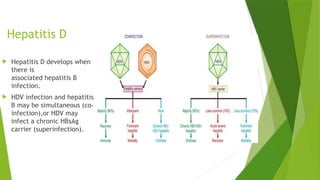
Hepatitis D
 Hepatitis D develops when
there is
associated hepatitis B
infection.
 HDV infection and hepatitis
B may be simultaneous (co-
infection),or HDV may
infect a chronic HBsAg
carrier (superinfection).
HEPATITIS D VIRUS
1. HDV identification is done in the blood and in the liver cell
nuclei.
2. HDAg detectable in the blood and on fixed liver
tissue specimens.
3. Anti-HD antibody in acute hepatitis which is initially
IgM type and later replaced by IgG type anti-HD antibody
which persists for life to confer immunity against
reinfection.
 PATHOGENESIS:
 HDV, unlike HBV, is thought to cause direct cytopathic
effect on hepatocytes.
Hepatitis C
 Hepatitis C infection is acquired by blood transfusions, blood
products, haemodialysis, parenteral drug abuse and accidental
cuts and needle-pricks in health workers.
 Clinically, acute HCV hepatitis is milder than HBV hepatitis but
HCV has a higher rate of progression to chronic hepatitis than HBV.
 Occurrence of cirrhosis after 5 to 10 years and progression to
hepatocellular carcinoma are other late consequences of HCV
infection.
 HEPATITIS C VIRUS (HCV)-
 HCV is a single-stranded, enveloped RNA virus, having a diameter
of 30-60 nm. HCV genome has about 3000 amino acids.
PATHOGENESIS
 HCV-activated CD4+ helper T lymphocytes stimulate CD8+T
lymphocytes via cytokines elaborated by CD4+ helper T cells.
 The stimulated CD8+T lymphocytes, in turn, elaborate antiviral
cytokines against various HCV antigens.
HEPATITIS-E
 Hepatitis E is an enterically-transmitted virus, previously labelled as
epidemic or enterically transmitted variant of non-A non-B hepatitis.
 The infection is generally acquired by contamination of water
supplies such as after monsoon flooding.
 HEV infection has a particularly high mortality in pregnant women but
is otherwise a self-limited disease and has not been associated with
chronic liver disease.
HEPATITIS E VIRUS
 HEV is a single-stranded 32-34 nm, icosahedral non-enveloped virus.
The virus has been isolated from stools, bile and liver of infected
persons.
 Serologic markers for HEV include the following:
 Anti-HEV antibodies of both IgM and IgG class.
 Both fall rapidly after acute illness but routine serologic testing for
HEV antibodies is not available.
 HEV-RNA.
VIRAL HEPATITIS ETILOGICAL CLASSIFICATION.pptx

VIRAL HEPATITIS ETILOGICAL CLASSIFICATION.pptx

  • 1.
  • 2.
    CLASSIFICATION  The termviral hepatitis is used to describe infection of the liver caused by hepatotropic viruses.  There are 5 main varieties of these viruses causing distinct types of viral hepatitis:  Hepatitis A virus.  Hepatitis B virus.  Hepatitis C virus.  Hepatitis D (delta) virus.  Hepatitis E virus.
  • 3.
    HEPATITIS A  HepatitisA is responsible for 20-25% of clinical hepatitis in the developing countries of the world.  Hepatitis A is usually a benign, self-limiting disease and has an incubation period of 15-45 days.  It is almost exclusively spread by faeco-oral route.  The spread is related to close personal contact such as in overcrowding, poor hygienic and sanitary conditions.  Frequently affected age group is 5-14 years; adults are often infected by spread from children.
  • 4.
    HEPATITIS A VIRUS(HAV)  The etiologic agent for hepatitis A, HAV, is a small, 27 nm diameter, icosahedral nonenveloped, single-stranded RNA virus. PATHOGENESIS:  The virus is present in the liver cells, bile, stool and blood during the incubation period and in pre-icteric phase but viral shedding diminishes after the onset of jaundice.  Serum markers for hepatitis A infection are:  IgM anti-HAV antibody appears in the serum at the onset of symptoms of acute hepatitis A.  IgG anti-HAV antibody is detected in the serum after acute illness and remains detectable indefinitely. It gives lifelong protective immunity against reinfection with HAV.
  • 5.
    Hepatitis B  Incubationperiod (30-180 days).  Transmitted parenterally such as in recipients of blood and blood products, I.V drug addicts, renal dialysis and hospital workers exposed to blood, and by intimate physical contact.  PATHOGENESIS:  Since a carrier state of hepatitis B without hepatocellular damage exists, it means that HBV is not directly cytopathic.  HEPATITIS B VIRUS (HBV):  HBV show 3 forms of viral particles of 2 sizes: small (sphere and tubules/filaments) and large (spheres)
  • 6.
    Serologic and viralmarkers 1. HBsAg: appears early in the blood after about 6 weeks of infection and its detection is an indicator of active HBV infection. 2. Anti-HBs: Specific antibody to HBsAg in serum called anti-HBs appears late, about 3 months after the onset. 3. HBeAg : HBeAg derived from core protein is present (3-6 weeks) during an acute attack.
  • 7.
    4) Anti-HBe :Seroconversion from HBeAg to anti-HBe during acute stage of illness is a prognostic sign for resolution of infection. 5) HBcAg: HBcAg derived from core protein cannot be detected in the blood. 6) Anti-HBc: In the initial period, it is IgM class antibody which persists for 4-6 months and is followed later by IgG anti-HBc. 7) HBV-DNA: Detection of HBV-DNA by molecular hybridisation using the Southern blot technique is the most sensitive index of hepatitis B infection.
  • 8.
    Hepatitis D  HepatitisD develops when there is associated hepatitis B infection.  HDV infection and hepatitis B may be simultaneous (co- infection),or HDV may infect a chronic HBsAg carrier (superinfection).
  • 9.
    HEPATITIS D VIRUS 1.HDV identification is done in the blood and in the liver cell nuclei. 2. HDAg detectable in the blood and on fixed liver tissue specimens. 3. Anti-HD antibody in acute hepatitis which is initially IgM type and later replaced by IgG type anti-HD antibody which persists for life to confer immunity against reinfection.  PATHOGENESIS:  HDV, unlike HBV, is thought to cause direct cytopathic effect on hepatocytes.
  • 10.
    Hepatitis C  HepatitisC infection is acquired by blood transfusions, blood products, haemodialysis, parenteral drug abuse and accidental cuts and needle-pricks in health workers.  Clinically, acute HCV hepatitis is milder than HBV hepatitis but HCV has a higher rate of progression to chronic hepatitis than HBV.  Occurrence of cirrhosis after 5 to 10 years and progression to hepatocellular carcinoma are other late consequences of HCV infection.  HEPATITIS C VIRUS (HCV)-  HCV is a single-stranded, enveloped RNA virus, having a diameter of 30-60 nm. HCV genome has about 3000 amino acids.
  • 11.
    PATHOGENESIS  HCV-activated CD4+helper T lymphocytes stimulate CD8+T lymphocytes via cytokines elaborated by CD4+ helper T cells.  The stimulated CD8+T lymphocytes, in turn, elaborate antiviral cytokines against various HCV antigens.
  • 12.
    HEPATITIS-E  Hepatitis Eis an enterically-transmitted virus, previously labelled as epidemic or enterically transmitted variant of non-A non-B hepatitis.  The infection is generally acquired by contamination of water supplies such as after monsoon flooding.  HEV infection has a particularly high mortality in pregnant women but is otherwise a self-limited disease and has not been associated with chronic liver disease.
  • 13.
    HEPATITIS E VIRUS HEV is a single-stranded 32-34 nm, icosahedral non-enveloped virus. The virus has been isolated from stools, bile and liver of infected persons.  Serologic markers for HEV include the following:  Anti-HEV antibodies of both IgM and IgG class.  Both fall rapidly after acute illness but routine serologic testing for HEV antibodies is not available.  HEV-RNA.