LIVER ABSCESS
Dr. S. K. MOHAN
S3 UNIT
SJH & VMMC, NEW DELHI
• Pus filled cavity in liver .
1. PYOGENIC LIVER ABSCESS
2. AMOEBIC LIVER ABSCESS
3. FUNGAL LIVER ABSCESS
PYOGENIC LIVER ABSCESS
INCIDENCE
• Recent studies shows incidence of 3.6 cases per 100,000 of
population.
• Male: female- 1.5:1
• Age~ >50 years
Risk factors
• Cirrhosis
• Diabetes mellitus
• Malignant disorders
• Chronic renal failure.
• Post biliary surgeries
• Post liver transplant
Pathogenesis
• Occurs when an inoculum of bacteria regardless of the
route of exposure, exceeds the ability of liver to clear it.
• Organism invades tissue-> neutrophil infiltration and
formation of organized liver abscess.
Routes of infection.
1. Via biliary tree.( obstruction –stasis –infection= ascending
suppurative cholangitis)
2. Via portal vein:( drains GI tract- infections /malignancies=
pyelophlebitis)
3. Via hepatic artery( any systemic infections- endocarditis/ immune
compromised conditions.)
4. Via direct extension:-
from suppurative cholecystitis, subphrenic abscess, perinephric abscess, perforation
peritonitis
5. Traumatic – penetrating /blunt trauma – direct inoculation of organisms
6. Cryptogenic :- no specific cause.
( possible explanations- undiagnosed abd. Pathology/diabetes/ malignancy)
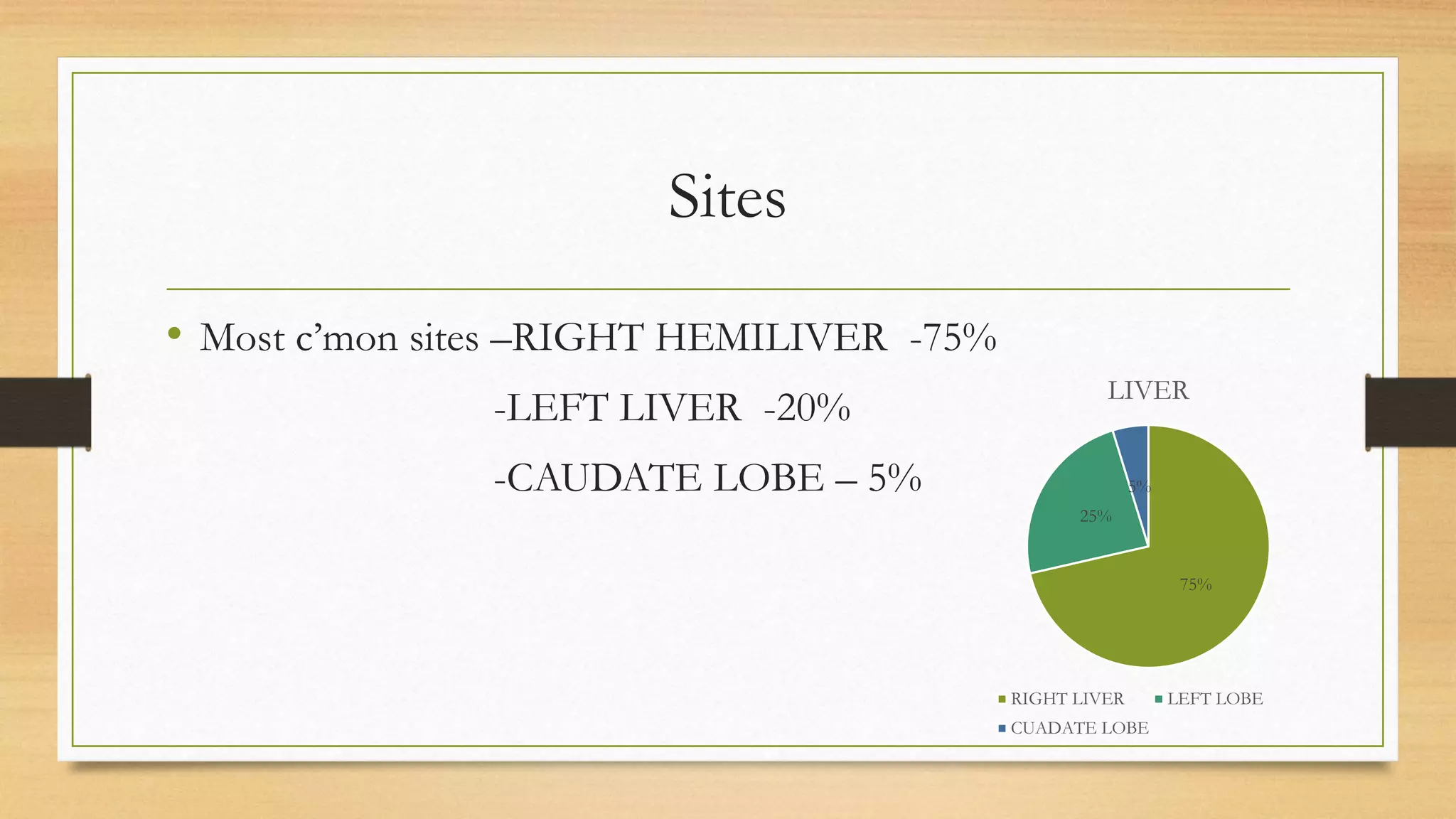
Sites
• Most c’mon sites –RIGHT HEMILIVER -75%
-LEFT LIVER -20%
-CAUDATE LOBE – 5%
75%
25%
5%
LIVER
RIGHT LIVER LEFT LOBE
CUADATE LOBE
• 50% of liver Abscess is solitary
• Size varies from 1mm to 4/5 cm in diameter.
• Can be multi loculated/ single cavity
MICROBIOLOGY
• Abscess from pyelophlebitis( portal vein)- mostly
polymicrobial ( >G- ve)
• systemic infections( hepatic A.)- mostly mono microbial.
• 40% of liver abscess- poly microbial.
• 40-60% contains anaerobic organisms.
• Most c’mon organism- E. Coli and Klebsiella
pneumonea.
• Others:- staph. Aureus, enterococci, bacteroides,
streptococcus viridans.
• Very rarely (<10%):-pseudomona, proteus, enterobacter,
serratia.
Clinical features
• Classic symptoms- FEVER, RIGHT UPPER ABD. PAIN AND
JAUNDICE (BUT RARELY SEEN < 10%)
• FEVER -96%
• CHILLS-80%
• ABD. PAIN- 53%
• JAUNDICE -20%
• Anorexia
• Malaise
• Nausea, vomiting
• Cough, chest pain.
• diarrhoea
SIGNS
• Fever with right hypochondrial tenderness( 40- 70%) MC findings.
• Jaundice in 25 %
• Hepatomegaly in 50 %
• Chest finding in 50 %
INVESTIGATIONS
• NON SPECIFIC
• Leukocytosis in 70-90%
• Anaemia is c’mon
• ALP in 80%
• S. Bil in 20-50%
• Hypoalbuminemia, PT-INR
• C-XRAY
• Abnormal in 50% cases
Elevated R hemidiaphragm,
R sided pleural effusion,
Atelectasis
• ABDOMINAL XRAY.
• Rarely shows air fluid levels
in liver
• Portal venous gas
ULTRASONOGRAPHY
• SENSITIVITY~80-95%
• Shows round/ oval shaped
hypoechoic lesions
CT
• Sensitivity~95-100%
• Hypodense heterogenous lesion
• With irregular margins and enhanced rim
Differential diagnosis.
• Amoebic liver abscess
• Echinococcal cyst
TREATMENT
MEDICAL
• BROAD SPECTRUM IV ANTIBIOTICS COVERING G+, G-,
ANEROBES(PENCILLIN +
AMINOGLYCOSIDES+METRONIDAZOLE)
• 3 RD GEN. CEPHALOSPORIN + METRONIDAZOLES
• SPECIFIC ANTIBIOTICS AS PER CULTURE AND SENSITIVITY
• TREATMENT FOR MIN. 2 WEEKS/ TILL SYMPTOMS SUBSIDES.
Pigtail insertion
Usg guided aspiration
INVASIVE
• PERCUTANEOUS DRAINAGE
1. Abscess size < 5 cm- needle aspiration ( 60% success rate)/ catheter
drainage(~100% success rate)
2. Abscess size >5cm- catheter drainage
3. Percutaneous catheter drainage is the treatment of choice now a days
4. Surgery should be reserved for patients who require sxical treatment for
primary pathological process
• Similar success / mortality rate is seen in percutaneous and surgical
management.
• Mortality rate is 50-100% if
treated with antibiotcs with out any drainage
COMPLICATIONS
• RUPTURE OF ABSCESS
To pleural cavity-empyma pleuroperitoneal
fistula
To peritoneum –peritonitis
To pericardial cavity- tamponade/ effusion
To bronchi-
• Sepsis
• Shock
• Mortality <3 %
AMEBIC LIVER ABSCESS
• Caused by entemoeba hystolytica, a protozoan
• Seen mainly in tropical and developing countries
• Endemic in India, Mexico, Africa and S. America
• ~40,000 to 100,000 deaths every year.
Incidence
• Male to female -10:1
• Age – 20- 40 years
Risk factors
• Alcoholics
• Travel to endemic area
• Immunocompromised conditions
• malnutrition
Pathogensis
• E. histolytica- aprotozoan
– exists in 2 forms.
• Spreads feco orally by cysts
• Humans – principal host-
• Sigmoid colon and ceacum.
Life cycle
Pathology
• Due to liquefactive necrosis of liver– a cavity of blood +
necrotic tissues
• Necrosis continues until Glissons capsule– so cavity is
typically crisscrossed by portal triads
Clinical features
• ~ 80% of patients presented with prolonged symptoms <10 days
• Abdominal pain -92%
• Fever-90%
• Abdominal tenderness- 78%
• Hepatomegaly-50%
• anorexia-, diarrhoea, jaundice, wt. loss., symptoms of complicatns
• Acutely (<10 days)- 50% have multiple lesions
• Patients presents
• Chronic(>2 weeks)- 80% single right sided lesion
Investigations
NON SPECIFIC
• Leuckocytosis without eosinophils
• Anaemia
• Deranged LFT- mc increased PTINR
• Only 30 % have detectable ameba in stool.
SPECIFIC
• Circulating anti amoebic antibodies are present in 95% patients.
• Enzyme immune assays 99% sensitivity (ELISA)
• Entemeba antigen detecting kits
Radiology
• C xray- 50% abnormal
• USG ABD- 90% SENSITIVITY- round lesions abutting liver capsules
• HYPOECHOGENIC LESION
• NO RIM ECHOS
• CT
• Hypodense and heterogenous
• No RIM ENHANCEMENT
Differential diagnosis
• Viral hepatitis
• Echinococcal disease
• Cholangitis, cholecystitis
Treatment
TISSUE AMEBOCIDES
1. METRONIDAZOLE 750MG PO/IV Q8H X 10 DAYS( Curative in
> 90%)
2. TINIDZOLE/ORNIDAZOLE
3. EMETINE HYDROCHLORIDE- more effective but cardiac SE.
4. CHLOROQUINE- less effective.1GM(600MG base )OD X 3 DAYS
then 500mg( 300mg base) OD FOR 2-3 weeks
LUMINAL AMEBOCIDES
• IODOQUINOL 650MG TID X 20 DAYS OR
• PARAMOMYCIN 500MG TID X 10 DAYS OR
• DILOXAANIDE FUROATE 500MG TID X 10 DAYS
• SURGICAL INTERVENTIONS
• Indications for aspiration
• Size >5cm
• Impending rupture
• Left lobe abscess – pericardial rupture
Indications for laparotomy- intestinal perforation, pericardial
rupture
COMPLICATIONS
• RUPTURE OF ABSCESS
To plueral cavity-empyma pleuroperitoneal
fistula
To peritoneium –peritonitis/intestine fistula
To pericardial cavity-tamponade/ effusion
To bronchi-fistula
Death in 5-50% in ruptured cases
• SECONDARY INFECTIONS
• AMEBOMA-
• INTESTINAL ULCER PERFORATION
• PERCUTANEOUS FISTILA - RARE
Thanks…..
SKM25

Liver abcsess

  • 1.
    LIVER ABSCESS Dr. S.K. MOHAN S3 UNIT SJH & VMMC, NEW DELHI
  • 2.
    • Pus filledcavity in liver . 1. PYOGENIC LIVER ABSCESS 2. AMOEBIC LIVER ABSCESS 3. FUNGAL LIVER ABSCESS
  • 3.
    PYOGENIC LIVER ABSCESS INCIDENCE •Recent studies shows incidence of 3.6 cases per 100,000 of population. • Male: female- 1.5:1 • Age~ >50 years
  • 4.
    Risk factors • Cirrhosis •Diabetes mellitus • Malignant disorders • Chronic renal failure. • Post biliary surgeries • Post liver transplant
  • 5.
    Pathogenesis • Occurs whenan inoculum of bacteria regardless of the route of exposure, exceeds the ability of liver to clear it. • Organism invades tissue-> neutrophil infiltration and formation of organized liver abscess.
  • 6.
    Routes of infection. 1.Via biliary tree.( obstruction –stasis –infection= ascending suppurative cholangitis) 2. Via portal vein:( drains GI tract- infections /malignancies= pyelophlebitis) 3. Via hepatic artery( any systemic infections- endocarditis/ immune compromised conditions.)
  • 7.
    4. Via directextension:- from suppurative cholecystitis, subphrenic abscess, perinephric abscess, perforation peritonitis 5. Traumatic – penetrating /blunt trauma – direct inoculation of organisms 6. Cryptogenic :- no specific cause. ( possible explanations- undiagnosed abd. Pathology/diabetes/ malignancy)
  • 10.
    Sites • Most c’monsites –RIGHT HEMILIVER -75% -LEFT LIVER -20% -CAUDATE LOBE – 5% 75% 25% 5% LIVER RIGHT LIVER LEFT LOBE CUADATE LOBE
  • 11.
    • 50% ofliver Abscess is solitary • Size varies from 1mm to 4/5 cm in diameter. • Can be multi loculated/ single cavity
  • 12.
    MICROBIOLOGY • Abscess frompyelophlebitis( portal vein)- mostly polymicrobial ( >G- ve) • systemic infections( hepatic A.)- mostly mono microbial. • 40% of liver abscess- poly microbial. • 40-60% contains anaerobic organisms.
  • 13.
    • Most c’monorganism- E. Coli and Klebsiella pneumonea. • Others:- staph. Aureus, enterococci, bacteroides, streptococcus viridans. • Very rarely (<10%):-pseudomona, proteus, enterobacter, serratia.
  • 14.
    Clinical features • Classicsymptoms- FEVER, RIGHT UPPER ABD. PAIN AND JAUNDICE (BUT RARELY SEEN < 10%) • FEVER -96% • CHILLS-80% • ABD. PAIN- 53% • JAUNDICE -20%
  • 15.
    • Anorexia • Malaise •Nausea, vomiting • Cough, chest pain. • diarrhoea
  • 17.
    SIGNS • Fever withright hypochondrial tenderness( 40- 70%) MC findings. • Jaundice in 25 % • Hepatomegaly in 50 % • Chest finding in 50 %
  • 18.
    INVESTIGATIONS • NON SPECIFIC •Leukocytosis in 70-90% • Anaemia is c’mon • ALP in 80% • S. Bil in 20-50% • Hypoalbuminemia, PT-INR
  • 19.
    • C-XRAY • Abnormalin 50% cases Elevated R hemidiaphragm, R sided pleural effusion, Atelectasis
  • 20.
    • ABDOMINAL XRAY. •Rarely shows air fluid levels in liver • Portal venous gas
  • 21.
    ULTRASONOGRAPHY • SENSITIVITY~80-95% • Showsround/ oval shaped hypoechoic lesions
  • 23.
    CT • Sensitivity~95-100% • Hypodenseheterogenous lesion • With irregular margins and enhanced rim
  • 24.
    Differential diagnosis. • Amoebicliver abscess • Echinococcal cyst
  • 25.
    TREATMENT MEDICAL • BROAD SPECTRUMIV ANTIBIOTICS COVERING G+, G-, ANEROBES(PENCILLIN + AMINOGLYCOSIDES+METRONIDAZOLE) • 3 RD GEN. CEPHALOSPORIN + METRONIDAZOLES • SPECIFIC ANTIBIOTICS AS PER CULTURE AND SENSITIVITY • TREATMENT FOR MIN. 2 WEEKS/ TILL SYMPTOMS SUBSIDES.
  • 26.
  • 27.
    INVASIVE • PERCUTANEOUS DRAINAGE 1.Abscess size < 5 cm- needle aspiration ( 60% success rate)/ catheter drainage(~100% success rate) 2. Abscess size >5cm- catheter drainage 3. Percutaneous catheter drainage is the treatment of choice now a days 4. Surgery should be reserved for patients who require sxical treatment for primary pathological process
  • 28.
    • Similar success/ mortality rate is seen in percutaneous and surgical management. • Mortality rate is 50-100% if treated with antibiotcs with out any drainage
  • 29.
    COMPLICATIONS • RUPTURE OFABSCESS To pleural cavity-empyma pleuroperitoneal fistula To peritoneum –peritonitis To pericardial cavity- tamponade/ effusion To bronchi-
  • 30.
  • 31.
  • 32.
    • Caused byentemoeba hystolytica, a protozoan • Seen mainly in tropical and developing countries • Endemic in India, Mexico, Africa and S. America • ~40,000 to 100,000 deaths every year.
  • 33.
    Incidence • Male tofemale -10:1 • Age – 20- 40 years
  • 34.
    Risk factors • Alcoholics •Travel to endemic area • Immunocompromised conditions • malnutrition
  • 35.
    Pathogensis • E. histolytica-aprotozoan – exists in 2 forms. • Spreads feco orally by cysts • Humans – principal host- • Sigmoid colon and ceacum.
  • 36.
  • 39.
    Pathology • Due toliquefactive necrosis of liver– a cavity of blood + necrotic tissues • Necrosis continues until Glissons capsule– so cavity is typically crisscrossed by portal triads
  • 42.
    Clinical features • ~80% of patients presented with prolonged symptoms <10 days • Abdominal pain -92% • Fever-90% • Abdominal tenderness- 78% • Hepatomegaly-50% • anorexia-, diarrhoea, jaundice, wt. loss., symptoms of complicatns
  • 43.
    • Acutely (<10days)- 50% have multiple lesions • Patients presents • Chronic(>2 weeks)- 80% single right sided lesion
  • 44.
    Investigations NON SPECIFIC • Leuckocytosiswithout eosinophils • Anaemia • Deranged LFT- mc increased PTINR • Only 30 % have detectable ameba in stool.
  • 45.
    SPECIFIC • Circulating antiamoebic antibodies are present in 95% patients. • Enzyme immune assays 99% sensitivity (ELISA) • Entemeba antigen detecting kits
  • 46.
    Radiology • C xray-50% abnormal • USG ABD- 90% SENSITIVITY- round lesions abutting liver capsules • HYPOECHOGENIC LESION • NO RIM ECHOS
  • 47.
    • CT • Hypodenseand heterogenous • No RIM ENHANCEMENT
  • 48.
    Differential diagnosis • Viralhepatitis • Echinococcal disease • Cholangitis, cholecystitis
  • 49.
    Treatment TISSUE AMEBOCIDES 1. METRONIDAZOLE750MG PO/IV Q8H X 10 DAYS( Curative in > 90%) 2. TINIDZOLE/ORNIDAZOLE 3. EMETINE HYDROCHLORIDE- more effective but cardiac SE. 4. CHLOROQUINE- less effective.1GM(600MG base )OD X 3 DAYS then 500mg( 300mg base) OD FOR 2-3 weeks
  • 50.
    LUMINAL AMEBOCIDES • IODOQUINOL650MG TID X 20 DAYS OR • PARAMOMYCIN 500MG TID X 10 DAYS OR • DILOXAANIDE FUROATE 500MG TID X 10 DAYS
  • 51.
    • SURGICAL INTERVENTIONS •Indications for aspiration • Size >5cm • Impending rupture • Left lobe abscess – pericardial rupture Indications for laparotomy- intestinal perforation, pericardial rupture
  • 53.
    COMPLICATIONS • RUPTURE OFABSCESS To plueral cavity-empyma pleuroperitoneal fistula To peritoneium –peritonitis/intestine fistula To pericardial cavity-tamponade/ effusion To bronchi-fistula Death in 5-50% in ruptured cases
  • 54.
    • SECONDARY INFECTIONS •AMEBOMA- • INTESTINAL ULCER PERFORATION • PERCUTANEOUS FISTILA - RARE
  • 55.