

INTERNATIONAL BUSINESS Modes of entry
Dr. Nguyen Hai
Ninh
WHEN SHOULD A FIRM ENTER A
FOREIGN MARKET?
“Once attractive markets are
identified, the firm must consider
the timing of entry”
1. Early Entry – when the firm
enters a foreign market before
other foreign firms
2. Late entry – when the firm
enters the market after firms
have already established
themselves in the market
FIRST MOVER
Pros
• The ability to pre-empt rivals
by establishing a strong brand
name
• The ability to build up sales
volume, experience curve
• The ability to tie customers
into products or services and
making it difficult for later
entrants to win business
PROS & CONS
Cons
• Pioneering costs - arise when
the foreign business is so
different from the home market
• The expense to learn the rules
of new business game
• The costs of business failure,
mistakes
• The costs of promoting and
educating customers
MODES OF ENTRY
• Export
• Licensing
• Franchising
• Turnkey project
• Join venture
• Whole owned
subsidiary
6
EXPORTING
Mostly, first step to enter the global market
Choose exporting:
 it avoids the costs of establishing local manufacturing operations
 it helps the firm achieve experience curve and location economies
Not choose exporting:
 high transport costs and tariffs can make it uneconomical
 agents in a foreign country may not act in exporter’s best interest
Type of exporting
 Indirect Exporting (Export merchants, Export agents, Export management
companies (EMC)
 Cooperative Exporting (Piggyback Exporting)
 Direct Exporting (Firms set up their own exporting departments)
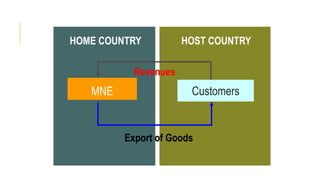
HOME COUNTRY HOST COUNTRY
Export of Goods
MNE
Revenues
Customers
LICENSING
Choose licensing
 The firm avoids development costs and risks associated with
opening a foreign market
 It avoids barriers to investment
 Capitalize on market opportunities without developing those
applications itself
Not choose licensing
 The firm doesn’t have the tight control required for realizing
experience curve and location economies
 ability to coordinate strategic moves is limited
 proprietary (or intangible) assets could be lost
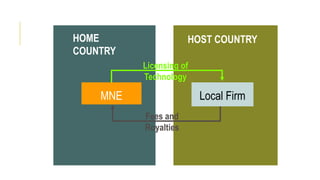
Local Firm
Licensing of
Technology
HOME
COUNTRY
HOST COUNTRY
MNE
Fees and
Royalties
FRANCHISING
Choose franchising
 it avoids the costs and risks of opening up a foreign market
 firms can quickly build a global presence
Not choose exporting:
 it inhibits the firm's ability to take profits out of one country to support
competitive attacks in another
 the geographic distance of the firm from franchisees can make it difficult
to detect poor quality
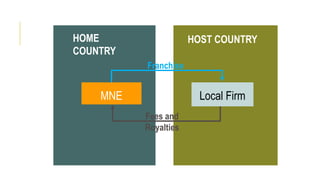
Local Firm
Franchise
HOME
COUNTRY
HOST COUNTRY
MNE
Fees and
Royalties
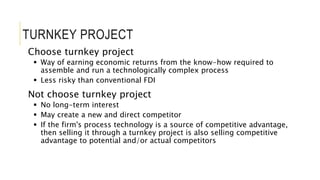
TURNKEY PROJECT
Choose turnkey project
 Way of earning economic returns from the know-how required to
assemble and run a technologically complex process
 Less risky than conventional FDI
Not choose turnkey project
 No long-term interest
 May create a new and direct competitor
 If the firm's process technology is a source of competitive advantage,
then selling it through a turnkey project is also selling competitive
advantage to potential and/or actual competitors
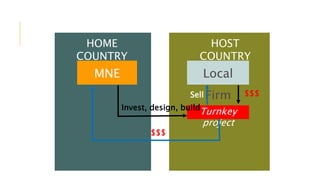
Turnkey
project
Invest, design, build
MNE Local
Firm
HOME
COUNTRY
HOST
COUNTRY
$$$
$$$
Sell
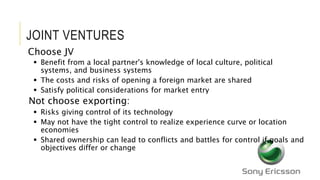
JOINT VENTURES
Choose JV
 Benefit from a local partner's knowledge of local culture, political
systems, and business systems
 The costs and risks of opening a foreign market are shared
 Satisfy political considerations for market entry
Not choose exporting:
 Risks giving control of its technology
 May not have the tight control to realize experience curve or location
economies
 Shared ownership can lead to conflicts and battles for control if goals and
objectives differ or change
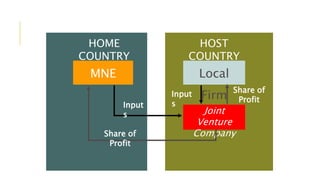
Joint
Venture
Company
Input
s
MNE Local
Firm
HOME
COUNTRY
HOST
COUNTRY
Input
s
Share of
Profit
Share of
Profit
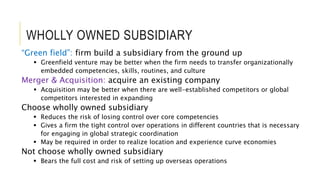
WHOLLY OWNED SUBSIDIARY
“Green field”: firm build a subsidiary from the ground up
 Greenfield venture may be better when the firm needs to transfer organizationally
embedded competencies, skills, routines, and culture
Merger & Acquisition: acquire an existing company
 Acquisition may be better when there are well-established competitors or global
competitors interested in expanding
Choose wholly owned subsidiary
 Reduces the risk of losing control over core competencies
 Gives a firm the tight control over operations in different countries that is necessary
for engaging in global strategic coordination
 May be required in order to realize location and experience curve economies
Not choose wholly owned subsidiary
 Bears the full cost and risk of setting up overseas operations
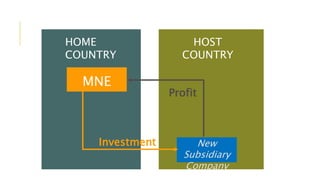
New
Subsidiary
Company
Investment
HOME
COUNTRY
HOST
COUNTRY
MNE
Profit
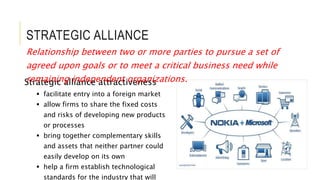
STRATEGIC ALLIANCE
Strategic alliance attractiveness
 facilitate entry into a foreign market
 allow firms to share the fixed costs
and risks of developing new products
or processes
 bring together complementary skills
and assets that neither partner could
easily develop on its own
 help a firm establish technological
standards for the industry that will
Relationship between two or more parties to pursue a set of
agreed upon goals or to meet a critical business need while
remaining independent organizations.

International market entry modes

  • 1.
    INTERNATIONAL BUSINESS Modesof entry Dr. Nguyen Hai Ninh
  • 2.
    WHEN SHOULD AFIRM ENTER A FOREIGN MARKET? “Once attractive markets are identified, the firm must consider the timing of entry” 1. Early Entry – when the firm enters a foreign market before other foreign firms 2. Late entry – when the firm enters the market after firms have already established themselves in the market
  • 3.
  • 4.
    Pros • The abilityto pre-empt rivals by establishing a strong brand name • The ability to build up sales volume, experience curve • The ability to tie customers into products or services and making it difficult for later entrants to win business PROS & CONS Cons • Pioneering costs - arise when the foreign business is so different from the home market • The expense to learn the rules of new business game • The costs of business failure, mistakes • The costs of promoting and educating customers
  • 5.
    MODES OF ENTRY •Export • Licensing • Franchising • Turnkey project • Join venture • Whole owned subsidiary 6
  • 6.
    EXPORTING Mostly, first stepto enter the global market Choose exporting:  it avoids the costs of establishing local manufacturing operations  it helps the firm achieve experience curve and location economies Not choose exporting:  high transport costs and tariffs can make it uneconomical  agents in a foreign country may not act in exporter’s best interest Type of exporting  Indirect Exporting (Export merchants, Export agents, Export management companies (EMC)  Cooperative Exporting (Piggyback Exporting)  Direct Exporting (Firms set up their own exporting departments)
  • 7.
    HOME COUNTRY HOSTCOUNTRY Export of Goods MNE Revenues Customers
  • 8.
    LICENSING Choose licensing  Thefirm avoids development costs and risks associated with opening a foreign market  It avoids barriers to investment  Capitalize on market opportunities without developing those applications itself Not choose licensing  The firm doesn’t have the tight control required for realizing experience curve and location economies  ability to coordinate strategic moves is limited  proprietary (or intangible) assets could be lost
  • 9.
  • 10.
    FRANCHISING Choose franchising  itavoids the costs and risks of opening up a foreign market  firms can quickly build a global presence Not choose exporting:  it inhibits the firm's ability to take profits out of one country to support competitive attacks in another  the geographic distance of the firm from franchisees can make it difficult to detect poor quality
  • 11.
  • 12.
    TURNKEY PROJECT Choose turnkeyproject  Way of earning economic returns from the know-how required to assemble and run a technologically complex process  Less risky than conventional FDI Not choose turnkey project  No long-term interest  May create a new and direct competitor  If the firm's process technology is a source of competitive advantage, then selling it through a turnkey project is also selling competitive advantage to potential and/or actual competitors
  • 13.
    Turnkey project Invest, design, build MNELocal Firm HOME COUNTRY HOST COUNTRY $$$ $$$ Sell
  • 14.
    JOINT VENTURES Choose JV Benefit from a local partner's knowledge of local culture, political systems, and business systems  The costs and risks of opening a foreign market are shared  Satisfy political considerations for market entry Not choose exporting:  Risks giving control of its technology  May not have the tight control to realize experience curve or location economies  Shared ownership can lead to conflicts and battles for control if goals and objectives differ or change
  • 15.
  • 16.
    WHOLLY OWNED SUBSIDIARY “Greenfield”: firm build a subsidiary from the ground up  Greenfield venture may be better when the firm needs to transfer organizationally embedded competencies, skills, routines, and culture Merger & Acquisition: acquire an existing company  Acquisition may be better when there are well-established competitors or global competitors interested in expanding Choose wholly owned subsidiary  Reduces the risk of losing control over core competencies  Gives a firm the tight control over operations in different countries that is necessary for engaging in global strategic coordination  May be required in order to realize location and experience curve economies Not choose wholly owned subsidiary  Bears the full cost and risk of setting up overseas operations
  • 17.
  • 18.
    STRATEGIC ALLIANCE Strategic allianceattractiveness  facilitate entry into a foreign market  allow firms to share the fixed costs and risks of developing new products or processes  bring together complementary skills and assets that neither partner could easily develop on its own  help a firm establish technological standards for the industry that will Relationship between two or more parties to pursue a set of agreed upon goals or to meet a critical business need while remaining independent organizations.