Market Entry Methods 
Presented By: 
Krishna Kumar Jaisawal 
MBA-IB 3rd sem 
Roll no:19
Introduction 
• When an organization has made a decision to 
enter an overseas market, there are a variety of 
option open to it. 
• These option vary with cost, risk and the degree 
of control which can be exercise over them. 
• One of the important strategic decision in 
international business is the mode of entering the 
foreign market.
Introduction 
• A market entry strategy is the planned method of 
delivering goods or services to a target market and 
distributing them there. 
• A institutional mechanism by which a firm makes its 
products and services available to consumer in 
overseas market. 
• Franklin Root defines the market entry strategy as “a 
comprehensive plan which sets forth the objectives, 
goals, resources and polices that guide a company’s 
international business operation for sustainable growth 
in the world.”
4 
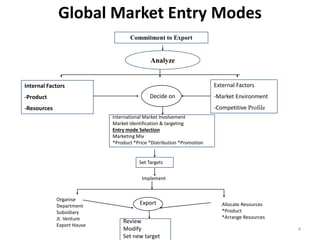
Global Market Entry Modes 
Commitment to Export 
Analyze 
Internal Factors 
-Product 
-Resources 
External Factors 
-Market Environment 
-Competitive Profile 
Decide on 
International Market Involvement 
Market Identification & targeting 
Entry mode Selection 
Marketing Mix 
*Product *Price *Distribution *Promotion 
Organise 
Department 
Subsidiary 
Jt. Venture 
Export House 
Allocate Resources 
*Product 
*Arrange Resources 
Set Targets 
Implement 
Export 
Review 
Modify 
Set new target
Concept of International Market Entry 
• Once a firm has decided to establish itself in global 
market—it becomes necessary that the Company studies 
and analyzes the various options available to enter the 
international markets and select the most suitable one. 
• This decision is to be taken with ulmost care—Not only is 
the financial resources in stake but the extent to which the 
company‘s marketing strategy can be employed in the new 
market also depends on this decision 
• Mode of entry varies from low -risk ,low-control modes 
with minimum resource commitment e.g. indirect exports 
to high-risk, high control modes with a higher level of 
commitment by establishing its own manufacturing 
facilities in foreign markets (subsidiaries).
Key Issues 
An organization willing to “go international” faces 3 
major issues: 
• Marketing: which countries, which segments, 
how to manage, how to enter, with what 
information 
• Sourcing : whether to obtain products, make or 
buy 
• Investment & control: joint venture, global 
partner, acquisition
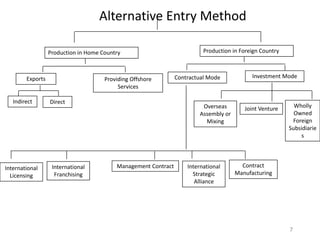
Alternative Entry Method 
7 
Production in Home Country Production in Foreign Country 
Exports Providing Offshore 
Services 
Contractual Mode Investment Mode 
Direct 
Overseas 
Assembly or 
Mixing 
Joint Venture Wholly 
Owned 
Foreign 
Subsidiarie 
s 
International 
Franchising 
Management Contract International 
Strategic 
Alliance 
Contract 
Manufacturing 
Indirect 
International 
Licensing
Production in Home Country: 
1.Export Entry: 
A firm has two basic options for carrying out export 
operation. 
• Market contacted through a domestically located 
intermediary—an approach called Indirect Exporting 
• Market can be reached through an intermediary located 
in foreign market--an approach termed as Direct 
Exporting
Indirect Export 
a situation in which a company sells its products to customers in 
another country using an intermediary (= a person or 
organization that arranges business agreements), or a product 
that is sold in this way 
Direct Export 
a situation in which a company sells its products directly to 
customers in another country without using another person or 
organization to make arrangements for them, or a product that 
is sold in this way
Production in foreign country 
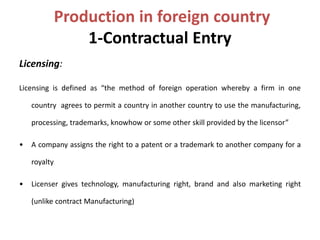
1-Contractual Entry 
Licensing: 
Licensing is defined as “the method of foreign operation whereby a firm in one 
country agrees to permit a country in another country to use the manufacturing, 
processing, trademarks, knowhow or some other skill provided by the licensor” 
• A company assigns the right to a patent or a trademark to another company for a 
royalty 
• Licenser gives technology, manufacturing right, brand and also marketing right 
(unlike contract Manufacturing)
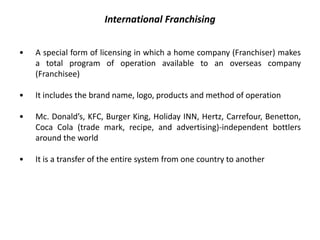
International Franchising 
• A special form of licensing in which a home company (Franchiser) makes 
a total program of operation available to an overseas company 
(Franchisee) 
• It includes the brand name, logo, products and method of operation 
• Mc. Donald’s, KFC, Burger King, Holiday INN, Hertz, Carrefour, Benetton, 
Coca Cola (trade mark, recipe, and advertising)-independent bottlers 
around the world 
• It is a transfer of the entire system from one country to another
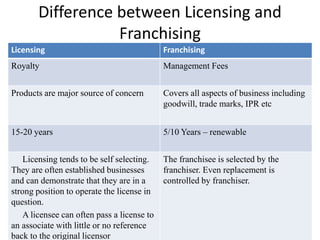
Difference between Licensing and 
Franchising 
Licensing Franchising 
Royalty Management Fees 
Products are major source of concern Covers all aspects of business including 
goodwill, trade marks, IPR etc 
15-20 years 5/10 Years – renewable 
Licensing tends to be self selecting. 
They are often established businesses 
and can demonstrate that they are in a 
strong position to operate the license in 
question. 
A licensee can often pass a license to 
an associate with little or no reference 
back to the original licensor 
The franchisee is selected by the 
franchiser. Even replacement is 
controlled by franchiser.
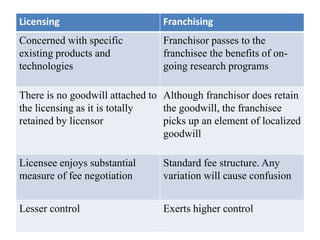
Licensing Franchising 
Concerned with specific 
existing products and 
technologies 
Franchisor passes to the 
franchisee the benefits of on-going 
research programs 
There is no goodwill attached to 
the licensing as it is totally 
retained by licensor 
Although franchisor does retain 
the goodwill, the franchisee 
picks up an element of localized 
goodwill 
Licensee enjoys substantial 
measure of fee negotiation 
Standard fee structure. Any 
variation will cause confusion 
Lesser control Exerts higher control
Management contract 
A management contract is an arrangement under which operational control 
of an enterprise is vested by contract in a separate enterprise which performs 
the necessary managerial functions in return for a fee 
A management contract can involve a wide range of functions, such as 
technical operation of a production facility, management of personnel, 
accounting, marketing services and training.
International Strategic Alliance 
An important mode of doing international business. An alliance 
is an inter-firm collaboration over a given economic space and 
time for the attainment of the participating companies’ goals. 
contract manufacturing 
A contract manufacturer ("CM") is a manufacturer that contracts 
with a firm for components or products. It is a form of 
outsourcing
2-Investment mode 
Joint Venture: 
• Joint venture can be defined as “an enterprise in which two or 
more investors share ownership and control over property 
right and operation”. 
• It is very common strategy to enter in the foreign market. 
• Any firm of association which implies collaboration for more 
than a transitory period is a joint venture. 
• A joint venture may be brought about by a foreign investor 
showing an interest in local company.
Wholly Owned Foreign Subsidiaries 
A wholly owned subsidiary is a company that is completely 
owned by another company called the parent company or 
holding company. The parent company will hold all of the 
subsidiary's common stock. Since the parent company owns all 
of the subsidiary's stock, it has the right to appoint the 
subsidiary's board of directors, which controls the subsidiary.
market entry methods

market entry methods

  • 1.
    Market Entry Methods Presented By: Krishna Kumar Jaisawal MBA-IB 3rd sem Roll no:19
  • 2.
    Introduction • Whenan organization has made a decision to enter an overseas market, there are a variety of option open to it. • These option vary with cost, risk and the degree of control which can be exercise over them. • One of the important strategic decision in international business is the mode of entering the foreign market.
  • 3.
    Introduction • Amarket entry strategy is the planned method of delivering goods or services to a target market and distributing them there. • A institutional mechanism by which a firm makes its products and services available to consumer in overseas market. • Franklin Root defines the market entry strategy as “a comprehensive plan which sets forth the objectives, goals, resources and polices that guide a company’s international business operation for sustainable growth in the world.”
  • 4.
    4 Global MarketEntry Modes Commitment to Export Analyze Internal Factors -Product -Resources External Factors -Market Environment -Competitive Profile Decide on International Market Involvement Market Identification & targeting Entry mode Selection Marketing Mix *Product *Price *Distribution *Promotion Organise Department Subsidiary Jt. Venture Export House Allocate Resources *Product *Arrange Resources Set Targets Implement Export Review Modify Set new target
  • 5.
    Concept of InternationalMarket Entry • Once a firm has decided to establish itself in global market—it becomes necessary that the Company studies and analyzes the various options available to enter the international markets and select the most suitable one. • This decision is to be taken with ulmost care—Not only is the financial resources in stake but the extent to which the company‘s marketing strategy can be employed in the new market also depends on this decision • Mode of entry varies from low -risk ,low-control modes with minimum resource commitment e.g. indirect exports to high-risk, high control modes with a higher level of commitment by establishing its own manufacturing facilities in foreign markets (subsidiaries).
  • 6.
    Key Issues Anorganization willing to “go international” faces 3 major issues: • Marketing: which countries, which segments, how to manage, how to enter, with what information • Sourcing : whether to obtain products, make or buy • Investment & control: joint venture, global partner, acquisition
  • 7.
    Alternative Entry Method 7 Production in Home Country Production in Foreign Country Exports Providing Offshore Services Contractual Mode Investment Mode Direct Overseas Assembly or Mixing Joint Venture Wholly Owned Foreign Subsidiarie s International Franchising Management Contract International Strategic Alliance Contract Manufacturing Indirect International Licensing
  • 8.
    Production in HomeCountry: 1.Export Entry: A firm has two basic options for carrying out export operation. • Market contacted through a domestically located intermediary—an approach called Indirect Exporting • Market can be reached through an intermediary located in foreign market--an approach termed as Direct Exporting
  • 9.
    Indirect Export asituation in which a company sells its products to customers in another country using an intermediary (= a person or organization that arranges business agreements), or a product that is sold in this way Direct Export a situation in which a company sells its products directly to customers in another country without using another person or organization to make arrangements for them, or a product that is sold in this way
  • 10.
    Production in foreigncountry 1-Contractual Entry Licensing: Licensing is defined as “the method of foreign operation whereby a firm in one country agrees to permit a country in another country to use the manufacturing, processing, trademarks, knowhow or some other skill provided by the licensor” • A company assigns the right to a patent or a trademark to another company for a royalty • Licenser gives technology, manufacturing right, brand and also marketing right (unlike contract Manufacturing)
  • 11.
    International Franchising •A special form of licensing in which a home company (Franchiser) makes a total program of operation available to an overseas company (Franchisee) • It includes the brand name, logo, products and method of operation • Mc. Donald’s, KFC, Burger King, Holiday INN, Hertz, Carrefour, Benetton, Coca Cola (trade mark, recipe, and advertising)-independent bottlers around the world • It is a transfer of the entire system from one country to another
  • 12.
    Difference between Licensingand Franchising Licensing Franchising Royalty Management Fees Products are major source of concern Covers all aspects of business including goodwill, trade marks, IPR etc 15-20 years 5/10 Years – renewable Licensing tends to be self selecting. They are often established businesses and can demonstrate that they are in a strong position to operate the license in question. A licensee can often pass a license to an associate with little or no reference back to the original licensor The franchisee is selected by the franchiser. Even replacement is controlled by franchiser.
  • 13.
    Licensing Franchising Concernedwith specific existing products and technologies Franchisor passes to the franchisee the benefits of on-going research programs There is no goodwill attached to the licensing as it is totally retained by licensor Although franchisor does retain the goodwill, the franchisee picks up an element of localized goodwill Licensee enjoys substantial measure of fee negotiation Standard fee structure. Any variation will cause confusion Lesser control Exerts higher control
  • 14.
    Management contract Amanagement contract is an arrangement under which operational control of an enterprise is vested by contract in a separate enterprise which performs the necessary managerial functions in return for a fee A management contract can involve a wide range of functions, such as technical operation of a production facility, management of personnel, accounting, marketing services and training.
  • 15.
    International Strategic Alliance An important mode of doing international business. An alliance is an inter-firm collaboration over a given economic space and time for the attainment of the participating companies’ goals. contract manufacturing A contract manufacturer ("CM") is a manufacturer that contracts with a firm for components or products. It is a form of outsourcing
  • 16.
    2-Investment mode JointVenture: • Joint venture can be defined as “an enterprise in which two or more investors share ownership and control over property right and operation”. • It is very common strategy to enter in the foreign market. • Any firm of association which implies collaboration for more than a transitory period is a joint venture. • A joint venture may be brought about by a foreign investor showing an interest in local company.
  • 17.
    Wholly Owned ForeignSubsidiaries A wholly owned subsidiary is a company that is completely owned by another company called the parent company or holding company. The parent company will hold all of the subsidiary's common stock. Since the parent company owns all of the subsidiary's stock, it has the right to appoint the subsidiary's board of directors, which controls the subsidiary.