Literature Elements
Plot, Theme, Character, Conflict,
Setting & Point of View
Plot
• PLOT -- The plot is how the author
arranges events to develop his/her basic
idea; it is the sequence of events in a story
or play. The plot is a planned, logical
series of events having a beginning,
middle, and end. There are five essential
parts of plot:
Plot
• a) Introduction - The beginning of the
story where the characters and the setting
is revealed.
Plot
• b) Rising Action - This is where the
events in the story become complicated
and the conflict in the story is revealed
(events between the introduction and
climax).
Plot
• c) Climax - This is the highest point of
interest and the turning point of the
story. The reader wonders what will
happen next; will the conflict be resolved
or not?
Plot
• d) Falling action - The events and
complications begin to resolve
themselves. The reader knows what has
happened next and if the conflict was
resolved or not (events between climax
and denouement).
Plot
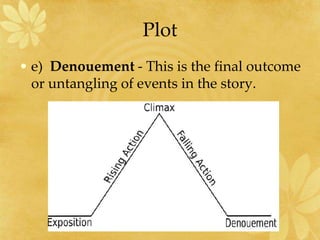
• e) Denouement - This is the final outcome
or untangling of events in the story.
Theme
• THEME -- The theme in a piece of fiction
is its controlling idea or its central
insight. It is the author's underlying
meaning or main idea that she/he is trying
to convey. The theme may be the author's
thoughts about a topic or view of human
nature.
Theme
• Some simple examples of common themes
from literature, TV, and film are:
- Things are not always as they appear to be
- Love is blind
- Believe in yourself
- People are afraid of change
- Don't judge a book by its cover
Character
• Protagonist and Antagonist
• One character is usually clearly central to
the story with all major events having
some importance to this character - he/she
is the PROTAGONIST.
• The one who opposes the main character
is called the ANTAGONIST.
Character
• The Characteristics of a Person -
In order for a story to seem real to the reader its
characters must seem real. Characterization is
the information the author gives the reader
about the characters themselves. The author
may reveal a character in several ways:
a) his/her physical appearance
b) what he/she says, thinks, feels and dreams
c) what he/she does or does not do
d) what others say about him/her and how
others react to him/her
Conflict
• CONFLICT-- Conflict is essential to
plot. Without conflict there is no plot. It
is the opposition of forces which ties one
incident to another and makes the plot
move. Conflict doesn’t just mean
arguments, but it is any form of
opposition that faces the main character.
Within a short story there may be only one
central struggle, or there may be one
dominant struggle with many minor ones.
Conflict
• Person vs. Person – when one character is struggling
against another.
• Person vs. Nature – when a character is struggling
against the forces of nature (for example, a storm, an
animal, the wilderness, etc.)
• Person vs. Society – when a character struggles against
ideas, practices, or customs of other people.
• Person vs. Self - The leading character struggles with
himself/herself; with his/her own soul, ideas of right or
wrong, physical limitations, choices, etc.
Setting
• SETTING -- The time and location in
which a story takes place is called the
setting. For some stories the setting is
very important, while for others it is
not. There are several aspects of a story's
setting to consider when examining how
setting contributes to a story (some, or all,
may be present in a story)
Setting
• a) place - geographical location. Where is the action of
the story taking place?
• b) time - When is the story taking place? (historical
period, time of day, year, etc)
• c) weather conditions - Is it rainy, sunny, stormy, etc?
• d) social conditions - What is the daily life of the
character's like? Does the story contain local colour
(writing that focuses on the speech, dress, mannerisms,
customs, etc. of a particular place)?
• e) mood or atmosphere - What feeling is created at the
beginning of the story? Is it bright and cheerful or dark
and frightening?
Point Of View
• The vantage point in which the story is told.
• First Person - ‘I’
• Third Person - ‘He, she it”
• Omniscient-having infinite awareness,
understanding, and insight
possessed of universal or complete knowledge

Literature Elements

  • 1.
    Literature Elements Plot, Theme,Character, Conflict, Setting & Point of View
  • 2.
    Plot • PLOT --The plot is how the author arranges events to develop his/her basic idea; it is the sequence of events in a story or play. The plot is a planned, logical series of events having a beginning, middle, and end. There are five essential parts of plot:
  • 3.
    Plot • a) Introduction- The beginning of the story where the characters and the setting is revealed.
  • 4.
    Plot • b) RisingAction - This is where the events in the story become complicated and the conflict in the story is revealed (events between the introduction and climax).
  • 5.
    Plot • c) Climax- This is the highest point of interest and the turning point of the story. The reader wonders what will happen next; will the conflict be resolved or not?
  • 6.
    Plot • d) Fallingaction - The events and complications begin to resolve themselves. The reader knows what has happened next and if the conflict was resolved or not (events between climax and denouement).
  • 7.
    Plot • e) Denouement- This is the final outcome or untangling of events in the story.
  • 8.
    Theme • THEME --The theme in a piece of fiction is its controlling idea or its central insight. It is the author's underlying meaning or main idea that she/he is trying to convey. The theme may be the author's thoughts about a topic or view of human nature.
  • 9.
    Theme • Some simpleexamples of common themes from literature, TV, and film are: - Things are not always as they appear to be - Love is blind - Believe in yourself - People are afraid of change - Don't judge a book by its cover
  • 10.
    Character • Protagonist andAntagonist • One character is usually clearly central to the story with all major events having some importance to this character - he/she is the PROTAGONIST. • The one who opposes the main character is called the ANTAGONIST.
  • 11.
    Character • The Characteristicsof a Person - In order for a story to seem real to the reader its characters must seem real. Characterization is the information the author gives the reader about the characters themselves. The author may reveal a character in several ways: a) his/her physical appearance b) what he/she says, thinks, feels and dreams c) what he/she does or does not do d) what others say about him/her and how others react to him/her
  • 12.
    Conflict • CONFLICT-- Conflictis essential to plot. Without conflict there is no plot. It is the opposition of forces which ties one incident to another and makes the plot move. Conflict doesn’t just mean arguments, but it is any form of opposition that faces the main character. Within a short story there may be only one central struggle, or there may be one dominant struggle with many minor ones.
  • 13.
    Conflict • Person vs.Person – when one character is struggling against another. • Person vs. Nature – when a character is struggling against the forces of nature (for example, a storm, an animal, the wilderness, etc.) • Person vs. Society – when a character struggles against ideas, practices, or customs of other people. • Person vs. Self - The leading character struggles with himself/herself; with his/her own soul, ideas of right or wrong, physical limitations, choices, etc.
  • 14.
    Setting • SETTING --The time and location in which a story takes place is called the setting. For some stories the setting is very important, while for others it is not. There are several aspects of a story's setting to consider when examining how setting contributes to a story (some, or all, may be present in a story)
  • 15.
    Setting • a) place- geographical location. Where is the action of the story taking place? • b) time - When is the story taking place? (historical period, time of day, year, etc) • c) weather conditions - Is it rainy, sunny, stormy, etc? • d) social conditions - What is the daily life of the character's like? Does the story contain local colour (writing that focuses on the speech, dress, mannerisms, customs, etc. of a particular place)? • e) mood or atmosphere - What feeling is created at the beginning of the story? Is it bright and cheerful or dark and frightening?
  • 16.
    Point Of View •The vantage point in which the story is told. • First Person - ‘I’ • Third Person - ‘He, she it” • Omniscient-having infinite awareness, understanding, and insight possessed of universal or complete knowledge