LITERARY TERMS
Literary Terms
 Characters
 People in a story, play,
novel
Major Characters
 most important
Minor Characters
 less important
Literary Terms
Characterization – The way the author
presents the personality of a character.
Directly - describing the character
Indirectly - by showing the character’s actions,
speech, and thoughts and how they affect the
other characters.
Character Traits – the qualities that a
character possesses.
Literary Terms
 Setting
Time, place, and
general environment of
a story.
When and where
Established through
description
Creates a certain
atmosphere or mood
Literary Terms
 Plot
 sequence of events in a short story, novel, play, or poem.
 Subplot
 minor plot in a story that is usually related to the main plot and
supports the main plot.
Major Elements of the Plot:
- Conflict
- Rising Action
- Climax
- Resolution
Literary Terms
 Conflict
 Problem in a story.
Internal Conflict
Struggle in the mind of a character
who must resolve something.
External Conflict
Struggle between characters;
between characters and a force of
nature
Literary Terms
 Rising Action
Action builds and a problem or
conflict develops.
 Climax
Problem reaches a high point and
the outcome becomes known.
Literary Terms
Resolution
Problem or conflict is solved.
Literary Terms
Theme
 Main idea
 Message the writer conveys
Whole story, title, plot, characters, setting, and
mood.
Literary Terms
 Point of View
Who is telling the story?
1st Person
Narrator is usually a character in the story. (uses the
pronouns “I” or “we”).
3rd Person
Most common
 Narrator may or may not be a character in the story.
(uses the pronouns “he,” “she,” or “they”),
Literary Terms
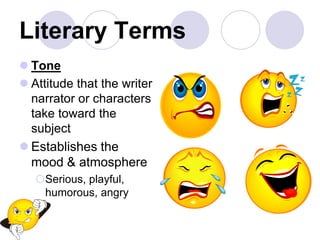
 Tone
 Attitude that the writer
narrator or characters
take toward the
subject
 Establishes the
mood & atmosphere
Serious, playful,
humorous, angry
Literary Terms
 Style
The way the author
expresses his/her ideas
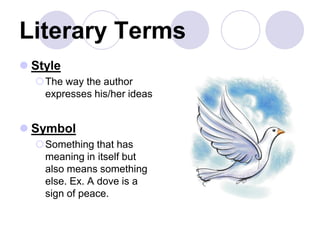
 Symbol
Something that has
meaning in itself but
also means something
else. Ex. A dove is a
sign of peace.
Literary Terms
Figurative language
Words used in a special way to add meaning.
Bold Words!
Metaphor
comparison between two unlike things. Ex. Her
eyes were stars in the midnight sky.
Simile
two things are compared using “as,” or “like.”
Ex. Her eyes sparkled like diamonds.
Literary Terms
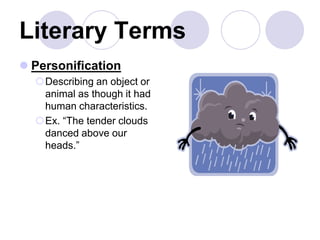
 Personification
Describing an object or
animal as though it had
human characteristics.
Ex. “The tender clouds
danced above our
heads.”
Literary Terms
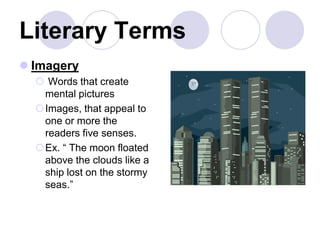
 Imagery
 Words that create
mental pictures
Images, that appeal to
one or more the
readers five senses.
Ex. “ The moon floated
above the clouds like a
ship lost on the stormy
seas.”
Literary Terms
Flashback
Interrupts the present action in a story to tell
about something that happened in the past.
(The movie “The Notebook”)
Foreshadowing
 Hints in a story that give the reader advance
warning of events to come.
Literary Terms
Irony
contrast or difference between what you think
will happen & what actually happens
A situation is ironic when it is totally different
from what the reader or character expected.
Literary Terms
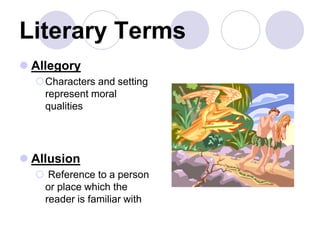
 Allegory
Characters and setting
represent moral
qualities
 Allusion
 Reference to a person
or place which the
reader is familiar with
Literary Terms
Alliteration
repetition of the initial consonant sound
Adds musical quality
Rhythm
Creates mood and emphasis
She sells sea shells at the sea shore
Literary Terms
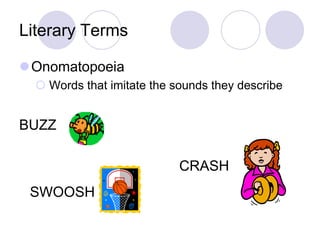
Onomatopoeia
 Words that imitate the sounds they describe
BUZZ
CRASH
SWOOSH
Literary Terms
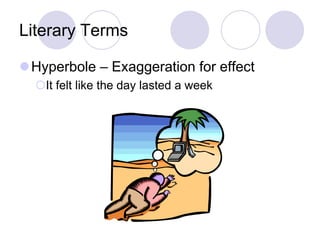
Hyperbole – Exaggeration for effect
It felt like the day lasted a week
Literary Terms
 Denotation
Dictionary meaning of a work
 Connotation
Suggested or implied meaning
of a word
Munch and chew mean
basically the same
Literary Terms
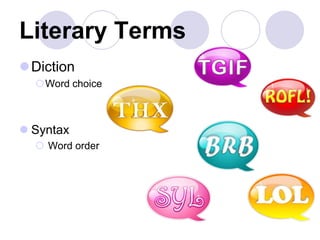
Diction
Word choice
 Syntax
 Word order
Literary Terms – Poetry
Ballad
Narrative poem written in rhythmic stanzas
Old form of Poetry (originally sung)
Emotion and adventure
Couplet
2 consecutive lines of poetry that rhyme
Literary Terms – Poetry
 Descriptive poem
Short poem
Reveals the poet’s
feelings about what is
being described
Literary Terms – Poetry
 Free verse
 No regular sequence or
pattern of rhythm
 Light verse
 Amusing
Literary Terms – Poetry
 Nonsense verse
Humor results from unusual
rhythm, play on words, or
absurd ideas.
 Lyric poetry
Expresses the poet’s feelings
Short
Reaction to an experience
Literary Terms – Poetry
Narrative poem
tells a story
Quatrain
stanza of four lines
Refrain
 a line or phrase repeated at regular points in a
poem (usually at the end of each stanza)
Literary Terms – Poetry
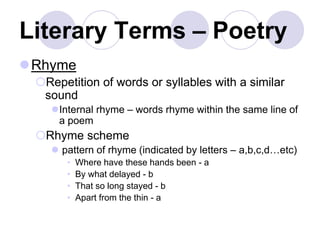
Rhyme
Repetition of words or syllables with a similar
sound
Internal rhyme – words rhyme within the same line of
a poem
Rhyme scheme
 pattern of rhyme (indicated by letters – a,b,c,d…etc)
• Where have these hands been - a
• By what delayed - b
• That so long stayed - b
• Apart from the thin - a
Literary Terms – Poetry
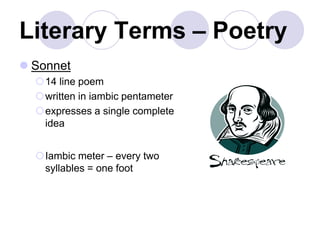
 Sonnet
14 line poem
written in iambic pentameter
expresses a single complete
idea
Iambic meter – every two
syllables = one foot
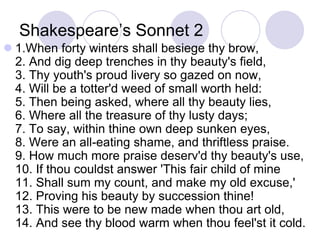
Shakespeare’s Sonnet 2
 1.When forty winters shall besiege thy brow,
2. And dig deep trenches in thy beauty's field,
3. Thy youth's proud livery so gazed on now,
4. Will be a totter'd weed of small worth held:
5. Then being asked, where all thy beauty lies,
6. Where all the treasure of thy lusty days;
7. To say, within thine own deep sunken eyes,
8. Were an all-eating shame, and thriftless praise.
9. How much more praise deserv'd thy beauty's use,
10. If thou couldst answer 'This fair child of mine
11. Shall sum my count, and make my old excuse,'
12. Proving his beauty by succession thine!
13. This were to be new made when thou art old,
14. And see thy blood warm when thou feel'st it cold.
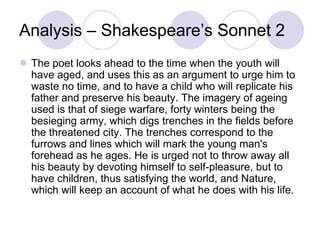
Analysis – Shakespeare’s Sonnet 2
 The poet looks ahead to the time when the youth will
have aged, and uses this as an argument to urge him to
waste no time, and to have a child who will replicate his
father and preserve his beauty. The imagery of ageing
used is that of siege warfare, forty winters being the
besieging army, which digs trenches in the fields before
the threatened city. The trenches correspond to the
furrows and lines which will mark the young man's
forehead as he ages. He is urged not to throw away all
his beauty by devoting himself to self-pleasure, but to
have children, thus satisfying the world, and Nature,
which will keep an account of what he does with his life.
Literary Terms
Drama – Literature meant to be performed
on a stage
Literary Terms
Plays are usually broken up into
Acts
Scenes

Literary devices otl

  • 1.
  • 2.
    Literary Terms  Characters People in a story, play, novel Major Characters  most important Minor Characters  less important
  • 3.
    Literary Terms Characterization –The way the author presents the personality of a character. Directly - describing the character Indirectly - by showing the character’s actions, speech, and thoughts and how they affect the other characters. Character Traits – the qualities that a character possesses.
  • 4.
    Literary Terms  Setting Time,place, and general environment of a story. When and where Established through description Creates a certain atmosphere or mood
  • 5.
    Literary Terms  Plot sequence of events in a short story, novel, play, or poem.  Subplot  minor plot in a story that is usually related to the main plot and supports the main plot. Major Elements of the Plot: - Conflict - Rising Action - Climax - Resolution
  • 6.
    Literary Terms  Conflict Problem in a story. Internal Conflict Struggle in the mind of a character who must resolve something. External Conflict Struggle between characters; between characters and a force of nature
  • 7.
    Literary Terms  RisingAction Action builds and a problem or conflict develops.  Climax Problem reaches a high point and the outcome becomes known.
  • 8.
  • 9.
    Literary Terms Theme  Mainidea  Message the writer conveys Whole story, title, plot, characters, setting, and mood.
  • 10.
    Literary Terms  Pointof View Who is telling the story? 1st Person Narrator is usually a character in the story. (uses the pronouns “I” or “we”). 3rd Person Most common  Narrator may or may not be a character in the story. (uses the pronouns “he,” “she,” or “they”),
  • 11.
    Literary Terms  Tone Attitude that the writer narrator or characters take toward the subject  Establishes the mood & atmosphere Serious, playful, humorous, angry
  • 12.
    Literary Terms  Style Theway the author expresses his/her ideas  Symbol Something that has meaning in itself but also means something else. Ex. A dove is a sign of peace.
  • 13.
    Literary Terms Figurative language Wordsused in a special way to add meaning. Bold Words! Metaphor comparison between two unlike things. Ex. Her eyes were stars in the midnight sky. Simile two things are compared using “as,” or “like.” Ex. Her eyes sparkled like diamonds.
  • 14.
    Literary Terms  Personification Describingan object or animal as though it had human characteristics. Ex. “The tender clouds danced above our heads.”
  • 15.
    Literary Terms  Imagery Words that create mental pictures Images, that appeal to one or more the readers five senses. Ex. “ The moon floated above the clouds like a ship lost on the stormy seas.”
  • 16.
    Literary Terms Flashback Interrupts thepresent action in a story to tell about something that happened in the past. (The movie “The Notebook”) Foreshadowing  Hints in a story that give the reader advance warning of events to come.
  • 17.
    Literary Terms Irony contrast ordifference between what you think will happen & what actually happens A situation is ironic when it is totally different from what the reader or character expected.
  • 18.
    Literary Terms  Allegory Charactersand setting represent moral qualities  Allusion  Reference to a person or place which the reader is familiar with
  • 19.
    Literary Terms Alliteration repetition ofthe initial consonant sound Adds musical quality Rhythm Creates mood and emphasis She sells sea shells at the sea shore
  • 20.
    Literary Terms Onomatopoeia  Wordsthat imitate the sounds they describe BUZZ CRASH SWOOSH
  • 21.
    Literary Terms Hyperbole –Exaggeration for effect It felt like the day lasted a week
  • 22.
    Literary Terms  Denotation Dictionarymeaning of a work  Connotation Suggested or implied meaning of a word Munch and chew mean basically the same
  • 23.
  • 24.
    Literary Terms –Poetry Ballad Narrative poem written in rhythmic stanzas Old form of Poetry (originally sung) Emotion and adventure Couplet 2 consecutive lines of poetry that rhyme
  • 25.
    Literary Terms –Poetry  Descriptive poem Short poem Reveals the poet’s feelings about what is being described
  • 26.
    Literary Terms –Poetry  Free verse  No regular sequence or pattern of rhythm  Light verse  Amusing
  • 27.
    Literary Terms –Poetry  Nonsense verse Humor results from unusual rhythm, play on words, or absurd ideas.  Lyric poetry Expresses the poet’s feelings Short Reaction to an experience
  • 28.
    Literary Terms –Poetry Narrative poem tells a story Quatrain stanza of four lines Refrain  a line or phrase repeated at regular points in a poem (usually at the end of each stanza)
  • 29.
    Literary Terms –Poetry Rhyme Repetition of words or syllables with a similar sound Internal rhyme – words rhyme within the same line of a poem Rhyme scheme  pattern of rhyme (indicated by letters – a,b,c,d…etc) • Where have these hands been - a • By what delayed - b • That so long stayed - b • Apart from the thin - a
  • 30.
    Literary Terms –Poetry  Sonnet 14 line poem written in iambic pentameter expresses a single complete idea Iambic meter – every two syllables = one foot
  • 31.
    Shakespeare’s Sonnet 2 1.When forty winters shall besiege thy brow, 2. And dig deep trenches in thy beauty's field, 3. Thy youth's proud livery so gazed on now, 4. Will be a totter'd weed of small worth held: 5. Then being asked, where all thy beauty lies, 6. Where all the treasure of thy lusty days; 7. To say, within thine own deep sunken eyes, 8. Were an all-eating shame, and thriftless praise. 9. How much more praise deserv'd thy beauty's use, 10. If thou couldst answer 'This fair child of mine 11. Shall sum my count, and make my old excuse,' 12. Proving his beauty by succession thine! 13. This were to be new made when thou art old, 14. And see thy blood warm when thou feel'st it cold.
  • 32.
    Analysis – Shakespeare’sSonnet 2  The poet looks ahead to the time when the youth will have aged, and uses this as an argument to urge him to waste no time, and to have a child who will replicate his father and preserve his beauty. The imagery of ageing used is that of siege warfare, forty winters being the besieging army, which digs trenches in the fields before the threatened city. The trenches correspond to the furrows and lines which will mark the young man's forehead as he ages. He is urged not to throw away all his beauty by devoting himself to self-pleasure, but to have children, thus satisfying the world, and Nature, which will keep an account of what he does with his life.
  • 33.
    Literary Terms Drama –Literature meant to be performed on a stage
  • 34.
    Literary Terms Plays areusually broken up into Acts Scenes