Elements of
Prose
a.k.a.- The parts of a
story
Prose
 There are 2 types of writing:
prose- anything that is NOT poetry or plays
poetry
 Prose is divided into 2 categories:
short story
novel
Short Story
 Definition: Fictional story that can be read in
one sitting.
Example: “A Rose for Emily,” “The Cask
of Amontillado,” or “The Most Dangerous
Game”
Novel
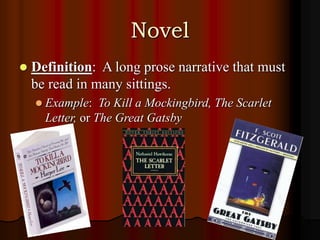
 Definition: A long prose narrative that must
be read in many sittings.
 Example: To Kill a Mockingbird, The Scarlet
Letter, or The Great Gatsby
Elements of Prose
 Plot
 Character
 Setting
 Point of View
 Theme
 Irony
 Symbol
Plot
 The “framework” or “skeleton” of the story;
A series of related events that are linked
together
What Makes Up Plot?
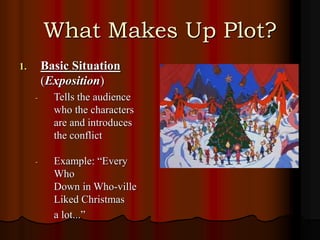
1. Basic Situation
(Exposition)
- Tells the audience
who the characters
are and introduces
the conflict
- Example: “Every
Who
Down in Who-ville
Liked Christmas
a lot...”
What Makes Up Plot?
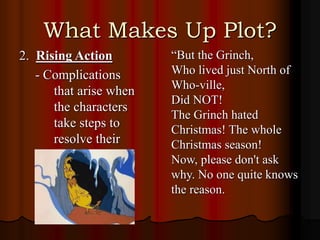
2. Rising Action
- Complications
that arise when
the characters
take steps to
resolve their
conflicts
“But the Grinch,
Who lived just North of
Who-ville,
Did NOT!
The Grinch hated
Christmas! The whole
Christmas season!
Now, please don't ask
why. No one quite knows
the reason.
What Makes Up Plot?
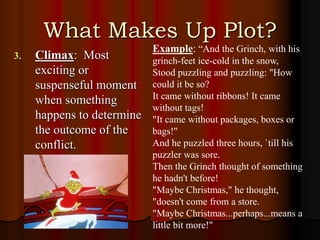
3. Climax: Most
exciting or
suspenseful moment
when something
happens to determine
the outcome of the
conflict.
Example: “And the Grinch, with his
grinch-feet ice-cold in the snow,
Stood puzzling and puzzling: "How
could it be so?
It came without ribbons! It came
without tags!
"It came without packages, boxes or
bags!"
And he puzzled three hours, `till his
puzzler was sore.
Then the Grinch thought of something
he hadn't before!
"Maybe Christmas," he thought,
"doesn't come from a store.
"Maybe Christmas...perhaps...means a
little bit more!"
What Makes Up Plot?
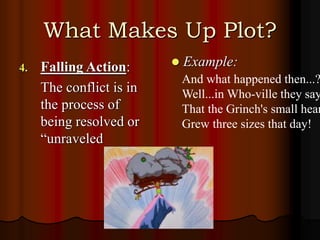
4. Falling Action:
The conflict is in
the process of
being resolved or
“unraveled
 Example:
And what happened then...?
Well...in Who-ville they say
That the Grinch's small hear
Grew three sizes that day!
What Makes Up Plot?
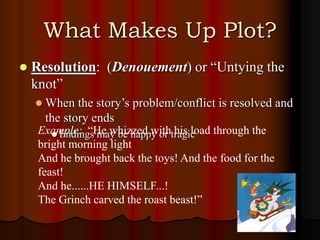
 Resolution: (Denouement) or “Untying the
knot”
 When the story’s problem/conflict is resolved and
the story ends
 Endings may be happy or tragic
Example: “He whizzed with his load through the
bright morning light
And he brought back the toys! And the food for the
feast!
And he......HE HIMSELF...!
The Grinch carved the roast beast!”
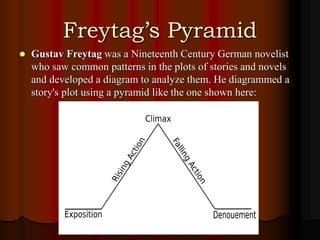
Freytag’s Pyramid
 Gustav Freytag was a Nineteenth Century German novelist
who saw common patterns in the plots of stories and novels
and developed a diagram to analyze them. He diagrammed a
story's plot using a pyramid like the one shown here:
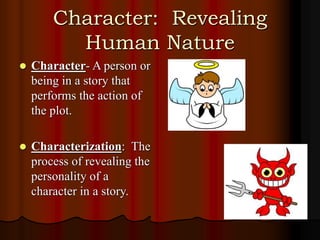
Character: Revealing
Human Nature
 Character- A person or
being in a story that
performs the action of
the plot.
 Characterization: The
process of revealing the
personality of a
character in a story.
Steps to the
Characterization Process
 A writer can reveal a character in the following ways:
1. Letting up hear the character speak
2. Describing how the character looks & dresses
3. Letting us listen to the character’s inner thoughts and
feelings
4. Revealing what other characters in the story think or
say about the character
5. Showing us what the character does – how he or she
acts
*These call on the reader to take the information he or she is
given to interpret for himself/herself the kind of
character he or she is reading about. This is called
INDIRECT CHARACTERIZATION
Steps to the
Characterization Process
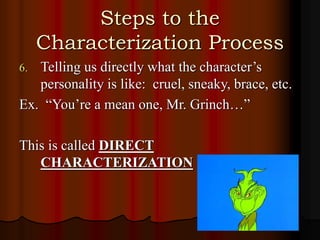
6. Telling us directly what the character’s
personality is like: cruel, sneaky, brace, etc.
Ex. “You’re a mean one, Mr. Grinch…”
This is called DIRECT
CHARACTERIZATION
Types of Characters
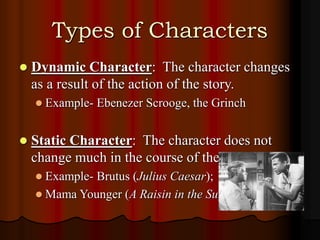
 Dynamic Character: The character changes
as a result of the action of the story.
 Example- Ebenezer Scrooge, the Grinch
 Static Character: The character does not
change much in the course of the story.
 Example- Brutus (Julius Caesar);
 Mama Younger (A Raisin in the Sun)
Types of Characters
 Protagonist: The main character of the story.
 Can be good or evil
 Antagonist: The character or force that comes
into conflict with the protagonist
 Can be another person, an animal, a force of
nature, society, the character’s own conscience,
etc.
Setting
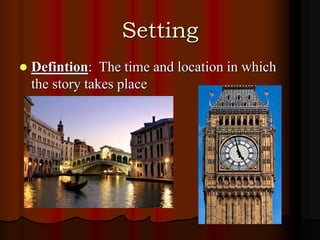
 Defintion: The time and location in which
the story takes place
Setting
 Purpose of Setting
1. Gives background information
2. Provides conflict
- Man vs. Nature, Man vs. Society
3. Can reveal a lot about someone’s character
4. Provides mood or atmosphere
- Mood- the feeling WE get when we read a
story
5. Can paint images for the reader
- Images – words that call forth the 5 senses
Theme
 Definition: The insight about human life that
is revealed in a literary work. The “golden
thread” woven throughout the story.
-The theme is what the author is saying through the
story (it’s a deeper truth about reality)
- The plot how he says it : it is the story he uses to
get this point across
Point of View
 Definition: The direction from which the
writer has chosen to tell the story
There are 3 Points of
View
1. First Person: One of the characters tells the
story; talks directly to the reader
- Uses the pronoun “I,” “me,” “we,” or “us”
2. Third Person Limited: The narrator will
focus on the thoughts & feelings of just one
character
- Reader experiences the events of the story through
the memory and senses of only one character
There are 3 Points of
View
3. Third-Person Omniscient- “All-knowing”
- An all-knowing narrator who refers to all
the characters as “he” and “she.” Knows the
thoughts and feelings of ALL of the
characters.
*The narrator is not necessarily the story’s
author*
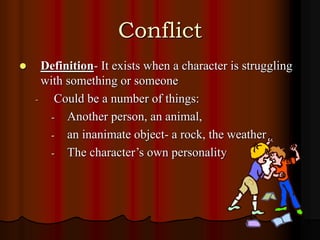
Conflict
 Definition- It exists when a character is struggling
with something or someone
- Could be a number of things:
- Another person, an animal,
- an inanimate object- a rock, the weather
- The character’s own personality
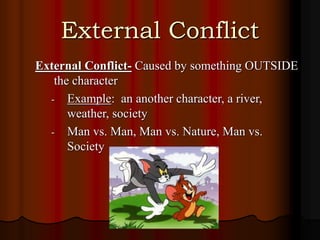
External Conflict
External Conflict- Caused by something OUTSIDE
the character
- Example: an another character, a river,
weather, society
- Man vs. Man, Man vs. Nature, Man vs.
Society
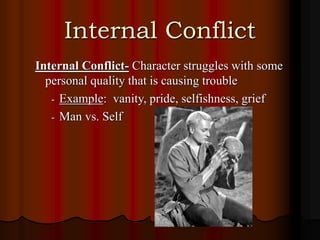
Internal Conflict
Internal Conflict- Character struggles with some
personal quality that is causing trouble
- Example: vanity, pride, selfishness, grief
- Man vs. Self
Foreshadowing
 Definition: Clues about what is going to
happen as the story unfolds
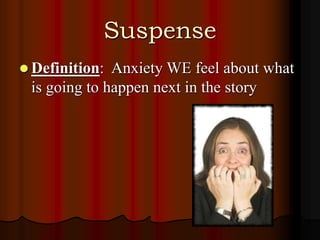
Suspense
 Definition: Anxiety WE feel about what
is going to happen next in the story
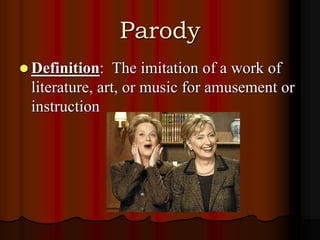
Parody
 Definition: The imitation of a work of
literature, art, or music for amusement or
instruction
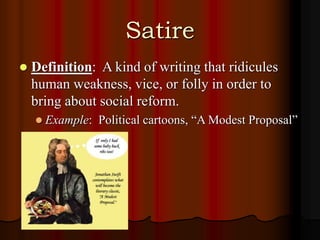
Satire
 Definition: A kind of writing that ridicules
human weakness, vice, or folly in order to
bring about social reform.
 Example: Political cartoons, “A Modest Proposal”
Irony
 Definition: An “unexpected twist” in a story
- 3 Types of Irony:
1. Verbal: Someone says one thing but
means another
- also known as sarcasm
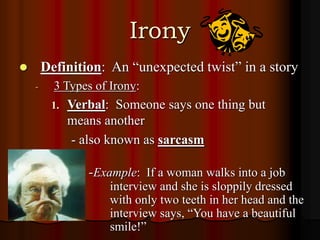
-Example: If a woman walks into a job
interview and she is sloppily dressed
with only two teeth in her head and the
interview says, “You have a beautiful
smile!”
Irony
2. Situational: When a reader expects one
thing to happen and the opposite occurs
- Example- Everyone knows the sad irony in “Richard
Cory.” Why would someone so successful and rich
be so unhappy as to kill himself? In a wonderfully
ironic letter, George Bernard Shaw celebrates his
mother’s death and cremation. Charles Dickens’
character Mr. McChoakumchild is
anything but a teacher.
Irony
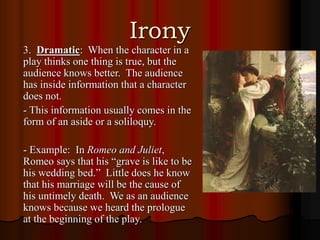
3. Dramatic: When the character in a
play thinks one thing is true, but the
audience knows better. The audience
has inside information that a character
does not.
- This information usually comes in the
form of an aside or a soliloquy.
- Example: In Romeo and Juliet,
Romeo says that his “grave is like to be
his wedding bed.” Little does he know
that his marriage will be the cause of
his untimely death. We as an audience
knows because we heard the prologue
at the beginning of the play.
More Elements of Prose
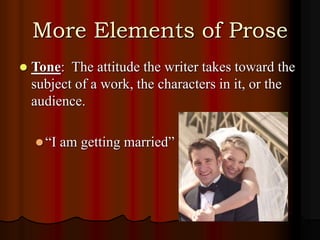
 Tone: The attitude the writer takes toward the
subject of a work, the characters in it, or the
audience.
“I am getting married”
Tone Example
 “The Author To Her Book”
Thou ill-formed offspring of my feeble
brain,
Who after birth did'st by my side remain,
Till snatcht from thence by friends, less
wise than true,
Who thee abroad exposed to public view,
Made thee in rags, halting to th' press to
trudge,
Where errors were not lessened (all may
judge).
At thy return my blushing was not small,
My rambling brat (in print) should
mother call.
I cast thee by as one unfit for light,
The visage was so irksome in my sight,
Yet being mine own, at length affection
would
Thy blemishes amend, if so I could.
I washed thy face, but more defects I
saw,
And rubbing off a spot, still made a flaw.
I stretcht thy joints to make thee even
feet,
Yet still thou run'st more hobbling than is
meet.
In better dress to trim thee was my mind,
But nought save home-spun cloth, i' th'
house I find.
In this array, 'mongst vulgars may'st thou
roam.
In critic's hands, beware thou dost not
come,
And take thy way where yet thou art not
known.
If for thy father askt, say, thou hadst
none;
And for thy mother, she alas is poor,
Which caused her thus to send thee out
of door.
Denotation/Connotatio
n
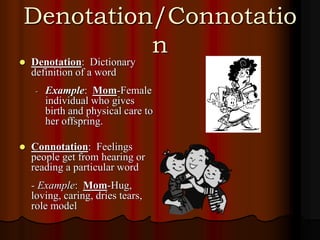
 Denotation: Dictionary
definition of a word
- Example: Mom-Female
individual who gives
birth and physical care to
her offspring.
 Connotation: Feelings
people get from hearing or
reading a particular word
- Example: Mom-Hug,
loving, caring, dries tears,
role model
Denotation/Connotatio
n
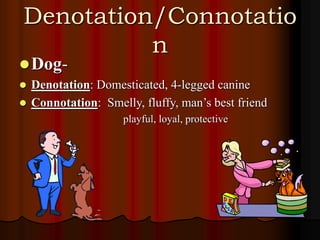
Dog-
 Denotation: Domesticated, 4-legged canine
 Connotation: Smelly, fluffy, man’s best friend
playful, loyal, protective
Denotation/Connotatio
n
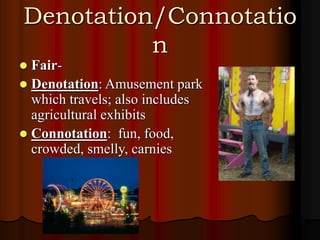
 Fair-
 Denotation: Amusement park
which travels; also includes
agricultural exhibits
 Connotation: fun, food,
crowded, smelly, carnies

240105955-elements-of-prose.ppt

  • 1.
  • 2.
    Prose  There are2 types of writing: prose- anything that is NOT poetry or plays poetry  Prose is divided into 2 categories: short story novel
  • 3.
    Short Story  Definition:Fictional story that can be read in one sitting. Example: “A Rose for Emily,” “The Cask of Amontillado,” or “The Most Dangerous Game”
  • 4.
    Novel  Definition: Along prose narrative that must be read in many sittings.  Example: To Kill a Mockingbird, The Scarlet Letter, or The Great Gatsby
  • 5.
    Elements of Prose Plot  Character  Setting  Point of View  Theme  Irony  Symbol
  • 6.
    Plot  The “framework”or “skeleton” of the story; A series of related events that are linked together
  • 7.
    What Makes UpPlot? 1. Basic Situation (Exposition) - Tells the audience who the characters are and introduces the conflict - Example: “Every Who Down in Who-ville Liked Christmas a lot...”
  • 8.
    What Makes UpPlot? 2. Rising Action - Complications that arise when the characters take steps to resolve their conflicts “But the Grinch, Who lived just North of Who-ville, Did NOT! The Grinch hated Christmas! The whole Christmas season! Now, please don't ask why. No one quite knows the reason.
  • 9.
    What Makes UpPlot? 3. Climax: Most exciting or suspenseful moment when something happens to determine the outcome of the conflict. Example: “And the Grinch, with his grinch-feet ice-cold in the snow, Stood puzzling and puzzling: "How could it be so? It came without ribbons! It came without tags! "It came without packages, boxes or bags!" And he puzzled three hours, `till his puzzler was sore. Then the Grinch thought of something he hadn't before! "Maybe Christmas," he thought, "doesn't come from a store. "Maybe Christmas...perhaps...means a little bit more!"
  • 10.
    What Makes UpPlot? 4. Falling Action: The conflict is in the process of being resolved or “unraveled  Example: And what happened then...? Well...in Who-ville they say That the Grinch's small hear Grew three sizes that day!
  • 11.
    What Makes UpPlot?  Resolution: (Denouement) or “Untying the knot”  When the story’s problem/conflict is resolved and the story ends  Endings may be happy or tragic Example: “He whizzed with his load through the bright morning light And he brought back the toys! And the food for the feast! And he......HE HIMSELF...! The Grinch carved the roast beast!”
  • 12.
    Freytag’s Pyramid  GustavFreytag was a Nineteenth Century German novelist who saw common patterns in the plots of stories and novels and developed a diagram to analyze them. He diagrammed a story's plot using a pyramid like the one shown here:
  • 13.
    Character: Revealing Human Nature Character- A person or being in a story that performs the action of the plot.  Characterization: The process of revealing the personality of a character in a story.
  • 14.
    Steps to the CharacterizationProcess  A writer can reveal a character in the following ways: 1. Letting up hear the character speak 2. Describing how the character looks & dresses 3. Letting us listen to the character’s inner thoughts and feelings 4. Revealing what other characters in the story think or say about the character 5. Showing us what the character does – how he or she acts *These call on the reader to take the information he or she is given to interpret for himself/herself the kind of character he or she is reading about. This is called INDIRECT CHARACTERIZATION
  • 15.
    Steps to the CharacterizationProcess 6. Telling us directly what the character’s personality is like: cruel, sneaky, brace, etc. Ex. “You’re a mean one, Mr. Grinch…” This is called DIRECT CHARACTERIZATION
  • 16.
    Types of Characters Dynamic Character: The character changes as a result of the action of the story.  Example- Ebenezer Scrooge, the Grinch  Static Character: The character does not change much in the course of the story.  Example- Brutus (Julius Caesar);  Mama Younger (A Raisin in the Sun)
  • 17.
    Types of Characters Protagonist: The main character of the story.  Can be good or evil  Antagonist: The character or force that comes into conflict with the protagonist  Can be another person, an animal, a force of nature, society, the character’s own conscience, etc.
  • 18.
    Setting  Defintion: Thetime and location in which the story takes place
  • 19.
    Setting  Purpose ofSetting 1. Gives background information 2. Provides conflict - Man vs. Nature, Man vs. Society 3. Can reveal a lot about someone’s character 4. Provides mood or atmosphere - Mood- the feeling WE get when we read a story 5. Can paint images for the reader - Images – words that call forth the 5 senses
  • 20.
    Theme  Definition: Theinsight about human life that is revealed in a literary work. The “golden thread” woven throughout the story. -The theme is what the author is saying through the story (it’s a deeper truth about reality) - The plot how he says it : it is the story he uses to get this point across
  • 21.
    Point of View Definition: The direction from which the writer has chosen to tell the story
  • 22.
    There are 3Points of View 1. First Person: One of the characters tells the story; talks directly to the reader - Uses the pronoun “I,” “me,” “we,” or “us” 2. Third Person Limited: The narrator will focus on the thoughts & feelings of just one character - Reader experiences the events of the story through the memory and senses of only one character
  • 23.
    There are 3Points of View 3. Third-Person Omniscient- “All-knowing” - An all-knowing narrator who refers to all the characters as “he” and “she.” Knows the thoughts and feelings of ALL of the characters. *The narrator is not necessarily the story’s author*
  • 24.
    Conflict  Definition- Itexists when a character is struggling with something or someone - Could be a number of things: - Another person, an animal, - an inanimate object- a rock, the weather - The character’s own personality
  • 25.
    External Conflict External Conflict-Caused by something OUTSIDE the character - Example: an another character, a river, weather, society - Man vs. Man, Man vs. Nature, Man vs. Society
  • 26.
    Internal Conflict Internal Conflict-Character struggles with some personal quality that is causing trouble - Example: vanity, pride, selfishness, grief - Man vs. Self
  • 27.
    Foreshadowing  Definition: Cluesabout what is going to happen as the story unfolds
  • 28.
    Suspense  Definition: AnxietyWE feel about what is going to happen next in the story
  • 29.
    Parody  Definition: Theimitation of a work of literature, art, or music for amusement or instruction
  • 30.
    Satire  Definition: Akind of writing that ridicules human weakness, vice, or folly in order to bring about social reform.  Example: Political cartoons, “A Modest Proposal”
  • 31.
    Irony  Definition: An“unexpected twist” in a story - 3 Types of Irony: 1. Verbal: Someone says one thing but means another - also known as sarcasm -Example: If a woman walks into a job interview and she is sloppily dressed with only two teeth in her head and the interview says, “You have a beautiful smile!”
  • 32.
    Irony 2. Situational: Whena reader expects one thing to happen and the opposite occurs - Example- Everyone knows the sad irony in “Richard Cory.” Why would someone so successful and rich be so unhappy as to kill himself? In a wonderfully ironic letter, George Bernard Shaw celebrates his mother’s death and cremation. Charles Dickens’ character Mr. McChoakumchild is anything but a teacher.
  • 33.
    Irony 3. Dramatic: Whenthe character in a play thinks one thing is true, but the audience knows better. The audience has inside information that a character does not. - This information usually comes in the form of an aside or a soliloquy. - Example: In Romeo and Juliet, Romeo says that his “grave is like to be his wedding bed.” Little does he know that his marriage will be the cause of his untimely death. We as an audience knows because we heard the prologue at the beginning of the play.
  • 34.
    More Elements ofProse  Tone: The attitude the writer takes toward the subject of a work, the characters in it, or the audience. “I am getting married”
  • 35.
    Tone Example  “TheAuthor To Her Book” Thou ill-formed offspring of my feeble brain, Who after birth did'st by my side remain, Till snatcht from thence by friends, less wise than true, Who thee abroad exposed to public view, Made thee in rags, halting to th' press to trudge, Where errors were not lessened (all may judge). At thy return my blushing was not small, My rambling brat (in print) should mother call. I cast thee by as one unfit for light, The visage was so irksome in my sight, Yet being mine own, at length affection would Thy blemishes amend, if so I could. I washed thy face, but more defects I saw, And rubbing off a spot, still made a flaw. I stretcht thy joints to make thee even feet, Yet still thou run'st more hobbling than is meet. In better dress to trim thee was my mind, But nought save home-spun cloth, i' th' house I find. In this array, 'mongst vulgars may'st thou roam. In critic's hands, beware thou dost not come, And take thy way where yet thou art not known. If for thy father askt, say, thou hadst none; And for thy mother, she alas is poor, Which caused her thus to send thee out of door.
  • 36.
    Denotation/Connotatio n  Denotation: Dictionary definitionof a word - Example: Mom-Female individual who gives birth and physical care to her offspring.  Connotation: Feelings people get from hearing or reading a particular word - Example: Mom-Hug, loving, caring, dries tears, role model
  • 37.
    Denotation/Connotatio n Dog-  Denotation: Domesticated,4-legged canine  Connotation: Smelly, fluffy, man’s best friend playful, loyal, protective
  • 38.
    Denotation/Connotatio n  Fair-  Denotation:Amusement park which travels; also includes agricultural exhibits  Connotation: fun, food, crowded, smelly, carnies