John Donne
John DonneBorn in London, 1572Poet, satirist, lawyer and priestMarried Ann More, niece of Sir Thomas Egerton, Lord Keeper of the Great SealSatires, love poetry, elegies, sermonsWrote on religion, sexuality, love and death
More Background…Metaphysical PoetMetaphysicsSeeking to understand the fundamental nature of being and the world, and attempts to answer two basic questions: What is there, and what is it like?Metaphysical ConceitsExtended metaphorsMotif of True Religion“A Harry or a Martin taught [me] this.”
The FleaRhyme schemePlayfulThe flea as an erotic symbolContrary to Donne’s later religious poems
Good Friday, 1613. Riding WestwardApology for Faithless Acts5 ArgumentsLines 1-14 NatureLines 15-28 Looking at God causes deathLines 29-32 “Pity”Lines 33-35 “Memory”Lines 35-40 Submits to “Corrections”
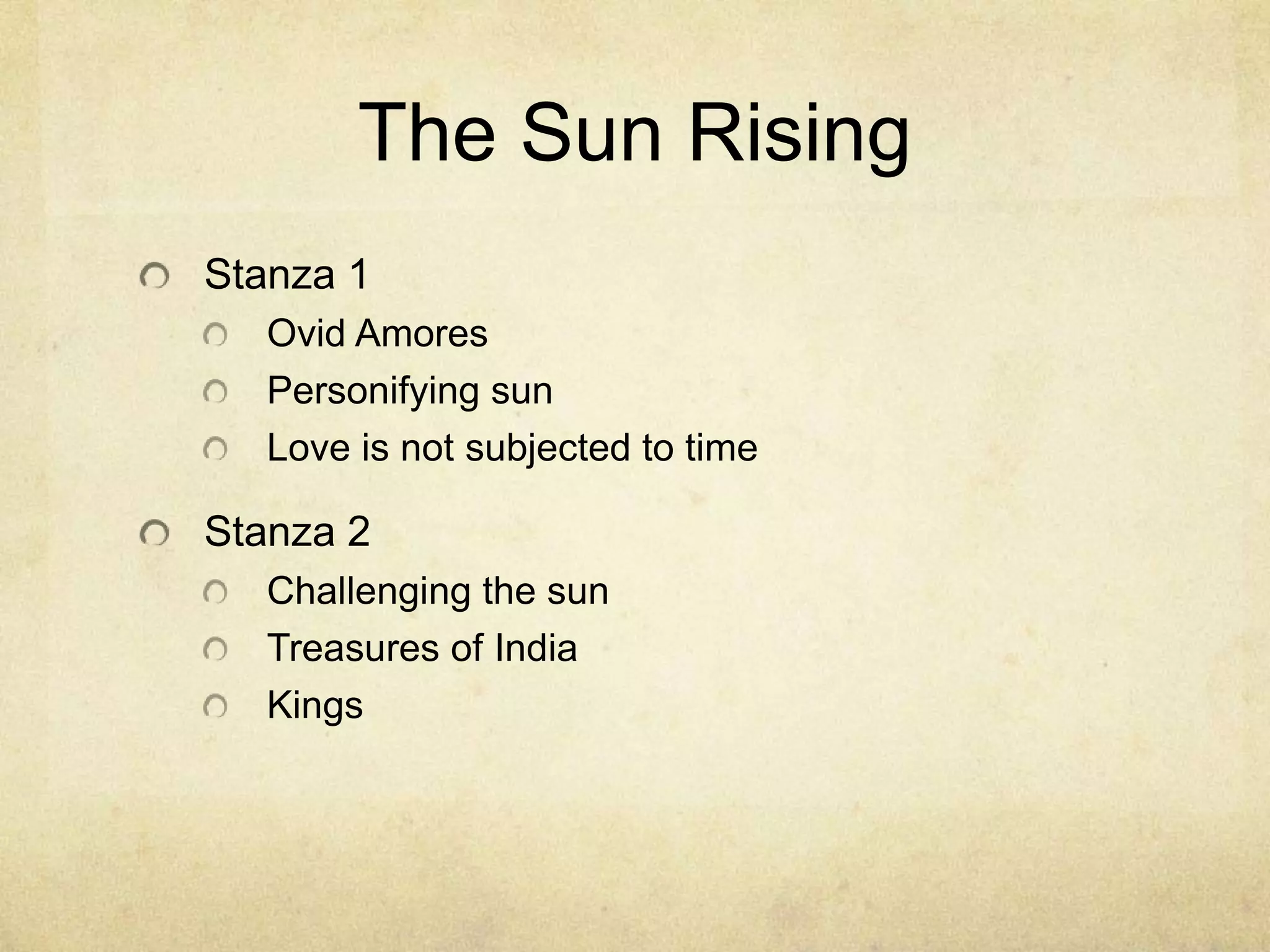
The Sun RisingStanza 1Ovid AmoresPersonifying sunLove is not subjected to timeStanza 2Challenging the sunTreasures of IndiaKings
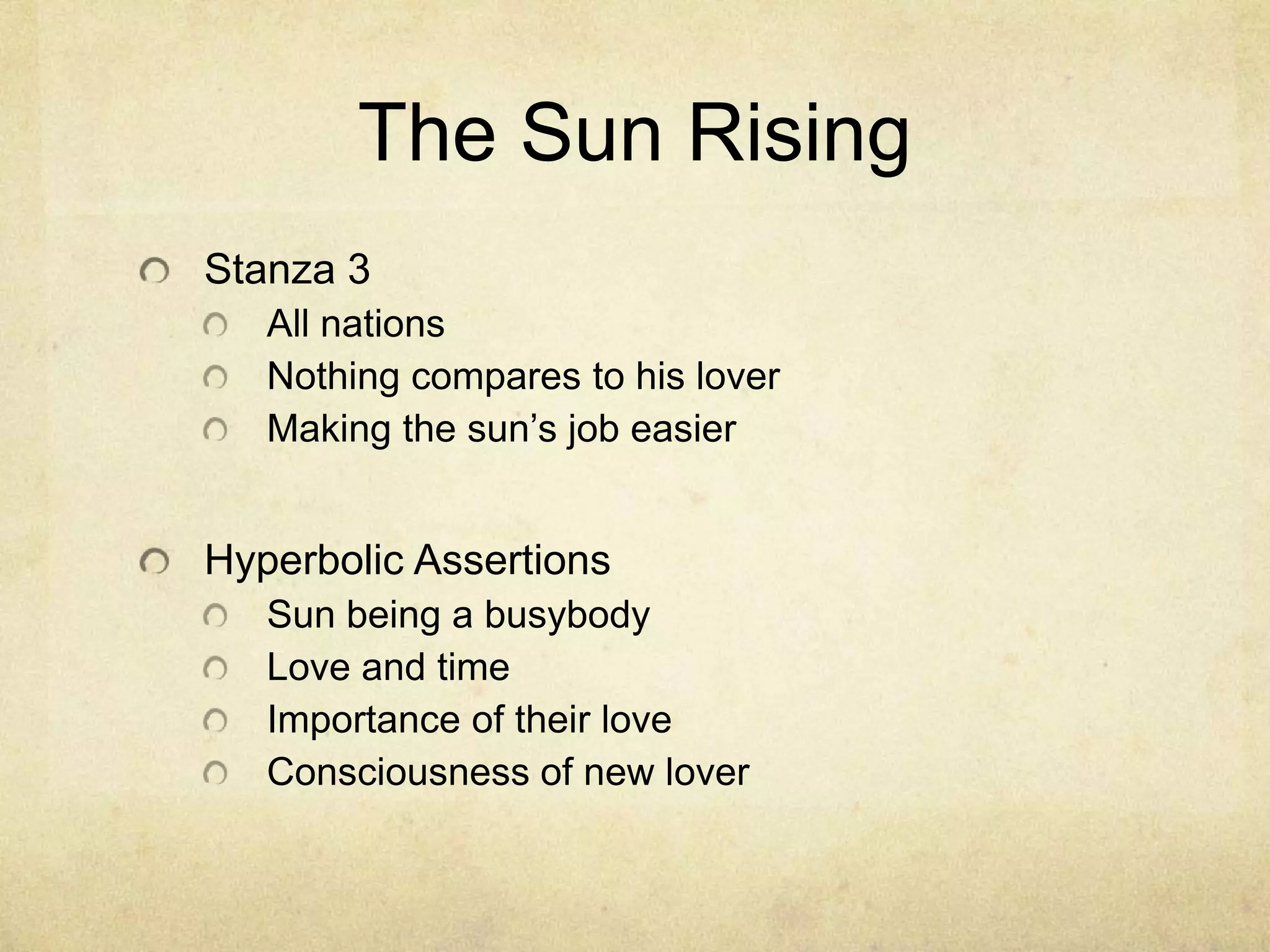
The Sun RisingStanza 3All nationsNothing compares to his loverMaking the sun’s job easierHyperbolic AssertionsSun being a busybodyLove and timeImportance of their loveConsciousness of new lover
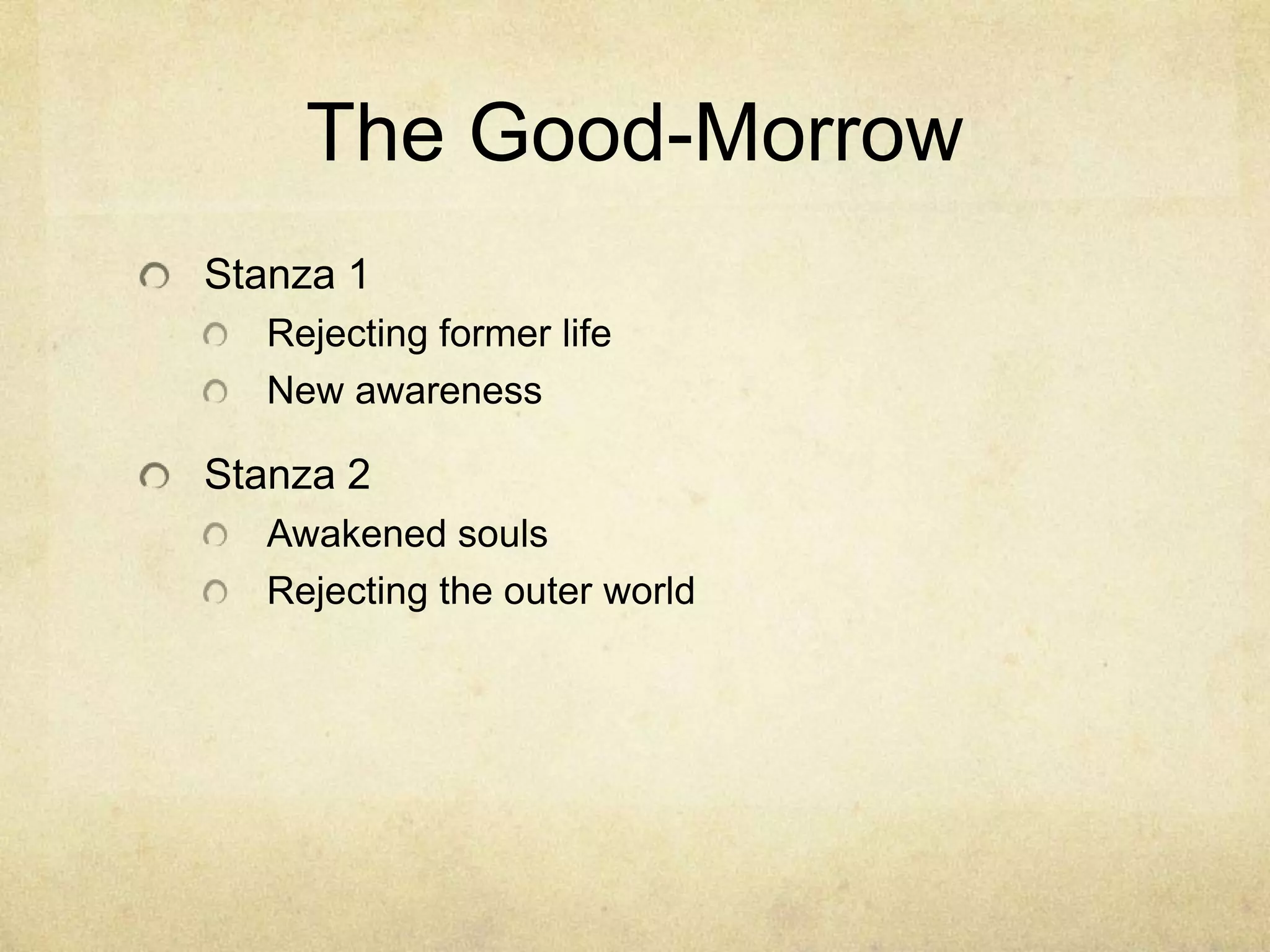
The Good-MorrowStanza 1Rejecting former lifeNew awarenessStanza 2Awakened soulsRejecting the outer world
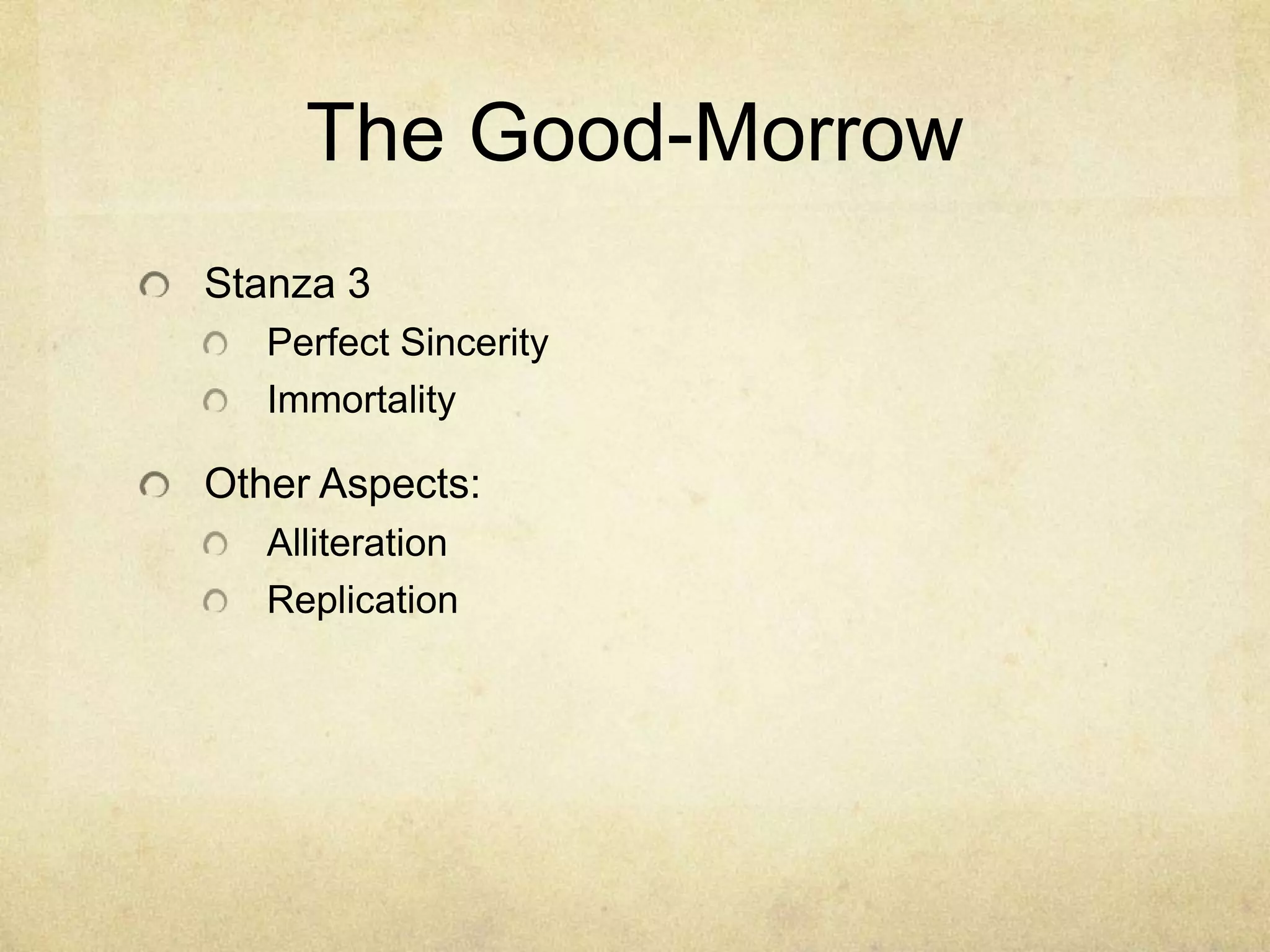
The Good-MorrowStanza 3Perfect SincerityImmortalityOther Aspects:AlliterationReplication
The CanonizationStanza Three:“Call us what you will, we are made by such love;Call her one, me another fly,We’re tapers too, and at our own cost die,And we in us find the eagle and the dove.The phoenix riddle hath more witBy us: we two being one, are it.So, to one neutral thing both sexes fit.We die and rise the same, and proveMysterious by this love.
The CanonizationStanza Three:“Call us what you will, we are made by such love;Call her one, me another fly,We’re tapers too, and at our own cost die,And we in us find the eagle and the dove.The phoenix riddle hath more witBy us: we two being one, are it.So, to one neutral thing both sexes fit.We die and rise the same, and proveMysterious by this love.”
The CanonizationStanza Four:“We can die by it, if not live by love,And if unfit for tombs and hearseOur legend be, it will be fit for verse;And if no piece of chronicle we prove,We’ll build in sonnets pretty rooms;As well a well-wrought urn becomesThe greatest ashes, as half-acre tombs,And by these hymns, all shall approveUs canonized for love;”
A Valediction: Forbidden MourningMain Points	Metaphysical Conceits	Marriage between spiritual and physical love
A Valediction: Forbidden MourningStanza Six:“Our two souls therefore, which are one,Though I must go, endure not yetA breach, but an expansion,Like gold to airy thinness beat.”
A Valediction: Forbidden MourningStanza Seven“If they be two they are two soAs stiff twin compasses are two;Thy soul, the fixed foot, makes no showTo move, but doth, if th’ other do.”
A Valediction: Forbidden MourningStanza Eight:“And though it in the center sit,Yet when the other far doth roam,It leans and harkens after it,And grows erect, as that comes home.”
A Valediction: Forbidden MourningStanza Nine:“Such wilt thou be to me, who must, Like th’ other foot, obliquely run;Thy firmness makes my circle just,And makes me end where I begun.”
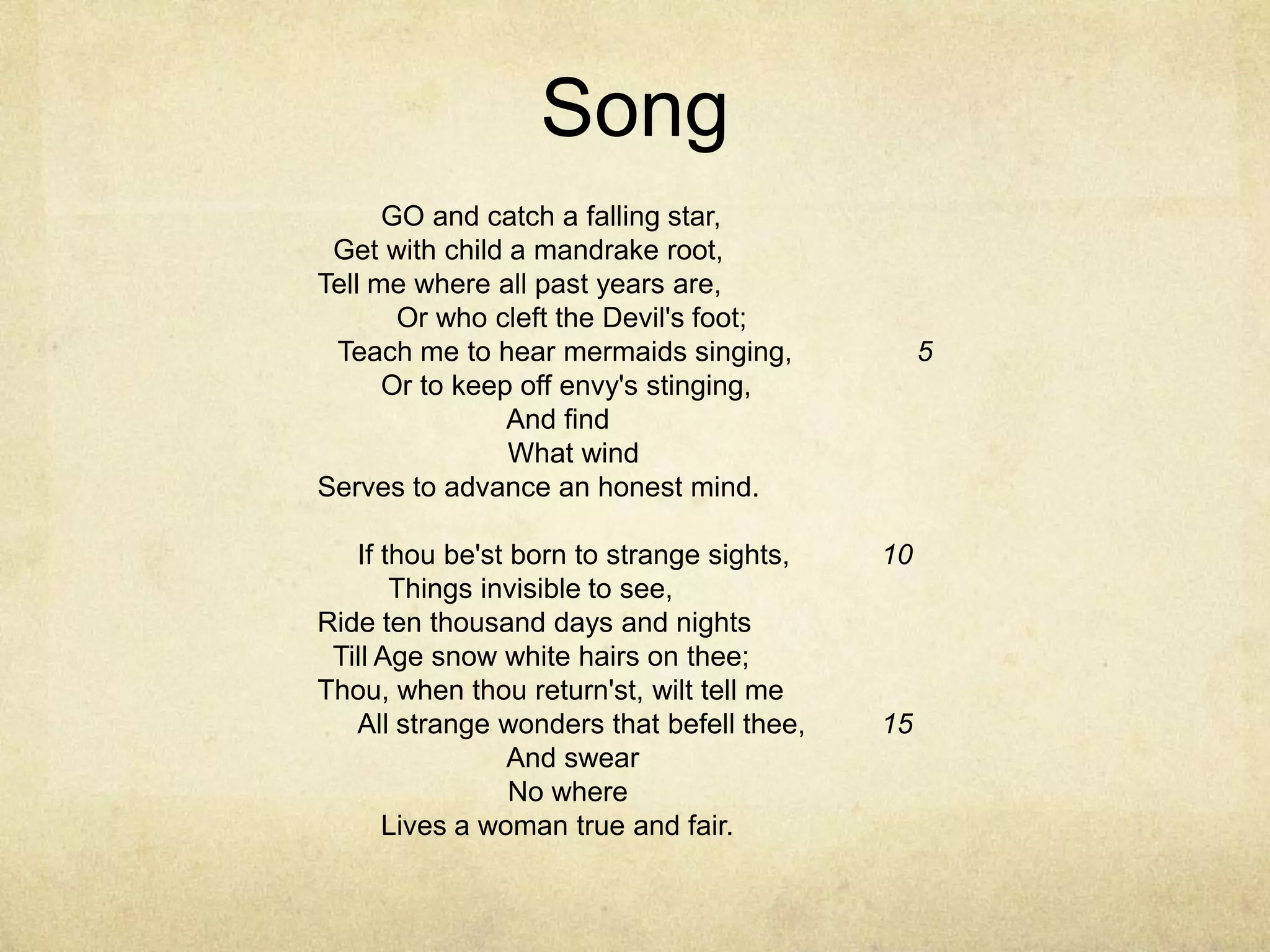
SongGO and catch a falling star,	 	  Get with child a mandrake root,	 	Tell me where all past years are,	 	  Or who cleft the Devil's foot;	 	Teach me to hear mermaids singing,	         5Or to keep off envy's stinging,	 	        And find	 	        What wind	 	Serves to advance an honest mind.	 	 		If thou be'st born to strange sights,	  10 Things invisible to see,	 	Ride ten thousand days and nights	 	  Till Age snow white hairs on thee;	 	Thou, when thou return'st, wilt tell me	 	All strange wonders that befell thee,	  15        And swear	 	        No where	 	Lives a woman true and fair.	 	 
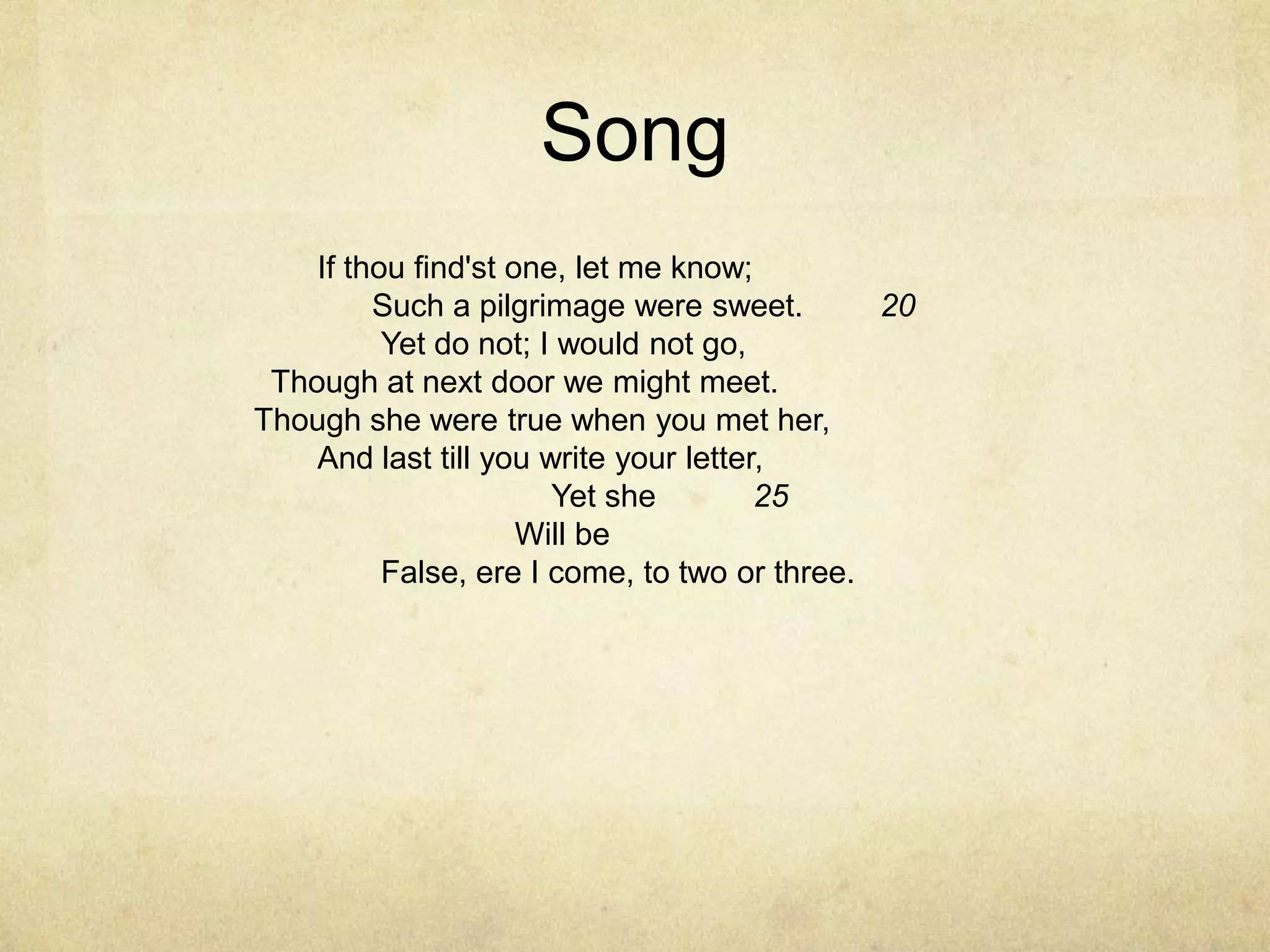
SongIf thou find'st one, let me know;	 	  Such a pilgrimage were sweet.	  20Yet do not; I would not go,	 	  Though at next door we might meet.	 	Though she were true when you met her,	 	And last till you write your letter,	 	        Yet she	  25        Will be	 	False, ere I come, to two or three.
What is Donne talking about in this poem, and what is his attitude about the subject?What is his thought process through each stanza?What elements of metaphysical poetry do you see in this poem?
Holy Sonnets (1, 7, 10, 13, 14, 18)Determine:StructureThemesMessageToneHow are these sonnets Metaphysical?
Holy Sonnet 1THOU hast made me, and shall Thy work decay ?Repair me now, for now mine end doth haste ;I run to death, and Death meets me as fast,And all my pleasures are like yesterday.I dare not move my dim eyes any way ;Despair behind, and Death before doth castSuch terror, and my feeble flesh doth wasteBy sin in it, which it towards hell doth weigh.Only Thou art above, and when towards TheeBy Thy leave I can look, I rise again ;But our old subtle foe so tempteth me,That not one hour myself I can sustain.Thy grace may wing me to prevent his artAnd thou like adamant draw mine iron heart.
Holy Sonnet 7At the round earth's imagined corners blowYour trumpets, angels, and arise, ariseFrom death, you numberless infinitiesOf souls, and to your scattered bodies go ;All whom the flood did, and fire shall o'erthrow,All whom war, dea[r]th, age, agues, tyrannies,Despair, law, chance hath slain, and you, whose eyesShall behold God, and never taste death's woe.But let them sleep, Lord, and me mourn a space ;For, if above all these my sins abound,'Tis late to ask abundance of Thy grace,When we are there.   Here on this lowly ground,Teach me how to repent, for that's as goodAs if Thou hadstseal'd my pardon with Thy blood.
Holy Sonnet 10	Death, be not proud, though some have called thee Mighty and dreadful, for thou art not so ; For those, whom thou think'st thou dost overthrow, Die not, poor Death, nor yet canst thou kill me. From rest and sleep, which but thy picture[s] be, Much pleasure, then from thee much more must flow, And soonest our best men with thee do go, Rest of their bones, and soul's delivery. Thou'rt slave to Fate, chance, kings, and desperate men, And dost with poison, war, and sickness dwell, And poppy, or charms can make us sleep as well, And better than thy stroke ;  why swell'st thou then ? One short sleep past, we wake eternally, And Death shall be no more ;  Death, thou shalt die.
Holy Sonnet 13What if this present were the world's last night ?Mark in my heart, O soul, where thou dost dwell,The picture of Christ crucified, and tellWhether His countenance can thee affright.Tears in His eyes quench the amazing light ;Blood fills his frowns, which from His pierced head fell ;And can that tongue adjudge thee unto hell,Which pray'd forgiveness for His foes' fierce spite ?No, no ; but as in my idolatryI said to all my profane mistresses,Beauty of pity, foulness only isA sign of rigour ; so I say to thee,To wicked spirits are horrid shapes assign'd ;This beauteous form assures a piteous mind.
Holy Sonnet 14Batter my heart, three-person'd God ; for youAs yet but knock ; breathe, shine, and seek to mend ;That I may rise, and stand, o'erthrow me, and bendYour force, to break, blow, burn, and make me new.I, like an usurp'd town, to another due,Labour to admit you, but O, to no end.Reason, your viceroy in me, me should defend,But is captived, and proves weak or untrue.Yet dearly I love you, and would be loved fain,But am betroth'd unto your enemy ;Divorce me, untie, or break that knot again,Take me to you, imprison me, for I,Except you enthrall me, never shall be free,Nor ever chaste, except you ravish me.
Holy Sonnet 18Show me, dear Christ, thy spouse so bright and clear.What! is it she which on the other shoreGoes richly painted? or which, robbed and tore,Laments and mourns in Germany and here?Sleeps she a thousand, then peeps up one year?Is she self-truth, and errs? now new, now outwore?Doth she, and did she, and shall she evermoreOn one, on seven, or on no hill appear?Dwells she with us, or like adventuring knightsFirst travel we to seek, and then make love?Betray, kind husband, thy spouse to our sights,And let mine amorous soul court thy mild dove,Who is most true and pleasing to thee then         When she is embraced and open to most men.

John donne

  • 1.
  • 2.
    John DonneBorn inLondon, 1572Poet, satirist, lawyer and priestMarried Ann More, niece of Sir Thomas Egerton, Lord Keeper of the Great SealSatires, love poetry, elegies, sermonsWrote on religion, sexuality, love and death
  • 3.
    More Background…Metaphysical PoetMetaphysicsSeekingto understand the fundamental nature of being and the world, and attempts to answer two basic questions: What is there, and what is it like?Metaphysical ConceitsExtended metaphorsMotif of True Religion“A Harry or a Martin taught [me] this.”
  • 4.
    The FleaRhyme schemePlayfulTheflea as an erotic symbolContrary to Donne’s later religious poems
  • 5.
    Good Friday, 1613.Riding WestwardApology for Faithless Acts5 ArgumentsLines 1-14 NatureLines 15-28 Looking at God causes deathLines 29-32 “Pity”Lines 33-35 “Memory”Lines 35-40 Submits to “Corrections”
  • 6.
    The Sun RisingStanza1Ovid AmoresPersonifying sunLove is not subjected to timeStanza 2Challenging the sunTreasures of IndiaKings
  • 7.
    The Sun RisingStanza3All nationsNothing compares to his loverMaking the sun’s job easierHyperbolic AssertionsSun being a busybodyLove and timeImportance of their loveConsciousness of new lover
  • 8.
    The Good-MorrowStanza 1Rejectingformer lifeNew awarenessStanza 2Awakened soulsRejecting the outer world
  • 9.
    The Good-MorrowStanza 3PerfectSincerityImmortalityOther Aspects:AlliterationReplication
  • 10.
    The CanonizationStanza Three:“Callus what you will, we are made by such love;Call her one, me another fly,We’re tapers too, and at our own cost die,And we in us find the eagle and the dove.The phoenix riddle hath more witBy us: we two being one, are it.So, to one neutral thing both sexes fit.We die and rise the same, and proveMysterious by this love.
  • 11.
    The CanonizationStanza Three:“Callus what you will, we are made by such love;Call her one, me another fly,We’re tapers too, and at our own cost die,And we in us find the eagle and the dove.The phoenix riddle hath more witBy us: we two being one, are it.So, to one neutral thing both sexes fit.We die and rise the same, and proveMysterious by this love.”
  • 12.
    The CanonizationStanza Four:“Wecan die by it, if not live by love,And if unfit for tombs and hearseOur legend be, it will be fit for verse;And if no piece of chronicle we prove,We’ll build in sonnets pretty rooms;As well a well-wrought urn becomesThe greatest ashes, as half-acre tombs,And by these hymns, all shall approveUs canonized for love;”
  • 13.
    A Valediction: ForbiddenMourningMain Points Metaphysical Conceits Marriage between spiritual and physical love
  • 14.
    A Valediction: ForbiddenMourningStanza Six:“Our two souls therefore, which are one,Though I must go, endure not yetA breach, but an expansion,Like gold to airy thinness beat.”
  • 15.
    A Valediction: ForbiddenMourningStanza Seven“If they be two they are two soAs stiff twin compasses are two;Thy soul, the fixed foot, makes no showTo move, but doth, if th’ other do.”
  • 16.
    A Valediction: ForbiddenMourningStanza Eight:“And though it in the center sit,Yet when the other far doth roam,It leans and harkens after it,And grows erect, as that comes home.”
  • 17.
    A Valediction: ForbiddenMourningStanza Nine:“Such wilt thou be to me, who must, Like th’ other foot, obliquely run;Thy firmness makes my circle just,And makes me end where I begun.”
  • 18.
    SongGO and catcha falling star,     Get with child a mandrake root,   Tell me where all past years are,     Or who cleft the Devil's foot;   Teach me to hear mermaids singing,          5Or to keep off envy's stinging,           And find           What wind   Serves to advance an honest mind.     If thou be'st born to strange sights,   10 Things invisible to see,   Ride ten thousand days and nights     Till Age snow white hairs on thee;   Thou, when thou return'st, wilt tell me   All strange wonders that befell thee,   15        And swear           No where   Lives a woman true and fair.    
  • 19.
    SongIf thou find'stone, let me know;     Such a pilgrimage were sweet.   20Yet do not; I would not go,     Though at next door we might meet.   Though she were true when you met her,   And last till you write your letter,           Yet she   25        Will be   False, ere I come, to two or three.
  • 20.
    What is Donnetalking about in this poem, and what is his attitude about the subject?What is his thought process through each stanza?What elements of metaphysical poetry do you see in this poem?
  • 21.
    Holy Sonnets (1,7, 10, 13, 14, 18)Determine:StructureThemesMessageToneHow are these sonnets Metaphysical?
  • 22.
    Holy Sonnet 1THOUhast made me, and shall Thy work decay ?Repair me now, for now mine end doth haste ;I run to death, and Death meets me as fast,And all my pleasures are like yesterday.I dare not move my dim eyes any way ;Despair behind, and Death before doth castSuch terror, and my feeble flesh doth wasteBy sin in it, which it towards hell doth weigh.Only Thou art above, and when towards TheeBy Thy leave I can look, I rise again ;But our old subtle foe so tempteth me,That not one hour myself I can sustain.Thy grace may wing me to prevent his artAnd thou like adamant draw mine iron heart.
  • 23.
    Holy Sonnet 7Atthe round earth's imagined corners blowYour trumpets, angels, and arise, ariseFrom death, you numberless infinitiesOf souls, and to your scattered bodies go ;All whom the flood did, and fire shall o'erthrow,All whom war, dea[r]th, age, agues, tyrannies,Despair, law, chance hath slain, and you, whose eyesShall behold God, and never taste death's woe.But let them sleep, Lord, and me mourn a space ;For, if above all these my sins abound,'Tis late to ask abundance of Thy grace,When we are there.   Here on this lowly ground,Teach me how to repent, for that's as goodAs if Thou hadstseal'd my pardon with Thy blood.
  • 24.
    Holy Sonnet 10 Death,be not proud, though some have called thee Mighty and dreadful, for thou art not so ; For those, whom thou think'st thou dost overthrow, Die not, poor Death, nor yet canst thou kill me. From rest and sleep, which but thy picture[s] be, Much pleasure, then from thee much more must flow, And soonest our best men with thee do go, Rest of their bones, and soul's delivery. Thou'rt slave to Fate, chance, kings, and desperate men, And dost with poison, war, and sickness dwell, And poppy, or charms can make us sleep as well, And better than thy stroke ;  why swell'st thou then ? One short sleep past, we wake eternally, And Death shall be no more ;  Death, thou shalt die.
  • 25.
    Holy Sonnet 13Whatif this present were the world's last night ?Mark in my heart, O soul, where thou dost dwell,The picture of Christ crucified, and tellWhether His countenance can thee affright.Tears in His eyes quench the amazing light ;Blood fills his frowns, which from His pierced head fell ;And can that tongue adjudge thee unto hell,Which pray'd forgiveness for His foes' fierce spite ?No, no ; but as in my idolatryI said to all my profane mistresses,Beauty of pity, foulness only isA sign of rigour ; so I say to thee,To wicked spirits are horrid shapes assign'd ;This beauteous form assures a piteous mind.
  • 26.
    Holy Sonnet 14Battermy heart, three-person'd God ; for youAs yet but knock ; breathe, shine, and seek to mend ;That I may rise, and stand, o'erthrow me, and bendYour force, to break, blow, burn, and make me new.I, like an usurp'd town, to another due,Labour to admit you, but O, to no end.Reason, your viceroy in me, me should defend,But is captived, and proves weak or untrue.Yet dearly I love you, and would be loved fain,But am betroth'd unto your enemy ;Divorce me, untie, or break that knot again,Take me to you, imprison me, for I,Except you enthrall me, never shall be free,Nor ever chaste, except you ravish me.
  • 27.
    Holy Sonnet 18Showme, dear Christ, thy spouse so bright and clear.What! is it she which on the other shoreGoes richly painted? or which, robbed and tore,Laments and mourns in Germany and here?Sleeps she a thousand, then peeps up one year?Is she self-truth, and errs? now new, now outwore?Doth she, and did she, and shall she evermoreOn one, on seven, or on no hill appear?Dwells she with us, or like adventuring knightsFirst travel we to seek, and then make love?Betray, kind husband, thy spouse to our sights,And let mine amorous soul court thy mild dove,Who is most true and pleasing to thee then When she is embraced and open to most men.