A story or narrative with two meanings; the
obvious or literal meaning that is immediately
clear, and a second, usually hidden meaning
Allegory
“The Lion, the Witch, and the Wardrobe
by C.S. Lewis is a religious allegory. In
it, we find that Aslan the lion
represents Christ or God, the White
Witch represents evil”
Words that start with the same consonant
sound (not just the same letter), used
repeatedly in a phrase or sentence.
Alliteration
The bullets
bombarded the
battlefield
A reference to a historical theme, event or,
form of media
Allusion - Historical
“Rome wasn’t built in a day.”
A reference to another literary work
Allusion - Literary
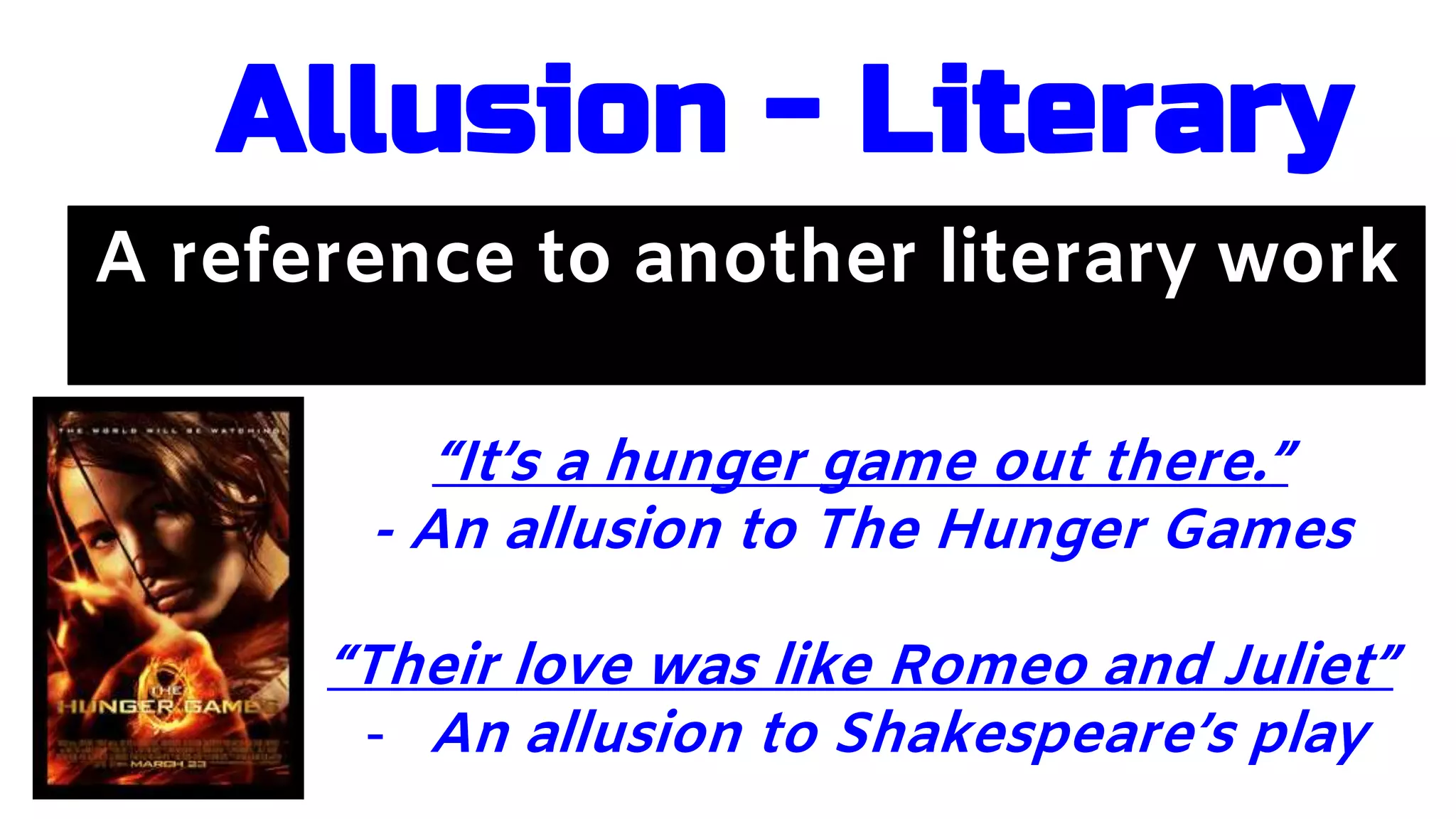
“It’s a hunger game out there.”
- An allusion to The Hunger Games
“Their love was like Romeo and Juliet”
- An allusion to Shakespeare’s play
A reference to a theological quote
or theme.
Allusion - Religious
“The lush grounds looked
like the Garden of Eden”
Human traits, ambitions, emotions or
behaviours given to animals,natural
phenomena , non human beings or objects.
Anthropomorphism
In the Disney film, Beauty and the Beast, the
clock and the teapot all act and behave as if
they are human beings.
Repetition of the same word or phrase at the
end of successive sentences.
Antistrophe
Don’t you ever talk about my
friends! You don’t know any of
my friends. You don’t look at
any of my friends. And you
certainly wouldn’t condescend
to speak to any of my friends.
Opposite ideas are put together in a sentence
to achieve a contrasting effect.
Antithesis
It was the best of times, it was the worst
of times, it was the age of wisdom, it was
the age of foolishness.
(Charles Dickens)
A figure of speech where a speaker expresses doubt or
perplexity regarding a question. The doubts may
appear as rhetorical questions, often in the beginning
of the text.
Aporia
“What’s in a name? That which we call a rose by any
other name would smell as sweet.”
(William Shakespeare, Romeo & Juliet)
Assonance is when two or more words, close to one
another repeat the same vowel sound, but start with
different consonant sounds.
Assonance
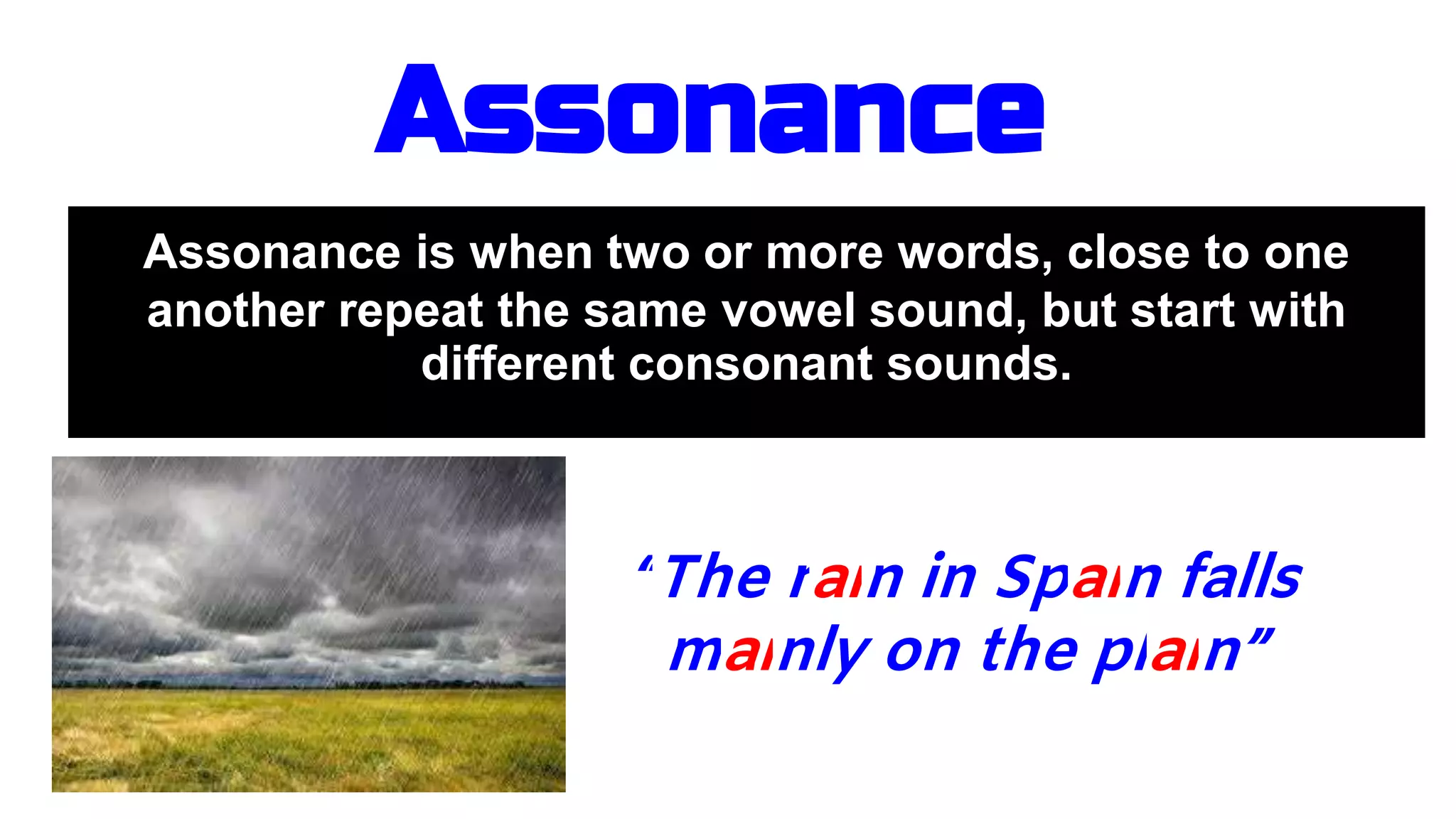
“The rain in Spain falls
mainly on the plain”
The absence of a conjunction (such as ‘and,
or, but, for, nor, so, yet’) between parts of a
sentence.
Asyndeton
“I came, I saw, I conquered.”
- Julius Caesar
A pause that occurs within a line of poetry,
usually marked by some form of punctuation
such as a full stop, comma, ellipsis, or dash
Caesura
“To be, or not to be - that is
the question.”
Repetitive sounds produced by consonants
within a sentence or phrase, often in quick
succession
Consonance
“The lumpy, bumpy
road ”
A text with a lesson and/or warning, intended to
convey instruction and/or information. Provokes
thought about moral and ethical behaviour
Didacticism
The story of Frankenstein is didactic;
warning nineteenth century society about
the dangers of ‘playing God’ in the
unethical creation of human life
A conjunction - usually ‘either’ or ‘but’, that
dramatically interrupts the rhythm of the
sentence to introduce a contrast
Disjunction
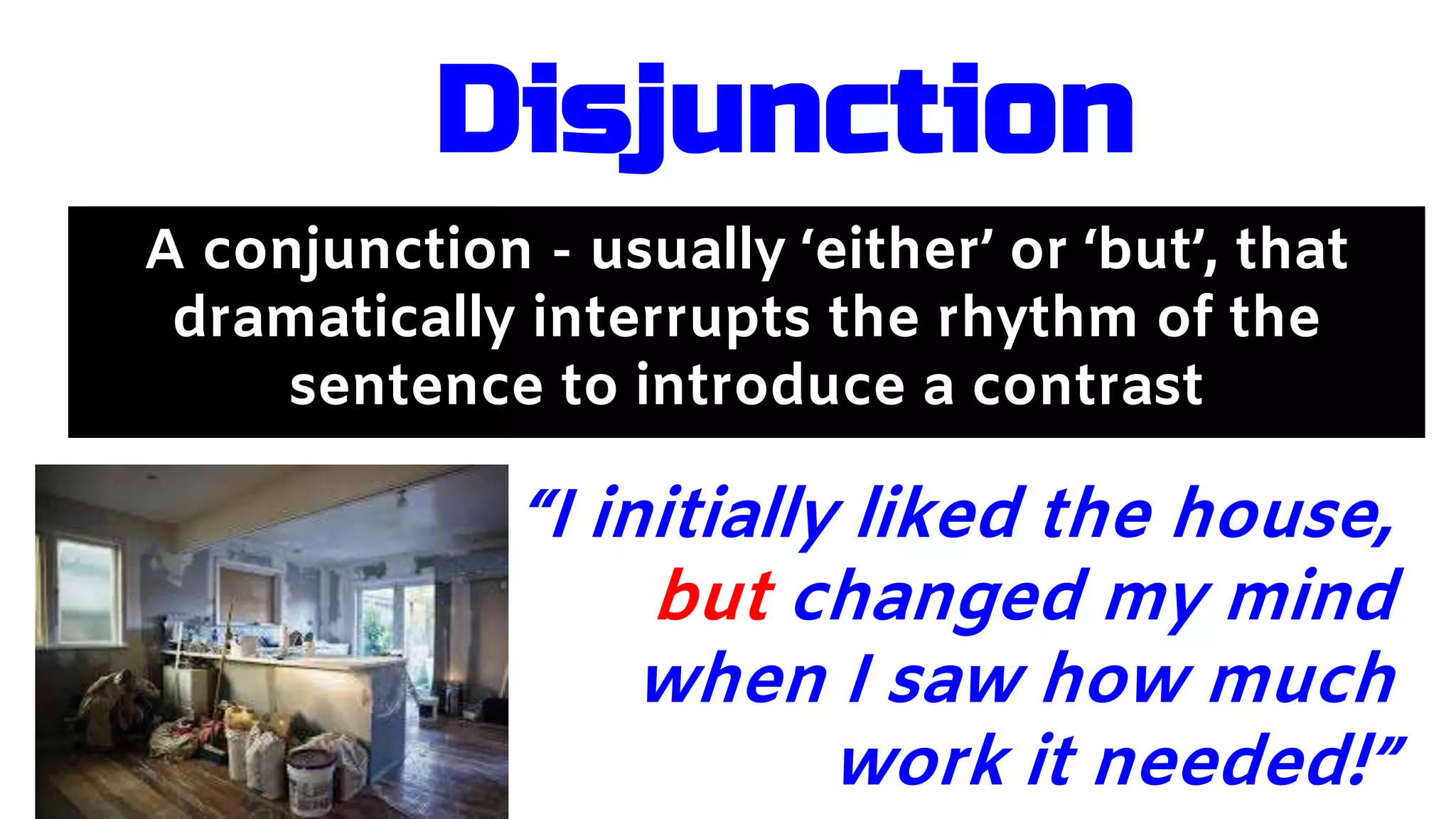
“I initially liked the house,
but changed my mind
when I saw how much
work it needed!”
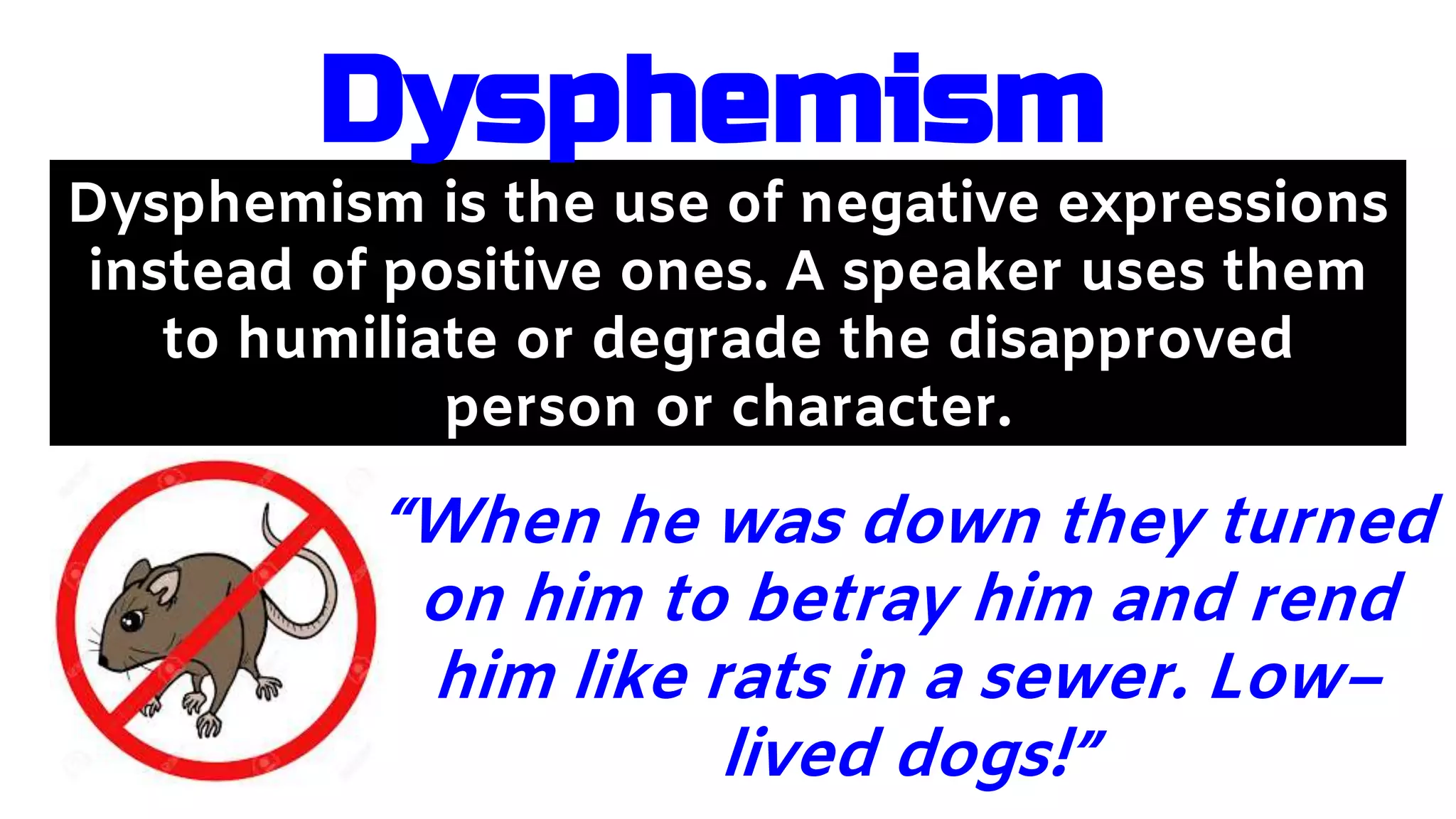
Dysphemism is the use of negative expressions
instead of positive ones. A speaker uses them
to humiliate or degrade the disapproved
person or character.
Dysphemism
“When he was down they turned
on him to betray him and rend
him like rats in a sewer. Low–
lived dogs!”
A dramatic pause created by more than one full stop
(...) that creates tensions or suggests that words can’t
be spoken
Ellipsis
“I don’t know…I’m not sure”
Moving over from one line to another without
a terminating punctuation mark, usually to
create fluency and an increase of pace.
Enjambment
Cold Morning Time
Ice Crystals reflect the rays
of blazing sunrise
Refers to polite, indirect expressions that replace
words and phrases considered harsh and impolite, or
which suggest something unpleasant
Euphemism
“Kicked the Bucket” -
describes the death of a
person)
“Golden years” – describes
A characters inability to comprehend their own
situation when an audience can. The audience
knows something a character does not
IRONY: Dramatic Irony
“She did not know
she was being
followed, the whole
time.”
This occurs when what actually happens is the
opposite of what is expected or appropriate
IRONY: Situational Irony
“A fire station
burns down”
A character says one thing but means the
opposite
IRONY: Verbal irony
This is also a form of sarcasm
Comparing two things by saying that one ‘is’ the other
in order to draw stronger comparison and often add a
level of figurative meaning.
Metaphor
He was a beast in the
boxing ring!
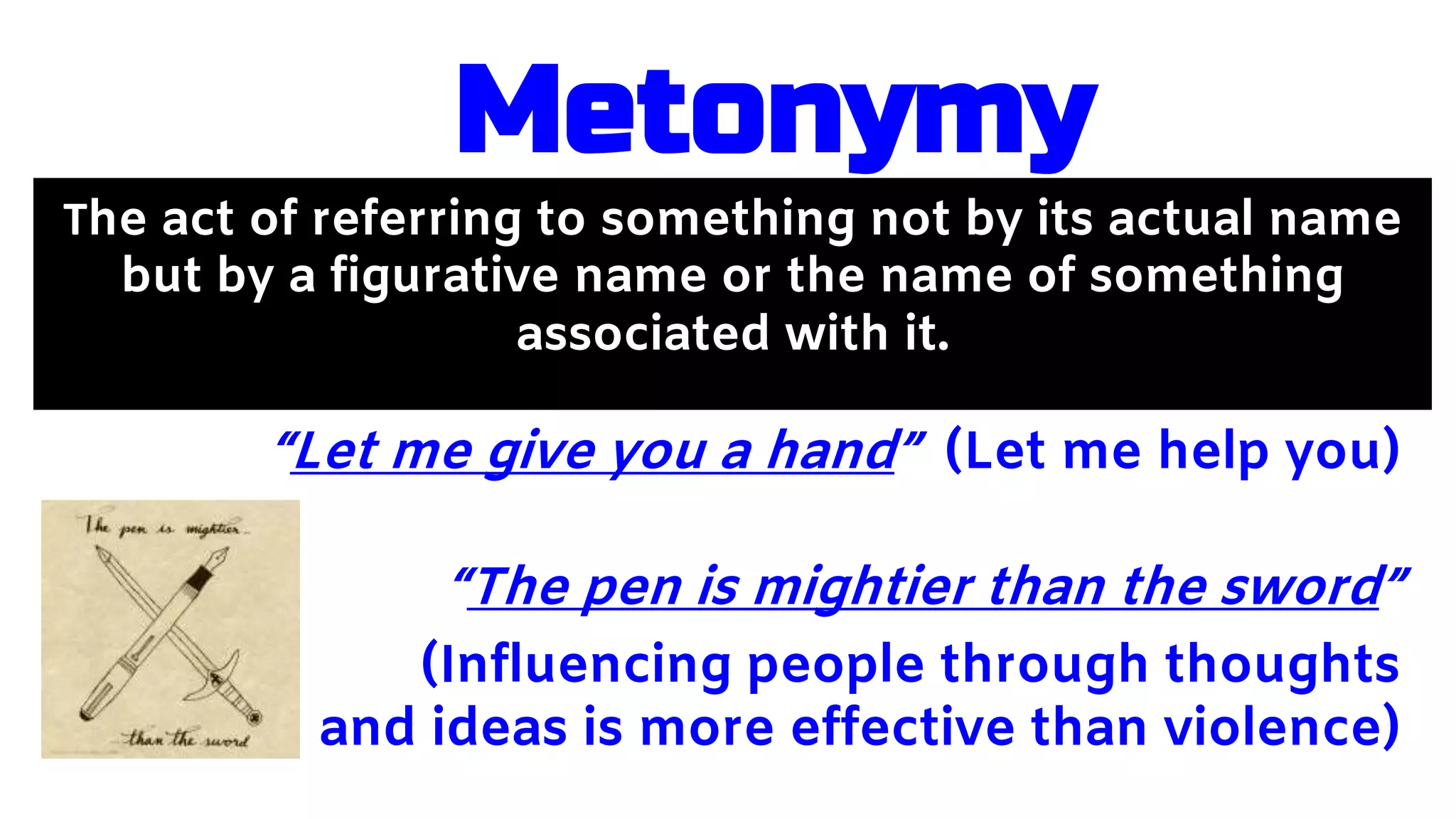
The act of referring to something not by its actual name
but by a figurative name or the name of something
associated with it.
Metonymy
“Let me give you a hand” (Let me help you)
“The pen is mightier than the sword”
(Influencing people through thoughts
and ideas is more effective than violence)
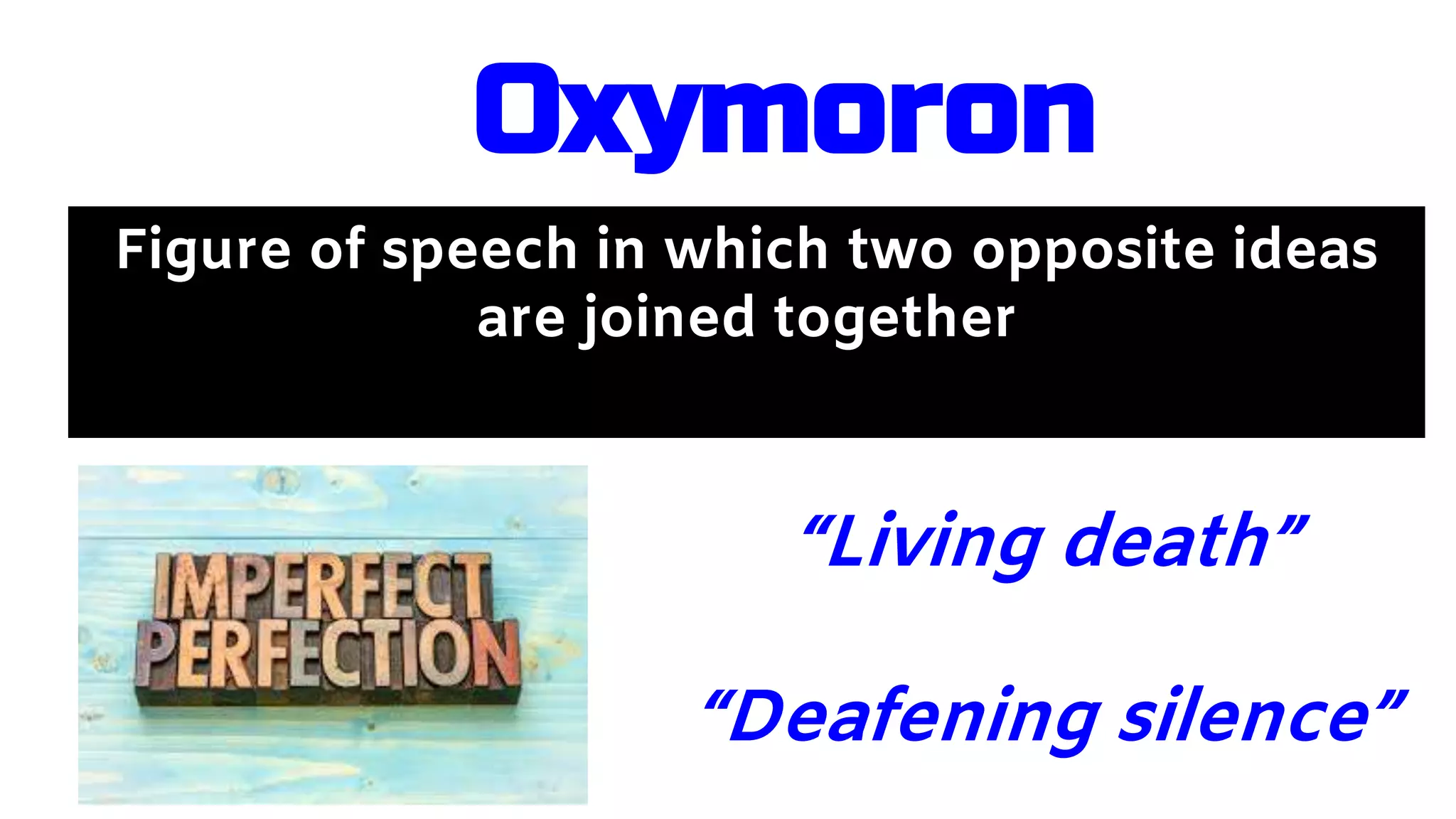
Figure of speech in which two opposite ideas
are joined together
Oxymoron
“Living death”
“Deafening silence”
A statement that appears to be self -
contradictory or silly, but which may include a
truth
Paradox
“I must be cruel only
to be kind”
(Hamlet)
A literary device that attributes human
qualities and emotions to nature
Pathetic Fallacy
“The angry thunder
and troubled wind
consumed the city”
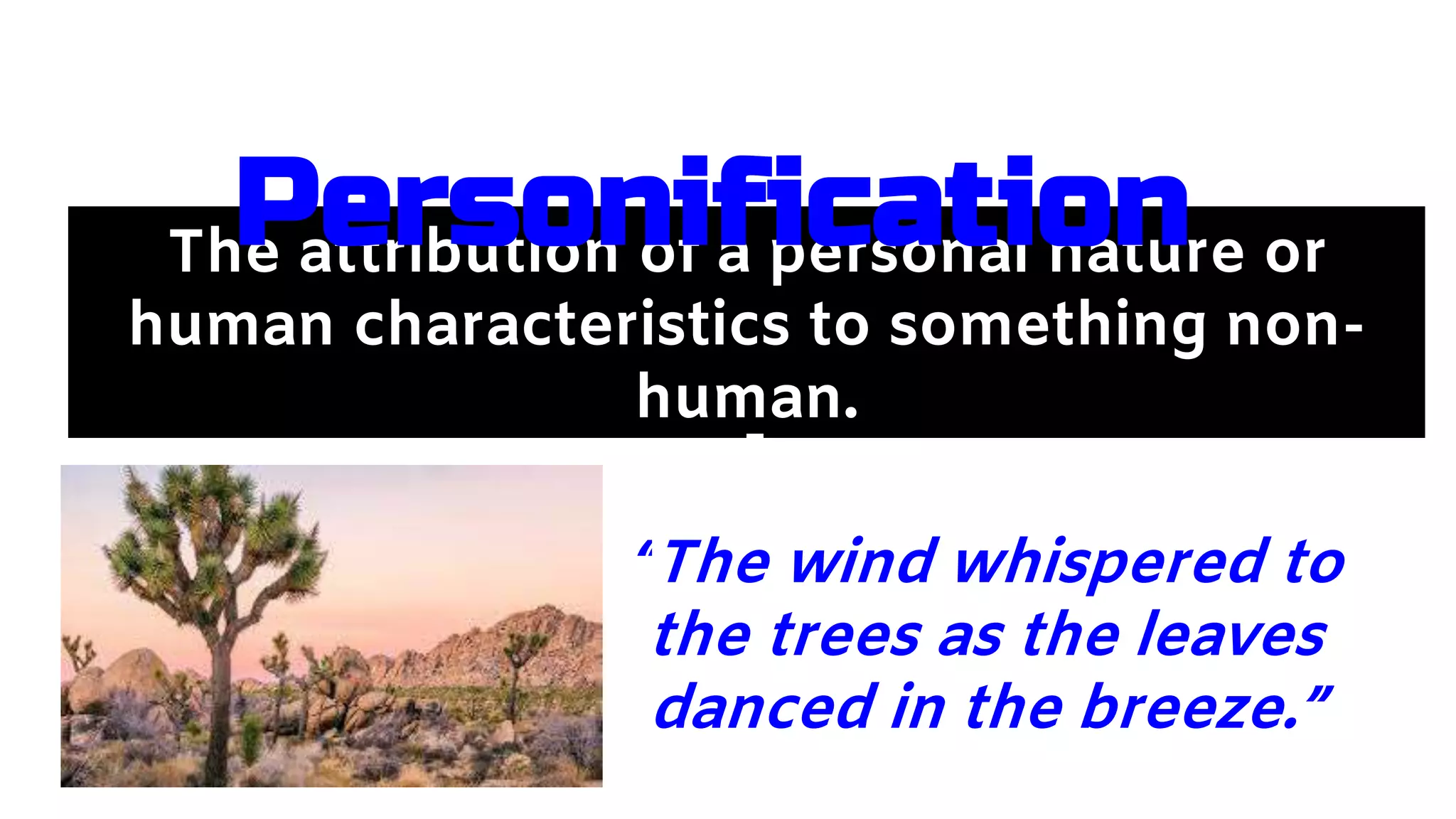
The attribution of a personal nature or
human characteristics to something non-
human.
Personification
“The wind whispered to
the trees as the leaves
danced in the breeze.”
A literary technique where conjunctions (and, but, or,
is, if) are used repeatedly in quick succession, often
with no commas, even when the conjunctions could be
removed.
Polysyndeton
“I wore a sweater, and a
hat, and a scarf, and a
pair of boots, and
mittens!”
The repetition of the consonant sounds of s, sh, z.
Sibilance occurs when the repetition of these
specific sounds are in close proximity.
Sibilance
“The snake slithered silently into the
sleepy forest.”
Comparing one thing with another thing,
words such as “as” and “like” are often used.
Simile
“He was as brave as a lion”
A technique adopted by writers to present ideas,
characters, or places in such a manner that they
appeal to more than one sense, like hearing, sight,
smell, and touch at a given time.
Synaesthesia
The hot sand burnt underfoot,
whilst the taste of salt permeated
the air as seagulls squawked in
the distance. The shimmering
blanket of blue beckoned.
TOUCH
SIGHT
TASTE
SOUND
A part of something represents the whole, or it
may use a whole to represent a part.
Synecdoche
“A nice set of wheels”
The repetitive use of phrases or words that have similar
meanings. In simple words, it is expressing the same thing,
an idea or saying, two or more times in different ways.
Tautology
“Repeat that again,”
and “reiterate again.”
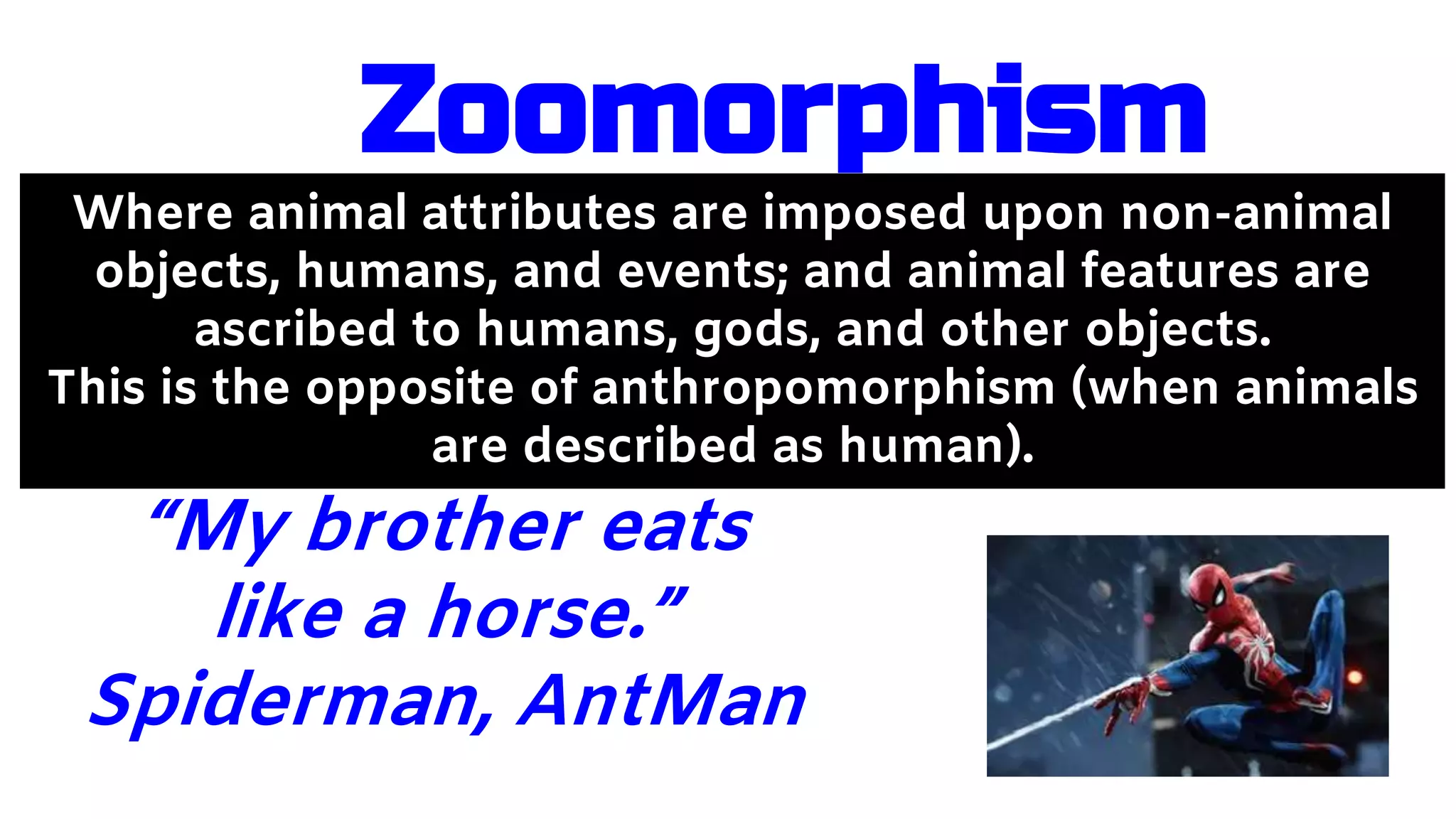
Where animal attributes are imposed upon non-animal
objects, humans, and events; and animal features are
ascribed to humans, gods, and other objects.
This is the opposite of anthropomorphism (when animals
are described as human).
Zoomorphism
“My brother eats
like a horse.”
Spiderman, AntMan

Literary Techniques

  • 1.
    A story ornarrative with two meanings; the obvious or literal meaning that is immediately clear, and a second, usually hidden meaning Allegory “The Lion, the Witch, and the Wardrobe by C.S. Lewis is a religious allegory. In it, we find that Aslan the lion represents Christ or God, the White Witch represents evil”
  • 2.
    Words that startwith the same consonant sound (not just the same letter), used repeatedly in a phrase or sentence. Alliteration The bullets bombarded the battlefield
  • 3.
    A reference toa historical theme, event or, form of media Allusion - Historical “Rome wasn’t built in a day.”
  • 4.
    A reference toanother literary work Allusion - Literary “It’s a hunger game out there.” - An allusion to The Hunger Games “Their love was like Romeo and Juliet” - An allusion to Shakespeare’s play
  • 5.
    A reference toa theological quote or theme. Allusion - Religious “The lush grounds looked like the Garden of Eden”
  • 6.
    Human traits, ambitions,emotions or behaviours given to animals,natural phenomena , non human beings or objects. Anthropomorphism In the Disney film, Beauty and the Beast, the clock and the teapot all act and behave as if they are human beings.
  • 7.
    Repetition of thesame word or phrase at the end of successive sentences. Antistrophe Don’t you ever talk about my friends! You don’t know any of my friends. You don’t look at any of my friends. And you certainly wouldn’t condescend to speak to any of my friends.
  • 8.
    Opposite ideas areput together in a sentence to achieve a contrasting effect. Antithesis It was the best of times, it was the worst of times, it was the age of wisdom, it was the age of foolishness. (Charles Dickens)
  • 9.
    A figure ofspeech where a speaker expresses doubt or perplexity regarding a question. The doubts may appear as rhetorical questions, often in the beginning of the text. Aporia “What’s in a name? That which we call a rose by any other name would smell as sweet.” (William Shakespeare, Romeo & Juliet)
  • 10.
    Assonance is whentwo or more words, close to one another repeat the same vowel sound, but start with different consonant sounds. Assonance “The rain in Spain falls mainly on the plain”
  • 11.
    The absence ofa conjunction (such as ‘and, or, but, for, nor, so, yet’) between parts of a sentence. Asyndeton “I came, I saw, I conquered.” - Julius Caesar
  • 12.
    A pause thatoccurs within a line of poetry, usually marked by some form of punctuation such as a full stop, comma, ellipsis, or dash Caesura “To be, or not to be - that is the question.”
  • 13.
    Repetitive sounds producedby consonants within a sentence or phrase, often in quick succession Consonance “The lumpy, bumpy road ”
  • 14.
    A text witha lesson and/or warning, intended to convey instruction and/or information. Provokes thought about moral and ethical behaviour Didacticism The story of Frankenstein is didactic; warning nineteenth century society about the dangers of ‘playing God’ in the unethical creation of human life
  • 15.
    A conjunction -usually ‘either’ or ‘but’, that dramatically interrupts the rhythm of the sentence to introduce a contrast Disjunction “I initially liked the house, but changed my mind when I saw how much work it needed!”
  • 16.
    Dysphemism is theuse of negative expressions instead of positive ones. A speaker uses them to humiliate or degrade the disapproved person or character. Dysphemism “When he was down they turned on him to betray him and rend him like rats in a sewer. Low– lived dogs!”
  • 17.
    A dramatic pausecreated by more than one full stop (...) that creates tensions or suggests that words can’t be spoken Ellipsis “I don’t know…I’m not sure”
  • 18.
    Moving over fromone line to another without a terminating punctuation mark, usually to create fluency and an increase of pace. Enjambment Cold Morning Time Ice Crystals reflect the rays of blazing sunrise
  • 19.
    Refers to polite,indirect expressions that replace words and phrases considered harsh and impolite, or which suggest something unpleasant Euphemism “Kicked the Bucket” - describes the death of a person) “Golden years” – describes
  • 20.
    A characters inabilityto comprehend their own situation when an audience can. The audience knows something a character does not IRONY: Dramatic Irony “She did not know she was being followed, the whole time.”
  • 21.
    This occurs whenwhat actually happens is the opposite of what is expected or appropriate IRONY: Situational Irony “A fire station burns down”
  • 22.
    A character saysone thing but means the opposite IRONY: Verbal irony This is also a form of sarcasm
  • 23.
    Comparing two thingsby saying that one ‘is’ the other in order to draw stronger comparison and often add a level of figurative meaning. Metaphor He was a beast in the boxing ring!
  • 24.
    The act ofreferring to something not by its actual name but by a figurative name or the name of something associated with it. Metonymy “Let me give you a hand” (Let me help you) “The pen is mightier than the sword” (Influencing people through thoughts and ideas is more effective than violence)
  • 25.
    Figure of speechin which two opposite ideas are joined together Oxymoron “Living death” “Deafening silence”
  • 26.
    A statement thatappears to be self - contradictory or silly, but which may include a truth Paradox “I must be cruel only to be kind” (Hamlet)
  • 27.
    A literary devicethat attributes human qualities and emotions to nature Pathetic Fallacy “The angry thunder and troubled wind consumed the city”
  • 28.
    The attribution ofa personal nature or human characteristics to something non- human. Personification “The wind whispered to the trees as the leaves danced in the breeze.”
  • 29.
    A literary techniquewhere conjunctions (and, but, or, is, if) are used repeatedly in quick succession, often with no commas, even when the conjunctions could be removed. Polysyndeton “I wore a sweater, and a hat, and a scarf, and a pair of boots, and mittens!”
  • 30.
    The repetition ofthe consonant sounds of s, sh, z. Sibilance occurs when the repetition of these specific sounds are in close proximity. Sibilance “The snake slithered silently into the sleepy forest.”
  • 31.
    Comparing one thingwith another thing, words such as “as” and “like” are often used. Simile “He was as brave as a lion”
  • 32.
    A technique adoptedby writers to present ideas, characters, or places in such a manner that they appeal to more than one sense, like hearing, sight, smell, and touch at a given time. Synaesthesia The hot sand burnt underfoot, whilst the taste of salt permeated the air as seagulls squawked in the distance. The shimmering blanket of blue beckoned. TOUCH SIGHT TASTE SOUND
  • 33.
    A part ofsomething represents the whole, or it may use a whole to represent a part. Synecdoche “A nice set of wheels”
  • 34.
    The repetitive useof phrases or words that have similar meanings. In simple words, it is expressing the same thing, an idea or saying, two or more times in different ways. Tautology “Repeat that again,” and “reiterate again.”
  • 35.
    Where animal attributesare imposed upon non-animal objects, humans, and events; and animal features are ascribed to humans, gods, and other objects. This is the opposite of anthropomorphism (when animals are described as human). Zoomorphism “My brother eats like a horse.” Spiderman, AntMan