Figures of Speech
Make your writing
colorful
Figures of Speech
Figures of speech are words or
phrases that depart from
straightforward literal language.
Figures of speech are often used
and crafted for emphasis,
freshness, expression, or clarity.
SIMILE
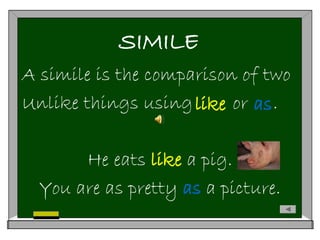
A simile is the comparison of two
Unlike things using or .
He eats like a pig.
You are as pretty as a picture.
like as
METAPHOR
A metaphor is the comparison of
two unlike things or expressions,
sometimes using the verb “to be,”
and not using like or as (as in a
simile).
“To be” (am, is, are, was, were)
METAPHOR
He is a pig.
“You are a tulip.”
From “A Meditation for his Mistress”
~Robert Herrick
ALLITERATION
Alliteration is the of
initial consonant sounds of
neighboring words.
Sally sells seashells by the seashore.
repetition
ALLITERATION
“She left the Heaven of Heroes and came down
To make a man to meet the mortal need,
A man to match the mountains and the sea,
The friendly welcome of the wayside well.”
From “Lincoln, the Man of the People”
~Edwin Markham
Metonymy
 (literally, a change of name),
an object is designated to be the
name of something else which is
generally associated with it.
Eg: The Crown, for the King
ONOMATOPOEIA
(on-uh-mat-uh-pee-uh)
An onomatopoeia is a word that imitates
the it represents.
The chiming of the bells…
The boom of the explosion…
sound
ONOMATOPOEIA
“Tinkling sleigh bells
Clanging fire bells
Mellow chiming wedding bells
Tolling, moaning, and groaning funeral
bells”
From “The Bells”
~Edgar Allan Poe
HYPERBOLE
A hyperbole is an or
an .
=
His feet are as big as boats!
I nearly died laughing!
exaggeration
overstatement
HYPERBOLE
“Here once the embattled farmers stood
And fired .”
From “The Concord Hymn”
~Ralph Waldo Emerson
the shot heard round the world
PERSONIFICATION
Giving human qualities to
things that are not human
The moon looked down at me.
Apostrophe
 a direct address to the dead, to the absent, or to
a personified object or idea. This figure is a
special form of Personification.
Eg: "Oh! Stars and clouds and winds, ye are
all about to mock me; if ye really pity me,
crush sensation and memory; let me become
as nought; but if not, depart, depart, and leave
me in darkness." (Mary Shelley,
Frankenstein, 1818)
Antithesis
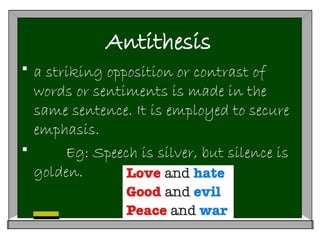
 a striking opposition or contrast of
words or sentiments is made in the
same sentence. It is employed to secure
emphasis.
 Eg: Speech is silver, but silence is
golden.
IDIOM
A saying that means something
different than what it says
It’s raining cats and dogs.
OXYMORON
-a special form of Antithesis,
whereby two contradictory
qualities are predicted at once of the
same thing.
Eg: "I am busy doing nothing."
PALINDROME
Words that are the same spelled front
wards and backwards
Stanley Yelnats
Racecar
Evil Olive
Irony
 Irony happens when there‘s a
marked contrast between what is
said and what is meant, or between
appearance and reality.
Three Types of Irony
 Verbal irony. Takes place when the
speaker says something in sharp
contrast to his or her actual
meaning.
Ex: Well, isn‘t this nice Uttered by a man
―
whose plane is going down.
(From the song Ironic of Alanis Morrissette)
―
 Note: Verbal irony can also consist of
ironic similes, which are
―
comparisons in which the two things
are not alike at all.
Ex: Your hand is soft as sandpaper.
(Means your hand is rough.)
You are warm as ice.
(Means you are cold)
Dramatic Irony. Happens when the
audience has more information than
one or more characters in a work of
literature.
Ex: Shakespeare‘s Othello Othello‘s best friend
Lago is evil and attempting to bring Othello
down.
Desdemona has been faithful, though
Othello doesn‘t know this.
(The audience is aware but Othello is not aware.)
Situational irony. Contains of a
situation in which the outcome is
very different from what was
expected.
EX: The movie ―The Wonderful Wizard of Oz
The citizens of the Emerald City assume that Oz is
great and allpowerful, yet the man behind the
curtain is revealed to be an old man with no special
powers.
TEST YOUR KNOWLEDGE!
He clattered and clanged as he
washed the dishes.
(A) Simile
(B) Onomatopoeia
(C) Hyperbole
TEST YOUR KNOWLEDGE!
Life is a beach!
(A)Metaphor
(B)Alliteration
(C) Simile
TEST YOUR KNOWLEDGE!
“Peter Piper picked a peck of pickled peppers.”
~Mother Goose
(A) Onomatopoeia
(B) Hyperbole
(C) Alliteration
TEST YOUR KNOWLEDGE!
The river falls under us like a
trap door.
(A) Onomatopoeia
(B) Simile
(C) Metaphor
TEST YOUR KNOWLEDGE!
I’m so hungry I could eat a horse!
(A) Hyperbole
(B) Metaphor
(C) Onomatopoeia
TEST YOUR KNOWLEDGE!
“Don’t delay dawn’s disarming display.
Dusk demands daylight.”
From “Dewdrops Dancing Down Daises”
~Paul Mc Cann
(A) Onomatopoeia
(B) Alliteration
(C) Hyperbole
TEST YOUR KNOWLEDGE!
I’ve heard that joke a billion
times, but it still cracks me up!
(A) Simile
(B) Metaphor
(C) Hyperbole
TEST YOUR KNOWLEDGE!
The glass vase is as fragile as a
child’s sandcastle.
(A) Metaphor
(B) Alliteration
(C) Simile
TEST YOUR KNOWLEDGE!
The buzzing bee startled me!
(A) Hypberbole
(B) Onomatopoeia
(C) Metaphor
TEST YOUR KNOWLEDGE!
She looked at him with fire in her
eyes.
(A) Alliteration
(B) Simile
(C) Metaphor
TEST YOUR KNOWLEDGE
The sun draped its arms
around my shoulders
A) Personification
B) Oxymoron
C) Palindrome
TEST YOUR KNOWLEDGE
You look like a million
dollars.
A) Personification
B) Idiom
C) Oxymoron
TEST YOUR KNOWLEDGE
You looked pretty ugly in
that dress.
A) Onomatopoeia
B) Oxymoron
C) Alliteration
TEST YOUR KNOWLEDGE
The boy shouted, “Madam, I’m
Adam!”
A) Personification
B) Oxymoron
C) Palindrome

1.4-FiguresofSpeech.ppt oral communication

  • 1.
    Figures of Speech Makeyour writing colorful
  • 2.
    Figures of Speech Figuresof speech are words or phrases that depart from straightforward literal language. Figures of speech are often used and crafted for emphasis, freshness, expression, or clarity.
  • 3.
    SIMILE A simile isthe comparison of two Unlike things using or . He eats like a pig. You are as pretty as a picture. like as
  • 4.
    METAPHOR A metaphor isthe comparison of two unlike things or expressions, sometimes using the verb “to be,” and not using like or as (as in a simile). “To be” (am, is, are, was, were)
  • 5.
    METAPHOR He is apig. “You are a tulip.” From “A Meditation for his Mistress” ~Robert Herrick
  • 6.
    ALLITERATION Alliteration is theof initial consonant sounds of neighboring words. Sally sells seashells by the seashore. repetition
  • 7.
    ALLITERATION “She left theHeaven of Heroes and came down To make a man to meet the mortal need, A man to match the mountains and the sea, The friendly welcome of the wayside well.” From “Lincoln, the Man of the People” ~Edwin Markham
  • 8.
    Metonymy  (literally, achange of name), an object is designated to be the name of something else which is generally associated with it. Eg: The Crown, for the King
  • 9.
    ONOMATOPOEIA (on-uh-mat-uh-pee-uh) An onomatopoeia isa word that imitates the it represents. The chiming of the bells… The boom of the explosion… sound
  • 10.
    ONOMATOPOEIA “Tinkling sleigh bells Clangingfire bells Mellow chiming wedding bells Tolling, moaning, and groaning funeral bells” From “The Bells” ~Edgar Allan Poe
  • 11.
    HYPERBOLE A hyperbole isan or an . = His feet are as big as boats! I nearly died laughing! exaggeration overstatement
  • 12.
    HYPERBOLE “Here once theembattled farmers stood And fired .” From “The Concord Hymn” ~Ralph Waldo Emerson the shot heard round the world
  • 13.
    PERSONIFICATION Giving human qualitiesto things that are not human The moon looked down at me.
  • 14.
    Apostrophe  a directaddress to the dead, to the absent, or to a personified object or idea. This figure is a special form of Personification. Eg: "Oh! Stars and clouds and winds, ye are all about to mock me; if ye really pity me, crush sensation and memory; let me become as nought; but if not, depart, depart, and leave me in darkness." (Mary Shelley, Frankenstein, 1818)
  • 15.
    Antithesis  a strikingopposition or contrast of words or sentiments is made in the same sentence. It is employed to secure emphasis.  Eg: Speech is silver, but silence is golden.
  • 16.
    IDIOM A saying thatmeans something different than what it says It’s raining cats and dogs.
  • 17.
    OXYMORON -a special formof Antithesis, whereby two contradictory qualities are predicted at once of the same thing. Eg: "I am busy doing nothing."
  • 18.
    PALINDROME Words that arethe same spelled front wards and backwards Stanley Yelnats Racecar Evil Olive
  • 19.
    Irony  Irony happenswhen there‘s a marked contrast between what is said and what is meant, or between appearance and reality.
  • 20.
    Three Types ofIrony  Verbal irony. Takes place when the speaker says something in sharp contrast to his or her actual meaning. Ex: Well, isn‘t this nice Uttered by a man ― whose plane is going down. (From the song Ironic of Alanis Morrissette) ―
  • 21.
     Note: Verbalirony can also consist of ironic similes, which are ― comparisons in which the two things are not alike at all. Ex: Your hand is soft as sandpaper. (Means your hand is rough.) You are warm as ice. (Means you are cold)
  • 22.
    Dramatic Irony. Happenswhen the audience has more information than one or more characters in a work of literature. Ex: Shakespeare‘s Othello Othello‘s best friend Lago is evil and attempting to bring Othello down. Desdemona has been faithful, though Othello doesn‘t know this. (The audience is aware but Othello is not aware.)
  • 23.
    Situational irony. Containsof a situation in which the outcome is very different from what was expected. EX: The movie ―The Wonderful Wizard of Oz The citizens of the Emerald City assume that Oz is great and allpowerful, yet the man behind the curtain is revealed to be an old man with no special powers.
  • 25.
    TEST YOUR KNOWLEDGE! Heclattered and clanged as he washed the dishes. (A) Simile (B) Onomatopoeia (C) Hyperbole
  • 26.
    TEST YOUR KNOWLEDGE! Lifeis a beach! (A)Metaphor (B)Alliteration (C) Simile
  • 27.
    TEST YOUR KNOWLEDGE! “PeterPiper picked a peck of pickled peppers.” ~Mother Goose (A) Onomatopoeia (B) Hyperbole (C) Alliteration
  • 28.
    TEST YOUR KNOWLEDGE! Theriver falls under us like a trap door. (A) Onomatopoeia (B) Simile (C) Metaphor
  • 29.
    TEST YOUR KNOWLEDGE! I’mso hungry I could eat a horse! (A) Hyperbole (B) Metaphor (C) Onomatopoeia
  • 30.
    TEST YOUR KNOWLEDGE! “Don’tdelay dawn’s disarming display. Dusk demands daylight.” From “Dewdrops Dancing Down Daises” ~Paul Mc Cann (A) Onomatopoeia (B) Alliteration (C) Hyperbole
  • 31.
    TEST YOUR KNOWLEDGE! I’veheard that joke a billion times, but it still cracks me up! (A) Simile (B) Metaphor (C) Hyperbole
  • 32.
    TEST YOUR KNOWLEDGE! Theglass vase is as fragile as a child’s sandcastle. (A) Metaphor (B) Alliteration (C) Simile
  • 33.
    TEST YOUR KNOWLEDGE! Thebuzzing bee startled me! (A) Hypberbole (B) Onomatopoeia (C) Metaphor
  • 34.
    TEST YOUR KNOWLEDGE! Shelooked at him with fire in her eyes. (A) Alliteration (B) Simile (C) Metaphor
  • 35.
    TEST YOUR KNOWLEDGE Thesun draped its arms around my shoulders A) Personification B) Oxymoron C) Palindrome
  • 36.
    TEST YOUR KNOWLEDGE Youlook like a million dollars. A) Personification B) Idiom C) Oxymoron
  • 37.
    TEST YOUR KNOWLEDGE Youlooked pretty ugly in that dress. A) Onomatopoeia B) Oxymoron C) Alliteration
  • 38.
    TEST YOUR KNOWLEDGE Theboy shouted, “Madam, I’m Adam!” A) Personification B) Oxymoron C) Palindrome

Editor's Notes

  • #19 This can be a difference between the surface meaning of something that is said and the underlying meaning.
  • #20 The speaker regularly makes a statement that seems very direct, yet indicates that the opposite is in fact true, or what the speaker really means.
  • #23 There are contradictions and contrasts present in situational irony