LITERARY APPRECIATION
ANNISA EKA RAHMA
NIM : 1888203053
IKIP WIDYA DARMA
SURABAYA
PROSE
• The form of written language that is not organized according to
formal patterns of verse . It may have some sort of rhythm and some
devices of repetition and balance, but these are not governed by
regularly sustained formal arrangement. The significant unit is the
sentence, not the line. Hence it is represented without line breaks in
writing
IKIP WIDYA DARMA
SURABAYA
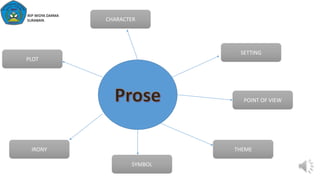
Prose
Poetry
Short Story
Novel
IKIP WIDYA DARMA
SURABAYA
PLOT
CHARACTER
SETTING
POINT OF VIEW
THEMEIRONY
SYMBOL
IKIP WIDYA DARMA
SURABAYA
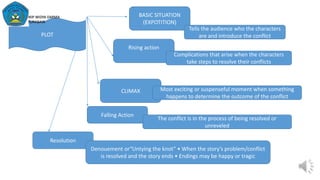
PLOT
BASIC SITUATION
(EXPOTITION)
Tells the audience who the characters
are and introduce the conflict
Rising action
Complications that arise when the characters
take steps to resolve their conflicts
CLIMAX Most exciting or suspenseful moment when something
happens to determine the outcome of the conflict
Falling Action
The conflict is in the process of being resolved or
unreveled
Resolution
Denouement or“Untying the knot” • When the story’s problem/conflict
is resolved and the story ends • Endings may be happy or tragic
IKIP WIDYA DARMA
SURABAYA
Freytag’s Pyramid
Gustav Freytag was a Nineteenth Century German novelist who saw common patterns in the plots of stories
and novels and developed a diagram to analyze them. He diagrammed a story's plot using a pyramid like the
one shown here:
EXPOSITION
Climax
DENOUEMENT
IKIP WIDYA DARMA
SURABAYA
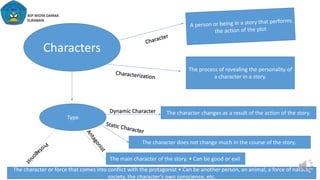
Characters
The process of revealing the personality of
a character in a story.
Type
Dynamic Character The character changes as a result of the action of the story.
The character does not change much in the course of the story.
The main character of the story. • Can be good or evil
The character or force that comes into conflict with the protagonist • Can be another person, an animal, a force of nature,
society, the character’s own conscience, etc.
IKIP WIDYA DARMA
SURABAYA
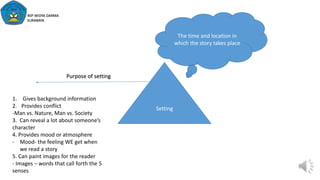
Setting
The time and location in
which the story takes place
Purpose of setting
1. Gives background information
2. Provides conflict
-Man vs. Nature, Man vs. Society
3. Can reveal a lot about someone’s
character
4. Provides mood or atmosphere
- Mood- the feeling WE get when
we read a story
5. Can paint images for the reader
- Images – words that call forth the 5
senses
IKIP WIDYA DARMA
SURABAYA
Theme
The insight about human life that is revealed in a literary work.
The “golden thread” woven throughout the story
IKIP WIDYA DARMA
SURABAYA
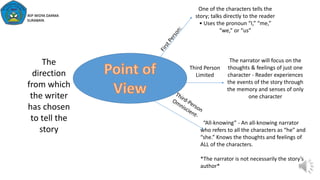
The
direction
from which
the writer
has chosen
to tell the
story
“All-knowing” - An all-knowing narrator
who refers to all the characters as “he” and
“she.” Knows the thoughts and feelings of
ALL of the characters.
*The narrator is not necessarily the story’s
author*
Third Person
Limited
One of the characters tells the
story; talks directly to the reader
• Uses the pronoun “I,” “me,”
“we,” or “us”
The narrator will focus on the
thoughts & feelings of just one
character - Reader experiences
the events of the story through
the memory and senses of only
one character
IKIP WIDYA DARMA
SURABAYA
IKIP WIDYA DARMA
SURABAYA
CONFLICT
It exists when a character is
struggling with something or
someone
Could be a number of things:
• Another person, an animal,
• an inanimate object- a rock, the
weather
• The character’s own personality
External Conflict- Caused by something OUTSIDE the character
Example: an another character, a river, weather, society
• Man vs. Man, Man vs. Nature, Man vs. Society
Internal Conflict- Character struggles with some personal quality
that is causing trouble
Example: vanity, pride, selfishness, grief
• Man vs. Self
IKIP WIDYA DARMA
SURABAYA
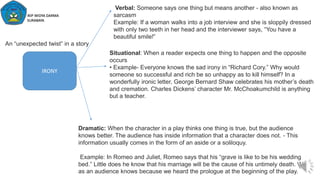
IRONY
An “unexpected twist” in a story
Verbal: Someone says one thing but means another - also known as
sarcasm
Example: If a woman walks into a job interview and she is sloppily dressed
with only two teeth in her head and the interviewer says, “You have a
beautiful smile!”
Situational: When a reader expects one thing to happen and the opposite
occurs
• Example- Everyone knows the sad irony in “Richard Cory.” Why would
someone so successful and rich be so unhappy as to kill himself? In a
wonderfully ironic letter, George Bernard Shaw celebrates his mother’s death
and cremation. Charles Dickens’ character Mr. McChoakumchild is anything
but a teacher.
Dramatic: When the character in a play thinks one thing is true, but the audience
knows better. The audience has inside information that a character does not. - This
information usually comes in the form of an aside or a soliloquy.
Example: In Romeo and Juliet, Romeo says that his “grave is like to be his wedding
bed.” Little does he know that his marriage will be the cause of his untimely death. We
as an audience knows because we heard the prologue at the beginning of the play.

Literary appreciation prose

  • 1.
    LITERARY APPRECIATION ANNISA EKARAHMA NIM : 1888203053 IKIP WIDYA DARMA SURABAYA
  • 2.
    PROSE • The formof written language that is not organized according to formal patterns of verse . It may have some sort of rhythm and some devices of repetition and balance, but these are not governed by regularly sustained formal arrangement. The significant unit is the sentence, not the line. Hence it is represented without line breaks in writing IKIP WIDYA DARMA SURABAYA
  • 3.
  • 4.
  • 5.
    PLOT BASIC SITUATION (EXPOTITION) Tells theaudience who the characters are and introduce the conflict Rising action Complications that arise when the characters take steps to resolve their conflicts CLIMAX Most exciting or suspenseful moment when something happens to determine the outcome of the conflict Falling Action The conflict is in the process of being resolved or unreveled Resolution Denouement or“Untying the knot” • When the story’s problem/conflict is resolved and the story ends • Endings may be happy or tragic IKIP WIDYA DARMA SURABAYA
  • 6.
    Freytag’s Pyramid Gustav Freytagwas a Nineteenth Century German novelist who saw common patterns in the plots of stories and novels and developed a diagram to analyze them. He diagrammed a story's plot using a pyramid like the one shown here: EXPOSITION Climax DENOUEMENT IKIP WIDYA DARMA SURABAYA
  • 7.
    Characters The process ofrevealing the personality of a character in a story. Type Dynamic Character The character changes as a result of the action of the story. The character does not change much in the course of the story. The main character of the story. • Can be good or evil The character or force that comes into conflict with the protagonist • Can be another person, an animal, a force of nature, society, the character’s own conscience, etc. IKIP WIDYA DARMA SURABAYA
  • 8.
    Setting The time andlocation in which the story takes place Purpose of setting 1. Gives background information 2. Provides conflict -Man vs. Nature, Man vs. Society 3. Can reveal a lot about someone’s character 4. Provides mood or atmosphere - Mood- the feeling WE get when we read a story 5. Can paint images for the reader - Images – words that call forth the 5 senses IKIP WIDYA DARMA SURABAYA
  • 9.
    Theme The insight abouthuman life that is revealed in a literary work. The “golden thread” woven throughout the story IKIP WIDYA DARMA SURABAYA
  • 10.
    The direction from which the writer haschosen to tell the story “All-knowing” - An all-knowing narrator who refers to all the characters as “he” and “she.” Knows the thoughts and feelings of ALL of the characters. *The narrator is not necessarily the story’s author* Third Person Limited One of the characters tells the story; talks directly to the reader • Uses the pronoun “I,” “me,” “we,” or “us” The narrator will focus on the thoughts & feelings of just one character - Reader experiences the events of the story through the memory and senses of only one character IKIP WIDYA DARMA SURABAYA
  • 11.
    IKIP WIDYA DARMA SURABAYA CONFLICT Itexists when a character is struggling with something or someone Could be a number of things: • Another person, an animal, • an inanimate object- a rock, the weather • The character’s own personality External Conflict- Caused by something OUTSIDE the character Example: an another character, a river, weather, society • Man vs. Man, Man vs. Nature, Man vs. Society Internal Conflict- Character struggles with some personal quality that is causing trouble Example: vanity, pride, selfishness, grief • Man vs. Self
  • 12.
    IKIP WIDYA DARMA SURABAYA IRONY An“unexpected twist” in a story Verbal: Someone says one thing but means another - also known as sarcasm Example: If a woman walks into a job interview and she is sloppily dressed with only two teeth in her head and the interviewer says, “You have a beautiful smile!” Situational: When a reader expects one thing to happen and the opposite occurs • Example- Everyone knows the sad irony in “Richard Cory.” Why would someone so successful and rich be so unhappy as to kill himself? In a wonderfully ironic letter, George Bernard Shaw celebrates his mother’s death and cremation. Charles Dickens’ character Mr. McChoakumchild is anything but a teacher. Dramatic: When the character in a play thinks one thing is true, but the audience knows better. The audience has inside information that a character does not. - This information usually comes in the form of an aside or a soliloquy. Example: In Romeo and Juliet, Romeo says that his “grave is like to be his wedding bed.” Little does he know that his marriage will be the cause of his untimely death. We as an audience knows because we heard the prologue at the beginning of the play.