Patricia GrayPatricia Gray
Graves County High SchoolGraves County High School
Language Arts DepartmentLanguage Arts Department
9th Grade9th Grade
Elements of a Short Storyof a Short Story
A short story is a work of fictionA short story is a work of fiction
that can be read in one sitting.that can be read in one sitting.
PlotPlot
The chain of related events that takeThe chain of related events that take
place in a story.place in a story.
Built around conflict, which is a struggleBuilt around conflict, which is a struggle
between opposing forces.between opposing forces.
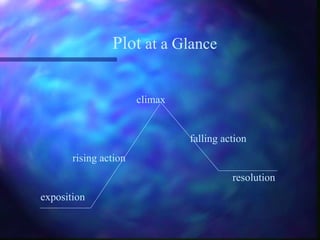
Plot at a Glance
climax
falling action
rising action
resolution
exposition
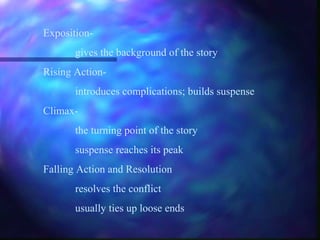
Exposition-
gives the background of the story
Rising Action-
introduces complications; builds suspense
Climax-
the turning point of the story
suspense reaches its peak
Falling Action and Resolution
resolves the conflict
usually ties up loose ends
The plot of a short story centers
around conflict. Conflict is a
struggle between opposing
forces.
Complications build the
reader’s excitement.
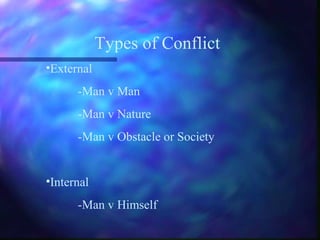
Types of Conflict
•External
-Man v Man
-Man v Nature
-Man v Obstacle or Society
•Internal
-Man v Himself
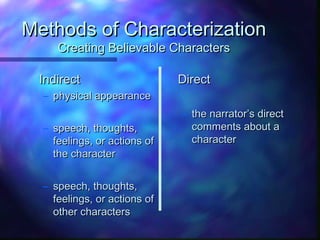
Methods of CharacterizationMethods of Characterization
Creating Believable CharactersCreating Believable Characters
IndirectIndirect
– physical appearancephysical appearance
– speech, thoughts,speech, thoughts,
feelings, or actions offeelings, or actions of
the characterthe character
– speech, thoughts,speech, thoughts,
feelings, or actions offeelings, or actions of
other charactersother characters
DirectDirect
– the narrator’s directthe narrator’s direct
comments about acomments about a
charactercharacter
Types of Characters
•Main or Minor
•Protagonist or Antagonist
•Round or Flat
•Dynamic or Static
•*Stereotypes=Stock Characters*
Setting= time and place
-puts the reader in the story by
giving the reader the feeling of
being in the situation.
-creates atmosphere by the
positive or negative feelings
associated with the place.
Point of View or . . .
(Who’s telling this story
anyway?)
-the vantage point from which the story
is told.
-determines how much we, the readers,
know about the characters.
1st Person
• Narrator is a character in the story.
•Narrator uses first-person pronouns, I,
me, my, we, us, our to refer to himself or
herself.
•Narrator knows the thoughts and
feelings of one character and speaks
directly to reader.
3rd Person Limited
•Narrator does not participate in action of
story.
•Narrator does not refer to himself or
herself.
•Narrator knows the thoughts and feelings
of one character, but readers are able to
maintain some emotional distance from the
character.
3rd Person Omniscient
•Narrator does not participate in action of
story.
•Narrator does not refer to himself or
herself.
•Narrator knows the thoughts and feelings
of all characters; readers get insight into
several characters.
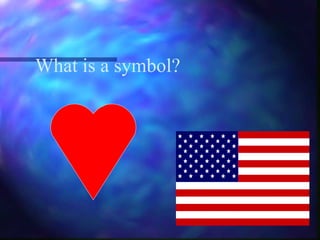
What is a symbol?
A symbol is a person, a
place, an activity, or an
object that stands for
something beyond itself.
Theme
In literature, theme is a perception about life or
human nature that the writer wants to share with the
reader.
In most cases, the theme is not stated directly but
must be inferred.
Themes can be revealed by
- a story’s title
- key phrases and statements about big ideas
- the ways the characters change and the
lessons they learn about life.
The End

Ss elements

  • 1.
    Patricia GrayPatricia Gray GravesCounty High SchoolGraves County High School Language Arts DepartmentLanguage Arts Department 9th Grade9th Grade
  • 2.
    Elements of aShort Storyof a Short Story A short story is a work of fictionA short story is a work of fiction that can be read in one sitting.that can be read in one sitting.
  • 3.
    PlotPlot The chain ofrelated events that takeThe chain of related events that take place in a story.place in a story. Built around conflict, which is a struggleBuilt around conflict, which is a struggle between opposing forces.between opposing forces.
  • 4.
    Plot at aGlance climax falling action rising action resolution exposition
  • 5.
    Exposition- gives the backgroundof the story Rising Action- introduces complications; builds suspense Climax- the turning point of the story suspense reaches its peak Falling Action and Resolution resolves the conflict usually ties up loose ends
  • 6.
    The plot ofa short story centers around conflict. Conflict is a struggle between opposing forces. Complications build the reader’s excitement.
  • 7.
    Types of Conflict •External -Manv Man -Man v Nature -Man v Obstacle or Society •Internal -Man v Himself
  • 8.
    Methods of CharacterizationMethodsof Characterization Creating Believable CharactersCreating Believable Characters IndirectIndirect – physical appearancephysical appearance – speech, thoughts,speech, thoughts, feelings, or actions offeelings, or actions of the characterthe character – speech, thoughts,speech, thoughts, feelings, or actions offeelings, or actions of other charactersother characters DirectDirect – the narrator’s directthe narrator’s direct comments about acomments about a charactercharacter
  • 9.
    Types of Characters •Mainor Minor •Protagonist or Antagonist •Round or Flat •Dynamic or Static •*Stereotypes=Stock Characters*
  • 10.
    Setting= time andplace -puts the reader in the story by giving the reader the feeling of being in the situation. -creates atmosphere by the positive or negative feelings associated with the place.
  • 11.
    Point of Viewor . . . (Who’s telling this story anyway?) -the vantage point from which the story is told. -determines how much we, the readers, know about the characters.
  • 12.
    1st Person • Narratoris a character in the story. •Narrator uses first-person pronouns, I, me, my, we, us, our to refer to himself or herself. •Narrator knows the thoughts and feelings of one character and speaks directly to reader.
  • 13.
    3rd Person Limited •Narratordoes not participate in action of story. •Narrator does not refer to himself or herself. •Narrator knows the thoughts and feelings of one character, but readers are able to maintain some emotional distance from the character.
  • 14.
    3rd Person Omniscient •Narratordoes not participate in action of story. •Narrator does not refer to himself or herself. •Narrator knows the thoughts and feelings of all characters; readers get insight into several characters.
  • 15.
    What is asymbol?
  • 16.
    A symbol isa person, a place, an activity, or an object that stands for something beyond itself.
  • 17.
    Theme In literature, themeis a perception about life or human nature that the writer wants to share with the reader. In most cases, the theme is not stated directly but must be inferred. Themes can be revealed by - a story’s title - key phrases and statements about big ideas - the ways the characters change and the lessons they learn about life.
  • 18.