Literal and Figurative
LanguageDIANA (113 12 005)
ULIN NIAM (113 12 025)
RIZKI WULANDARI (113 12 0 030)
 Literal and figurative language is a distinction within some fields of
language analysis.
 Literal language refers to words that do not deviate from their
defined meaning. to be literal is to mean what you say.
 Non-literal or figurative language refers to words, and groups of
words, that exaggerate or alter the usual meanings of the
component words. To be figurative is to not mean what you say but
imply something else
 Literal is a real, and Figurative is an imaginary
 A literal usage is the "normal" meanings of the words. It maintains a
consistent meaning regardless of the context, with "the intended
meaning correspond[ing] exactly the meaning" of the individual
words. Figurative use of language is the use of words or phrases in a
manner where the literal meaning of the words is not true or does
not make sense, but "implies a non-literal meaning which does
make sense or that could be true".
 Figurative language can be found in poetry where the writing
appeals to the senses. Figurative language can make you look at
the world differently; it can heighten your senses. It compares two
things in such a way that you find the comparison interesting or
even a bit surprising. Figurative language can take multiple forms
such as simile or metaphor. Merriam-Webster's Encyclopedia Of
Literature says that figurative language can be classified in five
categories: resemblance or relationship, emphasis or
understatement, figures of sound, verbal games, and errors.
 Figurative Language does not always mean what is being said or
read, but serves to make it more interesting.
Figurative Language and
Rhetorical Devices
 Figures of Speech
 Sounds
 Other Rhetorical Devices
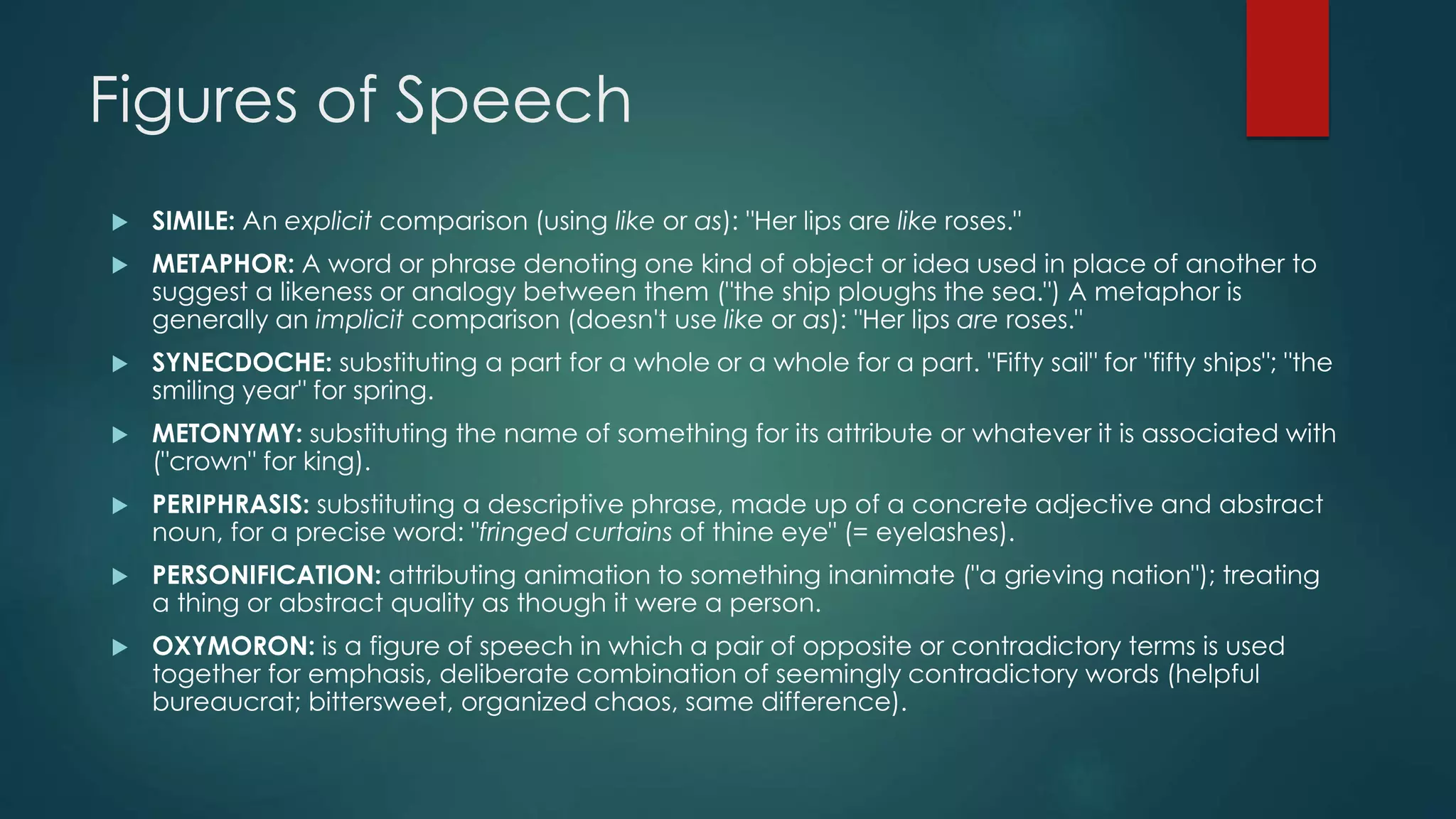
Figures of Speech
 SIMILE: An explicit comparison (using like or as): "Her lips are like roses."
 METAPHOR: A word or phrase denoting one kind of object or idea used in place of another to
suggest a likeness or analogy between them ("the ship ploughs the sea.") A metaphor is
generally an implicit comparison (doesn't use like or as): "Her lips are roses."
 SYNECDOCHE: substituting a part for a whole or a whole for a part. "Fifty sail" for "fifty ships"; "the
smiling year" for spring.
 METONYMY: substituting the name of something for its attribute or whatever it is associated with
("crown" for king).
 PERIPHRASIS: substituting a descriptive phrase, made up of a concrete adjective and abstract
noun, for a precise word: "fringed curtains of thine eye" (= eyelashes).
 PERSONIFICATION: attributing animation to something inanimate ("a grieving nation"); treating
a thing or abstract quality as though it were a person.
 OXYMORON: is a figure of speech in which a pair of opposite or contradictory terms is used
together for emphasis, deliberate combination of seemingly contradictory words (helpful
bureaucrat; bittersweet, organized chaos, same difference).
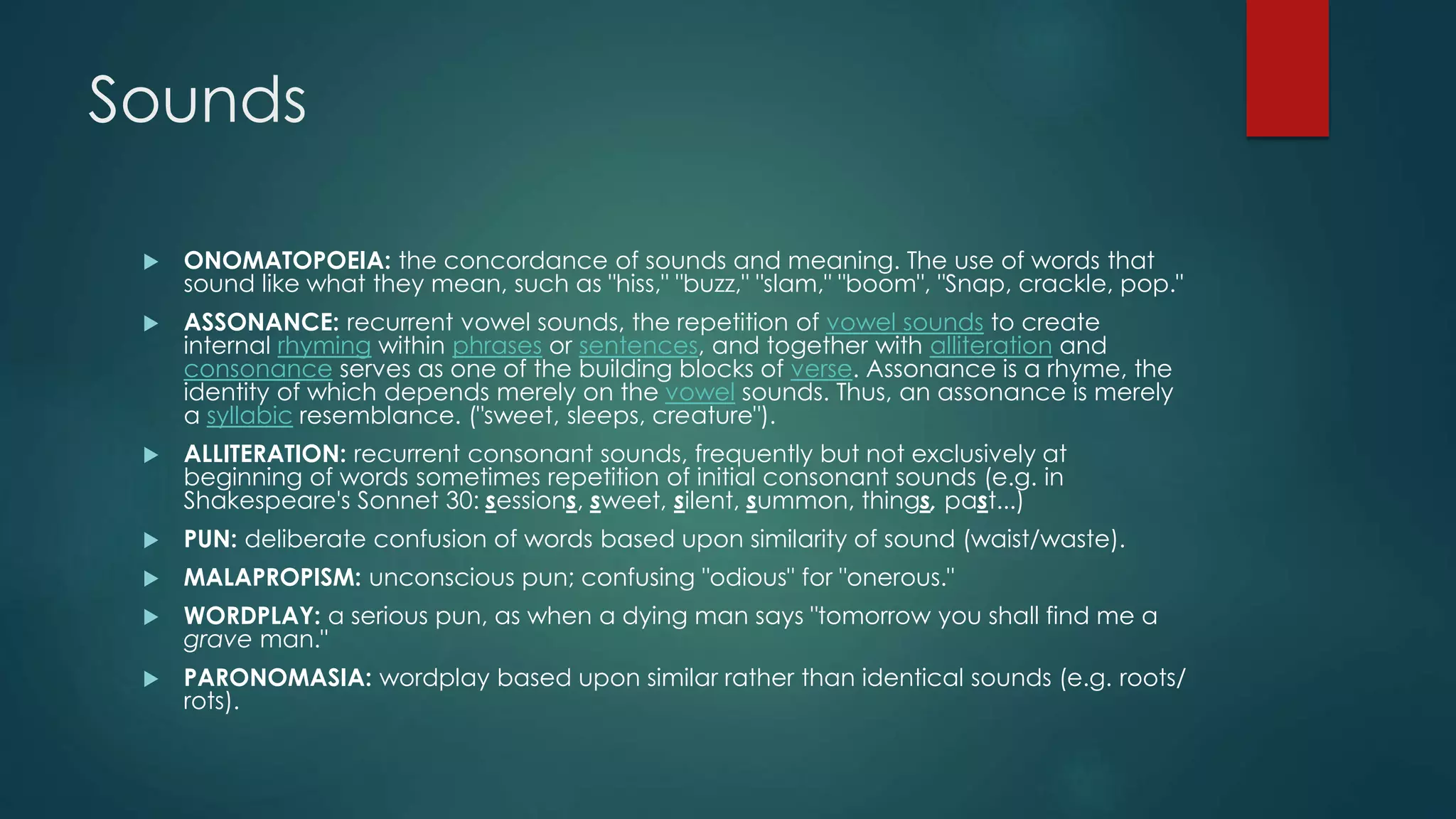
Sounds
 ONOMATOPOEIA: the concordance of sounds and meaning. The use of words that
sound like what they mean, such as "hiss," "buzz," "slam," "boom", "Snap, crackle, pop."
 ASSONANCE: recurrent vowel sounds, the repetition of vowel sounds to create
internal rhyming within phrases or sentences, and together with alliteration and
consonance serves as one of the building blocks of verse. Assonance is a rhyme, the
identity of which depends merely on the vowel sounds. Thus, an assonance is merely
a syllabic resemblance. ("sweet, sleeps, creature").
 ALLITERATION: recurrent consonant sounds, frequently but not exclusively at
beginning of words sometimes repetition of initial consonant sounds (e.g. in
Shakespeare's Sonnet 30: sessions, sweet, silent, summon, things, past...)
 PUN: deliberate confusion of words based upon similarity of sound (waist/waste).
 MALAPROPISM: unconscious pun; confusing "odious" for "onerous."
 WORDPLAY: a serious pun, as when a dying man says "tomorrow you shall find me a
grave man."
 PARONOMASIA: wordplay based upon similar rather than identical sounds (e.g. roots/
rots).
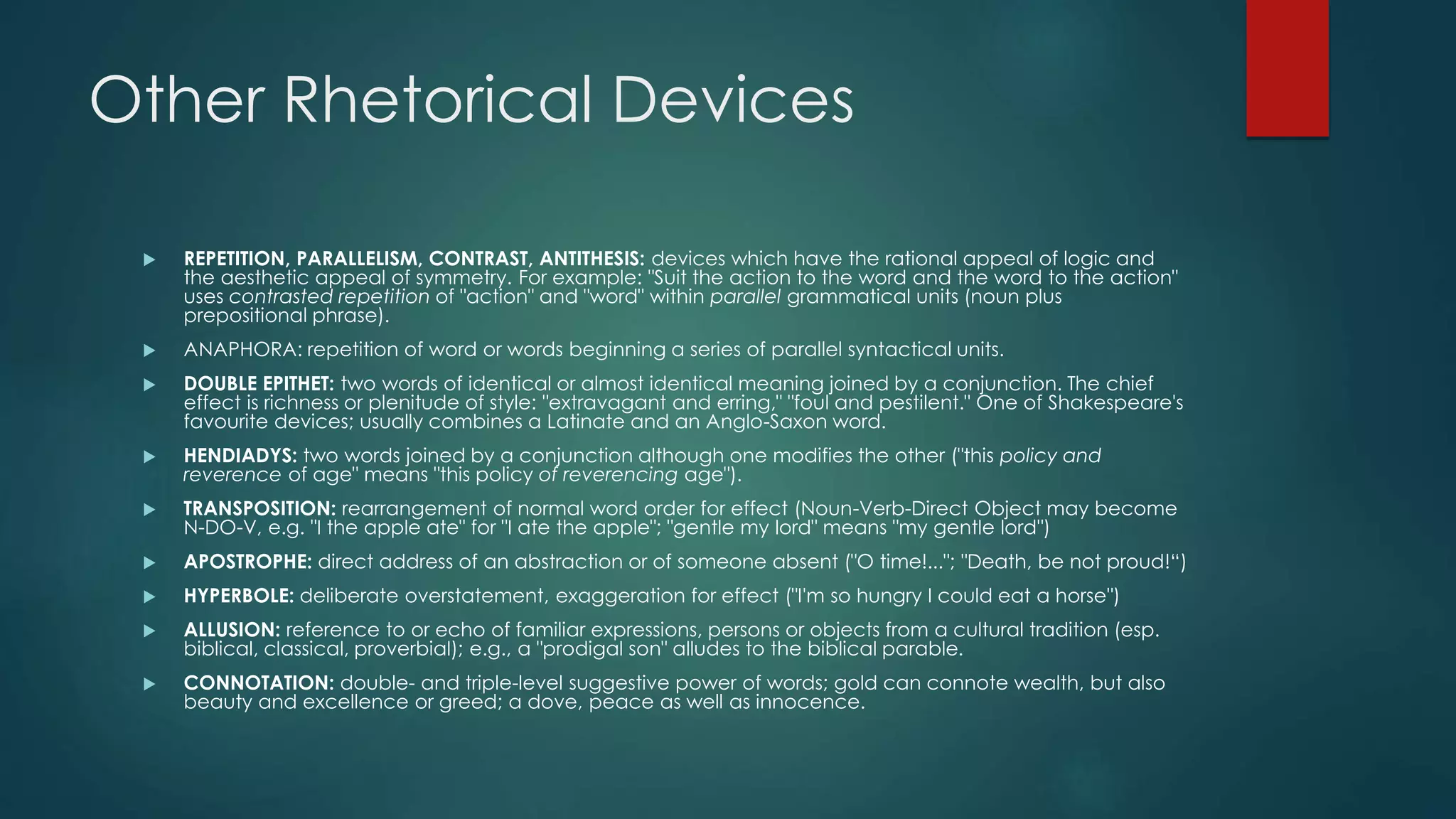
Other Rhetorical Devices
 REPETITION, PARALLELISM, CONTRAST, ANTITHESIS: devices which have the rational appeal of logic and
the aesthetic appeal of symmetry. For example: "Suit the action to the word and the word to the action"
uses contrasted repetition of "action" and "word" within parallel grammatical units (noun plus
prepositional phrase).
 ANAPHORA: repetition of word or words beginning a series of parallel syntactical units.
 DOUBLE EPITHET: two words of identical or almost identical meaning joined by a conjunction. The chief
effect is richness or plenitude of style: "extravagant and erring," "foul and pestilent." One of Shakespeare's
favourite devices; usually combines a Latinate and an Anglo-Saxon word.
 HENDIADYS: two words joined by a conjunction although one modifies the other ("this policy and
reverence of age" means "this policy of reverencing age").
 TRANSPOSITION: rearrangement of normal word order for effect (Noun-Verb-Direct Object may become
N-DO-V, e.g. "I the apple ate" for "I ate the apple"; "gentle my lord" means "my gentle lord")
 APOSTROPHE: direct address of an abstraction or of someone absent ("O time!..."; "Death, be not proud!“)
 HYPERBOLE: deliberate overstatement, exaggeration for effect ("I'm so hungry I could eat a horse")
 ALLUSION: reference to or echo of familiar expressions, persons or objects from a cultural tradition (esp.
biblical, classical, proverbial); e.g., a "prodigal son" alludes to the biblical parable.
 CONNOTATION: double- and triple-level suggestive power of words; gold can connote wealth, but also
beauty and excellence or greed; a dove, peace as well as innocence.
Thank You.

Literal and Figurative Language

  • 1.
    Literal and Figurative LanguageDIANA(113 12 005) ULIN NIAM (113 12 025) RIZKI WULANDARI (113 12 0 030)
  • 2.
     Literal andfigurative language is a distinction within some fields of language analysis.  Literal language refers to words that do not deviate from their defined meaning. to be literal is to mean what you say.  Non-literal or figurative language refers to words, and groups of words, that exaggerate or alter the usual meanings of the component words. To be figurative is to not mean what you say but imply something else  Literal is a real, and Figurative is an imaginary
  • 3.
     A literalusage is the "normal" meanings of the words. It maintains a consistent meaning regardless of the context, with "the intended meaning correspond[ing] exactly the meaning" of the individual words. Figurative use of language is the use of words or phrases in a manner where the literal meaning of the words is not true or does not make sense, but "implies a non-literal meaning which does make sense or that could be true".
  • 4.
     Figurative languagecan be found in poetry where the writing appeals to the senses. Figurative language can make you look at the world differently; it can heighten your senses. It compares two things in such a way that you find the comparison interesting or even a bit surprising. Figurative language can take multiple forms such as simile or metaphor. Merriam-Webster's Encyclopedia Of Literature says that figurative language can be classified in five categories: resemblance or relationship, emphasis or understatement, figures of sound, verbal games, and errors.  Figurative Language does not always mean what is being said or read, but serves to make it more interesting.
  • 5.
    Figurative Language and RhetoricalDevices  Figures of Speech  Sounds  Other Rhetorical Devices
  • 6.
    Figures of Speech SIMILE: An explicit comparison (using like or as): "Her lips are like roses."  METAPHOR: A word or phrase denoting one kind of object or idea used in place of another to suggest a likeness or analogy between them ("the ship ploughs the sea.") A metaphor is generally an implicit comparison (doesn't use like or as): "Her lips are roses."  SYNECDOCHE: substituting a part for a whole or a whole for a part. "Fifty sail" for "fifty ships"; "the smiling year" for spring.  METONYMY: substituting the name of something for its attribute or whatever it is associated with ("crown" for king).  PERIPHRASIS: substituting a descriptive phrase, made up of a concrete adjective and abstract noun, for a precise word: "fringed curtains of thine eye" (= eyelashes).  PERSONIFICATION: attributing animation to something inanimate ("a grieving nation"); treating a thing or abstract quality as though it were a person.  OXYMORON: is a figure of speech in which a pair of opposite or contradictory terms is used together for emphasis, deliberate combination of seemingly contradictory words (helpful bureaucrat; bittersweet, organized chaos, same difference).
  • 7.
    Sounds  ONOMATOPOEIA: theconcordance of sounds and meaning. The use of words that sound like what they mean, such as "hiss," "buzz," "slam," "boom", "Snap, crackle, pop."  ASSONANCE: recurrent vowel sounds, the repetition of vowel sounds to create internal rhyming within phrases or sentences, and together with alliteration and consonance serves as one of the building blocks of verse. Assonance is a rhyme, the identity of which depends merely on the vowel sounds. Thus, an assonance is merely a syllabic resemblance. ("sweet, sleeps, creature").  ALLITERATION: recurrent consonant sounds, frequently but not exclusively at beginning of words sometimes repetition of initial consonant sounds (e.g. in Shakespeare's Sonnet 30: sessions, sweet, silent, summon, things, past...)  PUN: deliberate confusion of words based upon similarity of sound (waist/waste).  MALAPROPISM: unconscious pun; confusing "odious" for "onerous."  WORDPLAY: a serious pun, as when a dying man says "tomorrow you shall find me a grave man."  PARONOMASIA: wordplay based upon similar rather than identical sounds (e.g. roots/ rots).
  • 8.
    Other Rhetorical Devices REPETITION, PARALLELISM, CONTRAST, ANTITHESIS: devices which have the rational appeal of logic and the aesthetic appeal of symmetry. For example: "Suit the action to the word and the word to the action" uses contrasted repetition of "action" and "word" within parallel grammatical units (noun plus prepositional phrase).  ANAPHORA: repetition of word or words beginning a series of parallel syntactical units.  DOUBLE EPITHET: two words of identical or almost identical meaning joined by a conjunction. The chief effect is richness or plenitude of style: "extravagant and erring," "foul and pestilent." One of Shakespeare's favourite devices; usually combines a Latinate and an Anglo-Saxon word.  HENDIADYS: two words joined by a conjunction although one modifies the other ("this policy and reverence of age" means "this policy of reverencing age").  TRANSPOSITION: rearrangement of normal word order for effect (Noun-Verb-Direct Object may become N-DO-V, e.g. "I the apple ate" for "I ate the apple"; "gentle my lord" means "my gentle lord")  APOSTROPHE: direct address of an abstraction or of someone absent ("O time!..."; "Death, be not proud!“)  HYPERBOLE: deliberate overstatement, exaggeration for effect ("I'm so hungry I could eat a horse")  ALLUSION: reference to or echo of familiar expressions, persons or objects from a cultural tradition (esp. biblical, classical, proverbial); e.g., a "prodigal son" alludes to the biblical parable.  CONNOTATION: double- and triple-level suggestive power of words; gold can connote wealth, but also beauty and excellence or greed; a dove, peace as well as innocence.
  • 9.