








ACTIVE LISTENING

Prepared by: Youssef Swellam
AGENDA
• Why do we listen
• Difference between listening and hearing
• How to become an active listener
• Summary
WHY DO WE LISTEN
•   We listen to obtain information.
•   We listen to understand.
•   We listen for enjoyment.
•   We listen to learn.

AND YOU THINK WE’D BE GOOD
AT IT !
DIFFERENCE BETWEEN LISTENING AND HEARING
HOW TO BE AN ACTIVE LISTENER
             ??
PAY ATTENTION

• Look at the speaker directly.
• Put aside distracting thoughts.
• Don't mentally prepare a
  battle!
• Avoid being distracted by
  environmental factors.
• "Listen" to the speaker's body
  language.
SHOW THAT YOU ARE LISTENING

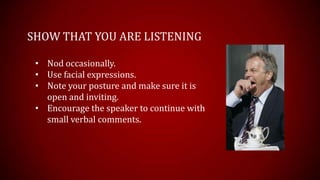
 • Nod occasionally.
 • Use facial expressions.
 • Note your posture and make sure it is
   open and inviting.
 • Encourage the speaker to continue with
   small verbal comments.
PROVIDE FEEDBACK

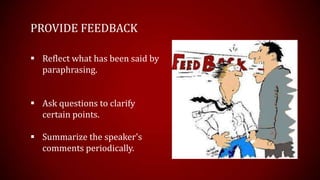
 Reflect what has been said by
  paraphrasing.


 Ask questions to clarify
  certain points.

 Summarize the speaker's
  comments periodically.
RESPOND
APPROPRIATELY
•   Be candid, open, and honest
    in your response.
•   Assert your opinions
    respectfully.
•   Treat the other person in a
    way that you think he or she
    would want to be treated.
BREAK YOUR
HABITS


Remind yourself
frequently that your
goal is to truly hear
what the other person is
saying.
SUMMARY

 •   How to be an active listener
 •   Pay attention
 •   Show that you are listening
 •   Give feedback
 •   Deferring judgments
 •   Respond appropriately
 •   Break habits
THANK YOU !


        @solly_joey

facebook.com/youssef.swellam

Active listening

  • 1.
  • 2.
    AGENDA • Why dowe listen • Difference between listening and hearing • How to become an active listener • Summary
  • 3.
    WHY DO WELISTEN • We listen to obtain information. • We listen to understand. • We listen for enjoyment. • We listen to learn. AND YOU THINK WE’D BE GOOD AT IT !
  • 4.
  • 5.
    HOW TO BEAN ACTIVE LISTENER ??
  • 6.
    PAY ATTENTION • Lookat the speaker directly. • Put aside distracting thoughts. • Don't mentally prepare a battle! • Avoid being distracted by environmental factors. • "Listen" to the speaker's body language.
  • 7.
    SHOW THAT YOUARE LISTENING • Nod occasionally. • Use facial expressions. • Note your posture and make sure it is open and inviting. • Encourage the speaker to continue with small verbal comments.
  • 8.
    PROVIDE FEEDBACK  Reflectwhat has been said by paraphrasing.  Ask questions to clarify certain points.  Summarize the speaker's comments periodically.
  • 10.
    RESPOND APPROPRIATELY • Be candid, open, and honest in your response. • Assert your opinions respectfully. • Treat the other person in a way that you think he or she would want to be treated.
  • 11.
    BREAK YOUR HABITS Remind yourself frequentlythat your goal is to truly hear what the other person is saying.
  • 12.
    SUMMARY • How to be an active listener • Pay attention • Show that you are listening • Give feedback • Deferring judgments • Respond appropriately • Break habits
  • 14.
    THANK YOU ! @solly_joey facebook.com/youssef.swellam

Editor's Notes

  • #5 There are several misconceptions about listening. The first of these is listening and hearing are the same thing. Hearing is the physiological process of registering sound waves as they hit the eardrum. We have no control over what we hear. The sounds we hear have no meaning until we give them their meaning in context.Listening on the other hand is an active process that constructs meaning from both verbal and nonverbal messages.
  • #8 Game of gestures
  • #9 Listening is an interaction between speaker and listener. It adds action to a normally passive process. The speaker looks for verbal and nonverbal responses from the listener to determine if the message is being listened to.We depend on our memory to fill in the blanks when we're listening. Because everyone has different memories, the speaker and the listener may attach different meanings to the same statement . However, our memories are fallible and we can't remember everything that we've ever listened to . There are many reasons why we forget some information that we've received].The first is cramming.
  • #10 Interrupting is a waste of time. It frustrates the speaker and limits full understanding of the message.Allow the speaker to finish each point before asking questions.Don't interrupt with counter arguments.