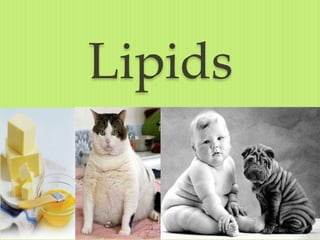
Lipids
Lipids
Lipids are naturally occurring
hydrophobic molecules. They are
heterogeneous group of compounds related to
fatty acids. They include fats, oils, waxes,
phospholipids, etc.
They make up about 70% of the dry weight
of the nervous system. Lipids are crucial for the
healthy functioning of the nerve cells.
Lipids are greasy or oily organic
substances; lipids are sparingly soluble in water
and are soluble in organic solvents like
chloroform, ether and benzene.
Lipids are biomolecules with no unique
patterns of monomers; often made up of
chains of carbon, hydrogen, and a few oxygen
and stored within the adipose tissues.
Basic units: fatty acids
-made of fatty acid molecules that consist two
distinct regions:
a long hydrophobic hydrocarbon chain
a hydrophilic head
Characteristics of Lipids
General characters of lipids are
• Lipids are relatively insoluble in water.
• They are soluble in non-polar solvents, like
ether, chloroform, methanol.
• Lipids have high energy content and are
metabolized to release calories.
• Lipids also act as electrical insulators, they
insulate nerve axons.
• Fats contain saturated fatty acids, they are
solid at room temperatures. Example,
animal fats.
• Plant fats are unsaturated and are liquid at
room temperatures.
• Pure fats are colorless, they have extremely
bland taste.
• They are freely soluble in organic solvents like
ether, acetone and benzene.
• The melting point of fats depends on the
length of the chain of the constituent fatty acid
and the degree of unsaturation.
• Geometric isomerism, the presence of double
bond in the unsaturated fatty acid of the lipid
molecule produces geometric or cis-trans
isomerism.
• Emulsification is the process by which a lipid
mass is converted to a number of small lipid
droplets. The process of emulsification happens
before the fats can be absorbed by the intestinal
walls.
• The fats are hydrolyzed by the enzyme lipases to
yield fatty acids and glycerol.
• The hydrolysis of fats by alkali is called
saponification. This reaction results in the
formation of glycerol and salts of fatty acids
called soaps.
• Hydrolytic rancidity is caused by the growth of
microorganisms which secrete enzymes like
lipases. These split fats into glycerol and free
fatty acids.
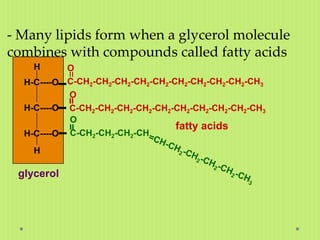
- Many lipids form when a glycerol molecule
combines with compounds called fatty acids
H
H-C----O
H-C----O
H-C----O
H
glycerol
O
C-CH2-CH2-CH2-CH2-CH2-CH2-CH2-CH2-CH2-CH3
fatty acids
O
C-CH2-CH2-CH2-CH2-CH2-CH2-CH2-CH2-CH2-CH3
O
C-CH2-CH2-CH2-CH
There are two groups
- The first group is composed of open-chain
compounds with polar heads and non-polar tails
(e.g. fatty acids, triglycerides, sphingolipids,
phosphoacylglecerols and glycolipids
- The second group is consists of fused ring
compounds exemplified by steroids, which
represents the cholesterol group.
Examples of Lipids
Few well known examples of lipids are as
follows:
Fatty acids - Oleic acid, Linoleic acid, Palmitoleic acid,
Arachidonic acid.
Fats and Oils - Animal fats - Butter, Lard, Human fat,
Herring oil. Plant oils - Coconut oil, Corn, Palm, Peanut,
Sunflower oil.
Waxes - Spermacti, Beeswax, Carnauba wax.
Phospholipids - Lecithins, Cephalins, Plasmoalogens,
Phosphatidyl inositols, Sphingomyelins.
Glycolipids - Kerasin, Phrenosin, Nervon,
Oxynervon.
Steroids - C 29, C 28, C 27, C 24, C 21 steroids.
Terpenes - Monoterpenes, Sesquiterpenes,
Diterpenes, Triterpenes.
Carotenoids - Lycopene, Carotenes,
Xanthophylls.
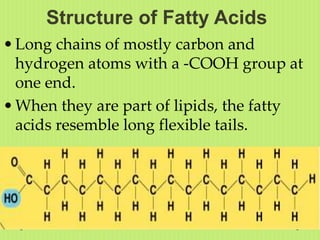
Structure of Fatty Acids
•Long chains of mostly carbon and
hydrogen atoms with a -COOH group at
one end.
•When they are part of lipids, the fatty
acids resemble long flexible tails.
Saturated and Unsaturated Fats
• Unsaturated fats :
– Carbon-carbon double bonds in the chains
– Configuration of one or more double
bonds between carbons in the fatty acids
allows for cis (“kinks” in the long chains of
hydrocarbon tails)
– Liquid at room temperature (oils, nuts, &
seeds)
Examples:
oleic and palmitoleic fatty acids
O
C-CH2-CH2-CH2-CH
unsaturated
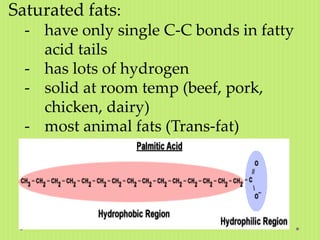
Saturated fats:
- have only single C-C bonds in fatty
acid tails
- has lots of hydrogen
- solid at room temp (beef, pork,
chicken, dairy)
- most animal fats (Trans-fat)
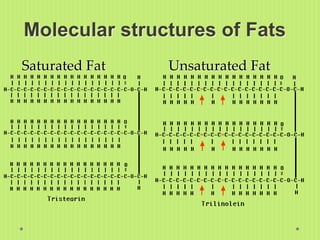
Molecular structures of Fats
Saturated Fat Unsaturated Fat
Saturated fatty
acid
Unsaturated
fatty acid
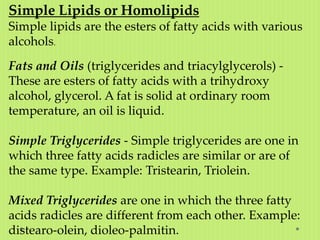
Simple Lipids or Homolipids
Simple lipids are the esters of fatty acids with various
alcohols.
Fats and Oils (triglycerides and triacylglycerols) -
These are esters of fatty acids with a trihydroxy
alcohol, glycerol. A fat is solid at ordinary room
temperature, an oil is liquid.
Simple Triglycerides - Simple triglycerides are one in
which three fatty acids radicles are similar or are of
the same type. Example: Tristearin, Triolein.
Mixed Triglycerides are one in which the three fatty
acids radicles are different from each other. Example:
distearo-olein, dioleo-palmitin.
Triglycerides
Triacylglycerol or triglycerides result
from the esterification of three fatty acids
into glycerol.
Triglycerides do not form part of the
cell membrane. They accumulate in
adipose tissues (fat cells) as stored energy.
Lipase is an enzyme that can
hydrolyze triglycerides.
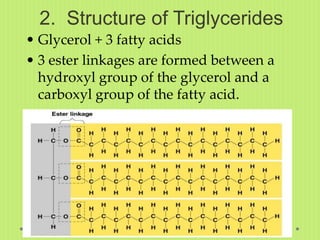
2. Structure of Triglycerides
• Glycerol + 3 fatty acids
• 3 ester linkages are formed between a
hydroxyl group of the glycerol and a
carboxyl group of the fatty acid.
Glycolipid are the compounds of fatty acids
with carbohydrates and contain nitrogen but
no phosphoric acid. These are carbohydrates
linked to the alcohol group of a lipid via
glycosidic bond found in nerves and brain cell
membranes. Glycolipids plays a big role in
tissue and organ specificity.
Derived Lipids
Derived lipids are the substances derived from
simple and compound lipids by hydrolysis.
These includes fatty acids, alcohols,
monoglycerides and diglycerides, steroids,
terpenes, carotenoids.
The most common derived lipids are steroids,
terpenes and carotenoids
.
Terpenes in majority are found in plants.
Example: Natural rubber. gernoil, etc.
Carotenoids are tetraterpenes. They are widely
distributed in both plants and animals. They are
exclusively of plant origin. Due to the presence of
many conjugated double bonds, they are colored red
or yellow. Example: Lycopreene, carotenes,
Xanthophylls.
Steroids these contain fused ring systems consists of
three six-membrane rings and one five-membrane
rings. Steroids are important part of many
hormones.
Cholesterol, as a steroid is an important part of
the cell membrane. They serves as an insulator since
they are hydrophobic.
Steroids
• Structure: Four carbon rings with no fatty acid tails
• Functions:
• Component of animal cell membranes
• Modified to form sex hormones
Lipids.pptx

Lipids.pptx

  • 1.
  • 2.
    Lipids Lipids are naturallyoccurring hydrophobic molecules. They are heterogeneous group of compounds related to fatty acids. They include fats, oils, waxes, phospholipids, etc. They make up about 70% of the dry weight of the nervous system. Lipids are crucial for the healthy functioning of the nerve cells. Lipids are greasy or oily organic substances; lipids are sparingly soluble in water and are soluble in organic solvents like chloroform, ether and benzene.
  • 3.
    Lipids are biomoleculeswith no unique patterns of monomers; often made up of chains of carbon, hydrogen, and a few oxygen and stored within the adipose tissues. Basic units: fatty acids -made of fatty acid molecules that consist two distinct regions: a long hydrophobic hydrocarbon chain a hydrophilic head
  • 5.
    Characteristics of Lipids Generalcharacters of lipids are • Lipids are relatively insoluble in water. • They are soluble in non-polar solvents, like ether, chloroform, methanol. • Lipids have high energy content and are metabolized to release calories. • Lipids also act as electrical insulators, they insulate nerve axons. • Fats contain saturated fatty acids, they are solid at room temperatures. Example, animal fats.
  • 6.
    • Plant fatsare unsaturated and are liquid at room temperatures. • Pure fats are colorless, they have extremely bland taste. • They are freely soluble in organic solvents like ether, acetone and benzene. • The melting point of fats depends on the length of the chain of the constituent fatty acid and the degree of unsaturation. • Geometric isomerism, the presence of double bond in the unsaturated fatty acid of the lipid molecule produces geometric or cis-trans isomerism.
  • 7.
    • Emulsification isthe process by which a lipid mass is converted to a number of small lipid droplets. The process of emulsification happens before the fats can be absorbed by the intestinal walls. • The fats are hydrolyzed by the enzyme lipases to yield fatty acids and glycerol. • The hydrolysis of fats by alkali is called saponification. This reaction results in the formation of glycerol and salts of fatty acids called soaps. • Hydrolytic rancidity is caused by the growth of microorganisms which secrete enzymes like lipases. These split fats into glycerol and free fatty acids.
  • 8.
    - Many lipidsform when a glycerol molecule combines with compounds called fatty acids H H-C----O H-C----O H-C----O H glycerol O C-CH2-CH2-CH2-CH2-CH2-CH2-CH2-CH2-CH2-CH3 fatty acids O C-CH2-CH2-CH2-CH2-CH2-CH2-CH2-CH2-CH2-CH3 O C-CH2-CH2-CH2-CH
  • 9.
    There are twogroups - The first group is composed of open-chain compounds with polar heads and non-polar tails (e.g. fatty acids, triglycerides, sphingolipids, phosphoacylglecerols and glycolipids - The second group is consists of fused ring compounds exemplified by steroids, which represents the cholesterol group.
  • 10.
    Examples of Lipids Fewwell known examples of lipids are as follows: Fatty acids - Oleic acid, Linoleic acid, Palmitoleic acid, Arachidonic acid. Fats and Oils - Animal fats - Butter, Lard, Human fat, Herring oil. Plant oils - Coconut oil, Corn, Palm, Peanut, Sunflower oil. Waxes - Spermacti, Beeswax, Carnauba wax. Phospholipids - Lecithins, Cephalins, Plasmoalogens, Phosphatidyl inositols, Sphingomyelins.
  • 11.
    Glycolipids - Kerasin,Phrenosin, Nervon, Oxynervon. Steroids - C 29, C 28, C 27, C 24, C 21 steroids. Terpenes - Monoterpenes, Sesquiterpenes, Diterpenes, Triterpenes. Carotenoids - Lycopene, Carotenes, Xanthophylls.
  • 12.
    Structure of FattyAcids •Long chains of mostly carbon and hydrogen atoms with a -COOH group at one end. •When they are part of lipids, the fatty acids resemble long flexible tails.
  • 13.
    Saturated and UnsaturatedFats • Unsaturated fats : – Carbon-carbon double bonds in the chains – Configuration of one or more double bonds between carbons in the fatty acids allows for cis (“kinks” in the long chains of hydrocarbon tails) – Liquid at room temperature (oils, nuts, & seeds) Examples: oleic and palmitoleic fatty acids O C-CH2-CH2-CH2-CH unsaturated
  • 14.
    Saturated fats: - haveonly single C-C bonds in fatty acid tails - has lots of hydrogen - solid at room temp (beef, pork, chicken, dairy) - most animal fats (Trans-fat)
  • 15.
    Molecular structures ofFats Saturated Fat Unsaturated Fat
  • 16.
  • 17.
    Simple Lipids orHomolipids Simple lipids are the esters of fatty acids with various alcohols. Fats and Oils (triglycerides and triacylglycerols) - These are esters of fatty acids with a trihydroxy alcohol, glycerol. A fat is solid at ordinary room temperature, an oil is liquid. Simple Triglycerides - Simple triglycerides are one in which three fatty acids radicles are similar or are of the same type. Example: Tristearin, Triolein. Mixed Triglycerides are one in which the three fatty acids radicles are different from each other. Example: distearo-olein, dioleo-palmitin.
  • 18.
    Triglycerides Triacylglycerol or triglyceridesresult from the esterification of three fatty acids into glycerol. Triglycerides do not form part of the cell membrane. They accumulate in adipose tissues (fat cells) as stored energy. Lipase is an enzyme that can hydrolyze triglycerides.
  • 19.
    2. Structure ofTriglycerides • Glycerol + 3 fatty acids • 3 ester linkages are formed between a hydroxyl group of the glycerol and a carboxyl group of the fatty acid.
  • 20.
    Glycolipid are thecompounds of fatty acids with carbohydrates and contain nitrogen but no phosphoric acid. These are carbohydrates linked to the alcohol group of a lipid via glycosidic bond found in nerves and brain cell membranes. Glycolipids plays a big role in tissue and organ specificity.
  • 21.
    Derived Lipids Derived lipidsare the substances derived from simple and compound lipids by hydrolysis. These includes fatty acids, alcohols, monoglycerides and diglycerides, steroids, terpenes, carotenoids. The most common derived lipids are steroids, terpenes and carotenoids . Terpenes in majority are found in plants. Example: Natural rubber. gernoil, etc.
  • 22.
    Carotenoids are tetraterpenes.They are widely distributed in both plants and animals. They are exclusively of plant origin. Due to the presence of many conjugated double bonds, they are colored red or yellow. Example: Lycopreene, carotenes, Xanthophylls. Steroids these contain fused ring systems consists of three six-membrane rings and one five-membrane rings. Steroids are important part of many hormones. Cholesterol, as a steroid is an important part of the cell membrane. They serves as an insulator since they are hydrophobic.
  • 23.
    Steroids • Structure: Fourcarbon rings with no fatty acid tails • Functions: • Component of animal cell membranes • Modified to form sex hormones